Love is at the center of Cowboy, a novel set in the turbulent 1960s. Love of family, friends, country, love of exploring your personal freedoms, and of course, the love you can experience when you’re young that hurts so bad you can taste it.
Jim Davis is a Texan, born and bred, who knows early on he must sample life away from the insular farm life of his small home town. Life at home is complicated by the turbulent relationship with a highly religious hard-driven father and a younger, football-star brother. Love of country and love of God are never far from the life of his family, but neither is Jim’s love of girls and sex, which carries a level of complexity all its own.
Jim’s plans for his own future become even more problematic when his father insists that he join the military. When he enlists in the Army, Jim becomes an officer, and, thanks in part to his completion of a dangerous mission—and his girlfriend, the daughter of a general—a successful life in the military seems all but assured.
Except he’s not biting. What else does the world offer? Jim leaves the military, winds up as a student at an eastern university, and discovers for the first time the drugs, sex, anti-war sentiments and other new feelings that became everyday experiences to others of his generation. All that becomes secondary to his relationship with Trish, the girl he falls in love with, who provides him with even greater complexities and harder choices that he could have ever foreseen. Can he allow her emotional roller coaster to control his life? Then again, can he truly live without her?
While their relationship is the centerpiece of Cowboy, the novel also provides a sketchbook of the times as seen by a young man who doesn’t necessarily buy into the social revolution in the glowing terms as do many of his contemporaries. Setting aside all that, Jim’s willingness to wait out the twists and turns of Trish’s life will ring true for anyone of any generation who has entered the country of love and discovered there are no paved roads and no roadmap.
To 21st Century readers, this is a historical novel. It takes place more than a half-century ago when so many of the social mores were first challenged by millions of young people across the world. How people talk to each other sometimes feels stagy. But it still rings true, both to the times and to the emotional makeup of the many characters who appear throughout the novel.
While Cowboy has the shape and feel of a memoir, it’s a worthwhile read for anyone who wants to remember the ‘60s or has a curiosity about that fabled era that their parents and/or grandparents lived through. More important, however, is the love story of Jim and Trish. The dynamics of their fragile love ring true for anyone of any age.
Cowboy by Bob Holt won CIBA 2018 Somerset First in Category in the SOMERSET Awards for literature.
Grace Johnson dreams of a life bigger than the one expected of a woman in the early nineteenth century. At twenty-two, she should be hoping for marriage and a home of her own. Instead, after a childhood spent privately acting for her mother, Grace secretly longs for a life in the spotlight, a place on a London stage, embracing the roles of Shakespeare’s greatest heroines. Alas, she fears her dream will never come true. Not only is Grace overly tall, clumsy, and what some would call plain, her father, a harsh man, blames her for her mother’s death. When his temper and drunkenness cause him to beat Grace, she finds herself alone on the dark streets of London’s theatre district, where a young man named Ned Plantagenet rescues her.
Ned, a stage manager at the Theatre Royal in Covent Garden, gives Grace a place to stay, and as their friendship grows, he takes her to a play, a rare event for the woman who has only seen one other play years ago. When she fills in for an absent chorus girl one night, she knows this is where she belongs and defies her father by begging her estranged aunt for a place to stay. However, the more time spent with her newfound theatre family, the more Grace realizes her mother and aunt had a strange connection to the cast and crew. Questions emerge. In this world where women’s dreams have little agency, Grace must decide just how far she is willing to go to build a new life for herself.
Perhaps the most striking trait of Grace Johnson is her willingness to accept the stigma associated with acting in the early 1800s. Though better than in centuries past, the theatre atmosphere was considered morally corrupt for women, even married ones. This world of impassioned men playing daring roles sure to seduce even the most hard-hearted of women often led to unwanted pregnancies and homeless girls, and Grace isn’t immune to the charms of one such rogue. Grace is well aware of what society might say about her, but that won’t stop her now. She makes her way on her own terms, doing what she must to continue acting even following her father’s disownment and her somewhat forced marriage. When her first acting performance flops, she licks her wounds then forges ahead.
This optimistic-survivor attitude isn’t particular to Grace alone, though. Both Mr. John Kemble and Ned exhibit the same trait. Mr. Kemble, renowned actor and owner of the Theatre Royal, knows he must find a way forward when fire destroys his precious theatre. Kemble begs and borrows to finance a new building, one that’s larger than any other theatre in England and later stands firm against the raging crowds rioting in every theatre. Ned understands that ‘he can’t change what [he] can’t change’ and refuses to mourn his lowly birth in the Foundling Hospital. This broad-shouldered, gentle giant rose from an orphanage to become the right-hand man of Kemble, a staple in the wings of this successful company. He is like everyone’s big brother, protective and watchful, a “white knight,” showing his bravery during the OP Riots and his pure heart caring for Grace in her hour of need.
This sprawling historical fiction takes the reader spinning through time with a cast of real-life stars of the London theatre in the early nineteenth century. The fictional characters interweave through the true story of two significant fires in the theatre district and the “Old Price” Riots, which disrupted theatre-goers and actors for months. Readers will see what life was like for the actors of the day as well as the average patron.
The Muse of Fire won 1st Place in the CIBA 2018 GOETHE Awards for Late Historical Fiction.
The Goethe Book Awards recognize emerging new talent in post-1750s Historical Fiction. The Goethe Book Awards is a division of the Chanticleer International Book Awards (The CIBAs).
The Goethe Book Awards competition is named for Johann Wolfgang von Goethe who was born at the dawn of the new era of enlightenment on August 28, 1749.
Chanticleer International Book Awards is looking for the best books featuring Late Period Historical Fiction. Regency, Victorian,18th Century, 19th Century, 20th Century, World and other wars, history of non-western cultures, set after the 1750s, we will put them to the test and choose the best among them.
These titles have moved forward in the judging rounds from SLUSH pile to the LONG LIST to the Goethe Shortlist and have now advanced to the Goethe Semi-Finalists positions. Semi-Finalists will be recognized at the 2020 Chanticleer Authors Conference and the 2019 CIBA banquet and ceremony. The First Place Category Winners, along with the CIBA Division Grand Prize winners, will be selected from the 16 CIBA divisions Semi-Finalists. We will announce the 1st Place Category winners and Grand Prize Division Winners at the CIBAs Banquet and Ceremony on Saturday, April 18th, 2020 at the luxurious Hotel Bellwether in Bellingham, Wash.
Congratulations to the 2019 Goethe Awards for post 1750s Historical Fiction Semi-Finalists
James Anderson O’Neal – Riley and the Great War
Vanda Writer – Paris, Adrift
Kari Bovee – Peccadillo at the Palace
Kari Bovee – Girl with a Gun
Kari Bovee – Grace in the Wings
PJ Devlin – Wissahickon Souls
John Hansen – Hard Times
Patricia Suprenant – Journey to the Isle of Devils
Lee Hutch – So Others May Live
Mike Jordan – The Runner
Lisa Braver Moss – SHRUG: A Novel
Sandra Wagner-Wright – Two Coins: A Biographical Novel
J.G. Schwartz – The Pearl Harbor Conspiracy
Marina Osipova – How Dare The Birds Sing
Marilyn Pemberton – The Jewel Garden
Mary Adler – Shadowed by Death: An Oliver Wright WWII Mystery
Good luck to all as your works move on to the next rounds of judging.
The 16 divisions of the 2019 CIBAs’Grand Prize Winners and the Five First Place Category Position award winners along with recognizing the Semi-Finalists will be announced at theApril 18th, 2020 Chanticleer International Book Awards Annual Awards Gala,which takes place at the Chanticleer Authors Conference that will be held in Bellingham, Wash.
We are now accepting submissions into the 2020 Goethe Book Awards for post-1750s Historical Fiction. The deadline for submissions is June 30, 2020. The 2020 winners will be announced in April 2021.
Debut novelist Bernard Mann has diligently researched a wide-ranging saga centered on the life, loves, songs, and struggles of King David, a central figure in the Old Testament and author of the Book of Psalms.
The tale begins at a crucial stage of David’s life as he is escaping the wrath of King Saul. Once a father-figure to the former shepherd boy, Saul’s view of David sours when the majority of his subjects begin to revere David over him. David flees with a small band of loyal stalwarts. He is still a fast friend to Saul’s son and likely successor, Jonathan, and is married to Saul’s daughter Maacah. Moreover, he still holds fast to his faith in God and continues to compose poems and songs in praise of Him. When both Saul and Jonathan perish in battle, David takes up the struggle, amasses an army, receives the crown, and seizes the city of Jerusalem, making it the seat of Israelite power.
The title, David and Avshalom, is reflective of the King’s sin of infidelity and murder. David lusts after his general’s wife. He sends the soldier to the front line of battle with a cryptic deadly message so he can take Batsheva as his lover and wife. David loses two precious sons, one of them his beloved Avshalom (often spelled “Absalom”) whom he had hoped to crown as his successor.
The details of King David’s life, as told in the Bible, are generally accepted. Mann includes augmented material in this lengthy portrait of one of history’s most significant players, whose actions in the restoration of the city of Jerusalem impact the region today. Portions of psalms (poetry/songs) speckle the narrative, put in place as the inspiration to critical junctures in the King’s life, such as the death of Samuel or the conquest of Goliath.
One aspect of David’s personality that Mann stresses is his respect for women. Calling together numerous scribes to begin recording his people’s history, David is introduced to the works of Judith and includes them and the writings of other women in the endeavor. Here is a king who contradicts the standard practices of the day and honors his daughters equally with his sons.
An international architecture expert, Mann pieced David’s exploits together by drawing on several books of the Bible – Samuel I and II, Joshua, Kings I, Chronicles I, and Psalms. He describes his book as “presented in fictional fabric” while assuring the reader of its scholarly sources and attributions. He has included some lesser-known facts about his main character – alliances, weaponry, and, again, the belief in the equality of women. Mann proclaims, “… David…was cast by the Lord in a different mold than that of any other man.”
The result? Mann delivers smart text, worthy of study, as well as a lively plot capable of engaging thoughtful readers. His prose is rich and his imagination equally so, as he brings King David back to life in a fresh way sure to invite attention and appreciation.
David and Avshalom: Life and Death in the Forest of Angels won First Place in the 2018 CIBAs, Chaucer Awards for Early Historical Fiction.
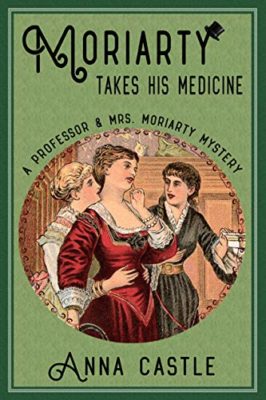
In Anna Castle’s British historical, cozy mystery novel, Moriarty Takes His Medicine, we find James Moriarty and his new bride, Angeline, struggling with their exciting, new relationship once the dust settles, so to speak.
James Moriarty, Sherlock Holmes’s nemesis, is a man who cares deeply for his wife, so much so, that he is driven to distraction and embraces the help of his former foe as an ally to help rescue Angelina from grave danger.
Sound like a melodrama? It is. Melodrama at it’s best, with strong women characters from the 1880s in several roles, providing a 2020 twist to the male-dominated period. That being said, Castle is no slouch when it comes to providing accurate historical details. She’s done her research and offers it up in an engaging and entertaining novel. The health spas and health tonics of the time provides an impressive backdrop to the mystery she develops, as Sherlock Holmes comes to Moriarty for help on a curious case, the death of a beloved aunt whose nephew suspects foul play. Together Moriarty and Holmes uncover a plot of devious mischief by medical professionals at a high-end spa/hospital where several elderly women and wealthy wives have stayed, only to die unexpectedly at home. Castle begins with the death of one woman.
Moriarty, Holmes, and Watson find that many of the women’s deaths went unchallenged because they all died at home after their stay, pointing to their own negligence and not that of the hospital, a devious plan, to say the least. Dr. Watson plays a small but crucial role at the beginning of their investigation as he uncovers the meaning behind “the Clennam treatment,” referring to a character from Little Dorritt, a Charles Dickens novel. And so, as Holmes is want to say, the game’s afoot.
Angelina’s past as a performer, a vocation she sorely misses, provides her with a means to help when she realizes her sister is being sent to the notorious spa for “the Clennam” treatment, code for “kill her.” Angelina takes on the most dangerous role of her life when she finds herself under the “Clennam” treatment.
Castle introduces the tonic as one in a series of archaic and debunked methods of treatment. She also explores aspects of electric shock therapy, and “the rest cure,” a popular method of treating a nervous and perhaps unruly woman to a treatment that did nothing to cure the root cause of their ailments. Alas, at that time, the men knew best even when they were wrong.
Castle turns this male-dominated society on its head. Women display their strength and ability to problem solve as they help to resolve this crime, and they do it with the full support of their men. A very satisfying twist on the social norms of the time, which brings us to a satisfactory conclusion.
In the end, we have something akin to a Shakespeare “comedy,” all the “good” characters live, all the lovers end up happily together, and all the villains fail and are doomed to suffer.
As the second novel in a series, this book could stand-alone. This romp through the beloved world of Sherlock Holmes will surprise you at every turn and please Sherlockians as well as lovers of British cozy mystery fans.
Moriarty Takes His Medicine won First Place in the 2018 CIBAs for Mystery and Mayhem.
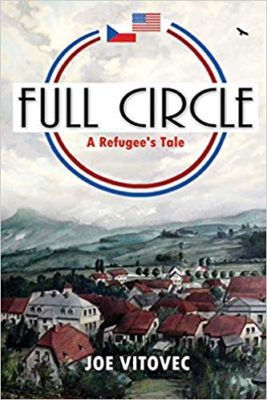
In the prologue of this lucid and gripping novel, Joe Vitovec notes that although Full Circle: A Refugee’s Tale is fiction, he “attempts to acquaint the reader with some of the locales and events that made this period so memorable, and leave a record for those who may one day wish to revisit the past.” He has done an extraordinary job with this literary recreation of the experiences of the “displaced persons” following World War II.
Vitovec takes the reader on a journey that begins with a boy in 1938 in a small town in Czechoslovakia and ends some fifty years later with that boy, now a middle-aged man, returning to his childhood home. What transpires in the intervening years is the heart of this politically and emotionally complex story, one with which many will be able to relate, while others will learn from and perhaps consider the current global refugee crisis with fresh insights and compassion. It is not a tale any reader will likely forget.
Jan Neuman is only eight when the men of his village leave for a military encampment and prepare to fight the Nazis who have invaded their lands. They never get the chance. As decreed by the Munich Conference, this area of Czechoslovakia is handed over to Hitler and made a German protectorate. The townspeople feel demoralized and live in constant terror that the Germans will arrest them for showing the slightest loyalty to their ousted leader or native culture. They endure degradations, subsisting on soup bones and potatoes, and Jan’s father, the town’s tailor, is made to sew Nazi uniforms.
Years pass, and finally, the Allied invasion buoys their spirits and hopes. One miraculous day, there are American soldiers in town, happy to share cigarettes and peanut butter, and make friends with the locals. Jan, a teenager, views the Americans as “bordering on godlike,” as does everyone in the village. This euphoric time is short-lived, however, with the departure of the liberating soldiers and arrival of the Russians, followed by a communist coup. The communists are eager to make arrests, and the townspeople become fearful and distrustful of one another.
As a student who works on a political newspaper, Jan is brought to the communists’ attention and will likely be arrested. When he hears of a resistance army being formed elsewhere, he stealthily leaves town with his friends. However, just as their fathers were denied the chance to fight, Jan and his friends discover that the resistance military base is in fact a refugee camp in Regensburg. Although it’s technically an American camp, it is run by Germans. He and his friends are told, “As refugees, you have no citizenship status, no rights.” Conditions are harsh, the camp overcrowded with Poles, Russians, Ukrainians, and Czechs. Morale is exceedingly low as people wait to see where they’ll be sent next. Although everyone wants to go to America, there are no fast or direct routes. Indeed, Jan’s refugee life has just begun.
Like so many others, Jan must attempt to rebuild his life again and again. Over the next two years, he will travel from camp to camp, make an ill attempt to join the French Foreign Legion, experience a devastating low outside the sewers of Paris, fall in love, and finally sail to America where his troubles are far from over.
Vitovec delivers a riveting story in beautiful and poignant prose, reminding us that the impact of war can be total, even for those who never set foot on a battlefield. Political losses hurt people deeply, but the loss of sense of self is endlessly tragic. Displacement is not just a geographic issue, but a psychological one. How much of our identity is built on where we are from? Who are we if we belong to no country? Imagine, if you can, owning nothing but memories, memories of a time and place, of a people who used to belong to a country and spoke its language. Imagine every identifying detail scrubbed from you, the only thing that motivates you is the instinct to stay alive. For years, the existence of the displaced boiled down to just that – a place to lay their heads at night, bread to keep their stomachs from aching, and perhaps the tiniest glimmer of hope that they were y headed somewhere that wasn’t yet another refugee camp, a place they would one day call home.
A book for political leaders, teachers, students, and anyone with a desire to not repeat the past. It’s a book that serves to remind us of what we have and what can be taken from us at a moment’s notice.
Full Circle, A Refugee’s Tale by Joseph Vitovec won First in Category in the CIBAs 2018 Goethe Awards for Late Historical Fiction.
Meet Peter Greene, CIBA Award-Winning author of High-Seas Action Adventure novels that appeals to all ages!
If you’ve ever been to a CAC (Chanticleer Authors Conference), you might recognize author Peter Greene. He’s the one that sits on the outside aisle, quiet and unassuming. Well kids, don’t be fooled! Peter has one of the best imaginations I know of—and there is a reason for his works are award-winning! You’ll just have to read on to discover it yourself!
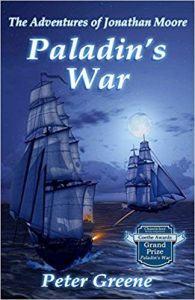
Peter Greene took home the Goethe Book Awards Grand Prize in the 2017 CIBAs for Historical Fiction for Paladin’s War.
CIBA 2017 Goethe Book Awards Winners Joe Vitovic & Peter Greene
Chanticleer: Tell us a little about yourself: How did you start writing?
Greene: My parents were both prolific storytellers, and they were amazingly descriptive, especially my Father. He would act out the voices and mannerisms of all the people. I learned a lot from trying to outdo them. Then in high school, when I took a creative writing class, my teacher, Mrs. Beem, would just yell out something like “a story with lots of movement” or “use the words ‘freedom’ and ‘cheesecake’ in a short story” and I would just go. The other kids sat and struggled, but I already had a plot, characters, and all that in seconds. She gave me A’s all the way through.
Structure: Pantzer or Plotter?
Chanti: That sounds like a great way to be introduced to storytelling!
So just how structured are you in your writing work?
Greene: Very structured, but only in the process, not in the structure of the piece.
I first list “essentials” – just the essential things I want in the story, in no order, and some may make it in there, some may not. This way I get ideas out of my head before they are lost in the ether!
Then comes some basic research, which is ongoing through the process of course, but I just want to make sure I’m building my fiction on a solid, believable foundation.
I then outline like a madman, very detailed at times, sometimes with partial chapters written out, sometimes with crude drawings! These outlines are dozens of pages long, and I print them and literally wallpaper my office with them! The outline for Paladin’s War covered three walls in my office!
Finally, I start the actual writing, usually in chronological order, but that is a rule I break depending on my mood.
When I’m done, I have my wife read the book out loud to me so I can hear the rough spots-that is critical— I find so much that makes me cringe: from unnatural dialogue to foggy descriptions to just clunky passages. I judge a competition and this is the advice that I tell almost every beginning author who enters the contest.
Then, I send to the editor for evaluation. But all of these steps are ‘writing’ to me. And I love all of it.
Authors Who Have Influenced Your Work
Chanti: That’s a good way to approach your writing! I like the Madman Outliner… sounds like the title of your next book! Name five of your favorite authors and describe how they influence your work.
1) Kurt Vonnegut, mostly his later stuff, like Breakfast of Champions because he became so irreverent after his ‘mainstream’ success. He taught me that style can change, and be ANYTHING as long as it has something valuable to say.
2) Erma Bombeck, again showing that style, if it is true, can let you do anything. I would read her columns, and even though I was about twenty-two years old and a single man in Los Angeles when I discovered her, I identified with her message and I laughed. Her writing seems so effortless! I miss her.
4) David McCullough. This is cliché, but he makes history come alive, and his writing voice (as well as his speaking voice), is so crystal clear. No extra stuff, just the best, most important things are covered in a wonderful manner that intrigues us. He never put his opinion in his works, because he doesn’t have to. History is history, and it is interesting enough.
5) J.R.R. Tolkien because he is the best at everything: plot, character, situation, excitement, humanity, emotion, poetry, prose and adventure. I have read the Silmarillion at least ten times and Lord of Rings each year since I was fourteen. I am always amazed at the scope of his stories, and the languages – truly amazing. I have learned from him that no matter how good I think I can be at times, I am no master. He is the true master. I would never try epic fantasy because the bar has been raised so high.
About Dialogue
Chanti: Great insights – and choices! You’ve given us something to chew on. What areas in your writing are you most confident in? What advice would you give someone who is struggling in that area?
Greene: Dialogue is pretty easy and natural for me, maybe because of my theatre training. As far as advice for others who struggle with dialogue, I’d say this: if you are always looking for a witty, snappy, clever, smart ways for your characters to speak, STOP! It will all come out cliché, and no one talks in clichés. It will read like an episode of some seventies, low-budget television series. J.D. Barker said at the last CAC19 that he sits in a Starbucks, has a cup of coffee and listens to what the people around him say, and he types it into his laptop! That is brilliant. It’s natural. I tried it. It was a blast!
JD Barker presented at CAC19!
Expanding Readership and Promoting Literacy
Chanti: Ah, that’s my favorite thing to do! What do you do in your community to improve/promote literacy?
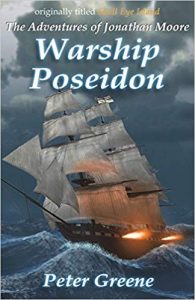
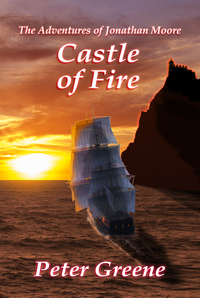
Greene: For the Adventures of Jonathan Moore series, I specifically targeted YA readers. I consciously write each book to graduate the reader from the fourth-fifth grade reading level with Warship Poseidon, to the sixth-seventh grade level with Castle of Fire, then Paladin’s War finishes on the ninth-tenth grade level. If a youngster reads all three, he jumps several reading levels! I also donate books to schools and libraries in the area and have done a few talks to writing classes.
Honestly, my book reviews from Chanticleer after my winning the Goethe award in 2018 and the (Chanticleer) review of Paladin’s War exploded my sales. I increased my sales by over 400%, so that worked for me! – Peter Greene
Marketing and Sales Tips
Chanti: That’s awesome! So, you give away books and present writing classes, what else do you do to market your books? What’s worked to sell more books, gain notoriety, and expand your literary footprint?
Greene: I don’t do enough, but when I learn something, I do it. I enter contests that are legit. Advertising can work, it just depends on finding what works for you. Honestly, my book reviews from Chanticleer after my winning the Goethe award in 2018 and the (Chanticleer) review of Paladin’s War exploded my sales. I increased my sales by over 400%, so that worked for me! You just have to try everything, meet people, and spread the word – without saying “Hey, I wrote this great book, you should read it.” Let others speak for you, and most of all, let your writing speak for you.
Let others speak for you, and most of all, let your writing speak for you. – Peter Greene
How do you separate your books in a crowded marketplace?
Chanti: That is incredible! I love that – especially how Chanticleer Reviews helped to boost your book sales by 400%! I think we need that on a t-shirt…
What is different about your series from other YA books out there?
Greene: Two things: I avoided all magic, superpowers and paranormal material. That’s all fun – but there is too much of it out there already. None of us will ever discover we have wizards or Olympians for parents or have a mystical ability. For this series, I wanted to point out that real heroes do exist, and they have throughout history.
I also decided to take it easy on the terminology and more unsavory aspects of life at sea. I’ve always loved the classic sea stories in Stevenson’s Treasure Island, Forester’s Horatio Hornblower, and O’Brian’sJack Aubrey series, but I couldn’t help thinking that for most of us, unless one had supporting texts and companion guides to get through all the jargon and technicalities, one could easily become lost-and maybe surrender to something easier to read. That would be too bad. And the things you do really need to know, well, wouldn’t it be best to learn that along with the characters? The ones that started out as land-lubbers just like you and your kids?
The Adventures of Jonathan Moore books are about one would-be hero and his friends who try to succeed using only their courage, their wits and industry alone – no magic necessary. And though I will never fill the shoes of Stevenson, Forester or O’Brian, I can attempt to follow in their footsteps.
Chanticleer: That’s great! But you never know…you may be the one to fill their shoes if “Adventures of Jonathan Moore” are any indication!
Now we would really do need to know a little bit more about when did you realize you that you were an author?
Greene: I got my degree in Theatre from Illinois State, and a playwriting professor said I had a “knack for dialogue and physical humor.” That made me continue writing. I wrote screenplays after college, and a studio exec at 20th Century Fox pulled me aside and said “you really can write, keep it up” – then years later, my first novel, Warship Poseidon won the Adventure Writers Competition’s Grandmaster award, and Clive and Dirk Cussler chose the winner. When Clive announced my name, he said “I read your book, you know. Beautifully written.” THAT made me think that maybe I have a little writing ability. So when I write, I always think “maybe Clive and Dirk will read this so it better be my best effort.”
Editor’s Note: Clive Cussler’s books have been published in more than 40 languages in more than 100 countries. They are New York Timesand international bestsellers. He has written 17 books in a row that reached the New York Times’ fiction best selling list. He is of a select group of authors to achieve this status. Cussler has also published more than 50 novels—quite the back list that keeps him on the list of richest authors in the world.
Chanticleer: Holy Moley, man! That’s Clive & Dirk Cussler! I can’t… I just need a moment… Okay then, what led you to write what you write?
Greene: I write a lot of different stuff in different genres, because, why not? The Adventures of Jonathan Moore series is YA historical fiction, and it all happened by accident. One night, as I was putting my children to bed, I realized that I was tired of reading the books available on our bookshelf. Knowing they were crazy about the Pirates of the Caribbean movie, I just said, “Tonight I’m going to tell you a story about twelve-year-old Jonathan Moore who lived in a dark and filthy alley, and how he ended up a hero on a tall sailing ship.” I kept telling a little bit each night, making it up as I went. My wife, who was listening to the stories each night, suggested that I write it as a novel. Ten years later I have three books in the series!
Chanti: And so the magic began… How do you come up with your ideas for a story?
Greene: Good question! Usually, something just clicks that I observe or realize, and off I go. For example, I was thinking about hidden social casts in America and I thought “Wow. People don’t see it, do they?” So BAM! This Sci-Fi idea hits me for a novel, the characters came quickly and then a plot and now the outline is almost finished. I’m starting it now. It’s a strong female character who uses history and propaganda to, well, you will have to read it!
Chanti: A SciFi novel! We can’t wait to read it! Are you going to enter it into the Cynus Book Awards?
Greene: Definitely!
Chanti: Thank you, Peter Greene with an “e,” and we look forward to seeing you at CAC20!
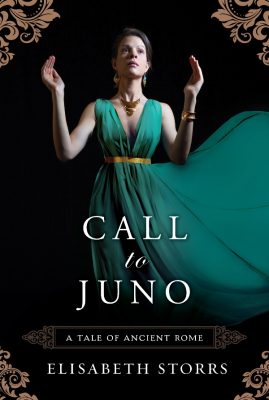
Elisabeth Storr delivers an extraordinary tale of “Peasant and patrician; concubine and master” where man seeking woman, man seeking man (mostly unrequited) and man seeking boy, erupts into a generous narrative of the quest for power between a reluctant Etruscan king, Vel Mastarna (situated in Veii—mere miles from his oppressor) and Marcus Furius Camillus—he who would be Rome’s dictator in her stunning Historical Fiction novel, Call to Juno:A Tale of Ancient Rome.
Veii has been under a 10-year siege; Rome biding its time at the unsurmountable gates, waiting to starve its conquest into submission (and thereby looting the bounty and putting Rome’s finances back into the black).
But there is danger afoot: almost entirely fueled by relationships strong or soured. Along with the “human” battlements, the gods must also be looked after—not a few of them “serving” both sides of the battle.
At the center of it all is Artile Mastarna an Etruscan soothsayer who would rather corrupt boys than provide life-advancing advice. His brother, Vel (albeit reluctantly) is readily betrayed by his all-knowing sibling who prefers to work with the Romans and topple his own countrymen. A further link to Rome comes in the beguiling and astute shape of Caecilia. Years ago, her Roman relatives used her as the glue for peace in a forced marriage between the warring countries. Their eldest, adopted son, Tarchon, also prefers the company of men and makes no bones about showing his inclination. Four other children have blessed this political union which, nonetheless, has become a truly loving relationship.
In Rome, the action centers around the highly ambitious Marcus Furius Camillus, unashamed patrician and consular general. His love interest is a former prostitute (kept a secret from her lover, but others within the circle are aware), who faithfully serves her master in the role of concubine. The gay blade on this side of the divide is Marcus Aemilius Mamercus, whose unrequited love for Appius Claudius Drusus is further complicated Drusus’ infatuation with Caecilia—all the better to kill the Etruscan king!
Watching, of course, are the gods. How curious that both sides worship the same deities, albeit with different names (e.g., Uni/Juno, Tina/Jupiter, Aplu/Apollo, Fufluns/Dionysus). When simultaneously beseeched for assistance from the disparate factions, what’s a god to do? Beware the thunderbolt!
As with all good historical fiction, Storrs takes us on a long-ago journey that has much relevance for the present day, proving once again the old adage that there is nothing new under the sun (and in this case, son). Savor the past, then fill in your own cast of 21st-century characters and see them through the lens of time.
Call to Juno won 1st Place in the 2017 Chaucer Awards for Early Historical Fiction.
Rory McCabe and Conor O’Neill are hard-working 12-year-olds, whose exploits and progress are narrated by the namesake of Clancy’s Pub who’s taken a liking to them. At times, he rewards the boys’ efforts with tales of their shared Irish heritage, its heroes and its glories. The boys have very different personalities, as Clancy discerns from their reactions to his lore. Rory is outraged as he hears of Ireland’s treatment by the British, while Conor accepts the information more quietly, studiously.
The two boys will soon meet a beautiful girl, Maria, the daughter of a well-to-do neighbor secretly aligned with a revolutionary resistance movement. Both will fall in love, but of the two, Rory will be the more open about his interest, while Conor will hold back, respectful but clearly smitten.
When the deep divide between Ireland and its oppressors begins to heat up, the boys, older now and more independent, again respond differently. Rory wants to join in and even die, if need be, for freedom, while Conor takes a more practical path. Then circumstances force both of them to the test, to demonstrate their deepest loyalties.
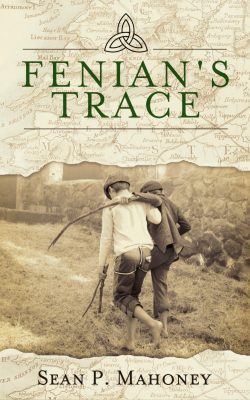
Author Sean P. Mahoney has won a prestigious Nicholl Fellowship for his screenplay version of Fenian’s Trace, which he subsequently adapted to the novel. The story focuses on the Easter Rising of 1916, when Irish patriots rose up, incensed by fighting alongside the British in World War I, while Britain continued the suppression of Irish rights. It is into this hotbed of revolutionary fervor that Rory and Conor, along with many others, are swept up.
Mahoney peppers his narrative with atmospheric touches, including many Irish words and speech cadences (captured wonderfully in the audiobook narration of Liam Carney) along with the fabled legacy of Fenian’s Trace, a patriot’s gravesite. It is on those grounds that the boys establish their chosen fortress, with significant consequences.
This wide-ranging panorama is a rich mix of folklore and fact, heroism during warfare, politics, and a star-crossed youthful love affair that will take on increasingly deeper meaning and, in the end, call for the ultimate sacrifice. Fenian’s Trace will appeal to readers across several genres, and as one might expect from Mahoney’s success in screenwriting, readers will delight in this colorful tale that begs for a cinematic version.
Fenian’s Trace won 1st Place in the 2017 Goethe Awards for Historical Fiction (post-1750s).
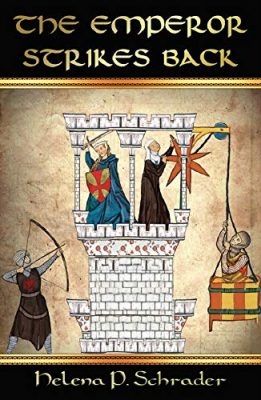
Welcome to the 13th century Beirut, Kingdom of Jerusalem, where chivalry is alive and well—along with treachery, greed, and the lust for power and control.
The Emperor Strikes Back has a cast that would put Cecile B. DeMille to shame. Helena P. Schrader has successfully fleshed out historical characters and events, bringing them to life in the reader’s mind. She depicts a conflict that occurred in the Outremer during the first third of the 13th century when Frederic II, the ambitious Holy Roman Emperor, sought to usurp John d’Ibelin, the Lord of Beirut, and lay claim to his fiefdom.
Schrader breathes life into the resulting, historically documented events, using the multiple voices of the Ibelin family, cohorts, and supporters, each of which reflects his or her own social status, belief system, and loyalties. As these characters share their experiences, the reader can almost smell the offal and blood, feel the pain of wounds, the effects of hunger, hardship, and fear, the taste of stale bread and sullied water, and the bittersweet taste of victory. Schrader’s detailed rendering of the ill-fated first marriage of Balian, Ibelin’s eldest son, and heir, to Eschiva de Montbéliard, a cousin by marriage, will capture readers hearts.
In order to marry, Balian and Eschiva must receive a papal dispensation, which their family friend, Gerold of Lausanne, Patriarch of Jerusalem and Papal Legate, provides. The trouble comes when Pope Gregory learns of this from an Ibelin political rival whose support he seeks, and the pope excommunicates the young couple. The effects create emotional and social rents in the fabric of their lives and the lives and fortunes of their family and supporters in unimaginable ways.
The Emperor Strikes Back gifts readers with a careful account of actual recorded events as told by the players involved, and at times utilizing their very own words. The wealth of details, characters, and situations, while true to life, can be confusing to those who have not read the foreword, research notes, and familiarized themselves with the glossary. In other words, we recommend familiarizing yourself with these fascinating additions to the novel before you dive right in. You will be greatly rewarded!
A good book for a long winter weekend—put the teapot on, stoke the fire, and plan on spending some time in the 13th century. Odds are, you will find yourself searching for Schrader’s previous works to read in this series while impatiently waiting for the next installment. Here are just a few that we adore: Envoy of Jerusalem, Defender of Jerusalem, Knight of Jerusalem, and The Last Crusader Kingdom.


 Love is at the center of Cowboy, a novel set in the turbulent 1960s. Love of family, friends, country, love of exploring your personal freedoms, and of course, the love you can experience when you’re young that hurts so bad you can taste it.

 Grace Johnson dreams of a life bigger than the one expected of a woman in the early nineteenth century. At twenty-two, she should be hoping for marriage and a home of her own. Instead, after a childhood spent privately acting for her mother, Grace secretly longs for a life in the spotlight, a place on a London stage, embracing the roles of Shakespeare’s greatest heroines. Alas, she fears her dream will never come true. Not only is Grace overly tall, clumsy, and what some would call plain, her father, a harsh man, blames her for her mother’s death. When his temper and drunkenness cause him to beat Grace, she finds herself alone on the dark streets of London’s theatre district, where a young man named Ned Plantagenet rescues her.
 The Goethe Book Awards recognize emerging new talent in post-1750s Historical Fiction. The Goethe Book Awards is a division of the Chanticleer International Book Awards (The CIBAs).


 Debut novelist Bernard Mann has diligently researched a wide-ranging saga centered on the life, loves, songs, and struggles of King David, a central figure in the Old Testament and author of the Book of Psalms.




 Welcome to the 13th century Beirut, Kingdom of Jerusalem, where chivalry is alive and well—along with treachery, greed, and the lust for power and control.