Tag: Chanticleer Book Reviews

  • RIDE the UNIVERSE by Mark Rues – Sci-Fi/Fantasy, Philosophy, Magic Realism

    RIDE the UNIVERSE by Mark Rues – Sci-Fi/Fantasy, Philosophy, Magic Realism

    A young boy goes on a journey through the solar system searching for the spirit of his sister, discovers the basics of science and spirituality with the help of a mystic teacher and a super-powered cat.

    Teddy DeXue’s ride around the universe begins in the summer of 1963, just as his amazing catch wins the Little League Championship for his team. But it doesn’t really start there. It really began the year before when Teddy’s sister Jean died, and his family fractured into broken, grieving pieces.

    Teddy has a secret. He believes that his sister is out there, somewhere, and that the moon, the big, bright full moon that helped him make his game-winning catch, is going to help him find her. With training from a mysterious spiritual master, a bit of scientific knowledge gleaned from his dad and guarded by Henry, his strange and slightly super-powered cat, how can he fail?

    While his best friend, Tem, thinks that Teddy’s quest is nothing more than wishful thinking, he goes along for the ride – and what a ride it is!

    As Teddy searches through the stars for his sister, his engineer father introduces him to scientific concepts about the nature of the universe; even the many ways that light can be refracted, reflected, and split. In his dreams, Master Fu-Hsi teaches him the spiritual side of what his father’s talking about. It’s up to Teddy to put that knowledge together to make his journey into the stars – and back.

    The story and the way it proceeds is reminiscent of the way the best-selling novel, Sophie’s World by Jostein Gaarder introduced young Sophie to the basic concepts and history of philosophy while pulling readers along for the fascinating journey.

    There’s also an element of the classic YA SF novel, A Wrinkle in Time by Madeleine L’Engle in Teddy’s search among the stars for his lost sister.

    The combination of the two elements draws readers on Teddy’s journey as he finds his way to his sister and back. Along the way, he grows up and learns what it is to love, even as his family finds their way back from heartbreak.

    Ride the Universe crosses genres of Sci-Fi, Fantasy, and Philosophy, as it uses those tropes and more than a bit of magical realism to tell its story.

    Ride the Universe is a multi-genre novel with heart. Fasten your seatbelt! For those searching for something a bit more outside the box, look no further, Ride the Universe is a magic Thunderbird of a ride – in an actual, honest-to-goodness, T-bird.
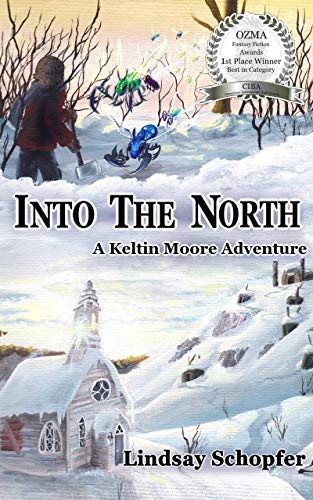
  • INTO the NORTH: A Keltin Moore Adventure by Lindsay Schopfer – Epic Fantasy, Steampunk, Action/Adventure

    INTO the NORTH: A Keltin Moore Adventure by Lindsay Schopfer – Epic Fantasy, Steampunk, Action/Adventure

    If Jack London had written about hunting fantastic beasts in a fantasy-tinged “Great White North” during a gold rush, instead of real animals in the Klondike, he’d have created a hunter like Keltin Moore and a beast like the Ghost of Lost Tap.


    The adventures of Keltin Moore read a lot like London’s best adventure stories, only written as if they were inspired by Larry Correia’s Monster Hunter International series. The combination leads to a chilling story (in more ways than one) about a professional beast hunter and his companions on a quest to make some money and save a town from a beast that no one has survived. Still, everyone has seen the aftermath of its depredations.

    They call it the Ghost of Lost Tap because it moves like a ghost. Or something supernatural. And no one has been able to catch it, certainly not the little band of shakedown artists calling themselves the Hunter Guild that has sprung up in the ramshackle boomtown of Lost Tap.

    The story focuses on the character of Keltin Moore, the last of a long and storied family of professional beast hunters. Keltin learned his trade at his father’s knee, and like his father, is used to hunting alone. But in his second adventure, he is traveling with an apprentice, young Jaylocke, who needs to learn a trade to earn his place as an adult among his own people.

    In Lost Tap, Keltin and Jaylocke band together with old friends that they fought with in the first book of Keltin’s adventures, The Beast Hunter. While they hunt the “Ghost,” Keltin finds himself meditating on the nature of leadership, his need to be alone versus his understanding that he needs others to bring down this unstoppable beast, and his feelings of responsibility to those under his care and in his heart.

    Keltin is a fascinating character. This second installment of the series provides a thought-provoking perspective on his profession, his responsibilities as a leader, and his desire to save people, often from their own mistakes.

    At the same time, the world that Keltin inhabits, as much as it will remind readers of London’s tales of the Klondike, is a fantasy world and not London’s historical one. Except for the beasts themselves, with atypical and strangely asymmetric biology, there is little magic in this world or not that is seen in this story.

    Beasts are killed with guns, not spells. No matter how unnatural they seem, a bullet to the brain, once Keltin manages to determine where a beast’s brain actually is, kills them just fine. But the places Keltin refers to, and the sentient nonhumans that he meets and befriends, remind the reader that this is a different world with its own history.

    While these reminders are not enough to make the reader feel they have missed too much by starting with this second book in the series, they do serve to tease the reader that there are stories yet to be told. We love this adventure/fantasy so much, we happily recommend readers to start with the first book in the series and then move on.

    Into the North: A Keltin Moore Adventure by Lindsay Schopfer is such a terrific story on its own that readers will feel compelled to pick up the other stories just to catch up on all the action! Highly recommended.

    Into the North: A Keltin Moore Adventure won First Place in the CIBA 2018 OZMA Awards for Fantasy Fiction.


  • The MAGIC CAPE CAPER by Steve Dimeo – Noir Private Eye, Detective Mystery, Mystery Romance

    The MAGIC CAPE CAPER by Steve Dimeo – Noir Private Eye, Detective Mystery, Mystery Romance

    A lighthearted, modern reimagining of the classic dime detective novel, The Magic Cape Caper is an assemblage of fun pop culture references in a contemporary setting.

    A former police detective, and a newly licensed private eye, Nick Christmas is hired by Mrs. James, the wife of scientist and inventor of an invisibility device, Dr. Bert James. She refuses to believe the conclusions of the police who believe Dr. Bert is dead after an apparent kidnapping. With no other cases and a dwindling case-flow, Nick and his young “Girl Friday” receptionist Miranda “Randi” Degrotti accept the challenge to get to the bottom of what is going on.

    A former English teacher, Author Steve Dimeo keeps a very lighthearted and upbeat tone throughout the novel which makes for a rather easy read. But, he also makes use of a sophisticated vocabulary that will have most of us crack open a few dictionaries.

    The natural chemistry between Nick and Randi is one of the more entertaining qualities of The Magic Cape Caper. It will likely be a defining presence in future installments of the series. As individual characters, they struggle to branch away from being classic characterizations. Nick is the wise-cracking detective and middle-aged male who can’t help but fixate on the female body; while his beguiling Girl Friday, Randi, “the blonde bombshell” surprises Nick with her ability to be a tough and intelligent woman.

    For those seeking a fun and lighthearted private-eye stories (Moonlighting and Castle fans take notice), The Magic Cape Caper delivers.

    Pop-culture references from past generations permeate the work. When Nick makes these, it is a positive and endearing character trait. However, perhaps the author should reconsider having the younger characters render the same references when they are clearly out of context unless they are immersed in it as a sub-culture, which could happen if the backstory was woven in. In the thinly veiled crime/romantic comedy PI series, Castle, this was done with aplomb with the episode on Steampunk Culture (Punked).

    In almost every chapter, the literary form of the male gaze is prevalent. Frequently, Nick has to take note of what Randi is wearing and how attractive it makes her look. It is even canon within the novel that Nick hired her because of her looks and how he could use them to his advantage in investigations, while her education and other skills were a surprising bonus.

    The Magic Cape Caper has a lot of heart, and the series has the potential to develop characters that become a favorite for devotees of smart but goofy and fun “detective” series that have a touch of romance in the air.


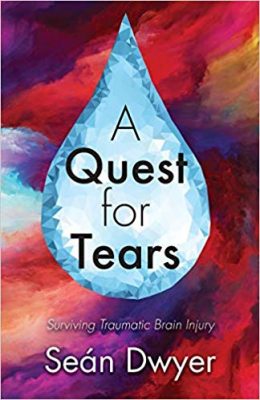
  • A QUEST for TEARS: Surviving Traumatic Brain Injury by Seán Dwyer – Memoir, Traumatic Brain Injury, Inspirational

    A QUEST for TEARS: Surviving Traumatic Brain Injury by Seán Dwyer – Memoir, Traumatic Brain Injury, Inspirational

    Journey Narrative Non Fiction 1st Place Best in Category CIBA Award gold an blue badge.


    A Quest for Tears by Sean Dwyer is a captivating memoir written four years after the author suffered a Traumatic Brain Injury (TBI) as the result of a rear-end car collision.

    While such casualties often foster long-term, unpredictable damage and seem a medical mystery, here Dwyer’s goal is to share his unique roadmap of struggles and experiences, while also advocating for fellow TBI survivors.

    At age fifty-four, Dwyer was a college educator, fluent in Spanish, and a creative writer who had authored two novels and a work of nonfiction. A prolific songwriter, he was also blessed with an excellent memory, supportive of the talent of colleagues, and was always able to display his emotions easily. But in the aftermath of his January 29, 2015 accident, life changed.

    Initially diagnosed with whiplash, back sprains, a leg wound, and soft-tissue damage to his arm, subsequent tests revealed a concussion and TBI. Now, in addition to dealing with the expected discomfort of his outer physical injuries, Dwyer was forced to navigate the arduous, mired path of debilitations faced by those dealing with head trauma. From a first-person perspective showcasing determination and resilience, Dwyer journeys through a slow, laborious labyrinth towards recovery. With a touch of wit, he applies the moniker

    “Sean 2.0” to his injured self, and like a software upgrade, he begins to explore the new cognitive alterations of his brain.

    Dwyer now faces life with an extreme sensitivity to light. Also, there is the absence of the familiar “earworm” that once inspired music and stories. His now quiet brain struggles for words has difficulty reading and lost the sense of musical enjoyment. Minimal laughter and a noticeable inability to shed tears lead him to wonder, “Am I going to be an emotional zombie for the rest of my days?

    Dwyer went from being a man with high regard for hygiene and fashion standards to an individual preferring comfortable attire and choosing vibrant novelty socks that delighted his injured brain. Painful head movements during a simple haircut caused him to eliminate the grooming event for two years. This was the new Dwyer.

    Dwyer seeks numerous treatments over several months, from physical therapy and acupuncture to neuropsychologists and craniosacral practitioners. During a visit with a priest, he looked for help from the sacrament of healing. Attending conferences with fellow TBI survivors proves an essential part of his recovery, as he learns progress can still occur well beyond the one-year mark of the initial injury. Lightening the intensity of this autobiographical account, Dwyer distinguishes the one-year “smashiversary” of his accident with a celebration at a local Mexican restaurant. Along with a cathartic, hanging car pinata, a gifted plaque featuring the accident photo Dwyer was always quick to produce in conversation, is humorously preserved with the fitting caption “stronger than steel.”

    The importance of the much-needed understanding and support he received from his wife and family, the medical community, and a vast tribe of friends, students, and colleagues continues to be imperative in Dwyer’s recovery.

    Mock classroom set-ups helped him acclimate to possibilities for teaching, while fellow writers proved compassionate in fueling his need to find new pathways for creative expression. Dwyer weaves poignant moments throughout his story, including an unexpected conversation with a wheelchair-bound boy who inspired him to push through his newfound obstacles. He also highlights the guiding force of his beloved elder feline companion, Sophie, who proved the utmost source of comfort throughout his ordeal.

    Written primarily as a resource for TBI survivors, their caregivers, and members of the medical community who often fail to distinguish the difference between intelligence and brain health, Dwyer’s A Quest For Tears is a remarkable achievement. Ultimately it proves a positive affirmation of the human spirit, focusing on the ability to learn and adapt when faced with the unique challenges brought on by sudden brain injury — a powerful and inspiring read.

    A Quest for Tears won First Place in the CIBA 2018 Journey Awards for Memoir/Biographical works.


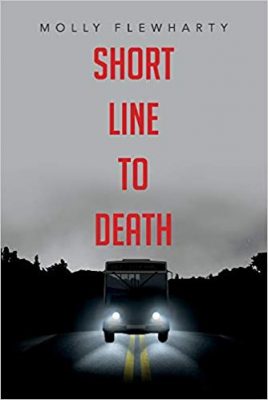
  • SHORT LINE to DEATH by Molly Flewharty – Female Sleuth, Cozy Mystery, Humorous Mystery

    SHORT LINE to DEATH by Molly Flewharty – Female Sleuth, Cozy Mystery, Humorous Mystery

    An upcoming divorcee has no idea that her life is about to change when she gets involved in a murder investigation in Molly Flewharty’s, Short Line to Death.

    Madeline Williams moves from New York to the small town of Cross Keys, Pennsylvania. She hopes the change will do her good since she’s in the throes of a divorce. Madeline decides to take the bus over driving on the long commute to her Manhattan job. Traveling is lonely since she is the new kid on the block among a group of regulars. That changes when Tom Firemark, the handsome owner of The Opossum, sits next to her during their daily trips.

    Madeline and Tom’s growing friendship shifts when they become eyewitnesses to a mysterious murder on the bus, which is the second murder that has occurred in the town over the last few months. Since Police Chief Billy West is over his head trying to solve the first crime, Tom, who has PI experience, takes it upon himself to do his investigations on this newest incident. Because Madeline was an innocent bystander at the scene of the crime, he invokes Madeline to join him in sleuthing.

    Teaming together proves to be better than Madeline imagines as the two become more comfortable with each other amid processing a flurry of possible suspects. But as the puzzle pieces begin to fall in place, Madeline finds herself way over her head. Whether or not she can complete the investigation unscathed remains to be seen.

    First-time author, Molly Flewharty, spins a host of red herrings in Short Line to Death. She pulls from her own experience commuting from Manhattan to Pennsylvania to create the small-town setting and accompanying atmosphere replete with a well-rounded mix of elusive characters. Top on that chart is Roberta Carlson (whose ultimate demise is shocking yet a welcome to those who were tired of her surly disposition) is at the center of Tom and Madeline’s investigation. Now with the most obnoxious person out of the way, sniffing out the murderous culprit may be tougher than the team anticipates.

    Chapters filled with detailed descriptions of various Cross Keys establishments and homes alternate between the police chief’s frustrating search behind the death of the town’s miscreant, Bart Grickly; Tom and Madeline’s investigation; and Madeline’s struggles with her broken marriage and new-found feelings towards Tom.

    Flewharty delivers a tension-filled mystery banquet of suspects ranging from ordinary people with personal problems to those we’re sure “did the deed.”

    Short Line to Death will have mystery fans lined up to see what’s next from Flewharty. Highly recommended.


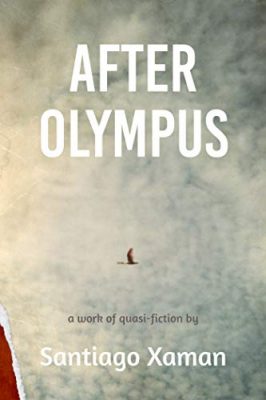
  • AFTER OLYMPUS: A Work of Quasi-Fiction by Santiago Xaman – Magic Realism, Literary Fiction, Multi-Cultural

    AFTER OLYMPUS: A Work of Quasi-Fiction by Santiago Xaman – Magic Realism, Literary Fiction, Multi-Cultural

    Reviewers note:  Consider the term, “quasi-fiction” in the subtitle of this novel by Santiago Xaman. It’s key to reading and understanding this deeply compelling and innovative work. The book begins with two definitions of quasi-fiction:  1. A narrative combining fictional characters with published facts of minor historical significance. 2. The form of realism evoked by quasi-fictional content. Having completed the book, I find I must smile at the term, “realism,” as used in the second definition.

    In this groundbreaking novel, what is real – and what isn’t – is always the heart of the matter. There are elements of reality in the fantastical, and there are elements of magic realism in the rather ordinary. After Olympus is a novel about characters who don’t just think outside the box; they are outside the box.

    Intrigued? You should be. We don’t see novels like this every day, but this one will find its way into the hands of the most discerning readers.

    After Olympus is arranged into six sections: Alpha, Beta, Gamma, Delton, Epsilon, and Omega. Yes, Greek letters, very appropriate for a work laced with mythic associations, associations that will take the reader, as the title notes. Santiago Xaman tells his story via a manuscript found on his property in California. We learn of his childhood in Guatemala in the 1950s and early 1960s, his plea to Xaman Ek, the North Star, for the power of invisibility. We meet his sister who wants to fly like the Mancho bird that nests where the rainbow ends. A fire will change the tide of Santiago’s life, eventually bringing him to the United States, where adoptive American parents raise him.

    Throughout his adult life, he will live with a Russian woman raised in the communist Soviet Union and who has burdensome secrets that will impact Santiago’s life in ordinary and extraordinary ways. One night, Santiago witnesses what he thinks is a falling star but is fuselage falling from a Soviet spacecraft. The event brings two international Stanford scientists to his door and a puzzle of a quest begins, one that will encompass the themes of schism and reconciliation, myopia and sight, and inequity and prosperity.

    Gus, a businessman with a dream to be the “Yahoo of the medical world,” will join this group that Santiago comes to refer to as “magicians.” They will accomplish things that might seem magical, but just as one must carefully observe a magician for sleight of hand, the reader should follow the words of this enigmatic narrative with complete focus.

    The magicians’ projects include designing new frameworks to analyze and make use of neuropsychological testing, intersections of social and political media, employment opportunities for young women with small children, and a gamut of concepts intended to make the world a better place through the removal of hurdles and the dissolving of problems. If technical innovation can be decapitalized and the profits realized by those most deserving of them, the economy can be reinvented. But there are villains on the scene as well and what they do to counter the magicians’ is astounding.

    The ultimate triumph of After Olympus is that it’s not just one book. It will be different books for different people. Included in it is the old and classic story of the blind men who describe an elephant in entirely different ways. What one brings to this book may influence what one thinks they’re reading. The ending alone will make readers wonder if they really know the difference between tusk and tail.

    After Olympus is a superb selection for any book group interested in a novel that is so thoroughly outside the box, so uncaged, that it’s a bit wild, in the best of ways.


  • HOW DACHSHUNDS CAME to BE: A Tall Tale About a Short Long Dog by Kizzie Jones – Children’s Books, Mythology & Folk Tale, Children’s Dog Books

    HOW DACHSHUNDS CAME to BE: A Tall Tale About a Short Long Dog by Kizzie Jones – Children’s Books, Mythology & Folk Tale, Children’s Dog Books

    Author Kizzie Jones creates a beautiful origin story about how the lovable dog species – the Dachshund – came to be with the help of illustrator Scott Ward.

    In an enchanted time and place, a little girl walks every day along a beautiful beach, delighting in the sea stars, anemones, mussels, and barnacles that are revealed when the tides sweep out. She combs the beach for treasured “friends” of shells and sand dollars. A pod of humpback whales visits the beach twice yearly, and the little girl thrills to see the whales and their newborn calves. But the little girl is lonely and more than anything, wishes for an animal friend to take home with her.

    Kizzie Jones loves dachshunds (she has three) and lives near the Salish Sea, where Orcas and Humpback whales and other sea life frolic and play. This familiar setting provides a rich environment for her charming stories to take root. How Dachshunds Came to Be: A Tall Tale About a Short Long Dog, is Kizzie Jones’ first book, and like the other books in her series, A Tall Tale About a Dachshund and a Pelican: How a Friendship Came to Be, and her very latest book in the series,  A Tall Tale  About Dachshunds in Costumes: How MORE Dogs Came to Beartist Scott Ward’s illustrations perfectly match the mood of Jones’ narrative – bright, fresh, almost etheric colors of sea, sand, and the whimsical renderings of the little girl and those who love and surround her. Each page number is highlighted on the back of a dachshund, and the three dogs that rush to befriend the little girl are simply adorable. This sweet collaboration makes a perfect “read-to” for parents and grandparents of toddlers and an engagingly accessible tale for older children to delve into on their own.

    Shortly after the little girl leaves the beach for home, the whales decide to find a companion for her. This friend would need to be a warm-blooded mammal – able to breathe fresh air. Each creature has ideas about the ideal companion. A barnacle suggests giving it a long nose; seals advise a “long sleek body” just right for cuddling; anemones think it needs soft wavy whiskers and eyebrows. The octopus naturally suggests 8 limbs. Still, the group settles on four, with padding on the ends of their legs – suitable for walking on land.

    By the time the little girl awakens and returns to the beach, she finds not one but three new friends – black, brown-red, and golden dachshunds. They run to her, ready for cuddles and loves.


  • GENERAL in COMMAND – The Life of Major General John B. Anderson by Michael M. Van Ness – Military History, WWII Biographies, Military & Spy Biographies

    GENERAL in COMMAND – The Life of Major General John B. Anderson by Michael M. Van Ness – Military History, WWII Biographies, Military & Spy Biographies

    Michael M. Van Ness, the grandson of “the general in command,” has created a remarkable biography chronicling the adventures of a farm boy who rose high rank in the US military and served with distinction in two world wars as a combatant, officer, and sage observer.

    Born in 1891, John Benjamin Anderson must have had considerable intelligence as well as patriotism and grit, since he was accepted at West Point Military Academy at age 19, an honor conferred on only 130 applicants per year—and finished in the top third of his class. He would soon serve under General Pershing in the Mexican War, giving him the experience of combat and coincidentally, his first ride in an automobile. That deployment earned him inclusion in Pershing’s ranks in World War I. It was then his diaries began, and though he protested humorously that “I hate to write,” these personal recollections give readers an up-close picture of the devastation of warfare.

    Anderson also describes, in straightforward prose, the grim conditions of foot soldiers in that terrible war—in muddy water up to their waists in the trenches, and always carrying two gas masks. The war gave him a chance for advancement through the ranks, and admiration for his fellow fighters, including the “bulldog tenacity of the British.”

    His welcome home included giving a speech to the locals along with the realization that the military would be his lifetime profession, as the family had died or scattered. He studied to attain the rank of major and then lieutenant colonel, married happily, worked in Washington, DC, and had an assignment with the CCC (Civilian Conservation Corps) during the Great Depression.

    In 1942, as a new war was rumbling once more in Europe, he took charge of training an infantry division. In 1944, he met with Winston Churchill; in fact, at one time he escorted Winston Churchill and Field Marshal Montgomery over the Rhine River. General William Simpson was a dear friend of Anderson’s and the pair maintained contact for years. He wrote letters to his wife, daughter, and mother-in-law; his homey descriptions included seeing a cart drawn by a dog, and noting foreign celebrations of Christmas. His XVI corps served in the Rhineland campaign, and he personally oversaw the liberation of the Dutch city of Roermond, where his name is revered to this day.

    After the war, Anderson retired but often attended reunions with his military cohort and continued to receive civilian recognition. However, unlike many others, including his friend Simpson, he did not receive a post-war promotion. A rise to lieutenant general would fairly reflect his actual role in World War II, so Van Ness and others continue to petition for this honor—a third star—to be bestowed posthumously, as it is undoubtedly merited.

    Van Ness served in the Navy in a medical capacity and shares a deep understanding of his outstanding forebear in this well-organized life story, which offers a thorough, thoughtful exploration of the many issues that arose during his grandfather’s wartime service. General in Command – The Life of Major General John B. Anderson will resound those who have served their country, either at home or abroad, their families, and with military history buffs. Highly recommended.


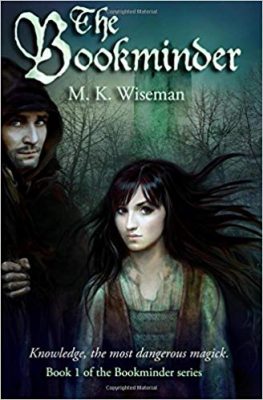
  • The BOOKMINDER by M.K. Wiseman – Fantasy, Coming of Age, Magic

    The BOOKMINDER by M.K. Wiseman – Fantasy, Coming of Age, Magic

    More than anything, Liara just wants to belong. As an orphan “fey” child in the seventeenth century, Liara has been a ward of the Church for ten of her sixteen years. Grateful to be taken in and cared for by Father Phenlick, she knows most of the villagers want her gone.

    The product of a rape by a magical creature, Liara is imbued with magic and in many ways is magic itself. The powerful wizard who created the creatures responsible for the attack during the attack on the valley, knows nothing of her existence. Father Phenlick enlisted the help of Nagareth, the wizard of the woods, to shield Liara and the village from further assaults all while outlawing the very power he is secretly trusting.

    At St. Sophia, Liara is safe until she steals from the village busybody. When Liara’s extensive hidden stash is discovered in a “magicked” hollow tree, the Venetian soldiers who protect the valley force Father Phenlick to ostracize Liara. Abandoned by even her friends, Liara is taken in by Nagareth, who promises Phenlick that he will not teacher Liara his craft. Liara begs Nagareth for magical instruction, but he only allows her to care for his extensive magical library. Gradually, Nagareth sees great potential in his new ward, but when everyone in Dvigard is killed by a mysterious plague, he begins to fear that he can’t protect her from her powerful creator who will want her powers for his own if she is discovered.

    Liara cannot see the danger around her, and as her own magical knowledge grows through her maintenance of Nagareth’s books, her only goal is to exact revenge against her father. As her abilities grow so does her anger and confusion at the only person standing between her and her destruction.

    Liara is a complex, dynamic character. Her history gives her more than normal teenage problems. Liara’s mother was driven crazy by the rape and was never able to truly care for or love Liara, leaving Liara to the cruelty of the villagers. Without Father Phenlick, Liara would never have survived, and though he tries to give her a home, he isn’t able to fill the emptiness deep within her. Liara desperately needs something and somewhere of her own, which is why she steals–to fill her life with things that are her own. In creating her hollow-tree hiding place, she creates that place where she isn’t afraid to be herself. Though she is unaware of her own magic, it is as much a part of her as her history.

    In the beginning, all Liara wants is to grow that power. She desires the very thing others accuse her of having to give her what she has never had, but it’s a double-edged sword. She is hated for her supposed abilities even before she shows evidence of magic, but when she finds the magic she wants so badly, it will define her. She wants others to see she has feelings and dreams, but in the very thing she wants most, this undeniable power, people will see only that. She limits herself to this magical creature, and that drive quickly becomes an obsession. Only too late does she see Nagarath’s minimal use of magic isn’t a waste. She almost allows her prejudiced idea that magic should be grandiose to cloud the important lesson she learns about living simply, living for love and not power. As she grows through her relationship with Nagareth, she learns what magic should truly be.

    The evolving bond between Liara and Nagareth is a beautiful story. Only nine years Liara’s senior, Nagareth sees Liara as a child in the beginning, but over the novel’s development, he begins to see Liara as a true companion. The joy she brings to his life, the peace she makes him feel, even though she annoyingly begs him to teach her magic, becomes invaluable to the lonely wizard.

    He wants to make sure she has a life of stability, not fear. As he opens himself up more and more, he becomes her friend. He realizes she has given him more than he has returned and relents in his promise not to teach her. Nagareth grows as much as his precious ward.

    The Bookminder won 1st Place in the CIBA 2017 OZMA Awards for Fantasy Fiction.


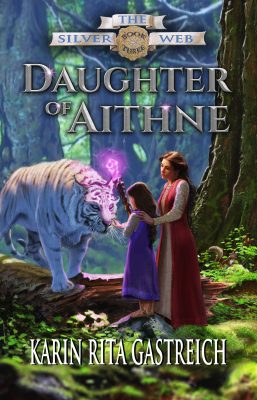
  • Daughter of Aithne: The Silver Web Series, Book 3 by Karin Rita Gastreich – Romance Fantasy, Sword & Sorcery, Magic Realism

    Daughter of Aithne: The Silver Web Series, Book 3 by Karin Rita Gastreich – Romance Fantasy, Sword & Sorcery, Magic Realism

    Writer and ecologist Karin Rita Gastreich draws inspiration from her trips to the magical forests of Costa Rica to bring life to the Silver Web series. An unforgettable journey, Daughter of Aithne, is the finale to the epic story of Queen Eolyn the High Maga, set in a world of seemingly never-ending war where female practitioners of magic (maga) are feared.

    Set ten years after the conclusion of Gastreich’s second installment in the series Sword of ShadowsDaughter of Aithne begins during an era of abundant peace. That peace quickly turns to turmoil when a group of Eolyn’s magical progeny commits an act of grave betrayal by kidnapping Princess Elisara, daughter of the former Queen Taesara.

    The Mage King Akmael immediately orders all maga to lay down their arms and have their magic bound. For years magas have been prosecuted for having magic and were all but annihilated by the crown. Except for a small amount that managed to escape hoping to one day be able to live their lives of magic according to their beloved culture. Fear of women’s magic is still alive in the kingdom, and the King, wishing only to protect his queen and her daughters, attempts to avoid an outbreak of war by banning all magas use of their craft.

    Gastreich uses vivid language to transport readers into the story. An overarching theme of distrust and vying for loyalties in and among kingdoms presented in this third installment of the Silver Web series is reminiscent of other high fantasy series such as George R. R. Martin’s A Song of Ice and Fire. Gastreich masterfully executes an effective use of narrative misdirection throughout the story.

    Karin Rita Gastreich has an apparent love for the magic of nature and breathes that into the heart of her books, but she also successfully sets real-world issues at the forefront. She follows a common trope within the Young Adult genre by taking an issue from today and melding it into her narrative. Here, the main element in the Silver Web trilogy is the stark contrast of beliefs and opinions centering around magic and especially female magic welders. Many fear their magic and believe magas are dangerous, but then have little or no issue with male mages.

    A triumphant story of adversity, Daughter of Aithne is the exciting conclusion to the Silver Web series. Readers of all ages may hope this is not the last time Gastreich will return to her fantastical world of magic.

    Daughter of Aithne won 1st Place in the CIBA 2017 OZMA Awards for Fantasy novels.