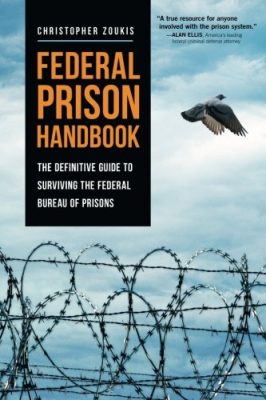
In the Federal Prison Handbook-The Definitive Guide to Surviving the Federal Bureau of Prison, Christopher Zoukis has meticulously identified, collected, and organized a compendium of information regarding life in federal prison. Zoukis’ straightforward writing, free of personal bias or opinion, is neither mysterious nor titillating—reality is not sensationalized—it’s not fiction, it’s the facts.
However, if through some twist of fate, you or a loved one finds yourself in the unthinkable situation of going to prison, it may become the best book you’ve ever read.
Consider. You’ve been sentenced to serve time in one of the Federal Bureau of Prisons’ 125 stand-alone facilities, a private contract facility, or a satellite prison camp scattered throughout the United States. You, who need directions to find your way through Costco to the deli, must now enter an unfamiliar world with its own lexicon, rules, and consequences. How will you survive?
As a thirty-year-old federal prisoner, incarcerated since he was a high school senior, Zoukis speaks authoritatively to that question—and other issues you haven’t even considered—and, why would you, with no previous experience or points of reference.
Zoukis has created a comprehensive guide to seemingly all aspects of prison life—from entering the front doors to the time you leave. He provides annotated, specific information regarding life in this mandated setting, a community which exists within both real and figurative walls. Its written and unwritten rules allow little latitude for divergent behavior or personal desires. And, perhaps equally important, Zoukis delineates the unique customs and unwritten social mores of prison culture.
Each handbook section cites and explains rules and regulations in detail, as well as providing practical tips, based upon the author’s experiences, observations, and information garnered from extensive interviews of fellow prisoners. The Federal Prison Handbook disabuses some of the sensationalism created by fiction, tell-alls, and media in general, regarding sexual abuse, gang violence, power hierarchies, and such. The topics are objectively elucidated within the context of the prison rules, consequences, and the overall prison culture.
Unlike many popular “survival” books, the Federal Prison Handbook will probably not give the reader an emotional rush or provide an epiphany regarding the meaning of life. However, it could prove invaluable to counselors, lawyers, families, and individuals who find themselves facing incarceration in the federal prison system.
Federal Prison Handbook-The Definitive Guide to Surviving the Federal Bureau of Prison won First Place in the Instruction & Insight Awards in 2017.
The Little Peeps Book Awards recognize emerging new talent and outstanding works of Early Readers. The Little Peeps Book Awards is a division of the Chanticleer Reviews International Book Awards – the CIBAs.
Chanticleer Book Reviews is looking for the best books featuring stories of all shapes and sizes written to an audience for Early Readers. Storybooks, Beginning Chapter Books, Picture Books, Activity Books & Educational Books we will put them to the test and choose the best Children’s Books among them.
Good Luck to the Semi-Finalists as Your Works Compete for the 2018 First Place Category Positions!
Please click here for the awarded digital badge and for more information on book stickers.
The 2018 Little Peeps Book Awards Semi-Finalists:
Carolyn Watkins – The Knock...a collection of childhood memories
Pamela Tomlin – My Truly Most Favorite Fluffy Friend
Ashley Davidson-Fisher – La Petite Josette en Provence Going To Les Baux-de-Provence (Voyage aux Baux-de-Provence)
A. & C. Kruspe –I’m Car 55, But I Want to Be Number 1
Leea Baltes –Goodnight Wishes!
Sylva Fae – Yoga Fox
Sylva Fae – Mindful Monsters
Carolyn Leeper – My Stars!
Lauren Mosback – Braving the Bully
Eva Newermann –The Universe: A Work of Art
Denise Ditto – The Tooth Collector Fairies: Home from Decay Valley
Stephanie Warner – Mopsey and the Diverse Dog Show
Stacy Einfalt – Go Team!
Peggy Sullivan – Tevye the Magical Theater Cat
Sheree K. Nielsen & Pat Wahler – Midnight The One-Eyed Cat
Lauren Mosback –My Sister’s Super Skills
Veronica Ruth Fischer – Oscar’s Christmas Wish
The 2018 Little Peeps Shortlisters will compete for the Semi-finalists positions. First-In-Category Positions will be selected from the Semi-Finalists. First Place Category Award winners will automatically be entered into the Little Peeps GRAND PRIZE AWARD competition. The CBR Grand Prize Genre Winners will compete for the CBR Overall Grand Prize for Best Book.
As always, please do not hesitate to contact us with any questions, concerns, or suggestions at Info@ChantiReviews.com.
The Little Peeps Grand Prize Winner and the First Place Category Position award winners along with all Semi-Finalists in attendance will be announced at theApril 27th, 2019 Chanticleer Book Awards Annual Awards Gala,which takes place at the Chanticleer Authors Conference that will be held in Bellingham, Wash.
To compete in the 2019 Little Peeps Book Awards or for more information, pleaseclick here.
A Chanticleer Editorial Services Writing Toolbox Series
While rules and techniques are not written in stone, most of the basic guidelines of fiction stem from logic and an understanding of dramatic structure. Don’t break the rules until you know them, or better yet, until your first novels have sold. – Jessica Morrell
The Developemental Editing Checklist by Jessica Morrell
VOICE
From the opening paragraphs, is there a clear, distinct and engaging voice? The writer’s voice should have authenticity, individuality, or originality.
Log-Line aka Elevator Pitch
Is there a single, simple conflict that drives the action? Can your plot be summed up in a single sentence? (Log-line aka The Elevator Pitch). Keep your log-line visible and in plain sight whenever you are editing your work-in-progress to remind you of your story’s focus.
Opening – is it grabbing?
Does the story begin with a change or threat in the protagonist’s life? Or the loss of something important? Or an action happening that should be prevented.
The opening should contain a hook or inciting incident that creates stress, unease, questions, or opens a can of worms. The story needs to start in the first sentence.
Is the story driven?
Does each scene provide a sense of momentum, or narrative drive pushing the story forward? Does each description? Or are the words there for the writer?
Is the story immersive?
Is the story highly visual? Can your reader imagine “seeing it” while reading or listening to it?
Ticking Clock?
Is there a sense of time running out or another driving factor that creates tension? Even light-hearted or humorous stories should have tension.
Weather or Atmosphere
Does the story contain weather? What is the environment or the atmosphere like? Make sure that your story doesn’t have the “empty room” syndrome.
Is Backstory on a need to know basis?
Have you worked at weaving data, description and backstory into the narrative so that it doesn’t interrupt the forward movement of the story?
Did You SHOW and TELL?
Have you dramatized the action in scenes or have you summarized?
“Show, don’t tell” is a useful guideline for writers, but fiction is actually ‘told’ and ‘shown.’ A combination of both techniques creates the most effective fiction.
Scenes are most effective when you’re revealing complicated interactions between characters and emotions change via the scene.
Exposition is most effective when you’re filling in background information or moving quickly between two scenes. Too much showing or too many scenes make the story too drawn out just as too much exposition makes it static.
Setting
Are the settings interesting, unique, memorable?
Does the setting have the potential to teach readers about a place, a profession, a way of life?
Or does it overshadow the story?
Conflict
Is the conflict weak or boring or not enough to sustain a manuscript of a particular length?
Or does the conflict seems contrived?
Or begins too far into the story? This happens far too often.
Pacing
Often writers apply the same level of speed or word count to everything in the story from a major heartbreak or ride across town. Sagging middle is another pacing problem so that the reader feels like it takes too long to reach the end.
Other times, the story plods along only to barrel past the most interesting moments in the story.
Do the chapter endings make your reader want to keep reading?
Have you ended scenes (chapters) with thrusters, surprises or cliffhangers?
Readers need a reason to keep turning the page and all stories need growing intensity until the climax or resolution.
Flashbacks
Have you relied on flashbacks to relate to the protagonist’s backstory? If so, is the information necessary and do the flashbacks disrupt the momentum of the story?
Are your characters recognizable?
Have you repeated some physical characteristics, descriptions of the characters throughout the story so the reader is reminded of their physical attributes and personality?
Is each character consistent? Are his or her dominant traits in evidence throughout the story?
Transitions
Are your transitions brisk and do they serve to keep the reader moving through time, space and mood?
Do you quickly slip in and out of scenes?
Story Arc
Are there a series of setbacks, mini-crisis, and complications along the way?
Does the protagonist have a goal in each scene? Or something that will affect the protagonist is taking place?
Have you added unexpected events midway in the story?
Have you deftly handled your theme and premise, or are you on a soapbox preaching or shouting at the reader with an overreaching message pushing an agenda? This happens more often than one would think.
Dialogue
When you read the dialogue out loud, does it sound natural?
Do you trip over words when you read the dialogue out loud?
Does the dialogue contain tension?
Does each character sound distinctive?
Be aware of these problems: overly long exchanges; characters giving speeches, or the dialogue contains no tension or conflict.
Does each character sound distinct?
The Ending
Is the protagonist the person in the story most involved in the action, most likely to be changed by events in the story?
Does the ending provide the most emotional and dramatic scenes?
Does the ending tie up most of the subplots?
Does the ending deliver? Does it satisfy?
The best endings are not contrived or convenient. They are the logical and highly dramatic culmination of the proceeding events. The climax is the highest emotional pitch of your story, a decision, a collision of forces, and settling of scores. Also in this category are too many loose ends and subplots dangling, and questions unanswered.
The ending is what makes your work “go viral.” Take special care with the ending. –Kiffer
RULE #1 from Jessica
While rules and techniques are not written in stone, most of the basic guidelines of fiction stem from logic and an understanding of dramatic structure. Don’t break the rules until you know them, or better yet, until your first novels have sold.
Editor’s Note: Often it is hard for the author to objectively read her or his work for the above issues. Authors often “hear and see” their story in their minds’ eyes. The trick is to have someone else hear and see the story from words on the page from outside of the author’s mind. This is where the author’s agent or the publisher’s editor comes into play by doing a close read of the work for these top-level issues before editing begins.
We, at Chanticleer Reviews Editorial Services, see that it is at the point where authors make the mistake to start copyediting their works when they should have their manuscript evaluated by an editor, agent, or publisher.
The power of a manuscript overview makes it one of the best tools that traditional publishing houses and literary agents make available to their authors.
Best-selling authors receive great editing and feedback from agents and senior editors on early drafts, which most self-publishing authors never receive. When feedback comes early in a work’s progress it allows the author to not only create a more polished final product, but also publish more works.
It can be very difficult for the author to discern the above issues because it takes fresh eyes and perspective to evaluate the manuscript aka work-in-progress. The entire manuscript should be read and then commented on and evaluated. To learn more about Chanticleer’s Manuscript Overview and Evaluation Service can save you time and money, please click here.
Click here to download the handy WORD file that you can print out of the above points on Developmental Editing.
Jessica Page Morrell
Jessica Morrellis a top-tier developmental editor and a contributor to Writer’s Digest magazine, and she teaches Master Writing Craft Classes at the Chanticleer Authors Conference that is held annually along with teaching at Chanticleer writing workshops.
Jessica understands both sides of the editorial desk–as a highly-sought after content development editor and an author. Her work also appears in multiple anthologies and The Writer and Writer’s Digest magazines. She is known for explaining the hows and whys of what makes for excellent writing and for sharing very clear examples that examines the technical aspects of writing that emphases layering and subtext. Her books on writing craft are considered “a must have” for any serious writer’s toolkit. For links for her writing craft books, please click on here.
Chanticleer Reviews andOnWord Talkswill interview Jessica for more of her writing tips and advice. Stay tuned! ~ Chanticleer (who hails from Chaucer’sCanterbury Tales).
Click here for more information about the 2019 Chanticleer Authors Conference!
Author Sandra Wagner-Wright brings to life a story rife with “politics, power struggles, and patriarchy” in her newest historical novel Two Coins.
Mary Pigot is Lady Superintendent of the Ladies’ Association Female Mission in Calcutta, India. Born and raised in Calcutta, Mary is well acquainted with the climate, culture, and customs of the locals. Her diligence to faithfully spread God’s Word to the peoples of India while showing respect to their traditions places her in high esteem among the Ladies’ Association in Scotland.
In walks William Hastie, the new principal of the Scottish College, ten years into Mary’s position. His mission is to “restore harmony” between the Scottish College and the Female Mission. The only problem is that his definition of “restoring harmony” has to reflect Scottish principles. William realizes from the get-go that he has significant work to do when he recognizes Mary’s relaxed and unorthodox ways. As a result, friction immediately builds between the two.
While Mary continually contends with William’s nitpickiness, things grow from bad to worse when querulous Georgiana Smail comes on board as Mary’s assistant. Unbeknownst to Mary, Georgiana makes a detailed account of Mary’s faults and sends her findings in a report to the Ladies’ Association in Scotland. Mary returns to Scotland to defend her good name. More issues brew, this time involving her worst enemy, William Hastie. In the process of finding a solution to her ever-rising problems, the last thing she expects is to take William to court for libel.
Award-winning author Sandra Wagner-Wright brings to life an unprecedented event of the latter half of the 19th century. Based on actual events, Two Coins grew to fruition when she got wind of the case of Pigot vs. Hastie amid her research on missionary work in India. Original sources proved Mary Pigot to be a woman ahead of her time as marked by her professional accomplishments and tenacity for upholding her rights.
Building a plot from first and secondary sources is nothing to sneeze at, especially when details need to be presented in a way that identifies a novel as historical fiction. To Wagner-Wright’s credit is her ability not only to collect details but also breathe life into them. One of the most notable aspects of Two Coins is that it is written in present tense, which allows readers to feel as though they are experiencing a past event in real time.
Wagner-Wright takes her story one step further by designing her narrative in the first person and then alternates it between viewpoints from Mary and William (mainly), and (periodically) James Wilson, a close associate, and friend of Mary’s. The constant shifting while following a steady timetable allows the narrative to flow freely from one chapter into the next.
Two Coins keeps to the vernacular of the era with all of its patriarchally-laced social norms. Here the author includes a well-developed cast of primary and secondary characters that are mostly, though not exclusively, composed of historical figures. Scenes are a lively mix of engaging dialogue delicately balanced with a backset of nuances befitting British India—extreme temperatures (heat to monsoons), food, living conditions, adaptations due to climate (i.e., mosquito netting, nutshell-filled mattresses to keep away rodents), and Hindi terminology.
Tension (sprinkled with sarcastically comedic moments) rises with the court proceedings that are intertwined with unexpected plot twists. Two Coins, with its overtones to women’s rights, is nothing less than a stellar and ageless novel.
The CLUE Book Awards recognize emerging talent and outstanding works in the genre of Suspense, Thriller, Crime, & Mystery Novels. The CLUE Book Awards is a genre division of the Chanticleer International Book Awards (The CIBAs).
Information about the #CIBAs Long Lists, Short Lists, and Semi-Finalists Announcement Rounds.
These titles have moved forward in the judging rounds from SLUSH pile to the 2018 Long List (aka the Slush Pile Survivors) to the SHORTLIST and have competed for the 2018 CLUE SEMIFINALISTS positions.
These titles are in the running for the First Place Category Winner positions of the 2018 CLUE Book Awards novel competition for Suspense, Thriller, Crime, and Mystery Novels. Good Luck to All!
The First Place Category Winners will be announced at the Chanticleer Awards Banquet and Ceremony. The First Place Category winners will automatically be entered into the CLUE GRAND PRIZE AWARD competition. The 16 CBR Grand Prize Genre Winners will compete for the CBR Overall Grand Prize for Best Book and its $1,000 purse. First Place Category and Grand Prize Awards will be announced and recognized at the Chanticleer Awards Banquet and Ceremony on Saturday, April 27th, 2019, Bellingham, Washington.
All Semi-Finalists will receive official notification by email and will be tagged in a Facebook Announcement and promotion—if they are following Chanticleer Reviews on Facebook. Facebook will only allow us to tag those who follow CR on FB. Click on this Semi-Finalist badge link to the downloadable digital badge and for information about Semi-Finalists book stickers.
The Official 2018 CLUE Book Awards Semi-Finalists:
Lauren E. Rico – Reverie (Reverie Trilogy, Book 1)
The CLUE Grand Prize Winner and the First Place Category Position award winners will be announced at theApril 27th, 2019 Chanticleer Book Awards Annual Awards Gala,which takes place at the Chanticleer Authors Conference that will be held in Bellingham, Wash.
We are now accepting submissions into the 2018 CLUE Book Awards writing competition. The deadline for submissions is September 30th, 2019. Please click here for more information.
As always, please do not hesitate to contact us with any questions, concerns, or suggestions at Info@ChantiReviews.com.
The magic of living in 19th century England comes to life in the early chapters of Peter Greene’s delightful, but also exciting, story—with British Navy Midshipman Jonathan Moore and daughter of the Governor of the Bahamas, Delain Dowdeswell, enjoying the fashionable new treat of ice cream, then joining their friends and family members at the boat race in Dover on a beautiful day. Granted, that wasn’t how everyone lived, and even these special few lived daily lives far less comfortable than do most ordinary people today. But they didn’t know that.
Jonathan is the son of Admiral Nathaniel Moore, who had been imprisoned in France during the Napoleonic wars. This happenstance orphaned the boy, who lived a sorry few years on the streets of London until he was found by his father’s friend, Captain Walker. The admiral was eventually rescued, and he and Jonathan were reunited. Delain and her sisters, Penelope and Rebecca, had been sent by their parents to live with the Walkers, who, with the help of Barbara Thompson, were tasked with teaching the sisters to become ladies. That seems unlikely for the irrepressible, fourteen-year-old adventuress, Delain, who once stowed away on the HMS Poseidon, from which she fired more than one cannon shot in battle!
Shortly after the race at Dover, however, the young midshipman, also fourteen, boards the HMS Paladin, along with his former street friend Sean Flagon, soon to become a Marine captain, board the HMS Paladin, leaving their friend Delain behind as they head straight into an adventure way beyond their expectations. Not surprisingly, Delain soon finds herself in a spy adventure right in London. And perhaps not so strangely for these three musketeers, their adventures overlap.
Greene paints not only the scenes in London but those on the Mediterranean, the Adriatic, and even the Black Sea with vivid color and action. He allows us to experience life on the sailing ships of His Majesty’s Royal Navy, telling us what the officers and crew wear, what they eat, where they sleep, how they talk, and especially what they do. As Peter Greene writes in his Acknowledgments, he “hoped to create a series that would capture the excitement and thrill of being on one of His Majesty’s wind-powered warships in the [Lord] Nelson era.”
The action on the HMS Paladin, as well as her sister ship, the HMS Echo, mostly unbeknownst to each other, rise to a fever pitch as they find themselves engaged in an explosive battle not with the French, but with the Russians and even the Turks! As you might guess from the overall tone of Greene’s story, the British, at least most of them, live to return to England.
This book was such fun to read. I’m hoping Peter Greene will give us a Book Four. Meanwhile, those who haven’t read Books 1 and 2 of The Adventures of Jonathan Moore, Warship Poseidon, and Castle of Fire, as well as a number of earlier books, will have some good reading to tide them over.
The OZMA Book Awards recognize emerging talent and outstanding works in the genre of Fantasy Fiction. The OZMA Book Awards is a genre division of the Chanticleer International Book Awards (The #CIBAs).
Information about the #CIBAs Long Lists and Short Lists and Announcement Rounds.
These titles have moved forward in the judging rounds from SLUSH pile to the 2018 Long List (aka the Slush Pile Survivors) to the Shortlist. We incorporate the Long List when the judges request an additional round of judging to accommodate the number and/or quality of entries received. These entries are now Shortlisted and are in competition for the 2018 OZMA SemiFinalist positions. The Semi-Finalists positions will compete for the coveted First Place Category Winners of the 2018 OZMA Book Awards.
The 2018 First Place Category Winners and Grand Prize winners will be announced at the Chanticleer Awards Banquet and Ceremony that will be held during the Chanticleer Authors Conference and CIBA Ceremony and Banquet.
The First Place Category winners will automatically be entered into the OZMA GRAND PRIZE AWARD competition. The 16 CBR Grand Prize Genre Winners will compete for the CBR Overall Grand Prize for Best Book and its $1,000 purse. First Place Category and Grand Prize Awards will be announced and recognized at the Chanticleer Awards Banquet and Ceremony on Saturday, April 27th, 2019, Bellingham, Washington.
The following works have made it to the 2018 OZMA Book Awards Shortlist Long List:
Pamela LePage –Virtuous Souls
J.V. Rutz –The Illusion Killer
Megan Wong – Island Whispers
Allan Batchelder – Steel, Blood & Fire
EA Bishop – RAGNAROK: Demon Seed
Daryl Ellerbe –The Amazons
Kristin Secorsky –Dragon Chosen: The Dragon Riders of Eryieth
Paul E. Vaughn – Luminess Legends: Dragon Ascendants
Kathleen Neeley – Master None
Paul E. Vaughn – Luminess Legends: Dragon Ascendants
Jennifer Allis Provost – Gallowglass
T.K. Riggins – Money Jane
Susan Faw – Heart Of Shadra
Franklin Posner – Suburban Vampire Ragnarok
Nancy Guild Bendall – Nethermost Regained
M. K. Wiseman – The Kithseeker
Anthony Nordvik-Nash –Hedda Stein-Sun’s UnRemembered Islands
Nancy Guild Bendall – Nethermost Regained
Elana A. Mugdan – Dragon Speaker
Elizabeth Crowens – Silent Meridian
Lindsay Schopfer – Into the North: A Keltin Moore Adventure
Miriam Cumming – Namesakes
Chris Dews – Antler Jinny and the Raven
D.M. Cain – A Chronicle of Chaos
To view the 2017 OZMA Book Awards winners, pleaseclick here.
To view the 2018 OZMA Book Awards Long List, please click here.
Grand Prize Ribbons!
The OZMA Grand Prize Winner and the First Place Category Position award winners will be announced at theApril 27th, 2019 Chanticleer Book Awards Annual Awards Gala,which takes place at the Chanticleer Authors Conference that will be held in Bellingham, Wash.
We are now accepting entries into the 2019 OZMA Book Awards for Fantasy Fiction. For more information, please click here.
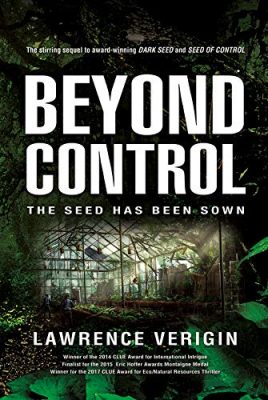
Now we reap the bitter consequences of what was diabolically sown in the first two books in the award-winning, exciting Dark Seed trilogy. In author Lawrence Verigin’s third book, the agents of The Club have implemented their evil plan and drive forward in complete denial of the unintended consequences that are now Beyond Control and threaten all human life on earth. Can these perils be stopped and reversed? Nick Barnes and his team have been left discredited and seemingly powerless to vanquish the dark forces behind this ecological thriller.
Nick Barnes finds himself victim to his own circumstances that are now also Beyond Control. At the start of this book, he struggles against convincing evidence that cleverly frames him for a serious crime, landing him in jail.
The twisting tale turns as the enemy runs its ominous empire unchecked. There is no guarantee that Nick’s plan will work, yet as the group sets out to track the evil conspirators across the globe, tragic environmental dangers loom on the horizon. The Club follows the trail of chaos left in the wake of the enemy and are able to understand the global catastrophic events that will ensue if the evildoers cannot be stopped. However, not everyone is able to see the truth in what these few see. Denial is powerful and feels safer than the dire truth Nick and his companions offer.
In fact, the members of the Club see the lethal dangers growing quickly because their foes’ inexcusable misuse of the science they are now wielding without understanding and without conscience. It’s up to Nick and his band to act, but their fight is against deluded fanatics, and in such fights, painful losses are inevitable. Is a final showdown with The Club something Nick’s group can win?
Author Lawrence Verigin writes to entertain while bringing attention to socially relevant subjects. His research into agricultural science is impressive, seamlessly weaving information into the narrative of the story, giving readers a satisfying and captivating set of novels.
Beyond Control is a fight to save the earth’s population from the seeds of devastation. It’s a thrilling portrait of our hero’s will to treasure life. However, Nick is up against a completely different worldview, and the stakes in this venture are high. Against him, greed is being led by a brutally selfish, power-hungry adversary who coldly explains his evil actions as justification being in the eye of the beholder.
Rule #1 for Developmental Writing Tips Guidelines by Jessica Page Morrell
While rules and techniques are not written in stone, most of the basic guidelines of fiction stem from logic and an understanding of dramatic structure. Don’t break the rules until you know them, or better yet, until your first novels have sold.
Editor’s Note: Often it is hard for the author to objectively read her or his work for the following issues. This is where the author’s agent or the publisher’s editor comes into play by doing a close read of the work for these top-level issues. We, at Chanticleer Reviews Editorial Services, see that it is at the point where authors make the mistake to start copyediting their works when they should have their manuscript evaluated by an editor, agent, or publisher.
The power of a manuscript overview makes it one of the best tools that traditional publishing houses and literary agents make available to their authors. Best-selling authors receive great editing and feedback from agents and senior editors on early drafts, which most self-publishing authors never receive. When feedback comes early in a work’s progress it allows the author to, not only create a more polished final product but also publish more works.
It is very difficult for the author to discern the following because it takes fresh eyes and perspective to evaluate the manuscript aka work-in-progress. The entire manuscript should be read and then commented on and evaluated. To learn more about Chanticleer’s Manuscript Overview and Evaluation Service can save you time and money, please click here.
Writer’s Toolbox
Now for the DEVELOPMENTAL FICTION TIPS and GUIDELINES by Jessica Page Morrell
Chanticleer Reviews Editorial Services WRITER’S TOOLBOX SERIES
While rules and techniques are not written in stone, most of the basic guidelines of fiction stem from logic and an understanding of dramatic structure. Don’t break the rules until you know them instinctfully.
Nothing should happen at random and all fiction is causal.
Plot stems from adversity.
Each major character has an agenda.
Foreshadow all important elements.
The protagonist is proactive, taking charge of events, formulating goals and plans.
Plot dramatizes character.
Avoid gimmicky openings—whatever happens in the opening scene needs to provide a big payoff.
Don’t create an ordinary problem for your protagonist to face or overcome. If this problem is not solved, it should destroy something important in his life.
Although a protagonist’s problems are the basis for fiction, don’t throw in a pile of unrelated or extraneous problems simply to complicate the plot.
Avoid problems being solved by another character, a rescuer, or a force of nature.
Remember that major fictional characters always evolve, including antagonists and villains.
Minimize or eliminate transitions between scenes and chapters when you can. Contemporary readers are able to jump locations and time zones in the story with little direction.
Make certain that details and descriptions are included for a reason, to contribute to the overall plot and create a vivid, brimming world. Details are chosen chiefly to stir the reader’s emotions, characterize and push the story forward.
Do not use last-minute rescues, the cavalry arriving to save the protagonist or coincidences to end a story.
Avoid needless flashbacks. Flashbacks are vital to the overall plot, vivid and brief if possible. Because they stop the forward momentum of a story, the writer needs a good reason to leave the straight-ahead chronology.
Do not include characters without names.
Each scene and chapter should somehow ratchet up the tension.
Write about the most important or interesting segment in a protagonist’s life, not birth to death biography.
Do not depict the villain screwing up in order for the protagonist to win. The protagonist needs to be more desperate or have a stronger will or desire to win.
Watch out for car chases, earthquakes and other acts of nature, bombs, explosions and other incendiary devices to end the story.
If the story contains a victim, such as a murder victim in a mystery, make certain that the reader can feel loss and empathy for him or her.
Remember that major fictional characters evolve.
A plot is designed to reveal the protagonist taking on goals and overcoming opposition.
Nothing in fiction happens at random; everything is causally related.
Beware of digressions that follow your interests or research, not the story. Rein yourself in.
Write an ending that the reader cannot see coming.
Allow readers to understand why villains do what they do by providing some backstory and motivation.
Make certain that all your characters do not sound the same.
Write about the most important or interesting segment in your character’s lives—not a birth to death biography.
Structure scenes around scene goals.
Beware of digressions that follow your interests rather than the plot.
Write an ending that the reader cannot see coming.
Allow readers to understand why villains do what they do by providing some backstory and motivation.
Make certain that all your characters do not sound the same.
Write about the most important or interesting segment in your character’s lives—not a birth to death biography.
Structure scenes around scene goals.
Beware of digressions that follow your interests rather than the plot.
And, finally, Rule Number 1 again:
While rules and techniques are not written in stone, most of the basic guidelines of fiction stem from logic and an understanding of dramatic structure. Don’t break the rules until you know them, or better yet, until your first novels have sold.
DEVELOPMENTAL FICTION TIPS that you can print out.
Jessica Page Morrell
Jessica Morrell is a top-tier developmental editor and a contributor to Writer’s Digest magazine, and she teaches Master Writing Craft Classes at the Chanticleer Authors Conference that is held annually along with teaching at Chanticleer writing workshops.
Jessica understands both sides of the editorial desk–as a highly-sought after content development editor and an author. Her work also appears in multiple anthologies and The Writer and Writer’s Digest magazines. She is known for explaining the hows and whys of what makes for excellent writing and for sharing very clear examples that examines the technical aspects of writing that emphases layering and subtext. Her books on writing craft are considered “a must have” for any serious writer’s toolkit. For links for her writing craft books, please click on here.
Chanticleer Reviews andOnWord Talkswill interview Jessica for more of her writing tips and advice. Stay tuned! ~ Chanticleer (who hails from Chaucer’sCanterbury Tales).
The CHATELAINE Book Awards recognize emerging new talent and outstanding works in the genre of Romantic Fiction and Women’s Fiction. The Chatelaine Book Awards is a genre division of Chanticleer International Book Awards and Novel Competitions ( The #CIBAs).
These titles have moved forward in the judging from the 2018 Chatelaine Book Awards SHORT LIST the limited 2018 Chatelaine Semi-Finalists positions. The First Place Category Positions will be chosen from the Semi-Finalists. The 2018 Chatelaine Book Awards Semi-Finalists and First Place Positions along with Chatelaine Grand Prize Award Winner will be recognized at the Annual Chanticleer Authors Conference, Book Fair, and CIBA Awards Galathat will take place on Friday, Saturday, and Sunday, April 26th, 27th, & 28th, 2019.
We are looking for the best new books featuring romantic themes and adventures of the heart, historical love affairs, perhaps a little steamy romance, and stories that appeal especially to women.
Visit this link to download the digital badge!
Congratulations to the 2018 Chatelaine Book Awards Semi-Finalists!
L.E. Rico –Blame It on the Bet
Trent Meunier –Flowers and Milkshakes
Pamela LePage – Virtuous Souls
Gail Noble-Sanderson – The Lavender House in Meuse
J.P. Kenna –Allurement Westward
Mona Sedrak –Six Months
Cerella Sechrist –The Way Back to Erin
Rebekah N. Bryan – Brit with the Pink Hair
Elizabeth Crowens – Dear Mr. Hitchcock
F. E. Greene – The Next Forever
Elena Mikalsen – Wrapped in the Stars
Diane Shute – Midnight Crossing
Lucinda Brant – Satyr’s Son: A Georgian Historical Romance
Alix Nichols – The Traitor’s Bride
Nicola Slade –The House at Ladywell
Michelle Cox –A Promise Given
Tammy Mannersly –Persuading Lucy
Stickers are available for order.
The Chatelaine Semi-Finalists will compete for the limited Chatelaine First-In-Category Positions. First Place Category Award winners will automatically be entered into the Chatelaine GRAND PRIZE AWARD competition. The CBR Grand Prize Genre Winners will compete for the CIBA Overall Grand Prize for Best Book and its $1,000 purse. 2018 First Place Category winners will be announced at the CIBA Banquet and Ceremony that will be held on Saturday, April 27th, 2019 at the Hotel Bellwether, Bellingham, Wash.
We are now accepting submissions into the 2019 Chatelaine Book Awards writing competition. The deadline for submissions into the 2019 Chatelaine Book Awards is August 30th, 2019. Please click here for more information.
As always, please do not hesitate to contact us with any questions, concerns, or suggestions at Info@ChantiReviews.com.

 The Little Peeps Book Awards recognize emerging new talent and outstanding works of Early Readers. The Little Peeps Book Awards is a division of the Chanticleer Reviews International Book Awards – the CIBAs.





 The CLUE Book Awards recognize emerging talent and outstanding works in the genre of Suspense, Thriller, Crime, & Mystery Novels. The CLUE Book Awards is a genre division of the Chanticleer International Book Awards (The CIBAs).
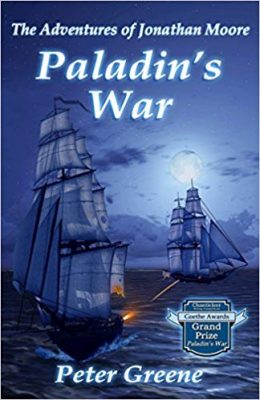
 The magic of living in 19th century England comes to life in the early chapters of Peter Greene’s delightful, but also exciting, story—with British Navy Midshipman Jonathan Moore and daughter of the Governor of the Bahamas, Delain Dowdeswell, enjoying the fashionable new treat of ice cream, then joining their friends and family members at the boat race in Dover on a beautiful day. Granted, that wasn’t how everyone lived, and even these special few lived daily lives far less comfortable than do most ordinary people today. But they didn’t know that.



 The CHATELAINE Book Awards recognize emerging new talent and outstanding works in the genre of Romantic Fiction and Women’s Fiction. The Chatelaine Book Awards is a genre division of Chanticleer International Book Awards and Novel Competitions ( The #CIBAs).