The CHAUCER Book Awards recognize emerging new talent and outstanding works in pre-1750s Historical Fiction. The CHAUCER Book Awards is a division of the Chanticleer International Book Awards (The CIBAs).
The Chaucer Book Awards competition is named for Geoffrey Chaucer the author of the legendary Canterbury Tales. The work is considered to be one of the greatest works in the English language. It was among the first non-secular books written in Middle English to be printed in 1483.
Chanticleer International Book Awards is seeking for the best books featuring Pre-1750s Historical Fiction, including pre-history, ancient history, Classical, world history (non-western culture), Dark Ages and Medieval Europe, Renaissance, Elizabethan, Tudor, 1600s, we will put them to the test and choose the best among them.
These titles have moved forward in the judging rounds from SLUSH pile to the 2019 CHAUCER Book Awards LONG LIST. These entries are now in competition for 2019 CHAUCER Shortlist. The ShortListers’ works will compete for the Semi-Finalists positions. Semi-Finalists will be announced and recognized at the CAC20 banquet and ceremony. The First Place Category Winners, along with the CIBA Division Grand Prize winners, will be selected from the 16 CIBA divisions Semi-Finalists. We will announce the 1st Place Category winners and Grand Prize Division Winners at the CIBAs Banquet and Ceremony on Saturday, April 18th, 2020 at the luxurious Hotel Bellwether in Bellingham, Wash.
These titles are in the running for the SHORT LIST of the 2019 CHAUCER Book Awards for pre-1750s Historical Fiction.Good luck to all as your works move on to the next rounds of judging.
James Conroyd Martin – Fortune’s Child: A Novel of Empress Theodora
Gail Avery Halverson – The Skeptical Physick
William S. Roberts – Hatchepsut, Female Falcon Over Egypt
Susanne Dunlap – Listen to the Wind
JC Corry – The Storyteller’s Reputation
K.M. Pohlkamp – Shadows of Hemlock
E. L. Diamond – The Wolf of God
Linda Cardillo – Love That Moves the Sun: Vittoria Colonna and Michelangelo Buonarotti
Alexander Geiger – Flood Tide: An Epic Novel of the Greek Invasion of Persia
Stephanie Renee dos Santos – Cut from the Earth
Cryssa Bazos – Severed Knot
Kate Murdoch – The Orange Grove
June Hall McCash – Eleanor’s Daughter: A Novel of Marie de Champagne
Michelle Toohey – Dark Madonnas
Catherine Mathis – Death in Coimbra
Patricia J. Boomsma – The Way of Glory
Brianna Nichole – The High Priestess and the Half-Blood Prince
A.L.Cleven – 26.2
C. K. Ruppelt – From Darkness – A Novel of the Ancient Roman World
Alexandrea Weis – Realm
F. Scott Kimmich – The Magdalene Malediction
Susan Heldt Davis – The Mother’s Tale
James Hutson-Wiley – The Sugar Merchant
Vince Pantalone – Incident on the Road to Canterbury
Robert Cole – The Falcons of Gebtu
Anna Belfrage – The Cold Light of Dawn
Which of these works will move forward in the judging rounds for the 2019 Goethe Book Awards for post-1750s Historical Fiction?
The 16 divisions of the 2019 CIBAs’Grand Prize Winners and the Five First Place Category Position award winners along with recognizing the Semi-Finalists will be announced at theApril 18th, 2020 Chanticleer International Book Awards Annual Awards Gala,which takes place at the Chanticleer Authors Conference that will be held in Bellingham, Wash.
We are now accepting submissions into the 2020 CHAUCER Book Awards for pre-1750s Historical Fiction. The deadline for submissions is June 30, 2020. The 2020 winners will be announced in April 2021.

As always, please contact us at Chanticleer@ChantiReviews.com with any questions, concerns, or suggestions!
What is it about a particular manuscript that makes it interesting to a literary agent (or the agent’s slush pile reader), acquisition editor, or professional reviewer?
While it may take more than a crystal ball to figure out exactly what lit agents and publishing houses acquisition departments want and let alone reviewers, guidance can be had. Line editors do understand what these gatekeepers want to see and, perhaps more importantly, what they do not want to see in a manuscript.
Advice from line editors can be an author’s first line of defense in climbing out of the slush pile to gaining a gatekeeper’s interest. No crystal ball required.
Jessica Morrell, a top-tier developmental editor for major authors and publishing houses, knows what these gatekeepers are seeking along with what makes them cringe.
Editors, agents, and reviewers are word people, most were English or journalism majors in college and have a great love and respect for the written word. They will notice your level of craft within the first sentences, so your efforts must be polished, vivid and exceptional.
Craft Tips & Techniques by Jessica Morrell, Editor
(with Added Comments, from Kiffer Brown, publisher of Chanticleer Reviews magazine)
Your manuscript lives or dies on your opening sentencesand each word must be perfect, precise, and weighted with meaning.
(Most slushers (who work for agents and acquisition departments) do not read past the few pages of a manuscript. Don’t blame them for not reading more of your manuscript. Slushers have more works than they can possibly read in a month but have to slush in a given day. It is the writer’s job, neigh duty, to keep the slusher engaged. Slushers are professional readers who are panning for “gold and gems in the raw.” This system is by design, btw.)
Editors notice and are turned off by passive voice and wimpy verbs.
(Enough said.)
Editors notice when the viewpoint jumps or shifts within a scene.
(This is a pet peeve of professional reviewers—an indication of lack of writing craft and skills.)
Editors notice too much telling (reporting or summary) and not enough showing in all types of writing including essays and memoir.
(A line editor can help with too much telling with comments and questions.)
Editors notice when emotions are announced instead of dramatized.
(Reviewers call this “lazy writing.”)
Editors notice the frequent use of names in dialogue. Generally, leave out names.
(Multiple names, especially names that are similar, are irritating to reviewers. When the reviewer has to make notes about who is whom it had better be for furthering the plot significantly.)
An editor notices sloppy punctuation such as excessive use of exclamation points, quote marks around inner thoughts, improper use of semicolons and ellipsis.
(Reviewers see this as the author not being professional about the work (or his or her writing career) to have it professionally proofed – the most basic type of editing.)
Editors notice protagonists who are not proactive, heroic in some way, and bigger than life. (
Reviewer’s Mantra – Novels are depictions of life without the boring bits.)
Editors notice characters with a limited emotional range and expression.
(One-dimensional character and cardboard characters are uninteresting.)
Editors notice large and small inaccuracies and inconsistencies—when the character has blue eyes on page 23 and green eyes on page 57; when a character drives an old, beat-up, pick-up truck that is inexplicably equipped with airbags; when an animal, plant, or species of any sort is misnamed or shows up in the wrong region of the country.
(Did the author care enough to do the background research for the work? These technical details’ correctness can make or break the construct of a story.)
Editors notice when technical details don’t ring true—such as in a mystery when police don’t follow standard arrest procedure; or when a yacht sinks from a single bullet hole; or explosive materials are used haphazardly. (See comment above.)
Editors notice vague descriptions (plant instead of ivy, a tree instead of oak) and generalities instead of details that bring the reader into a specific time and place.
(Vague descriptions are perceived as lazy writing which is not a reputation that an author would want to be known for.)
Editors notice when writers don’t write for all the senses, especially leaving out smells.
(This is called the white room syndrome and it makes a manuscript about as boring to read as an old school telephone book.)
Editors notice small confusions such as misusing it’s and its, that and which, affect and effect, compliment and complement, lay and lie.
(With tools (apps) such as Grammarly and Grammar Girl, there is no reason for these misuses to occur. Additionally, these basics are covered thoroughly in The Elements of Style, a slim tome that is indispensable writers.)
Editors notice overly long paragraphs and a general lack of white space. Generally, paragraphs are five or six sentences long and as taught in grade school introduce a topic, develop a topic, then conclude or lead on to the next paragraph.
(Edit, delete, cut your word count—as Stephen King says, “Kill your darlings.” The rule of thumb is that most manuscripts can be cut by 20 percent.)
Editors notice a lack of transitions—the words and phrases that announce a change in mood or emotion, time, and place so the reader can easily follow. They also know excess transitions as when you follow your characters across every room and along every sidewalk.
(Use transitions as you would salt and pepper—just enough but not too much. The correct amount of transitional phrases are the hallmark of solid writing.)
Editors notice excess modifiers, purple prose, and too much description. The best writing is lean and economical and every word in every sentence has a job to do.
(Yes! Every word must move the story forward.)
Editors notice a voice that is flat, inappropriate, or boring. Voice, whether it is the writer’s voice in an essay or the viewpoint character or narrator in fiction, must breathe life into the piece and hint at the person behind the words.
(Writing styles can mimick the guests at a cocktail party. There is always the bore who goes on and on and usually in too much detail also. The bore is the one guest who is the least tolerated even more so than the boisterous, the chatty, the tipsy, and even the know-it-all. But everyone loves the one who can tell a good story, or the who has a bit a mystery, and the one who is interested in others and respects others is always invited back. Respect your readers with your writing and your writing will earn respect.)
Chanticleer Editorial Services
Did you know that Chanticleer offers editorial services? We do and have been doing so since 2011.
Our professional editors are top-notch and are experts in the Chicago Manual of Style. They have and are working for the top publishing houses (TOR, McMillian, Thomas Mercer, Penguin Random House, etc.). If you would like more information, we invite you to email Kiffer or Sharon at KBrown@ChantiReviews.com or SAnderson@ChantiReviews.com for more information, testimonials, and fees.
We work with a small number of exclusive clients who want to collaborate with our team of top-editors on an on-going basis. Contact us today!
Chanticleer Editorial Services also offers writing craft sessions and masterclasses. Sign up to find out where, when, and how sessions being held.
Writer’s Toolbox
Thank you for reading this Chanticleer Writer’s Toolbox article.
The Goethe Book Awards recognize emerging new talent in post-1750s Historical Fiction. The Goethe Book Awards is a division of the Chanticleer International Book Awards (The CIBAs).
The Goethe Book Awards competition is named for Johann Wolfgang von Goethe who was born at the dawn of the new era of enlightenment on August 28, 1749.
Chanticleer International Book Awards is looking for the best books featuring Late Period Historical Fiction. Regency, Victorian,18th Century, 19th Century, 20th Century, World and other wars, history of non-western cultures, set after the 1750s, we will put them to the test and choose the best among them.
These titles have moved forward in the judging rounds from SLUSH pile to the 2019 Goethe Book Awards LONG LIST. These entries are now in competition for 2019 Goethe Shortlist. The ShortListers’ works will compete for the Semi-Finalists positions.Semi-Finalists will be announced and recognized at the CAC20 banquet and ceremony. The First Place Category Winners, along with the CIBA Division Grand Prize winners, will be selected from the 16 CIBA divisions Semi-Finalists. We will announce the 1st Place Category winners and Grand Prize Division Winners at the CIBAs Banquet and Ceremony on Saturday, April 18th, 2020 at the luxurious Hotel Bellwether in Bellingham, Wash.
These titles are in the running for the SHORT LIST of the 2019 Goethe Book Awards for post-1750s Historical Fiction.Good luck to all as your works move on to the next rounds of judging.
James Anderson O’Neal – Riley and the Great War
Deborah Lincoln – The Trace of a Bird
Vanda Writer – Paris, Adrift
Louella Bryant – Cowboy Code
Lori Swerda – Star-Spangled Scandal
Kari Bovee – Peccadillo at the Palace
Kari Bovee – Girl with a Gun
Kari Bovee – Grace in the Wings
PJ Devlin – Wissahickon Souls
John Hansen – Out of Necessity
John Hansen – Hard Times
Patricia Suprenant – Journey to the Isle of Devils
GS Johnston – Sweet Bitter Cane
Mike Van Horn – Neil Down: A Shot at Immortality
Lee Hutch – So Others May Live
Lucinda Elliot – The Peterloo Affair
Mike Jordan – The Runner
Lisa Braver Moss – SHRUG: A Novel
Melissa Koons – Orion’s Honor
Marina Osipova – How Dare The Birds Sing
Sandra Wagner-Wright – Two Coins: A Biographical Novel
J.G. Schwartz – The Pearl Harbor Conspiracy
Marilyn Pemberton – The Jewel Garden
Rebecca Rosenberg – The Secret Life of Mrs. London
Which of these works will move forward in the judging rounds for the 2019 Goethe Book Awards for post-1750s Historical Fiction?
The 16 divisions of the 2019 CIBAs’Grand Prize Winners and the Five First Place Category Position award winners along with recognizing the Semi-Finalists will be announced at theApril 18th, 2020 Chanticleer International Book Awards Annual Awards Gala,which takes place at the Chanticleer Authors Conference that will be held in Bellingham, Wash.
We are now accepting submissions into the 2020 Goethe Book Awards for post-1750s Historical Fiction. The deadline for submissions is June 30, 2020. The 2020 winners will be announced in April 2021.

Anyone who has fantasized about what it would be like to be a time traveler or have had a strong desire to put on a thinking cap then solve a puzzling murder might well find both of these wishes fulfilled vicariously through Keith Tittle’s début novel, Drawn Back.
Set in Portland, Oregon, this tale of greed, corruption, ruthless murder and love that spans many decades shifts back and forth between 1929 as the stock market crash approaches and the much-less calamitous year of 1991.
A dreadful murder takes place at the beginning of the novel to kick off the action in 1929; a preamble of what’s to come. Fast-forward to 1991 as Professor Patrick O’Connell is just beginning his tenure at Portland State’s history department, with a wage that’s not quite a living wage and a desire to find a place to live while he grades papers and contemplates his failed marriage. The answer comes sooner than expected when he meets the beautiful and charming Rachel Wirth, whose wily grandmother, Julia, insists that he move into her family home gratis instead of paying rent.
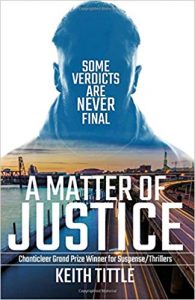
In his 10-Question Author Interview, Tittle admits that his approach to storytelling is strongly influenced by his love of movies from the 1930s and ‘40s – and a very good influence indeed. Tittle weaves a solid who-dun-it character-driven story, a multifaceted mystery incorporating elements of romance and time-travel. Despite the need for one more editorial pass, Drawn Back invites the readers to “…explore its characters’ motivations and morality in the darkest of circumstances.” A Matter of Justice, the author’s second title won the CIBA 2016 Clue Awards for Mystery and Suspense novels.
Unable to truly comprehend his newfound luck with these two remarkable women, O’Connell wanders about the otherwise empty house (both women live elsewhere) and literally steps back into the same dwelling 62 years earlier and becomes the sole witness of a well-planned murder. Then, by intervening with a critical piece of “placed” evidence, the wheels are set in motion for an incredible journey through time where any wrong move by the “guest” could have disastrous ramifications in the future yet to come.
Tittle delivers a most believable narrative that finds its focus around corporate greed, villains who are willing to do whatever it takes to “win,” and two women who are waiting for their hero to uncover the truth.
The question becomes, can our hero right the wrongs of the past without destroying the future? Readers will delight in the answers.
Welcome to Lyon, France, circa 1193. Battle-hardened veterans, returned from the Third Crusade, serve as loyal guards and spies for wealthy merchants. Some have crossed into the world of the bourgeoisie.
Across Europe, monarchs are restless, the Church is ruthless, and trade is flourishing, bringing in rare, sought-after commodities from faraway markets, and fueling cutthroat competition in the burgeoning economy.
In Guillaume: Book Two of The Triptych Chronicle, Prue Batten reimagines the life of one such upwardly mobile trader/merchant who lives in this socio-political chrysalis and is unwittingly caught up in issues and events that will change the future.
Guillaume de Gisborne is an archer recently returned from the Third Crusade. He helps manage de Clochard, a small textile house struggling to survive after the death of its founder. When an arson fire threatens the property and merchandise of this already struggling business, Guillaume keeps watch over the premises and the prized, purple-dyed, velvet and fine wool fabric from Al-Andalus that is slated to go to the Holy Roman Emperor. During the night, he is attacked by strangers who are searching for something on the property.
Subsequently, Guillaume learns that a copy of the heretical Vaudès Bible, which the Church wants to destroy, may very well be hidden somewhere on the de Clochard premises. This is, perhaps, what the assailants were seeking.
Guillaume, assisted by Ariella Ben Simon, the beautiful Jewish daughter of a textile merchant in Venezia, and several of Sir Guy of Gisborne’s most trusted guards, seeks to find the book hoping to save it and return it to its rightful owners, the Poor Men of Lyon, proponents of the Vaudès’ dogma.
While working together, Guillaume and Ariella learn to understand, rely upon, and eventually love one another. They begin to plan their future—but Destiny has something else in mind.
After getting through the prologue and a long, (9,293 word) first chapter, the pace never slows. The amount and complexity of information included in chapter one may seem overwhelming, but the reward of gaining powerful knowledge that will enable the reader to relate to and understand Guillaume’s world is simply indispensable.
Overall, Batten’s rich sensory imagery, engaging characters, and authentic voice, combined with meticulous research and attention to detail add depth and dimension to a cleverly crafted, multi-layered plot. The writing is both gritty and lyrical, creating a moving, memorable story.
But wait! There’s more! Batten’s research notes at the end of the book are an absolute gift for history buffs and historical fiction fans.
Guillaume (The Triptych Chronicle, Book Two) by Prue Batten won 1st Place in the CIBA 2017 Chaucer Awards for Early Historical Fiction.
In the days when piracy was the number one concern for seafaring merchants, ships were built with one purpose in mind—to repel attacks from pirates. It was thought that a floating fortress, and a crew as ruthless as those they faced, could protect the cargo stashed in the cavernous holds.
Painting by Ambroise Louis Garneray
Bristling with cannons, the Spanish and English galleons were thought to be untakable. The pirates soon convinced them otherwise, but by the time news reached the merchant houses in both nations, ships had been lost or commandeered, and their own guns turned on newly arriving ships. Soon, the pirates had captured so many ships, their flotillas outnumbered those of their prey.
Human beings were treated and traded as cargo, just as gold or silk, sugar or tea. All were equally valued by pirates, as booty for gain.
The island of Jamaica is just one example of a place that was populated by the pirate trade. The proceeds of piracy were traded on the market until the pirated cargo could no longer be traced to the stolen goods.
Today, books are stolen, given a new title and a new cover, and then resold in the publishing industry’s market place.
Our book baby is all grown up, just waiting to be stolen away by nefarious means, and resold on some island (read market), not of our choosing. How can we, the merchant owner of our books, protect our damsel/damoiseau in distress? How can we keep the pirates from raiding our ships, and stealing our coin?
According to Investopedia “blockchain is a distributed, decentralized, public ledger.”
The block is made up of three distinct structures.
The first aspect is that the block stores information about transactions, such as the dollar amount of a purchase, and the date and time it was purchased. This information is recorded in a ledger contained within the block.
The second aspect is that the block records the ‘who’ of the transaction. It keeps a record of the purchaser as a digitally encrypted signature, which is a permanent entry on the ledger.
The third aspect is that the block records each transaction as a unique feature called a hash. Every transaction within the block has its own unique coding. No two are alike.
Why is this relevant to your damsel/damoiseau in distress, you ask?
The biggest risk factor, to the distribution of any form of electronic art, is piracy. That is the ability for that work to be stolen. The oceans of digital publishing are ripe with pirates, who are happy to steal any e-book at any time.
But they don’t even need to go that far. We practically invite the pirates to steal our work, any time we give away or sell anything on the internet because there is nothing protecting the digital rights of that book. A few words of copyright in a manuscript do nothing to prevent your work from being reproduced in any currently known format, anywhere on the planet.
Once that book is “out there” there is no getting it back. Bye, bye, sweet damsel! Dare I say it again? Not to be outdone, you send cease and desist emails to every site that has your book baby illegally uploaded for sale. Of course, they ignore you. The pirate’s code trumps all.
Blockchain.
Digitalizing your book into blocks of code, blockchain has the power to prevent your work from being stolen. That pirate ship on the horizon will smack into a reef, impossible to cross. They may try to lob a few cannon shots at your ship, to no avail.
Book Pirates be Foiled!
The only way to get to your book IS TO PAY FOR IT. Isn’t that wonderful? What a novel concept, actually being paid for your work.
“But…what will keep them from reselling it once they have a copy?” you ask.
Ah, good question. Because blockchain is an encrypted source file, your entire book is encrypted. To access that work, you must have a key, a token, to unlock it. But the token can only be used by the purchaser. It will not work for anyone else. Web-based, blockchain books are read in browsers. Currently, this means that an internet connection is required. The book is owned by the purchaser, but it still exists virtually.
A book published in blockchain cannot be copied, resold, or redistributed in any manner. It can only be read by the purchaser, using the token given to them on purchase.
Other advantages to blockchain include being able to create digital limited editions, with serial numbers attached to them to confirm they are truly limited additions. These unique books could contain anything from visual and audio art and files, interviews, etc. Anything that can be digitalized, could become part of this unique format.
So, a book in blockchain cannot ever be resold?
Ah, well that power is in your control. As the owner of the rights to distribution (by virtue of it being block chained) you can authorize a book to be resold, under rights and terms that you set. For example, let’s say that a customer bought a $50.00 limited edition from you. You could make it part of the blockchain code that resales are permitted, but that 50% of every resale comes to you. The blockchain, because of the unique coding attached to the original transaction, will know that it is that exact copy being resold and enforce the 50% deposit to your account when the transaction occurs.
If this is such a wonderful technology, why isn’t everyone using it?
Blockchain first came into being in 1991. As with all new technologies, it has to be tested and tried, before becoming mainstream. As it moves into its third decade of existence, the world of commerce is paying attention. Start-up companies, such as Bookchain, are cropping up and will be the wave of the future. As more and more of these types of companies appear in the market place, the retail organizations will be forced to adopt the technology.
I see pressure coming from the big five publishing houses, as they look for better ways to protect their investments.
Blockchain Could Put Authors At Center of Publishing Universe
The Alliance of Independent Authors (Chanticleer Reviews is a vetted partner member of ALLi) agrees:
“If this decentralized technology fulfills its promise, the outcome could be a creator-led publishing industry.
While indie authors, and the companies that serve them, are a growing presence and power in publishing, large corporate intermediaries such as Amazon still stand between authors and their readers and dominate the self-publishing marketplace. Blockchain tech may help to build the road that leads to true independence for self-publishers.” April 2018 – London Book Fair
Change comes with a cost, and the big retailers will be reluctant to embrace such technologies, as they make money off of the pirates as surely as those island ports of old. Change will have to be forced on them.
E-book piracy can be combated, we only need the sword of technology in hand and move forward.
Read the first two articles of this series by Susan Faw by clicking the links below:
Piracy—Not Just on the High Seas Part 1 of 3 by Susan Faw
The Dante Rossetti Book Awards recognize emerging new talent and outstanding works in Young Adult Fiction. The Dante Rossetti Book Awards is a genre division of the Chanticleer International Book Awards (#CIBAs).
Named in honor of the British poet & painter Dante Gabriel Rossetti who founded the Pre-Ralphaelite Brotherhood in 1848.
Chanticleer International Book Awards is looking for the best books featuring stories of all shapes and sizes written to an audience between the ages of about twelve to eighteen (imaginary or real). Science Fiction, Fantasy, Dystopian, Mystery, Paranormal, Historical, Romance, Literary, we will put them to the test and choose the best Young Adult Books among them for the winners of the Dante Rossetti Book Awards for Young Adult Fiction.
These titles have moved forward in the judging rounds from SLUSH pile to the 2019 Dante Rossetti Book Awards LONG LIST. These entries are now in competition for 2019 Dante Rossetti Shortlist. The ShortListers’ works will compete for the Semi-Finalists positions.Semi-Finalists will be announced and recognized at the CAC20 banquet and ceremony. The First Place Category Winners, along with the CIBA Division Grand Prize winners, will be selected from the 16 CIBA divisions Semi-Finalists. We will announce the 1st Place Category winners and Grand Prize Division Winners at the CIBAs Banquet and Ceremony on Saturday, April 18th, 2020 at the luxurious Hotel Bellwether in Bellingham, Wash.
These titles are in the running for the SHORT LIST of the 2019 Dante Rossetti Book Awards for Young Adult Fiction. Good luck to all as your works move on to the next rounds of judging.
Navya Sarikonda – The Enchanters’ Child
J.A. Roth – When The Bee Stings
Nick Korolev – Jerry Swift and Chiron’s Pride
Leslie Wibberley – Seriously, Universe?
Zachary Ryan – High School Queens
Veronica Myers – Winter’s Progeny
Julieanne Lynch – Beneath the Lighthouse
Jacinta Jade – Change of Darkness
Kelly Watt – The India Diaries: Book One Tiger’s Rock
Alex Paul – The Valley of Death, Book 5, Arken Freeth and the Adventure of the Neanderthals
J. Taylor Baker – The Cardorian Complex
Glen Sobey – No Fences in Alaska
Jan Von Schleh – But Not Forever
Christine Gallagher – Swimming Without Goggles
Samantha Long – Hopelessly Devoted
Michelle Rene – Manufactured Witches
Nancy Thorne – Victorian Town
Ted Neill – Jamhuri, Njambi & Fighting Zombies
Rachel VanZandt – Return of the Eagle
Thomas Corrigan – Right Now Is Worth It
A. Cort Sinnes – Quicksilver
Leslea Wahl – Where You Lead
C.R. Stewart – Britfield and the Lost Crown
Susan Brown – Twelve
Susan Brown – Catching Toads
J.T. Blossom – The Tunes of Lenore
James M Roberts – The Crossroads of Logan Michaels
Michael R. French – Beginner’s Guide to Winning an Election
Sandra L Rostirolla – Cecilia
Kristina Bak – Nowever
Zachry Wheeler – Max and the Multiverse
V. A. Givens – Sealed with a Twist
Tom Edwards – The Honourable Catherine
Michael Bialys – The Chronicles of the Virago: Book I The Novus
David Patneaude – Fast Backward
John Middleton – Dillion & The Curse of Arminius
Which of these works will move forward in the judging rounds for the 2019 Dante Rossetti Book Awards for Young Adult Fiction?
The 16 divisions of the 2019 CIBAs’Grand Prize Winners and the Five First Place Category Position award winners along with recognizing the Semi-Finalists will be announced at theApril 18th, 2020 Chanticleer International Book Awards Annual Awards Gala,which takes place at the Chanticleer Authors Conference that will be held in Bellingham, Wash.
We are now accepting submissions into the 2020 Dante Rossetti Awards Book Awards. The deadline for submissions is May 31st, 2020. The winners will be announced in April 2021.
The GERTRUDE WARNER Book Awards recognize emerging new talent and outstanding works in the genre of middle-grade readers, fiction and non-fiction, that compel children to read and explore. The Gertrude Warner Book Awards is a division of the Chanticleer International Book Awards (CIBAs).
Named in honor of the author of the quintessential children’s series – The Boxcar Children, Gertrude Warner.
Chanticleer International Book Awards is looking for the best books featuring stories of all shapes and sizes written to an audience between the ages of about eight to twelve. Science Fiction, Fantasy, Mystery, Paranormal, Historical, Adventure we will put them to the test and choose the best Middle-Grade Books among them.
These titles have moved forward in the judging rounds from SLUSH pile to the 2019 Gertrude Warner Book Awards LONG LIST. These entries are now in competition for 2019 Gertrude Warner Shortlist. The Short Listers will compete for the Semi-Finalists positions. The Semi-Finalists will be announced and recognized at the CAC20 banquet and ceremony. The First Place Category Winners, along with the CIBA Division Grand Prize winners, will be selected from the 16 CIBA divisions Semi-Finalists. We will announce the 1st Place Category winners and Grand Prize Division Winners at the CIBAs Banquet and Ceremony on Saturday, April 18th, 2020 at the luxurious Hotel Bellwether in Bellingham, Wash.
These titles are in the running for the SHORT LIST of the 2019 Gertrude Warner Book Awards for Middle-Grade Readers. Good luck to all as your works move on to the next rounds of judging.
Carolyn Watkins – The Knock…a collection of childhood memories
Joyce Major – The Orangutan Rescue Gang
Nancy McDonald – Boy from Berlin
Veronica Myers – Flight of Maldar
Jason Otis – Monkey and Moose & the Pirates of Pine Point
B.L. Smith – Bert Mintenko and the Serious Business
B.L. Smith – Bert Mintenko and the Minor Misdemeanors
Jason Colpitts – Corrine and the Underground Province
Mobi Warren – The Bee Maker
Amber L. Wyss – Phoenix Rising
Wendy Leighton-Porter – The Shadow of the Tudor Rose
Sue Bough – Norman Snodgrass Saves the Green Planet
Kit Bakke – Dancing on the Edge
M.J. Evans – PINTO!
M.J. Evans – The Stone of Wisdom – Book 4 of the Centaur Chronicles
Beth Stickley – Tarnation’s Gate
Lis Anna-Langston – Maya Loop
T.X. Troan – Sophia Freeman and the Mysterious Fountain
Lexi Rees – Eternal Seas
Rachel VanZandt – P.J. O’Breslin’s Pirate Journey
Catherine Mallette – Don’t Ask Me
Wendy Leighton-Porter – The Shadow of the Volcano
O’Dempsey Rynehart – The Seeds of Stone (A Sliver of Dark and Bright Series #1)
Diane Rios – Return of the Evening Star
C.R. Stewart – Britfield and the Lost Crown
Kay M. Bates’ – ‘B’ is for Baylee
Alexander Usher – Katie Hope: Blood Bonds
Susan Brown – Sammy and the Devil Dog
Wendy Leighton-Porter – The Shadow of the Pyramid
R. B. Maxwell – The Invisible Agent
Rey Clark – Legends of the Vale
Francis B. Glad – Ernie Germy Jenkins
L.S. Barron – Harper T and the Timewave
Maria Ashworth – SUSHI KITTY
Gregory Saur – Diving Catch
Liana Gardner – 7th Grade Revolution
Liana Gardner – The Journal of Angela Ashby
Jeff Orlowski – Avery Green And The Nightmare Busters
L.M. Kemp – Skye’s Journey
Trayner Bane – Windhollow and the Axe Breaker (Windhollows, Book 3)
Leanne M. Pankuch – Dragon’s Truth
Alex Paul – The Valley of Death, Book 5, Arken Freeth and the Adventure of the Neanderthals
Which of these works will move forward in the judging rounds for the 2019 Gertrude Warner Book Awards for Middle-Grade Readers?
The 16 divisions of the 2019 CIBAs’Grand Prize Winners and the Five First Place Category Position award winners along with recognizing the Semi-Finalists will be announced at theApril 18th, 2020 Chanticleer International Book Awards Annual Awards Gala,which takes place at the Chanticleer Authors Conference that will be held in Bellingham, Wash.
We are now accepting submissions into the 2020 Gertrude Warner Awards Book Awards. The deadline for submissions is May 30th, 2020. The winners will be announced in April 2021.
Salem Grimes has a lot of goals – lose more weight than her friend Trisha, find a dress for the upcoming date she doesn’t really want to go on, and keep her dog, Stump, from throwing up on the kitchen floor. Unfortunately, solving a murder (again) isn’t on her to-do list, but Salem is thrown into another mystery completely against her will when she sees a body in a Sonic dumpster.
When her BFF Viv, an 80-ish firecracker of a woman with a penchant for expensive shoes, hears about it, she can’t wait to get started cracking the case. After all, she and Viv have already solved one mystery, and Viv is convinced their unofficial PI firm, Discreet Investigations, can find the murderer. But the ladies quickly realize they have their work cut out for them when the victim is identified as CJ Hardin, golden boy physician and local Hope for Homes organizer who recently “came out” in a very public way and stirred up a huge controversy in Lubbock, Texas.
Controversy and theories swirl since CJ was thought to have run off days earlier with the $200K in funds from a recent Hope for Homes fundraising effort. When the murder is labeled a hate crime, Salem, Viv, and their newest partner Dale find themselves in some scary situations, including an altercation with Rambo the fighting rooster. Between being laughed at by one hot police detective she’s had crushed on since fourth grade, fighting her urge to drink herself “cool” in order to keep from throat-punching Dale, Salem has to find a killer before the community implodes.
The struggles of the LGBTQ community are front and center in this novel. CJ, the murdered man, is a victim before he is the victim. CJ has spent his life as so many LGBTQ people have, playing a role, pretending to be something he is not in order to fit the required societal mold. The son of a prominent family, a prestigious doctor in his own right, and the perfect fiancé to a woman he has always been expected to marry, CJ never truly got to live his life in his own way. Not long after being caught in a passionate embrace with a man, CJ is more or less forced to come out in a very public way and then he is murdered, labeled another casualty of hate, and though his murder doesn’t quite turn out so cut and dry, his story is nonetheless tragic.
A Christian novel highlighting the struggles in the LGBTQ community is an anomaly, and Kim Hunt Harris expertly handles the issues smartly by placing them front and center in her lead character’s lap. Salem feels a strong connection with the LGBTQ message boards she studies after being swept up in CJ’s death. She understands the dark loneliness of never fitting in, of being a victim of abuse, and of hiding what she truly is, burying her true self.
Damaged by a selfish, abusive mother, Salem is determined not to let that define her anymore. After ten years of drowning her feelings in booze, she has found her footing in Christianity, but she is confused about her feelings, uncertain how to reconcile her blossoming faith with the reality around her – what she thinks and feels about the LGBT community around her.
Salem’s story is one of redemption – hers and everyone else’s. She wants to be a person who can look herself in the eye, and she fights daily to become that very person.
Through common sense, humor, and her daily prayers in her self-made devotional room (aka the guest bedroom in her trailer at Trailertopia), Salem navigates the world in a “human” way. She struggles to justify God’s love with the church’s condemnation against homosexuality. She struggles against her complete dislike of Dale with the Biblical edicts of patience and kindness. She struggles with wanting to feel God’s presence in her life versus her all too real feelings of pettiness and anger.
Salem’s battles aren’t black or white, right or wrong. She’s human and that’s why we like her so much. She understands that “contempt and disrespect for another person’s most precious beliefs” don’t make the world a better place.
Unsightly Bulges (A Trailer Park Princess Cozy Mystery Book 2) by Kim Hunt Harris took home 1st Place in the 2017 CIBA M&M Awards for Mayhem and Mystery.
The boldness of the ideas contained within this novel about cloning begins with its title. The word “apotheosis” can be freely translated as 1.a. the perfect form or example of something, 1.b. the highest or best part of something, or 2. elevation to divine status. (Merriman-Webster Online Dictionary). It is with these expectations that the book begins with a letter from John Numen, who tells us from the beginning that he is unapologetically a multifaceted scientist, medical researcher, doctor, billionaire investor, a fugitive on the FBI’s Most Wanted list, and a fledgling serial killer.
We believe him.
Numen’s trajectory from a scientist to a reclusive but fiendish killer with infinite financial resources is quite the tale. Human cloning is his obsession. He believes he has developed the science to make it easy and practical despite its medical and scientific, legal and ethical challenges. As he progresses decades into the future, he plans carefully for the lifespan he needs and the facilities he requires to develop his ideas into practical tools. He has the resources to do both and gives us a front-row seat on the often-murderous details involved in how he accomplishes his goals, whether it be on his private island in the Caribbean or at his Colorado estate.
What distinguishes Numen from many other mad scientists is his portrayal as a human being. He is as capable of loving as he is in murdering. His descriptions of both give this read a humanity most welcome in the sci-fi genre. In particular, his love affair with the wife of a business colleague and its tragic ending lend a dramatic sensibility that sci-fi books rarely achieve.
For more than half the book, the potential for it becoming the basis for a long-form television mini-series virtually leaps off the page. Then the story seems to wander a bit, shifting the point of view from Numen to a female kickboxer with dreams of MMA championships and the moxie to carry it out. Fast action sequences and brutal punches make for a great diversion.
What Darrell Lee delivers is a fast-paced thriller with a lot of tendrils that are likely to snatch readers up and keep them in the chair, a well-drawn mad scientist with a sexy kick-ass femme fatal, and an interesting story that may stay with you for a while.
All in all, we expect The Apotheosis will indeed find its fan-base among those who love fast-paced, unapologetic sci-fi thrillers.