Author: A Lock

  • JERKWATER by Jamie Zerndt – Native American Fiction, Friendship Fiction, Ethnic & Regional Fiction

    JERKWATER by Jamie Zerndt – Native American Fiction, Friendship Fiction, Ethnic & Regional Fiction

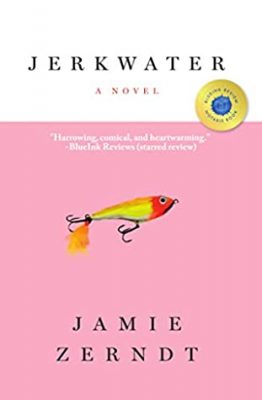
    Blue and Gold Somerset First Place Winner Badge for Best in CategoryThree friends in Mercer, Wisconsin find ways to deal with their problems amid a racist town in Jamie Zerndt’s Jerkwater.

    Shawna Reynolds’ life changed when her white stepdad murdered her Ojibwa mother. Now living with her Naan (grandmother), Shawna surrounds herself with those who make her feel most comfortable. Besides Naan, she clings to her horse Seven, her behind-the-scenes Ojibwa boyfriend Elmer, and two white friends: Kay O’Brien and her son Douglas. But racial tension cuts through the town of Mercer itself, galvanized by a fight over fishing rights.

    Soon after the death of her husband Norm, sixty-four-year-old Kay O’Brien learns that she nears the late stage of Alzheimer’s disease. Norm’s sudden demise shocks her and Douglas to the point that she withholds her recent diagnosis from him. Kay has a few church-lady friends, but feels closest to Shawna, spending time together drinking foul-tasting Manhattans. Shawna divulges that she’s been accepted into veterinary school, and in turn, Kay discloses her Alzheimer’s.

    Douglas, who blames himself for his father’s death, takes over his dad’s unstable car repair business more out of guilt than aptitude. However, amongst the apparent doom and gloom of their lives, Shawna connects with animals, Douglas develops his art, and Kay still has enough wits about her to create positive change.

    The three friends share something vital: they understand pain.

    Each one struggles with their own unresolved issues: Shawna, anger over her mother’s death; Kay, health problems and the loss of her husband; and Douglas, caught between guilt and his desire to be an artist.

    Jenna, a newbie who runs a hippish coffee house in town, takes an immediate interest in Douglas and his artwork. In the meantime, Kay discovers Norm’s poems written to a secret French love. But this upsetting news gets lost in the “Alzheimer” translation. She believes herself to be the secret love and takes off on Seven, babbling in nonsensical French. Although the situation is nothing less than strange, the friends have no idea that this bizarre moment will initiate a flurry of unforgettable and life-changing events.

    Raconteur extraordinaire Jamie Zerndt produces a witty yet moving story of friendship.

    Alternating his latest novel between three third-person narratives, Zerndt weaves in the local information about the Ojibwa and their constant fight with racist fishing rights in the highly-populated white town of Mercer, Wisconsin. Zerndt paints a convincing and visceral picture of emotion through his principal cast on many levels: low self-esteem, depression (leading to alcoholism), anger, and fear. His characters stay grounded, unremarkable, and relatable, especially Kay who struggles with the fact that she has no control of her mental state – something the older generation dreads.

    Undoubtedly, sadness abounds from one page onward. But so does humor, love, and tenderness.

    The humor arrives in darkness and sarcasm, as the characters face death and hate coming from a town dripping in racism. Sometimes, you have to laugh at pain in its face, and that’s precisely what Shawna, Kay, and Douglas do. Love unfolds awkwardly as an escape for Shawna and as a revelation for Douglas. Religion also comes into play as Kay bounces her thoughts of God between her relationship to the Catholic church, the church ladies she chums with, and a hippish priest who offers his services in an unorthodox way.

    While chapters close on cliffhangers and tension builds with each character, Zerndt offers very little in the way of clues to the story’s apex. Instead, he uses the element of surprise, which allows readers to experience the depths of Shawna, Douglas, and Kay in ways they may not think possible.

    Kudos to Zerndt for a brilliant literary work! Jerkwater is an absorbing read from beginning to end.

    Jamie Zerndt’s Jerkwater won 1st Place in the 2019 CIBA Somerset Book Awards for Contemporary and Literary Novels.

    5 Star Best Book Chanticleer Reviews round silver sticker

    Somerset Literary and Contemporary Chanticleer International Book Awards 1st Place Winner oval Gold Foil sticker


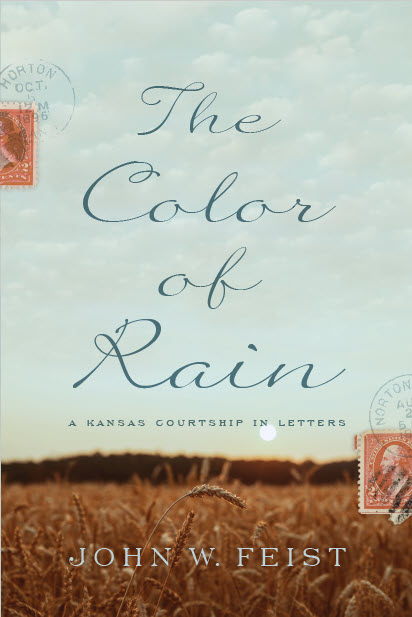
  • The COLOR of RAIN: A Kansas Courtship in Letters by John W. Feist – Family Saga 19th Century, Love Story in Letters, Family History

    The COLOR of RAIN: A Kansas Courtship in Letters by John W. Feist – Family Saga 19th Century, Love Story in Letters, Family History


    Author John W. Feist unfolds a true-love story, old-fashioned letter style, in his historical romance novel, The Color of Rain: A Kansas Courtship in Letters.

    Three and a half years pass before Irene Webb, a college-educated schoolteacher, hears about the beloved Wilson family she stayed with as a boarder, caring for Harold and Wallis, their two sons. But the news sent to her in August of 1896 is not good; Allie, Frank’s wife, unexpectedly dies. “I realize this is no time for letters,” Irene writes to him before expressing her most profound condolences. Formalities aside, the letter sparks renewed friendship, and the two Kansas friends begin exchanging letters regularly.

    A handsome, well-respected local banker and now eligible bachelor, Frank Wilson, is nothing less than a hot ticket item with “the path to [his] home … a pilgrimage for unmarried women bearing casseroles.”

    While the attention is encouraging, he’s not interested in finding a replacement for Allie right away. Except for Irene. Three months after Allie’s death, Frank makes the day trip via two trains from Horton to visit her at her parents’ farm in Nortonville—a mere half-hour drive with today’s modern conveniences. Thus, a long-distance courtship commences.

    Frank and Irene remain busy people – his with banking, and Irene (the oldest of seven children) cares for her ailing father and holds down the fort of the large Webb household. The two lovers keep to weekly letter-writing since they barely have the chance to see each other, especially when trials and tribulations convolute their individual lives. Irene cannot imagine the issues she must confront, including an enticing school principal offer, as she contemplates marriage.

    Rising author, John W. Feist, utilized his storytelling skills to bring a love journey to life.

    The benefactor of his grandparents’ courtship correspondence, Feist saw an opportunity to go back in time and recreate what “dating” looked like near the turn of the twentieth century. It’s difficult to imagine the formalities behind courtship, let alone women succumbing to patriarchal ties. But that was not necessarily the case with Feist’s grandparents.

    If Irene wasn’t the intellectual she was, she might have balked at Frank’s direction toward marital preparation. Instead of following through with the usual romantic proposal, Frank gave her Orson Squire Fowler’s groundbreaking Creative and Sexual Science to read and for them to discuss. To his delight, she took up the challenge. Although the hefty read might have carried an undercurrent of male domination, what made it revolutionary was Fowler’s eye-opening stance that husbands and wives should be considered equals, an ideal Frank had with Allie and hoped he’d have Irene.

    Of course, there is so much more to Frank and Irene’s relationship.

    The Color of Rain: A Kansas Courtship in Letters goes beyond recording a family legacy; it is a human-interest story. Feist’s rich writing style stitches historical details, providing a seamless flow from letters-writing to narrative sections that capture everyday life’s realities amid unsettling times. Concerns over Indian Territory and Negro Freeman allotments (which Frank was involved in as a banker) and contracting diseases like malaria and typhoid (both Irene’s mother had, eventually dying from the latter) are two prime examples.

    The Color of Rain: A Kansas Courtship in Letters is a must-read for all, especially history aficionados.


    5 Star Best Book Chanticleer Reviews round silver sticker

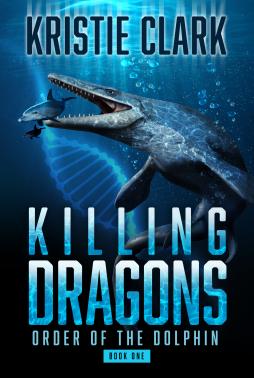
  • KILLING DRAGONS: Order of the Dolphin, Book One by Kristie Clark – Environmental Thrillers, Navy SEAL Dolphins Sci-fi, Human-Animal Communications Thrillers

    KILLING DRAGONS: Order of the Dolphin, Book One by Kristie Clark – Environmental Thrillers, Navy SEAL Dolphins Sci-fi, Human-Animal Communications Thrillers

    A search for the truth behind Lusca, the legendary sea dragon, leads to areas far more menacing than a mere myth in Kristie Clark’s Killing Dragons: Order of the Dolphin.

    Eva Paz is a doctorate-level marine biologist at the Roatan Institute for Marine Sciences (RIMS), performing research on whistle-signature spectrograms. Even though Eva believes she’s close to a breakthrough in dolphin-human communication, her statistics may not be enough to keep the grant she needs to continue her work and support her employment at RIMS. Her connection with a petite Atlantic bottlenose dolphin named Taffy, an animal trained by the Navy, and Taffy’s mate, Finn, go back thirteen years during a horrific time in Eva’s life.

    During that time, Eva met Thomas Sternberg, a Navy SEAL diver who changed his career path to a pediatric oncologist. He’s also Eva’s ex-boyfriend. 

    Luis’s mysterious death (boyfriend to Eva’s mother) raises concerns about the welfare of her family since she becomes the sole supporter; holding onto that grant is now a necessity. Even more disturbing is the sizeable conical tooth found near his corpse—a sign to the locals that Luis fell victim to none other than Lusca, the mythological sea dragon.

    Julian Gulliver, a notorious investor, approaches Eva, hoping that she’ll take up his offer to support her research while requesting her assistance to identify a predator that’s been attacking Atlantis, his open-ocean fish farms. Unbeknownst to Eva, Julian hires Thomas as his expert diver for his newly-opened dive shop in the expensive Parrot Tree resort, a legal cover for his illegitimate business transactions. 

    Meanwhile, Taffy’s pectoral fin washes ashore with another conical tooth.

    Heartbreaking as that is, Eva discovers something else. Taffy is pregnant. As Eva’s problems build with additional mysterious deaths and Finn earmarked as the target monster, the last person she expects to have back is Thomas. Danger only heightens when he joins her cause, trying to solve the mystery behind the Lusca myth.

    Rising author Kristie Clark spins a gripping debut that is more fact than fiction. Clark sets her story in Roatan, the largest and most developed of the Bay Islands in the Western Caribbean. Her book opens with a glimpse into the life of Eva Paz—a devoted marine biologist whose research focuses on advanced human-and-animal communication with Navy dolphins trained to locate sea mines—before all things sinister break lose.

    Luis’s horrendous death fosters locals’ belief in the legendary Lusca.

    To Eva, Luis’s demise only sends a reminder of her horrifying past when her brother died. From that point, scenes continually flip from backstories to the present and alternate between protagonists (Eva, Thomas, and even Taffy, the dolphin!) and antagonists (Julian and Ignacio).

    The events in Killing Dragons cover little over seven nail-biting weeks.

    To keep her narrative flowing, Clark employs a variety of literary elements. One is her journal entry style that opens each chapter, which mentally prepares readers for location changes. 

    High on the literary-element chart, though, several unresolved situations among the characters roll from one unsettling scene to the next; add to that, terror continues building as the mysterious monster takes more lives amid the ominous presence of Julian and his minions. If that wasn’t enough, Clark throws one more item into the mix: the slow-burning-sexual tension between Eva and Thomas’s strained relationship.

    Clark skillfully weaves in a flurry of fascinating facts covering everything from environmental issues with the fish farming industry and the reality of tainted fish to the severe effects on humans and the latest treatment in oncology/cancer research. Clark includes incredible advances in marine life research, as well. 

    Brilliantly executed, Killing Dragons undoubtedly whets the literary appetite of those who like their sci-fi thrillers with a bit of sexy in the mix. Clark has no trouble holding her own in the vast field of thriller authors – and readers will be happy to learn the next book in the Order of the Dolphin series may splash on the scene very soon!


    5 Star Best Book Chanticleer Reviews round silver sticker

  • BLOSSOM — The Wild Ambassador of Tewksbury (Audiobook Review) by Anna Carner – Animal Rights, Friendship, Environmental & Naturalist Biographies

    BLOSSOM — The Wild Ambassador of Tewksbury (Audiobook Review) by Anna Carner – Animal Rights, Friendship, Environmental & Naturalist Biographies

    One woman’s encounter with a rescued deer turns into an unanticipated life-changing experience in Blossom — The Wild Ambassador of Tewksbury, the audiobook.
    Author Anna Carner lived in a horse-friendly farming area of New Jersey in 1999, when she encountered a newborn fawn, barely breathing, near her home. The animal seemed to be communicating its need to her, and, with some experience of animal and human care, Carner set out to revive the fawn. She took the baby deer into her house and nursed her back to health. When she and her husband, Pino, saw the fawn curled up asleep with the family dog, the couple knew they had a new pet. Her name, Blossom, seemed suited to her sweetness and soft, gentle beauty.

    Caring for animals was not uncommon nor unfamiliar to Anna, who, with her husband Pino, housed horses and raised alpacas on their property. But bringing in a fawn was different because some community members considered deer a nuisance and hunting a sport to be enjoyed. As Blossom grew, she would venture farther away from home for more extended periods. Anna and Pino circulated “please, don’t shoot Blossom” posters to bring awareness and compassion for not just the friendly deer but for all deer. While many championed Blossom’s safety, others did not.

    Narrator Petrea Burchard breathes life into the audio adaptation of Anna Carner’s captivating and moving memoir. Setting the tone from the get-go, Burchard’s soft, silken voice immediately draws readers in as she deftly prepares the groundwork of bucolic Tewksbury scenes that are mere façades to the danger lurking in its midst. Carner’s memoir functions more like a mystery thriller; its well-balanced mix between the first-person narrative and engaging dialogue and emotional roller-coaster scenes provides Burchard plenty of room to use the full range of her vocal skills.

    Carner’s encounter with Blossom pushes her to recall childhood memories she’d rather leave behind. She can’t since the parallels of victim and rescuer between her present and past are too powerful to dismiss. While much of the story centers on the present, Carner appropriately shifts to disturbing but at the same time thought-provoking moments from her dysfunctional youth. The alterations may not be unusual from a reader standpoint but challenging for a narrator since Carner’s memoir includes a full cast of mostly secondary characters—neighbors, hunters, veterinarians, supporters—many of whom play critical roles in the direction of the story.

    However, from a listener standpoint, three characters besides Anna take the front-and-center stage to shape the narrative. When Burchard morphs into Caruso, the Carner’s opera-loving and chattering parrot, her comical voice provides a definite mood change that lightens the story’s continual underlying tension focused on Anna’s incessant worry that a hunter will take Blossom down. The story’s tenor shifts again with the introduction of children’s voices, particularly Viola, one of the young burn-unit patients whom Anna befriends while in the hospital. Burchard’s attention to narrative details enhances the innocence and compassion as the girls converse with one another, discussing life issues. Lastly, another voice change, when Anna receives phone calls from a creepy stalker. Burchard’s gravelly tone against the terror in Anna’s voice could easily make one think the story was a Stephen King novel; it’s that spine-chilling.

    Audience listening level: Light profanity and sexual references (mainly dealing with animals) make this perfect for middle-graders on up.

    Riveting from beginning to end, Blossom—The Wild Ambassador of Tewksbury audiobook is a powerful story of love, determination, and hope for the betterment of wildlife conservation that won First in Category in the CIBA 2019 Journey Awards for Memoirs and Biographies.  A highly recommended listen!

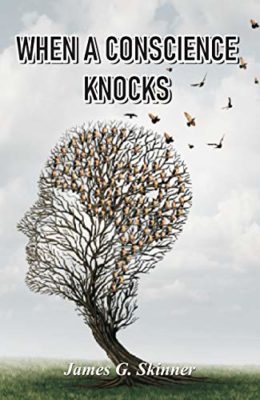
  • WHEN a CONSCIENCE KNOCKS by James G. Skinner – Romantic Literature, Marriage/Relationships, Alzheimer’s disease

    WHEN a CONSCIENCE KNOCKS by James G. Skinner – Romantic Literature, Marriage/Relationships, Alzheimer’s disease

    One woman’s life follows a roller-coaster ride of love, political turmoil, and tragedy in James G. Skinner’s novel When a Conscience Knocks.

    Jenny Robinson enters a confessional and falls apart. Sensing her distress, the Catholic priest encourages her to divulge her story, which she does. In 1976, at the age of twenty-two, Jenny left her hometown of Richmond, England, and took a teaching job in Iran.

    It’s during this time where she meets Juan Miguel Ochoa, a Gallaecian. A diplomat at the Spanish Embassy, Juan is near twenty years her senior. Romance ensues, and within less than two years, Jenny and Juan marry.

    Jenny has no idea what she’s getting into as she blindly trusts Juan’s lead throughout his diplomatic career. During their marriage, Juan’s work takes them to numerous trips through Europe, Central and South America, and the USA amid political tensions, wars, and terrorism. But as they approach their twenty-fifth anniversary, life throws a disturbing curveball. Juan’s erratic behavior heralds the early onset of Alzheimer’s. While Jenny’s life abruptly fills with uncertainty, the last thing she expects is to be involved in an affair.

    New author James G. Skinner opens with a conflicting scene as his principal character, Jenny Robinson Ochoa, confesses to committing adultery. At the same time, her husband slowly succumbs to Alzheimer’s disease in a nursing care facility. What follows in the twenty-plus chapters is the account she discloses to a Catholic priest.

    Jenny’s feelings and thoughts about her husband’s involvement with the chaotic global events surrounding them dominate Skinner’s first-person British narrative. Her continual ponderings, covered within a chronological list of backstories, capture her personality’s development amid the ebb and flow of their marriage, travels, and political upheavals. Conversations between Jenny and Juan focus on explanations of world history and Juan’s diplomatic involvement to a politically uninterested wife. Although the many dialogue scenes that present facts tend to be a bit dry, Skinner does a decent job weaving in historical events.

    As stated in the Dedication, the purpose of When a Conscience Knocks is to provide readers with an example of how Alzheimer’s affects intimate relationships. No one would dispute that Alzheimer’s disease is devastating to both victims and loved ones, and Skinner’s fictional character is not exempt. Rather than placing the debilitating disease front and center, Skinner pivots the attention upon the partner. Indeed, this is a coming-of-age tale—one’s woman’s struggle to find her identity, her voice amid conflict and relational codependency.

    When a Conscience Knocks takes an alternate route, describing the pain and torment those on the sidelines experience when their partners succumb to Alzheimer’s disease’s devastation.


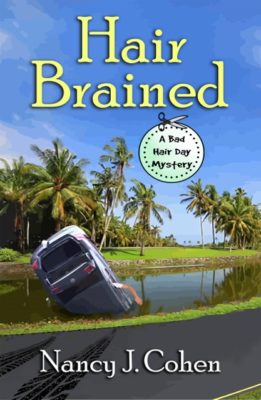
  • HAIR BRAINED: The Bad Hair Day Mysteries, Book 14 by Nancy Cohen – Cozy Mystery, Amateur Sleuths, Women Sleuths

    HAIR BRAINED: The Bad Hair Day Mysteries, Book 14 by Nancy Cohen – Cozy Mystery, Amateur Sleuths, Women Sleuths

    A young infant and a flurry of disturbing information enter Marla’s life in Nancy Cohen’s newest mystery, Hair Brained: The Bad Hair Day Mysteries, Book 14.

    Marla Vail’s expectations of bringing in a joyful and prosperous New Year immediately dwindle when she learns that her friends, Tally and Ken Riggs, have gone missing, leaving Luke, their four-month-old son, in the care of the babysitter. Since Marla is listed as guardian of Luke, she and Dalton, her husband, have no choice but to bring Luke to their home. Marla faces the “great unknown” with a ray of hope that she would be hearing from her friends soon. But that never happens.

    A trip to the hospital confirms Marla and Dalton’s worst fears. A car accident leaves Ken deceased and Tally in ICU and comatose. Now Marla has to find a way of juggling caring for Luke while running her busy hair salon. Amid the abrupt changes under horrific circumstances, Marla has no idea that there is much more behind the car crash, especially when one of Ken’s colleagues is murdered.

    If you haven’t already heard of Nancy Cohen, where have you been? The award-winning mystery author pens unique and fascinating stories about a somewhat underdog mid-thirties hairdresser who has a fetish for detective work. And why not, considering her husband is a police detective? The odd stylist-sleuthing combo makes for fresh and tantalizing reading for a wide-range audience that goes well-beyond mystery aficionados.

    Cohen’s writing style is surefooted, and her characters are vibrant and varied (multicultural, racially mixed), as in Hair Brained, the fourteenth installment of her Bad Hair Day Mysteries series. Marla, Cohen’s featured character, may have had her past set of traumatic situations, but that doesn’t seem to stop her when she senses something awry. A feisty woman-of-action, Marla faces fear trembling but determined to win over dark and seemingly unconquerable conditions even with an infant in her arms. 

    One would think that characters would be commonplace in laid-back Florida, but that’s far from the truth. From warm and caring family members and well-meaning people scarcely eking out a living to an imaginative mix of surly folk, Cohen’s cozy represents folks from various backgrounds befitting amalgamated Floridians. The action builds with a slew of twists, turns, and near nail-biting climactic tension. 

    The hair-raising, fast and delightful cozy mystery, Hair Brained: The Bad Hair Day Mysteries, Book 14 won First Place in the CIBAs 2018 M&M Awards for Cozy Mystery Novels. 

  • SHORT LINE to DEATH by Molly Flewharty – Female Sleuth, Cozy Mystery, Humorous Mystery

    SHORT LINE to DEATH by Molly Flewharty – Female Sleuth, Cozy Mystery, Humorous Mystery

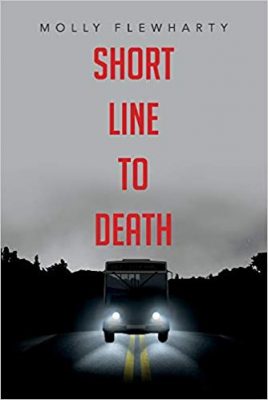
    An upcoming divorcee has no idea that her life is about to change when she gets involved in a murder investigation in Molly Flewharty’s, Short Line to Death.

    Madeline Williams moves from New York to the small town of Cross Keys, Pennsylvania. She hopes the change will do her good since she’s in the throes of a divorce. Madeline decides to take the bus over driving on the long commute to her Manhattan job. Traveling is lonely since she is the new kid on the block among a group of regulars. That changes when Tom Firemark, the handsome owner of The Opossum, sits next to her during their daily trips.

    Madeline and Tom’s growing friendship shifts when they become eyewitnesses to a mysterious murder on the bus, which is the second murder that has occurred in the town over the last few months. Since Police Chief Billy West is over his head trying to solve the first crime, Tom, who has PI experience, takes it upon himself to do his investigations on this newest incident. Because Madeline was an innocent bystander at the scene of the crime, he invokes Madeline to join him in sleuthing.

    Teaming together proves to be better than Madeline imagines as the two become more comfortable with each other amid processing a flurry of possible suspects. But as the puzzle pieces begin to fall in place, Madeline finds herself way over her head. Whether or not she can complete the investigation unscathed remains to be seen.

    First-time author, Molly Flewharty, spins a host of red herrings in Short Line to Death. She pulls from her own experience commuting from Manhattan to Pennsylvania to create the small-town setting and accompanying atmosphere replete with a well-rounded mix of elusive characters. Top on that chart is Roberta Carlson (whose ultimate demise is shocking yet a welcome to those who were tired of her surly disposition) is at the center of Tom and Madeline’s investigation. Now with the most obnoxious person out of the way, sniffing out the murderous culprit may be tougher than the team anticipates.

    Chapters filled with detailed descriptions of various Cross Keys establishments and homes alternate between the police chief’s frustrating search behind the death of the town’s miscreant, Bart Grickly; Tom and Madeline’s investigation; and Madeline’s struggles with her broken marriage and new-found feelings towards Tom.

    Flewharty delivers a tension-filled mystery banquet of suspects ranging from ordinary people with personal problems to those we’re sure “did the deed.”

    Short Line to Death will have mystery fans lined up to see what’s next from Flewharty. Highly recommended.


  • BLIND TRUST by John W. Feist – Political Thriller, Suspense/Thriller, High-Stakes Int’l Thriller

    BLIND TRUST by John W. Feist – Political Thriller, Suspense/Thriller, High-Stakes Int’l Thriller

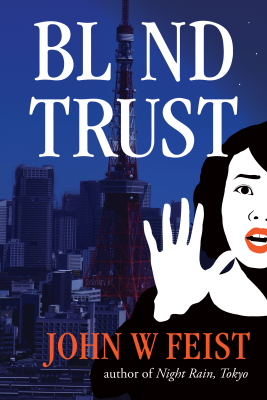
    Brad Oaks and his wife Amaya have no idea what is in store when they answer a call for help from the newly appointed Japanese prime minister in John W. Feist’s second novel, Blind Trust.

    The year is 2022, and a mysterious explosion compromises Japan’s electric grid infrastructure (LNG regasification, to be precise). Yuko Kagano’s election as the next prime minister comes with the hope that she will commit to her campaign promise of restoring Japan’s energy structure. However, she must first deal with the criminal activity associated with the previous leader. She needs help. She calls on Brad Oaks and Amaya Mori, his wife, for advice on pipeline and steel strategies. Amaya especially, as the two women have known one another since college, and both are heirs to familial steel companies, the American Elgar Steel and the Japanese Kanawa, respectively.

    Brad Oaks gave up his lawyer career a few years back after he rescued Amaya when she was abducted due to her connections with her father’s company. The two fell in love, married, and moved to California. Now, Brad is the executive vice president of Elgar Steel (Please refer to John W. Feist’s first novel in the series, Night Rain, Tokyo). Three years later, they receive a call from Eisuke Tanaka, the commissioner of the Tokyo Metropolitan Police, who delivers the message that Yuko requests a meeting with them in Tokyo. The call couldn’t have come in a more inconvenient time. Brad and Amaya are critically assessing a possible new season in their marriage: adoption. Placing their plans on hold, they fly to Tokyo unaware that they will be walking into deadly covert schemes to undermine the prime minister.

    John Feist blazes a path in his approach to geopolitical suspense. Having ventured into Japanese culture via his past professional connections, Feist understands, firsthand, the underlying and ongoing cultural tension that exists between the Japanese and foreigners in the business sector. That said, Feist’s method of storytelling is not Americanized, which usually follows an often dizzying and fast-paced route. Instead, tension builds through innuendo-rich dialogue scenes between characters as he undergirds his plot with realistic aspects of Japanese culture that is rooted in “nativism” (the revival or perpetuation of an indigenous culture especially in opposition to acculturation, Merriam-Webster).

    Feist does an excellent job surrounding Brad and Amaya, his principal characters, with a diverse cast of characters that range from subdued to surly. Each chapter alternates character POVs packed with a handful of red herrings and a plethora of unexpected twists and turns amid political history and the sights, sounds, and smells of a beautiful Asian country.

    Blind Trust is a unique and satisfying Political Thriller that closes on a promising note of a sequel.


  • The TIME TRAVELER PROFESSOR, Book Two: A POCKETFUL of LODESTONES by Elizabeth Crowens – Alternate History/Sci-fi, Time Travel, Steampunk

    The TIME TRAVELER PROFESSOR, Book Two: A POCKETFUL of LODESTONES by Elizabeth Crowens – Alternate History/Sci-fi, Time Travel, Steampunk

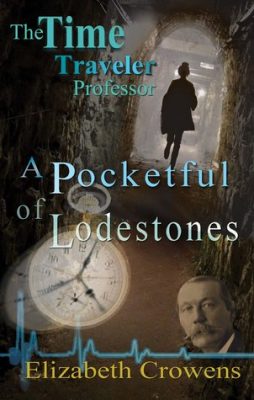
    A musician-turned-time-traveler is in for more than he bargains for during his World War I experiences in book two of Elizabeth Crowens’s The Time Traveler Professor, Book Two: A Pocketful of Lodestones.

    John Patrick Scott volunteers for the Royal Scot Army. His life drastically shifts from one of comfort in Germany to misery in no-man’s-land trenches in Belgium and France. Fortunately, he has in his possession his grandfather’s heirloom timepiece (his time-travel device), his journal, and the mysterious red book, which is the essential item that connected him to Arthur Conan Doyle in the first place. Now separated from the famed author, John uses his middle-of-the-night sentry duty to delve into the metaphysical and psychic world, while Arthur does his time-traveling in hopes of finding the red book.

    Because of John’s prophetic abilities, he is known by his fellow soldiers as a fortune teller and Le Conteur (storyteller); the latter due to the red book’s magic of creating impending tales (often horrific) veiled in allegory. Strange things occur when John begins seeing soldier ghosts, and the name Aliskiya Lleullne, his future self, pops up in various situations, especially among an enigmatic man who goes by the moniker of Benedyct Boniface. A battlefield accident produces more supernatural weirdness for John. After recuperating, he takes on a military-intelligence position in London, where he and Arthur reunite. The two reignite their time-traveling passion, intending to go back to feudal Japan. Instead, they are in for a big surprise when they end up in London’s Elizabethan era.

    Award-winning author, Elizabeth Crowens, opens A Pocketful of Lodestones with an author’s note, explicitly encouraging steampunk readers to read Silent Meridian, book one of the Time Traveler Professor Trilogy, before probing into book two. While Crowens sprinkles aspects of Silent Meridian’s plot, the references are too light and do not offer an in-depth understanding. Thus, her cautionary note warrants merit.

    That said, there is a lot more going on in this novel compared to the first book. Having first-hand experience with the horrors of war, John’s arrogance all but disappears. He spends more time meditating on humanity—focusing on the plight of his military comrades—and less on himself, except unresolved issues from his past and future time travels. John also discovers that his penchant for predicting the future and storytelling acts as a healing balm for his struggling troop.

    A Pocketful of Lodestones is a meal of a read, which will surely satisfy Sherlock Holmes and history aficionados.

    Author, Elizabeth Crowens won 1st Place for her novel in the CIBA 2017 Paranormal Awards.


  • The TIME TRAVELER PROFESSOR, Book One: SILENT MERIDIAN by Elizabeth Crowens – Steampunk, Sherlockian, Time Travel

    The TIME TRAVELER PROFESSOR, Book One: SILENT MERIDIAN by Elizabeth Crowens – Steampunk, Sherlockian, Time Travel

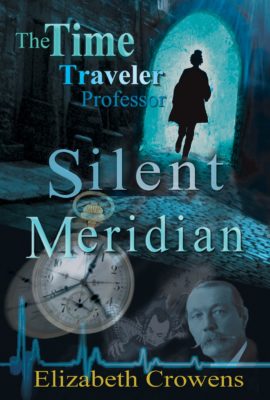
    A budding concert pianist delves into the realms of spiritism, sexuality, and scary foreshadowing through his time travel adventures in Elizabeth Crowens’ steampunk novel, Silent Meridian.

    John Patrick Scott, a conservatory student, meets with Arthur Conan Doyle in Edinburgh, Scotland under unusual circumstances because of an elusive and mysterious red book. Arthur, lacking inspiration and tired of his Holmes character, covertly employs John as a ghostwriter. The two also indulge in the transmigration of souls and time travel. The latter topic is of high interest to the young aspiring musician since he has already accrued a handful of time-travel experiences via a mechanism of his creation. Although Arthur introduces John to nightly practices of communicating telepathically, John doesn’t include the beloved author in his time-traveling adventures until years later.

    John’s time-traveling skills sharpen to the point that he no longer needs his device and uses his grandfather’s timepiece instead. He becomes particularly fixed on exploring his past, especially his school days at the Underground University; he includes Wendell Mackenzie, his old schoolmate, on his adventures—some of which John escapes just in the nick of time. Over time, John finds it difficult to distinguish between time travel and dreams and seeks the help of Sigmund Freud and Carl Jung. His adventures take a dark turn when they predict an impending war.

    Sherlock Holmes’ enthusiast, Elizabeth Crowens, spins a wild tale riddled with glimpses of stories and themes from the early 20th century. Crowens’ quirky narrative, which covers sixteen years, could easily befit behind-the-scenes to John’s ghostwriting connections to Doyle’s published works: The Man with the Twisted Lip, The Adventure of Charles Augustus Milverton, and The Adventure of the Greek Interpreter, to name a few.

    Scenes regularly flip from John’s music studies and his time-travel quests, and are heavily punctuated with references to prominent historical figures and their thematic connections of the era, such as H.G. Wells, J.M. Barrie, Jules Verne (fantasy and sci-fi); Sigmund Freud, Carl Jung (psychology); and Aleister Crowley, Theodore Reuss (metaphysical). While sexual identity plays a close second to the last parenthesized theme scenes, providing only innuendos. John continuously processes his particular leanings, weighing his feelings as a woman in some of his time-travel ventures and amid affairs against Doyle’s and Wells’ free-love beliefs.

    Crowens balances nonfiction with fiction by incorporating memorable characters, such as Whit, John’s annoying tutor, and Finn (who John dubs Sherlock), John’s “Jiminy Cricket” guide who is only visible to John and comes and goes as he pleases. Sure to be a new favorite for Sherlock Holmes’ aficionados, Silent Meridian’s cliff-hanging closure is a perfect segue to the second book in Crowens’ The Time Traveler Professor series, A Pocketful of Lodestones.