Tag: WWII

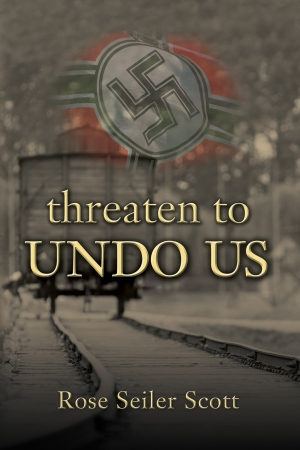
  • THREATEN to UNDO US by Rose Seiler Scott

    THREATEN to UNDO US by Rose Seiler Scott

    Born to an ethnic German family in Poland, Liesel Bauer is raised to appreciate the complex cultural differences of her tight-knit rural farming community. Friendships between families are generational, forged in the spirit of cooperation and extending back for centuries. But when politics turn to war Liesel learns that the bonds of shared lives are easily severed.

    Liesel’s story spans nearly three decades – from the time of the Bolshevik reprisals of 1919 through the aftermath of World War II. Her early years take place during a period of political calm, thus enabling the reader to follow Liesel’s growth from a clever and loving child to shy teen and, ultimately, to a woman who draws strength from both her faith and from her role as wife and mother. It’s with this strength that she will arm herself for the times ahead.

    As Hitler gathers his supporters and builds a case for war, Liesel’s town is cleaved in two. Neighbors lose trust in one another and friendships are dissolved.

    For the thousands of German families that have the foresight to leave Poland, an exodus is set in motion. Knowing no other life, Liesel and her family stay and she shows us that the bravest actions in war are rooted in the routines salvaged from everyday life.

    “Threaten to Undo Us” is a novel rich with meticulous historical detail mined from both primary and secondary sources. From the descriptions of daily farm life and cultural customs to the price that shifting political loyalties exacted on the war’s victims, the reader is immersed in a story that rings true on multiple levels.

    Author Rose Seiler Scott has delivered a thoughtful and vivid picture of the plight of ethnic Germans living in Poland during and after World War II. Caught between their birthrights on Polish soil and the call of the German fatherland they were stripped of their human rights and became refugees within their home country.

    Through the struggles of one woman and her family the author has crafted an homage to the millions of ethnic Germans, once living in Poland, who lost their property, their freedom and, in many instances, their lives. With a literary sleight of hand this quiet narrative deftly guides readers outside of their comfort zones, demanding that attention be paid to the follies of the past.

    [Reviewer’s Note: Historical Sources and Quote References are included.]

  • An Editorial Review of “Paul, Betty, and Pearl” by Karl Larew

    An Editorial Review of “Paul, Betty, and Pearl” by Karl Larew

    In the summer of 1941, a ship approaches Honolulu. Watching on deck is young Army Lt. Paul Van Vliet, a 1936 graduate of Cornell University who then joined the US Army Signal Corps, in which he was trained in radar and radio/wire communications.

    WWII is well underway in Europe, and Japan has begun its imperial foraging for new territory in the Far East, but where will it stop? Could Japan envision an assault on US territories—or even the United States itself? Stepping up preparedness in Hawaii is underway.

    Karl Larew’s excellent work of historical fiction starts with Paul Van Vliet’s introduction to life and military duty in Hawaii. Paul’s sister Dottie, married to pineapple and sugar plantation owner Sam Lauterbaugh, is delighted to have her younger brother so close and soon invites him to a dinner party.

    Paul is immediately attracted to another guest, Betty Lundstrom, wife of the often absent Navy Lt. Eric Lundstrom. The somewhat melancholy Betty is equally attracted to Paul. However, neither has any intention of a relationship beyond friendship based on a common interest in music and Paul’s offer to give ukulele lessons to six-year-old Rosalie Lundstrom.

    On the duty side, Paul meets his superior officers, Capt. Bascom, as loose with his language as he is with his liquor, and Col. Tothill, very much the diplomat. Paul begins his assigned work—an assessment of what the Army Signal Corps in Hawaii might need to support a war in the Pacific.

    In the months to come, Paul becomes a frequent visitor at the Lundstrom home.  As Rosalie’s lessons progress, however, so does the relationship between Paul and Betty.

    Then, one Sunday morning—to be precise, Dec. 7, 1941—Paul awakes at about 0800 to the sounds of change.  Japan has just hit Pearl Harbor with a disastrous air strike. Soon, the U.S. is at war in both the Pacific and Europe.

    Paul plays a major role in getting radio and wire communications established and coordinated and is promoted to Army Captain. Betty and Rosalie are evacuated—to spend the rest of the war with Betty’s parents in Washington, D.C.

    The story of the “Pearl Harbor surprise attack” and its aftermath is brought to life by its telling through conversation and letters, a technique Larew expertly uses to draw his readers back in time, right into history (and his story). Larew’s personal experience (this book is dedicated to his father, Brigadier General Walter B. Larew [fusion_builder_container hundred_percent=”yes” overflow=”visible”][fusion_builder_row][fusion_builder_column type=”1_1″ background_position=”left top” background_color=”” border_size=”” border_color=”” border_style=”solid” spacing=”yes” background_image=”” background_repeat=”no-repeat” padding=”” margin_top=”0px” margin_bottom=”0px” class=”” id=”” animation_type=”” animation_speed=”0.3″ animation_direction=”left” hide_on_mobile=”no” center_content=”no” min_height=”none”][1904-1973], U.S. Army Signal Corps) greatly enhances his description of Paul’s work, as well as of military communications equipment and operations during WWII.

    When Paul is ordered to Washington, he and Betty cannot resist seeing each other. They become convinced that they are destined to marry. But Paul is sent to Algiers in Sept. 1943, and then to London. Another promotion, to Major, accompanies his assignment to command one of the new JASCO (Joint Assault Signal Company) communications units, destined to land on Omaha Beach on D-Day. Paul’s rising star is assured by his performance on the European front, including during the Battle of the Bulge.

    As we all know, WWII ended in Europe in May 1945 and in the Pacific three months later. But as peace descends on the military fronts, new battles escalate in Washington—between Democrats and Republicans in Congress, as to how (and why?!) Japan was able to approach Pearl Harbor undetected; and between the Army and the Army Air Forces, as to whether the latter should break away to become the U.S. Air Force. Well, that’s history—look it up.

    On the family front, well, that’s Karl Larew’s story of Betty and Paul—read this fascinating and enjoyable book. And don’t stop with “Paul, Betty, and Pearl.” It’s just the first of three.[/fusion_builder_column][/fusion_builder_row][/fusion_builder_container]

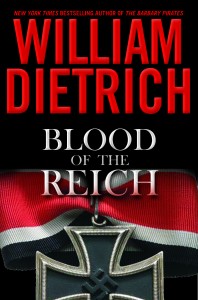
  • Blood of the Reich by William Dietrich

    Blood of the Reich by William Dietrich

    Prepare yourself for grand adventure as William Dietrich deftly blends the fruits of a fertile imagination and well-researched historical facts into a tale so well-crafted that characters and images seem to jump from the page in wide-screen 3-D. I was only 12 pages into Blood of the Reich when I became apprehensive that this hypnotic thriller would eventually come to an end.

    From the golden, autumnal splendor of present day Washington State’s Skagit River Valley to the vivid color of prayer flags waving in contrast to the stark remoteness of Tibet, you’ll be there, deeply involved, wanting more. Blood, a major player in this complex mystery, will be as red as the trees of  the Pacific Northwest are green.

    Then find yourself in 1938 when a Nazi expedition journeys to the high Himalayas to determine if there is any truth to a myth that hints  of  an ancient city located there that cradles a source of immense power—power which could accelerate their plan of world domination. Close on their heels are the Americans, bent on decoding the satanic plan. Both parties are armed and dangerous.  However, the Nazis have the advantage: a very old vial of blood.

    In a saga that spans a turbulent seventy years of action, romance and intrigue, the historian-author maintains a high level of entertainment and page turning. Dietrich’s narrative is as informative and amusing as it is boldly exciting. Be prepared to fully surrender your sense of reality to a high velocity ride that crashes head-on with a sensational blood splattered finale.

    Blood of the Reich deftly blurs the line between science and the paranormal as it exposes the veins of a twisted relationship between the human race and our own, often terrifying, technologies.  With his memorable characters, dichotomy of  modern technology and ancient Buddhist Tibetan temples,  along with non-stop action, and thrilling plot, Dietrich delivers.