Tag: WWII History

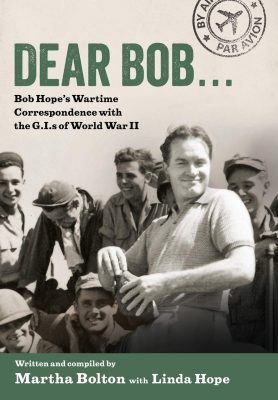
  • DEAR BOB: Bob Hope’s Wartime Correspondence with the G.I.s of World War II by Martha Bolton with Linda Hope – WWII History, Letter Collections, Inspirational

    During World War II, Bob Hope traveled almost ceaselessly to outposts large and small, entertaining US troops – and inspiring them; Martha Bolton brings the extent of this work to light in Dear Bob.

    Writer Martha Bolton worked with and for comedian Bob Hope. Now, with Hope’s daughter Linda, she has gathered and organized the letters written to Bob by the soldiers he helped.

    Hope, English born, and born to entertain, once said he could not retire and go fishing because “Fish don’t applaud.” Among his sizzling lines – and there are hundreds recorded here – he told one audience that he’d gotten a wonderful welcome when he arrived at their camp: “I received a 10-gun salute… They told me on the operating table.”

    His performances could have been forgotten were it not for the letters from soldiers of every stripe, and those soldiers’ families – who did not forget him.

    One such letter recounts to Bob, of his visit to Sicily in 1943, that “It was something more than a show- it seemed to lift us spiritually.” Another soldier tells him, “Your humor leaves a wake behind you which lasts longer than the wake behind a ship.” One man, “merely a lonely Private” sequestered in a hospital after a grenade blew up in his face, heard Bob on his radio show and said that from it he, “derived my only pleasure during my blindness.”

    Hope for his part, responded to as many letters as he could, injecting more of his humor for his admirers: “Give all the boys my best and tell them I’ll take care of the girls until their return.” To the folks back home, he praised the soldiers, “We know them as the finest fighting machine and the finest audience in the world.” He would insist on making as many show stops as possible on every tour, diligently hunting out remote camps far from where he was initially invited.

    Post-war, he continued his mission to present material in honor of these fighters. President Truman gave him a Citation of Thanks, and President Clinton named him as the first Honorary Veteran.

    Hope had indeed served in the armed forces in a way that used his abilities to their best effect. And yet, as many recall, he was also just himself, doing what he knew how to do, and sharing that gift unselfishly with thousands of others.

    Bolton offers an in-depth look at Bob’s shows and the people around him.

    Dear Bob includes a multitude of photographs and written input from others in Bob’s cast, lists of his singular honors, and the names of organizations and people who worked beside him and behind the scenes to keep these memories safely stored away.

    His enthusiastically delivered humor gave hard-working, battle-weary soldiers the few hours of relaxation they needed. Laughter is a medicine, and in that way, Bob Hope was a medic as well as an entertainer. Bolton’s collection will be read by a new generation and by the few fighters left who might have seen him, heard him, and had the impetus to compose a letter beginning with, “Dear Bob…”

    Dear Bob by Martha Bolton won Grand Prize in the 2021 CIBA Military and Front Line Book Awards.

     

    5 Stars! Best Book Chanticleer Book Reviews

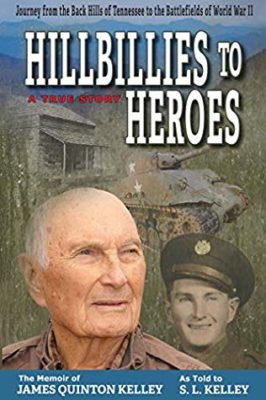
  • HILLBILLIES to HEROES: Journey from the Back Hills of Tennessee to the Battlefields of World War II – The Memoir of James Quinton Kelley by S.L. Kelley – World War II Biography, American Heroes, World War II History

    HILLBILLIES to HEROES: Journey from the Back Hills of Tennessee to the Battlefields of World War II – The Memoir of James Quinton Kelley by S.L. Kelley – World War II Biography, American Heroes, World War II History

    World War II veteran Quinton Kelley recounted his life story to an avid biographer – his daughter, S. L. Kelley, a documentarian and award-winning video producer.

    Kelley’s tale begins in Coker Creek, Tennessee, where he was raised on an 80-acre farm, in a log cabin that he described as rough, but “brightened” with flowers. Taught to be honest and hardworking by his parents, he grew up with kerosene lamps for light, a fireplace for warmth and a wood stove for cooking. His recollections are colorful, with language that recalls his roots.

    As a boy, he wore shoes only to church or to town and attended a church that doubled as a one-room schoolhouse. Everyone in the region knew someone who made moonshine, “a scruffy bunch,” Kelley called them; the local country store had bullet holes in the walls from fights between that bunch and the storekeeper. In his teens, he began work away from the farm, first for a local gold prospector, then for the TVA. Then in 1940 he heard about World War II and knew he’d be drafted.

    The second part of the book shows Kelley leaving Coker Creek for Camp Beale, California, where he became the company carpenter. Assigned to an armored division, the former farm boy showed his worth as the only member of his group who did not need the training to drive a tank. He met fellow recruits from all over America, and despite the manly joshing and rough language among them, the boys in his platoon once generously gave him money to get home when his sister was dangerously ill.

    He drove into combat, first in France, then in Germany, as part of an initiative that ultimately saw the end of Hitler’s Third Reich. Kelley (who passed away before the publication of his memoir) did not glorify himself in recounting his war exploits, but vividly described what it’s like to sit in a tank, looking at the action through a tiny window, always in danger of being killed while trapped inside the metal box. There’s not much room, he opined, for mistakes in battle.

    In his Tennessee argot, he states that combat “made me a bit jubrous.” Still a homeboy at heart, courting a girl by mail, Kelley noted that French and German people were good farmers, though still using horses, and very orderly in their houses and fields. Camped near Berchtesgaden after victory, he refused to go see Hitler’s former hangout: “I didn’t want to waste a minute on that sorry ol’ scudder.” Once back in the US, marriage to his sweetheart soon followed.

    Two books in one, this substantial memoir can be read equally avidly by nostalgic southern and mountain folk as a wide-ranging recreation of simpler times, or by anyone who is drawn to tales of war – both the battles and the long days and hours waiting and watching for the next conflict – as seen up close and personal. Using her writer’s instinct and flair, S.L. Kelley has done a remarkable job of combining her father’s spoken words, his accent, and slant, with those of fellow combatants, and others. Her book would make a splendid gift for old-timers, and a wholesome educational read for younger generations who would do well to remember and revere the sacrifices of America’s soldiers, and a heartfelt recollection that those who make history can be kindhearted and good!

    Kiffer’s favorite quote from this book: “…it took all of our personal sacrifices to go from war to peace.”  Quinton Kelley