Tag: WWII Aviation

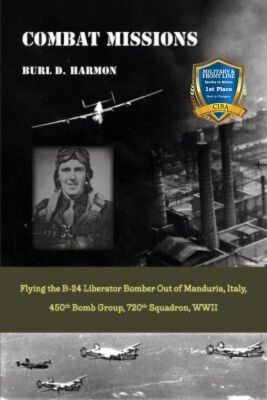
  • COMBAT MISSIONS by Burl D. Harmon – Wartime Memoirs, WWII Aviation, Military History


    Gold and Blue Military and Front Line Awards First Place Badge for Service to Others

    Sometimes, a close and personal story can reveal the true weight of major historical events. Combat Missions, a memoir from WWII veteran Burl D. Harmon, achieves this by detailing how Europe’s vicious aerial battles shape a young boy’s entry to manhood.

     On December 7, 1941, Harmon is summoned to his high school’s auditorium to hear President Roosevelt proclaim it as, “a day which will live in infamy…” Soon after, his draft notice arrives. Harmon’s junior college studies and work at the local Rexall drug store are put on hold as he joins the vast flood of young American men and women conscripted into military service. Leaving his small Iowa town and a family mostly sheltered from the grim realities of the outside world, he travels to New York City with people from every imaginable background.

     With no prior mechanical experience, he works diligently to become a flight engineer, training to master a lexicon of manual tasks and learn the intricacies of air-to-air combat amidst bombing runs. His training takes him even farther from home, to Detroit, Lorado, Texas, Puerto Rico, and even Cuba.

    In these unfamiliar places, Harmon experiences other, more hidden sides of adulthood, including a visit to a notorious brothel in Havana. The reader feels his innocence shedding, but not his moral compass, which keeps him from indulging in many of the temptations that entice other draftees.

    Once trained, Harmon spends most of his deployment in Italy, where he flies a total of 38 perilous missions.

    He takes readers into the cockpit to experience aerial battle with first-hand, harrowing descriptions. But this memoir shows much more than just the violence of war. It’s also about the men he served with, the officers he served under, and the good and bad of both. He names beloved friends and respected officers, gives us glimpses of those who survived the war to live fruitful lives, and memorializes those who were lost in Europe’s battle-scarred skies.

    Harmon reveals the struggles and joys of his own life in the shadow of war.

    We see his quarreling parents in Iowa, the often tormented and confusing love life of a young man, and the family he befriends in Italy with the kindness they bestow upon him. At the conclusion of the war, he tells us of how it was to come home. He has to readjust to a quiet existence as he stumbles around trying to figure out a way forward until, ultimately, he discovers his love of teaching.

    Decades later, at 85, Harmon takes on a new challenge when he joins a group called Global Volunteers, which places him overseas once again. The adventure takes him back to Italy, near the place where he was stationed during the war. It’s a bittersweet return. He makes new friends but discovers the family that he’d spent time with during the war is gone, chased from their home by fleeing Nazis who rampaged villages and confiscated everything they could find ahead of the Allied force’s advances.

    This trim volume shows how the experience of war shaped Harmon’s character and the course of his life, looking back now at 97. Readers interested in the Greatest Generation, who risked their lives to win a war against a rising fascist power, this memoir offers fascinating and meaningful detail from that time. For those who want to understand the way war can change a young boy’s life, Combat Missions is a personal, compassionate must-read.

    Combat Missions by Burl D. Harmon won First Place in the 2021 CIBA Military & Front Line Awards for Narrative Non-Fiction.


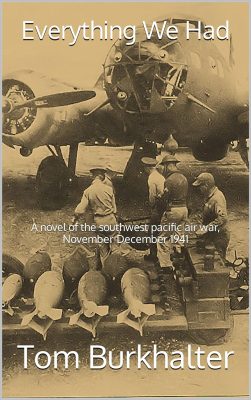
  • EVERYTHING WE HAD: No Merciful War Book 1 by Tom Burkhalter – WWII Aviation, Historical Fiction, Military History


    Everything We Had, book one of Tom Burkhalter’s No Merciful War series is an inexorable thrill that will grip readers tight. It starts with a poker game, through which a main character’s luck soon becomes evident. But will that luck hold out?

    Jack—the poker player—and Charlie—Jack’s older brother—have been separated by war, even though that war has yet to be declared. Everything We Had focuses more on the machinations leading up to US involvement in World War II than on actual combat. The gears of war that have so many young men caught in them move with gradual but inevitable force, and so Everything We Had takes a more thoughtful approach to a historic moment in time.

    Connecting with the characters is a gradual process as you get to know the intricacies that make up their individual personalities. This sets the reader up to feel the emotions of the characters as they face an uncertain fate, and throughout the book the author’s clear and methodical research shines with details such as specific views, locations, and—most notably—comprehensive descriptions of the airplanes Jack and Charlie pilot. This allows the reader to become deeply familiar with the motivations of the characters and the capabilities of the airplanes they fly.

    The importance of their family gradually emerges, too, through their mother’s letters and their memories of their father who flew racing planes. The more readers learn, the more attachment they feel to these characters, giving weight to the growing danger they face.

    Even side characters in Everything We Had have names, hometowns, and sweethearts they’ve left behind. This grants a sense of truth in the actual people who were lost to war.

    Readers may not track every last piece of information—especially the technical details of planes and flight—but the story remains accessible, with its most important details emerging with time. Like flying a P-26, it takes a bit of patience and skill to follow everything in this book, but Burkhalter trusts his readers to keep up.

    The perspective switches between Jack, Charlie, and occasionally Al, who becomes Charlie’s navigator. Al’s viewpoint lends interest at first, but Everything We Had focuses on Jack and Charlie’s narratives as they become more complex and dire.

    Through dialogue, readers start to piece together the puzzle: why Jack and Charlie’s father is gone, who Jack’s mysterious love interest is, and the strength of Charlie’s desire to be a leader. Burkhalter makes good use of dialogue for exposition as readers see how the war gradually unfolds, and how little information the men prepping for combat are told. For much of the book, Jack and Charlie aren’t even sure of each other’s whereabouts.

    Sensory descriptions help ground this intricate story.

    A few wonderful flying scenes—including Jack flying in challenge to a rival pilot—give physicality to the technical descriptions of planes. Small details, like a black Bakelite telephone, and a manila envelope holding mysterious contents, make the narrative even more tangible—not to mention historically accurate. Character descriptions remain simple, but with so many named characters in the story, this helps avoid overwhelming the reader with information.

    The book uses true-to-form period language and stereotypes of US enemies. While this can make for an uncomfortable read at times, it serves the book’s historically-accurate illustration of  a growing conflict. However, the main characters show their good hearts. They speak respectfully of women and, for the most part, of each other. In fact, a sense of camaraderie grows steadily even among former rivals as the war creeps closer.

    When the war arrives, late in the book, it shakes the reader like a stone thrown into the still pond of the characters’ lives, who wait for war with a growing sense of apprehension.

    With war, of course, comes injury and more death than these characters have ever seen.

    Yet Burkhalter steers away from lurid, bloody descriptions and instead focuses on how the violence affects Jack and Charlie internally as people. They come from a privileged background, with a healthy dose of luck, and have distinguished themselves each as leaders by the time war arrives. Yet it’s far from certain that these accolades will help protect them from the hopeless-sounding odds: the US is under-prepared and low on supplies, while the enemy has at least one ace in the hole.

    After such a carefully paced book, the ending comes quickly, and leaves some loose ends untied, nudging readers to continue with this fascinating series.

    Thanks to Burkhalter’s meticulous research, real events, places, and even people in the early Pacific war get a well-deserved remembrance in the form of fiction.

    The No Merciful War series by Tom Burkhalter won First Place in the CIBA Series Awards for Fiction Series.


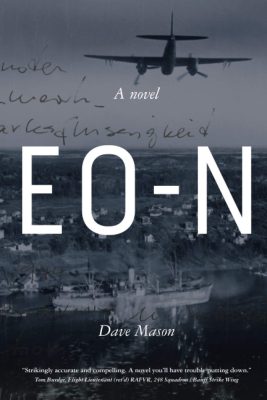
  • EO-N by Dave Mason – Historical Fiction, WWII Fiction, Historical Mystery


    A young boy in Norway makes a discovery while playing with his dog, opening the mystery of EO-N by Dave Mason, a detective story spanning multiple decades and both sides of the Atlantic, a deep dive into the horrors of Nazi Germany, and a heartfelt love story.

    A small metal fragment leads to the discovery of a downed WWII twin-engine Mosquito fighter-bomber hidden in snow and glacial ice for nearly 75 years. The crash site yields an initial set of clues, one of which finds its way across the world to Alison Wiley, a biotech CEO in Seattle. Having recently lost her mother, and, a few years earlier, her brother in Afghanistan, she finds her days full of despair, but the discovery makes a distant connection to her long-lost grandfather, and she flies to Norway. There, she meets Scott Wilcox, a Canadian researcher assigned to investigate the discovery after his government learned that the crashed aircraft belonged to the Royal Canadian Air Force. Their attraction is both intellectual and emotional, but the quest to uncover the plane’s mysteries and the fate of Alison’s grandfather place any romance to the side.

    At first, the crash doesn’t appear exceptional, until certain contradictory and confusing clues emerge that make it clear that the circumstances that led to the plane’s fate were anything but simple.

    EO-N’s story is complex, leading the reader from clue to revelation with a sure hand. And it takes a dark secret from the past and develops it into something that might make the world a better place.

    The details are key to the novel’s success. Readers will wonder whether the facts outlined in the book are based on actual history, and while the specifics of the heinous Nazi activities at the center of the story may differ somewhat from reality, the spirit of the revelations rings true.

    This novel is impeccably researched, and the characters are believable, warm, and heartbreaking. Readers won’t be able to put it down until its perfect conclusion.

    EO-N by Dave Mason won the Grand Prize in the 2021 CIBA Hemingway Awards for 20th Century Wartime Fiction.


    5 Star Best Book Chanticleer Reviews round silver sticker

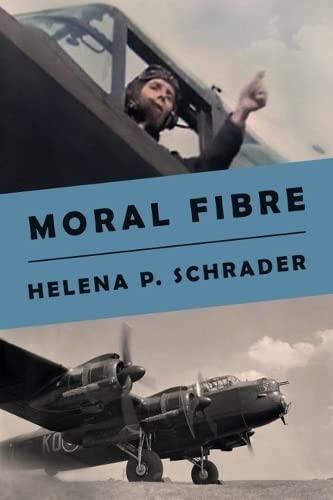
  • MORAL FIBRE: A Bomber Pilot’s Story by Helena P. Schrader – Historical Fiction, WWII, Historical Aviation


    In Moral Fibre: A Bomber Pilot’s Story, Helena P. Schrader takes readers to 1943 England, where deeply held values of honor and bravery mingle with the importance of one’s place in society. It was a time and place where failures of the former could shatter the latter and change a man’s life forever.

    Within this psychological landscape, the reader is led to wonder, in the case of RAF pilot Christopher “Kit” Moran, will the war break him?

    With thirty-six missions under his belt and as a decorated veteran, Kit suddenly refuses to fly another mission. Although a shock to everyone who knows him, Kit has his reasons. The new assignment comes less than one day on solid ground and two hours of sleep since returning from his most recent bombing sortie over Berlin. In itself a harrowing experience, the mission ended with his best friend, the plane’s skipper, being mortally injured and ultimately dying. The RAF hierarch deems Kit LMF (Lacking Moral Fibre) – a term introduced in 1940 to address those who refused to fly without having a verifiable medical reason. He is sent to a diagnostic center and examined by a psychiatrist.

    The psychiatrist understands. Kit is not insane nor lacking in moral fibre. He was simply “wiped out.”

    So Kit is declared capable and fit for duty and given the opportunity to train as a pilot. This outcome was a far cry from what he, an experienced flight engineer, expected after the incident that sent his career off track.

    The novel really takes off in 1944 when, after completing pilot training in South Africa, Kit returns to England for the final stages of training and ultimately a return to operations. Now he must put his experience and training into practice while sublimating his lingering self-doubt and anxiety about his own resilience. Should he fail, people will die, and his dreams will die with him.

    What ensues takes the reader into the English psyche of that time, tapping the depths of human emotions, holding them up to the light, and revealing their concomitant beauty and ugliness in times of fear and crises.

    Before the war is over for Kit, he finds his inner strength, finds love, and learns the true meaning of sacrifice.

    Meticulously researched and skillfully written, Schrader’s Moral Fibre steps off the pages and comes to life. Her nuanced characters and authentic dialogue also provide a glimpse of Britain’s stratified class-conscious culture during the WWII era.

    Schrader picks a critical period during WWII for the setting and, in so doing, educates today’s readers about the horrors of a war that was and what it takes to save a nation – and perhaps the free world.

    In Moral Fibre: A Bomber Pilot’s Story, Helena P. Schrader again reaffirms George Santanya’s position, “Those who cannot remember the past are condemned to repeat it.”


    5 Stars! Best Book Chanticleer Book Reviews for Moral Fibre