Tag: Writing Fiction

  • TIPS for FICTION WRITERS – from Jessica Morrell’s Editor’s Desk and Kiffer Brown – Chanticleer Writers Toolbox Series

    TIPS for FICTION WRITERS – from Jessica Morrell’s Editor’s Desk and Kiffer Brown – Chanticleer Writers Toolbox Series

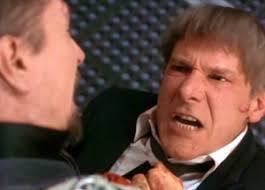
    Get off my plane! Air Force One (1997)

    Sometimes we all need reminders to keep us on track and focused while writing. We hope that you will find these tips handy.

    • Make certain that a major crisis, reversal or twist occurs at the midpoint to send the story skittering in a new direction and creating new motivation for the protagonist.
      • Kiffer:  It doesn’t matter if you are writing a lighthearted romance or a thriller or middle-grade fiction, keeping your readers guessing will keep them entertained and turning the pages.
    • Make certain that your protagonist is struggling with internal conflict as well as external conflict.
      • Kiffer: Jessica has contributed some excellent posts on creating complicated protagonists. See links below.
    • The reader’s first glimpse of the protagonist should evoke sympathy.
      • Kiffer: Think of Celie of The Color Purple, Harry Potter, Tom Ripley in the The Talented Mr. Ripley, James Bond in Casino Royale, Anne Shirley of Anne of Green Gables, Dana of Kindred, Katniss in the Hunger Games, Bella Swan in Twilight.

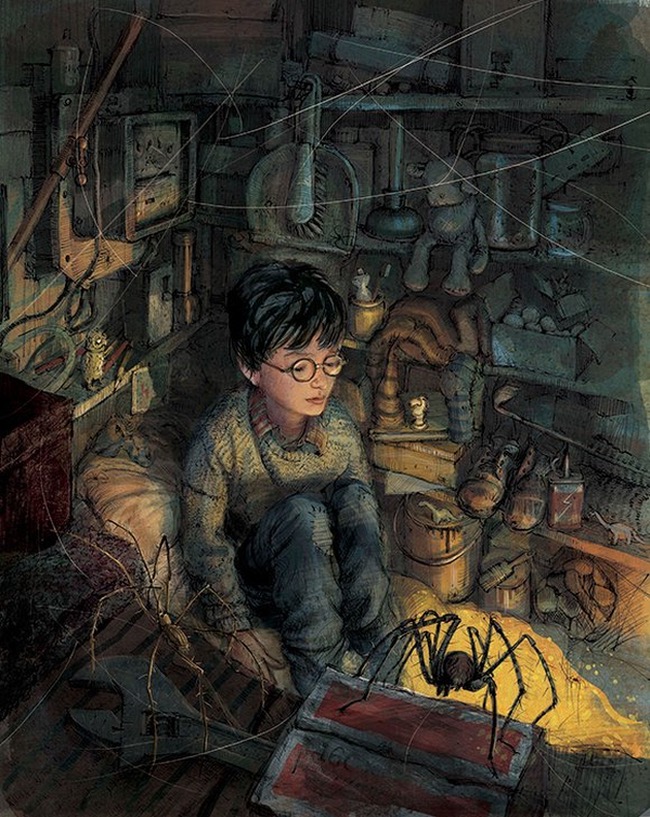
        The Cupboard Under the Stairs Artwork by Jim Kay, Illustrator for the Harry Potter series.
    • Base fiction around a single dramatic question.
      • Kiffer: This will become your log-line or pitch. See link below.
    • Remember always that you are a storyteller first. Stories are not merely about issues or themes. Fiction is about how threatening events affect fictional people.
    •  While a storyline requires a series of crises, surprises and reversals, do not use violence, sex, sin, gore, or murder to enliven a sagging plot.
      • Kiffer: This is known as lazy writing in the publishing biz. Don’t ever let yourself get labeled as a “lazy writer” by taking the easy way out.
    •  Don’t launch a story with too many characters for the readers to track in the opening.
      • Kiffer:  This is something that we see often when evaluating manuscripts–too many story lines cramped into one work when they should be divided out into a series or other story arcs.
    •  Keep dialect to a minimum and don’t write it without thorough research or intimate knowledge.
    • Dialogue immediately reveals a writer’s skills. Use it sparingly  and effectively by understanding that it is inherently dramatic. Avoid long sections of endless dialogue. Also avoid long sections where there is no dialogue. Eliminate mundane exchanges and repetitions. Limit using dialogue to reveal backstory.  Keep attributions short.
    •  Remember that the opening has much to accomplish including establishing the voice, viewpoint, tone, and pacing.
      • Kiffer: Most readers will determine if they want to invest time in reading a work by the opening.
    •  Characters are revealed while acting, talking, making choices and decisions. People are what they do.
    •  Make certain that there is a visual element on every page.
      • Kiffer: Scenes that are void of sensory input have a writing craft problem known as  “white room” syndrome. White room syndrome is where the characters float around the scene without visuals, noise, smells, atmosphere, or tactile experiences. There is nothing to anchor the reader into the scene.
    •  Create a vibrant and quirky cast of secondary and minor characters to enliven the story and reveal several sides of the protagonist.
    •  Don’t start major edits or rewrites until you finish your first draft.
      • Kiffer: As award-winning author Michelle Rene advises: “Pour your heart and soul into the rough draft with reckless abandon.” In other words, don’t start nitpicking and ripping into your work until you have a story idea that is fully formed. Let yourself be creative! Get the story down and then go back to fill in the blanks or to do research. Enjoy the creativity of following in love with your story and characters.

        Head Over Heels in Love with Your Story Idea!
    •  Each major character has an agenda and purpose.
    •  Avoid problems being solved by another character or force of nature.
      • Kiffer:  Avoid Deux Ex Machina (aka dragons, lottery winnings, Prince Charming, etc.). However, there are few times when it works (these tend to be in works that explore the human psyche) such as in the Wizard of Oz when it was all a dream for Dorothy or in Shakespearean works that tend incorporate human psyche archetypes.
    •  Beware of digressions that follow your interests or research, not the story. Rein yourself in.
      • Kiffer: This means that you should not use all that research that you gathered. However, all that research could become subtext and subtle undercurrents of your story. Use research as you would spice—as needed. Just because you have it (research/spice) doesn’t mean that you should use it all. #justsaying

    •  Nothing should happen at random, all fiction is causal. Fiction is storytelling.
    •  Structure scenes around scene goals and opposition to these goals.
      • Kiffer: This is the story current—imagine that your story is a river. Does it flow straight at a constant speed? Or does it bend and twist so that the readers do not know what is just around the corner? Does it have eddies? Does it have turbulence caused by huge obstacles to overcome? Does it run deep? Or shallow? Or both? Shallows can be very dangerous…

    Keep writing, keep dreaming, have heart. Jessica

    Keep creating magic! Kiffer 


    Chanticleer’s Writer’s Toolbox

    Handy Links to More Chanticleer Writers Toolbox Series blog posts

    Will Your Story Idea Work? by Jessica Morrell

    Writing Protagonists by Jessica Morrell

    How to Write Your First Draft in Four Weeks by Michelle Rene, award-winning author

    Prepping to Write: Plotting, Inciting Incidents, Atmosphere, Characters by Jessica Morrell and Kiffer Brown with advice from Chelsea Cain, Robert Dugoni, Stephen King…

    Inciting Incident: Story, Setbacks, and Surprises for the Protagonist – Jessica Morrell

    Minor Characters – the SPICE of FICTION by Jessica Morrell  (Part 1 & 2) 

    Part Two

    Essence of Characters Part One by Jessica Morrell

    Essence of Characters Part Two by Jessica Morrell


    Jessica Page Morrell
    Jessica Page Morrell

    Jessica Page Morrell is a top-tier developmental editor for books and screenplays. Her articles have appeared in Writer’s Digest and The Writer magazines. She is known for explaining the hows and whys of what makes for excellent writing and for sharing very clear examples that examine the technical aspects of writing that emphases layering and subtext. Her books on writing craft are considered “a must have” for any serious writer’s toolkit.

    Jessica will teach the Master Craft Writing Classes at the Chanticleer Authors Conference VIRTUAL Conference that will be held from Tuesday, Sept 8 – Sunday, Sept. 13, 2020. She will present sessions and Master Classes during the conference. She and Kiffer will also host a fun kaffeeklatch for Word Nerds at CAC20.

    Did you know that Chanticleer offers editorial services? We do and have been doing so since 2011.

    And that our professional editors are top-notch and are experts in the Chicago Manual of Style. They have and are working for the top publishing houses (TOR, Macmillan, Thomas Mercer, Penguin Random House, etc.) and award-winning independent presses. If you would like more information, we invite you to email Kiffer or Sharon at KBrown@ChantiReviews.com or SAnderson@ChantiReviews.com.

    Click here to read more about our Editorial services: https://www.chantireviews.com/services/Editorial-Services-p85337185

    A great way to get started is with our manuscript evaluation service. Here are some handy links about this tried and true service:

    https://www.chantireviews.com/manuscript-reviews/

    We work with a small number of exclusive clients who want to collaborate with our team of top-editors on an on-going basis. Contact us today!

    Writer’s Toolbox

    Thank you for reading this Chanticleer Writer’s Toolbox article. 

  • ELEMENTS of SUCCESSFUL FICTION – Writing Fiction Guidelines by Jessica Morrell – Writers Toolbox Series

    ELEMENTS of SUCCESSFUL FICTION – Writing Fiction Guidelines by Jessica Morrell – Writers Toolbox Series

    The best fiction touches the deep layers in us. A writer achieves this effect by embedding dozens of techniques into his or her story. – Jessica Page Morrell

    Dramatic Question 

    Compelling fiction is based on a single, powerful question that must be answered by the story climax. This question will be dramatized chiefly via action in a series of events or scenes. If you are writing a romance, the question always involves whether the couple will resolve their differences and declare their love. In a mystery the dramatic question might be will Detective Smith find the serial killer in time to prevent another senseless death? In The Old Man and Seathe dramatic question is will Santiago catch the big fish and thus restore his pride and reputation?

    An Intimate, Simmering World 

    An intimate world isn’t created by merely piling on details. It means your story world has the resonance of childhood memories, the vividness of a dream, and the power of a movie. It’s filled in with shadows and corners and dogs and ice cubes and the sounds and smells of a dryer humming on wash day and a car blaring past, rap music shaking the windows. These details lend it authority, potency, and a palpable physical existence.

    An intimate story takes us to a specific place and coaxes us to remain there. An intimate story is lifelike and feels as real and complicated as the world the reader inhabits. When he finishes the final pages and leaves the story world, he should feel the satisfaction of the ending, but also a huge sense of loss. Like a friend has moved to another town just when the friendship had reached a level of closeness and trust.

    Characters Built from Dominant Traits

    Create main characters with dominant and unforgettable traits as a foundation of personality. These traits will be showcased in the story events, will help him achieve or fail at goals, and will make the story person consistent. For example, Sherlock Holmes’ dominant traits are that he is analytical, Bohemian, opinionated and intelligent. These traits are showcased in every story he appears in along with secondary and contrasting traits. When the character first appears in the first scene, he arrives in the story with his dominant traits intact.

    Emotional Needs

    Protagonists and the main characters are people with baggage and emotional needs stemming from their pasts. These needs, coupled with motivation cause characters to act as they do. For example, in Silence of the Lambs Clarisse  Starling is propelled by childhood traumas to both succeed and heal the wounds caused by the death of her father.

    Significance 

    The storyline focuses on the most significant events in the protagonist’s life.

    Motivation Entwined with Backstory 

    Motivation, the why? of fiction, is at the heart of every scene, fueling your character’s desires and driving him to accomplish goals. It provides a solid foundation for the often complicated reasons for your character’s behaviors choices, actions,  and blunders.  Motivating factors provide trajectories for character development, as a character’s past inevitably intersects with his present. Your character’s motivations must be in sync with his core personality traits and realistically linked to goals so that readers can take on these goals as their own.

    Desire 

    Desire is the lifeblood of fictional characters. Not only do your characters want something, but they also want something badly. Santiago, in The Old Man and the Sea desperately wants to restore his reputation and also wants his friendship and partnership with the boy to resume. And in the lonely hours when he is far out at sea, desperately struggling to hang on to the fish and fighting off sharks, we see his fierce desire acted out and the price he pays for it.

    You can bestow on your character flaming red hair, an endearing, crooked grin and a penchant for chocolate and noir movies, but if she doesn’t want something badly, she’s merely a prop in your story, not a driving force. But if she wants to win the Miss Florida contest, take over her boss’ job, or become the first female shortstop for the Atlanta Braves, then you’ve got a character who will make things happen and a story that will be propelled by desire.

    Threat

    Fiction is based on a series of threatening changes inflicted on the protagonist. In many stories, these threats force him or her to change or act in ways he or she needs to change or act. Often too, what the protagonist fears most is what is showcased in a novel or short story. It can be fear of losing his family, job, or health with this dreaded outcome providing interest, action, and conflict.

    Causality 

    Events in fiction are never random or unconnected. They are always linked by causality with one event causing more events later in the story, which in turn causes complications, which cause more events, which cause bad decisions, etc.

    Inner Conflict 

    A fictional character doesn’t arrive at easy decisions or choices. Instead, he is burdened by difficult or impossible choices, particularly moral choices, that often make him doubt himself and question his actions. Inner conflict works in tandem with outer conflict—an physical obstacle, villain or antagonist–to make the story more involving, dramatic, and events more meaningful.

     Complications   A story builds and deepens by adding complications, twists, reversals, and surprises that add tension and forward motion. Plots don’t follow a straight path, instead, there are zigzags, dead ends, and sidetracks. Complications create obstacles and conflict, cause decisions to be made, paths to be chosen.

     Midpoint Reversal 

    The middle of a novel comprises more than half its length. At about the midpoint of most novels, a dramatic reversal occurs. The hunter becomes the hunted; a second murder occurs proving the detective has been wrong in his suspicions; a former lover arrives in town to complicate a budding romance. This reversal keeps the middle from bogging down and becoming predictable and also breathes new life and often a new direction into the story.

    Satisfying Ending 

    every story needs an ending that satisfies the reader while concluding the plot. The final scenes, when the tensions are red hot and the character has reached a point of no return, must deliver drama, emotion, yet a logical conclusion. This is not to suggest that every plot ends with a shoot-out or physical confrontation because some endings are quieter, more thoughtful. Some endings are ambivalent, some a dramatic or a violent clash of wills. But there is always a sense that all the forces that have been operating in your story world have finally come to a head and the protagonist’s world is forever changed.

    The end is just the beginning…

    A Note from the Editor: A satisfying ending is one of the top, if not the top, reasons why books go viral and what will make your reader want to read your next work. Make sure that the you put as much effort in to a satisfying ending as you do into your opening hook—if not more. Kiffer Brown

    Jessica Morrell is a top-tier developmental editor and a contributor to Writer’s Digest magazine, and she teaches Master Writing Craft Classes at the Chanticleer Authors Conference that is held annually along with teaching at Chanticleer writing workshops.

    Jessica Page Morrell

    Jessica will teach a Master Class and advanced writing craft sessions at CAC19

    Workshops and Sessions Jessica will teach at the 2019 Chanticleer Authors Conference: 

    Immersive Fiction: Writing Fiction so Readers Land Amid Your Story and Don’t Want to Leave. Ever.


    We live in a clattering, distracting world that pulls at readers’ attention and senses. To compete your fiction needs be immersive, as in an alternate reality that your reader can enter into. Thus your readers are experiencing it, not simply reading it. An immersive story is an intimate, sensory story. It takes place in a world that a reader can see, smell, feel, and hear and it’s based on characters readers come to know and care deeply about. With the opening pages, readers are swept into a world that is so resoundingly real and intricately constructed that they leave their ordinary lives to venture forth and live daily along with the characters.

    Immersive Fiction Part 1:  Atmospherics

    Readers want to feel as if they’re part of a story world interacting with viewpoint characters. Fictional worlds that are immersive are nuanced, intricate, and alive with significant details. We’ll sort through what makes details significant and necessary. Plan to delve into atmosphere and tone, often under-appreciated techniques in a writer’s toolbox, yet they can be so effective to heighten suspense, create reality, and underline emotions and key moments. We’ll highlight how to use weather, lighting, interiors, unsafe places, and what I call “surround sound.” Finally, we’ll also discuss the key elements needed of world build in realistic genre fiction such as historical, sci-fi, and fantasy, and to make your stories memorable and immersive.

    Immersive Fiction Part 2: Your Sometimes Heart-breaking, Sometimes Messed-up, Sometimes Heroic Fictional Cast

    For many writers, the most fun of creating a story is fleshing out characters who battle, grow, and plop into heaps of trouble. Because readers need relatable, yet irksome, yet potent story people to follow and fret over. Their flaws and mistakes drive us crazy, their choices and moral dilemmas worry us sick, their triumphs feel as sweet as our own.
    Characters first need to be intriguing and readers need to meet them at a pivotal, irreversible moment. From there they’ll tread where we dare not, fall in love with losers and sometimes winners, and take on monsters when we’d be cowering. But still characters, including secondary characters, need a vivid essence and need to be bigger than life. And by story’s end they need to grow, also called an arc. This workshop will delve into the more intricate aspects of character building and creating arcs, the art of creating characters who will live in the reader’s heart and memory.

    Immersive Fiction Part 3: Stakes and Motivations

    One major reason that people ‘buy into’ storytelling of all types is that there are serious stakes involved. Readers need to feel as if they also have a stake in the story. Stakes create tension, but most of all dread in a story because a character’s happiness, perhaps even his life, depends on them. The stakes might mean saving a vulnerable child snatched by a creepy predator, or saving the galaxy, or defeating Voldemort and his Deatheater.

    Motivations are the reason characters attempt any action in a story. You’ll learn that motivations are deeply felt, drive a story, and will require a character’s chief personality traits to fulfill. We’ll discuss how motivations reveal backstory and a character’s inner world, create goals, and will exact a cost as the story progresses. We’ll discuss a variety of stakes, motivations, and goals so that you’ll learn clear examples of how all are entwined with plot and character.

    If you would like to learn more about the sessions and Master Writing Craft Workshops please click on this link that goes to https://www.chantireviews.com/chanticleer-conference/