NICOLE J. PERSUN – Award Winning and Bestselling Author and Creative Writing Instructor
Nicole J. Persun is an award-winning and internationally bestselling author with a master’s degree in Creative Writing & Instruction. Nicole has written and published in multiple genres, most recently book club fiction under the pen name Jennifer Gold. Her most recent novel, Halfway to You, was an Amazon First Reads selection in March 2023. Learn more at nicolejpersun.com. Discover her recent novels at jennifergoldauthor.com.
Still thinking about Registering for the Chanticleer Authors Conference?
Find out why The Writer Magazine (founded in 1887) has repeatedly recognized the Chanticleer Authors Conference as one of the best conferences to attend and participate in for North America.
Christine Fairchild offers 35+ years experience as a writer, editor, and book doctor. She’s conducted celebrity interviews (XFiles, SciFiMall.com), edited for technical giants (Microsoft, Hitachi), and served as a marketing/readability specialist for consumer products (DHL, Cingular, AT&T). She now specializes in Suspense fiction and helps authors take their work, and their career, to the next level through her online workshops, classes at conferences and one-on-one book-doctoring of clients’ novels. She also writes suspense and historical fiction, so she understands the challenges authors face in their craft and the publishing industry.
• Power Moves to Make Your Story UNDENIABLE • Look Out! He’s Behind You! Effectively Using Suspense to Insure a Page-Turner Story • And more to be announced!
Still thinking about Registering for the Chanticleer Authors Conference?
Find out why The Writer Magazine (founded in 1887) has repeatedly recognized the Chanticleer Authors Conference as one of the best conferences to attend and participate in for North America.
SUSAN V. MEYERS – Creative Writing Program Director Non-Fiction Writer and Pushcart Prize Nominee
After growing up on a carnival route, Susan V. Meyers, PhD., is a professor and Director of the Creative Writing Program at Seattle University.
Having received grants from Fulbright, the National Endowment for the Humanities, and several arts residencies, she has been nominated for The Best American Series and several Pushcart Prizes. Her novel Failing the Trapeze won the Nilsen Award, and other work has appeared in Creative Nonfiction, Huffington Post, The Rumpus, Hippocampus, So to Speak, New Orleans Review, and The Minnesota Review. You can find her at susanvmeyers.com.
Susan will present a session on Dynamic Dialogue: The Art of Subtext and Grabbing Your Reader and Not Letting Go
Still thinking about Registering for the Chanticleer Authors Conference?
Find out why The Writer Magazine (founded in 1887) has repeatedly recognized the Chanticleer Authors Conference as one of the best conferences to attend and participate in for North America.
LUCAS SOUTHWORTH – Award Winning Short Story Author
Lucas Southworth’s book of short stories, Everyone Here Has a Gun, won the Association of Writers and Writing Program’s Grace Paley Prize. He has published stories in magazines such as the Pushcart Prize Anthology, Conjunctions, The Iowa Review, AGNI, Copper Nickel, and many others. He has also received Grants, fellowships, and residencies from The Maryland State Arts Council, The Truman Capote Trust, Virginia Center for the Creative Arts, the Jentel Artist Residency Program, Monson Arts, and Arteles Creative Center in Finland. Usually, he divides his time between Baltimore and Washington, where teaches fiction and screenwriting at Loyola University Maryland and at Seattle U.
Lucas will have sessions on:
How to Design a Smashing Screenplay: The importance of planning and outlining a story before you write
Key Elements of Writing the Short Story
Still thinking about Registering for the Chanticleer Authors Conference?
Find out why The Writer Magazine (founded in 1887) has repeatedly recognized the Chanticleer Authors Conference as one of the best conferences to attend and participate in for North America.
Jennifer entered Mr. Hostler’s home, finding herself in an empty white room.
“Where’s your furniture?” she asked.
Mr. Hostler cocked a brow. “You don’t need chairs to talk, Ms. Trent.”
White Room Syndrome is an ominous name for a common problem in prose writing: the characters are acting, talking, and moving the story forward, but all in a scene that hasn’t been set through description. They’re in an empty white void. Despite the name, a literal white room is not required.
Chances are good you’ve seen White Room Syndrome at some point in your own writing, where an old friend’s attic, the car of a speeding train, or even the great outdoors aren’t described to the reader beyond those broad descriptions.
So, how do you paint a scene? Well, you can’t include every single detail about the locations your characters go to, not without sacrificing any hope of good pacing – or readers finishing your book. So, I’m going to go over five critical lenses you can use to figure out which aspects of a setting are most valuable to the story: The lenses of clarity, character, tone, imagination, and pacing.
First, the lens of clarity; you must construct the world to seem cohesive.
“Then where am I supposed to put this?” Jennifer demanded, shaking her sodden umbrella.
Mr. Hostler took it from her. “First, you ought to close it. You certainly don’t need any more bad luck. And, where else would it go?” He set it carefully in the umbrella stand.
“Hey! Where did that come from–”
“Why, it’s always been there. We live in a rainy city after all,” Mr. Hostler said.
Oh that’s where I left that!
Without a scene set in your reader’s mind, the actions of your characters will be harder to imagine, and immersion will suffer. Description bears much of the responsibility for maintaining continuity in your story, both at a small scale and a large one.
Focus on the specifics of your setting.
If your story is set in a desert town, then perhaps a room is filled with the hum of air conditioning, while sunlight bathes everything near the windows.
These small details will become part of your readers’ gestalt image of this town and its environment. So, rather than having a character comment on the heat of their city, you can simply let the dry stretch of sand, pitcher of ice water on the table, or faint smell of sweat comment on it instead. What an average person’s house looks, sounds, and smells like can tell you a lot about a town, from weather to economics to culture.
Building the world, piece by piece
On the smaller scale, try to describe important details for the actions of the coming scene.
If someone is going to lunge across their desk, then take a moment to describe that desk as the scene opens on the room around it. What’s going to fall and clatter to the floor? If one of your characters is worn down after a long day of work, about to have an argument with their inconsiderate partner, you might describe the car in the driveway that one of them will later angrily drive off in. Remember the principle of setup and payoff: willing suspension of disbelief thrives when important details are established before they come into action.
Not all details should be practical building blocks for the beats of a scene. As much as they can reveal the world itself, so can they reveal the people within it.
Consider next the lens of character
A description of a woman with butterflies in her stomach, of possibility in a beautiful world:
Pink crocuses beckon to the first rays of sunlight, eager on the riverbank. Marie’s fingers explored the spirals and stripes of the railing. To where did they all lead? On the far end of the bridge, a wooden board creaked faintly beneath Rona’s familiar blue boots as she stopped a few feet away. She seemed to belong on the bridge’s rising arch. Cool, piney air filled Marie’s chest.
You could fall in love here
A description of a woman who’s probably going to go missing in about two pages:
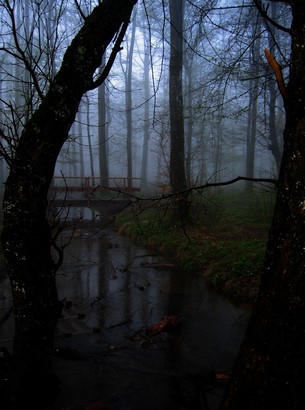
Dark green roots slithered out from the riverbank, disappearing beneath murk and silt. Marie’s every step was interrogated by the stark light of dawn. She traced the spirals of the wooden railing, but her fingers never quite escaped the splintery prodding of their coils. A sharp whine cut through the air, and Marie’s eyes darted up to find Rona, standing not but a few feet from her. Those heavy boots, sagging jacket, and long, flat hair all seemed to whisper that only a few old planks separated Marie from the sinking grip of the river.
Not a place to go walking alone
Because of the tone set by these descriptions, the conversation between these characters will have a strong foundation, with words that would otherwise mean very little now being heavy with implication (for better or for worse). Choose those details which tighten tension and keep your readers excited to see how this scene plays out.
This is a great time to employ sensory description beyond sight and sound. Yeasty baking bread, the calloused fingers of mountain wind on exposed skin, a disappointingly-unsweet taste of fresh cherry sap – details like these put your readers into the bodies of your characters, a powerful tool for establishing the emotional shade of a scene.
To spark imagination, use a lens of specificity
Find the balance of trusting your reader and showing them your world.
It’s not just a sunny day – the sun sears white even the empty sky around it. What can you describe in ten words that says a thousand about your setting? What could your character have on their desk that shows the fear seeded deep in their bones? How should the light fall in the old church, to make clear that something is very, very wrong in this town? These evocative details act as foundations, allowing readers to fill in the empty space without even realizing they’re doing it.
Give them enough of a groundwork to understand how a location feels, show them the striking details, but don’t spell out every mundane element of someone’s kitchen.
No hard and fast rules
These lenses aren’t requirements for every scene, especially as you’re drafting (consider this article by Michelle Rene on Write Fast, Edit Slow.) Lenses are useful tools for when you’re editing your work, thinking about what each line of description is supposed to do for your story.
Does it accomplish its goal?
Would something else be stronger in its place?
Could combine two lines into a single, more evocative one?
If you don’t know what color to paint your white room, try these lenses, and see what they can show you about the walls of your story.
Chanticleer Editorial Services – when you are ready
Did you know that Chanticleer offers editorial services?
We do and have been doing so since 2011.
Tools of the Editing Trade
Our professional editors are top-notch and are experts in the Chicago Manual of Style. They have and are working for the top publishing houses (TOR, McMillian, Thomas Mercer, Penguin Random House, Simon Schuster, etc.).
If you would like more information, we invite you to email Kiffer or Sharon at KBrown@ChantiReviews.com or SAnderson@ChantiReviews.com for more information, testimonials, and fees.
We work with a small number of exclusive clients who want to collaborate with our team of top-editors on an on-going basis.Contact us today!
Chanticleer Editorial Services also offers writing craft sessions and masterclasses. Sign up to find out where, when, and how sessions being held.
Thank you for reading this ENCORE Chanticleer Writer’s Toolbox article.
Scott Taylor – Editorial Assistant
Scott has worked as a book editor since 2020, with a BA in English & Writing from The Evergreen State College.
He facilitates a small writing critique group, and serves as an editor on the biennial anthology The Writer’s Corner. Scott’s book reviews feature on the Chanticleer Book Reviews website. His own writing centers on speculative and surreal fiction, from sci-fi & fantasy to magical realism, and has been published in the HamLit literary journal.
Beyond working on novels and short stories, Scott explores other media and modes of narrative, such as playwriting, tabletop game design, and music composition. He finds moving from one medium to another offers inspiration that feeds back into his prose work.
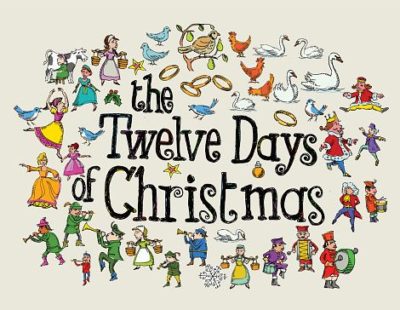
Celebrating the Twelve Days of Christmas – One Day at a Time
“But Jiminy Crickets, it’s after December 25th! Is it not too late for the 12 Days of Christmas?” you say.
Not to fear, Chanticleerians! The 12 Days of Christmas begins on December 26th! And it continues to the 6th of January – Three Kings Day. The four weeks leading up to Christmas are known as Advent.
Some say that December 25th is the first day of Christmas, but we are going with the medieval date of the 26th because revelry could not take place on the 25th as it was a holy day. And the Twelve Days of Christmas is about revelry!
So if you haven’t finished wrapping presents, sending out those cards, and baking cookies—don’t worry—you’ve got an extra 12 days!
Happy Holidays to You from the Chanticleer Team!
On the Eighth day of Christmas, my true love sent to me
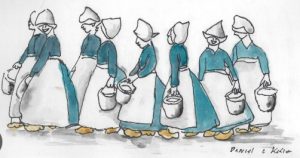
Eight Maids A-Milking
Seven Swans A-Swimming
Six Geese A-Laying
Five Golden Rings
Four Calling Birds
Three French hens (Chanticleer’s favorite #justsaying)
Two turtle doves
And a partridge in a pear tree
On the Eighth Day of Christmas, Chanticleer brings to me…
Eight Writing Craft Books
On The Roost we’ve started a Writing Craft Book Group that reads and discusses books specifically on writing craft. While the information from book to book can repeat a little bit, the conversation is always excellent.
A rough estimate of the number of writing craft books available
Let us know if you have a book group that helps inform your writing life!
Just as every dark and stormy night, dinner party, holiday gathering, or bustling office on payday are infused with mood, so are scenes in the best fiction.
Mood affects, resonates, and reinforces the reader’s emotions, aids in understanding key moments, and enhances his or her immersion into the story events.
Mood is the feel or atmosphere or ambience of a story or scene.
ALL writing should evoke a mood.
Miranda at “that” dinner party that takes place in the STATION ELEVEN series. The tension is palpable.
Mood is the Soundtrack of Fiction aka Mood as Backdrop
Mood is omnipresent in the best books much like the soundtracks of notable films. As with movies without a soundtrack, fiction is not complete and captivating without having moods as a backdrop. Mood makes readers worry about heroines stranded in lonely castles and fog-bound moors. It feeds suspense and tension, and is in fact inseparable from them. It is essential to genres like horror, thrillers, and action, but is necessary to every moment in every story where you want a reader to feel a certain way. You can stage your characters in dramatic events but without setting up the proper mood, the characters’ actions will fall short.
Mood is What Readers Feel While Reading Your Story.
Mood is what the reader feels while reading a scene or story. It’s not the reader’s emotions, (though mood is designed to influence them) but the atmosphere (the vibe) of a scene or story. It’s the tornado heading for Dorothy Gale’s Kansas farm. In the film, once the viewers spot that towering tunnel and witness winds lashing the countryside, fear sets in. Will Dorothy make it to cellar in time?
It’s what the reader notices, what gets under his or her skin. Not all readers will experience/perceive the same mood from a scene, although the writer tries to achieve a particular feel common to every reader.
A quick example from everyday life–candlelight is soothing and soft; overhead fluorescent lights are harsh and even irritating.
Tip: Mood should change and vary as the story moves forward. Moods in subplots should vary from the main storyline.
Why Mood?
Deepens the reader’s experience.
Creates cohesion.
Enhances tension and suspense.
Evokes emotions, creates emotional connections to the characters and their situations.
Works with reader’s nervous system.
Underlines themes.
Mood helps fiction become more immersive, alive, lifelike and creates a backdrop for drama.
Mood is Created by a Range of Literary Devices:
Setting
Conflict
Imagery
Sensory Details
Characters Reacting and Responding in Scenes.
Diana Gabaldon’s Outlander series is an exemplary example of infusing mood into scenes: joy, fear, longing, betrayal, expectation, disappointment, and so on.
Evoking mood in fiction – Outlander by Diana Gabaldon
Use Descriptive Language to Induce Moods
While setting is most commonly used to induce moods, descriptive language is a potent tool and that decreases or amps up tension. In Dean Koontz’s psychological thriller The Face, a horrific storm lashes Los Angeles a few days before Christmas adding a delicious shiver of danger and tension. The weather is referred to in each scene, causes things to happen and creates an ominous, the ‘world-is-askew’ mood. For example, he writes, “In the witches’ cauldron of the sky, late-morning light brewed into a thick gloom more suitable to winter dusk.”
Mood is created on a word-by-word basis by choosing sensory details that stir emotions, but also by orchestrating pacing. Slow down for important moments, places readers need to savor. Pacing naturally speeds up when excitement is high, conflict is intense, action is nonstop. Short sentences and paragraphs communicate excitement, urgency, panic, anger, shock, and violence. Short sentences land a gut punch and demand readers keep zipping through the text.
While most stories, especially short stories, have an overarching atmosphere, the ambience or vibe of a story will change over time and change in intensity.
Mood is linked to tension and suspense and getting under your reader’s skin.
Use mood to foreshadow.
Remember that a vague or pallid setting will create vague and pallid emotions/reactions in your readers. – Jessica Morrell
Example as Mood as Backdrop
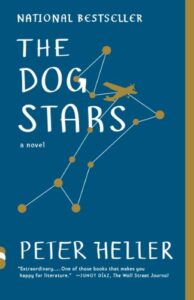
Peter Heller’s brilliant novel The Dog Stars takes place in a future where the world has been ravaged by a pandemic that’s killed off most of the population. If that wasn’t bad enough, the natural world is dying off too. He wrote it in 2012. I’m a sucker for a post-apocalyptic novel, even when they’re shockingly prescient. I cannot recommend enough this beautiful, compelling, heart-wrenching story that invaded my thoughts for days while reading it. This backdrop to the state of affairs the protagonist Hig exists in, is dropped in on page 6.
“In the beginning there was Fear. Not so much the flu by then, by then I walked, I talked. Not so much talked, but of sound body—and of mind, you be the judge. Two straight weeks of fever, three days 104 to105, I know it cooked my brains. Encephalitis or something else. Hot. Thoughts that once belonged, that felt at home with each other, were now discomfited, unsure. Depressed, like those shaggy Norwegian ponies that Russian professor moved to the Siberian Arctic I read about before. He was trying to recreate the Ice Age, a lot of grass and fauna and few people. Had he known what was coming he would have pursued another hobby. Half the ponies died, I think from heartbreak for their Scandinavian forests, half hung out at the research station and were fed grain and still died. That’s how my thoughts are sometimes. When I’m stressed. When something’s bothering me and won’t let go. They’re pretty good, I mean they function, but a lot of times they feel out of place, kinda sad, sometimes wondering if maybe they are supposed to be ten thousand miles from here in a place with a million square miles of cold Norwegian spruce. Sometimes I don’t trust my thoughts not to bolt for the brush. Probably not my brain, probably normal for where we’re at.”
“I don’t want to be confused: we are nine years out. The flu killed almost everybody, then the blood disease killed more. The ones who are left are mostly Not Nice, that is why we live here on the plain, why I patrol every day.”
Example of Mood Setting the Stage
“Stop that you’ll fall.”
A week’s worth of snow has compressed into ice, each day’s danger hidden beneath a nighttime dusting of powder. Every few yards my boots travel farther than my boots intended, and my stomach pitches, braced for a fall. Our progress is slow, and I wished I’d thought to bring Sophia on a sled instead.
Reluctantly, she opens her eyes, swivels her head owllike, away from the shops, to hide her face in her sleeve. I squeeze her gloved hand. She hates the birds that hang in the butcher’s window, their neck iridescent feathers cruelly at odds with the lifeless eyes they embellish.
I hate the birds too.
Adam says I’ve given the phobia to her, like a cold or a piece of unwanted jewelry.
“Where did she get it from them?” he said when I protested turning to an invisible crowd, as if the absence of answer proved his point. “Not me.”
Of course not. Adam doesn’t have weaknesses.
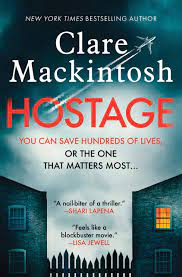
This is the opening salvo for Hostage written by Clare Mackintosh, a ‘locked room’ thriller. The locked room in this story is a London to Sydney flight. It feels like a thriller doesn’t it? Those creepy dead birds, dangerous snow, and the husband-wife conflict signal something bad is going to happen.
Keep writing, keep dreaming, have heart. Jessica
Jessica Page Morrell
Jessica Morrell is a top-tier developmental editor and a contributor to Chanticleer Reviews Media and to the Writer’s Digest magazine. She teaches Master Writing Craft Classes along with sessions at the Chanticleer Authors Conference that is held annually along with teaching at Chanticleer writing workshops that are held throughout the year.
Jessica Morrell’s Classes and Workshops at CAC22
June 23 – 26, 2022 at the Hotel Bellwether, Bellingham, Wash. In Real Life and Virtual!
Using Film Techniques for Fiction Writers– Camera angles, method acting for getting into a character’s pov, and creating subtext and tight dialogue
Your Brain on Writing
Captivating Co-Starsthat add depth to your work-in-progress
No matter your writing level, your story needs a kickass main character. Now, I don’t mean you need a brawler, a bully, or beast to headline your story–instead, you need someone who readers have never met before. An unforgettable someone who fascinates and captivates. Someone who readers can care about, empathize with.
A story person who can carry the weight of your storyline.
Examples: Katniss of Hunger Games, Kirsten of Station Eleven, Jay Gatsby in the Great Gatsby, Celie in the Color Purple, Poirot in the Hercule Poirot series, Arsene Lupin of the Lupin, Gentleman-Burglar series by Maurice Leblanc, Harry Potter of the Harry Potter series.
You will notice that most of these protagonists can carry the weight of a series. Readers want to spend time with them.
Hercule Poirot of Agatha Christie’s series
Create a worthy protagonist:
A fictional person who is about to face some of themost interesting events and hardest challenges of his or her life. Elizabeth Bennet ofPride and Prejudice is a good example.
A protagonist who hasskin in the game. Elizabeth’s situation–living with her family because she has no means of support–means she is in aninescapable position.
A character you can pile on troubles and miseries and he or shewon’t topple. Well, maybe topple, but then is capable of rising again to face the challenges of the story events. This means your protagonist can stand up to his or her opposition, enemies, and travails, however difficult.
Think about the character Kirsten Raymonde in Station Eleven by Emily St. John Mandel. Kirsten is strong, observant, and skilled in protecting herself. She struggles with the violence of the new world and the fact that she has killed other people to survive. She believes in the power of art to make her new brutal life worth living and longs to better understand the world left behind.
The protagonist, Kirsten Raymonde, of Station Eleven by Emily St. John Mandel
A character withrealistic and possibly relatable flaws. InPride and PrejudiceLizzie Bennet possesses a sharp tongue that matches her quick wit, but she’s also prone to jump to conclusions {prejudice} and might be prouder than might be good for her.
A character who is complicated and complex, which in turn leads to inner conflict.This means protagonist battles his/her circumstances hindered by his or her personality, nature, and circumstances.
Use characters with significant histories{backstory}that cast a shadow onto the present. Typically this means past traumas or troubles that somehow mess with his/her ability to face the story conflict and hardships. InPride and PrejudiceElizabeth Bennet’s family is dysfunctional, in that the father is uninvolved and distant, their mother is an ambitious busybody, and her younger sisters will chase any man in a uniform. Which is going to lead to a scandal that the family might not recover from.
Lizzie’s older sister Jane is typical of a woman of her times–Regency England–who seems to accept society’s norms and has a sweet disposition. Oh, and low expectations. Lizzie, on the other hand, is different from her sisters–a reader, a dreamer and yet a realistic type because she’s aware of her family’s flaws and disapproves of her father. But importantly, she’s a woman who will not marry unless her beloved is a perfect match.
Smiling in spite of being subject to England’s Inheritance Laws during the Regency Era.- which means they will not inherit land or the family home. Husbands will be required.
But the ultimate backdrop for this story comes from England’s inheritance laws. The family’s five daughters unable to inherit their family estate because they’re female, which creates a threat that hangs over the story. This is an excellent example of the Regency English era.
All stories need anoverarching threat. Think worst-case scenario.
Fiction typically, but not always, is told from the protagonist’s viewpoint.The pov character is the reader’s entrée into the story world, the lens we view the story through.The prideful Lizzie provides access into society’s norms and expectations for females. Thus, she serves as a reflection of the story’s themes and premise. {It is a truth universally acknowledged, that a single man in possession of good fortune, must also be in want of a wife.}
If Pride and Prejudice was told from elder sister Jane’s or Lydia’s viewpoint it would be a far different tale.
Less complex and involving, since Jane isn’t exactly a firecracker and 15-year-old Lydia’s agenda is all about romance with a dashing soldier, Mr. Wickham. No matter that his agenda is ungentlemanly at best. Then there’s the matriarch, Mrs. Bennet, who is well aware of the unfairness of inheritance laws and is determined her daughters will be married because that’s all the security they can hope for. While Mrs. Bennet is realistic, it’s doubtful she’d provide an honest perspective.
Early on in your story development, consider thinking about or perhaps outlining what the narrative would look like from your other character’s perspectives. You may gain an interesting slant to your story line. Kiffer
Seating is Limited. The esteemed WRITER Magazine (founded in 1887) has repeatedly recognized the Chanticleer Authors Conference as one of the best conferences to attend and participate in for North America.
IF you are participating in NaNoWriMo, you are getting close to the FINISH LINE! Stay the Course as you try to achieve the 50,000 words goal.
If you are NOT participating in NaNoWriMo, then we hope that this post will spur you on as write your work-in-progress (w-i-p) or your next work.
RULE # 1
WRITE FAST! EDIT SLOW!
Don’t edit your first draft as you write it!
Writing your first draft should be a mad dash to get your story out of your brain. Don’t hinder it by worrying about each little detail. There will be time for that later. NaNoWriMo or not.
Not taking our word for that piece of advice?
Chelsea Cain, a bestselling thriller author (with a TV series to her credit), gives this piece of advice:
Write the bare-bones version of the scene first using mostly dialogue, and then move on and in the second draft flesh out the scenes with description and action.
“Action is dialogue. Dialogue is action.” –Robert Dugoni, Amazon Bestselling Author
What is YOUR STORY?
Story is essentially a problem that needs solving for the protagonist. –Jessica Morrell
What is yourprotagonist’sproblem that must be solved—or else?
What is the worst thing that can happennextto your protagonist?
Remember that it is not your problem. It is your protagonist’s problem, obstacle, impossible dream.
Start at least one subplot. This subplot(s) should also complicate the protagonist’s goals.
No matter when the problem begins (it’s always in Act One) the problem is weighty and vexing, perhaps insurmountable. If the problem is not immediately personal, it should become so that it will create a bond (connection) between the protagonist and antagonist. Classic examples are the connection between Sherlock Holmes and Jim Moriarty and Harry Potter and Voldemort.
What is the inciting event or threat?
The inciting incident might lead to the problem. This event will disrupt the status quo, demand response, and set actions in motion. It’s a threat that unbalances the story world and creates dilemmas that must be dealt with.
To name a few:
The tornado incident in the Wizard of OZ
Katniss’s little sister selected for the Hunger Games
Luke Skywalker ‘seeing’ and hearing Princess Leia calling for help in Star Wars
These are great tips to get your creativity groove on!
Remember you want to send your protagonist into new emotional territory with new challenges and pressures.
And at the same time, she will need to deal with new physical territories such as a new school (Footloose) or a different culture (Dances with Wolves) or a different legal society with different norms (Handmaid’s Tale)or a new environment (Deadwood) or a different time (Outlander)or galaxy (Farscape).
Don’t be afraid to stage danger in benign or lovely settings or conversely gentle scenes in dangerous and gruesome settings.
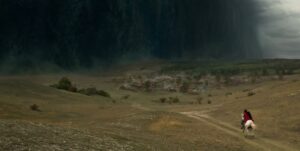
Kiffer’s Note: I just saw this bucolic scene while watching The Wheel of Time first episode. All white coats and white tents. And then, bam! We learn that the guys in white are not the “good guys” —at all—even if their name is Children of the Light.
Bucolic looking camp scene in Wheel of Time inhabited by these characters all in white.
Atmosphere
Allow the overall atmosphere and mood to imbue your writing from the get-go.
The atmosphere lends itself to the overall tone and mood of a work. Allow it to permeate your work as you write.
The atmosphere in Shadow and Bone series by Leigh Bardugo
Or Sex in the City by Carrie Bradshaw
Why use atmosphere in your first draft? (or during NaNoWriMo)?
Because it will affect your mood and approach to your story.
It will make you focus on creating unease–a necessary ingredient not always considered in early drafts.
Unease contributes to writing a page-turner.
Atmosphere underlines themes–even if you don’t have your themes nailed down yet.
Here is the link to our Writer’s Toolbox article onAtmosphere
Emotional Baggage
Know your protagonist’s main emotional wound, sometimes called baggage in real life. How is it going to affect his or her ability to solve the story problem? (See the questions below to jumpstart creativity.)
Remember that Writers (that is you) should carry a notebook everywhere you go. You never know when a brilliant solution is going to appear.Jessica Morrell
If I could offer a single piece of advice about creating characters it would be this (Jessica Morrell):
Take risks with your main characters.
Make them stand out from the myriads of fiction published each year.
And don’t be afraid to allow eccentricities, quirks, and oddball ways of seeing reality.
More questions for your protagonist from Jessica Morrell—these are guaranteed to get your creative wheels turning:
First, ask yourself these questions and then “ask” your protagonist. Have your protagonist go into depth. Find out what your protagonist’s iceberg under the waterline is all about.
Photo taken in Greenland’s waters.
Kiffer suggests that you take a walk when you are considering these questions. Be sure to either take notes or record your thoughts on your smartphone while you explore your protagonist’s emotional baggage.Walk a mile in your protagonist’s shoes.
What’s the most embarrassing thing that has ever happened to you?
What is your biggest regret?
What is your superpower?
Who do you cherish most in the world?
If you could change one thing about your world, what would it be?
What is your average day or schedule?
What 5-6 words sum up your values?
What do you do after a really bad day?
How do you celebrate?
The secret you’d never tell your significant other? Your mother? Your sibling?
What reminds you of home?
What item must you always take along when traveling?
Favorite drink?
Secret vice?
Pizza or tacos? Cookies or tequila?
Favorite climate?
Reading or television to unwind?
Breakfast or coffee only?
We hope that we helping you, Dear Writer, to arm and prep yourself to get down to the writing of your next work—the reckoning.
Ernest Hemingway: There is nothing to writing. All you do is sit down at a typewriter andbleed.
Stay tuned for more NaNoWriMo Tips // Jump Start Your Novel Tips
Chanticleer Editorial Services – when you are ready
Did you know that Chanticleer offers editorial services?We do and have been doing so since 2011.
Tools of the Editing Trade
Our professional editors are top-notch and are experts in the Chicago Manual of Style. They have and are working for the top publishing houses (TOR, McMillian, Thomas Mercer, Penguin Random House, Simon Schuster, etc.).
If you would like more information, we invite you to email Kiffer or Sharon at KBrown@ChantiReviews.com or SAnderson@ChantiReviews.com for more information, testimonials, and fees.
We work with a small number of exclusive clients who want to collaborate with our team of top-editors on an on-going basis.Contact us today!
Chanticleer Editorial Services also offers writing craft sessions and masterclasses. Sign up to find out where, when, and how sessions being held.
Jessica Morrell is a top-tier developmental editor and a contributor to Chanticleer Reviews Media and to the Writer’s Digest magazine. She teaches Master Writing Craft Classes at the Chanticleer Authors Conference that is held annually along with teaching at Chanticleer writing workshops that are held throughout the year.
Keep creating magic! Kiffer
Kathryn (Kiffer) Brown is CEO and co-founder of Chanticleer Reviews and Chanticleer Int’l Book Awards (The CIBAs) thatDiscover Today’s Best Books. She founded Chanticleer Reviews in 2010 to help authors to unlock the secrets of successful publishing and to enhance book discoverability. She is also a scout for select literary agencies, publishing houses, and entertainment producers.
You’re handing your precious book over to a beta reader to see if it’s worthwhile, ready, perhaps, for a Chanticleer Book Review or to be entered into the Chanticleer Int’l Book Awards. They look at you over the cover that you worked so many long hours on with your designer and say with all the authority of fate: “I just don’t think your main character is very likeable,” they say. “Can’t you make them more likeable? All characters should be likeable.”
Are your grumpy readers right?
Writer, they are wrong
You can of course have an unlikeable main character! If they were only willing to read for ten minutes though, you may have a more difficult problem on your hands than whether or not your character is someone they want to be friends with. Some of the most compelling characters in literature aren’t someone I’d want to share a hotel room with anytime soon.
We can sleep in separate bedrooms. Really, it’s okay.
The key isn’t to worry about whether or not your protagonist is “likeable” (which is a tricky word to define), but about whether or not they are interesting.
Are the actions they take moving the plot forward while engaging the reader at the same time? Those two things must be true of anything that happens in your story.
Manuscript Overviews and Editing
Now, if the majority of your readers are coming back to you and letting you know these early drafts aren’t working, we highly recommend a Manuscript Overview.A manuscript overview (MOV) is a broad overview of your manuscript – what’s working and what isn’t from all aspects of your story: structure, plot, pacing, character development, dialogue, etc. We are here to offer our guidance on what you need next. Save time and money by honing your work before you begin the editorial process.
Here, we’ll go through a few basic checks to make sure that your character is compelling.
On Writing Compelling Characters
There are a few questions you’ll want to ask to see if your complex character is someone who will grab your reader’s attention.
What is the Status Quo your character inhabits?
What is your character’s Desire?
How does the Conflict impede the character’s Desire?
Speaking of Secondary Characters, Severus Snape, Professor of Potions from the Harry Potter series is a prime example of uncompelling compelling character.
Severus Snape
Status Quo
This is the classic way you engage readers with your story. The story is introduced, and something happens to break the status quo. One story where this jumps to mind is Neal Stephenson’s Seveneves. With cannibalism and the end of the world, there’s no lack of unlikeable characters in this book, but all the characters rivet your attention.
Seveneves begins with the moon blowing up. Well, more accurately, with it being split into four pieces. Up until the catalyst (the breaking of the status quo), the four chunks of the moon are a point of fascination, friendly enough to have one chunk named “The Bean.” Then the status quo changes when one of the moon chunks hits another and they start to fragment even more. This gives all the characters a goal to work for: Save the Human Race. Having a strong focus for your characters will help readers empathize with them and want to know what’s happening.
Our favorite editor Jessica Morrell has an excellent article detailing even more ways to stir up trouble for your characters here.
Character Desire
Similar to the breaking of the status quo, your characters will all want something different out of the world you’ve written them in. Of course, like the breaking of the status quo, this problem won’t be easy for them to solve.
Tom Ellis as Lucifer from Netflix
There are two common methods of frustrating your character’s ability to achieve their desire. The first is simply to make it difficult to do. Anything that takes a lot of work and will make them struggle. The other excellent choice is to have them try to solve the wrong thing. So often characters misunderstand what will make them happy or they struggle to find the correct solution to their problem. By having them do the wrong thing, the reader will be able to enjoy a much more interesting story than an unlikeable person succeeding at everything they do and never growing or developing.
Cats
Who doesn’t love cats? We love cats at Chanticleer, that’s for sure!
The newest additions to the Chanticleer family: Tiefen and Biscuit at 15-weeks-old
Now the connection between cats and what to do with your unlikeable character might not be immediately clear, and it might sometimes be a metaphor rather than an actual cat. The tried and true advice is you have a character who might be a little rough around the edges save a cat early on in the story. This shows that, despite their flaws, they do care about the world around them, and they will help a creature in need. Of course, this doesn’t have to be a literal cat, but it’s something sweet the character chooses to do without being pressured.
For those of you in The Roost, Chanticleer’s online community, you know that we have been reading SAVE THE CAT, WRITES a NOVEL by Jessica Brody (based on the screenwriting books by Blake Snyder) in our Writing Craft Book Group. There is even a reading guide by Chanticleer’s David Beaumier uploaded to the activity feed.
The opposite can happen too! In Lower Decks, the irreverent Star Trek cartoon that’s currently playing on Paramount+, Beckett Mariner kills a holographic character to establish herself as the villain in a fantasy program she designed.
Beckett Mariner as Vindicta in “Crisis Point” from Star Trek Lower Decks
It’s fairly easy to flip through the first pages of your book to see if there’s a cat who your narrator can save in the early pages of your work, and then see if you can find a few beta readers to poll on their feelings.
To consider more of the timing and development of plot in relation to your characters, review this article here.
“There’s no such thing as writer’s block or plotter’s block. There’s only perfectionist’s block.” Jessica Brody
Go forth and write!
When you’re ready,did you know that Chanticleer offers editorial services?We do and have been doing so since 2011.
Our professional editors are top-notch and are experts in the Chicago Manual of Style. They have and are working for the top publishing houses (TOR, McMillian, Thomas Mercer, Penguin Random House, Simon Schuster, etc.).
If you would like more information, we invite you to email Kiffer or Sharon at KBrown@ChantiReviews.com or SAnderson@ChantiReviews.com for more information, testimonials, and fees.
We work with a small number of exclusive clients who want to collaborate with our team of top-editors on an on-going basis.Contact us today!
Chanticleer Editorial Services also offers writing craft sessions and masterclasses. Sign up to find out where, when, and how sessions being held.
A great way to get started is with our manuscript evaluation service, with more information availablehere.
And we do editorial consultations for $75. Learn morehere.
If you’re confident in your book, consider submitting it for a Editorial Book Reviewhereor to one of our Chanticleer International Awardshere.
Also remember! Our 10th Anniversary Chanticleer Authors Conference (CAC22) will be April 7-10, 2022, where our 2021 CIBA winners will be announced. Space is limited and seats are already filling up, so sign up today! CAC22 and the CIBA Ceremonies will be hosted at the Hotel Bellwether in Beautiful Bellingham, Wash. Sign up and see the latest updates here!
Writer’s Toolbox
Thank you for reading this Chanticleer Writer’s Toolbox article.