Learning another language has always been my portal to understanding the nuances of my own language, American English. Currently, I am trying to learn European Portuguese to add to my faltering French and German. It is a very slow process but still appeals to my word nerdiness that I attribute to my Latin classes in high school.
In reviewing books and many other types of media, my most frequent complaint is when the writers are lazy with their word usage. Not punctuation. Not verb agreement. Not even when the writers are being pedantic. What makes me twitch the most is Lazy Word CHOICE!
Not that the words must be sesquipedalian. (Definition at the end of the post.)
For example, the word PERFECT.
Would any of these words below be a better fit than “perfect” for conveying your thoughts with a more exact meaning?
impeccable
without fault
flawless
faultless (slightly different than flawless)
incomparable
sublime
ideal
the best
shiny new
perfection
absolutely
None of the words above are sesquipedalian (ahem), but they do have slightly different connotations to convey your thoughts more exactly, don’t they?
And now, as promised, the definition of sesquipedalia: very long words.
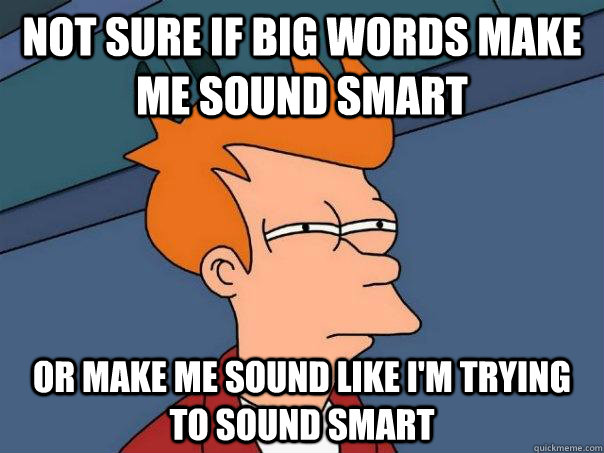
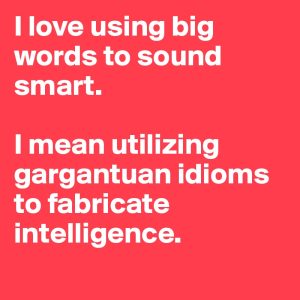
Sesquipedalian: a person who uses big words to sound smart.
Even though Diane Garland and I are lexicomanes, I hope that we do not come across as sesquipedalian. However, no one would accuse me of being pauciloquent.
Lexicomane:lover of dictionaries
Pauciloquent: using few words in speech or conversation
The main point is that as a writer, you do not want to bumfuzzle your readers or listeners.
Bumfuzzle: confuse, perplex, fluster
To bring this diverting (aka fun, I hope) post to a close, I would like to share some words that I read in a business journal that are supposed to make you sound smarter. However, their synonyms might work better in your works. It depends. Right? Right! Or as my friend with whom English is a second language admonishes me to say, “Correct? Correct!” instead of right—especially when giving directions.
articulate (well-spoken)
accolades (kudos)
brevity (concise)
adulation (excessive flattery)
anomaly (odd)
pithy (brief, clever remark)
lucid (clear and intelligible)
bespoke (custom-made)
diatribe (rant)
vitriolic (nasty, scathing comment or action)
aplomb (confidence)
resplendent (shining brilliantly)
Do you have some words that you would love to share or ones that you think should be abolished (scrapped) from the English language? Let me know!
REMINDER to WRITE FAST and EDIT SLOW
And remember to not worry about word choice when you are creating your first or second draft.
Word choice editing comes after you get your story’s first or second draft draft down in words from the “mindfilm” that you experience when you are creating a work.
I do hope that you have enjoyed reading this post at least half as much as I enjoyed writing it. Until next time,
Keep on Writing! Kiffer
Chanticleer Editorial Services – when you are ready
Did you know that Chanticleer offers editorial services?We do and have been doing so since 2011.
Tools of the Editing Trade
Our professional editors are top-notch and are experts in the Chicago Manual of Style. They have and are working for the top publishing houses (TOR, McMillian, Thomas Mercer, Penguin Random House, Simon Schuster, etc.).
If you would like more information, we invite you to email Kiffer at KBrown@ChantiReviews.com for more information, testimonials, and fees.
We work with a small number of exclusive clients who want to collaborate with our team of top editors on an ongoing basis.Contact us today!
Chanticleer Editorial Services also offers writing craft sessions and masterclasses. Sign up to find out where, when, and how sessions are being held.
No matter your writing level, your story needs a kickass main character. Now, I don’t mean you need a brawler, a bully, or beast to headline your story–instead, you need someone who readers have never met before. An unforgettable someone who fascinates and captivates. Someone who readers can care about, empathize with.
A story person who can carry the weight of your storyline.
Examples: Katniss of Hunger Games, Kirsten of Station Eleven, Jay Gatsby in the Great Gatsby, Celie in the Color Purple, Poirot in the Hercule Poirot series, Arsene Lupin of the Lupin, Gentleman-Burglar series by Maurice Leblanc, Harry Potter of the Harry Potter series.
You will notice that most of these protagonists can carry the weight of a series. Readers want to spend time with them.
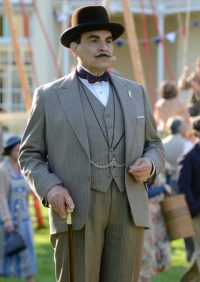
Hercule Poirot of Agatha Christie’s series
Create a worthy protagonist:
A fictional person who is about to face some of themost interesting events and hardest challenges of his or her life. Elizabeth Bennet ofPride and Prejudice is a good example.
A protagonist who hasskin in the game. Elizabeth’s situation–living with her family because she has no means of support–means she is in aninescapable position.
A character you can pile on troubles and miseries and he or shewon’t topple. Well, maybe topple, but then is capable of rising again to face the challenges of the story events. This means your protagonist can stand up to his or her opposition, enemies, and travails, however difficult.
Think about the character Kirsten Raymonde in Station Eleven by Emily St. John Mandel. Kirsten is strong, observant, and skilled in protecting herself. She struggles with the violence of the new world and the fact that she has killed other people to survive. She believes in the power of art to make her new brutal life worth living and longs to better understand the world left behind.
The protagonist, Kirsten Raymonde, of Station Eleven by Emily St. John Mandel
A character withrealistic and possibly relatable flaws. InPride and PrejudiceLizzie Bennet possesses a sharp tongue that matches her quick wit, but she’s also prone to jump to conclusions {prejudice} and might be prouder than might be good for her.
A character who is complicated and complex, which in turn leads to inner conflict.This means protagonist battles his/her circumstances hindered by his or her personality, nature, and circumstances.
Use characters with significant histories{backstory}that cast a shadow onto the present. Typically this means past traumas or troubles that somehow mess with his/her ability to face the story conflict and hardships. InPride and PrejudiceElizabeth Bennet’s family is dysfunctional, in that the father is uninvolved and distant, their mother is an ambitious busybody, and her younger sisters will chase any man in a uniform. Which is going to lead to a scandal that the family might not recover from.
Lizzie’s older sister Jane is typical of a woman of her times–Regency England–who seems to accept society’s norms and has a sweet disposition. Oh, and low expectations. Lizzie, on the other hand, is different from her sisters–a reader, a dreamer and yet a realistic type because she’s aware of her family’s flaws and disapproves of her father. But importantly, she’s a woman who will not marry unless her beloved is a perfect match.
Smiling in spite of being subject to England’s Inheritance Laws during the Regency Era.- which means they will not inherit land or the family home. Husbands will be required.
But the ultimate backdrop for this story comes from England’s inheritance laws. The family’s five daughters unable to inherit their family estate because they’re female, which creates a threat that hangs over the story. This is an excellent example of the Regency English era.
All stories need anoverarching threat. Think worst-case scenario.
Fiction typically, but not always, is told from the protagonist’s viewpoint.The pov character is the reader’s entrée into the story world, the lens we view the story through.The prideful Lizzie provides access into society’s norms and expectations for females. Thus, she serves as a reflection of the story’s themes and premise. {It is a truth universally acknowledged, that a single man in possession of good fortune, must also be in want of a wife.}
If Pride and Prejudice was told from elder sister Jane’s or Lydia’s viewpoint it would be a far different tale.
Less complex and involving, since Jane isn’t exactly a firecracker and 15-year-old Lydia’s agenda is all about romance with a dashing soldier, Mr. Wickham. No matter that his agenda is ungentlemanly at best. Then there’s the matriarch, Mrs. Bennet, who is well aware of the unfairness of inheritance laws and is determined her daughters will be married because that’s all the security they can hope for. While Mrs. Bennet is realistic, it’s doubtful she’d provide an honest perspective.
Early on in your story development, consider thinking about or perhaps outlining what the narrative would look like from your other character’s perspectives. You may gain an interesting slant to your story line. Kiffer
Seating is Limited. The esteemed WRITER Magazine (founded in 1887) has repeatedly recognized the Chanticleer Authors Conference as one of the best conferences to attend and participate in for North America.
“If you’re going to have a character appear in a story long enough to sell a newspaper, he’d better be real enough that you can smell his breath.” ~ Ford Madox Ford
She might has well been talking to three empty chairs…
You see, it’s impossible to write fiction without understanding its underpinnings such as conflict, scene structure, and character development. Without this understanding , you might write two or three or four hundred pages, but you won’t end up with a story; instead you’ll produce a lot of words on a lot of pages or a haphazard pile of scenes loosely clustered around characters who never quite come to life.
The best fiction touches the deep layers in us. A writer achieves this effect by embedding dozens of techniques into his or her story.
Do your characters sound like this?
We hope that you have found these encore posts to be useful reminders and prompts for your work-in-progress!
And in cased you missed it, here is the link to our New Year’s Eve post with the first five articles. Click here.
NOW for Kiffer’s Number One Tip for Writers in 2022!
RULE # 1
WRITE FAST! EDIT SLOW!
Don’t edit your first draft as you write it!
Writing your first draft should be a mad dash to get your story out of your brain. Don’t hinder it by worrying about each little detail. There will be time for that later.
Try to unspool the “mind-film” in your brain before reworking every sentence. Get your story out. Let the characters introduce themselves to you. Create the Atmosphere.
There will be plenty of time to craft and hone sentences later. Meanwhile, fall in love with your story. Experience the rush and the thrill of creativity!
We wish you joy and peace in the New Year from all of us at Chanticleer!
We hope to see you at the 2022 Chanticleer Authors Conference and the 2021 CIBA Banquet and Ceremony
Our 10th Anniversary Chanticleer Authors Conference (CAC22) will be April 7-10, 2022, where our 2021 CIBA winners will be announced. Space is limited and seats are already filling up, so sign up today! CAC22 and the CIBA Ceremonies will be hosted at the Hotel Bellwether in Beautiful Bellingham, Wash. Sign up and see the latest updates here!
Secondary Characters. They can drive their co-stars crazy and they can also drive the plot. They can star in their own subplots and often support the protagonist’s goals. Or thwart the protagonist’s goals.
Benny, the unforgettable secondary character in “The Queen’s Gambit” by Walter Tevis
Using characters’ eyes to reveal emotion and meaning. If you’re serious about writing, you must notice subtext and how to convey it. And that often begins with the eyes.
Beth Harmon knows she will win several moves out in this scene of Queen’s Gambit
A look at more advanced ways of considering writing from some of the best craft books to come out in the last decade. Consider the narrator in your story, structure, proportion, and, most importantly, the heart of your work.
How-To tips and examples for adding fuel your characters’ fires. Your character should always have a lot to prove and master, so he or she can get off on the wrong foot and things can go downhill from there. Naturally.
Hitchhiker’s Guide to the Galaxy protagonist, the last known Earthling – Arthur Dent
Learn how to edit ruthlessly with these top tips with handy links! Make sure you get the most out of your next round of editing for your work-in-progress.
The Editor – going over the ms with an MOV.
We hope that you have found these encore posts to be useful reminders and prompts for your work-in-progress!
We wish you joy and peace in the New Year from all of us at Chanticleer!
January 1st, 2022, we will post five more of the The Top Ten Writing Posts for 2021 along with Kiffer’s Number One Tip for Writers in 2022!
When you’re ready,did you know that Chanticleer offers editorial services?We do and have been doing so since 2011.
Our professional editors are top-notch and are experts in the Chicago Manual of Style. They have and are working for the top publishing houses (TOR, McMillian, Thomas Mercer, Penguin Random House, Simon Schuster, etc.).
If you would like more information, we invite you to email Kiffer or Sharon at KBrown@ChantiReviews.com or SAnderson@ChantiReviews.com for more information, testimonials, and fees.
We work with a small number of exclusive clients who want to collaborate with our team of top editors on an on-going basis.Contact us today!
Chanticleer Editorial Services also offers writing craft sessions and masterclasses. Sign up to find out where, when, and how sessions being held.
A great way to get started is with our manuscript evaluation service, with more information availablehere.
And we do editorial consultations for $75. Learn morehere.
If you’re confident in your book, consider submitting it for a Editorial Book Reviewhereor to one of our Chanticleer International Awardshere.
Our 10th Anniversary Chanticleer Authors Conference (CAC22) will be June 23-26, 2022, where our 2021 CIBA winners will be announced. Space is limited and seats are already filling up, so sign up today! CAC22 and the CIBA Ceremonies will be hosted at the Hotel Bellwether in Beautiful Bellingham, Wash. Sign up and see the latest updates here!
Henry Cavill stealing our hearts as Sherlock in the movie Enola Holmes. He definitely stole Kiffer’s.
When we look at writing craft, it can help to start general and then move on to specifics. Start with questions to help orient yourself toward how you will edit the work:
What do you see as the genre?
What is the climax?
How do you imagine the story’s structure?
What is the heart of the story?
The heart of the story can be more generally understood as theme, but it really boils down to where does the blood flow in the veins of the writing. I make sure that is always in my mind when editing for an author, and I recommend it for any writer who is working on a piece.
Write down the heart of your story somewhere you can always look at it—on a sticky note near your writing area, at the bottom of the document you’re working in, anywhere you can see it. Having the heart of the piece as an easy reference point lets us keep an eye on the destination as we write or edit toward the end.
The Evolving Nature of Structure
Get ready for book recommendations! In terms of structure, David recommends Jane Alison’sMeander, Spiral, Explode, whichsets the bar for how we can reimagine the shape of our books. Most stories won’t tell their author what their structure is supposed to look like until they are nearly finished.
Most of the time when we think of the structure of a story, we think of the Aristotelian spear. But story structure can look like anything! A spiral, a flower, a canoe, an inverted spear. Of course, there’s nothing wrong if your story structure does fall into this classic description, but keep in mind that doesn’t mean we close ourselves off to all other structures.
Aristotelian Spear story structure
Alison takes the idea of seeing the structure literally, recommending that writers draw out the shape of the story. To do this, she recommends visualizing summary like this “__” a scene like this “–” and a still spot (interiority or a moment where the narrator pauses and explains events) as “·”. This is the example of the structure she sees when blocking out a section of Vikram Chandra’s “Shakti”
__ __ __ __ — — — · —
You can see the pattern beginning to form, four moments of summary, followed by three scenes, a still spot, and then finishing with a scene. What do your own stories look like?
Again, usually this structure becomes visible as the story reaches completion, allowing the author to see the images and metaphors that really shape it.
Narration in Four Parts
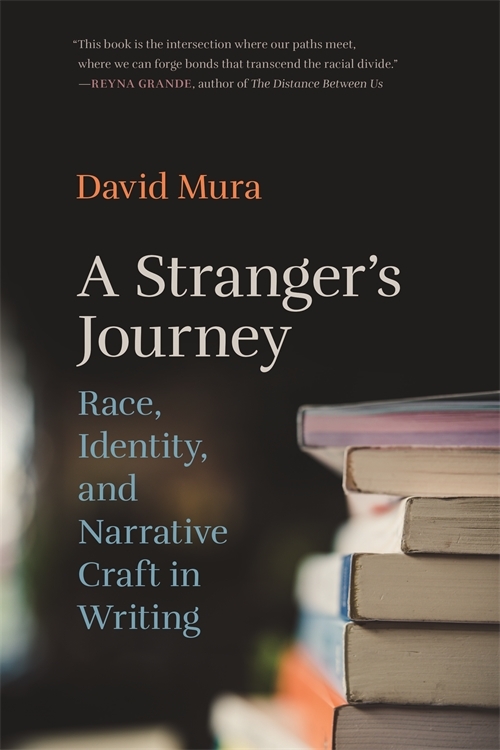
The next section here owes much to David Mura’s Book A Stranger’s Journey. At the start of his chapter “Four Questions Concerning the Narrator” Mura simply asks:
Who is the narrator?
Whom is the narrator telling her story to?
Where is the narrator telling the story?
Why is the narrator telling the story?
These simple questions open up most stories in wonderful ways that surprise and delight their authors. It changes the idea of the narrator just being the main character in their present (if so, is the narration in present first person, and does the reader only get information the main character knows?). Or perhaps the narrator is you, the author; remember you are a living, breathing, ever changing being, while your narrator becomes fixed in time the moment you put down your pen and stop the editing process. Understanding this allows the writer to slow down and understand the perspective of narration in their story.
From Avengers: Infinity War
Let’s look at a short story attributed to Ernest Hemingway to better understand these questions of narrator. The story is as follows:
For sale: baby shoes, never worn
Who is the narrator? We could say a newspaper or even the person who wrote the advertisement, possibly the parent of this child. We could also say that Hemingway is telling the story since he was asked to write a six word story.
Who is the narrator speaking to? Anyone who might want to buy baby shoes. If Hemingway is the narrator, then it’s also with the secondary desire to make the reader sad since the tragedy implied by baby shoes that have never been worn weighs heavily on us.
Where is the narrator telling the story? In the newspaper? A sign in a window?
Why is the narrator telling the story? Hard question. Maybe honestly just to sell the baby shoes. Maybe to find closure and remove the last reminders of their loss. Maybe in the hopes that someone will reach out.
In examining the narrator and understanding the relationship the narrator has with the reader, we create work with richer tone, voice, and a better understanding of what information needs to be shared.
All in Good Measure
The next book recommendation is Renni Browne and Dave King’s Self-Editing for Fiction Writers. While many of their chapters are excellent, their fourth one, “Proportion” stands out among many craft books as a unique topic. The quickest way to say this is to simply ask the writer to say what they mean to say, and then move on without spending too much time repeating the point. Often, this repetition breaks the sense of proportion needed for the story, leaving the weakest repeat to carry the weight of the scene in which it appears.
An example of this would be if the sunset was described as two Polaroids being jammed together to make the sky and land, and then describing again how the rocky cliffs were at odds with the soft clouds of sunset. Remember, choose which one seems stronger and cut the weaker one.
Most craft books touch on this as the idea of trusting the reader. Write the best story you can imagine writing, and then, after showing it to readers, you’ll understand if the way you wrote it made sense or not. Taking too much time to belabor your point will make it seem overwrought and overwritten to the point that the reader might lose interest (something I always fear when writing about proportion).
All Together
So, the key parts of craft I’m looking at here are: Heart, Structure, Narration, and Proportion. Of course, there are the traditional ones that we hear about everywhere:
Dialogue
Character
Plot
Voice
Beat
The ever present struggle between show and tell.
Of course it’s important to have a good grasp of the basics, you can’t have the four elements above without them! But understanding how you’ll put it all together in the end is what makes a work really sing.
When we finish our first draft our work suddenly transforms into a behemoth that’s impossible to approach. We’ll give you some great advice here, though if you’re at the point where you’ve done all this the next step is to find some extra eyes for your work. For an unbiased evaluation that will help you better understand what works and what needs to be improved in your book, check out our Manuscript Overviews editorial service here. Remember Kiffer’s advice to have a manuscript assessment prior to beginning line editing or copy editing. A manuscript overview/evaluation will save you time, money, and will improve your work-in-progress.
The CIBAs – Discovering Today’s Best Books and Authors
If you’ve read through this and think “I’ve done all this, and I’m ready for the next step!” Congratulations! We would recommend putting some positive attention on your book at this point. You can enter it in a Chanticleer International Book Award Contest here or submit it for a professional Editorial Review here. And remember, it never hurts to do both.
Looking for more story structure? You can find many articles here from a search of our site.
Chanticleer Editorial Services – when you are ready
Did you know that Chanticleer offers editorial services?We do and have been doing so since 2011.
Tools of the Editing Trade
Our professional editors are top-notch and are experts in the Chicago Manual of Style. They have and are working for the top publishing houses (TOR, McMillian, Thomas Mercer, Penguin Random House, Simon Schuster, etc.).
If you would like more information, we invite you to email Kiffer or Sharon at KBrown@ChantiReviews.com or SAnderson@ChantiReviews.com for more information, testimonials, and fees.
We work with a small number of exclusive clients who want to collaborate with our team of top-editors on an on-going basis.Contact us today!
Chanticleer Editorial Services also offers writing craft sessions and masterclasses. Sign up to find out where, when, and how sessions being held.
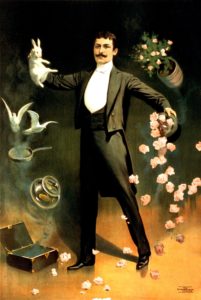
The best fiction touches the deep layers in us. A writer achieves this affect by embedding dozens of techniques into his story. The process is artful, and, I’m to report, often sly. In fact, fiction writers employ the sort of sleight-of-hand used by a magician; he distracts with patter; whispers so that we lean in to hear his low, confiding tone; surprises us when we least expect to be surprised, produces flourishes that awe with their boldness. And somehow he makes it look easy, although we know that it has taken years for him to master.
But of course, writing fiction is not easy or merely a matter of employing tricks.
Fiction writing means applying craft and artifice, and, like a conjurer’s lightening-speed maneuvers, it can be learned. You’ll look beyond the magician’s charming grin and focus on his ever-moving fingers, on the devices tucked up his sleeves, and then peer into his bag of gadgets. You start by mastering a few card tricks and then move on to a more difficult step: disassembling the magician’s contraptions, applying them to your understanding, and finally adding them to your stories.
Explore
Let’s begin with this understanding: Stories explore how interesting people act while dealing with significant problems at an important time in their lives.
Stories explore human vulnerabilities and strengths and are usually focused on a character’s goals and dilemmas.
Photo by @alessandroerbetta
Stories inquire into why people act, react, struggle and change as they do.
Stories are shaped from techniques that make the narrative lifelike and involved, complicated, and tense. And these fundamentals saturate the story with meaning which result in a deep, multi-layered world.
It seems that there are as many types of fiction configured into novels, novellas, and short stories, as there are stars in a shimmering summer sky. There are comedies, tragedies, happily-ever-after stories, horror stories, historical re-creations, fantasies, young adult stories and novels that roller-coaster along with pathos, black humor, and grim portrayals of humanity. Some novels track the affairs of the heart; others track a murderer to his hideout or a monster to his lair. Fiction can be of a serious or literary bent or can be as fluffy as cotton candy. Short stories come in all sizes, and novels weigh in at a mere 60,000 words or ramble on to 200,000 words, while most lie in between.
So the first choice of a would-be fiction writer is to choose the type and scope of the story (short, novella, novel, series, or epic?); then comes the reality of crafting it. That’s when a word-slinger-to-be discovers that creating a compelling narrative is complex and difficult. Or, that the idea for a story that seemed so dazzling and original when he first imagined it becomes flat and predictable when translated onto the page.
Adding to this reality, beginning writers are often daunted by rules and advice about how fiction is constructed. I’ve noticed that writers tackle fiction in several ways. Some writers simply ignore advice, preferring to wing it or write guided by instinct and intuition, claiming that guideline are a straight jacket to plotting and creativity. Then there are writers who take the opposite path and slavishly read every book written on the topic, outline obsessively, and work with archetypes and mythic structure. The writers in the second group often spend five, six, ten years on a manuscript, revising it so many times that it bears little resemblance to their original concept. Perhaps the healthiest approach to writing fiction lies somewhere in between.
He may be on to something…
You see, it’s impossible to write fiction without understanding its underpinnings such as conflict, scene structure, and character development. Without this understanding , you might write two or three or four hundred pages, but you won’t end up with a story; instead you’ll produce a lot of words on a lot of pages or a haphazard pile of scenes loosely clustered around characters who never quite
come to life.
A story of any length can never be haphazard or based on predictable characters. Readers want to be haunted by characters and specific scenes that linger in their memory. They want to carry their story within and as they go about daily activities. They want to be transported to another time and place. Let’s begin adding to our understanding, so that you too can create a haunting story.
Ingredients for Success
Writing fiction means you’ll be entering another realm because fiction writing requires an intense immersion into your character’s lives and your story world. And because a novel is the sum of many parts, you learn how these parts work together, then once mastered, you can add the delicate layers of techniques that are covered in these chapters.
It’s difficult to find the perfect analogy for writing fiction, but you can compare it to another kind of artistry—an elaborate meal prepared with precision by a master chef. Every element of the meal will entice, from the aromas to the presentation to the last savored morsel. There will be an array of flavors, textures, and colors all meant to beguile and satisfy, a constellation of delights. The same with works of music or art that resonant.
While a magician’s tricks happen at lighting speed and thus are difficult to discern, you can witness a chef at work, a composer hammering out her next piece, or an artist trying to capture the light or test for the perfect brushstroke, and learn from their practiced approach. For purpose of illustration, we will use the chef! You can take note of the ingredients he works with—extra-virgin olive oil and aged balsamic vinegar, fresh oregano, the finely minced garlic or ginger. You can witness how he sears the flank steak to seal in flavors and deglazes the pan to create a sauce. If you suspect that his seemingly effortless approach took years to acquire, you’d be right. But luckily, his recipe can be followed and his techniques emulated.
When it comes to fiction, think of these elements as your ingredients, not formulas. Remember, too, that cooking is a physical activity and requires forethought and analysis, as does fiction writing. When you cook a dish such as paella, you use a whole list of ingredients, but if you don’t add the correct ingredients at the correct time and fail to allow the ingredients to simmer until the flavors have melded, the dish will fail. Or, if you omit a crucial ingredient like saffron, it won’t taste authentic. Similarly, ingredients in fiction are the raw materials that combine to create a finished product, but they don’t necessarily create an involving story.
Good stories come from the vibrancy of your characters, along with the subtler aspects found between the lines. – Jessica Page Morrell
LEARN FROM THE BEST at VCAC 20!
Jessica will teach Master Writing Classes for Intermediate to Advanced Writers at VCAC20!
Jessica Page Morrell
Jessica Page Morrell is a top-tier developmental editor for books and screenplays. Her articles have appeared in Writer’s Digest and The Writer magazines. She is known for explaining the hows and whys of what makes for excellent writing and for sharing very clear examples that examine the technical aspects of writing that emphases layering and subtext. Her books on writing craft are considered “a must have” for any serious writer’s toolkit.
Jessica will teachMaster Craft Writing Classesat theChanticleer Authors Conference VIRTUAL Conference that will be held from Tuesday, Sept 8 – Sunday, Sept. 13, 2020. She will present sessions and Master Classes on September 17, & 18, 2020 in conjunction with the virtual conference. She and Kiffer will also host a fun kaffeeklatch for Word Nerds at VCAC20.
Did you know that Chanticleer offers editorial services?We do and have been doing so since 2011.
And that our professional editors are top-notch and are experts in theChicago Manual of Style.They have and are working for the top publishing houses (TOR, Macmillan, Thomas Mercer, Penguin Random House, etc.) and award-winning independent presses. If you would like more information, we invite you to email Kiffer or Sharon at KBrown@ChantiReviews.com or SAnderson@ChantiReviews.com.
We work with a small number of exclusive clients who want to collaborate with our team of top-editors on an on-going basis. Contact us today!
Writer’s Toolbox
Thank you for reading this Chanticleer Writer’s Toolbox encore edition article.
We encourage you to stay in contact with each other and with us during this stint of practicing physical distancing to prevent the spread of COVID-19 — especially at this time of re-opening.
Let us know how you are doing, what is going on where you live, how are you progressing on your writing projects.
I invite each of you to join us atThe Roost– a private online Chanticleer Community for writers and authors and publishing professionals. You are welcome to email me for more info also.
We are active onFacebook,Twitter, and Instagram. You can find us by using our social media handle @ChantiReviews
Minimize physical contact! Maximize social connecting!
Be well. Stay safe. Keep writing! Keep Creating! Kiffer
Sometimes we all need reminders to keep us on track and focused while writing. We hope that you will find these tips handy.
Make certain that a major crisis, reversal or twist occurs at the midpoint to send the story skittering in a new direction and creating new motivation for the protagonist.
Kiffer: It doesn’t matter if you are writing a lighthearted romance or a thriller or middle-grade fiction, keeping your readers guessing will keep them entertained and turning the pages.
Make certain that your protagonist is struggling with internal conflict as well as external conflict.
Kiffer: Jessica has contributed some excellent posts on creating complicated protagonists. See links below.
The reader’s first glimpse of the protagonist should evoke sympathy.
Kiffer: Think of Celie of The Color Purple, Harry Potter, Tom Ripley in the The Talented Mr. Ripley, James Bond in Casino Royale, Anne Shirley of Anne of Green Gables, Dana of Kindred, Katniss in the Hunger Games, Bella Swan in Twilight.
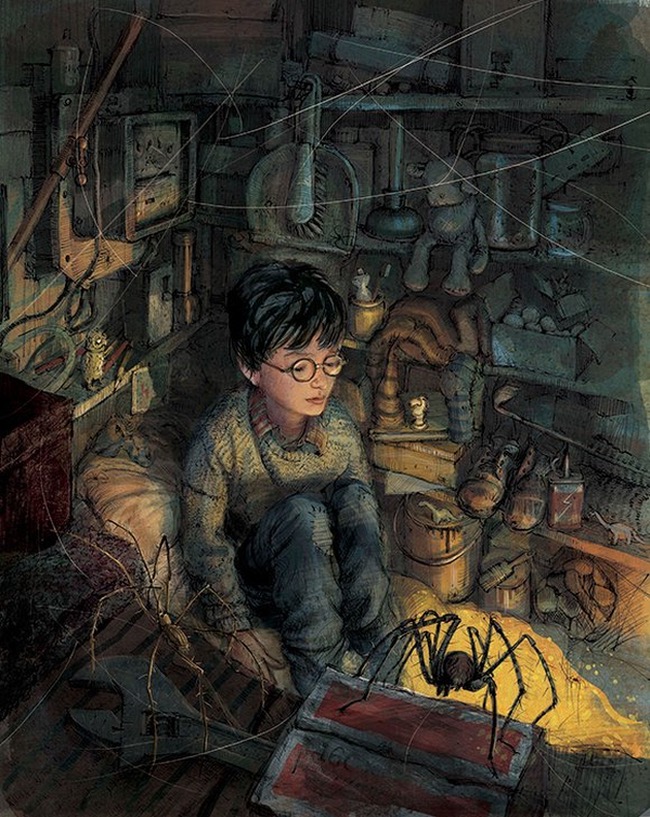
The Cupboard Under the Stairs Artwork by Jim Kay, Illustrator for the Harry Potter series.
Base fiction around a single dramatic question.
Kiffer: This will become your log-line or pitch. See link below.
Remember always that you are a storyteller first. Stories are not merely about issues or themes. Fiction is about how threatening events affect fictional people.
While a storyline requires a series of crises, surprises and reversals, do not use violence, sex, sin, gore, or murder to enliven a sagging plot.
Kiffer: This is known as lazy writing in the publishing biz. Don’t ever let yourself get labeled as a “lazy writer” by taking the easy way out.
Don’t launch a story with too many characters for the readers to track in the opening.
Kiffer: This is something that we see often when evaluating manuscripts–too many story lines cramped into one work when they should be divided out into a series or other story arcs.
Keep dialect to a minimum and don’t write it without thorough research or intimate knowledge.
Dialogue immediately reveals a writer’s skills. Use it sparingly and effectively by understanding that it is inherently dramatic. Avoid long sections of endless dialogue. Also avoid long sections where there is no dialogue. Eliminate mundane exchanges and repetitions. Limit using dialogue to reveal backstory. Keep attributions short.
Remember that the opening has much to accomplish including establishing the voice, viewpoint, tone, and pacing.
Kiffer: Most readers will determine if they want to invest time in reading a work by the opening.
Characters are revealed while acting, talking, making choices and decisions. People are what they do.
Make certain that there is a visual element on every page.
Kiffer: Scenes that are void of sensory input have a writing craft problem known as “white room” syndrome. White room syndrome is where the characters float around the scene without visuals, noise, smells, atmosphere, or tactile experiences. There is nothing to anchor the reader into the scene.
Create a vibrant and quirky cast of secondary and minor characters to enliven the story and reveal several sides of the protagonist.
Don’t start major edits or rewrites until you finish your first draft.
Kiffer: As award-winning author Michelle Rene advises: “Pour your heart and soul into the rough draft with reckless abandon.” In other words, don’t start nitpicking and ripping into your work until you have a story idea that is fully formed. Let yourself be creative! Get the story down and then go back to fill in the blanks or to do research. Enjoy the creativity of following in love with your story and characters.
Head Over Heels in Love with Your Story Idea!
Each major character has an agenda and purpose.
Avoid problems being solved by another character or force of nature.
Kiffer: Avoid Deux Ex Machina (aka dragons, lottery winnings, Prince Charming, etc.). However, there are few times when it works (these tend to be in works that explore the human psyche) such as in the Wizard of Oz when it was all a dream for Dorothy or in Shakespearean works that tend incorporate human psyche archetypes.
Beware of digressions that follow your interests or research, not the story. Rein yourself in.
Kiffer: This means that you should not use all that research that you gathered. However, all that research could become subtext and subtle undercurrents of your story. Use research as you would spice—as needed. Just because you have it (research/spice) doesn’t mean that you should use it all. #justsaying
Nothing should happen at random, all fiction is causal. Fiction is storytelling.
Structure scenes around scene goals and opposition to these goals.
Kiffer: This is the story current—imagine that your story is a river. Does it flow straight at a constant speed? Or does it bend and twist so that the readers do not know what is just around the corner? Does it have eddies? Does it have turbulence caused by huge obstacles to overcome? Does it run deep? Or shallow? Or both? Shallows can be very dangerous…
Keep writing, keep dreaming, have heart. Jessica
Keep creating magic! Kiffer
Chanticleer’s Writer’s Toolbox
Handy Links to More Chanticleer Writers Toolbox Series blog posts
Jessica Page Morrell is a top-tier developmental editor for books and screenplays. Her articles have appeared in Writer’s Digest and The Writer magazines. She is known for explaining the hows and whys of what makes for excellent writing and for sharing very clear examples that examine the technical aspects of writing that emphases layering and subtext. Her books on writing craft are considered “a must have” for any serious writer’s toolkit.
Jessica will teach theMaster Craft Writing Classesat theChanticleer Authors Conference VIRTUAL Conference that will be held from Tuesday, Sept 8 – Sunday, Sept. 13, 2020. She will present sessions and Master Classes during the conference. She and Kiffer will also host a fun kaffeeklatch for Word Nerds at CAC20.
Did you know that Chanticleer offers editorial services?We do and have been doing so since 2011.
And that our professional editors are top-notch and are experts in theChicago Manual of Style.They have and are working for the top publishing houses (TOR, Macmillan, Thomas Mercer, Penguin Random House, etc.) and award-winning independent presses. If you would like more information, we invite you to email Kiffer or Sharon at KBrown@ChantiReviews.com or SAnderson@ChantiReviews.com.
If you are partaking in NaNoWriMo, then you have made past the halfway mark by now. Congratulations!
We hope that this article will provide prompting to spur you on to the finish line!
The best fiction touches the deep layers in us. A writer achieves this effect by embedding dozens of techniques into his or her story. – Jessica P. Morrell
Dramatic Question
Compelling fiction is based on a single, powerful question that must be answered by the story climax.
This question will be dramatized chiefly via action in a series of events or scenes.
Examples:
If you are writing a romance, the question always involves whether the couple will resolve their differences and declare their love.
In a mystery the dramatic question might be will Detective Smith find the serial killer in time to prevent another senseless death?
In The Old Man and Sea, the dramatic question is will Santiago catch the big fish and thus restore his pride and reputation?
Assignments:
What is the dramatic question in Harry Potter and the Sorcerer’s Stone?
What is the dramatic question in Stephanie Myers’ Twilight Saga?
An intimate world isn’t created by merely piling on details.
It means your story world has the resonance of childhood memories, the vividness of a dream, and the power of a movie.
An intimate, simmering world is filled in with shadows and corners and dogs and ice cubes and the sounds and smells of a dryer humming on wash day and a car blaring past, with pop music shaking the windows. These details lend it authority, potency, and a palpable physical existence.
Diana Gabaldon’s The Outlander Series simmering details make this time-travel, fantasy, horror, science fiction extremely believable and immersive fiction.
Outlander — Diana Gabaldon’s details make for immersive fiction
An intimate story takes us to a specific place and coaxes us to remain there. An intimate story is lifelike and feels as real and complicated as the world the reader inhabits. When he finishes the final pages, and leaves the story world, he should feel the satisfaction of the ending, but also a huge sense of loss. Like a friend has moved to another town just when the friendship had reached a level of closeness and trust. – Jessica P. Morrell
Characters Built from Dominant Traits
Create main characters with dominant and unforgettable traits as a foundation of personality.
These traits will be showcased in the story events, will help him achieve or fail at goals, and will make the story person consistent.
For example, Sherlock Holmes’ dominant traits are that he is analytical, Bohemian, opinionated and intelligent. These traits are showcased in every story he appears in along with secondary and contrasting traits. When the character first appears in the first scene, he arrives in the story with his dominant traits intact.
Outlander’s Claire and Jamie.
Lord of the Rings‘ Gandolf
Lisa Wingate’s Before We Were Yours’ villain Georgia Tann
The Witcher by Andrzej Sapkowski
Emotional Need
The protagonists and main characters are people with baggage and emotional needs stemming from their pasts. These needs, coupled with motivation cause characters to act as they do.
For example, in Silence of the Lambs Clarisse Starling is propelled by childhood traumas to both succeed and heal the wounds caused by the death of her father.
Robert Dugoni’s Tracy Crosswhite in his The Tracy Crosswhite series.
Significance
The storyline focuses on the most significant events in the protagonist’s life.
Example: Robert Dugoni’s Tracy Crosswhite searches for the killer of her sister in his The Tracy Crosswhite series.
Craig Johnson’s Longmire series – Sheriff Walt Longmire whose wife was murdered.
Motivation Entwined with Backstory
Motivation, the why? of fiction, is at the heart of every scene, fueling your character’s desires and driving him to accomplish goals.
Motivation provides a solid foundation for the often complicated reasons for your character’s behaviors choices, actions, and blunders.
Motivating factors provide trajectories for character development, as a character’s past inevitably intersects with his present.
Your character’s motivations must be in sync with his core personality traits and realistically linked to goals so that readers can take on these goals as their own.
Desire
Desire is the lifeblood of fictional characters.
Not only do your characters want something, but they also must want something badly.
You can bestow on your character flaming red hair, an endearing, crooked grin and a penchant for chocolate and noir movies, but if she doesn’t want something badly, she’s merely a prop in your story, not a driving force. But if she wants to win the Miss Florida contest, take over her boss’ job, or become the first female shortstop for the Atlanta Braves, then you’ve got a character who will make things happen and a story that will be propelled by desire.
The Ring from Lord of the Rings is a perfect example of a symbol of desire on so many different levels.
Frodo and The Ring – LOTR by J.R.R. Tolkein
Threat
Fiction is based on a series of threatening changes inflicted on the protagonist.
In many stories, these threats force him or her to change or act in ways he or she needs to change or act.
Often too, what the protagonist fears most is what is showcased in a novel or short story. It can be fear of losing his family, job, or health with a dreaded outcome.
Fear of losing to a threat or threats provide interest, action, and conflict.
Causality
Events in fiction are never random or unconnected. They are always linked by causality with one event causing more events later in the story, which in turn causes complications, which cause more events, which cause bad decisions, etc.
A fictional character doesn’t arrive at easy decisions or choices.
Instead, he is burdened by difficult or impossible choices, particularly moral choices, that often make him doubt himself and question his actions.
Inner conflict works in tandem with outer conflict—a physical obstacle, villain or antagonist–to make the story more involving, dramatic, and events more meaningful.
Complications
A story builds and deepens by adding complications, twists, reversals, and surprises that add tension and forward motion.
Plots don’t follow a straight path. Instead, there are zigzags, dead ends, and sidetracks.
Complications create obstacles and conflict, cause decisions to be made, paths to be chosen.
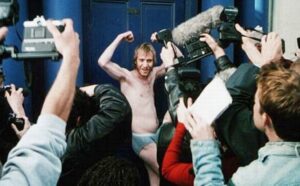
My favorite complication is one from Notting Hill when Spike is standing outside in his underwear strutting around with the paparazzi going wild for a peek at Anna Scott. How could Anna and William ever expect that complication?
A complication from Notting Hill – the film.
Midpoint Reversal
The middle of a novel comprises more than half its length.
At about the midpoint of most novels, a dramatic reversal occurs. The hunter becomes the hunted; a second murder occurs proving the detective has been wrong in his suspicions; a former lover arrives in town to complicate a budding romance.
This reversal keeps the middle from bogging down and becoming predictable and also breathes new life and often a new direction into the story.
Satisfying Ending
Every story needs an ending that satisfies the reader while concluding the plot.
A satisfying ending does not have to be “happy” or victorious or riding off into the sunset.
The final scenes, when the tensions are red hot and the character has reached a point of no return, must deliver drama, emotion, yet a logical conclusion.
This is not to suggest that every plot ends with a shoot-out or physical confrontation.
Some endings are quieter, more thoughtful. Some endings are ambivalent, some a dramatic or a violent clash of wills.
However, there is always a sense that all the forces that have been operating in your story world have finally come to a head and the protagonist’s world is forever changed.
We are cheering you on to the Finish Line! You can do it!
Jessica Page Morrell
Keep writing, keep dreaming, have heart. Jessica
Jessica Morrell is a top-tier developmental editor and a contributor to Chanticleer Reviews Media and to the Writer’s Digest magazine. She teaches Master Writing Craft Classes at the Chanticleer Authors Conference that is held annually along with teaching at Chanticleer writing workshops that are held throughout the year.
Kiffer Brown
Keep creating magic! Kiffer
Kathryn (Kiffer) Brown is CEO and co-founder of Chanticleer Reviews and Chanticleer Int’l Book Awards (The CIBAs) thatDiscover Today’s Best Books. She founded Chanticleer Reviews in 2010 to help authors to unlock the secrets of successful publishing and to enhance book discoverability. She is also a scout for select literary agencies, publishing houses, and entertainment producers.
Chanticleer Editorial Services – when you are ready
Did you know that Chanticleer offers editorial services? We do and have been doing so since 2011.
Tools of the Editing Trade
Our professional editors are top-notch and are experts in the Chicago Manual of Style. They have and are working for the top publishing houses (TOR, McMillian, Thomas Mercer, Penguin Random House, Simon Schuster, etc.).
If you would like more information, we invite you to email Kiffer or Sharon at KBrown@ChantiReviews.com or SAnderson@ChantiReviews.com for more information, testimonials, and fees.
We work with a small number of exclusive clients who want to collaborate with our team of top-editors on an on-going basis.Contact us today!
Chanticleer Editorial Services also offers writing craft sessions and masterclasses. Sign up to find out where, when, and how sessions being held.
What is it about a particular manuscript that makes it interesting to a literary agent (or the agent’s slush pile reader), acquisition editor, or professional reviewer?
While it may take more than a crystal ball to figure out exactly what lit agents and publishing houses acquisition departments want and let alone reviewers, guidance can be had. Line editors do understand what these gatekeepers want to see and, perhaps more importantly, what they do not want to see in a manuscript.
Advice from line editors can be an author’s first line of defense in climbing out of the slush pile to gaining a gatekeeper’s interest. No crystal ball required.
Jessica Morrell, a top-tier developmental editor for major authors and publishing houses, knows what these gatekeepers are seeking along with what makes them cringe.
Editors, agents, and reviewers are word people, most were English or journalism majors in college and have a great love and respect for the written word. They will notice your level of craft within the first sentences, so your efforts must be polished, vivid and exceptional.
Craft Tips & Techniques by Jessica Morrell, Editor
(with Added Comments, from Kiffer Brown, publisher of Chanticleer Reviews magazine)
Your manuscript lives or dies on your opening sentencesand each word must be perfect, precise, and weighted with meaning.
(Most slushers (who work for agents and acquisition departments) do not read past the few pages of a manuscript. Don’t blame them for not reading more of your manuscript. Slushers have more works than they can possibly read in a month but have to slush in a given day. It is the writer’s job, neigh duty, to keep the slusher engaged. Slushers are professional readers who are panning for “gold and gems in the raw.” This system is by design, btw.)
Editors notice and are turned off by passive voice and wimpy verbs.
(Enough said.)
Editors notice when the viewpoint jumps or shifts within a scene.
(This is a pet peeve of professional reviewers—an indication of lack of writing craft and skills.)
Editors notice too much telling (reporting or summary) and not enough showing in all types of writing including essays and memoir.
(A line editor can help with too much telling with comments and questions.)
Editors notice when emotions are announced instead of dramatized.
(Reviewers call this “lazy writing.”)
Editors notice the frequent use of names in dialogue. Generally, leave out names.
(Multiple names, especially names that are similar, are irritating to reviewers. When the reviewer has to make notes about who is whom it had better be for furthering the plot significantly.)
An editor notices sloppy punctuation such as excessive use of exclamation points, quote marks around inner thoughts, improper use of semicolons and ellipsis.
(Reviewers see this as the author not being professional about the work (or his or her writing career) to have it professionally proofed – the most basic type of editing.)
Editors notice protagonists who are not proactive, heroic in some way, and bigger than life. (
Reviewer’s Mantra – Novels are depictions of life without the boring bits.)
Editors notice characters with a limited emotional range and expression.
(One-dimensional character and cardboard characters are uninteresting.)
Editors notice large and small inaccuracies and inconsistencies—when the character has blue eyes on page 23 and green eyes on page 57; when a character drives an old, beat-up, pick-up truck that is inexplicably equipped with airbags; when an animal, plant, or species of any sort is misnamed or shows up in the wrong region of the country.
(Did the author care enough to do the background research for the work? These technical details’ correctness can make or break the construct of a story.)
Editors notice when technical details don’t ring true—such as in a mystery when police don’t follow standard arrest procedure; or when a yacht sinks from a single bullet hole; or explosive materials are used haphazardly. (See comment above.)
Editors notice vague descriptions (plant instead of ivy, a tree instead of oak) and generalities instead of details that bring the reader into a specific time and place.
(Vague descriptions are perceived as lazy writing which is not a reputation that an author would want to be known for.)
Editors notice when writers don’t write for all the senses, especially leaving out smells.
(This is called the white room syndrome and it makes a manuscript about as boring to read as an old school telephone book.)
Editors notice small confusions such as misusing it’s and its, that and which, affect and effect, compliment and complement, lay and lie.
(With tools (apps) such as Grammarly and Grammar Girl, there is no reason for these misuses to occur. Additionally, these basics are covered thoroughly in The Elements of Style, a slim tome that is indispensable writers.)
Editors notice overly long paragraphs and a general lack of white space. Generally, paragraphs are five or six sentences long and as taught in grade school introduce a topic, develop a topic, then conclude or lead on to the next paragraph.
(Edit, delete, cut your word count—as Stephen King says, “Kill your darlings.” The rule of thumb is that most manuscripts can be cut by 20 percent.)
Editors notice a lack of transitions—the words and phrases that announce a change in mood or emotion, time, and place so the reader can easily follow. They also know excess transitions as when you follow your characters across every room and along every sidewalk.
(Use transitions as you would salt and pepper—just enough but not too much. The correct amount of transitional phrases are the hallmark of solid writing.)
Editors notice excess modifiers, purple prose, and too much description. The best writing is lean and economical and every word in every sentence has a job to do.
(Yes! Every word must move the story forward.)
Editors notice a voice that is flat, inappropriate, or boring. Voice, whether it is the writer’s voice in an essay or the viewpoint character or narrator in fiction, must breathe life into the piece and hint at the person behind the words.
(Writing styles can mimick the guests at a cocktail party. There is always the bore who goes on and on and usually in too much detail also. The bore is the one guest who is the least tolerated even more so than the boisterous, the chatty, the tipsy, and even the know-it-all. But everyone loves the one who can tell a good story, or the who has a bit a mystery, and the one who is interested in others and respects others is always invited back. Respect your readers with your writing and your writing will earn respect.)
Chanticleer Editorial Services
Did you know that Chanticleer offers editorial services? We do and have been doing so since 2011.
Our professional editors are top-notch and are experts in the Chicago Manual of Style. They have and are working for the top publishing houses (TOR, McMillian, Thomas Mercer, Penguin Random House, etc.). If you would like more information, we invite you to email Kiffer or Sharon at KBrown@ChantiReviews.com or SAnderson@ChantiReviews.com for more information, testimonials, and fees.
We work with a small number of exclusive clients who want to collaborate with our team of top-editors on an on-going basis. Contact us today!
Chanticleer Editorial Services also offers writing craft sessions and masterclasses. Sign up to find out where, when, and how sessions being held.
Writer’s Toolbox
Thank you for reading this Chanticleer Writer’s Toolbox article.