Tag: Writers Tool Box

  • Turning Points and Plot Points in Storytelling from Jessica Morrell’s Editor’s Desk – A Chanticleer Writers Toolbox post

    Turning Points and Plot Points in Storytelling from Jessica Morrell’s Editor’s Desk – A Chanticleer Writers Toolbox post

    Jessica Morrell, Top-tiered Developmental Editor Shares Her Thoughts on Turning Points and Plot Points in Storytelling

    Jessica Page Morrell
    Jessica Page Morrell, Top-Tiered Developmental Editor

    I want to talk about the thresholds and milestones that happen in storytelling, including films. These milestones are given different names by various experts. Most commonly they’re called turning points or plot points.

    Turning Point or Plot Point Development

    Crucial Scenes

    I was recently working on a client’s manuscript and an important scene was taking place in an early chapter creating the first major turning point. It features two main characters about to make love for the first time. It’s a crucial scene because everything in the story will change after this, the stakes will rise, serious repercussions will shape their futures. It’s an especially important scene because it’s the tale of forbidden love and once they’ve crossed this line they’ve admitted censure and danger into their lives. My job is to help the writer make the scene more momentous and intense, making sure the scenes contain enough emotional clout. Because these essential moments need to create major ramifications.

    Turning points are irrevocable changes staged as events or scenes, and are where the story shifts in a new direction. They’re also thresholds so characters pass through into a new situation. These moments, always shown via action, usually have an emotional change that comes with them. –Jessica Morrell

    Before this event, things might return back to normal; afterward, it’s a whole new game.

    One Way Gates

    As I’ve mentioned here before, effective fiction takes your main characters into new physical and emotional territory. Turning points are the thresholds to the other side. They signal the reader that danger and shifting tides lie ahead. I like to think of them as one way gates.

    The new territory can also be new spiritual territory, where principles, beliefs, and hearts are tested. Also, they are often tests and reveal what your protagonist is made of.

    And while turning points shift the direction of the story, keep in mind is that they’re also emotional turning points. I was thinking about them yesterday and how they snatch a protagonist from his or her comfort zone and thrust him or her into a threatening situation.

    Let’s look at The Hunger Games to help identify these crucial moments. It’s the first book in Suzanne Collins dystopian series that takes place in Panem, a country that’s formed after the collapse of North American governments.

    Inciting Incidents

    The inciting incident or catalyst happens on Reaping Day, an annual lottery where each of Panem’s 12 Districts must send two ‘tributes’ to participate in the state-sponsored, fight-to-the-death Hunger Games while the whole country watches the gruesome contest. Because the underlying brutality of the governing regime is an omnipresent threat. The winning district receives food. 
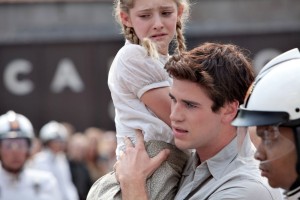
    Reaping Day in The Hunger Games – Gale and Prim (Katniss’ little sister).

    The story reprises the virgin sacrifices that existed in many cultures along with nods to mythical happenings. But then Collins has borrowed liberally from mythology and gory human history including a mashup of Dust Bowl imagery, a Nazi-like regime including the architecture, symbolism, and vicious stormtroopers, along with a hideous disparity between the classes.

    Complications

    At the Reaping, Katniss Everdeen volunteers to replace her 12-year-old sister Primrose in the deadly Games.

    Central Dramatic Question

    This creates the central dramatic question: Will Katniss survive? Then Peeta Mellark is chosen from District 12 too, and wouldn’t you know it, they have some history together because one of the rules of storytelling is Complicate, Complicate, Complicate.

    Katniss and Peeta leave home for the Capital (a threshold) and that’s when readers and movie-goers find out just how twisted and corrupt the Panem leadership is.

    Katniss and Peeta see just how wealthy the governing body is and how poor they are on the deluxe train ride.

    Plot Points Pushing Ahead the Plot’s Trajectory

    It turns out that Peeta is secretly in love with Katniss. Because Katniss needs to win to save her family, this is another complication in an already ghastly competition. Does she care about him too? Will she be forced to turn into a soulless killer to survive? The turning points that follow keep changing and pushing ahead the plot’s trajectory, but all affect her goal to survive.

    Katniss and Peeta decide to become allies and feign love in order to increase their chances of survival. Because the heartless denizens of the Capital love a love story in the midst of their killing field. Back in District 12 Katniss had learned to hunt to feed her family since her father had died in a mining accident. During the exhibition before the Games she gains notice for her archery skills.

    Atmosphere and Landscape

    Another turning point happens when the tributes enter the Arena – a nightmarish landscape where the rules keep changing, monsters and walls of flames appear out of nowhere. And can we just reiterate that these are children and teens operating in this whole blood-soaked nightmare?

    The children and teens from the 12 districts that must fight to the death until there is one survivor. Then, his or her district will receive food. The Hunger Games.

    Secondary Characters: Reflections of the Protagonist and Antagonist 

    The youngest tribute from District 11 is Rue and she represents innocence and all that’s wrong with the government and Games. Though agile and wily, she seems doomed or at least underestimated.

    Once the Games begin in the mad scramble to secure weapons and supplies Peeta and Katniss become separated.

    Katniss has been chased up a tree for safety and that’s when she hears a bird-like call. Rue is nearby in a tree. She warns Katniss of a nearby nest of deadly tracker-jackers (genetically-modified bee monsters). Katniss saws off the branch and the tracker jackers swarm on their adversaries. The girls become allies and readers, and viewers recognize that Rue is surrogate for her sister Prim.

    Rue warning Katniss about the deadly nest of robot yellowjackets.

    As allies they concoct a plan to destroy the Cornucopia, a huge stash of weapons and supplies.

    Reversals and Ramifications

    Returning to Rue after Katniss succeeds, she witnesses her being murdered by another tribute. It is a major turning point in the story.

    The fallout cannot be overstated:

    • Katniss changes from a hunter to a killer, first taking out Rue’s murderer.
    • The story slows down briefly so Katniss can process her grief and feelings.
    • The slave-like conditions the citizens of Pandem live under is emphasized by Rue’s senseless death.
    • It reinforces Katniss’ desire to survive – she will win for Rue.
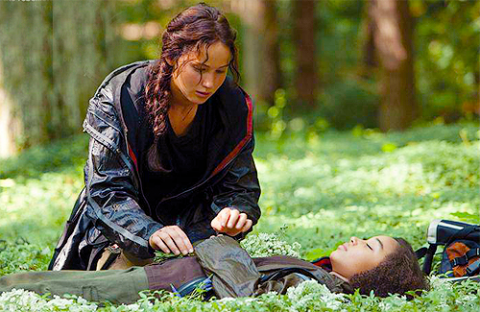
    • Katniss openly defies the Capital when she rings flowers around Rue’s corpse, showing her affection and respect.
    • Katniss uses her weapon for good when cutting flowers to honor Rue.

    The link to this emotional scene is here.

    Then with the Games’ cameras rolling, and honor and respect has been shown to Rue’s corpse, Katniss stands and salutes (as tribute) the other district’s people who are watching via he Games’ cameras, marking her defiance and the beginning of a rebellion. We’re talking major ramifications.

    Katniss’ symbol of defiance and respect is televised to all the districts in the Hunger Games. This simple gesture starts a movement.

    Later, Katniss’ compassion toward Rue saves her own life because Rue’s district sends her food – once again breaking the rules of the Games.

    Before: Rue and Katniss are allies and sisters in the struggle for survival.

    After:  Katniss would rather die than let the government regime win or steal her humanity.

    Question for Writers: What are the before and after statuses in your turning points for your work-in-progress?

    Another excellent example of plot points and turning points is The Toy Story series. It has terrific examples of thresholds that are easily identified because the characters often land in a new setting as they pass through each threshold.

    *Still photos copyright Lion’s Gate Entertainment

    Keep writing, keep dreaming, have heart. Jessica

    Jessica Morrell is a top-tier developmental editor and a contributor to Chanticleer Reviews Media and to the Writer’s Digest magazine. She teaches Master Writing Craft Classes at the Chanticleer Authors Conference that is held annually along with teaching at Chanticleer writing workshops that are held throughout the year. We suggest visiting her website for more articles on writing and the writing life. 


    When you’re ready, did you know that Chanticleer offers editorial services? We do and have been doing so since 2011.

    Our professional editors are top-notch and are experts in the Chicago Manual of Style. They have and are working for the top publishing houses (TOR, McMillian, Thomas Mercer, Penguin Random House, Simon Schuster, etc.).

    If you would like more information, we invite you to email Kiffer or Sharon at KBrown@ChantiReviews.com or SAnderson@ChantiReviews.com for more information, testimonials, and fees.

    We work with a small number of exclusive clients who want to collaborate with our team of top editors on an on-going basis. Contact us today!

    Chanticleer Editorial Services also offers writing craft sessions and masterclasses. Sign up to find out where, when, and how sessions being held.

    A great way to get started is with our manuscript evaluation service, with more information available here.

    And we do editorial consultations for $75. Learn more here.

    If you’re confident in your book, consider submitting it for a Editorial Book Review here or to one of our Chanticleer International Awards here.

    Our 10th Anniversary Chanticleer Authors Conference (CAC22) will be April 7-10, 2022, where our 2021 CIBA winners will be announced. Space is limited and seats are already filling up, so sign up today!  CAC22 and the CIBA Ceremonies will be hosted at the Hotel Bellwether in Beautiful Bellingham, Wash. Sign up and see the latest updates here!


    Robert Dugoni
    Robert Dugoni is one of our most popular speakers at the Chanticleer Author Conference.

    Writer’s Toolbox

    Thank you for reading this Chanticleer Writer’s Toolbox article.

    Writers Toolbox Helpful Links: 

    At Its Core, the ‘Twilight’ Saga Is a Story About ________

    The INCITING INCIDENT: STORY, SETBACKS and SURPRISES for the PROTAGONIST

    BEATS & CONFLICT: The Engine for Your Book

  • COMMON FICTION ERRORS – a Checklist from Jessica Morrell’s Editor’s Desk and Kiffer Brown – a Chanticleer Writer’s Toolbox post

    COMMON FICTION ERRORS – a Checklist from Jessica Morrell’s Editor’s Desk and Kiffer Brown – a Chanticleer Writer’s Toolbox post

    Sometimes knowing what not to do is helpful in writing your work-in-progress.

    Jessica Morrell, top-tiered developmental editor, and Kiffer Brown share with us on what to keep in mind as you create your work with this handy list.

    • Not knowing your ending as you write.
      • This lack of  direction not only makes the process more difficult, but results in missed opportunities to insert foreshadowing and clues.
    • Hooks: The opening hook does not raise a compelling question and relate to the whole.
      • Do the individual chapters contain their own hooks to compel the reader to turn the page?
    • Inciting Incident. Not having a catalyst for your story. What is yours?

      Your readers waiting for the inciting incident.
    • Flat Characters. Not understanding your main character, especially how he or  she is  shaped by the past, and using these factors from the past along with motivations as the basis for the plot. Causality.
      • Not giving your main character tangible goals and motivations.
      • Are your characters introduce
    • Lack of Tension. Not making the stakes high enough.
      • Without high stakes, the reader won’t care.
    • Smooth Sailing—does not make for great storytelling. Not creating obstacles for the character to struggle against.
      • Without obstacles, the story will not have enough tension or suspense—even it is a light-hearted romance or a humorous piece.
    • Whatever. Not involving your readers emotionally.
      • It’s important that the reader take on the character’s goals while entertaining them with the events of the story.

    • Yada Yada Yada. Adding needless flashbacks. Dumping backstory.
      • Use flashbacks only if they add drama and reveal information that cannot be told through present action.
      • Are the first 40 pages for your benefit and not the reader’s?
    • Dialogue: Do your characters all sound alike?
      • Dialogue is generally too long, mundane or  stilted. Do your characters tend to give speeches? Don’t let this happen.
      • Remember, most dialogue exchanges should contain conflict. As Robert Dugoni states: “Dialogue is Action. Action is Dialogue.”
    • Development: Not understanding that fiction requires introducing change throughout the story.
      • Insert enough complications, surprises, reversals, and new elements to create tension, suspense, and to force the reader to discover how these complications turn out.
    • Saggy Middle? Not inserting a major complication or reversal in the middle of the story to push the plot into a fresh direction and increase the reader’s interest. Just when you your reader thinks she knows what happens next, the unthinkable happens.
    • White Room Syndrome. Not writing enough setting details  to create a vivid, real world.
    • Lack of Atmosphere. Not realizing that  setting can interact with plot and character and affect the mood and tone.
    • Dearth of Causality. (Yes, again) Do not forget that causality is a prime factor in plotting.
      • A plot is not a series of random scenes, but connected through a chain of causal, interrelated events.
    • Unsatisfactory ending. Does  your conclusion fail to offer a big pay off.
      • As the plot concludes, tensions are unbearable, and a point of no return is reached. The conflicting forces should meet in a face-to-face contest that resolves the issues, reveals a winner, or at least changes how things look. The ending does not have to be happy, but it does need to be satisfying—even if there is more story to come and more plot questions to answer.

    The best fiction touches the deep layers in us. A writer achieves this effect by embedding dozens of techniques into his or her story. An intimate story takes us to a specific place and coaxes us to remain there. An intimate story is lifelike and feels as real and complicated as the world the reader inhabits. When he finishes the final pages, and leaves the story world, he should feel the satisfaction of the ending, but also a huge sense of loss. Like a friend has moved to another town just when the friendship had reached a level of closeness and trust. — Jessica P. Morrell


    Jessica Page Morrell

    Keep writing, keep dreaming, have heart. Jessica

    Jessica Morrell is a top-tier developmental editor and a contributor to Chanticleer Reviews Media and to the Writer’s Digest magazine. She teaches Master Writing Craft Classes at the Chanticleer Authors Conference that is held annually along with teaching at Chanticleer writing workshops that are held throughout the year. 


    Kiffer Brown

    Keep creating magic! Kiffer 

    Kathryn (Kiffer) Brown is CEO and co-founder of Chanticleer Reviews and Chanticleer Int’l Book Awards (The CIBAs) that Discover Today’s Best Books. She founded Chanticleer Reviews in 2010 to help authors to unlock the secrets of successful publishing and to enhance book discoverability. She is also a scout for select literary agencies, publishing houses, and entertainment producers.


    When you’re ready, did you know that Chanticleer offers editorial services? We do and have been doing so since 2011.

    Our professional editors are top-notch and are experts in the Chicago Manual of Style. They have and are working for the top publishing houses (TOR, McMillian, Thomas Mercer, Penguin Random House, Simon Schuster, etc.).

    If you would like more information, we invite you to email Kiffer or Sharon at KBrown@ChantiReviews.com or SAnderson@ChantiReviews.com for more information, testimonials, and fees.

    We work with a small number of exclusive clients who want to collaborate with our team of top editors on an on-going basis. Contact us today!

    Chanticleer Editorial Services also offers writing craft sessions and masterclasses. Sign up to find out where, when, and how sessions being held.

    A great way to get started is with our manuscript evaluation service, with more information available here.

    And we do editorial consultations for $75. Learn more here.

    If you’re confident in your book, consider submitting it for a Editorial Book Review here or to one of our Chanticleer International Awards here.

    Our 10th Anniversary Chanticleer Authors Conference (CAC22) will be April 7-10, 2022, where our 2021 CIBA winners will be announced. Space is limited and seats are already filling up, so sign up today!  CAC22 and the CIBA Ceremonies will be hosted at the Hotel Bellwether in Beautiful Bellingham, Wash. Sign up and see the latest updates here!


    Robert Dugoni
    Robert Dugoni is one of our most popular speakers

    Writer’s Toolbox

    Thank you for reading this Chanticleer Writer’s Toolbox article.

    Writers Toolbox Helpful Links: 

    At Its Core, the ‘Twilight’ Saga Is a Story About ________

    The INCITING INCIDENT: STORY, SETBACKS and SURPRISES for the PROTAGONIST

    BEATS & CONFLICT: The Engine for Your Book

  • BEATS & CONFLICT: The Engine for Your Book — A Chanticleer Writing Toolbox Primer Article by David Beaumier

    BEATS & CONFLICT: The Engine for Your Book — A Chanticleer Writing Toolbox Primer Article by David Beaumier

    Structure, Conflict, & Beats — Bringing it All Together

    Conflict is key to any story. Even if the stakes are low and the show is purportedly about nothing, like in Seinfeld, the characters are motivated and pushed through new changes. As writers continually produce work, we are always revisiting the ways in which we understand writing.

    Kramer, George, Elaine, and Jerry from the TV show Seinfeld
    The Cast of Seinfeld – A Series about Nothing

    One of the newest, most popular writing craft books is Jessica Brody’s Save the Cat! Writes a Novel, which promises to be the last book you’ll ever need for novel writing, but one can never have too many books, especially on craft.

    At Chanticleer, We Love to See Story Come to Life

    The biggest feedback we give to authors in our Awards or for our Editorial Reviews is that, while the story was well-written and error-free, there was not much actual story that happened in it. For that reason, we always recommend that authors commit to a Manuscript Overview to make sure they’re heading in the right direction with their Work in Progress. Read more about those here.

    So We’re Talking About Dialogue Beats Here?

    If you’re interested in making your dialogue sing, that’s wonderful, and we recommend you do work to make sure all that interstitial tissue in your book is doing what it needs to do, but this toolbox article will focus on the overarching structure questions in terms of beats. If you’re interested in reading more about dialogue mechanics this article here from Margie Lawson has some great suggestions on language and beats!

    Beats not beets!
    Beats not beets!

    We Are Talking About Conflict

    Conflict is the engine that motivates a book. It doesn’t need to be zombies coming to destroy the world, but it has to be your main character’s desire for change (which often isn’t really their true desire at the start of the story). What we’re going to look at here is the way characters are motivated and approach the ending theme as they move through the book.

    Save the Cat really shines in the way it points out that characters are often given the answer to all their life’s troubles early on, but they resist it throughout the story. One great example is Benjamin Sisko at the start of Star Trek: DS9.

    When Sisko arrives on Deep Space Nine to take command of the station, all he wants is to keep running from the past with his son Jake. He doesn’t realize that this assignment is the beginning of his journey to healing from the terrible trauma of losing his wife two years ago. All the tools are there for him to create a home where he is, but he doesn’t understand this until maybe Season 5 of the show, and by that point, his desires have totally morphed in response to the environment he found himself in.

    At least Season 4 Benjamin Sisko sitting at his desk in his Starfleet Uniform
    Captain Benjamin Sisko of Deep Space Nine (of the Star Trek Universe)

    As Sisko moves from season to season, we see each point of growth and story structure as beats from which he grows and changes.

    Story Structure as Beats

    First off, what are beats?

    Think about white space in a sketch for a painting. All the lines that make up the body of the work are the dialogue of your piece–it gives the plot, characters, and conflict a structure to work within. The beats are the color that fills it in, showing the reader a complete picture of what’s taking place. As you write, ask yourself if you’re better at overwriting and then trimming back or underwriting and fleshing out. Play to your strengths for your first draft, and then come back ready to adjust for any areas you know you’ll be weak.

    Worth Repeating

    As you write, ask yourself if you’re better at overwriting and then trimming back or underwriting and fleshing out. Play to your strengths for your first draft, and then come back ready to adjust for any areas you know you’ll be weak. David B.

    Let’s look at the overall structure of a book

    Let’s start out with Save the Cat. In this book, Brody breaks out most plots to follow the following Structure:

    • Opening Image
    • Theme Stated
    • Catalyst
    • Break into 2
    • B Story
    • Midpoint
    • All is Lost
    • Break into 3
    • Final Image

    Each of these big sections is subdivided into categories based on how many scenes move it forward, which are further defined as multi-scene beats or single scene beats. Some of them are obvious, like the Opening Image and Closing Image tend to be a single scene beat where we get in and fulfill that need for the writing, and then get out. While most of these make sense just by glancing at them (or you can figure out that Catalyst is another way of saying The Inciting Incident), here’s a quick guide to some of the wonkier names from Save the Cat.

    Cove a Save the Cat, orange background with yellow lettering and an orange cat clinging to a dangling rope

    Break Into 2 & Break Into 3

    This refers to Acts 2 and 3 of your story. Brody focuses on the 3 Act structure for novel writing, which does fit the majority of work out there. For differing ideas on how to structure a book, be sure to check out our article here.

    The focus for the Break Into parts is on marking a clear delineation between your Acts. An example Brody uses is Jane Eyre, with Act I being her mistreatment and time at school, Act II being her role as governess for Mr. Rochester, and Act III being her escape from St. John and return to Mr. Rochester as an independent woman.

    B Story

    Often the introduction of B Story introduces the character who will help your protagonist learn the theme or lesson that they will need in order to grow properly by the end of the story. They are a helper-character who represents the new world of Act II that your main character enters. Keeping with Jane Eyre, Mr. Rochester is a foil to Jane’s meekness that forces her to stand up for herself and push back against his rude brashness, pushing her to change.

    Jane Eyre and Mr. Rochester about to kiss
    Mia Wasikowska and Michael Fassbender in the 2011 Jane Eyre film – Charlotte Bronte 1847

    Clear as Mud?

    Rather than write out all of Save the Cat, Jessica Brody has already mostly done it for you here. And Brody isn’t alone in having great ideas of how to look at the intersection of conflict and structure!

    Click on the link above to read more about Brody’s 15 Beats of Story Telling. We are not affiliates of Brody or Wolf 359, but we are passionate about sharing the best tools with Chanticleerians. Kiffer

    There is a wonderful breakdown of story structure that is quite similar written by Gabriel Urbina to describe the story structure for the brilliant SciFi podcast Wolf 359, written by Urbina, Sarah Shachat, and Zach Valenti. You can read his breakdown of the story structure here and learn more about Wolf 359 here.

    Our own Jessica Morrell, of course, has a brilliant take on Story that focuses more on different aspects such as character, structure, and plot which can be found here.

    Beat Sheets Will Meet You Where You Are

    The great thing about this tool is you can use it to plot out the work you’re planning or to analyze the work that you have. Brody’s cheat sheet linked above even offers general percentages on how long each section of the Save the Cat structure should take. Remember that different genres have different typical lengths, and keep those lengths in mind as your write and plot. And, as always, the work is yours; these are just guidelines, not hard and fast rules for success.

    Be sure to get more than your eyes on the work! Beta readers and friends are great, but nothing beats a professional Manuscript Overview you can get from Chanticleer.


    Chanticleer Editorial Services – when you are ready

    Did you know that Chanticleer offers editorial services? We do and have been doing so since 2011.

    Tools of the Editing Trade

    Our professional editors are top-notch and are experts in the Chicago Manual of Style. They have and are working for the top publishing houses (TOR, McMillian, Thomas Mercer, Penguin Random House, Simon Schuster, etc.).

    If you would like more information, we invite you to email Kiffer or Sharon at KBrown@ChantiReviews.com or SAnderson@ChantiReviews.com for more information, testimonials, and fees.

    We work with a small number of exclusive clients who want to collaborate with our team of top editors on an ongoing basis. Contact us today!

    Chanticleer Editorial Services also offers writing craft sessions and masterclasses. Sign up to find out where, when, and how sessions being held.

    A great way to get started is with our manuscript evaluation service. Here are some handy links about this tried and true service: https://www.chantireviews.com/manuscript-reviews/

    And we do editorial consultations. for $75.  https://www.chantireviews.com/services/Editorial-Services-p85337185

    Writer’s Toolbox

    Thank you for reading this Chanticleer Writer’s Toolbox article.

    Writers Toolbox Helpful Links: 

    Rhythm and Cadence and Beats, Oh Yes! by Margie Lawson

    Understanding Story Structure by David Beaumier

    How to Write Your Novel Using the Save the Cat Beat Sheet

    10 Point Story Structure

    COMPONENT LAYERS of SUCCESSFUL FICTION by Jessica Morrell 

    The traditional publishing tool that indie authors can use to propel their writing careers to new levels?  https://www.chantireviews.com/2016/05/15/the-seven-must-haves-for-authors-unlocking-the-secrets-of-successful-publishing-series-by-kiffer-brown/

  • Character Development, Dialogue, and Beats, a Chanticleer Writers Toolbox Article by David Beaumier

    Character Development, Dialogue, and Beats, a Chanticleer Writers Toolbox Article by David Beaumier

    Understanding What Makes Good Character Development

    Character Development is a tricky matter. In this article we’ll go through the basics of setting up what your character does and how you describe them, coupled with the idea of beats in dialogue.

    A character sketch model covered in paint
    Artists all over use character models!

    Consider the following excerpt from a recent work in progress from a friend of Chanticleer:

    In the guest room we have spider plants that have often refused to die in the past. They grow everywhere and propagate like mad, their white and green spear-like leaves overflowing any pot we put them into. We keep them trimmed back carefully, letting them give us plenty of fresh oxygen while at the same time making sure our space isn’t entirely overrun.

    This description comes in the middle of getting something for another character, and there are 4 paragraphs of plant and room descriptions. Four! That’s too much narrative description that adds little to the story and does nothing to build tension. Now look at the revision of all those paragraphs:

    I head out to the kitchen. I don’t see Mom, but this is the week we’re supposed to water the plants, so I fill up our yellow watering pail with a comically long spout that aids in watering closer to the base on the plants. The red and green leafed crotons in the kitchen next to the sink are first, then the fishtail palm in the bathroom that always wants more water despite the wetness of its location, the spider plants in the office, my kalanchoe was watered last week, and then I finish with the lemon tree. The lemon trees petals are almost all gone, which means we’ll have meyer lemons soon, but any sweet smell it had recently is gone.

    Red and Green Succulent Plant

    Now, in addition to understanding that the character is looking for their mother. The plants appear in a flash, coupled with the action of being watered, and we end on the lemon tree, which promises something good, but right now seems rather lackluster, which mirrors the mood of the overall scene. This quick summary helps the story move from prolonged description that will make the reader’s eyes glaze over, and instead moves us from one point to the next.

    Interested more in secondary characters? Learn more about them from the one and only Jessica Morrell here. For more that focuses on general background characters, try this article from Skip Ferderber here.

    So when do we put in a little summary for the character?

    Renni Browne and Dave King say the following in their book Self-Editing for Fiction Writers:

    If your characters actually act the way your summaries say they will, the summaries aren’t needed. If they don’t, the summaries are misleading. Either way, your fiction is likely to be more much effective without the character summary

    In terms of time progression in a story summary is a way of storytelling where a little is described to cover a large period of time. It helps to have it balanced with scenes where action and time are equivalent, or moments of interiority where a lot happens in almost always a slow point in the narrative. However you choose to do it, make sure there’s a good balance in terms of time in your work, and that scene is often the driving force.

    A balance scale holding two question marks.

    Looking for tips to streamline your dialogue? Make it more potent with tips from Jessica Morrell here.

    Unobtrusive ways to develop Character

    • Learn their history so that when you write them it will come out intuitively
    • Show how other characters react to them directly.
    • Show how the world interacts with them as they move through it.

    That’s well and good, but how do you measure your character development? Well, we’re glad you asked:

    • How much time do you spend describing characters?
    • Are you telling us characteristics that will show up later in dialogue and action?
    • How much of the character’s history have you explored with the reader? Does the reader need all of that information, or does the story read well without it? If so, when do they need to know it

    Dialogue Mechanics

    A famous author once called dialogue the purest form of scene.

    Dialogue bubble, Photo booth props free printables

    Obviously there are moments where this is wrong, such as when the dialogue is done as a form of telling.

    “Hi Joe, I haven’t seen you since the divorce with June after you came back from the war!”

    A person answering the phone in a friendly manner
    You may remember plays where it starts out with someone answering the phone and setting up the plot by responding to the person on the other end.

    However, the idea of telling that sneaks its way most prominently into dialogue mechanics is the dialogue tag, often accompanied by an adverb. Consider Newgate Callander of The New York Times Book Review take on the wildly successful Bourne Ultimatum series:

    Mr. Ludlum has other peculiarities. For example, he hates the “he said” locution and avoids it as much as possible. Characters in “The Bourne Ultimatum” seldom “say” anything. Instead, they cry, interject, interrupt, muse, state, counter, conclude, mumble, whisper (Mr. Ludlum is great on whispers), intone, roar, exclaim, fume, explode, mutter. There is one especially unforgettable tautology “‘I repeat,’ repeated Alex.’

    The book may sell in the millions, but it’s still junk.

    Let’s take it further and look at even more examples of redundant or overemphasized dialogue tags:

    • “I’ll kill your whole family,” he hissed maliciously.
    • “You can’t be serious,” she said in astonishment.
    • “Give it to me,” she demanded
    • “Here it is,” he offered.
    • “Is it loaded?” she inquired?

    These all share one thing—they fear the use of “said.” Sure, sometimes a word other than “said” will help break things up for variety’s sake, but “said” is almost always proper and good to use.

    “Said” is essentially a punctuation mark for readers. It serves the purpose of helping them track who said what in a dialogue.

    See what Peter Greene says about realistic dialogue in his interview here.

    Adverbs: Friend or Foe

    2016-2017 Psychic Yes Or No Oracle - Get Accurate Answers
    To be or not to be

    Adverbs are the enemy much of the time in dialogue. There is almost always a better word to use. Putting in a prop like the dreaded -ly will make your dialogue seem weak, even if it isn’t.

    The only real exception to the rule is with the dialogue tag “said” because it’s so ubiquitous that it can allow for some extra description on occasion. Remember, the dialogue will often do the work of setting the tone for you.

    Gabriel García Márquez would eliminate all adverbs from his writing, choosing instead to use the word in another form.

    For example, instead of “he said softly” I would write “he said, his voice soft”

    A few general tips:

    • Pronoun substitutions are fine
    • Renaming the character can be wonky. Dave, Mr. Winchester, The Sheriff, the officer, the lawman, CHOOSE!
    • New speaker/new action means a new paragraph!
    • Ending with a dialogue tag uses a comma. Ending with an action uses a period. Ex: “Hey there,” he said. vs “Hey there.” He scratched his chin.
    • This indicates interruption: “Now wait just—”
    • This indicates trailing off: “Now wait just a second…”

    Again, consider how you measure these things.

    • Check your dialogue for explanations. Consider bringing a highlighter for this job.
    • Cut the explanations and reread your dialogue. If it reads worse, you may need to rewrite your dialogue.
    • Mark every adverb related to dialogue. How many of them are based on adjectives describing emotion? Which ones can you cut?

    Woman student highlighting with text marker in document

    Beats in Character Development

    Let’s pause here to talk a little bit about beats and figure out how to us them to balance out dialogue. Again, using an example from Self-Editing:

    “But didn’t you promise…” Jessie said.

    “I did nothing of the sort,’ Tyrone said.

    “Now, look, you two—” Dudley said.

    You stay out of this,” Tryon said.

    VS.

    “But didn’t you promise…” Jessie said.

    “I did nothing of the sort,’ Tyrone said.

    Dudley stepped between them and held up his hands. “Now, look, you two—”

    Tyrone spun on him. “You stay out of this.”

    Just like the saids, there can be too many beats, so be careful how you balance it.

    Think about white space in a sketch for a painting. All the lines that make up the body of the work are the dialogue of your piece–it gives the plot, characters, and conflict a structure to work within. The beats are the color the fill it in, showing the reader a complete picture of what’s taking place. As you write, ask yourself if you’re better at overwriting and then trimming back or underwriting and fleshing out. Play to your strengths for your first draft, and then come back ready to adjust for any areas you know you’ll be weak.

    Glass Painting : 10 Steps (with Pictures) - Instructables

    The beats tie your dialogue together. Map them by marking the descriptions you have interspersed within your dialogue.

    Make your beats sing by seeing what Margie Lawson has to say about rhythm and cadence here.


    Chanticleer Editorial Services – when you are ready

    Did you know that Chanticleer offers editorial services? We do and have been doing so since 2011.

    Tools of the Editing Trade

    Our professional editors are top-notch and are experts in the Chicago Manual of Style. They have and are working for the top publishing houses (TOR, McMillian, Thomas Mercer, Penguin Random House, Simon Schuster, etc.).

    If you would like more information, we invite you to email Kiffer or Sharon at KBrown@ChantiReviews.com or SAnderson@ChantiReviews.com for more information, testimonials, and fees.

    We work with a small number of exclusive clients who want to collaborate with our team of top-editors on an on-going basis. Contact us today!

    Chanticleer Editorial Services also offers writing craft sessions and masterclasses. Sign up to find out where, when, and how sessions being held.

    A great way to get started is with our manuscript evaluation service. Here are some handy links about this tried and true service: https://www.chantireviews.com/manuscript-reviews/

    And we do editorial consultations. for $75.  https://www.chantireviews.com/services/Editorial-Services-p85337185

    Writer’s Toolbox

    Thank you for reading this Chanticleer Writer’s Toolbox article.

    Writers Toolbox Helpful Links: 

    Supporting Cast – Taking Risks with Your Secondary Characters – From the Editor’s Desk of Jessica Morrell

    Putting More Character into Your Characters – by Skip Ferderber

    How He Increased Book Sales, Writes Realistic Dialogue, and Structures His Writing — Award-winning Author Peter Greene Shares His Tips and Tools

    TIPS for POTENT DIALOGUE by Jessica Morrell

    Rhythm and Cadence and Beats, Oh Yes! by Margie Lawson

    The traditional publishing tool that indie authors can use to propel their writing careers to new levels?  https://www.chantireviews.com/2016/05/15/the-seven-must-haves-for-authors-unlocking-the-secrets-of-successful-publishing-series-by-kiffer-brown/

  • RULE #1 of Writing a Novel – Unspooling the Story in Your Brain Onto the Page –  Links included-Chanticleer Writers Tool Kit

    RULE #1 of Writing a Novel – Unspooling the Story in Your Brain Onto the Page – Links included-Chanticleer Writers Tool Kit

    The FIRST RULE of Writing Your Next Book

    (From top editor Jessica Morrell and Chanticleer’s own Kiffer Brown along with advice from Stephen King, Chelsea Cain, Ernest Hemingway, Robert Dugoni, J.D. Barker,  and many more bestselling authors).

    The Secret to Successful Publishing

    Don’t edit your first draft as you write it!

    Writing your first draft should be a mad dash to get your story out of your brain. Jessica calls it “unspooling your story thread.”

    Don’t hinder it by worrying about each little detail. There will be time for that later. NaNoWriMo or not.

    Not taking our word for that piece of advice?

    Chelsea Cain, a bestselling thriller author (with a TV series to her credit),  gives this piece of advice:

    Write the bare-bones version of the scene first using mostly dialogue, and then move on and in the second draft flesh out the scenes with description and action.

    Action is dialogue. Dialogue is action. – Robert Dugoni, Amazon Bestselling Author

    What is YOUR STORY?

    Story is essentially a problem that needs solving for the protagonist. – Jessica Morrell

    • What is your protagonist’s problem that must be solved—or else?
    • What is the worst thing that can happen next to your protagonist?
    • Remember that it is not your problem. It is your protagonist’s problem, obstacle, impossible dream.
    • Start at least one subplot. This subplot(s) should also complicate the protagonist’s goals.

    No matter when the problem begins (it’s always in Act One) the problem is weighty and vexing, perhaps insurmountable. If the problem is not immediately personal, it should become so that it will create a bond (connection) between the protagonist and antagonist. (A classic example is the connection between Sherlock Holmes and Jim Moriarty).

    Sherlock Holmes and James Moriarty

    What is the inciting event or threat? 

    The inciting incident might lead to the problem. This event will disrupt the status quo, demand response, and set actions in motion. It’s a threat that unbalances the story world and creates dilemmas that must be dealt with.

     These excerpts above are from The Inciting Incident blogpost


    Environment (internal and external)

    • Remember you want to send your protagonist into new emotional territory with new challenges and pressures.
    • And at the same time, she will need to deal with new physical territories such as a new school (Footloose) or a different culture (Dances with Wolves) or a different legal society with different norms (Handmaid’s Tale) or a new environment (Deadwood)  or a different time (Outlander) or galaxy (Farscape).
    • Don’t be afraid to stage danger in benign or lovely settings or conversely gentle scenes in dangerous and gruesome settings.

    Atmosphere

    • Allow the overall atmosphere and mood to imbue your writing from the get-go.
    • The atmosphere lends itself to the overall tone and mood of a work. Allow it to permeate your work as you write.

    Why use atmosphere in your first draft? (or during NaNoWriMo)? 

    • Because it will affect your mood and approach to your story.
    • It will make you focus on creating unease–a necessary ingredient not always considered in early drafts.
    • Unease contributes to writing a page-turner.
    • Atmosphere underlines themes–even if you don’t have your themes nailed down yet.

    Here is the link to our Writer’s Toolbox article on Atmosphere

    Emotional Baggage

    • Know your protagonist’s main emotional wound, sometimes called baggage in real life. How is it going to affect his or her ability to solve the story problem? (See the questions below to jumpstart creativity.)

    Remember that Writers (that is you) should carry a notebook everywhere you go. You never know when a brilliant solution is going to appear. Jessica Morrell

      If I could offer a single piece of advice about creating characters it would be this (Jessica Morrell):

      • Take risks with your main characters.
      • Make them stand out from the myriads of fiction published each year.
      • And don’t be afraid to allow eccentricities, quirks, and oddball ways of seeing reality.

      More questions for your protagonist from Jessica Morrell—these are guaranteed to get your creative wheels turning:

      First, ask yourself these questions and then “ask” your protagonist. Have your protagonist go into depth. Find out what your protagonist’s iceberg under the waterline is all about.

                                                                                      Photo taken in Greenland’s waters.

      Kiffer suggests that you take a walk when you are considering these questions. Be sure to either take notes or record your thoughts on your smartphone while you explore your protagonist’s emotional baggage. Walk a mile in your protagonist’s shoes. 

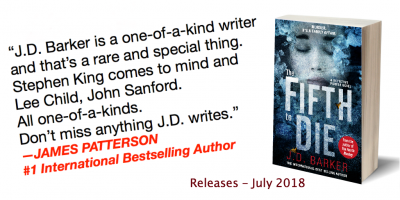
      J.D. Barker stated at the Chanticleer Authors Conference 2019 that he knows which rides his main characters would go on at Disney Land, the type of beer that he/she would order, and favorite toys that he/she played with as a child. He may not use this info in his manuscript but knowing  this information gives his characters subtext and undercurrents that make his novels international bestsellers.

      Jessica Morrell suggests that you ask your protagonist these questions?

      • What’s the most embarrassing thing that has ever happened to you?
      • What is your biggest regret?
      • What is your superpower?
      • Who do you cherish most in the world?
      • If you could change one thing about your world, what would it be?
      • What is your average day or schedule?
      • What 5-6 words sum up your values?
      • What do you do after a really bad day?
      • How do you celebrate?
      • The secret you’d never tell your significant other? Your mother? Your sibling?
      • What reminds you of home?
      • What item must you always take along when traveling?
      • Favorite drink?
      • Secret vice?
      • Pizza or tacos? Cookies or tequila?
      • Favorite climate?
      • Reading or television to unwind?
      • Breakfast or coffee only?

      We hope that we helping you, Dear Writer, to arm and prep yourself to get down to the writing of your next work—the reckoning.


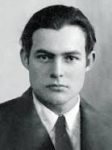
      Ernest Hemingway:  There is nothing to writing. All you do is sit down at a typewriter and bleed.

      Unspooling the Thread of Your Story

      Stay tuned for more Writing and NaNoWriMo Tips

      Link to Part One of our Annual NaNoWriMo Writing Tips Series


      Chanticleer Editorial Services – when you are ready

      Did you know that Chanticleer offers editorial services? We do and have been doing so since 2011.

      Tools of the Editing Trade

      Our professional editors are top-notch and are experts in the Chicago Manual of Style. They have and are working for the top publishing houses (TOR, McMillian, Thomas Mercer, Penguin Random House, Simon Schuster, etc.).

      If you would like more information, we invite you to email Kiffer or Sharon at KBrown@ChantiReviews.com or SAnderson@ChantiReviews.com for more information, testimonials, and fees.

      We work with a small number of exclusive clients who want to collaborate with our team of top-editors on an on-going basis. Contact us today!

      Chanticleer Editorial Services also offers writing craft sessions and masterclasses. Sign up to find out where, when, and how sessions being held.

      A great way to get started is with our manuscript evaluation service. Here are some handy links about this tried and true service: https://www.chantireviews.com/manuscript-reviews/

      And we do editorial consultations. for $75.  https://www.chantireviews.com/services/Editorial-Services-p85337185

      Writer’s Toolbox

      Thank you for reading this Chanticleer Writer’s Toolbox article.

      Writers Toolbox Helpful Links: 

      The INCITING INCIDENT: STORY, SETBACKS and SURPRISES for the PROTAGONIST – A Writer’s Toolbox Series from Jessica Morrell’s Editor’s Desk
      ESSENCE of CHARACTERS – Part One – From the Jessica Morrell’s Editor’s Desk – Writer’s Toolbox Series  

      Keep writing, keep dreaming, have heart. Jessica

      Jessica Morrell is a top-tier developmental editor and a contributor to Chanticleer Reviews Media and to the Writer’s Digest magazine. She teaches Master Writing Craft Classes at the Chanticleer Authors Conference that is held annually along with teaching at Chanticleer writing workshops that are held throughout the year. 


      Keep creating magic! Kiffer 

      Kathryn (Kiffer) Brown is CEO and co-founder of Chanticleer Reviews and Chanticleer Int’l Book Awards (The CIBAs) that Discover Today’s Best Books. She founded Chanticleer Reviews in 2010 to help authors to unlock the secrets of successful publishing and to enhance book discoverability. She is also a scout for select literary agencies, publishing houses, and entertainment producers.


    • COMPONENT LAYERS of SUCCESSFUL FICTION – A Chanticleer Writer’s Toolbox blog post by Jessica Morrell

      COMPONENT LAYERS of SUCCESSFUL FICTION – A Chanticleer Writer’s Toolbox blog post by Jessica Morrell

      Elements of successful fiction layer and fold back in on each other to create resonance, nuance, subtext, and undercurrents of great storytelling. – Kiffer Brown

      In this enlightening and instructional blog post by top-tiered editor and one of Chanticleer’s exceptional Master Writing Craft teachers, Jessica Morrell, will expand on the following components of exceptional fiction.

      Elements of Successful Fiction

      • The Dramatic Question
      • An Intimate Simmering World
      • Characters Built from Dominant Traits
      • Emotional Needs
      • Significance
      • Motivation Entwined with Backstory
      • Desire
      • Threat
      • Causality
      • Inner Conflict
      • Midpoint Reversal
      • Satisfying Ending

      Dramatic Question 

      Compelling fiction is based on a single, powerful question that must be answered by the story climax. This question will be dramatized chiefly via action in a series of events or scenes. If you are writing a romance, the question always involves whether the couple will resolve their differences and declare their love. In a mystery the dramatic question might be will Detective Smith find the serial killer in time to prevent another senseless death? In The Old Man and Seathe dramatic question is will Santiago catch the big fish and thus restore his pride and reputation?

      An Intimate, Simmering World 

      An intimate world isn’t created by merely piling on details. It means your story world has the resonance of childhood memories, the vividness of a dream, and the power of a movie. It’s filled in with shadows and corners and dogs and ice cubes and the sounds and smells of a dryer humming on wash day and a car blaring past, rock and roll music shaking the windows. Details lend your story authority, potency, and a palpable physical existence.

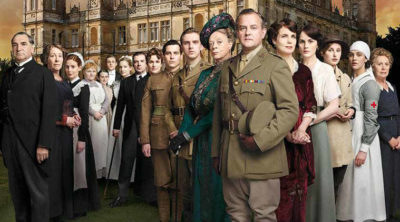
      Downton Abbey by Julian Fellowes — definitely an “intimate simmering world”

      An intimate story takes us to a specific place and coaxes us to remain there. An intimate story is lifelike and feels as real and complicated as the world the reader inhabits. When a reader finishes the final pages and leaves the story world, the reader should feel the satisfaction of the ending, but also a huge sense of loss. Much like a friend has moved to another town just when the friendship had reached a level of closeness and trust.

      Characters Built from Dominant Traits

      Create main characters with dominant and unforgettable traits as a foundation of personality. These traits will be showcased in the story events, will help him achieve or fail at goals, and will make the story person consistent. For example, Sherlock Holmes’ dominant traits are that he is analytical, Bohemian, opinionated, and intelligent. These traits are showcased in every story he appears in along with secondary and contrasting traits. When the character first appears in the first scene, the character should arrive in the story with dominant traits intact.

      Sherlock Holmes and Jim Moriaty – enduring characters since 1892.

      Emotional Needs

      Protagonists and the main characters are people with baggage and emotional needs stemming from their pasts. These needs, coupled with motivation, cause characters to act as they do. For example, in Silence of the Lambs Clarisse  Starling is propelled by childhood traumas to both succeed and heal the wounds caused by the death of her father.

      The EXPANSE by James S.A. Corey went from a Sci-Fi book series to one of Amazon’s top video series. One reason is that the characters have some major emotional baggage.

      Significance 

      The storyline focuses on the most significant events in the protagonist’s life.

      Kiffer’s Note: As we were taught in journalism school, this is the “So what?” that our professors would continuously ask us. What were, are, and will be the significant events? Your story will show the “why and how.” Make your readers care. Make your readers interested and keep them caring.

      Crazy Rich Asians by Kevin Kwan  –  3 Perspectives Cubed makes for a complex story.

      Motivation Entwined with Backstory 

      Motivation, the why? of fiction, is at the heart of every scene, fueling your character’s desires and driving him to accomplish goals. It provides a solid foundation for the often complicated reasons for your character’s behaviors choices, actions,  and blunders.  Motivating factors provide trajectories for character development, as a character’s past inevitably intersects with his present. Your character’s motivations must be in sync with his core personality traits and realistically linked to goals so that readers can take on these goals as their own.

      See The Expanse SciFi series above. It said to be the current Game of Thrones of TV series streaming.

      Names convey emotional baggage and foreshadowing

      Desire 

      Desire is the lifeblood of fictional characters. Not only do your characters want something, but they also want something badly. Santiago, in The Old Man and the Sea desperately wants to restore his reputation and also wants his friendship and partnership with the boy to resume. And in the lonely hours when he is far out at sea, desperately struggling to hang on to the fish and fighting off sharks, we see his fierce desire acted out and the price he pays for it.

      The classic A League of Their Own – to be rebooted on Amazon 2021

      Here is a fun link to: 25 Things You Might Not Know About A League of Their Own 

      You can bestow on your character flaming red hair, an endearing, crooked grin, and a penchant for chocolate and noir movies, but if she doesn’t want something badly, she’s merely a prop in your story, not a driving force. But if she wants to win the Miss Florida contest, take over her boss’ job, or become the first female shortstop for the Atlanta Braves, then you’ve got a character who will make things happen and a story that will be propelled by desire.

      Threat

      Fiction is based on a series of threatening changes inflicted on the protagonist. In many stories, these threats force him or her to change or act in ways he or she needs to change or act. Often too, what the protagonist fears most is what is showcased in a novel or short story. It can be fear of losing his family, job, or health with this dreaded outcome providing interest, action, and conflict.

      The Martian by Andy Weir – one big ticking clock on so many different levels.

      Causality 

      Events in fiction are never random or unconnected. They are always linked by causality with one event causing more events later in the story, which in turn causes complications, which cause more events, which cause bad decisions, etc.

      Causality – the physics of writing

      Inner Conflict 

      A fictional character doesn’t arrive at easy decisions or choices. Instead, he is burdened by difficult or impossible choices, particularly moral choices, that often make him doubt himself and question his actions. Inner conflict works in tandem with outer conflict—a physical obstacle, villain, or antagonist–to make the story more involving, dramatic, and events more meaningful.

       Complications   A story builds and deepens by adding complications, twists, reversals, and surprises that add tension and forward motion. Plots don’t follow a straight path, instead, there are zigzags, dead ends, and sidetracks. Complications create obstacles and conflict, cause decisions to be made, paths to be chosen.

      12 Years A Slave – based on the memoir of Solomon Northrup, published in 1854

       Midpoint Reversal 

      The middle of a novel comprises more than half its length. At about the midpoint of most novels, a dramatic reversal occurs. The hunter becomes the hunted; a second murder occurs proving the detective has been wrong in his suspicions; a former lover arrives in town to complicate a budding romance. This reversal keeps the middle from bogging down and becoming predictable and also breathes new life and often a new direction into the story.

      Mid-point Reversal of Bride and Prejudice, an adaptation of Jane Austen’s Pride and Prejudice. Published in 1813, it is still relevant.

      Satisfying Ending 

      Every story needs an ending that satisfies the reader while concluding the plot. The final scenes, when the tensions are red hot and the character has reached a point of no return, must deliver drama, emotion, yet a logical conclusion. This is not to suggest that every plot ends with a shoot-out or physical confrontation because some endings are quieter, more thoughtful. Some endings are ambivalent, some a dramatic or a violent clash of wills. But there is always a sense that all the forces that have been operating in your story world have finally come to a head and the protagonist’s world is forever changed.

      Below is a scene from The Martian that heralds that maybe—just maybe—our protagonist may make it home—alive. It is a fun and creatively acted scene.  What a scene stealer! – Kiffer Brown

      A reversal of fortune in The Martian by Andy Weir

      The end is just the beginning…

      A Note from the Editor: A satisfying ending is one of the top, if not the top, reasons why books go viral and what will make your reader want to read your next work. Make sure that the you put as much effort in to a satisfying ending as you do into your opening hook. Kiffer Brown

      I hope that you found the visual examples enlightening. Determining and then searching for my favorite ones was fun! – Kiffer


      Jessica Page Morrell

      Jessica Page Morrell is a top-tier developmental editor for books and screenplays. Her articles have appeared in Writer’s Digest and The Writer magazines. She is known for explaining the hows and whys of what makes for excellent writing and for sharing very clear examples that examine the technical aspects of writing that emphasizes layering and subtext. Her books on writing craft are considered “a must have” for any serious writer’s toolkit.

      Jessica will teach Master Craft Writing Classes at the Chanticleer Authors Conference VIRTUAL Conference that will be held from Tuesday, Sept 8 – Sunday, Sept. 13, 2020. She will present sessions and Master Classes on September 17, & 18,  2020 in conjunction with the virtual conference. She and Kiffer will also host a fun kaffeeklatch for Word Nerds at VCAC20.

      Did you know that Chanticleer offers editorial services? We do and have been doing so since 2011.

      And that our professional editors are top-notch and are experts in the Chicago Manual of Style. They have and are working for the top publishing houses (TOR, Macmillan, Thomas Mercer, Penguin Random House, etc.) and award-winning independent presses. If you would like more information, we invite you to email Kiffer or Sharon at KBrown@ChantiReviews.com or SAnderson@ChantiReviews.com.

      Click here to read more about our Editorial services: https://www.chantireviews.com/services/Editorial-Services-p85337185

      A great way to get started is with our manuscript evaluation service. Here are some handy links about this tried and true service:

      https://www.chantireviews.com/manuscript-reviews/

      We work with a small number of exclusive clients who want to collaborate with our team of top-editors on an on-going basis. Contact us today!

      Writer’s Toolbox

      Thank you for reading this Chanticleer Writer’s Toolbox encore edition article. 

      We encourage you to stay in contact with each other and with us  during this stint of practicing physical distancing to prevent the spread of COVID-19 — especially at this time of re-opening.

      Let us know how you are doing, what is going on where you live, how are you progressing on your writing projects.

      I invite each of you to join us at The Roost – a private online Chanticleer Community for writers and authors and publishing professionals. You are welcome to email me for more info also.

      We are active on Facebook, Twitter, and Instagram. You can find us by using our social media handle @ChantiReviews

      Minimize physical contact! Maximize social connecting!

      Be well. Stay safe. Keep writing! Keep Creating! Kiffer 

    • 15 Self-Editing Tips from the Editor’s Desk of Jessica Morrell – Chanticleer Writers Toolbox

      15 Self-Editing Tips from the Editor’s Desk of Jessica Morrell – Chanticleer Writers Toolbox

      Refresh your writing with these Self-Editing Tips

      It is time to Spring Clean our writing habits with precise, fresh language. Jessica Morrell suggests searching for these culprits that can easily sneak into our writing.

      Declutter Your Sentences by Eliminating These Junk Words

      1. Breathingdeep breathsbarely breathinginhalingexhaling, and other lung movements.  Many writers of all levels reveal their characters’ emotions and reactions using their breath, lack of breath, breathlessness, or as their main method of reacting and showing emotion. “I took a deep breath” is a phrase I’ve seen so often it’s a cliche.  Unless a character has the breath knocked out of him or is in the midst of childbirth, avoid focusing on breathing as your main means to create emotion. Instead collect a variety of mannerisms, reactions, gestures, and body language individual to each character.
      2. Said exclamations: Today’s readers are sophisticated and understand when characters are talking and that at times the character’s voices and emotions change. The notion is the ‘he said, she said’ parts of fiction appear invisible. Readers understand that a character might sound shrill by the circumstances and dialogue spoken so you don’t need to proclaim, Mary Ellen shrieked shrilly. Never write Jason emoted, pleaded, bantered, snarked, smirked, blasted, bleated, peeped, groused. Now occasionally in the midst of a horror story, you might want to underline how terrified a character is, but consider dabbing these attributions in only for the most terrifying or surprising moments.
      3. Down or up. As in Rachel sat down. Now Rachel can collapse into a chair, or sidle into an empty seat in a dark theater, or ease onto a sofa, or flump onto a bed. Sit and sat means a person is lowering himself or herself.  As in down. More accurately sit means supporting your weight on your buttocks.  Question your use of up. It seems so innocent, doesn’t it? Blithe stood up. Stood means up because standing means a person is upright, supporting himself on his feet.  Denzel stood, joining the screaming fans. Also, do not write grabbed up; grabbed suffices. Avoid appending up to spoke, hurry, lift, climb, and rose.
      4. Towards, backwards, forwards, upwards, downwards.  Replace with toward, backward, forward, upward, downward.
      5. ClichésOh how, I hate thee. Eliminate all your I took a deep breath. Ditto for eyes widened, out of the corner of my eye, jaw dropped, raven locks, and steely blue eyes. Then there is:  Each and every, knife to my heart, piece of cake, fire in the belly, he/she took my breath away. And before you write about your characters staring into each other’s eyes, think about how often it happens in real life and how often it happens in your stories.
      6. Mind matters, especially in the first person. You don’t need to report on how the character is reviewing things in his/her mind because this distances the reader and reminds her there is a narrator instead of the reader living amid the story world. So eliminate ‘mind raced‘ ‘thoughts raced‘ ‘mind’s eye‘ (a truly lame term), and ‘searching her mind.’
      7. Really. I mean really? Do you need it? Is the weather really cold or is it frigid or dangerously cold?
      8. I saw. If you’re writing in close first person you don’t need the I saw or I looked part of the sentence. Example: I saw ahead of me three leprechauns frolicking merrily in the grass. Instead: Ahead three leprechauns frolicked merrily in the grass. Why? The reader wants to pretend that he or she is spotting the leprechauns along with the character. Also describing the leprechauns implies the narrator or character is seeing or observing. No need to state it.
      9. Literally means exactly as described or in a literal or strict sense. It does not mean quite, actually or really. Wrong: I was so mad I was literally shaking like a leaf and red-faced. Or, I was so terrified I literally jumped out of my skin. Or, Her death literally brought me to my knees.  Better: The playoffs were watched by literally millions of fans.
      10. Basically, essentially, obviously, basically, totally. Hint: question every adverb you use with an -ly ending because many are so overused they’ve become meaningless. However, the larger issue is many people sow these words into their stories without understanding their correct meanings mostly to maximize or intensify. Over time many adverbs have become meaningless. Basically means at a basic level or fundamental sense, not almost or mostly. Essentially means the essence of something or in an essential manner, not almost or often.  Practically means in a practical manner not almost or mostly. Totally means completely, in every part, not really.
      11. Moments. I’ve read manuscripts where characters pause or think or kiss for only a moment hundreds of times throughout the story. There are plenty of ways to describe brief actions or thoughts.
      12. Suddenly. Because if you’re reading fiction you assume that actions, twists, and surprises will happen abruptly. They are devices used to increase tension and suspense. No need to announce it.
      13. That. If a sentence works without that, ditch it. Easy, right?
      14. Just. No, I’m not just kidding. Too many of us (guilt-hand raised) use this one out of habit. 
      15. Prepositional phrases. Prepositions are the carbohydrates of language. Of course, we need them for clarity but use with care. Instead of a book of poetry, use poetry book. Instead of a tower of flames, use towering flames.

      Kiffer’s Note:  So here’s the trick: When writing your first draft, write it. Don’t worry about the trees—words. Concentrate on the forest—the story. Then, when you are editing fix these issues. Replace dullards with the perfect words that will move your story forward, increase tension, enhance the atmosphere, add depth to your characters, make your dialogue pop, and immerse your reader into the world that you have created.

       A handy tool to help you recognize if these egregious junk words have infiltrated your manuscript is the “Find and Replace” tool that  can be found in WORD or other word processors. This tool finds and highlights specific words so that you can replace if needed to insure that every word counts. Click on this link, if you would like more information and how this tool works:  https://support.office.com/en-us/article/find-and-replace-text-c6728c16-469e-43cd-afe4-7708c6c779b7

      Don’t always use the first word or phrase that pops into your head because you might be using rusty, old clichés. Or fix these dullards when you edit. Like stock still, fast asleep, choking back tears, stirred up a hornet’s nest, did a double take, under the radar, and never in her wildest dreams.

      You are welcome to copy and paste this article into a document and print it for your writing craft and tools notebook for ease of access while you are editing you work-in-progress.


      Jessica Page Morrell

      Jessica Page Morrell is a top-tier developmental editor for books and screenplays. Her articles have appeared in Writer’s Digest and The Writer magazines. She is known for explaining the hows and whys of what makes for excellent writing and for sharing very clear examples that examine the technical aspects of writing that emphases layering and subtext. Her books on writing craft are considered “a must have” for any serious writer’s toolkit.

      Jessica will teach the Master Craft Writing Classes at the Chanticleer Authors Conference on Thursday, Sept. 3, 2020  and will present sessions during the conference. She and Kiffer will also host a fun kaffeeklatch for Word Nerds at CAC20.

      Did you know that Chanticleer offers editorial services? We do and have been doing so since 2011.

      And that our professional editors are top-notch and are experts in the Chicago Manual of Style. They have and are working for the top publishing houses (TOR, Macmillan, Thomas Mercer, Penguin Random House, etc.) and award-winning independent presses. If you would like more information, we invite you to email Kiffer or Sharon at KBrown@ChantiReviews.com or SAnderson@ChantiReviews.com.

      Click here to read more about our Editorial services: https://www.chantireviews.com/services/Editorial-Services-p85337185

      A great way to get started is with our manuscript evaluation service. Here are some handy links about this tried and true service:

      https://www.chantireviews.com/manuscript-reviews/

      We work with a small number of exclusive clients who want to collaborate with our team of top-editors on an on-going basis. Contact us today!

      Writer’s Toolbox

      Thank you for reading this Chanticleer Writer’s Toolbox article. 

    • GLISSANDO and WORDCRAFT from Jessica Morrell’s Editors Desk – A Chanticleer Writer’s Toolbox blog post

      GLISSANDO and WORDCRAFT from Jessica Morrell’s Editors Desk – A Chanticleer Writer’s Toolbox blog post

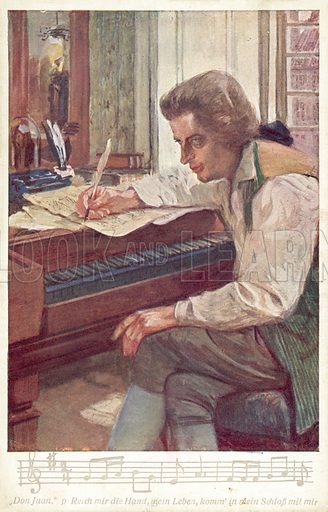
      Glissando is a term from music meaning sliding or gliding over keys.

      When glissando is applied to wordcraft, it means paying attention to the sound and flow of language.  Sounds arrest the reader’s attention. Even if your words are not read out loud, the reader hears them with her/his inner ear.

      All language has sound and sound communicates meaning, emotion, mood and tone. Language is also embedded with deeply appealing rhythms that, like drum beats or heart beats, that slip into the reader’s consciousness and enhance the experience of reading.

      In all writing, every word exists for a reason, every sentence builds the scene or idea. Each word is a note. Sometimes you want sound to lull a reader before you slap him with a heated argument or stage a bombshell scene. Sometimes you want him to pause at the end of a string of words. Sometimes you want to march along briskly as you dispense information.

      When sound is emphasized a narrative becomes poetic. When sound is deliberately employed, sentences, paragraphs and scenes have clout. Writing without themes, purpose and music is only typing and writing without paying attention to sound is flat and empty.

      Sound can add or subtract to the flow of writing.  Like other writing devices, flow is a nearly invisible factor, but when it’s employed, your writing will be seamless and will reflect the mood and ambiance of a particular point in a story.

      A note from Kiffer:  Think of a symphony.

      Think of symphonies and the myriad of moods that they evoke.

      A few examples:

      • Stravinsky’s riotous Rite of Spring
      • Gershwin’s sultry jazzy and brash exuberant Rhapsody in Blue
      • Bernstein’s fresh and challenging West Side Story
      • Mozart’s complex and exhilarating Jupiter 
      • Aaron Copland’s stirring and nostalgic Symphony for the Common Man
      • Bear McCreary’s Symphony for Battlestar Galactica  (a side note: Bear is from Bellingham)

      Each symphony is written with the same twelve notes, one note at a time. Each novel, each written work, is written one word at a time.

      Flow

      Flow happens when ideas and stories have fluidity, connectivity, and cohesion.  Flow is consciously applied as a courtesy to the reader because readers deeply resent being lost of confused when amidst a page or story. Readers also hate to be jolted or to dangle, or feel a sense of disorientation.  Flow provides the map, flow connects the dots, flow grants readers firm footing. Flow aids the internal logic needed to make your ideas comprehensible.  Flow will move the reader from sentence to sentence, paragraph to paragraph, idea to idea, scene to scene, and chapter to chapter with grace and ease.

      Transitions

      An essential technique that creates flow is transitions and it’s shocking how often writers neglect to use them.  Transitions are the words, phrases, sentences or paragraphs used to bridge what has been said with what is going to be said. Simple transitions are generally, but not always, a subordinate clause placed in the beginning of a sentence or paragraph and used as a road sign indicating a change. Probably the most famous transition in writing is “meanwhile, back at the ranch.” It provides an easy shorthand and the reader knows, Ah, we’ve changed locales; we’re at the ranch again. Wonder how Jane is getting along since Luke has been on the cattle drive for three months now.

      Transitions are handy devices because they can accomplish so much in only a few words. Their jobs are to signal: a change in time, a change in place, a shift in mood or tone, or a shift in point of view. Transitions also clarify relationships, emphasize, contrast or compare things, conclude actions or thoughts, and create associations.

      Here are a few tips for writing with wordcraft.

      • When in doubt, understate. Often the most painful, emotional, or violent moments in writing works best by using a minimalist approach.
      • Write about subjects that mean something to you, emotionally and intellectually; that force you to question your beliefs and values.
      • Save lush passages for choice moments in the story, especially decisions, revelations, and reversals. If you use heightened prose every time your character feels an emotion the whole will become contrived.
      • Omit redundancies like grotesquely ugly, grim reminders, complete surprise, and happy coincidence.
      • Make certain every sentence adds something new.
      • Generally avoid heightened prose for endings—often the best endings are concrete or understated.
      • Respect word territory. If you feature an unusual word in a sentence (effervescent, rococo, unremunerated, infelicity) then don’t repeat it again in a nearby paragraph or better yet, use it only once.

      Don’t forget to keep asking yourself, what does this remind me of?  As you lay out sentences and scenes, but also as go through your days, look around you with an artist’s curiosity.  It’s a simple question, and leads to wizardry.

      Keep writing, keep dreaming, have heart. Jessica


      Jessica Page Morrell

      Jessica Page Morrell is a top-tier developmental editor for books and screenplays. Her articles have appeared in Writer’s Digest and The Writer magazines. She is known for explaining the hows and whys of what makes for excellent writing and for sharing very clear examples that examine the technical aspects of writing that emphases layering and subtext. Her books on writing craft are considered “a must have” for any serious writer’s toolkit.

      Jessica will teach the Master Craft Writing Classes at the Chanticleer Authors Conference on Thursday, Sept. 3, 2020  and will present sessions during the conference.


      Did you know that Chanticleer offers editorial services? We do and have been doing so since 2011.

      And that our professional editors are top-notch and are experts in the Chicago Manual of Style. They have and are working for the top publishing houses (TOR, McMillian, Thomas Mercer, Penguin Random House, etc.). If you would like more information, we invite you to email Kiffer or Sharon at KBrown@ChantiReviews.com or SAnderson@ChantiReviews.com.

      A great way to get started is with our manuscript evaluation service. Here are some handy links about this tried and true service:

      https://www.chantireviews.com/manuscript-reviews/

      We work with a small number of exclusive clients who want to collaborate with our team of top-editors on an on-going basis. Contact us today!

      Writer’s Toolbox

      Thank you for reading this Chanticleer Writer’s Toolbox article. 

    • The INCITING INCIDENT:  STORY, SETBACKS and SURPRISES for the PROTAGONIST – A Writer’s Toolbox Series from Jessica Morrell’s Editor’s Desk

      The INCITING INCIDENT: STORY, SETBACKS and SURPRISES for the PROTAGONIST – A Writer’s Toolbox Series from Jessica Morrell’s Editor’s Desk

      Fiction features a problem that needs solving and only the protagonist can solve it.

      In short stories, the problem is often introduced by the inciting incident–an event that triggers or launches what follows.

      In longer fiction, the inciting incident might lead to the problem. This event will disrupt the status quo, demand response, and set actions in motion. It’s a threat that unbalances the story world and creates dilemmas that must be dealt with.

      The Wizard of Oz – Inciting Incident

      A simple plot structure is a protagonist struggling to solve an intolerable problem and re-establish order. Jessica Morrell

      No matter when the problem begins (it’s always in Act One) the problem is weighty and vexing, perhaps insurmountable. If the problem is not immediately personal, it should become so that it will create a bond (connection) between the protagonist and antagonist. (A classic example is the connection between Sherlock Holmes and Jim Moriarty).

      Sherlock Holmes and Jim Moriarty

      As you know, in real-life problems are sometimes unsolvable and don’t fit neatly into a satisfying narrative arc. Across the globe, there are ‘forever’ problems of climate change, financial inequities, immigrants who need homes, corporate greed, and fascism. No shallow fixes will work, though incremental changes can chip away at underlying issues.

      Closer to home, you might be dealing with a job that drives you crazy, but you cannot leave; family members who refuse to reconcile; health or mental health issues that can only be coped with, not cured; or agonizing decisions about caring for elderly family members. In fact, studies have shown that depression can be linked to seemingly unsolvable problems.

      This is why some people turn to fiction. Where love wins in the end, crimes are solved and justice is served, and friends or families reconcile. But in well-told tales, success never comes easy and it always exacts a toll. Often success comes from the protagonist tapping into inner resources he or she hadn’t accessed before.

      Frodo and the Ring – LOTR

      A FEW STORY  TIPS and HANDY REMINDERS from Jessica Morrell

      • As the story progresses the protagonist forms a plan. Now the plan can be shaky, untested, or desperate, but readers need a  strategy at work.
      • Force your character to solve smaller problems along the way to resolving the major story problem. A detective can dig up a much-needed witness or help a vulnerable street kid.
      • Endow your protagonist with specific, interesting skills and personality attributes that won’t waver and make him or her suited to the task.
      • Create a protagonist who is somehow lacking in something he or she needs for happiness or fulfillment.
      • Burden him or her with emotional baggage and needs, personal demons or addictions, then toss in cast members and subplots that distract, undermine, or hinder.
      • Understand how the problem makes the protagonist feel in each scene: hesitant, unaware, outgunned, overwhelmed, weak, unqualified, terrified.
      • Setbacks and surprises should be baked into the plot.

      Oh, and the protagonist should fail, fall on his face at least a few times along the way to the climax. Because your job as the master manipulator (aka author) is to blindside, torment, and thwart your characters. Again and again, so the outcome is in question and your readers are compelled to keep turning the pages.

      Jessica Page Morrell
      Jessica Page Morrell


      Keep writing, keep dreaming, have heart.  – Jessica 

      Jessica Morrell is a top-tier developmental editor and a contributor to Chanticleer Reviews Media and to the Writer’s Digest magazine. She teaches Master Writing Craft Classes at the Chanticleer Authors Conference that is held annually along with teaching at Chanticleer writing workshops that are held throughout the year. 


      Chanticleer Editorial Services

      Did you know that Chanticleer offers editorial services? We do and have been doing so since 2011.

      Our professional editors are top-notch and are experts in the Chicago Manual of Style. They have and are working for the top publishing houses (TOR, Macmillan, Thomas Mercer, Penguin Random House, Simon Schuster, etc.).

      If you would like more information, we invite you to email Kiffer or Sharon at KBrown@ChantiReviews.com or SAnderson@ChantiReviews.com for more information, testimonials, and fees.

      We work with a small number of exclusive clients who want to collaborate with our team of top-editors on an on-going basis. Contact us today!

      Chanticleer Editorial Services also offers writing craft sessions and masterclasses. Sign up to find out where, when, and how sessions being held.

      A great way to get started is with our manuscript evaluation service. Here are some handy links about this tried and true service:

      https://www.chantireviews.com/manuscript-reviews/

      Writer’s Toolbox

      Thank you for reading this Chanticleer Writer’s Toolbox article.

    • MINOR CHARACTERS – the SPICE of FICTION – Part One – From Jessica Morrell’s Editor’s Desk – Writers’ Toolbox Series

      MINOR CHARACTERS – the SPICE of FICTION – Part One – From Jessica Morrell’s Editor’s Desk – Writers’ Toolbox Series

      In fiction there’s a hierarchy when it comes to characters: the protagonist, antagonist, secondary characters, minor, walk-on, and stock characters. Let’s focus more on minor characters, shall we? Writers who neglect minor characters are neglecting essential ingredients to their works. It would be like omitting garlic or oregano from pasta sauce or cumin from a pot of chili.

      Minor characters, like secondary characters, operate in a strictly supporting role.

      • They are rarely viewpoint characters.
      • Don’t take up a lot of ‘stage time’ and readers generally don’t care about them a lot.
      • Do not have a subplot.
      • This means they’re usually ‘flat’ that is, they won’t change over the course of the story and they’re not fully dimensional. (There are exceptions to this.)
      Just a pinch makes all the difference!

      HOWEVER: Minor characters add color, verve, spice, eccentricity.

      • Make things happen, help advance the plot.
      • Establish the setting.
      • Provide insights or information about major characters. Without secondary and minor characters the protagonist would be isolated.
      • Prove that the protagonist has grown or changed.
      • Support the mood or atmosphere in a scene.
      • Breathe life into the story.
      • Disprove stereotypes.
      • Support themes.

      Examples:

      To Kill a Mockingbird: Heck Tate, Calpurnia, Judge John Taylor, Miss Maudie Atkinson, Dolphus Raymond

      A Christmas Carol: Tiny Tim, Belle, Scrooge’s former fiance, Fred, Scrooge’s nephew, Fezziwig

      Harry Potter series: Colin Creevey, Katie Bell, Pansy Parkinson,  Padmil & Parvati Patil, Neville Longbottom, Cho Chang (to name but a few)

      Hunger Games series: Madge Undersee, Katniss’ friend who gave her the mockingjay pin, Caesar Flickerman the television host, Effie Trinket, the District 12 escort, other tributes–Cato, Thresh, Clove, Foxface, Glimmer, Marvel,  (Rue is a secondary character)

      A few more tips:

      • While a minor character can be quirky or sexy, he or she shouldn’t distract readers from the main events and characters. Generally, the more you tell your reader about a minor character, the more you elevate his or her importance.
      • Use minor characters for humor or breathers in the story.
      • Minor characters should complete the story, create verisimilitude.
      • Give them a ‘job’ to do, such as a witness in a crime novel. In The Hunger Games,  Marvel, the tribute from District 1 kills Rue with a spear through her stomach. Later Katniss kills him. Although she’s already taken out several competitors, she is now a hunter, not the hunted, a significant shift in the story.
      • Emulate J.K. Rowling and Charles Dickens and grant your minor characters silly, memorable, or suggestive names. As in Martin Chuzzlewit and  Sophronia Akershem, and Uncle Pumblechook.
      • Use minor characters to reveal class, ethnicity, culture, and the milieu of the story world.

      A poignant example from Shawshank Redemption

      Don’t be afraid to give them a poignant role or to motivate another character as Brooks does in Shawshank Redemption. Poor Brook is elderly when he’s paroled from Shawshank. Problem was, he didn’t have the youth or skills to cope on the outside and ends up hanging himself. He serves as Red’s ‘anti-mentor’ in the story. Later, when Red the narrator is also paroled after spending years in prison, readers and movie viewers are reminded of Brooks’ fate. Will Red follow him? 

      Tolkien reveals volumes about his Middle Earth with the different minor characters and their kind in Lord of the Rings. 

      Examples of Lord of the Rings’ Minor Characters that come to mind are:

      • Barliman Butterbur, a man of Bree and a forgetful innkeeper where Gandalf frequented
      • Shagrat, an Uruk orc (role of villain)
      • Haldir, Elf of Lothlorien – He spoke the Common Tongue fluently so he was able to communicate with the Fellowship and to learn of their loss of Gandalf.
      • Rosie Cotton, a hobbit who patiently awaited Samwise Gamgee’s return to the Shire
      • Ugluk, a villain who was a leader of the Uruk-hai scouts and trusted servant of the evil wizard Saruman
      • Theodred, Prince of Rohan – a nobleman of birth and bravery
      • Goldberry, a female who embodied the spirit of Nature

      Notice that I didn’t need to use images for LOTR minor characters; their names practically describes them and their roles.

      If you are a fan of George R.R. Martin’s The Song of Fire and Ice series, you are well aware of his use of minor characters to move his series forward.


      Stop back by for Part Two — Minor Characters – The Spice of Fiction from the Writers’ Toolbox Series

      Writer’s Toolbox Series


      Keep writing, keep dreaming, have heart. Jessica

      Jessica Morrell is a top-tier developmental editor and a contributor to Chanticleer Reviews Media and to the Writer’s Digest magazine. She teaches Master Writing Craft Classes at the Chanticleer Authors Conference that is held annually along with teaching at Chanticleer writing workshops that are held throughout the year. 


      Did you know that Chanticleer offers editorial services? We do and have been doing so since 2011.

      And our professional editors are top-notch and are experts in the Chicago Manual of Style. They have and are working for the top publishing houses (TOR, McMillian, Thomas Mercer, Penguin Random House, etc.) and elite indie presses.

      We work with a small number of exclusive clients who want to collaborate with top-editors on an on-going basis.

      Contact us today! If you would like more information, we invite you to email Kiffer or Sharon at KBrown@ChantiReviews.com or SAnderson@ChantiReviews.com