Tag: War/Military

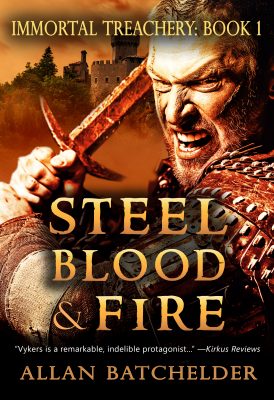
  • STEEL, BLOOD & FIRE by Allan Batchelder – Fantasy, Military, Fairy Tale

    STEEL, BLOOD & FIRE by Allan Batchelder – Fantasy, Military, Fairy Tale

    Tarmun Vykers, the central character in Allan Batchelder’s accomplished fantasy, has many epithets: “The Scourge of Empires,” “The Reaper,” “The Merciless One,” and sometimes just good old “Vykers the Vicious.” He’s very aware that he’s widely feared but not admired, and that’s just fine with him. He’s not the sentimental type.

    On the other hand, he’s darn likable. Why? Well, he’s smart, witty, and often sarcastic, but he’s also able to laugh at himself and the many predicaments that befall him. And he’s not the worst guy around.

    No, that would be Anders, better known as “The-End-Of-All-Things.” The-End is not likable.  Far from it. When one’s goal in life is taking enormous satisfaction and delight in the destruction of everyone and everything, you don’t have friends, you just have people who do your bidding because they’re terrified of you.

    Of course, a showdown between Vykers and The End is going to happen – and Batchelder has lots of fun getting us ready. In this world, the very weapons used have almost as much personality as characters who wield them. Along the way, we meet the cast, many of whom will prove invaluable to Vykers on his quest.

    And what a cast! Batchelder provides a lengthy list at the novel’s conclusion but they’re all so memorable, the reader doesn’t have to consult it often. For starters, there’s Arune, a shapeshifter who has taken up residence in Vykers’ mind where she reads his thoughts and responds with zingers of her own. Some of the most memorable scenes in the book, in fact, take place with Vykers seemingly talking to himself, but really, it’s Arune matching his wit, sentence for sentence. There is so much more to explore and fall in love with, we won’t ruin it for you here.

    If this all sounds like a lot of fun, it is. It’s easy to imagine Monty Python fans reveling over many of these scenes. This fantasy, however, has more to offer. The humor is adroitly balanced with darker chapters concerning primal fears and terrors.

    Steel, Blood & Fire will appeal to a broad group of readers. Although primarily a fantasy, the classic themes of fairy tales, myths and folklore are woven into the narrative.  Good versus evil, the gaining of self-knowledge while on a quest or a journey, transformation through enchantment – it’s all here but with a twist because Batchelder so deftly juggles ribald humor and unexpected poignancy.  He also allows the reader to view these themes through several lenses.  This is particularly true in the battle scenes, the author giving us the individual experiences of several of the male characters.  While there are fewer female characters, they are quite strong, fully realized, and residing in the forest and the castle, the folkloric motifs of the poor and the royal in play.

    The great news is the book is the first in the series Immortal Treachery. Batchelder concludes Steel, Blood & Fire on a tantalizing note and there’s clearly much more material to be mined. If it’s as fully realized as this book, the entire series is a must read.

    Fairy tales, myths, and folklore collide in Batchelder’s first book in the Immortal Treachery series, Steel, Blood & Fire, rollicking fun and seriously addictive read.

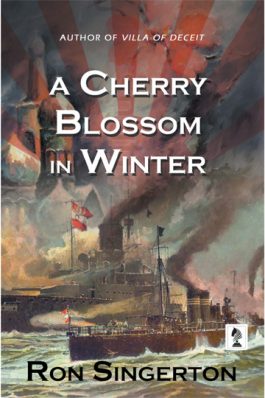
     

  • A CHERRY BLOSSOM in WINTER by Ron Singerton – Historical Fiction, Literary, War/Military, Romance

    A CHERRY BLOSSOM in WINTER by Ron Singerton – Historical Fiction, Literary, War/Military, Romance

    The story behind any war is a difficult one to tell. A Cherry Blossom in Winter by Ron Singerton takes us into not just one, but two, cultures at the turn of the last century in an attempt to show us both sides of a decisive naval conflict that would shape both countries and people for years to come.

    Alexei Brusilov is a young man destined for a talented future. He is bright and courageous, lightning-quick with a saber, and longs to join the Russian Naval Academy at the turn of the 20th century.  Like his father before him and many nobles of the Russian court of Tsar Nicholas II, Alexei sees his path as a military one, full of honor and discipline. Trouble always begins at home, however, as Alexei’s best friend becomes involved with Marxist revolutionaries ready to overthrow the Tsarist regime. Luckily, elements beyond his youthful control are in motion and before he can be caught for treason, Alexei will find himself in another world, another culture, and called upon to use all of his wits for the sake of love.

    Ron Singerton’s book, A Cherry Blossom in Winter, is a blending of historical and romantic fiction as we follow the young Russian Alexei to Japan and his first true test of manhood. He is there to accompany his father, Count Brusilov, a man of violent temper who disdains all things Japanese. But politics are politics, and all hints are pointing to a coming war between their two countries. It could be strategically important for young naval officers to understand Japanese in the near future, but Alexei’s goals are of a more personal nature. Readers will struggle with him as he attempts to make friends and learn the language, absorbed by the beauty and culture he sees. High Society, Religion, and Honor will all have different definitions by the time Alexei unexpectedly returns home.

    Yet the Moscow court and the Tsar have not been idle. A violent peasant revolution seems closer to reality all the time, as Alexei enters the Academy on the cusp of a family crisis. Everything seems to be on the verge of great, though not necessarily peaceful, change as the young man, now a brave naval cadet, attempts to finish school.

    In this way, Singerton’s book does a great job in presenting this pre-war time as one of both personal and national conflict.  History buffs need only go to the official record to discover the facts, the dates, and the battle locations of the Russo-Japanese war, but A Cherry Blossom in Winter works hard to make it a visceral experience. By pulling in the geopolitics of the beginning of the last century, along with developments such as the introduction of Marxist ideology, the near-collapse of Russian court nobility, anti-Jewish pogroms, the mistreatment of Russian peasants, and widespread anti-Asian sentiment, the overall effect is a slow-build to the climatic and brutal naval battle. Singerton’s use of the actual historic names for places, battle ships, and generals on both sides of the conflict also help the reader to feel right in the middle of that dangerous time. And yet the wartime reality is carefully balanced with not just one, but several love stories. Passion, whether for love or war, is keenly portrayed.

    Complex in its historical scope and list of characters, A Cherry Blossom in Winter is more successful in understanding men at war than the background love stories. This book won’t be for every romance reader as the plot points issue from exceptionally visceral entanglements – however, history buffs and those who love wartime epics will devour the read. Reminiscent of Puccini’s Madame Butterfly, readers will journey through an emotional landscape as dangerous as the raging battles themselves.

    5 Star Best Book Chanticleer Reviews round silver sticker

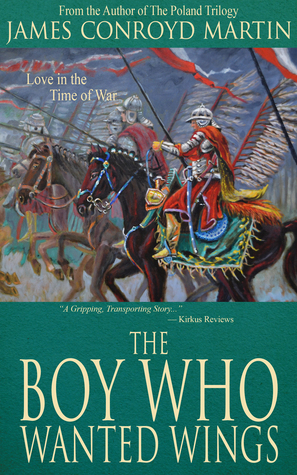
  • The BOY WHO WANTED WINGS by James Conroyd Martin – Medieval Historical Fiction, War/Military, European

    The BOY WHO WANTED WINGS by James Conroyd Martin – Medieval Historical Fiction, War/Military, European

    A suspenseful and often overlooked chapter in history, the siege of Vienna in the late 17th century is the subject of James Conroyd Martin’s masterful novel, The Boy Who Wanted Wings.

    Although Poland’s involvement in the protection of the city from the invading Turks is the mainstay of the book, Martin widens the breadth of his study to underscore the multinational effort undertaken to halt the spread of Islam, providing meticulously researched details about the allied forces of the Saxons, Franconians, and Bavarians uniting to halt the siege of the Ottomans and Crimean Tatars*.  Although this is a work of fiction, to the author’s credit, the wealth of historical information provided is beyond impressive.  Most helpful is the glossary of Polish cultural and military terms of the time at the outset of the book.

    The reader navigates this chapter in Europe’s past with Aleksy Gazdecki, a boy on the verge of manhood whose personal past and present circumstances present no end of identity issues.  A Tatar by birth, he was orphaned as an infant and raised by a Polish peasant family, tenants of Lord Halicki.  Aleksy’s swarthy complexion and dark, almond-shaped eyes cause him to stand out amongst the Poles and ultimately be treated with suspicion.  He longs to join the Winged Hussars, the elite branch of the Polish military whose legendary skills with seventeen-foot-long lances are announced by a uniform that includes “wings.”  Although he trains with a former soldier, currently a stablemaster, Aleksy knows how futile his dream is since only men of noble birth can become Winged Hussars.

    Amidst the military drama is, of course, personal drama.  Aleksy has a chance encounter with the beautiful Krystyna, Lord Halicki’s daughter, and the two engage in a dangerous, secretive romance, jumping the hurdles presented by her family, who are determined to see her married to a wealthy noble, as well as confronting the escalating war at hand. Krystyna’s brothers, the sweet Marek and the haughty, vengeful Roman, will cross paths with Aleksy again and again since he follows them into battle as Marek’s “retainer.”

    Just as Aleksy sought to overcome the circumstances of his birth in his romantic life, he will do so also on the battlefield. Ironically, his Tatar heritage gives him the opportunity to save a life, a very important life, and the resulting events put Krystyna within his reach. Martin takes no shortcuts and keeps the reader guessing with a long list of characters and numerous plots twists all carried out with exquisite pacing.

    Despite the triumph of the Poles, Martin deftly explores the addictive nature of bloodlust and the true consequences of war. Aleksy is exhausted and saddened by the killing and able to transcend nationalistic feelings.  He has killed men, regardless of where they’re from or what faith they practice. It’s an apt observation from a Tatar who has lived his life amongst a people other than his own, a Tatar who has tried to be the most loyal subject of Poland.

    This is a novel with staying power.  Given the geopolitical situations in the world today, the author reminds us that war has a long and bloody history, and political alliances are intricately tied to this history. James Conroyd Martin’s The Boy Who Wanted Wings will make one most glad for the opportunity to spend time in the 17th century.

    *Alternate spelling: Tartar

    This book is also available in Softcover (ISBN-13: 978-0997894509) and Hardcover (ISBN-13: 978-0997894516)

    5 Star Best Book Chanticleer Reviews round silver sticker


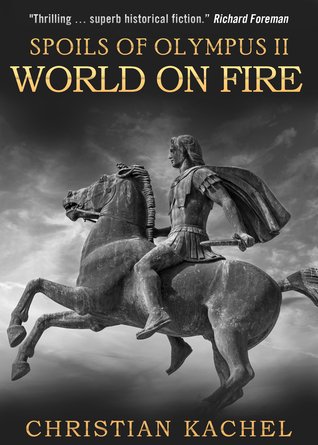
  • Spoils of Olympus II: World on Fire by Christian Kachel – Historical Fiction/War & Military/Post-Alexandrian Greece

    Spoils of Olympus II: World on Fire by Christian Kachel – Historical Fiction/War & Military/Post-Alexandrian Greece

    Spy-craft, betrayals, and bloody battles infuse this historical novel of Ancient Greece in the chaotic years following the death of Alexander the Great.

    World on Fire is the second novel in a complex historical saga narrated by Andrikos, a young man who started his fighting career on the streets of his hometown of Illandra. As a member of the underground cult, The King’s Hand, Andrikos and his traveling companion Vettias dedicate themselves to keeping Alexander’s lineage on the throne of Macedon. The pair is a study in contrasts: Vettias, the elder, is the more hardened soldier who teaches Andrikos the arts of espionage; while Andrikos maintains a youthful idealism that is sometimes at odds with the grim necessities of war.

    The lessons Andrikos learns from Vettias offer gripping scenes of surveillance, stealth, and expeditious killings. Together they must help restore Alexander’s dynasty, often posing as enemy operatives. This infiltration creates a multi-layered plot with far reaching implications on and off the battlefield.

    In addition to spy-craft and bloodletting, writer Christian Kachel makes room and time to establish Andrikos as a loyal, home-loving son whom his parents trust enough to guard Alexander’s widow Rhoxane and her young son, Alexander IV, within their household despite the obvious dangers.

    The arts of war form a central element of World on Fire, with vivid descriptions of ancient weaponry and hand-to-hand combat. To our delight, Kachel does not neglect the feminine, as he presents two powerful young women, both wise beyond their years: the teenage Queen of Macedon, Adea, who becomes a willing player in the plots against the enemies of Vettias and Andrikos; and Mara, Andrikos’ first love, to whom he made prior promises that he is now able to keep.

    By the end of ten years of travels and intrigues, Vettias and Andrikos will see the world differently and will have played their part in making positive changes.

    Kachel has staged this epic skillfully. Placing Andrikos as the narrator allows the reader to see many political and military viewpoints held by others through a young, albeit, sometimes naïve perception, and to enjoy periods of respite from war and treachery in scenes of romance, home life, and some moments of stolen passion.

    Kachel, three times deployed to fight in Afghanistan and Iraq, is a student of warfare who has chosen to concentrate his novelistic mastery on a sometimes neglected period of history—the aftermath of the death of Alexander the Great and resulting internecine struggles for dominance in the middle eastern region. Historians disagree on many details of this troubled era, giving Kachel free rein to explore possibilities clearly grounded in fact and research, but also informed by the author’s substantial imaginative gifts.

    5 Star Best Book Chanticleer Reviews round silver sticker

    “A master tactician and student of war, Christian Kachel brings history to life in The Spoils of War II: World on Fire; an engaging foray into the aftermath of Alexander the Great.” – Chanticleer Reviews