
Tag: Victorian Romance

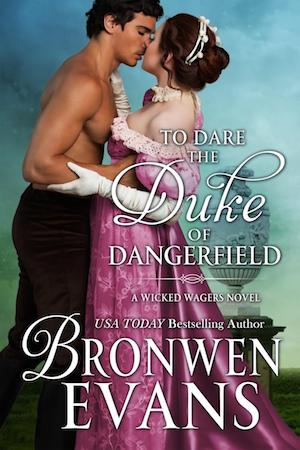
  • To DARE the DUKE of DANGERFIELD: Wicked Wagers Triology Book 1 by Bronwen Evans – Regency Romance, Historical Romance, Victorian Romance

    To DARE the DUKE of DANGERFIELD: Wicked Wagers Triology Book 1 by Bronwen Evans – Regency Romance, Historical Romance, Victorian Romance

    Chatelaine 1st Place Best in Category Blue and Gold Badge

    Lady Caitlin Southall wants to save her home in Bronwen Evan’s first novella in the Wicked Wager Trilogy, To Dare the Duke of Dangerfield.

    According to her deceased mother’s will, Caitlin inherits the estate upon her marriage or her twenty-fifth birthday, whichever occurs first. Since she’s twenty-three with no suitors on the horizon, Caitlin’s estate falls under the care of her father, the Earl of Bridgenorth. When her father loses Mansfield Manor in a faro game to the Duke of Dangerfield, Caitlin’s hopes of independence seem lost.

    Harlow Telford, a rakish devil, determined to see Caitlin’s father ruined, rejoices when he finally succeeds in divesting the Earl of Bridgenorth of his family home.

    Harlow vowed revenge fourteen years earlier when Bridgenorth seduced his recently widowed mother and left her pregnant. His half-brother Jeremy had been paying the price of that betrayal his whole life. Harlow swore he would give Jeremy what should have been his birthright, Mansfield Manor.

    But when the beautiful Caitlin marches into his home, demanding its return, Harlow’s captivated by her spirit. Caitlin’s undaunted in determination, and the two agree to a best of three challenges. If Caitlin wins, she gets her house back. If Harlow wins, he’ll get Caitlin in his bed. As the two face off against each other, they soon find much more at stake than they initially realized.

    Harlow Telford may seem like the typical, lust-worthy hero, but there’s much more.

    After suffering a broken heart at the hands of a cheating fiancé, Harlow swore off love. He spent his adulthood bedding women and gambling, but readers may suspect that Harlow possesses a conscience. Even while making the scandalous bargain with Caitlin, Harlow vows to propose marriage before Caitlin’s reputation falls into ruin. Though he should hate her for the sins of her father, he cannot ignore the lessons learned through watching his mother’s suffering at the hands of a rigid Victorian society.

    Harlow sees the injustice of Caitlin not inheriting her mother’s estate and makes numerous plans to rectify the mistake without compromising the promise he made to his half-brother. Harlow cannot take advantage of anyone hurt by the very man who hurt his mother. He finds himself wanting her respect, something he never expected to need from a woman.

    Lady Caitlin Southall, on the other hand, possesses an iron will and a salty disposition.

    Growing up motherless with a derelict father forced Caitlin into a keen awareness of her financial situation. Her bravery and fire make her a fantastic character, especially when she slaps the arrogant, albeit perfect, face of Harlow.

    Caitlan doesn’t hesitate to take matters into her own hands, even though that could mean destroying her reputation. Despite giving in to Harlow’s lecherous designs, she remains determined to find a husband who sees her as a true partner, not an heir-bearer. Her home means more than a place to live. For Caitlin, the manor embodies her security, a chance at financial independence from her father and husband. Retaining Mansfield Manor would prevent her from being sold off to the man who can fill her father’s empty purse.

    A simple theme for the novel revolves around the idea of what makes a house a home.

    Caitlin’s overwhelming desire to retain Mansfield Manor nearly becomes her undoing when she risks not just her reputation but also her life. Harlow’s love for his brother causes him to take revenge upon the man responsible for the unfortunate situation. His actions almost cost him the woman he loves. Both must learn that people make a house a home – not the stones with which it’s built.

    To Dare the Duke of Dangerfield won First in Category in the CHATELAINE Book Awards, a division of the CIBAs, for Romance novels.


     

    Chanticleer Book Reviews 5 Star Best Book silver foil stickerChatelaine 1st in Category gold foil book sticker image

  • LOVE and THE ARTS, a Blog-post from Kiffer Brown

    LOVE and THE ARTS, a Blog-post from Kiffer Brown

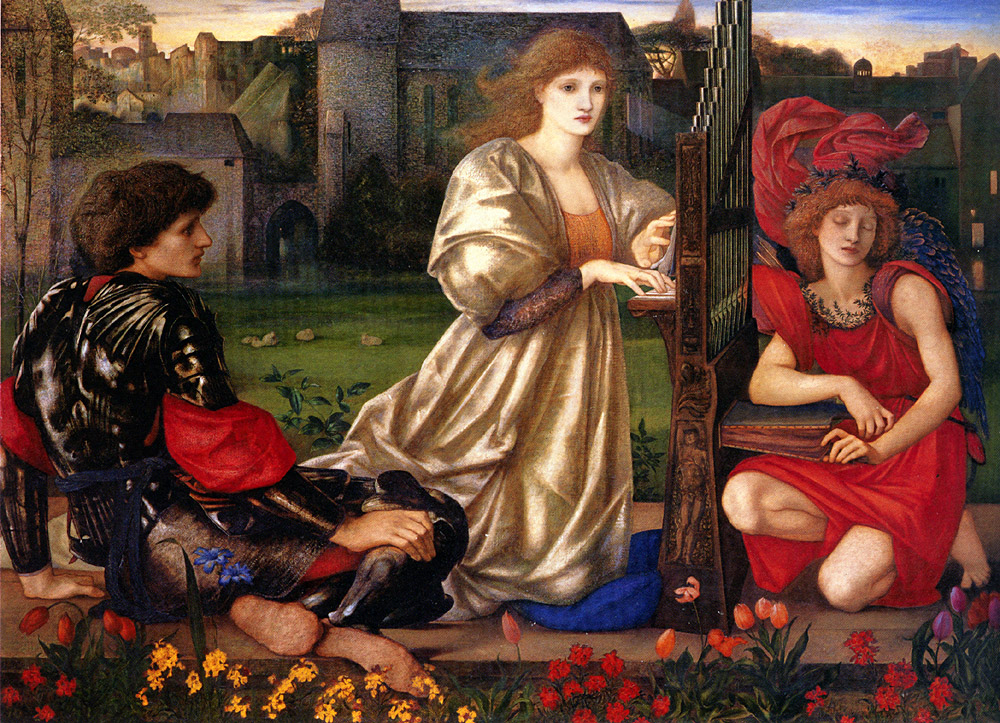
    Edward_Burne-Jones_Le_Chant_d_Amour_(Song_of_Love) (1)The Love Song by Sir Edward Burne-Jones portrays each of the three young people alone with their thoughts and dreams, but gathered together, as the sheep are in the distance, for comfort and support.

    Sir Burne-Jones was forty years-old when he painted this, perhaps remembering the daydreaming times and wistfulness of his youth.

    Sir Burne-Jones was mentored and influenced by Dante Gabriel Rossetti. Rossetti was one of Pre-Raphaelite Brotherhood founders who, in 1848, sought to create works of art that conjured a realm of heightened emotions, aspirations, and visual splendor that would elevate a modern society beset by change.1 

    These are apt words for today’s hyper-charged digital age.

    Sir Burne-Jones own words asserted, “Only this is true, that beauty is very beautiful, and softens, and comforts, and inspires, and rouses, and lifts up, and never fails.”  And this sentiment  is where the Pre-Ralphaelite movement artists of poets, novelists, painters, music composers, and craftsmen found connection and inspiration for their collaborations and works. 2


    The Dante Gabriel Rossetti Influence

    We have chosen Dante Gabriel Rossetti’s work to symbolize several of our writing competitions logos. We feel that the sentiment expressed by the Pre-Raphaelite movement exemplifies what inspires many authors to pick up their  proverbial pens to express their emotions and their observations of the visceral dynamics of living.

    Dante Gabriel Rossetti: artist, poet, and scholar of Italian Medieval art

    Dante Rossetti images

    Imagine nineteen-year-old Dante Rossetti looking at himself in a mirror as he is drawing his self-portrait in 1847.

    As a young man, Rossetti was known to be confident, articulate, and charming as he was zealous, emotional, and irresponsible.  His contemporaries called this a “poetic nature,” which drove him to combine the “human with the divine” in his art. His  self-portrait captures these many traits. 1


    We felt this portrait of  Rossetti would be perfect to represent Chanticleer’s novel competition for young adult fiction as it deftly embodies the flashing range of emotions that young people from any era have experienced, and probably will continue to experience in the future, as they encounter the crossroads of adulthood.

    Jane Burden Morris: muse, artist’s model, wife, and paramour

    The Chatelaine Awards

    Twenty years later Rossetti painted Jane Morris in a “Blue Silk Dress” in 1868. She was twenty-nine.

    He sublimely captures the many nuances of romance, love, and longing. Did a lover give her the flower tucked into her sash? What is she wistfully looking up from reading? What is on the other side of the drapery? Where did the flowers in the vase come from? Did she cut them or are they from a different suitor? As  many find with Rossetti’s work, there are endless possibilities for story ideas when viewing his art.

    Rossetti was a scholar of Medieval Art and Letters, along with pursuing knowledge of Arthurian Legend. He was profoundly influenced by his namesake, Dante Alighieri, and the English poet John Keats.

    Rossetti’s portrayal of Jane Burden Morris in the “Blue Silk Dress” (to me) is an ethereal image of women–a perfect image for the Chatelaine Awards for Women’s Fiction and Romantic Fiction.

    An Arthurian Legend Comes True in the Victorian Era?

    Jane Burden (Morris),  known as the Pre-Raphaelite ideal of beauty, came from an impoverished background, her father a stable-hand and her mother an illiterate domestic servant. Rossetti and Burne-Jones were struck by her beauty when they saw her when she and her sister attended a play in Oxford in 1857.  The artists asked her to model for them. She was eighteen and destined for a life as a domestic servant. The rest is history in this fairy-tale-come-true story–essentially Arthurian legend come to life.

    [fusion_builder_container hundred_percent=”yes” overflow=”visible”][fusion_builder_row][fusion_builder_column type=”1_1″ background_position=”left top” background_color=”” border_size=”” border_color=”” border_style=”solid” spacing=”yes” background_image=”” background_repeat=”no-repeat” padding=”” margin_top=”0px” margin_bottom=”0px” class=”” id=”” animation_type=”” animation_speed=”0.3″ animation_direction=”left” hide_on_mobile=”no” center_content=”no” min_height=”none”]

    Jane Morris as Guinevere
    “Guinevere” by William Morris. Artist’s model is Jane Burden, 18)


    Morris fell in love with Jane when she was modeling for his “Guinevere” painting and he asked her to marry him.  After they were engaged, she was privately educated to become a suitable wife for a gentleman of high society standing such as he was. They married on April 26, 1859; she was twenty, Morris was twenty-five.

    Apparently, she was quite intelligent, as she quickly took to her lessons and became fluent in French and Italian, became an accomplished pianist, and was known for her refined manners and eloquent  speech.

    Jane Burden Morris is considered to be the woman who inspired Bernard Shaw’s Pygmalion, more currently known as My Fair Lady of Audrey Hepburn fame. 1


    After her marriage to William Morris, she continued to model for Rossetti, which is another story unto itself. Jane Morris is said to have “consumed and obsessed him (Rossetti) in paint, poetry, and life.”4

    Was Morris Rossetti’s King Arthur? Was Rossetti Morris’s Lancelot? And Jane, was she Morris’s Guinevere?  Does life imitate art? 

    Love and the Arts during the Victorian Era in England

    If you ever get the opportunity to view the works of the Pre-Raphaelites, I urge you to do so! I have had the pleasure of viewing them at the Metropolitan Museum of Art in New York City and at a touring exhibit at the Rijkesmuseum in Amsterdam.  An interesting note is that the Rijkesmuseum titled the Pre-Raphaelite exhibit unabashedly as “Wives and Stunners.”  The artists and their wives must have been the subject of many a gossip column in the newspapers and scandal broadsheets as well as inspiration for the contemporary authors of that era: Oscar Wilde, Charles Dickens, the Brontë sisters,  Alfred Tennyson, Rudyard Kipling, and other notables.

    The Pre-Raphaelite art movement is one that has resonated with me since I was teenage girl. And now that I am a woman of a “certain age,” I find that it still does, increasingly so–especially now that I have come to know more about the artists and their muses.


     Background Information:
    • Sir Edward Burne-Jones, 1833–1898.
    • Dante Gabriel Rossetti, 1828-1882.
    • Jane Burden Morris, 1839-1914.
    • William Morris, 1834-1896.
    Citing and Acknowledgments
    1. Wikipedia Commons. 
    2. Metropolitan Museum of Art
    3. All art images via Wikipedia Commons. 
    4. Pamela Todd, "Pre-Raphaelites at Home," New York (2001).

    [/fusion_builder_column][/fusion_builder_row][/fusion_builder_container]