Tag: Terrorism

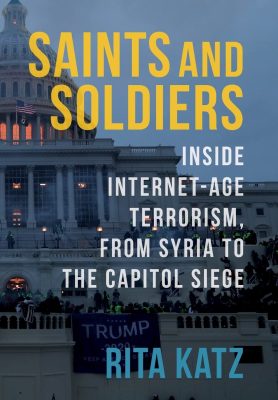
  • SAINTS And SOLDIERS: Inside Internet-Age Terrorism, From Syria to the Capitol Siege by Rita Katz – Journalism, Terrorism, Modern Communication


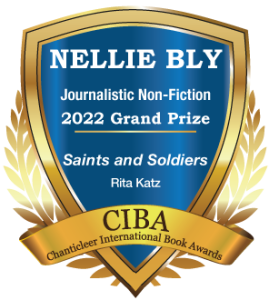
    The Nellie Bly Grand Prize Badge for Rita Katz and her book Saints and Soldiers

    To many, atrocities such as mass shootings and violent counter-protests seem to appear out of thin air, undertaken by independent actors. But Rita Katz, in her groundbreaking exploration of internet-age terrorism Saints and Soldiers, reveals a sinister ecosystem of violence multiplying worldwide, visible yet largely ignored.

    Katz– executive director of the counterterrorist organization SITE Intelligence Group– uses a strategic blend of primary media sources, personal narrative, and research analysis to unearth the haunting truths of internet-age terrorism. Although SITE once focused mainly on monitoring the actions of Islamist terrorist groups, Katz describes how it began applying the same tracking methods to white supremacists and neo-Nazis over a decade ago. As Katz writes, “the internet is more than just an asset for today’s new breed of terrorists. It is a necessity.”

    Throughout Saints and Soldiers, Katz uses her decades of intensive experience to describe how a new generation of internet-born white supremacist movements followed the same trajectory as ISIS. She exposes the network of threads that link white supremacist violence such as the Christchurch massacre of 2019 to their origins on messaging platforms such as 8chan, Discord, Stormfront, and Telegram. Indoctrinating vulnerable minds with extremist neo-Nazi ideology, these violent groups use a “screw your optics” mantra that celebrates gruesome violence and the “saints ” and “martyrs” that drive their hateful cause.

    Katz reveals her first-hand experiences with neo-Nazi organizations that have targeted her and her community for their counterterrorist work and her vulnerable identity as an Iraq-born, Jewish woman. Saints and Soldiers cements Katz’s commitment to creating a safer future for her loved ones and the world at large.

    While the truth of this violence may seem hopeless, Katz urges readers to keep reasonable goals toward change in sight.

    Katz faults the US government and tech companies with responding too late and neglecting the warning signs pointing toward future violent actions. While any internet posts connected to ISIS are treated with immediate action, white supremacist violence is largely ignored or dismissed with an excuse of “free speech.” As a result, responsible actors miss obvious signs pointing toward real danger. Katz implores tech companies to extend the digital walls that they have created to block ISIS terrorism to white supremacist platforms whenever possible, halting their ability to attract and radicalize more people.

    Katz’s intense storytelling does not shy away from reality, however grim.

    Graphic descriptions of terrorist attacks tied to antisemitism, racism, sexism, and xenophobia will resurrect fresh mourning in readers. However, although shocking, Katz’s writing is widely accessible. Rather than relying solely on written text, Katz incorporates images, screenshots of social media posts, tweets, and extremist artwork, creating a multimedia project that allows readers to deeply invest in and connect with the truth of her research. Similarly, Katz carefully deconstructs the process SITE uses to investigate possible terrorist concerns, bringing ethical transparency into a conversation often concealed from the larger public.

    Saints and Soldiers is eloquent, eye-opening, and timely. Katz compares and contrasts white nationalist neo-Nazi internet terrorist groups with the declining presence of ISIS extremist organizations, searching for solutions to violence. Threads of true stories weave together a chilling portrait of white supremacist terrorist threats proliferating in plain sight, while offering steps toward safety.

    Saints and Soldiers by Rita Katz won Grand Prize in the 2022 CIBA Nellie Bly Awards for Longform Journalism Non-Fiction.


    5 Stars! Best Book Chanticleer Book Reviews

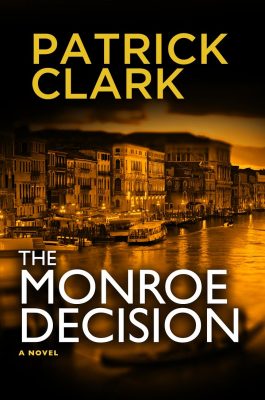
  • The MONROE DECISION by Patrick Clark – Spies & Politics, Terrorism, Thriller

    The MONROE DECISION by Patrick Clark – Spies & Politics, Terrorism, Thriller

    As a treaty expert for the Department of State, Aaron Monroe travels the world extensively, unquestioned and unsuspected. This allows him to efficiently fulfill his orders. You see, in reality, Monroe is an undercover operative for the covert arm of the US Council for Homeland Defense. He is the best at what he does—taking out targets, sanitizing scenes, and scooting away undetected.

    On holiday in Italy with Sarah, his wealthy, beautiful, Eurasian girlfriend, he abandons her in Venice for one day to keep an appointment in Trieste. A final “go” from his handler in Washington D.C. and Aaron tracks his targets, an al Qaeda and ISIS financier and a senior ISIS commander, to a decrepit villa in one of the city’s oldest areas.

    While clearing the building, after gaining entry and eliminating these men, Aaron finds an office equipped with multiple closed-circuit TV screens monitoring four locked, basement rooms. Three are crowded with young teenaged girls and one with pre-teen boys.

    Now what? A quick call to his handler, a decision—leave the captives for the police to find— sanitize the scene and get out undiscovered. During the cleaning process, Aaron finds a ledger written in what appears to be Arabic in the deceased financier’s satchel. As the ledger may contain valuable information, he slings the satchel over his shoulder and poof! He’s out of there.

    At Sarah’s insistence, Aaron relents and allows her into his shadow world. They trek around Europe and the United States, seeking to expose the international human trafficking ring that kidnapped those children to sell as unsullied brides for ISIS fighters and suicide bomber trainees.

    This dangerous quest takes them into the highest echelons of government and industry, where the lust for power and wealth supersedes human decency and democratic ideals. Ultimately, Monroe is forced to question whom he can truly trust and, perhaps more importantly, if anyone really has his back.

    The Monroe Decision explores relatively uncharted territory within the thriller genre. Clark uses socio-political facts and incidents from today’s headlines and accurate, detailed descriptions of familiar and exotic locations to create a mesmerizing yarn, replete with assassination, romance, betrayal and the triumph of good over evil.

    Clark offers no downtime for his readers: plot, characters, atmosphere, setting, and pacing coalesce into a smooth, captivating read that’s hard to put down. Our advice? Clear your calendar, turn off the phone, lock the door, and enjoy.   


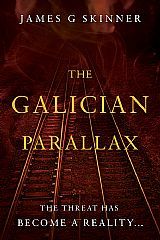
  • THE GALICIAN PARALLAX by James G. Skinner – Spies & Politics, Thriller, Terrorism

    THE GALICIAN PARALLAX by James G. Skinner – Spies & Politics, Thriller, Terrorism

    Lieutenant Sergio Quiroga of the Civil Guards has smelled something fishy brewing in the northwestern autonomous community of Spain known as Galicia for some time, and it’s not the world-renowned Port of Vigo.

    Not directly, anyway. It’s the cartels that are using the port to funnel drugs into Europe via the yachting enterprise, but what’s worse, the cartels have ties to the terrorist faction known as Al-Qaeda. The deeper Sergio delves into the latter organization by way of the former, the more he learns of their shifting plots to attack on European soil. Without the support of his superiors, Sergio must immerse himself in the Galician underworld in order to stay ahead of this thing. He eventually enlists the aid of British consul Stan Bullock to decipher exactly where and when the onslaughts are to take place.

    Largely set against the backdrop of northwest Spain following the 9/11 attacks, Skinner capitalizes on factual events to craft his narrative, such as the Madrid train bombings of 2004 and the bombings in London of 2005, to name a couple. And even more often he peppers in smaller-scale acts of aggression dually to punctuate the characterizations of Sergio and Stan and keep the looming threat they both face alive and machinating. To that point, Skinner also fills in the blanks of his international playing field by briefly focusing on the subsidiary parties such as the cartel leaders, Sergio and Stan’s superiors, and even the then President George W. Bush and Osama bin Laden.

    The Galician Parallax is certain to make a shrewd birthday gift for your diplomatically savvy uncle who likes to read about the second Bush administration and the concurrent War on Terror as if he were reading a series of dailies. The author maintains that he uses information based on facts to inform his readers rather than just trying to keep them entertained. On the other side of the coin, those readers more inclined to pick up a tight-knit character drama with some thrills here and there may be left wanting. Ultimately, Skinner, in his didactic world-building, challenges his readers and forces them to decide if they want to be informed or entertained. On the fiction side of things, Skinner imbues Sergio and Stan with their own personal struggles and desires to keep the reader caring about the story’s primary focal points.

    Make no mistake, The Galician Parallax is strong message serving to expose the cartel involvement in well-known terrorist organizations around the world. A timely and informative thriller set in Galicia, Spain. Shrewd writing about the international playing field of cartels by James G. Skinner!

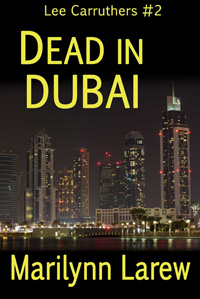
  • DEAD in DUBAI by Marilynn Larew; an international spy thriller

    DEAD in DUBAI by Marilynn Larew; an international spy thriller

    Larew has found a comfort zone in describing exotic settings, and her perspicacity for honing in on minute details gives her work a sense of authenticity. Through the eyes of her intrepid, intelligent heroine, we are treated to an insider’s view of locales like Dubai and Istanbul.

    In this second Lee Carruthers offering (The Spider Catchers provided the opening salvo), author Marilynn Larew again displays her prodigious knowledge of the international dealings in diamonds, deception and death that are hidden from the headlines.

    Employing her wry wit (“I disapprove of assassination, particularly my own”), Carruthers, a woman of a certain age (“my long brown hair had a few strands of silver”) is looking for a dead man. After quitting the CIA and vowing she wouldn’t go to Dubai to look for CIA operative George Branson, she is inveigled into doing just that by the appeals of Branson’s wife Cynthia, and possibly equally, by the little brass key that Cynthia gives her. Figuring out what that key unlocks will consume Carruthers; finding out why Cynthia plunges off a balcony to her death, and others will die while the hunt is on, will provoke far more troubling questions.

    Carruthers, a sort of female Bond, can identify a person’s borough of origin by his accent, and tell whether a man is an American or English by the way he takes his whiskey—with or without ice.  She knows where to get the best pastry, what wine to order, and in which Islamic enclave she can walk around without a head covering. She bribes passport control agents and befriends charming crooks. And she’s tough, always carrying a Glock, with a knife in a sheath on her leg.  She goes through several weapons in the course of this story, and uses a particular firearm to good effect occasioning one of the book’s better zingers: “Tears came to my eyes but they didn’t spoil my aim.”

    Carruthers is a person of principle, so when she gets caught up in a spy vs. spy morass, she keeps her own counsel and tries to do the right thing, though with the CIA and the Russian mafiya trying to outfox each other, she knows she may be seen as expendable. In the end, she has her ethics intact, a small bag of rough diamonds as compensation for her troubles, and some disturbing conclusions about who George Branson was, or is?—and who’s playing footsy with whom under the big table.

    In an age when national, ethnic and political identities and loyalties have blurred the lens of spy-craft, Larew’s heroine is right up to speed. And if the story line seems at times to move too fast and somewhat jerkily, it’s also true that there are few if any lulls in the action. Still, some readers may find the wrap-up final chapter rather mechanical, and may wonder why Carruthers, who keeps protesting that she quit the CIA in order not to be sent on dangerous assignments, hops on board for another missing-person case on the last page. But lucky for Larew’s readers that Carruthers accepts the assignments despite her better judgement.

    A sequel seems to be brewing that may perhaps reveal a softer side of Lee Carruthers. In this story there is a hint, but just: someone named Kemel, and a bloodstained pearl.

    Larew has built up steam with her fascinating femme-sometimes-fatale protagonist and her writer’s grip on the subtleties of international intrigue and double crossings that ratchets up the race against time in this spy vs. spy thriller.


  • WORST OF ALL EVILS by Janet McClintock

    WORST OF ALL EVILS by Janet McClintock

    After an economic collapse, the US Constitution is set aside; civil rights are a thing of the past. A driver can get pulled over just for being out late. Even unpaid parking tickets can warrant harassment and a stint in a holding cell.

    This is not the America that Joan Bowman fought for in Iraq; she swore an oath to uphold the constitution. An underground group, The Constitutional Defense Legion (CDL) has formed to do just that, through any means possible. They have adopted John Stark’s motto, “Live Free or Die” which always elicits “death is not the worst of all evils” as a response.

    Joan meets a CDL recruiter at the gym, and decides that by joining their forces, she can help overthrow the current tyrannical government. Her reasoning followed the quote from Edmond Burke: ‘The only thing necessary for the triumph of evil is for good men to do nothing.’

    Joan’s life gets turned upside-down when the CDL decides to make her home into a ‘base of operations’ and moves two other CDL members into it. She learns that asking questions isn’t the best way to get answers; everything is on a ‘need to know’ basis.

    Joan is a martial arts enthusiast, putting her fighting skills to good use when some of the CDL’s missions go sideways. Disobeying orders, she uses her own decision-making skills to rescue her colleagues.

    She can charm the keys off an unsuspecting suitor while gathering intelligence undercover, with no one questioning her motives. But as Joan starts to rise through the ranks, she starts to question the legion’s direction and becomes wary of the stone-cold, heartless personalities in the inner circle, witnessing unnecessary use of force.

    Duncan, who is grooming Joan for his own position, “is” the Legion, and lives for the Legion. He suffers from PTSD from a jungle ambush where he was the sole survivor. His best friend, Kearney, resents Joan and makes no effort to hide it, making her life as miserable as he can. Duncan works closely with Joan but is respectful and distant. Joan is told to be watchful of Duncan, and is unsure, for a while, why everyone is so afraid of him.

    Duncan realizes Joan might be the key to unlocking his personal demons, but their budding romance keeps getting interrupted. It was refreshing to see a relationship develop without the cliché “he noticed her curves” or similar sentiment that finds its way into so many stories where a man and woman are forced to work together and then form a connection. Instead, Joan starts to notice Duncan’s physique after a very long time, but knows she can’t trust him as much as she’d like to.  After all, he admitted he would have killed her if she hadn’t turned over her house to the CDL.

    Just because a person is paranoid it doesn’t mean there isn’t someone actually following him.” Over time, Joan becomes paranoid from being undercover for so long. Joan knows that no one can get out of the CDL alive and she has few options left.  The CDL’s motto, that “there are evils worse than death” begins to haunt her.

     Worst of All Evils is a harrowing look into how a terrorist organization might function, how individuals can get trapped in a situation that spirals out of their control, beyond their ability to leave. McClintock doesn’t spare us torture, violence, or even the after-effects of drinking too much. However, the fight sequences and chase scenes are entertaining and fun to visualize.

    This thriller will have you on the edge of your seat wondering what is going to happen next. I can easily see Worst of All Evils as a TV series because of the Joan character, a “relatively unnoticeable brunette,”  who surprises us at every turn with her skills of observation, quick thinking, as well as with her flaws and mistakes. If you enjoy raw dialogue, fast action, and risk taking (powered by PTSD), you’ll love Worst of All Evils by Janet McClintock.


  • An Editorial Review of “Petroplague” by Amy Rogers

    An Editorial Review of “Petroplague” by Amy Rogers

    If you’re a fan of techno-thrillers, you’ll want to read Petroplague by Amy Rogers just for the breath of fresh air it brings to the genre, especially by its characters—all realistic scientists behaving like real scientists would–and a fresh plot that avoids some of the tired clichés—lots of murder, mayhem, and a protagonist who performs a series of almost superhuman feats, one after another, and emerges unscathed. If you don’t usually read techno-thrillers, this one’s definitely worth picking up for the same reasons—it’s different.

    Christina Gonzales, the protagonist, is attractive and has a pleasant personality. However, she doesn’t wear make- up, and she dresses with comfort in mind. She’s investigating a strain of petroleum-eating bacteria, like those used to assist clean-up efforts after the Exxon Valdez disaster, for her PhD thesis at UCLA. Her bacteria, Syntrophus, are different in that they are anaerobic, and they work in concert with other bacteria deep in crude oil deposits to produce methane, the principle ingredient in natural gas. She is also helping her thesis adviser, develop a strain of E. coli that will produce isobutanol, a good but expensive substitute for gasoline.

    Christina shares an apartment with her cousin River and River’s boyfriend, Mickey, which is near the UCLA campus. The real action begins when we learn that an eco-terrorist bomb, which exploded in an underground storage tank of an abandoned gas station in South LA, destroyed Christina’s pilot project and thesis. The tanks, loaded with instrumentation, were filled with low-grade crude oil infected with Christina’s oil-eating bacteria. It quickly becomes clear that Christina’s bacteria were also released by the explosion and have evolved into aerobic organisms that are gobbling up gasoline, diesel fuel, and jet fuel. Also, out of their underground anaerobic environment, the bacteria are producing, not methane but acetic acid and hydrogen, an odorless, invisible and extremely explosive gas. This is the beginning of the LA petroplague.

    Cars, trucks and planes grind to a halt as Christina’s bacteria consume their fuel, while free hydrogen gas causes explosions and fires around the city. In an artful twist, Christina realizes that she has inadvertently passed information to the eco-terrorist. As the cast of characters continues to grow, Rogers weaves them into an intricate plot as the science becomes intriguingly more complex.

    Amy Rogers, a Harvard educated, M.D., and Ph.D.,  writes thrilling science-themed novels that pose “frightening what if? questions.” She grounds her thrillers in fact until the last possible second. Then she blurs the lines between fact and fiction. This is where Rogers well-crafted explanations maneuver her readers to become wrapped up in the story-line and with its compelling characters.

    In the interest of scientific literacy, Rogers added five-pages of technical notes at the end in which she explains the scientific details (with references, bless her heart) and distinguishes between and the  parts where, she admits, “I made this stuff up.” I can recommend Petroplague without hesitation to readers fascinated by real science as well as to my most science-phobic friends. The revelations in her writing will make readers feel like they are insiders in a field that only an elite few understand.

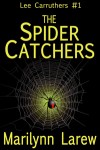
  • An Editorial Review of “Spider Catchers” by Marilynn Larew

    An Editorial Review of “Spider Catchers” by Marilynn Larew

    Lee Carruthers is sent to Fez, Morocco to find out what became of Alicia Harmon, a CIA analyst who has gone missing while investigating a potential new source of terrorist funds. So begins The Spider Catchers, Marilynn Larew’s first novel that deals with the battle between the CIA and terrorism.

    Carruthers bemoans receiving the new mission so quickly after just returning from Baghdad. However, she heads back into the field without much persuasion. Once in Fez, she meets with a hostile reception. Each answer she finds only leads to more questions as to why Harmon believes an untouchable Islamic politician is funding a new group of terrorists. Carruthers is methodical in the way she follows each lead, always taking the next logical path.

    While several characters play only incidental bit roles, Larew works hard to ensure between bombings and stakeouts that Carruthers’ important contacts are emphasized. Still, certain characters are sometimes lost in her sea of informants. The plot never falters, even when Alicia Harmon’s motivations are completely obscure to both Carruthers and the reader. The world is real with none of the antiseptic frequently found to ease the burden that comes with reading about terrorism.

    Readers who love a clandestine novel will be pleased with the way Larew weaves her mystery. She allows Lee Carruthers to gather hints and suspicions, but keeps the overarching web of conspiracy shrouded as she builds the tension. A dash of romance coupled with a healthy splash of righteous anger, and The Spider Catchers carries itself quite well. As Carruthers closes in on what Harmon is investigating, the attacks on her become more frequent. She has only a few trusted contacts to rely on, the majority of whom can only be trusted as long as she can pay them.

    The relentless determination with which Carruthers pursues her problems drives The Spider Catchers. Balancing between someone who wants out of Agency life, and someone who cannot stand the atrocities around her, Carruthers focuses on the task at hand with an impressive single-mindedness and a sharp tongue that leaves conservative Moroccans white-knuckled.

    The investigation into a CIA operation, and the suspicion between clandestine agencies places the reader in the same whirlwind of confusion Carruthers deals with on a regular basis. Each clue frustrates and worries the reader as much as it does her. Only in certain moments, as she narrates safely from the future, does Carruthers drop hints and foreshadows. Occasionally the glimpses of the future feel heavy handed, but in most cases they skillfully guide the reader to see clues that might otherwise be missed.

    The Spider Catchers works well within its spy-thriller genre, always maintaining the mystery of what happened to Alicia Harmon at the forefront. The slow clicking into place of all the pieces is a delight, and Carruthers oblivious attitude towards her own nature makes her quite the narrator. This book was a solid read, and the onset of a sequel is cause for excitement.