
Tag: Southern Fiction

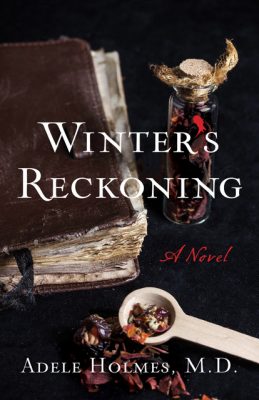
  • WINTER’s RECKONING by Adele Holmes – Southern United States Fiction, Women’s Historical Fiction,


    In Winter’s Reckoning by Adele Holmes, a mercurial new pastor in town threatens the families of two women. 

    Welcome to 1917. A time of suspenders for men and, in the cities, bloomers for women. Horse-drawn wagons range the landscape, stoves burn wood, and people have to use outdoor facilities. A time of few vaccines and no antibiotics. People understood little of most diseases. Germ theory still had ground to cover. Women routinely died in childbirth. Life could vanish in a moment. 

    In rural Jamesville, a Southern Appalachian town, Madeline Fairbanks does what she can to make the lives of friends and neighbors more comfortable. She works as the healer in this community – and has for the past quarter of a century. Madeline eases the passage into and out of life, treating aches and pains in between.

    Maddie comes from a long line of healers. Her grandmother taught her, and she’ll pass along what she knows to her granddaughter in turn. Hannah already has the inclination. The time has almost come to give her the ancestral box, which holds herbal remedy recipes and sketches and notes. That box contains all the learning from the women in their family who came before them.

    Maddie has also trained an apprentice, Renetta Morgan, who is just about ready to begin working in the community, her own community, alone.

    Maddie is white. Renetta is Black. They walk through town together, brazenly traversing from North Main (the white section of town) to South Main (the Black) and back again. Sometimes they go to tend the sick. Sometimes, to the fields and hillsides, gathering the healing flowers and roots and herbs. Other times, they work in Maddie’s cabin, creating tinctures, potions, and ointments. When Renetta learns enough, the two of them must no longer work together.

    The long-promised railroad has recently bypassed the town, spelling a slow death for the community, cut off now from the lifeline of the new transportation. With their Main Street shops shutting down, the townsfolk face hard times. In the South, rigid segregation, Jim Crow laws, black codes, and the Klan divide the community. In Jamesville, the pointy hat boys haven’t been active in recent memory, but that’s about to change. Not everyone turns a blind eye to the flagrant close fraternizing of Maddie and Ren, two uppity women who don’t seem to know their place. Tempers are fraying.

    Into this small town closing in on itself rides a lone horseman one day, who, after a brief look around, announces that he’s the new pastor. Reverend Carl Howard is the match to the powder keg.

    As the town adjusts to this new pastor in their midst, and Reverend Howard takes his measure of the place, we will watch events unfold from the vantage point of three characters, all of whom have secrets to keep. Secrets that could be their undoing.

    With the loss of the railroad, another potential casualty looms – one of education.

    The town is divided on whether to invest in secondary education or not. Currently, only the primary school offers its young charges the most rudimentary learning. Nothing to build on. With more education, Maddie thinks, real change might be possible. Greater equality between peoples, despite their gender or skin color. Greater freedom for women. Or at least a good step in that direction.

    The theme of education and what it can bring – more profound understanding, greater personal freedom and fulfillment, and economic opportunities – underlies the struggle of those for and against keeping women and Blacks “in their place.” One side looks forward to what could be; the other looks back to what has been. The balance of power always tilts in favor of those who have always held it. As the tension mounts, where words fail, violence threatens.

    When a severe winter storm hits, everyone’s lives are suspended.

    As they wait out the freeze, rationing their supplies and tearing up the porch for firewood, Maddie and Ren will come to know things about each other and themselves. And Hannah will grow up a little.

    Set in the brooding rural South, and for a good portion of the novel in the challenging and crystalline world of a deep snowstorm, Winter’s Reckoning is rich in storyline and character with plenty of mystery woven throughout. Simply put, here’s a story that takes on issues whose harm remains with us today. With a climactic pulpit scene that’s not to be missed – and one novel we can highly recommend!

    Winter’s Reckoning was a First Place Winner in the 2021 Goethe Awards.

    5 Stars! Best Book Chanticleer Book Reviews

  • LITTLE TEA by Claire Fullerton – Southern Fiction, Friendship Fiction, Cultural Heritage Fiction

    LITTLE TEA by Claire Fullerton – Southern Fiction, Friendship Fiction, Cultural Heritage Fiction

    Somerset Literary & Satire 1st Place Best in Category CIBA badgeAuthor Claire Fullerton’s skillfully crafted fourth novel, Little Tea, weaves bits and pieces of the human condition into a timely story.  

    Prepare to visit Fullerton’s Deep South, where, like the tropical storms from the Gulf, the southern mystique engulfs the land and its people. Beneath the genteel manners and tradition are whirlpools of passion, unrelenting memories, and behaviors that ebb and flow to and from the edges of conscious thought, leaving behind a sense of anxious anticipation.  

    From when Celia Wakefield agrees to meet her high-school friends, Renny Thornton and Ava Cameron, to spend a long weekend at Renny’s lake cabin in Arkansas, she’s been uneasy. She hasn’t gone “home” for more than ten years—it’s too painful. She first met Renny and Ava before her life inexorably changed. They were thirteen years old – newly-minted adolescents eager to spread their wings and take on the world. Besties ever since, Renny and Ava are a part of Celia’s present and unthinkable history. Celia needs their friendship, but the past floats just below the surface, like a ‘gator waiting for prey.

    But now she must go.  

    Ava, the fey sprite, the dream spinner, needs her help. She’s having a mid-life crisis and has reached out to her and Renny for support. 

    Celia agrees to fly to Memphis, meet Ava at the terminal, travel to Renny’s ranch in Olive Branch, Mississippi. From there, they will proceed to Renny’s lake house over the border in Arkansas for a long weekend of intervention and renewal. It’s all about Ava’s issues—not hers. It’s what good friends do. 

    That weekend, while Ava grapples with her discontent, alcoholism, and re-connects with her first love, Celia finds herself revisiting her own agonies. Her painful past, sublimated for so long, surfaces and demands resolution.   

    Little Tea resonates on many levels. 

    This modern-day drama juxtaposes the traumas of contemporary issues with unresolved traumas from history, where, for so many, the safe, secure, and predictable world of childhood innocence was ripped away, replaced by the unthinkable.

    For the reader who not only enjoys an engaging story but values skilled writing, Little Tea fits the bill. Fullerton’s use of lyrical language, imagery, and authentic dialogue capture the feel of the south. Her characters are believable—everyone knows an “Ava.” Fullerton uses setting as a nuanced character, always nearby, influencing without being intrusive and, her pacing and word choices are exemplary.        

    Like many modern, provocative novels, Little Tea ends not by tidying up anything. Fullerton leaves her readers with an open door, so to speak, that allows readers to venture out onto the porch, sit down on the old wicker rocker, and ponder what the characters might do next. In this trusting the reader, Fullerton gifts us with latitude for interpretation.      

    If you’ve never spent time in the south or wish to revisit, Little Tea will take you there. All in all, Fullerton has given readers a story that engages both the mind and the heart. Little Tea won First in Category in the 2019 Somerset Awards for literary fiction.

    5 Star Best Book Chanticleer Reviews round silver sticker


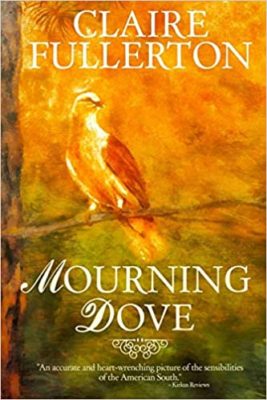
  • MOURNING DOVE by Claire Fullerton – Southern Fiction, Contemporary Literary Fiction, Saga Fiction

    MOURNING DOVE by Claire Fullerton – Southern Fiction, Contemporary Literary Fiction, Saga Fiction

    Camille Crossan appears to be living an idyllic life in Claire Fullerton’s poignant, evocative novel, Mourning Dove.  Living in a superbly appointed mansion in “magnolia-lined and manicured” Memphis during the 1960s and 1970s, Camille’s family life shimmers with Southern charm.  Her mother, Posey, usually outfitted in a Lily Pulitzer shift, Pappagallo shoes, and a signature shade of pink lipstick, is a beauty with the wryest sense of humor and steel determination.

    As a young girl, Camille, known as Millie, sees how those in her mother’s social orbit are captivated by her aura, how men are easily seduced by her flirtatious charm. Society is a game played by those who know its rules, and Posey means to win. Every time.  She, however, isn’t even the charismatic one in the family – that’s Finley, Millie’s older brother, who brims with intelligence, startling good looks, and messianic magnetism. A peek beneath the shiny surface of gracious Southern living, however, reveals enormous cracks in the foundation of the Crossan family.  One of the first things the adult Millie tells us about her brother is that he is dead.  She takes the reader back, though, to their childhood and coming of age, a tumultuous journey that both binds and separates the siblings.

    During her first decade, Millie’s family was living in Minneapolis with her tender-hearted, intellectual father who succumbed to alcoholism. Loss of money and, worse, the accompanying loss of social status, motivates Posey to uproot her children and move them to her childhood home in Memphis, a palatial mansion filled with antiques and portraits of forebears. It’s a volatile time, inside and outside the house, as centuries-old Southern traditions clash with the youth counterculture.

    Millie watches as her mother holds court during daily cocktail hours, a prospective second husband soon on the reel, and Finley, a gifted guitarist, plunges into the local music scene. But what role will she play? It’s difficult for her to see herself entirely separate from her brother for whom she has, “…a love devoid of envy, tied up in shared survival and my inability to see myself as anything more than the larger-than-life Finley’s little sister.”  Millie will grapple with her identity and question her destiny, whether she’ll be a bride in the Southern belle mode of her mother or if she’ll be the blossom that falls far from the magnolia tree. Meanwhile, Finley’s charisma both explodes and implodes in shocking and dangerous ways as he becomes revered by a group of people with no connection to the gentrified life. Like Millie, the reader is transfixed and apprehensive about where this less-traveled road will take Finley. Although the reader knows his grim fate from the outset of the book, his storyline is so engrossing that no drama is lost.

    Author, Claire Fullerton, is an enchantress with prose. The writing in this novel will cause you to stop, reread sentences, savor them, and note their architecture. Scenes sparkle as she masterfully summons moods and atmosphere. The reader can see Millie’s lovely but haunting home, and smell the rich fragrance of dogwood on a soft spring day. Fullerton has a keen ear for witty, authentic dialogue, and she deftly reveals much about personalities via conversation. It’s difficult to take leave of such a vivid, fully realized world. Fortunately for readers, Fullerton has written several books, opportunities to spend more time in her richly crafted worlds.

    Mourning Dove won First Place in the CIBA 2018 Somerset Awards for Literary Fiction.