Tag: Serious Authors

  • Spotlight on the 2021 Nellie Bly Book Awards for Journalistic Non-Fiction

    Spotlight on the 2021 Nellie Bly Book Awards for Journalistic Non-Fiction

    Your Report is coming due…

    You can hear the clicking of keys as you type up your next report, desperate to make tomorrow’s press.

    You know what’s coming. It’s the Nellie Bly Awards deadline at the end of November, and you have a book that will stop the presses! The Nellie Bly Book Awards for Investigative, Long-form Journalism, and Biographies. 
    Nellie Bly Awards
    Enter Today!

    Who is Nellie Bly?

    The Nellie Bly Awards are named for an American investigative journalist. Born Elizabeth Jane Cochran, Bly launched her career into the spotlight by posing as a mental patient to enter the insane asylum on Blackwell’s island. Writing her exposé on the abuses being committed there cemented her role as a leading name in investigative journalism.

    A charcoal-like drawing of a many leveled institute labeled "Charity Hospital"
    Illustration of Blackwell’s Asylum

    Her work had an immediate effect:

    Approximately one month after her articles ran in print, many of the most glaring problems she reported had improved: better living and sanitary conditions were instituted, more nourishing meals were provided, translators were hired for the foreign born who were not necessarily mentally ill but simply could not understand their keepers, and the most abusive nurses and physicians were fired and replaced (PBS.org).

    Nellie Bly – Early Life and Legacy

    Before that, she began writing under the name Nellie Bly after being invited to write a regular for the Pittsburgh Dispatch. WomensHistory.org lays more of her life out here. One thing noted in several articles is that Nellie Bly chose her name from a song by Stephen Foster. You can listen to the song and see the lyrics here:

    https://www.youtube.com/watch?v=fOcVjq67CsA

    Bly “became renowned for her investigative and undercover reporting, including posing as a sweatshop worker to expose poor working conditions faced by women” (Biography.com). In addition to her excellent reporting and support for civil rights, Bly was also a bit of an adventurer. Inspired by the book Around the World in Eighty Days, her newspaper, the New York World sent her to see if she could break the fictional record. She succeeded, making the journey in only 72 days! A record that would last until 1890.
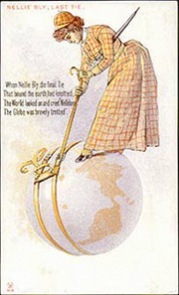
    Nellie By wrapping a string around the ruler
    Around the World in 72 Days by Nellie Bly

    Dr. Janice Ellis on The Importance of Journalism

    We’ll link to the review of her book soon, but we thought we would let Janice Ellis, PhD and Nellie Bly Grand Prize winner, talk about the importance of journalism. Here’s what she has to say:

    A Black woman wearing a jacket and a necklace
    Dr. Janice Ellis

    With all of the divisive and false information being communicated, the public needs Real Advocacy Journalism  today more than ever. There is a growing, if not urgent, need to understand the difference between the advocacy journalism being practiced today and Real Advocacy Journalism™. More importantly, we all need to readily recognize when one or the other is at play in trying to influence public opinion, or urge a hopeful, trusting public to take a particular action.

    What is the difference between advocacy journalism as it is practiced today and Real Advocacy Journalism™? Much of the advocacy journalism occurring is partisan, biased, and often blurs the lines between truth and lies, facts and fiction, and often presents fake news as real news. The purpose and objectives of this advocacy journalism constitute propaganda to gain public support for the interest and agenda of a few, a special interest group, or a small constituency rather than for the good of the majority. The public needs Real Advocacy Journalism today to put America back on the right course.

    Read more from her website here

    With all that in mind, let’s dive into some of the best Journalism books reviewed by Chanticleer!


    SHAPING PUBLIC OPINION: How Real Advocacy Journalism™ Should be Practiced
    By Janice Ellis, Ph.D.
    Grand Prize in Nellie Bly Awards

    Shaping Public Opinion Book Cover Image

    Janice S. Ellis, Ph.D., introduces the journalistic theories of Walter Lippmann in her new non-fiction work, Shaping Public Opinion: How Real Advocacy Journalism™ Should be Practiced.

    Walter Lippmann, considered one of the foremost journalists in the field over the last 100 years, was a mentor in absentia of Dr. Ellis in the art of advocacy journalism. During Lippmann’s 40+ year career, his columns were syndicated in over 250 newspapers nationwide and over 25 other international news and information outlets. Lippman focused on the ethical dissemination of information, especially about communities, society, and the world. A theory, which Dr. Ellis calls Real Advocacy Journalism.

    Continue reading here…

    WAKING up DYING
    By Robert A. Duke

    An intensely personal and compelling narrative, Waking Up Dying offers an insider’s perspective of the passage through cancer beginning with Duke’s wife’s diagnosis of stage IV glioblastoma brain cancertypically a fatal condition.

    Duke found the entire caregiving experience an agonizing, non-stop emotional rollercoaster: unbelievably frustrating, emotionally searing and increasingly chaotic.

    The author’s story of his dedicated and loving role as caregiver entails four phases of this tortuous journey: the couple’s daily coping with the disease; the author’s struggle through the health care system; the emotional reality of caregiving his dying wife; and the carefully documented material put forward as a basis for reforming the care system.

    Continue reading here…

    THE WINTER OLYMPICS: An Insider’s Guide to the Legends, Lore, and the Games
    By Ron C. Judd

    Flashbacks, gruesome accounts, victories relived, analysis, and competitors’ profiles of the Winter Olympics are revealed in Ron C. Judd’s captivating compendium titled The Winter Olympics: An Insider’s Guide to the Legends, Lore, and the Games.

    Judd doesn’t just report the scores, the times, the winners and the losers. He relays the human drama that unfolds during the Games—the glorious victories and, yes, the gut-wrenching agonies—the very stuff that becomes tomorrow’s lore and legends.

    Ron C. Judd is like a Joseph Campbell of the Olympic Games. He writes of transcendent experiences, of impossible feats, and, he says, “of moments that are beyond description.”  But describing these moments is exactly what he does. Judd deftly captures and vividly relates the escalation of emotions, the split-second moments that separate the winners from the losers after decades of day-in and day-out grueling training, the sweaty reality of the Olympics along with the heady glory and magic he has witnessed and experienced first-hand.

    Continue reading here…

    FIRE CALL! Sounding the Alarm to Save Our Vanishing Volunteers
    By George DeVault

    In his first job as a newspaper reporter, DeVault attended many emergencies – and firefighters were always on the scene. Gradually he discovered that the vast majority of America’s firefighters are volunteers, often leaving their regular jobs by prearrangement or rushing out from home in the middle of the night to respond to every conceivable crisis, from a simple kitchen fire to a multi-car crash to the cataclysmic events of 9-11-01.

    With the encouragement of empathetic wife Melanie, also a reporter, De Vault joined the firefighting ranks as a volunteer in Emmaus, Pennsylvania, while fully immersed in his journalistic career with Rodale Inc. He answered every call, about 5,000 over a thirty year period, no matter what else was going on in his life – even on a day when Melanie was in the hospital dealing with her own emergency.
    Continue reading here…


    Have a journalistic exploration that needs to be read? Submit by the end of November for the 2021 CIBAs! 

    Nellie Bly Awards

    See the 2020 Nellie Bly Award Winners here!
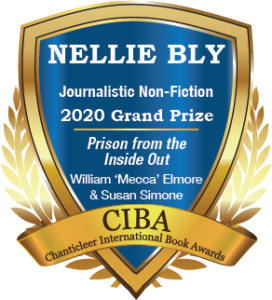
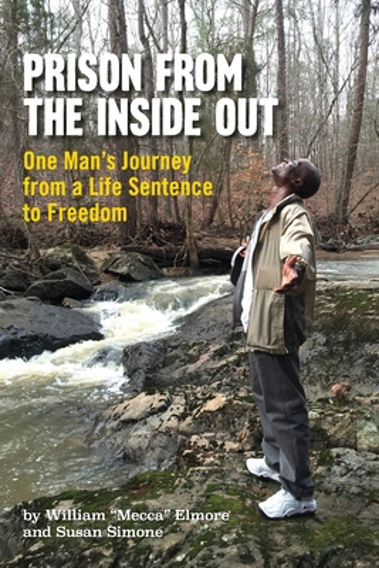
    Blue and Gold Badge for the Nellie Bly Grand Prize Prison from the Inside Out by William 'Mecca' Elmore & Susan Simone

    Looking to submit to our other Non-Fiction Divisions? See them all here!

    When you’re ready, did you know that Chanticleer offers editorial services? We do and have been doing so since 2011.

    Our professional editors are top-notch and are experts in the Chicago Manual of Style. They have and are working for the top publishing houses (TOR, McMillian, Thomas Mercer, Penguin Random House, Simon Schuster, etc.).

    If you would like more information, we invite you to email Kiffer or Sharon at KBrown@ChantiReviews.com or SAnderson@ChantiReviews.com for more information, testimonials, and fees.

    We work with a small number of exclusive clients who want to collaborate with our team of top-editors on an on-going basis. Contact us today!

    Chanticleer Editorial Services also offers writing craft sessions and masterclasses. Sign up to find out where, when, and how sessions being held.

    • A great way to get started is with our manuscript evaluation service, with more information available here.
    • And we do editorial consultations for $75. Learn more here.
    • If you’re confident in your book, consider submitting it for a Editorial Book Review here or to one of our Chanticleer International Awards here.
    And remember! Our 10th Anniversary Chanticleer Authors Conference (CAC22) will be April 7-10, 2022, where our 2021 CIBA winners will be announced. Space is limited and seats are already filling up, so sign up today!  CAC22 and the CIBA Ceremonies will be hosted at the Hotel Bellwether in Beautiful Bellingham, Wash. Sign up and see the latest updates here!

    CAC22 will feature Cathy Ace, Robert Dugoni, Scott Steindorff and more! We are excited!


    Writer’s Toolbox

    Thank you for reading this Chanticleer Spotlight article.

    Helpful Writer Links: 

    How Nellie Bly went undercover to expose abuse of the mentally ill

    Nellie Bly (1864-1922)

    “Nellie Bly” by STEPHEN FOSTER

    Nellie Bly Biography

    Public Needs Real Advocacy Journalism Today

    The traditional publishing tool that indie authors can use to propel their writing careers to new levels?  The Seven Must-Haves for Authors – Unlocking the Secrets of Successful Publishing Series by Kiffer Brown

  • Somerset Maugham is featured on the Spotlight for 2021 SOMERSET Book Awards for Literary and Contemporary Fiction

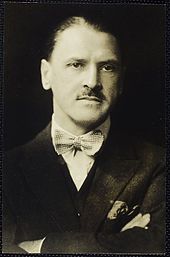
    Somerset Maugham is featured on the Spotlight for 2021 SOMERSET Book Awards for Literary and Contemporary Fiction

    The Somerset Awards: Understanding Literary Fiction

    Ah yes, literary fiction, often thought of as the highest form of writing. If only people could define exactly what it means. 

    Here are a few of Somerset Maugham’s work that typify literary fiction:

    • Of Human Bondage
    • The Razor’s Edge
    • The Moon and Sixpence 
    • And far too many to list here.


    Let’s start with some writing tips from Somerset Maugham himself. 

    • There are three rules for writing a novel. Unfortunately, no one knows what they are.
    • Every production of an artist should be the expression of an adventure of his soul.
    • I always find it more difficult to say the things I mean than the things I don’t.
    • The fact that a great many people believe something is no guarantee of its truth.
    • To acquire the habit of reading is to construct for yourself a refuge from almost all the miseries of life.
    • Impropriety is the soul of wit.
    • When I read a book I seem to read it with my eyes only, but now and then I come across a passage, perhaps only a phrase, which has a meaning for me, and it becomes part of me.
    • We do not write because we want to; we write because we have to.
    • I write only when inspiration strikes. Fortunately it strikes every morning at nine o’clock sharp.
    • If you can tell stories, create characters, devise incidents, and have sincerity and passion, it doesn’t matter a damn how you write.
    • Submit here to Chanticleer’s Somerset Book Awards before the end of November!

    We may have made one of those up…

    What a start! We still need to figure out this Literary Fiction business though. Before we dive into that, if you want to read more about Somerset Maugham, consider looking out our previous spotlight here where we discuss him at length! 

    To read more about the time he wrote in, click here.

    So What is Literary Fiction?

    The easiest way to attempt to answer this question is to start with what Literary Fiction is being defined in opposition to. Literary Fiction is not Genre Fiction. 

    So what’s Genre Fiction?

    Genre Fiction is written for people to enjoy it generally. It often follows a formula that uses conventional storytelling. The stories are meant to entertain, are plot driven, and they usually have a happy ending. As a result, there’s almost never a question of how to market genre fiction, making it easier to sell.

    So, if we take the opposite of all those and apply them to literary fiction, what do we get? 

    • It doesn’t follow a formula
    • Uses unconventional storytelling
    • Examines what it means to be human
    • It can be difficult to read
    • Character focused (not plot)
    • Endings vary or can even be uncertain
    LIterary Fiction isn’t an exact science

    That’s a tough sell! Of course, not all of these elements need to apply 

    Many literary fiction books are the kinds that stay with us for years after we read them. Chances are the longtime favorite that changed your life is a literary fiction book, or at least possesses some elements of it. 

    Here’s some contemporary Literary Fiction you may have heard of:

    • Harlem Shuffle by Colson Whitehead
    • The Book of Form and Emptiness by Ruth Ozeki
    • Little Fires Everywhere by Celeste Ng
    • A Little Life by Hanya Yanagihara
    • Kite Runner by Khaled Hosseini
    • Americanah by Chimamanda Ngozi Adiche 


    The NY Book Editors has this to say about Literary Fiction: 

    The term “literary fiction” is controversial and for good reason. As more “literary” writers venture into genre fiction, the lines of distinction have blurred. Sometimes, it’s not always clear. Perhaps, it is genre fiction that’s just pushing its own boundaries.

    It’s clear that Literary Fiction is a complex genre, worthy of being written and read. We’re happy to say that we’ve done our fair share here at Chanticleer! Check it out below!

    HARD CIDER
    By Barbara Stark-Nemon
    Grand Prize Winner in Somerset Awards

    Abbie Rose Stone is a woman determined to follow her newly discovered dream of producing her own craft hard apple cider while navigating the ups and downs of family life with her grown sons and husband.

    Abbie Rose knows how to deal with adversity, and dives headfirst into this new chapter of her life with energy and passion. She describes her early adulthood years of infertility struggles and the hardscrabble way she built her young family through invasive medical procedures, a surrogate attempt, and adoption barriers.

    Continue Reading

    MARTHA
    By Maggie St. Claire
    First Place Winner in Somerset Awards

    In the unique and compelling voice of an aging woman teetering on the edge of financial ruin, Maggie St. Claire’s debut novel, Martha, takes the reader from affluent residential areas of Los Angeles to its urban streets of despair, shadowing a 71-year-old, retired bank teller as she comes to grips with the challenges and adversities that threaten her existence.

    This is the story of Martha Moore, many years divorced, estranged from her only child, and living a lie, as she enters her golden years. The most important things in her life, outside her pride in her desirable Hancock Park bungalow, are her book club friends. She attends their meetings dressed in her finest, projecting what she hopes is the image of a well-educated, well-to-do, Los Angeles dowager. The three wealthy women who comprise the remainder of the group are her best, perhaps only friends, and sometimes that’s a stretch.

    Continue Reading

    MOURNING DOVE
    By Claire Fullerton
    First Place Winner in Somerset Awards

    Camille Crossan appears to be living an idyllic life in Claire Fullerton’s poignant, evocative novel, Mourning Dove.  Living in a superbly appointed mansion in “magnolia-lined and manicured” Memphis during the 1960s and 1970s, Camille’s family life shimmers with Southern charm.  Her mother, Posey, usually outfitted in a Lily Pulitzer shift, Pappagallo shoes, and a signature shade of pink lipstick, is a beauty with the wryest sense of humor and steel determination.

    As a young girl, Camille, known as Millie, sees how those in her mother’s social orbit are captivated by her aura, how men are easily seduced by her flirtatious charm. Society is a game played by those who know its rules, and Posey means to win. Every time.  She, however, isn’t even the charismatic one in the family – that’s Finley, Millie’s older brother, who brims with intelligence, startling good looks, and messianic magnetism. A peek beneath the shiny surface of gracious Southern living, however, reveals enormous cracks in the foundation of the Crossan family.  One of the first things the adult Millie tells us about her brother is that he is dead.  She takes the reader back, though, to their childhood and coming of age, a tumultuous journey that both binds and separates the siblings.

    Continue Reading

    JETTY CAT PALACE CAFÉ
    By Judy Keeslar Santamaria

    Judy Keeslar Santamaria’s skillfully crafted debut novel, Jetty Cat Palace Café, takes the reader from the sophisticated urban areas of Washington state to its remote cranberry coast, accompanying professor Morgen Marín on a life-altering quest.

    Like a present-day recipient of a DNA test gone wrong, when 34-year old Morgen, celebrated pianist and music professor, leaves after visiting her elderly grandmother Eleanor, her mind is spinning. Eleanor, preparing for the inevitable, shared family history, documents, and longstanding questions, which blindsided her granddaughter.

    Continue Reading

    JOEL EMMANUEL
    By J.P. Kenna
    First Place Winner in Somerset and Clue Awards

    Joel Emmanuel Book Cover Image

    Set in the Pacific Northwest in the 1970s, Joel Emmanuel by JP Kenna rewards its readers with the story of a boy coming of age and how he understands the changes around him. Kenna’s style echoes the English novels of the 19th century.

    Young Joel Emmanuel Webber, named for a Wobbly executed long ago in 1915, lives with his mother, Nance Raindance, in a cabin on the Skagit River near Seattle before it was a technopolis. Their world is antiquated even for the 1970s and defined by farming, fishing, and basics like a woodburning cookstove, kerosene lamps, and candles. Joel calls his mother by her given name, doesn’t know his father, and lives an open life free of school and, even occasionally, clothing. He is sensitive and easily succumbs to tears. 

    Continue Reading


    Have a story that breaks the mold? Submit by the end of November for the 2021 CIBAs! 

    A blue and gold badge for the 2020 Grand Prize Winner for Somerset Literary and Contemporary Fiction A Season in Lights By Gregory Erich Phillips

    See the 2020 Somerset Winners here!

    When you’re ready, did you know that Chanticleer offers editorial services? We do and have been doing so since 2011.

    Our professional editors are top-notch and are experts in the Chicago Manual of Style. They have and are working for the top publishing houses (TOR, McMillian, Thomas Mercer, Penguin Random House, Simon Schuster, etc.).

    If you would like more information, we invite you to email Kiffer or Sharon at KBrown@ChantiReviews.com or SAnderson@ChantiReviews.com for more information, testimonials, and fees.

    We work with a small number of exclusive clients who want to collaborate with our team of top-editors on an on-going basis. Contact us today!

    Chanticleer Editorial Services also offers writing craft sessions and masterclasses. Sign up to find out where, when, and how sessions being held.

    • A great way to get started is with our manuscript evaluation service, with more information available here.
    • And we do editorial consultations for $75. Learn more here.
    • If you’re confident in your book, consider submitting it for a Editorial Book Review here or to one of our Chanticleer International Awards here.

    And remember! Our 10th Anniversary Chanticleer Authors Conference (CAC22) will be April 7-10, 2022, where our 2021 CIBA winners will be announced. Space is limited and seats are already filling up, so sign up today!  CAC22 and the CIBA Ceremonies will be hosted at the Hotel Bellwether in Beautiful Bellingham, Wash. Sign up and see the latest updates here!

    Writer’s Toolbox

    Thank you for reading this Chanticleer Writer’s Toolbox article.

    Writers Toolbox Helpful Links: 

    The Prolific Writer W. Somerset Maugham

    Somerset as a Fin de Siècle Author

    What is Literary Fiction?

    The traditional publishing tool that indie authors can use to propel their writing careers to new levels?  The Seven Must-Haves for Authors – Unlocking the Secrets of Successful Publishing Series by Kiffer Brown
  • Spotlight on the 2021 HEMINGWAY Book Awards for 20th C. Wartime Fiction

    Spotlight on the 2021 HEMINGWAY Book Awards for 20th C. Wartime Fiction

    Chanticleer’s new Division for 20th Century Wartime Fiction: The Hemingway Awards

    The US fought five wars during the 1900s: World War I, World War II, the Korean War, the Vietnam War, and the Gulf War.

    Many of us have deep connections to these wars built into our family trees and history of military service. It’s no surprise that there are so many stories that delve into wartime fiction that we needed to create a new category for it this last year.

    Why Hemingway?

    Ernest Hemingway 1923 passport photo
    Young Hemingway

    Ernest Hemingway was one of the defining voices of his generation, especially in relation to The Great War where so many had to reconcile their lives as they were with the horrors of war they had experienced.

    “When you go to war as a boy you have a great illusion of immortality. Other people get killed; not you… Then when you are badly wounded the first time you lose that illusion and you know it can happen to you.” (read more here)

    While it’s well-known that Hemingway served in WWI and was honored for his bravery by the Italian government as an American Red Cross worker, it is less known that when Hemingway returned to post-war Europe he became a respected war correspondent. His grandson, Seán Hemingway describes the author’s reporting as “written in a new style of reporting that told the public about every facet of the war, especially, and most important, its effects on the common man, woman, and child.”

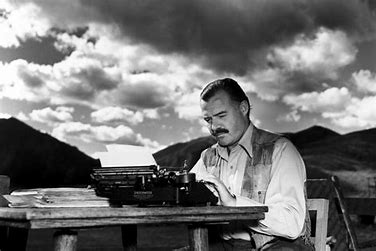
    Ernest Hemingway looking off to the right

    For those of you who know little about one of the most prolific war writers on the 20th century, he’s well worth a read, and shockingly modern in his thought. He was an early anti-fascist, being one of the first to decry Benito Mussolini.

    For all that Hemingway can dazzle and impress, there is another view of him.

    The Other Side of the Coin

    Despite his excellent writing, Hemingway is reputed to be a terrible person. An article from American Magazine, he’s described as follows:

    He was selfish and egomaniacal, a faithless husband and a treacherous friend. He drank too much, he brawled and bragged too much, he was a thankless son and, at times, a negligent father. He was also a great writer.

    Hemingway’s writing is reported to be the thing that he held above all else. More than his wives or the children he had, his writing and author platform always came first.

    Beyond that, his criticism of other works is scalding and harsh, beyond what anyone would reasonably consider helpful. This flies in direct contrast to a quote from LitHub where Hemingway opens up about the experience of being a new author, trying to break into the literary world:

    “The rejection slip is very hard to take on an empty stomach,” Hemingway later told a friend. “There were times when I’d sit at that old wooden table and read one of those cold slips that had been attached to a story I had loved and worked on very hard and believed in, and I couldn’t help crying.”

    We all know that he was published, many times:

    • The Torrents of Spring (1926)
    • The Sun Also Rises (1926)
    • A Farewell to Arms (1929)
    • Death in the Afternoon (1932)
    • Green Hills of Africa (1935)
    • To Have and Have Not (1937)
    • For Whom the Bell Tolls (1940)
    • Across the River and into the Trees (1950)
    • The Old Man and the Sea (1952)
    • A Moveable Feast (1964)

    Now we’d like to dive into some of the best books we’ve reviewed at Chanticleer with a focus on Wartime Fiction in the 20th Century.

    The QUISLING FACTOR
    By J. L. Oakley
    Grand Prize Winner in Hemingway Awards

    During World War II “quisling” became a byword for a particular type of traitor, one who not only betrays their own country but also actively collaborates with the invaders. The origin of the term was taken from an actual person, a Norwegian named Vidkun Quisling, who didn’t merely cooperate with the Nazis but actually headed a collaborationist regime in his own country.

    The Quisling Factor takes place in the immediate post-war period, as the Nuremberg Trials are gearing up in Germany. Norway is conducting its own post-war legal purge of collaborators at all levels of government.

    Keep Reading Here!

    HEART of the FEW
    By Jon Duncan
    First Place Winner in Hemingway Awards

    It is said that all is fair in love and war. In this wartime historical romance, young love is put to the ultimate test, and the love of family is strained to the breaking point. During World War II, the occupants of a ravaged England understand that all can be lost in a moment’s hesitation or in a hasty decision. Here, love is under attack by enemies seen and unseen. It’s the uncommon courage of many and the Heart of the Few that can hope to turn the fate of England during these dark days.

    Passion drives both sides in this wartime mystery/thriller about people who are determined to make a difference in the outcome of World War II. Like all powerful forces, passion has two sides. It’s a wondrous and beautiful emotion when applied to good purpose, but it becomes horrific and deadly when twisted and corrupt. The question author Jon Duncan asks amidst all the turmoil, treachery, death and desolation of war is: can love find a way?

    Keep Reading Here!

    The ACK-ACK GIRL (Love and War #1)
    By Chris Karlsen

    The Ack Ack Girl book cover

    Chris Karlsen’s new work, The Ack-Ack Girl, is the first in her World War II series, Love and War, and serves up plenty of story on both sides of that equation in its portrayal of Ava Armstrong, the “Ack-Ack” girl of the title. And what a story it is!

    Bombs are dropping on London in the heat and fire of the infamous Blitz. Shells are falling, as are the buildings that surround them, while fires spring up in the wake of the bombs that never seem to end. But when they finally stop, Ava and her friends are determined to get their loved ones somewhere safe and to find a way to serve up some revenge on the Germans.

    Keep Reading Here!

    WHERE EAGLES NEVER FLEW
    By Helena P. Schrader
    First Place Winner in Hemingway Awards

    The Royal Air Force struggles for control of the British sky, facing down the daunting numbers of Luftwaffe aircraft across the English Channel. At the forefront of these battles, the Royal Air Force’s young pilots fight to survive under mounting pressure and deadly German Messerschmitts.

    Where Eagles Never Flew follows the Battle of Britain as squadrons of the RAF must make do with undertrained pilots and little sleep if they want any chance at repelling the Luftwaffe bombing raids that become more and more frequent as the battle rages on. Operations rooms plot and direct the paths of aircraft, with members of the WAAF—Women’s Auxiliary Air Force—fielding waves of communications to and from the skies. Robert “Robin” Priestman flies on the front lines, dedicated to the fight despite weeks of unending tension and the great challenge of keeping his squadron awake and alive despite sortie after sortie.

    Keep Reading Here!

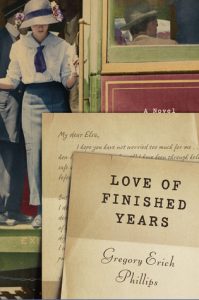
    LOVE OF FINISHED YEARS
    By Gregory Erich Phillips

    An immigrant’s journey, a forbidden love, a war to end all wars collide on the pages of a beautifully written historical fiction, Love of Finished Years by Gregory Erich Phillips.

    At twelve years of age, Elsa Schuller carries no expectations when she reaches Ellis Island in 1905. In fact, she has no idea why her father insists on leaving Germany for this supposed Land of Opportunity. Riddled with nothing less than challenges and hardship working in the sweatshops in lower Manhattan, Elsa’s only ray of hope is learning how to read and write English.

    Keep Reading Here!


    Have you written a 20th Century Wartime Fiction Novel? Submit before the end of November for the 2021 CIBAs! 

    Blue and Gold Badge for the Hemingway Grand Prize for 20th C. Wartime Fiction The Quisling Factor by J.L. Oakley

    See the 2020 Hemingway Awards Winners Here!

    When you’re ready, did you know that Chanticleer offers editorial services? We do and have been doing so since 2011.

    Our professional editors are top-notch and are experts in the Chicago Manual of Style. They have and are working for the top publishing houses (TOR, McMillian, Thomas Mercer, Penguin Random House, Simon Schuster, etc.).

    If you would like more information, we invite you to email Kiffer or Sharon at KBrown@ChantiReviews.com or SAnderson@ChantiReviews.com for more information, testimonials, and fees.

    We work with a small number of exclusive clients who want to collaborate with our team of top-editors on an on-going basis. Contact us today!

    Chanticleer Editorial Services also offers writing craft sessions and masterclasses. Sign up to find out where, when, and how sessions being held.

    • A great way to get started is with our manuscript evaluation service, with more information available here.
    • And we do editorial consultations for $75. Learn more here.
    • If you’re confident in your book, consider submitting it for a Editorial Book Review here or to one of our Chanticleer International Awards here.

    And remember! Our 10th Anniversary Chanticleer Authors Conference (CAC22) will be April 7-10, 2022, where our 2021 CIBA winners will be announced. Space is limited and seats are already filling up, so sign up today!  CAC22 and the CIBA Ceremonies will be hosted at the Hotel Bellwether in Beautiful Bellingham, Wash. Sign up and see the latest updates here!

    Writer’s Toolbox

    Thank you for reading this Chanticleer Spotlight article.

    Writers Recommended Helpful Links: 

    Hemingway on War and Its Aftermath

    Ernest Hemingway was a brilliant writer and a terrible person

    How Hemingway’s Bad Behavior Inspired a Generation

    The traditional publishing tool that indie authors can use to propel their writing careers to new levels?  The Seven Must-Haves for Authors – Unlocking the Secrets of Successful Publishing Series by Kiffer Brown
  • The Myth of the Unlikeable Character – A Chanticleer Toolbox Article By David Beaumier

    The Myth of the Unlikeable Character – A Chanticleer Toolbox Article By David Beaumier

    “No one likes my characters”

    You’re handing your precious book over to a beta reader to see if it’s worthwhile, ready, perhaps, for a Chanticleer Book Review or to be entered into the Chanticleer Int’l Book AwardsThey look at you over the cover that you worked so many long hours on with your designer and say with all the authority of fate: “I just don’t think your main character is very likeable,” they say. “Can’t you make them more likeable? All characters should be likeable.”

    A grumpy older white man
    Are your grumpy readers right?

    Writer, they are wrong

    You can of course have an unlikeable main character! If they were only willing to read for ten minutes though, you may have a more difficult problem on your hands than whether or not your character is someone they want to be friends with. Some of the most compelling characters in literature aren’t someone I’d want to share a hotel room with anytime soon. 

    A creepy character peering into a room
    We can sleep in separate bedrooms. Really, it’s okay.

    The key isn’t to worry about whether or not your protagonist is “likeable” (which is a tricky word to define), but about whether or not they are interesting.

    • Are the actions they take moving the plot forward while engaging the reader at the same time? Those two things must be true of anything that happens in your story. 

    Manuscript Overviews and Editing

    Now, if the majority of your readers are coming back to you and letting you know these early drafts aren’t working, we highly recommend a Manuscript Overview. A manuscript overview (MOV) is a broad overview of your manuscript – what’s working and what isn’t from all aspects of your story: structure, plot, pacing, character development, dialogue, etc. We are here to offer our guidance on what you need next. Save time and money by honing your work before you begin the editorial process.

    Here, we’ll go through a few basic checks to make sure that your character is compelling. 

    A person writing in a journal

    On Writing Compelling Characters

    There are a few questions you’ll want to ask to see if your complex character is someone who will grab your reader’s attention. 

    • What is the Status Quo your character inhabits? 
    • What is your character’s Desire?
    • How does the Conflict impede the character’s Desire?
    • Cats

    If you simply need help developing your character, consider reviewing this article on Secondary Characters here. Otherwise, read on!

    Speaking of Secondary Characters, Severus Snape, Professor of Potions from the Harry Potter series is a prime example of uncompelling compelling character.

    Severus Snape

    Status Quo

    This is the classic way you engage readers with your story. The story is introduced, and something happens to break the status quo. One story where this jumps to mind is Neal Stephenson’s Seveneves. With cannibalism and the end of the world, there’s no lack of unlikeable characters in this book, but all the characters rivet your attention. 

    Seveneves begins with the moon blowing up. Well, more accurately, with it being split into four pieces. Up until the catalyst (the breaking of the status quo), the four chunks of the moon are a point of fascination, friendly enough to have one chunk named “The Bean.” Then the status quo changes when one of the moon chunks hits another and they start to fragment even more. This gives all the characters a goal to work for: Save the Human Race. Having a strong focus for your characters will help readers empathize with them and want to know what’s happening.

    Our favorite editor Jessica Morrell has an excellent article detailing even more ways to stir up trouble for your characters here.

    Character Desire

    Similar to the breaking of the status quo, your characters will all want something different out of the world you’ve written them in. Of course, like the breaking of the status quo, this problem won’t be easy for them to solve. 

    An artful rendition of Tom Ellis as Lucifer with the words "What is it you truly desire?"
    Tom Ellis as Lucifer from Netflix

    There are two common methods of frustrating your character’s ability to achieve their desire. The first is simply to make it difficult to do. Anything that takes a lot of work and will make them struggle. The other excellent choice is to have them try to solve the wrong thing. So often characters misunderstand what will make them happy or they struggle to find the correct solution to their problem. By having them do the wrong thing, the reader will be able to enjoy a much more interesting story than an unlikeable person succeeding at everything they do and never growing or developing. 

    Cats

    Who doesn’t love cats? We love cats at Chanticleer, that’s for sure!

    Two kittens sleeping while spooned together
    The newest additions to the Chanticleer family: Tiefen and Biscuit at 15-weeks-old

    Now the connection between cats and what to do with your unlikeable character might not be immediately clear, and it might sometimes be a metaphor rather than an actual cat. The tried and true advice is you have a character who might be a little rough around the edges save a cat early on in the story. This shows that, despite their flaws, they do care about the world around them, and they will help a creature in need. Of course, this doesn’t have to be a literal cat, but it’s something sweet the character chooses to do without being pressured. 

    For those of you in The Roost, Chanticleer’s online community, you know that we have been reading SAVE THE CAT, WRITES a NOVEL by Jessica Brody (based on the screenwriting books by Blake Snyder) in our Writing Craft Book Group. There is even a reading guide by Chanticleer’s David Beaumier uploaded to the  activity feed.

    The opposite can happen too! In Lower Decks, the irreverent Star Trek cartoon that’s currently playing on Paramount+, Beckett Mariner kills a holographic character to establish herself as the villain in a fantasy program she designed. 

    Mariner dressed as Vindicta dressed as an intergalactic pirate
    Beckett Mariner as Vindicta in “Crisis Point” from Star Trek Lower Decks

    It’s fairly easy to flip through the first pages of your book to see if there’s a cat who your narrator can save in the early pages of your work, and then see if you can find a few beta readers to poll on their feelings. 

    To consider more of the timing and development of plot in relation to your characters, review this article here.

    “There’s no such thing as writer’s block or plotter’s block. There’s only perfectionist’s block.” Jessica Brody

    Go forth and write!


    When you’re ready, did you know that Chanticleer offers editorial services? We do and have been doing so since 2011.

    Our professional editors are top-notch and are experts in the Chicago Manual of Style. They have and are working for the top publishing houses (TOR, McMillian, Thomas Mercer, Penguin Random House, Simon Schuster, etc.).

    If you would like more information, we invite you to email Kiffer or Sharon at KBrown@ChantiReviews.com or SAnderson@ChantiReviews.com for more information, testimonials, and fees.

    We work with a small number of exclusive clients who want to collaborate with our team of top-editors on an on-going basis. Contact us today!

    Chanticleer Editorial Services also offers writing craft sessions and masterclasses. Sign up to find out where, when, and how sessions being held.

    A great way to get started is with our manuscript evaluation service, with more information available here.

    And we do editorial consultations for $75. Learn more here.  

    If you’re confident in your book, consider submitting it for a Editorial Book Review here or to one of our Chanticleer International Awards here.

    Also remember! Our 10th Anniversary Chanticleer Authors Conference (CAC22) will be April 7-10, 2022, where our 2021 CIBA winners will be announced. Space is limited and seats are already filling up, so sign up today!  CAC22 and the CIBA Ceremonies will be hosted at the Hotel Bellwether in Beautiful Bellingham, Wash. Sign up and see the latest updates here!

    Writer’s Toolbox

    Thank you for reading this Chanticleer Writer’s Toolbox article.

    Writers Toolbox Helpful Links: 

    AMPLIFY, MAGNIFY, & STIR UP TROUBLE for Your Main Characters – by Jessica Morrell

    Supporting Cast – Taking Risks with Your Secondary Characters – by Jessica Morrell

    Character Development, Dialogue, and Beats – by David Beaumier

    The traditional publishing tool that indie authors can use to propel their writing careers to new levels?  The Seven Must-Haves for Authors – Unlocking the Secrets of Successful Publishing Series by Kiffer Brown