Tag: SciFi

  • NATURE’S CONFESSION by JL Morin – Time Travel Romance, Science Fiction, Y/A Post-Apocalyptic Science Fiction

    NATURE’S CONFESSION by JL Morin – Time Travel Romance, Science Fiction, Y/A Post-Apocalyptic Science Fiction

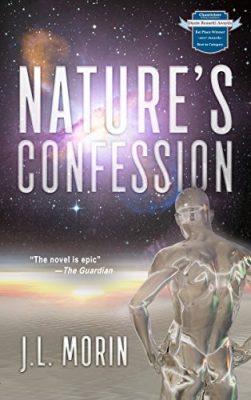
    In a dystopian near-future where nobody is safe, the world is ruled by a ruthless capitalist. Humankind’s last hope may be a fourteen-year-old named Boy. Part sci-fi, part diverse love story, Nature’s Confession by J.L. Morin is an ecological coming of age novel that spans the universe.

    The story opens with Boy, so-called because he hasn’t reached an age where he will be named yet for security reasons, managing to survive in the dystopian world he calls home. On next year’s earth, humanity is essentially enslaved by a worldwide corporate government, not for the people or by the people, but one that operates to ensure its citizens are brainwashed, downtrodden, and too exhausted to be able to offer any sort of resistance. When Boy stays after school one day, he meets a man who turns out to be his long-time idol—Tyree. Tyree is a member of the resistance and recruits Boy to help him and their cause, believing that Boy may be their last hope.

    As the story progresses, readers are introduced to a motley assortment of characters. Valentine, Tyree’s daughter, is a genius whose inventions have the power to change the world. Porter, Boy’s dad, shows up throughout the story as different versions of himself crossing over from other realities and timelines. Eleanor, most often referred to as Mom, leaves her stressful, humdrum life on earth to become a Member of Starliament. A telepathic dog-like hupcha with six tails and the wise, albeit manmade, Any Gynoid lead the crew to befuddle polluters.

    Almost every character gets their own chapter devoted to their point of view. Most of these chapters are told in the third person while a few switch to first-person narration. Boy, our hero, gets surprisingly few chapters. Rather than having Boy’s character be the main focus of the novel, Morin instead uses him as a frame for the book—showcasing him at both the beginning and the end. Boy’s journey unfolds through the eyes of those who surround him.

    Nature’s Confession—that she might not be able to sustain the human race anymore—will appeal to readers who like their sci-fi broad and far-reaching. This novel continually moves from one plot point to the next, often switching characters to give a broader sense of the story, and never lingers too long on the technicalities. Alien lifeforms, alternative clean energy sources, intergalactic travel as well as time travel, and multiple realities abound in this diverse, multi-cultural love story. Morin does an excellent job using Nature’s Confession as a timely foil for the challenges our society faces regarding climate change, big industry, sustainability, and how the human race will survive. Highly recommended!

    Nature’s Confession won 1st Place in the CIBA 2017 Dante Rossetti Awards for Young Adult Fiction.


  • The OPTICAL LASSO: Beware of Neptune’s Dark Side by Marc Corwin – Space Opera, Sci-Fi Adventure, Fantasy Action/Adventure

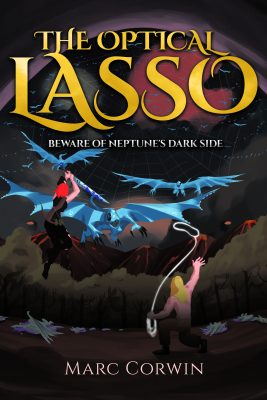
    The OPTICAL LASSO: Beware of Neptune’s Dark Side by Marc Corwin – Space Opera, Sci-Fi Adventure, Fantasy Action/Adventure

    Marc Corwin’s non-linear novel is jam-packed with science from the present era and over a century into the future. The wide-ranging tale of good versus evil overflows with wormholes, various iterations of the “dark side,” a truly miraculous invention (the lasso), shape-shifters, creatures that would not be out of place in Jurassic Park (notably the deadly goth, bringing literal meaning to “bat out of hell”), and all manner of spacecraft. It’s a veritable buffet for sci-fi devotees!

    At the center of it all is Jason Cody who nearly dies from what appears to be an incurable malady before reaching his seventh birthday, when a chance meeting with a puss-spewing creature immediately turns his fortunes around. The boy genius follows in his father’s footsteps into the U.S. space program and soon becomes the star astronaut. Using the science of his own invention while braving a treacherous wormhole on the way to Neptune and beyond, the incredible journey is accomplished in astonishing time, but Cody appears to have simultaneously vanished from the universe.

    Along for the ride in every sense of the word, is Lieutenant Janet Miles (a.k.a., Cat), the famed leader of the Fighting Fury (an all-female rescue team taking on harrowing assignments in the 22nd century). Incredibly, she teams up with Supreme Commander Cody to break out of a torturous prison. The escape itself is almost as fantastic as the fact that her sudden partner ought to be well over a century old and is as buff as the day he hurled away from Earth.

    The nemesis of nearly everyone in the book comes in the frequently altered shapes (evil incarnate predicted in the Centurions). Yet, it soon becomes apparent that this crimson entity who desperately wants to steal Cody’s lasso and put it to work for his own foul intentions is also the devil that wreaks havoc on Earth. Satan’s lair is the “now you see me, now you don’t” planet, Vixus, fully able to change its rotation and fueled by a mysterious force.

    Corwin has set himself an enormous task creating this multi-layered narrative aided by a large supporting cast filled with god-fearing troops and leaders alongside heartless liars who covet power and glory at any cost. The timeline shifts and backstory excursions, aided by the chapter headings, work very well.

    Finally, the ending is bound to produce mixed reactions, but without a doubt, readers will have a devil of a time getting there.

    5 Star Best Book Chanticleer Reviews round silver sticker

  • The APOTHEOSIS by Darrell Lee – Genetic Engineering, Science Fiction Thriller, Science-Fiction Adventure

    The APOTHEOSIS by Darrell Lee – Genetic Engineering, Science Fiction Thriller, Science-Fiction Adventure

    The boldness of the ideas contained within this novel about cloning begins with its title. The word “apotheosis” can be freely translated as 1.a. the perfect form or example of something, 1.b. the highest or best part of something, or 2. elevation to divine status. (Merriman-Webster Online Dictionary).  It is with these expectations that the book begins with a letter from John Numen, who tells us from the beginning that he is unapologetically a multifaceted scientist, medical researcher, doctor, billionaire investor, a fugitive on the FBI’s Most Wanted list, and a fledgling serial killer.

    We believe him.

    Numen’s trajectory from a scientist to a reclusive but fiendish killer with infinite financial resources is quite the tale. Human cloning is his obsession. He believes he has developed the science to make it easy and practical despite its medical and scientific, legal and ethical challenges. As he progresses decades into the future, he plans carefully for the lifespan he needs and the facilities he requires to develop his ideas into practical tools. He has the resources to do both and gives us a front-row seat on the often-murderous details involved in how he accomplishes his goals, whether it be on his private island in the Caribbean or at his Colorado estate.

    What distinguishes Numen from many other mad scientists is his portrayal as a human being. He is as capable of loving as he is in murdering. His descriptions of both give this read a humanity most welcome in the sci-fi genre. In particular, his love affair with the wife of a business colleague and its tragic ending lend a dramatic sensibility that sci-fi books rarely achieve.

    For more than half the book, the potential for it becoming the basis for a long-form television mini-series virtually leaps off the page. Then the story seems to wander a bit, shifting the point of view from Numen to a female kickboxer with dreams of MMA championships and the moxie to carry it out. Fast action sequences and brutal punches make for a great diversion.

    What Darrell Lee delivers is a fast-paced thriller with a lot of tendrils that are likely to snatch readers up and keep them in the chair, a well-drawn mad scientist with a sexy kick-ass femme fatal, and an interesting story that may stay with you for a while.

    All in all, we expect The Apotheosis will indeed find its fan-base among those who love fast-paced, unapologetic sci-fi thrillers.


  • BREACHING the PARALLEL by MWAnderson – Military Sci-Fi, Alternate History, Time Travel

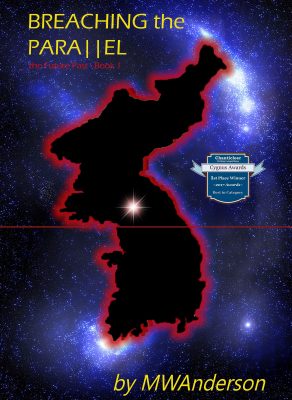
    BREACHING the PARALLEL by MWAnderson – Military Sci-Fi, Alternate History, Time Travel

    A one-way trip from the near future to the distant past forces one army unit to adapt to a life they could never have dreamt. Their flight into history will forever change the future that they know. Once there, they discover they are not the first to make the journey, and history as they knew it, has gone far, far off course.

    As the story opens, the U.S. 4th Armored Cavalry Regiment is conducting an incursion into North Korea during the Second Korean War – an event that seems all too plausible based on 21st-century tensions between North Korea and the rest of the world. But their journey is interrupted by an explosion that interacts with time and space, instantly transporting the 500 men and women from the 21st century A.D. to sometime between 1,000 and 500 B.C.E. Their world is gone – and there’s no way back.

    Their initial contact with a nearby village is peaceful until they are forced to decide whether to attempt to preserve the future, a future they are familiar with, or whether they should integrate themselves into their current circumstances and let future history take care of itself.

    A local warlord has been regularly raiding their village and conscripting young men for soldiers. None have ever returned. This time it’s the warlord’s men who don’t make it back to camp. They are wiped out by 21st-century weaponry in a matter of seconds. It comes as no surprise, then, when a more substantial unit arrives on the scene to investigate.

    Just as the soldiers begin to settle in, building homesteads, relationships, and new lives for themselves, they discover that they are not the first people to travel back in time. Those who have come before are enemies – old enemies.

    As the story begins, the circumstances in which the 4th Armored Cavalry finds themselves in are reminiscent of two classic works of alternate history/time travel science fiction, Island in the Sea of Time by S.M. Stirling and 1632 by Eric Flint. In both of those series openers, an unexplained event transports a location, leaving the time travelers to adapt to their changed circumstances and figure out a way to thrive in the past.

    The setup is a good basis for a Sci-fi. What makes Breaching the Parallel stand out from the rest is the interesting approach MWAnderson takes, by revealing that our protagonists are not the first to arrive and that people who traveled to the past before them, have become the dominant power in their brave new/old world. Breaching the Parallel sets the characters up for renewed conflict in a future book in this prospective series – a pretty interesting set of characters at that.

    Breaching the Parallel is a military sci-fi with a clever twist that both thrills and intrigues. MWAnderson shows his knowledge in detailing how an explicitly military mission would conduct itself in a situation where the mission has changed out of all recognition. Those who love a good military sci-fi need look no further – MWAnderson delivers in spades.

    Breaching the Parallel by MWAnderson won 1st Place in the CIBA 2017 Cygnus Awards for Science Fiction.


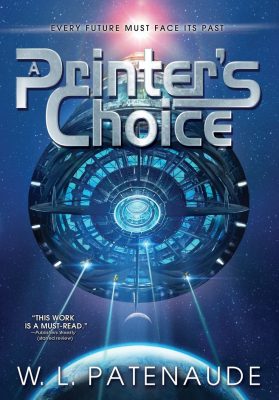
  • A PRINTER’S CHOICE by W. L. Patenaude – Sci-Fi/Cyber-Tech, Mystery, Literary

    A PRINTER’S CHOICE by W. L. Patenaude – Sci-Fi/Cyber-Tech, Mystery, Literary

    W. L. Patenaude’s suspenseful and philosophical novel, A Printer’s Choice, opens in the near future, 2088, and not all is well in the universe.

    Earth is plagued with famine, war, and violent religious extremism. Oceans have risen to deadly levels, and wildfires and storms continue unabated. The world’s resources are being strained and no recovery is in sight. In fact, things are so dire that parents can opt to have themselves euthanized in exchange for the government’s providing for their children’s health and education.

    Elsewhere in the cosmos, a murder has rocked “upside,” a conglomeration of locales in space that are being rapidly developed through a tense and volatile collaboration between engineers and builders. This murder is a first in the “New World” and the circumstances surrounding it set the stage for an investigation that will not only uncover the murderer but also will cause readers to ponder the very essence of human existence.

    Enter Father John Francis McClellan, a Roman Catholic priest in this thirties with a military background. He has been summoned by the Archbishop of Boston and the Vatican to travel to the New World to investigate the homicide. From the outset, the case presents enigmatic details. For example, the victim, Father Tanglao, a Dominican priest, had inexplicably been working as a laborer in the orbits.

    Like everyone else, Father McClellan wonders why a priest was upside where any expression of any faith is strictly prohibited. Was Father Tanglao’s murder connected to one of the engineers or a fellow builder? Could there be a connection to the murderous zealot with a messianic complex, Juan Carlos Solorzano?

    McClellan does know that Father Tanglao had dealings with a high-tech 3D printer, a machine with recesses of “Deep Intellect.”  McClellan has his own history with these sentient machines, encounters that have given him the experience necessary to delve into relations between people and devices possessing artificial intelligence.

    The printers have the ability to design their own upgrades as well as reproduce themselves. “New Athens” was built easily and rapidly by the printers and, given the disasters on Earth, there is an imminent need for worlds to be built in space as quickly as possible.

    The engineers argue that the checks and balances those in charge wish to implement will only hold progress back because they believe they can regain control over the machines down the road. The question will arise, what separates a human programmer from a mechanical one capable of critical thinking? And who “programmed” people? What transpires between McClellan and a specific machine includes a riveting and deeply thought-provoking discussion of trust and free will.

    Clearly, Patenaude is well versed in the readings of Aristotle, St. Thomas, St. Augustine, and Descartes, for starters, and likely a host of philosophers and theologians. His ability to draw upon multiple disciplines and to weave religious and philosophical allegories into characterization and plot put him at the forefront of literary thinkers. Suffice to say, this novel is profoundly deep and thought-provoking.

    While this book will appeal to sci-fi lovers and anyone game for a murder mystery in outer space, it should also spark the interest of anyone interested in grappling with theories of existence and the ultimate power of free will. A priest traveling to an entirely new world in the cosmos and finding that it’s still necessary to wrestle with the age-old questions of faith make for a powerful tale.


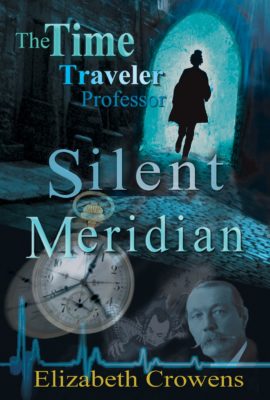
  • The TIME TRAVELER PROFESSOR, Book One: SILENT MERIDIAN by Elizabeth Crowens – Steampunk, Sherlockian, Time Travel

    The TIME TRAVELER PROFESSOR, Book One: SILENT MERIDIAN by Elizabeth Crowens – Steampunk, Sherlockian, Time Travel

    A budding concert pianist delves into the realms of spiritism, sexuality, and scary foreshadowing through his time travel adventures in Elizabeth Crowens’ steampunk novel, Silent Meridian.

    John Patrick Scott, a conservatory student, meets with Arthur Conan Doyle in Edinburgh, Scotland under unusual circumstances because of an elusive and mysterious red book. Arthur, lacking inspiration and tired of his Holmes character, covertly employs John as a ghostwriter. The two also indulge in the transmigration of souls and time travel. The latter topic is of high interest to the young aspiring musician since he has already accrued a handful of time-travel experiences via a mechanism of his creation. Although Arthur introduces John to nightly practices of communicating telepathically, John doesn’t include the beloved author in his time-traveling adventures until years later.

    John’s time-traveling skills sharpen to the point that he no longer needs his device and uses his grandfather’s timepiece instead. He becomes particularly fixed on exploring his past, especially his school days at the Underground University; he includes Wendell Mackenzie, his old schoolmate, on his adventures—some of which John escapes just in the nick of time. Over time, John finds it difficult to distinguish between time travel and dreams and seeks the help of Sigmund Freud and Carl Jung. His adventures take a dark turn when they predict an impending war.

    Sherlock Holmes’ enthusiast, Elizabeth Crowens, spins a wild tale riddled with glimpses of stories and themes from the early 20th century. Crowens’ quirky narrative, which covers sixteen years, could easily befit behind-the-scenes to John’s ghostwriting connections to Doyle’s published works: The Man with the Twisted Lip, The Adventure of Charles Augustus Milverton, and The Adventure of the Greek Interpreter, to name a few.

    Scenes regularly flip from John’s music studies and his time-travel quests, and are heavily punctuated with references to prominent historical figures and their thematic connections of the era, such as H.G. Wells, J.M. Barrie, Jules Verne (fantasy and sci-fi); Sigmund Freud, Carl Jung (psychology); and Aleister Crowley, Theodore Reuss (metaphysical). While sexual identity plays a close second to the last parenthesized theme scenes, providing only innuendos. John continuously processes his particular leanings, weighing his feelings as a woman in some of his time-travel ventures and amid affairs against Doyle’s and Wells’ free-love beliefs.

    Crowens balances nonfiction with fiction by incorporating memorable characters, such as Whit, John’s annoying tutor, and Finn (who John dubs Sherlock), John’s “Jiminy Cricket” guide who is only visible to John and comes and goes as he pleases. Sure to be a new favorite for Sherlock Holmes’ aficionados, Silent Meridian’s cliff-hanging closure is a perfect segue to the second book in Crowens’ The Time Traveler Professor series, A Pocketful of Lodestones.


  • CRYPTIC SPACES Book Three: DARK EDGE RISING by Deen Ferrell – Young Adult, Sci-fi/Fantasy, Action/Adventure

    CRYPTIC SPACES Book Three: DARK EDGE RISING by Deen Ferrell – Young Adult, Sci-fi/Fantasy, Action/Adventure

    Seventeen-year-old mathematical genius Willoughby has the weight of the world on his shoulders ─ literally. As part of a secret time travel organization known as Observations, Inc., Willoughby and his team, usually silent observers in their travels, are tasked with keeping the balance between control and chaos.

    Yet after the murder of their friend and mentor H.S. a year ago, Willoughby and his team have sought answers to questions they don’t even know how to ask. Everyone on the team has suffered, and Willoughby can’t help but feel he could have done more to help H.S. and more to keep his team, namely his girlfriend and musical prodigy Sydney, safe.

    Willoughby can “see” time code and take advantage of time junctions, he has a natural connection with time and can sometimes even track people throughout the time grid, a skill his nemesis, a man-like creature known as Beelzebub, takes credit for. Unfortunately for the Observations, Inc. crew, Beelzebub can also manipulate time but in a much more advanced way.

    Hellbent on finding the Prime Hole Facility, a time hub created by Earth’s historians the otherworldly Atlanteans, Beelzebub wants to recreate history, restructure mankind’s past, and plunge the planet into chaos. He and his Dark Edge Brotherhood will stop at nothing, having already killed Willoughby’s boss and mentor since Willoughby is the key to unlocking a gateway of power, unleashing unlimited control over man. Before he can harness his full potential, he and his team will have to solve millennia old clues while searching for a lost ancient princess and steering clear of the Dark Edge, but very soon, both Willoughby and Sydney will learn the real cost of his power.

    A prevailing idea within the novel is self-discovery. The characters often delve deep within themselves to find that hidden spark, that “push a little harder” mentality to solve the issues thrown at them by forces that want nothing more than to drown creativity, thus ridding the world of enlightenment and plunging it back into darkness. The characters have to stop fear’s subjugation and free themselves enough to look inside for the answers that are quietly waiting for daylight. Through that self-discovery comes growth but only when the characters stop looking to the world to define themselves (a lesson most people need). Only by genuinely finding the power within can Willoughby save humanity, but he can’t do that alone.

    The bond between the characters is not only the key to survival in this high-stakes time game but is also a strength of the novel. Since Dark Edge Rising is the third in the Cryptic Spaces series, the Observations, Inc. team is firmly established; however, this pre-established bond will not keep the reader from enjoying the character interactions. Each team member has their own unique ability or place on the team in this something-for-everyone narrative. Despite their individualism, the characters’ friendship dominates. Repeatedly, the theme of unity saves the day and keeps the plot rolling steadily along. Each member brings something new to the story, and the alternating point of view keeps the story fresh and the reader engaged.

    Cryptic Spaces, Book Three: Dark Edge Rising won First Place in the 2017 CIBAs in the Dante Rossetti Awards for Young Adult novels.


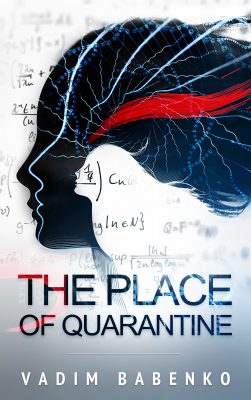
  • The PLACE of QUARANTINE by Vadim Babenko – Astronomy of the Universe, Russian Dramas/Plays, System Theory & Physics, Sci-Fi

    The PLACE of QUARANTINE by Vadim Babenko – Astronomy of the Universe, Russian Dramas/Plays, System Theory & Physics, Sci-Fi

    Theo awakens to a sound, which he likens to that of a trembling copper string. He finds himself midway up a stairway and realizes that the sound emanates from an ordinary fluorescent tube, about to burn out. He climbs to the next floor, where a door is open. A woman introduces herself as Elsa and welcomes him in.

    Not remembering anything, or knowing where he is, Theo asks Elsa. Her answer confounds him. He is in their apartment, in a place called Quarantine. In support of her response, she hands him a laminated paper that reads, “WELCOME. YOU HAVE EXPERIENCED CORPOREAL DEATH FOR THE FIRST TIME. THE DEATH OF THE BODY IS NOT AS SIGNIFICANT AS YOU MIGHT THINK. THERE IS NOTHING TO FEAR.” Really? Theo goes cold. Memories begin to emerge—a gunshot and terrifying pain, a woman in tears, the old streets of Bern. Then it all fades.

    Vadim Babenko, Russian-born physicist and businessman, left his former careers behind to become a writer of fiction—in The Place of Quarantine, thought-provoking fiction that begs us to consider what the reality of life truly is. In this effort, he draws on principles from the work of renowned researchers, such as Italian physicist Giuseppe Vitiello, to support the protagonist, Theo’s work, in particular, his concept of “the application of quantum field theory to the modeling of human memory and intelligence.”

    Yes, science plays a significant role in this book, but it’s a supportive role, a means to an end: our consideration of the possibilities of life beyond that which we experience on Earth, and of the regeneration of our knowledge and memories, and their further development to benefit the inhabitants of the place of a subsequent life. Theo is assigned an advisor/mentor/friend, called Nestor, to help him with the task of reviving the memories of his renowned, but uncompleted research on Earth. His knowledge and intelligence are needed in Quarantine and perhaps beyond. Since the particular vocabulary of physics and metaphysics is not familiar to many of us, a glossary of the terminology is at the reader’s fingertips.

    The science, however, is interwoven with the stories of characters from Theo’s very international first life—in particular, a beautiful young Asian woman, Tina, whom he met and loved in Bangkok and yearns for even in Quarantine; and a Russian businessman named Ivan Brevich, who is consumed with revenging the murder of his beloved wife, Nok. In Quarantine, his roommate Elsa adds a human element to his life, making his breakfast of coffee, fried eggs, and toast, and generally being his companion, although as phantom beings in a world of images. Nestor, who is but a face, with a voice, on the wall screen, is a friend as well as an advisor and research colleague.

    As Theo comes to believe in what his research is telling him, he becomes increasingly obsessed with finding Tina, if not in Quarantine, then in whatever life awaits him next, if indeed one does. Can he be satisfied with continuing his work for the benefit of Quarantine, or must he try to prove his belief by taking the chance to move on?

  • 10 Question Interview with Multi-Award-Winning Author, MICHELLE RENE – Book Discovery, AuthorLife, Book Marketing

    10 Question Interview with Multi-Award-Winning Author, MICHELLE RENE – Book Discovery, AuthorLife, Book Marketing

    * On the weekend of her new release, The Dodo Knight, we invite you to get to know one of our favorite authors, the incomparable, Michelle Rene!
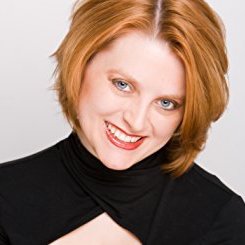
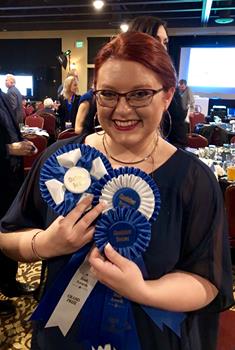
    Recently I had the opportunity to interview the creative advocate and the 2017 CIBA Overall Grand-Prize Winning Author, Michelle Rene, in our 10 Question Interview Series. It is no wonder her novels, short stories, and articles are consistently gaining recognition and winning awards. She is not only over-the-top talented, she is also generous with her time.

    Michelle Rene won the CIBA Overall Grand Prize in 2017 for her novel, Hour Glass, a unique and entertaining twist on the Calamity Jane legend, complete with engaging characters and extraordinary storytelling! A novel we highly recommend.

    Chanticleer: Tell us a little about yourself: How did you start writing?

    Michelle Rene: I’ve been writing since I was a kid. I actually spent a whole summer vacation hand-writing a two-hundred-page novel when I was thirteen. However, I was also very invested in art. I had my first artist job in video games at age sixteen, so when it was time to choose my career/college path, I chose to go to art school.

    While art was paying the bills, I continued to write, honing my craft and learning all I could about

    this ever-changing literary world. It was in 2014 that my first novel was published. I Once Knew Vincent went on to receive several indie awards, including Chanticleer’s First in Category for the Chaucer Award.

    Since then, I’ve had numerous novels, novellas, short stories, and essays published. Several went on to win significant indie awards. I’m extremely proud to say my novel, Hour Glass, won Chanticleer Review’s Best Overall Book Award for 2017.

    Chanticleer: We are very proud of your Overall WIN, as well! Congratulations! Let’s talk about genre. What genre best describes your work? And, what led you to write in this genre?

    Michelle Rene: I have a love/hate relationship with genre. The necessities of it are obvious. In the world of marketing, we have to know how to market a story and who to market it to. As far as my reading habits, I just look for a good story. I don’t really care what kind of story. In writing, I like that same freedom.

    That being said, I would say I write historical fiction and speculative fiction. Every once in a while, they overlap. I call myself a creative advocate, and most of my life has been in the pursuit of creativity. Writing speculative fiction quenches that thirst.

    As for historical fiction, I’m a huge museum buff, and history fascinates me. I count it a duty to try to make time periods and historical figures come to life as something more than names and dates on a page.
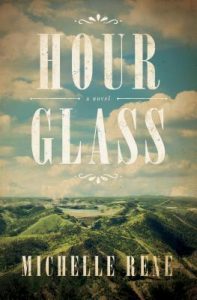
    Chanticleer: That’s what we love about you – and that’s why Hour Glass won! Do you find yourself following the rules or do you like to make up your own rules?

    Michelle Rene:  I’m not a fan of writing rules. The idea is rather rigid for something as creative as writing. I think there are good practices and guidelines to be aware of, but I always cringe when I hear someone say, “you can’t…” when criticizing someone’s stylistic choice. For every hard-and-fast writing rule, there is someone who broke it beautifully.

    My advice for emerging authors who ask for my “rules” is rather unimpressive. Don’t give up. That’s my only rule for writing. Keep going. Write more. Figure out your voice through trial and error.

    Chanticleer: Really, that’s the best advice anyone could give. Don’t Give Up. We should make t-shirts… What do you do when you’re not writing? Tells us a little about your hobbies.

    Michelle Rene: I’m a trained artist, so I like to paint, sculpt, draw, etc. I’m a firm believer in the idea that all creative ventures work toward telling a story in some way. I adore museums, reading, audiobooks, and learning new things. I’m also a belly dancer and occasionally perform at festivals and Renaissance fairs.

    Chanticleer: I’ve seen your costumes! You’re serious about everything you do. That’s very impressive. Where do your story ideas come from?

    Michelle Rene: I have no idea. Get it?

    Seriously, I tell everyone that my muse is extremely abusive. I once read that an author pictured her muse as this quiet girl who whispered beautiful, creative things to her through the bars of a vent.

    Mine is a sledgehammer-wielding jerk who shows up when I’m trying to sleep and regularly bashes in my head until I write the story. Sometimes, I see something interesting at a museum or a get inspired by a painting, but the story I want to tell hits hard and is a nuisance until I write it.

    Chanticleer: Good for you to pay attention to that muse. I mean, how could you help but pay attention! Name five of your favorite authors and describe how they influence your work.

    Michelle Rene: I have an extremely eclectic taste in reading, so this will look like a random list. Harper Lee because To Kill a Mockingbird was one of the first books I read over and over again. She showed me how to inject poetry in your prose in a simple way. David Sedaris because I’ve never laughed so hard in my life, and he taught me about humor in the absurd. Mary Roach because I never knew I liked reading or writing nonfiction until I read Stiff. Neil Gaiman because he has the same skeptical beliefs I do about genres and writes that way. Finally, Charlaine Harris because she’s one of the only authors who can write about vampires, shifters, and fairies, and I’ll eagerly read every book in her series.

    Chanticleer: Great list of authors. I, too, love Mary Roach for Stiff, but I suppose that’s no surprise to those who know me… Give us your best marketing tips, what’s worked to sell more books, gain notoriety, and expand your literary footprint.

    Michelle Rene: There are two things I’d list here. One is a slow burn marketing technique, and the other is a quick one. The quick boost is to run a sale (either discounted or free) and blast it through every social media and subscription channel you can for the day the sale begins. I’m not a believer in keeping your book discounted for more than a few days though.

    The slow burn technique takes a lot more effort but has the longest tail of benefit. Go to conferences, enter contests, and teach classes where you can. If you do those things, you will connect with amazing people who can help you along the way in ways you can’t imagine yet.


    Some of Michelle Rene’s other books for you to explore!


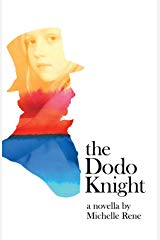
    Alice Liddell was the muse for Lewis Carroll’s Alice in Wonderland. But before the book was published, a rift opened between Carroll and the Liddell family. Also dubbed the “Liddell Riddle,” historians still speculate as to what happened to separate the famous author and his muse. Michelle Rene has imagined a beautiful and heart-breaking story of a special friendship and its unfortunate end. Told from the viewpoint of Alice herself, The Dodo Knight will transport you to Victorian England… and into the heart of a very special little girl. Pick up your copy of The Dodo Knight today!


    Chanticleer: Good tips. Thank you for those. What are you working on now? What can we look forward to seeing next from you?

    Michelle Rene: I’m working on two projects. One is a sci-fi mystery series about a psychoanalyst who can go into peoples’ minds. Currently, I have the first book done and am working on number two in the series.

    The other project is a historical fiction novel based Dr. Mary Edwards Walker. She was a Civil War surgeon when women weren’t allowed to do that, and she was the only woman to be awarded the Medal of Honor.

    Chanticleer: Oh, both sound delicious! I cannot wait to read them. Speaking of readers, what is the most important thing a reader can do for an author?

    Michelle Rene: Rate our books, review our books, tell your friends, and share our posts. In today’s literary world, there is a sea of books coming out every day. Word of mouth is our best long-term sales generator. If you tell people you liked my book, they are more likely to believe you than any advertisement I put out there.

    Chanticleer: This is so true. Thank you for saying that. What excites you most about writing?

    Michelle Rene: It is a powerful and equalizing force in the world. As long as you can string sentences together, you have a voice. Your story can be told. It doesn’t matter how old or young you are. Your wallet and waistline have no bearing. You don’t even have to be formally educated. Everyone’s story is possible, and stories change the world.

    Chanticleer: Thank you, Michelle, for participating in our 10-Question Author series. You are delightful! 


    Don’t you want to follow and like everything Michelle does? I do! Please check out her links – and share this interview with your friends!

    https://twitter.com/MRene_Author

    https://www.michellereneauthor.com/

    https://www.facebook.com/mrene.author/

    https://www.instagram.com/mrene_author/

    mewing_arts@yahoo.com

    Michelle’s Bio:

    Michelle Rene is a creative advocate and the author of a number of published works of science fiction, historical fiction, humor and everything in between. She is the author of novels, short stories, essays, and video games.

    She has won indie awards for her historical fiction work. Her novel, Hour Glass released to rave reviews from Kirkus and Publisher’s Weekly. It won Chanticleer Review’s “Best Book of the Year” award in 2018. Her experimental novella, Tattoo, released with a starred review in Publisher’s Weekly and was listed in Foreword Reviews top eight sci-fi/fantasy books this spring.

    When not writing, she is a professional artist and all-around odd person. She lives as the only female, writing in her little closet, with her husband, son, and ungrateful cat in Dallas, Texas.

     

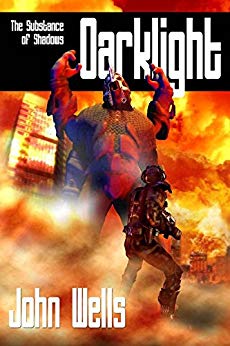
  • Darklight 1: The Substance of Shadows by John Wells – Hard SciFi, Genetic Engineering, Military SciFi

    Darklight 1: The Substance of Shadows by John Wells – Hard SciFi, Genetic Engineering, Military SciFi

    In the aftermath of the Second American Civil War, a feisty, determined genius develops a new way to explore outer space making himself and those he cares about the central target in an interplanetary war in this first-of-a-series Space Opera, Darklight 1: The Substance of Shadows by John Wells.

    Isaac “Crash” Tyson gets his nickname from refusing to give up. When faced with any problem, he just crashes on until whatever is in his way is resolved. A mathematics genius, Crash developed a new field of math, one that will open up space in such a way that earth explorers can take to the stars without any of the usual limitations. He only has to convince P-Quan, the Planetary Governor of Earth and his colleagues at the World Science Council to fund the project. They are all part of the PLAG (Planetary Government) a group of bureaucrats as crooked as they are ruthless.

    Surprisingly, P-Quan goes along with Crash’s proposal; in fact, he’s had his eyes on Crash for some time. He plans to acquire all of Crash’s test data and develop the technology for the exclusive use of the PLAG. Of course, if Crash has a problem with this, P-Quan has the power and the position to crush Crash, permanently.

    Crash is a genius all right, one who’s smart enough to be suspicious of P-Quan’s motivations. He takes on three assistants: the beautiful Lynn, in charge of operations, Nessi, the tech guy, and a hard-boiled policeman, DP, who is even more suspicious than his boss, and utterly loyal. After receiving the funding necessary, Crash gets busy and constructs the Spatial Exclusion Wave Generator (SEG) in a short time.

    The first test of the SEG successfully canceled the spatial field’s interaction with matter and energy. To put it in layman’s terms, the SEG created a Space Hole, an enormous glass-covered hole. So formidable is its power that Nessi pronounces that Shiva, the Hindu god of destruction, has been set loose. The good news: SEG works, creating the space hole Crash predicted. The bad news: before Crash can do anything more, PLAG rushes in for the kill.

    And in a distant galactic outpost, the drama on Earth is being monitored by the Cren Empire who have their own reasons for destroying Crash’s mission.

    The Substance of Shadows is a classic sci-fi of Operatic proportions, positing futuristic technologies, armaments, deep thought, and hidden dimensions. It links a home planet under threat to a small intrepid group of rebels who dare to go beyond known limits, and in doing so, realize that the universe is far more complex and dangerous than any of them could have imagined.

    At the offset, Wells paints a compelling, if bleak, scenario of a Second American Civil War predicated on some current political ideologies. The newly divided country will soon need what Crash can supply in the form of energy resources. In Crash, Wells offers an empathic leader for the Earthlings and other interstellar beings who will need guidance after the dust settles.

    Our review of Darksight II: Conflagaration can be read and enjoyed here.