Tag: Save the Cat!

  • Top Revision Tips Before a Manuscript Overview from the desk of David Beaumier

    You’ve arrived at the last page of your story and written those crucial, beautiful words: “The End.”

    A young Asian woman leans back from her computer, done with her work in a generic room.
    Finished at last!

    Well done! You deserve some time to rest before you dive into the next step of editing your story.

    Now, one key piece of advice here is there isn’t a wrong time to put your work in front of a professional for feedback. While this article will take you through steps that will bring your book to be as strong as you can possibly make it on your own, we all are of different skillsets, so if something isn’t for you, that’s when you bring in a professional editor.

    To start out with, what is a Manuscript Overview?

    Someone hard at work on a Manuscript Overview

    Perhaps the easiest definition can be pulled from our page on providing Manuscript Overviews (MOVs).

    It is an objective evaluation of a story idea that is fully formed with a beginning, middle, and end, but still in an early draft stage. The MOV comes before Line Editing and Copy Editing.

    No matter who you pick to perform a Manuscript Overview for your book, you should get one. The amount of time and money it saves on editing by being more general and help you go further with your own writing is on thing, but the most important part is it helps keep your book focused and your narrative strong. Traditional Publishing Houses use them, and it makes sense to follow suit.

    Typically, an MOV will cover

    • compelling nature of story
    • dialogue
    • character development
    • does the scenery and setting work with the story
    • backstory issues
    • professionalism of editing & formatting
    • continuity of storyline
    • plotting and plot-hole issues
    • writing craft

    So, the question remains, how do you get your book to that point: fully formed with a beginning, middle, and end. How do you get it to the best point you can do on your own?

    The Reverse Outline
    A Red Uno Reverse Card

    Once you’ve finished your manuscript, even if you already have an outline, you can create one that reflects the actual book you’ve written. From this point, you can edit that outline of your book as is. Working within the outline to create a roadmap to revision often feels much more approachable.

    Next off, we have a recommendation from Matt Bell, author of Refuse to Be Done.

    Rewrite your book.

    You can have the draft you wrote printed out, off to the side, on a separate monitor, whatever feels comfortable, but rewrite it using your new outline as a guide.
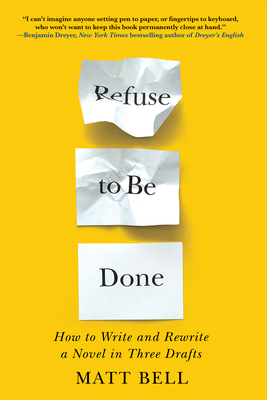
    Refuse to Be Done has a yellow cover with the title written out across 3 pieces of paper

    Bell’s theory behind this is that you will copy and paste a bad line (or duplicate scene). But you won’t rewrite a bad line.

    Not sure where to start in creating your outline? Jessica Brody’s beat sheet from Save the Cat! Writes a Novel can help. Brody breaks down the story into actionable beats you can aim for to keep your book flowing along. Check out her breakdown of story beats here!

    Once you’re done rewriting the book, it helps to go through and check to see if you’ve met the goals of a new outline. Ask yourself if your story has a beat and if you can dance to it.

    After all that work, you’re probably ready for a Manuscript Overview.

    What to do while you wait

    A standard Chanticleer MOV takes 6-9 weeks to finish. While that’s going on, we recommend following D.D. Black’s critical advice whenever you’re in writing limbo: Write the next thing.

    D.D. Black presented at CAC24! Check out his incredible series here!

    Not only will that get you out of your head and allow you to be more objective with your manuscript when it comes back, but it will put you ahead of the game for the next book.

    What do our authors say about our MOVs? Read recent testimonials here!

    Wow, huge thank you for this second review! It’s so detailed and very much what I was hoping for. The specifics about moving content and clarity are spot on. I knew it needed structural improvements but I was too close to do it. Please pass on my sincere thanks for this work! I’ve only started some of it & already feel a better flow. I’m hoping to possibly even cut about 10k words to make it tighter. – Sheridan Genrich author of REWIRED: Optimise Your Genetic Potential


    I’m writing to gratefully acknowledge receipt of the Manuscript Overview of my book. I am so pleased to have this close reading and incredibly helpful insights. These comments are far more beneficial than anything I had expected. It will be a pleasure addressing the editor’s critiques and trying out his concrete suggestions. Please extend to him my genuine gratitude. Chanticleer crows again! – John Feist, author of Edged in Purple and many more


    I finally got this copied and read. It’s just what I wanted it to be—a skillful job. I knew there were the kind of holes the editor mentioned, but he’s given me a plan for the revisions. Please pass on my thanks. – Linda Brugger, columnist and accidental author


    Please thank the reviewer for a very relevant and detailed review of my manuscript, ANKANAM. I plan to incorporate all his notes! – Vee Kumari, author of Ankanam.


    This was just what I needed. I am looking at the book with a new focus and have already started working up the suggested changes. The first thing I did was remove those items the editor mentioned should be deleted. It was a bit painful but necessary. There was plenty of meat in his review, which took me a while to digest, but changes are on the way. These will take some time, but I will likely be interested in the Manuscript Reconciliation process. I can tell the editor spent quite some time researching some of the issues raised in the book, which I greatly appreciated. It helped me see the book more from the reader’s perspective than mine. Please pass along my sincere thanks. – Jim Leonard


    Thank you for joining us for this Writer Toolbox Article

    A red toolbox with the words "What's in your toolbox

    There is so much to learn and do with Chanticleer!

    From our Book Award Program that has Discovered the Best Books since the early 2010s to our Editorial Book Reviews recognizing and promoting indie and traditional authors, Chanticleer knows your books are worth the effort to market professionally!


    When you’re ready, did you know that Chanticleer offers editorial services? We do and have been doing so since 2011.

    Our professional editors are top-notch and are experts in the Chicago Manual of Style. They have and are working for the top publishing houses (TOR, McMillian, Thomas Mercer, Penguin Random House, Simon Schuster, etc.).

    If you would like more information, we invite you to email us at info@ChantiReviews.com for more information, testimonials, and fees.

    We work with a small number of exclusive clients who want to collaborate with our team of top-editors on an on-going basis. Contact us today!

    Chanticleer Editorial Services also offers writing craft sessions and masterclasses. Sign up to find out where, when, and how sessions being held.

    A great way to get started is with our manuscript evaluation service, with more information available here.

    And we do editorial consultations for $75. Learn more here.  

    Writer Toolbox Helpful Links: 

    The traditional publishing tool that indie authors can use to propel their writing careers to new levels?  Check it out here!

  • The Myth of the Unlikeable Character – A Chanticleer Toolbox Article By David Beaumier

    The Myth of the Unlikeable Character – A Chanticleer Toolbox Article By David Beaumier

    “No one likes my characters”

    You’re handing your precious book over to a beta reader to see if it’s worthwhile, ready, perhaps, for a Chanticleer Book Review or to be entered into the Chanticleer Int’l Book AwardsThey look at you over the cover that you worked so many long hours on with your designer and say with all the authority of fate: “I just don’t think your main character is very likeable,” they say. “Can’t you make them more likeable? All characters should be likeable.”

    A grumpy older white man
    Are your grumpy readers right?

    Writer, they are wrong

    You can of course have an unlikeable main character! If they were only willing to read for ten minutes though, you may have a more difficult problem on your hands than whether or not your character is someone they want to be friends with. Some of the most compelling characters in literature aren’t someone I’d want to share a hotel room with anytime soon. 

    A creepy character peering into a room
    We can sleep in separate bedrooms. Really, it’s okay.

    The key isn’t to worry about whether or not your protagonist is “likeable” (which is a tricky word to define), but about whether or not they are interesting.

    • Are the actions they take moving the plot forward while engaging the reader at the same time? Those two things must be true of anything that happens in your story. 

    Manuscript Overviews and Editing

    Now, if the majority of your readers are coming back to you and letting you know these early drafts aren’t working, we highly recommend a Manuscript Overview. A manuscript overview (MOV) is a broad overview of your manuscript – what’s working and what isn’t from all aspects of your story: structure, plot, pacing, character development, dialogue, etc. We are here to offer our guidance on what you need next. Save time and money by honing your work before you begin the editorial process.

    Here, we’ll go through a few basic checks to make sure that your character is compelling. 

    A person writing in a journal

    On Writing Compelling Characters

    There are a few questions you’ll want to ask to see if your complex character is someone who will grab your reader’s attention. 

    • What is the Status Quo your character inhabits? 
    • What is your character’s Desire?
    • How does the Conflict impede the character’s Desire?
    • Cats

    If you simply need help developing your character, consider reviewing this article on Secondary Characters here. Otherwise, read on!

    Speaking of Secondary Characters, Severus Snape, Professor of Potions from the Harry Potter series is a prime example of uncompelling compelling character.

    Severus Snape

    Status Quo

    This is the classic way you engage readers with your story. The story is introduced, and something happens to break the status quo. One story where this jumps to mind is Neal Stephenson’s Seveneves. With cannibalism and the end of the world, there’s no lack of unlikeable characters in this book, but all the characters rivet your attention. 

    Seveneves begins with the moon blowing up. Well, more accurately, with it being split into four pieces. Up until the catalyst (the breaking of the status quo), the four chunks of the moon are a point of fascination, friendly enough to have one chunk named “The Bean.” Then the status quo changes when one of the moon chunks hits another and they start to fragment even more. This gives all the characters a goal to work for: Save the Human Race. Having a strong focus for your characters will help readers empathize with them and want to know what’s happening.

    Our favorite editor Jessica Morrell has an excellent article detailing even more ways to stir up trouble for your characters here.

    Character Desire

    Similar to the breaking of the status quo, your characters will all want something different out of the world you’ve written them in. Of course, like the breaking of the status quo, this problem won’t be easy for them to solve. 

    An artful rendition of Tom Ellis as Lucifer with the words "What is it you truly desire?"
    Tom Ellis as Lucifer from Netflix

    There are two common methods of frustrating your character’s ability to achieve their desire. The first is simply to make it difficult to do. Anything that takes a lot of work and will make them struggle. The other excellent choice is to have them try to solve the wrong thing. So often characters misunderstand what will make them happy or they struggle to find the correct solution to their problem. By having them do the wrong thing, the reader will be able to enjoy a much more interesting story than an unlikeable person succeeding at everything they do and never growing or developing. 

    Cats

    Who doesn’t love cats? We love cats at Chanticleer, that’s for sure!

    Two kittens sleeping while spooned together
    The newest additions to the Chanticleer family: Tiefen and Biscuit at 15-weeks-old

    Now the connection between cats and what to do with your unlikeable character might not be immediately clear, and it might sometimes be a metaphor rather than an actual cat. The tried and true advice is you have a character who might be a little rough around the edges save a cat early on in the story. This shows that, despite their flaws, they do care about the world around them, and they will help a creature in need. Of course, this doesn’t have to be a literal cat, but it’s something sweet the character chooses to do without being pressured. 

    For those of you in The Roost, Chanticleer’s online community, you know that we have been reading SAVE THE CAT, WRITES a NOVEL by Jessica Brody (based on the screenwriting books by Blake Snyder) in our Writing Craft Book Group. There is even a reading guide by Chanticleer’s David Beaumier uploaded to the  activity feed.

    The opposite can happen too! In Lower Decks, the irreverent Star Trek cartoon that’s currently playing on Paramount+, Beckett Mariner kills a holographic character to establish herself as the villain in a fantasy program she designed. 

    Mariner dressed as Vindicta dressed as an intergalactic pirate
    Beckett Mariner as Vindicta in “Crisis Point” from Star Trek Lower Decks

    It’s fairly easy to flip through the first pages of your book to see if there’s a cat who your narrator can save in the early pages of your work, and then see if you can find a few beta readers to poll on their feelings. 

    To consider more of the timing and development of plot in relation to your characters, review this article here.

    “There’s no such thing as writer’s block or plotter’s block. There’s only perfectionist’s block.” Jessica Brody

    Go forth and write!


    When you’re ready, did you know that Chanticleer offers editorial services? We do and have been doing so since 2011.

    Our professional editors are top-notch and are experts in the Chicago Manual of Style. They have and are working for the top publishing houses (TOR, McMillian, Thomas Mercer, Penguin Random House, Simon Schuster, etc.).

    If you would like more information, we invite you to email Kiffer or Sharon at KBrown@ChantiReviews.com or SAnderson@ChantiReviews.com for more information, testimonials, and fees.

    We work with a small number of exclusive clients who want to collaborate with our team of top-editors on an on-going basis. Contact us today!

    Chanticleer Editorial Services also offers writing craft sessions and masterclasses. Sign up to find out where, when, and how sessions being held.

    A great way to get started is with our manuscript evaluation service, with more information available here.

    And we do editorial consultations for $75. Learn more here.  

    If you’re confident in your book, consider submitting it for a Editorial Book Review here or to one of our Chanticleer International Awards here.

    Also remember! Our 10th Anniversary Chanticleer Authors Conference (CAC22) will be April 7-10, 2022, where our 2021 CIBA winners will be announced. Space is limited and seats are already filling up, so sign up today!  CAC22 and the CIBA Ceremonies will be hosted at the Hotel Bellwether in Beautiful Bellingham, Wash. Sign up and see the latest updates here!

    Writer’s Toolbox

    Thank you for reading this Chanticleer Writer’s Toolbox article.

    Writers Toolbox Helpful Links: 

    AMPLIFY, MAGNIFY, & STIR UP TROUBLE for Your Main Characters – by Jessica Morrell

    Supporting Cast – Taking Risks with Your Secondary Characters – by Jessica Morrell

    Character Development, Dialogue, and Beats – by David Beaumier

    The traditional publishing tool that indie authors can use to propel their writing careers to new levels?  The Seven Must-Haves for Authors – Unlocking the Secrets of Successful Publishing Series by Kiffer Brown