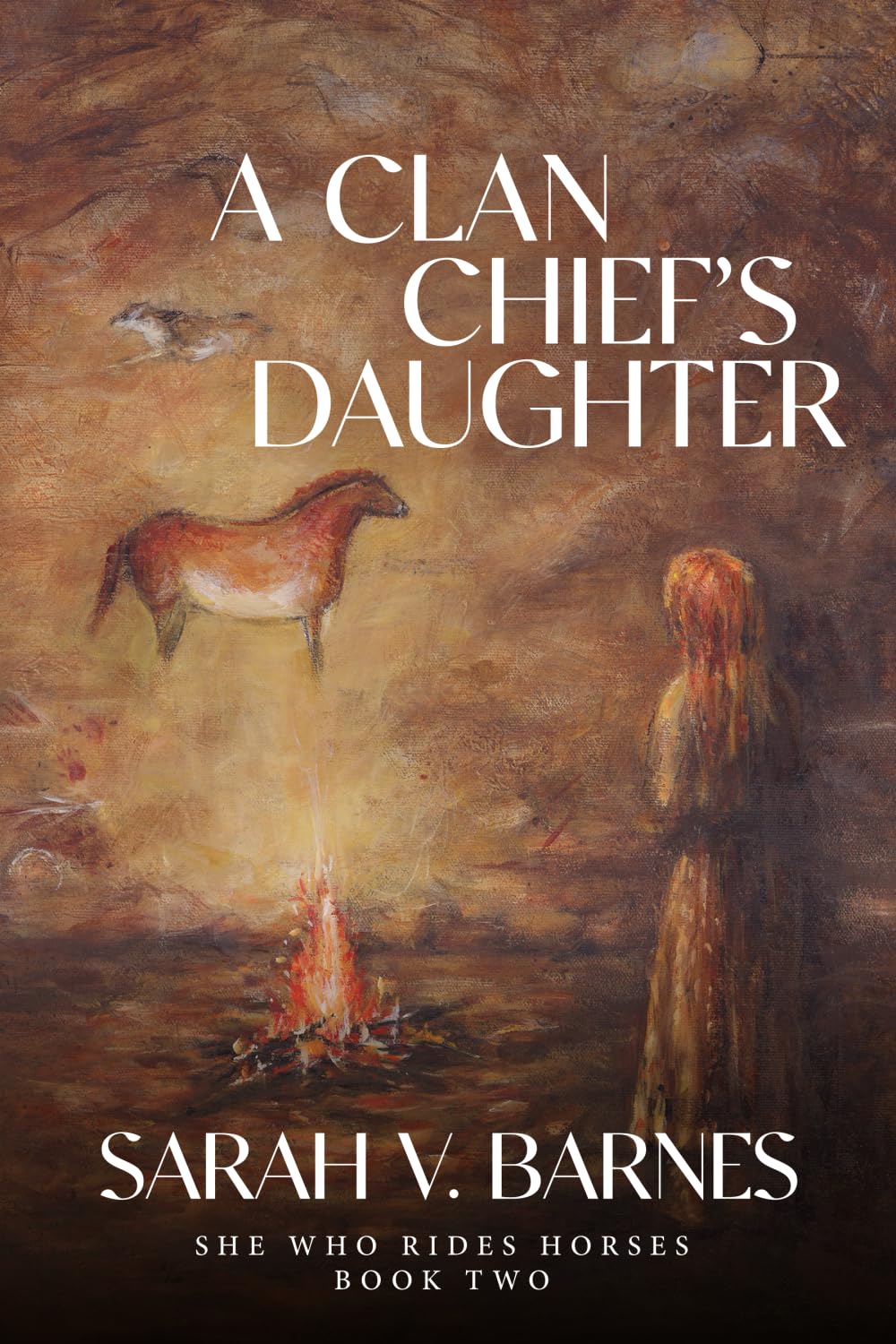
Caught in the midst of a succession crisis, Naya sacrifices much of herself to be the dutiful girl she thinks her father expects. In A Clan Chief’s Daughter by Sarah V. Barnes, Naya’s kept in the dark while enemies plot her family’s downfall.
In the previous book of the series, She Who Rides Horses, Naya began the monumental task of bonding with the wild horses of the Pontic-Caspian Steppe. Guided by dreams of purpose alongside the red filly Réhda, they’d gone so far as to gallop free together. But returning to her clan after a winter apart, Naya finds a terrible captivity waiting for both her and the horses she loves.
A confluence of tragedy and treachery leaves Naya’s father, Potis, vulnerable in his role as Chief.
The clans of the Plānos tribe are soon convening for their annual Gathering. As this year’s host, Potis is expected to supply a plentiful animal sacrifice, especially since he hopes to claim his late father’s position as Plānos Chief of Chiefs. That would be hard enough after a brutal winter, but without warning much of the clan’s livestock are slaughtered in a senseless and suspicious attack.
The stage set, a captivating young man arrives as the clan’s seeming savior. Wailos, son of Potis’s main rival, helps the clan capture a herd of horses that had become habituated to humans—the very same whose trust Naya earned. They are to be sacrificed in place of the clan’s missing livestock.
Wailos shows interest in Naya, who’s begun preparations to be presented as a young woman at the Gathering. He promises a rich bride price of livestock, and such a marriage could prove a valuable political alliance in itself. Naya disregards her own reservations about Wailos in the hopes of helping her father and maybe even sparing the horses.
Naya’s self-denial extends to her loved ones and her very purpose, as she holds herself responsible for the suffering of the horses in captivity.
She refuses her grandmother Awija’s lessons on the importance of dreams and following one’s own heart. Visiting the horses is more than she can bear, especially as it brings her close to Aytal. While Naya holds deep resentment towards the young man, she can’t forget the connection and affection that grew between them over the winter.
Naya’s mother Sata leaves the clan for her childhood home alongside Oyuun, Aytal’s father, and Naya refuses to see it as anything but a betrayal of her and Potis. She turns away from the pain of her conflicted feelings and into the role of a clan chief’s daughter.
When the promises of that role unravel around her, she risks losing her freedom, her loved ones, and her heart’s deepest desire forever.
Barnes builds a societal conflict with complicated systems of alliance and tradition, enriching the story and historical detail through their combination.
The contest for power as Plānos Chief of Chiefs is well-grounded in the immediate and daunting challenges Potis faces as he struggles to stabilize his people. All the while, threads of conspiracy close in around Potis and Naya alike, with the villains always a step ahead. Potis decides not to reveal the danger Wailos poses to Naya, building a powerful sense of dread as Wailos uses the social expectations of their tribe to draw her into a cruel trap.
This conflict revolves around a theme of cooperation versus competition. Potis understands the necessity of maintaining peaceful bonds within and beyond their tribe, but he faces people who are willing to destroy anyone to grasp power.
A Clan Chief’s Daughter shows the injustice of strict gender roles and the vital importance of fighting against them. Barnes uses her rich characters to illuminate different facets of this oppression.
Awija and Sata both hope to turn Naya away from accepting what is expected of her—to be traded away as a commodity through marriage. But though Sata’s struggle to understand her desires against social stricture mirrors Naya’s own, Naya can’t listen without confronting the parts of herself she wants only to escape.
Throughout Naya’s preparation for the Gathering, Awija tries to instill an understanding of self-possessed womanhood in her and the other girls. Having come from a different culture in her youth, Awija contrasts the beliefs of the Plānos. She implies how such gender roles are not essential facets of nature but rather tools of control and power consolidation—tools that this story’s villains wield to harrowing effect.
After months trying to put her wants and fears aside to better serve her expected role, Naya is betrayed completely. She hopes that there might yet be friends she can turn to, but will only reach them if she learns to trust herself again.
Naya’s inner journey takes her through despair at how much she loses, but also an enlightening catharsis. She sacrifices her connection to the horses in a way that mirrors Aytal’s earlier sacrifice of his skill as a bowman, making A Clan Chief’s Daughter an effective rejoinder to the themes established in She Who Rides Horses.
Once Naya accepts that she cannot separate her love, anger, and grief from one another, she can finally begin to brave her nightmares to recover her own destiny.
In its well-crafted combination of vulnerable personal journey, well-researched ancient setting, and commentary on social roles that still manifest in our world today, A Clan Chief’s Daughter by Sarah V. Barnes will fascinate and satisfy in equal measure. A worthy successor to the first book in the series, She Who Rides Horses.
Buy it now through Bookshop.org!