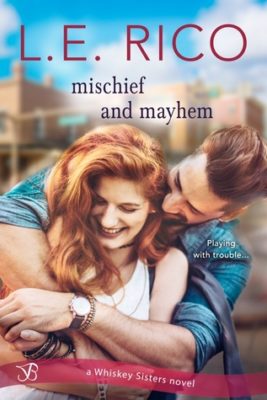
Jameson O’Halloran never asked for her life to be so complicated and unpredictable. She never asked for a cheating husband, never asked to be in charge of her father-in-law’s life, and indeed never asked for her brother-in-law to show up looking so irresistible. Since her recent divorce, Jameson has focused on rebuilding her life without the dream family she always wanted. Her toddler, Jackson, takes up most of her time, and when she isn’t caring for him, she is helping her sisters run the family pub in Mayhem, Minnesota, after the death of their father. Jameson is NOT looking for love, not now, maybe not ever again. Still, when her ex-father-in-law suffers a stroke, she is forced into the very delicate position of health proxy for the seriously ill man she still considers family. However, she isn’t alone. Big Win Clarke named a co-proxy, his estranged second son, Scott. Scott, a Project Peace employee, has spent the last ten years abroad, running from his father and from himself, but when he is called to his unconscious father’s bedside, he knows those years spent abroad were a mistake, one he may never get to correct if his father doesn’t recover. When he lays eyes on his beautiful ex-sister-in-law, he can’t deny the attraction drawing him to her. Together they must uncover the truth behind the mystery that sent him running years earlier and hopefully find themselves along the way.
The family bond is a strong theme within this novel. The contrast between the close-knit O’Hallaron sisters and the volatile Clarke brothers is significant to every part of the plot. The “Whiskey sisters,” Hennessy, Jameson, Walker, and Bailey, function as a solid unit. Named by their pub-owning father, these girls share more than their unique names; they have solidarity, which is touching and profound. Even when they argue, they know the immense love they have for each other will never fade. Pulling together to run the family business after their father’s death, these women willingly sacrifice for the legacy left them by their parents. Having lost their mother, the girls have been both mother and sister to each other. They celebrate triumphs and mourn their loss as one, filling in the gaps in their lives with sibling unity. Jameson can’t fathom going days without seeing her sisters, holding them, confiding in them, let alone years.
On the other hand, Scott and Win Clarke (junior) have never had and likely never will have that bond. The brothers have spent their lives at odds with one another, keeping secrets and driving a wedge in what could be the most enduring relationship of their lives. For Win, jealousy pushes him to exploit Scott’s weaknesses, and Scott’s need to escape keeps him from discovering the truth behind his family history and from forging a bond with his ill father. Just like the Whiskey sisters, the Clarke brothers have also lost their mother, but where that draws the women closer, it only serves as the catalyst for pushing the men apart. It isn’t until Scott begins to lean on Jameson that he finally sees what family should be. The Whiskey sisters show Scott the strength behind sibling loyalty and help him face the revelation that changes his life.
Like most novels of this genre, this second installment of this series is chocked-full of romance but with a refreshing burst of humor that will leave the reader LOLing! Scott Clarke is sigh-worthy on every level, and like most male protagonists in a romance novel, he struggles with the notion of settling down and committing to any woman. He’s unsure he can give up his nomadic life while feeling drawn to the idea of a home of his own, a family to come home to every night. Jameson has been hurt in a way only adultery can hurt. She feels unworthy of love and bitter that her picket-fence dream has been shattered by the only man she’s ever loved. In many respects, the plot is traditional for the genre, but the light-hearted nature of Scott and Jameson’s budding relationship is the real gem. In scene after scene, these two–and many of the other characters as well–will leave the reader in stitches. One of the novel’s best parts is Scott’s interaction with Siri, a novelty he has just discovered since his return to civilization after years in remote locations with Project Peace. Numerous chapters end with Scott’s philosophical discussions with his voice-activated assistant, and his first experience with Facetime is priceless! With scenes that will leave you swooning mixed in, the reader will not be disappointed with this clean, wholesome romance.
Character building, not just for the protagonist but with the entire cast of Mayhem, is a strength of the whole Whiskey Sisters series. From psychic baker to gossipy priest to celebrity cat sweater maker, the characters shine. Each of the O’Hallaron women has her own distinct personality, offering a promising glimpse of what is to come in the series. The reader will love her visit to this picturesque town and long for the cozy comfort of O’Halloran’s pub. The entire town is a unique tapestry with love woven into every scene. [Read our review of Blame it on the Bet the first book in the Whiskey Sisters’ series.]
Mischief and Mayhem won First Place in the CIBAs 2019 Chatelaine Awards for romantic fiction.
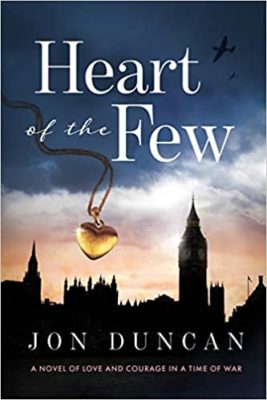
It is said that all is fair in love and war. In this wartime historical romance, young love is put to the ultimate test, and the love of family is strained to the breaking point. During World War II, the occupants of a ravaged England understand that all can be lost in a moment’s hesitation or in a hasty decision. Here, love is under attack by enemies seen and unseen. It’s the uncommon courage of many and the Heart of the Few that can hope to turn the fate of England during these dark days.
Passion drives both sides in this wartime mystery/thriller about people who are determined to make a difference in the outcome of World War II. Like all powerful forces, passion has two sides. It’s a wondrous and beautiful emotion when applied to good purpose, but it becomes horrific and deadly when twisted and corrupt. The question author Jon Duncan asks amidst all the turmoil, treachery, death and desolation of war is: can love find a way?
As the only daughter of the widowed Lord Ashford, Livy Ashford feels compelled to volunteer – a valiant calling of which her father wholeheartedly disapproves. War is too dangerous for a young woman. And, as one of Churchill’s trusted Intelligence officers, he’s well informed about the war news; Ashford knows of what he speaks. He wants Livy to remain protected in the upper echelons of London’s upper-class life.
Jamie Wallace is a butcher’s son who has trained to become one of the new RAF pilots. He is highly skilled and very nervous about his new profession. Regardless, Jamie vows to contribute to the war effort, especially on behalf of his brother, who is badly injured and fortunate to return home at all.
One day, Livy and Jamie stumble across each other on the edges of an airfield. Love strikes at first sight. Do they dare to follow their heartfelt feelings at a time when air raid sirens and bombings prove that tomorrow is not promised? There are many barriers to happiness. Even if there was no war, they come from very different backgrounds, and each is painfully aware of that fact. But not all dangers Livy and Jamie face wear the enemy’s uniform. In the heat of battle, class differences, and unwelcome attention, the young couple wrestles with how to make sense of their situation, remain focused on the war effort – and stay alive.
Author Jon Duncan presents a story with spellbinding, spine-tingling action, with romantic scenes of breathtaking tenderness. Duncan paints a vivid and well-researched picture of England at this critical time in history, packed full of plenty of intrigue. Duncan has a background in the movie and television industry, which is reflected in this novel. Research for this novel enlists many primary sources, including conversations Duncan had with people who lived the history in the time of The Battle of Britain. Some historical romance novels are read, Heart of the Few is one that will live with readers long after the book is put down. Highly recommended.
In the second in a series by author Halverson, an aristocratic, intellectually curious young woman has fallen in love with a young physician, a commoner whose radical experimentations have jeopardized his reputation. The couple is just recovering from the professional and personal rigors of dealing with London’s plague victims when the city is overwhelmed by fire. Their services are needed now more than ever.
Supported by mentor hospital administrator Father Hardwicke in his medical endeavors, Simon McKensie is finally on the verge of marrying the woman he adores, Catherine Abbott. Even the wealthy, protective Aunt Viola has come to terms with the fact that, though she might not approve the match on social grounds, she sees that Catherine will be happy with Simon.
If winning her aunt’s approval and administering aid to plague victims wasn’t enough, just days before their planned nuptials, a fire breaks out that threatens to delay them yet again. Worse, Catherine sustains a severe injury on her way to the hospital to help Simon treat burn victims. It seems that there may not be a wedding. But Simon acts quickly and effectively to save the life of his beloved, exchanging wedding vows with her even as she is barely recuperating from her accident.
The couple enjoys a short respite of marital bliss until their world comes crashing down again as Simon, experimenting with the new innovative field of blood transfusion, is accused of the murder of one of his patients. It will take all of Catherine’s energy and ingenuity to try to save him from the gallows, as enemies who have long despised his radical approaches rush forward to heap accusations on him.
Halverson follows the storyline begun in her earlier novel, The Boundary Stone. She has built and now sustains the romance between Catherine and Simon – emphasizing his scientific daring and her unusual willingness to step outside the expected role of women of her time and class – against a background of chaos, terror, and death. The author has drawn heavily on factual material about the horrendous fire that began in a little London bakery and destroyed thousands of houses and churches, including St. Paul’s Cathedral, leaving up to 70,000 homeless. Aggravating factors depicted included the Lord Mayor’s selfish unwillingness to act to contain the fire in its early hours, while in contrast, the rather flippant, fun-loving King Charles II steps in once the true extent of the damage becomes evident. Both these real people are characters in the narrative, along with Lady Wilbraham, a brilliant but unsung female architect, but will she be able to save McKensie from the gallows? Halverson brings many nameless figures in history to life to create a vibrant reality and a dynamic plot. Something all historical fiction fans crave.
With a loving and highly adventurous duo, readers will be looking for Part 3 of this impressive saga.
The Skeptical Physick won the CIBA 2019 Grand Prize in the CHATELAINE Book Awards for romantic fiction.
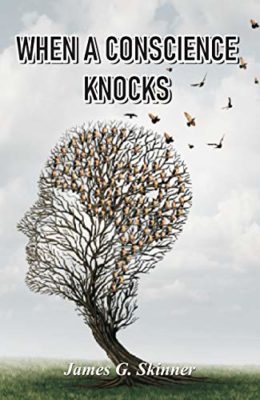
One woman’s life follows a roller-coaster ride of love, political turmoil, and tragedy in James G. Skinner’s novel When a Conscience Knocks.
Jenny Robinson enters a confessional and falls apart. Sensing her distress, the Catholic priest encourages her to divulge her story, which she does. In 1976, at the age of twenty-two, Jenny left her hometown of Richmond, England, and took a teaching job in Iran.
It’s during this time where she meets Juan Miguel Ochoa, a Gallaecian. A diplomat at the Spanish Embassy, Juan is near twenty years her senior. Romance ensues, and within less than two years, Jenny and Juan marry.
Jenny has no idea what she’s getting into as she blindly trusts Juan’s lead throughout his diplomatic career. During their marriage, Juan’s work takes them to numerous trips through Europe, Central and South America, and the USA amid political tensions, wars, and terrorism. But as they approach their twenty-fifth anniversary, life throws a disturbing curveball. Juan’s erratic behavior heralds the early onset of Alzheimer’s. While Jenny’s life abruptly fills with uncertainty, the last thing she expects is to be involved in an affair.
New author James G. Skinner opens with a conflicting scene as his principal character, Jenny Robinson Ochoa, confesses to committing adultery. At the same time, her husband slowly succumbs to Alzheimer’s disease in a nursing care facility. What follows in the twenty-plus chapters is the account she discloses to a Catholic priest.
Jenny’s feelings and thoughts about her husband’s involvement with the chaotic global events surrounding them dominate Skinner’s first-person British narrative. Her continual ponderings, covered within a chronological list of backstories, capture her personality’s development amid the ebb and flow of their marriage, travels, and political upheavals. Conversations between Jenny and Juan focus on explanations of world history and Juan’s diplomatic involvement to a politically uninterested wife. Although the many dialogue scenes that present facts tend to be a bit dry, Skinner does a decent job weaving in historical events.
As stated in the Dedication, the purpose of When a Conscience Knocks is to provide readers with an example of how Alzheimer’s affects intimate relationships. No one would dispute that Alzheimer’s disease is devastating to both victims and loved ones, and Skinner’s fictional character is not exempt. Rather than placing the debilitating disease front and center, Skinner pivots the attention upon the partner. Indeed, this is a coming-of-age tale—one’s woman’s struggle to find her identity, her voice amid conflict and relational codependency.
When a Conscience Knocks takes an alternate route, describing the pain and torment those on the sidelines experience when their partners succumb to Alzheimer’s disease’s devastation.
Irish-born Gillian McAllister knew she was meant for bigger things than a quiet life among her large extended family. Leaving home at seventeen against her protective father’s wishes, Gillian is looking for adventure – and that’s exactly what she finds. She was a nanny for a maharaja, a caretaker for WWII internees, and a nurse on the Isle of Man before finally becoming a wife, mother, and grandmother in London, Canada, where she spent the majority of her eighty-nine years.
However, with only weeks to live after being stricken by cancer, she knows her time with her beloved granddaughter and namesake is truly precious. Before she goes, she wants to pass on the poems that capture her long, adventurous life to the junior Gilly in hopes the girl will use the poems to write about her adventure – her hidden love story.
While on vacation in Canada, the teenage Gillian meets and falls madly in love with Christian Hunter. Her love of Christian consumes her, but she leaves him at the cusp of a war that soon alters the world’s course. Destiny isn’t finished with the pair, and they reunite after the carnage to find their love is as fiery and fierce as ever. However, even a love this strong can’t outrun fate, and Gillian is determined to find a way to show her beloved granddaughter the truth before it is too late.
The character relationships between Gillian and others is a perfectly developed part of the novel. Gillian’s attachment to her granddaughter is more than just a name. Young Gilly is an aspiring novelist. Both women understand the importance of storytelling and the impact of words. From the moment Gilly was born, Gillian felt the connection between them and believes only Gilly can breathe life into her adoration of Christian Hunter. She entrusts her poems to Gilly without disclosing the story, allowing the girl to uncover the secret hidden for over fifty years. Watching their last days together unfold is touching and reminiscent for any reader who has shared a bond with a grandparent.
Gillian’s secret love, Christian, is another meaningful relationship. From the time she was young, Gillian knew someone was waiting for her, someone drawing closer with each day, someone staring at the same moon and longing for another. When she meets Christian, she just knows as does he, and though, ultimately, Gillian comes to realize that devoting herself to one man when the world is waiting may not be what she truly wants. But Gillian cannot deny the connection between them. The two are the epitome of opposites attract with his easy-going, unrushed personality, but he immediately sees the effect she has on others, her zest for life. No matter how hard either tries to drown out the thought of the other, they can’t escape their entwined destinies, and their contrary natures create a perfect balance. The dance of fate between Christian and Gillian is thrilling and will keep the reader wondering until the end.
The gorgeous settings of Gillian’s life are an integral part of her history. The richly painted scenes are beautiful and inspiring for the character as well as the reader. From the sweeping sea cliffs to the serenity of Gillian’s cottage on the Isle of Man, the setting becomes its own character. Gillian both embodies and is affected by the scenery. In the quiet of a winter-draped meadow and the countryside teeming with life, Gillian sees herself and the many lives she’s lived.
A beautiful theme within this novel is the simple notion of loving life. Even before she steps out into the adult world and leaves Ireland, Gillian knows that life is for living. She wants to squeeze every drop of adventure possible from the time she is given and feast on all that it has to offer. Her ingenuity, spunk, and spicy attitude create an unquenchable need to travel, to meet people, and, most importantly, to make the world a better place. She refuses to settle for a mediocre life and rejects the moderation others preach and try to instill in her. Her “magnificent obsession” isn’t diminished by anything – not heartbreak, a world war, or even death. She lives with passion and gusto, fostering the belief in others that love and laughter, stories and adventures, make life worth living. Her sprawling life’s story is more than just survival and lost love. It’s about finding joy and purpose amongst death and destruction.
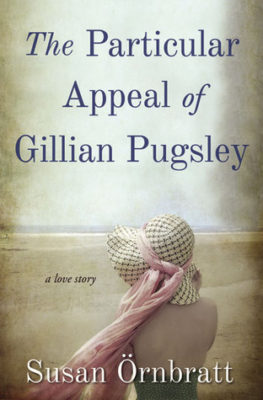
The Particular Appeal of Gillian Pugsley won 1st Place in the CIBAs 2015 CHATELAINE Awards in the category of 20th Century Historical Fiction.
We’ve long said that we are leaders in digital and technology. This is who we are! Now, because of our new living situation, i.e. COVID19, digital platforms and marketing tips are even more important to creating and sustaining our author platforms and building our readership.
What we need is strategy – and a bit of know-how to make our efforts pay off. We all want to sell books. We all want to be writing and connecting with our audiences. While thinking about this today, Kiffer and I thought we would revisit one of our most helpful posts about Book Marketing. Michelle Cox’s, Hot Marketing Tips are Shared in the 10 Question Author Interview with MICHELLE COX – Author Interviews, Marketing, Craft of Writing. Here’s an author who knows what she’s talking about.
Michelle Cox is one of the panelists on A Multi-prong Approach to Book Marketing with Paul Hanson of Village Books, Michelle Cox – Historical Fiction, J.I. Rogers – Science Fiction, and Tina Sloan, contemporary thriller author and actress that is scheduled for Sunday, Sept 13, 2020 at VCAC.
After reading this post, you feel you would like some new information, I would like to invite you to our VCAC starting next week, September 8 – 13, 2020, where experts, like bestselling authors Robert Dugoni, J.D. Barker, top film producer Scott Steindorff, author /actor Chris Humphreys, Amy Stapleton and Wayne Richard from CHATABLES, and Paul Cutsinger from ALEXA, Anita Michalski and Jonathan Hurley from Hindenburg Systems – and so many, many more experts (click here to see a complete list of our Headliners, Presenters, and Faculty) who will go into depth about book marketing in today’s new world. We even have Tana Hope to show us how to take care of yourself. We all need that, right?
Here’s your official invitation to VCAC20: click here.
And now, back to Michelle Cox…
Mystery & Mayhem Book Awards Grand Prize winner Michelle Cox graciously shares her writing life and knowledge with us along with some hot marketing tips and tools! Read on!
“When I finally decided to try writing, the creativity within me, that divine essence, finally found its true home. I’m happiest when I’m creating, and I hope I can keep writing for a long time.” – Michelle Cox
Michelle Cox, award-winning author, at work in her writing lair
Chanticleer: Thanks for coming by, Michelle. Tell us what genre best describes your work? And, what led you to write in this genre?
Cox: Well, that’s a great question! I usually at least place as a semi-finalist in three different categories at the Chanticleer awards, for example, so that should be a pretty good indication.
My series is set during the 1930s in Chicago, so that qualifies it to be historical fiction, but it’s also mystery and romance. I guess “romantic-suspense” would be the best way to describe the series, but without the bare-chested guys on the cover.
They always say to write what you would want to read, and this is it! I set the series set in my favorite era; added a little bit of mystery, a little bit of romance; flavored it with the haves- and the have-nots of the era, as well as a touch of the English aristocracy; and then stocked it with lots of characters and subplots weaving in and out . . . sheer heaven!
Chanticleer: And that’s why we love you and your books! What do you do when you’re not writing? Tells us a little about your hobbies.
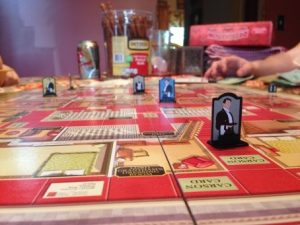
Cox: I no longer have any! I used to have hobbies before writing took over my life. If I do have a few minutes here and there, I still love to garden and bake, but my real love, however, is board games. I’m a fanatic and have become a sort of a collector now.
Playing games with Michelle Cox! Did the butler do it?
Chanti: That sounds like a lot of fun! So, how do you approach your writing day?
Cox: As soon as my kids get on the bus at 6:50 am, I make my second cup of coffee and sit down at my desk. I’m not allowed to do any social media, though I do always do a quick email check to see, you know, if I won the Pulitzer or something (it’s always no), and then I start working on whatever manuscript I’m currently on. My brain is its crispest early in the morning, so I have to use that time for the work that takes the most concentration. There’s something to be said about productivity when you know you only have a limited time to write. There’s no room for writer’s block or procrastination. When you know you only have so much time, you have a way of just sitting down and doing it.
When I reach whatever my writing goal is for that day, I spend the next five to seven hours (until the kids come home) doing marketing and PR—anything from writing the blog or the newsletter or articles or interviews, taping podcasts, setting up events, answering email, attending to social media, etc. It’s really a full-time job, though, sadly, the actual writing, the part I love, is the part I get to spend the least on.
Chanti: Marketing pays off, right? Name five of your favorite authors and describe how they influence your work.
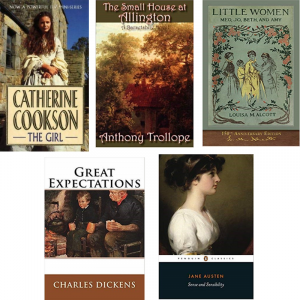
Cox: My series is known for the plethora of rich characters scattered throughout and the big saga-like plots. I was definitely influenced in this by my early favorites: Louisa May Alcott, Catherine Cookson, and Charles Dickens. My other two favorites would be Anthony Trollope and Jane Austin for their subtlety in character and their overall ability to use language so beautifully.
Chanti: I cannot argue with your choices. These are delicious authors – and novels!
I know you gave us a snapshot of your work-day earlier, but could you give us your best marketing tips, what’s worked to sell more books, gain notoriety, and expand your literary footprint.
Cox: Wow! That’s a great question, but so hard to answer. All marketing is pretty elusive, isn’t it? It’s a constant process of throwing things at the wall and seeing what sticks. It’s also important to remember that what works for one person, might not work for everyone. It’s not an exact science. If it were, we’d all be rich!
But, in general, here are some good marketing tips that I have found to work:
Try to figure out where your readers are. Most of my readers, for example, are on Facebook, so that’s where I spend most of my social media time.
Think of yourself as a brand and try to match your posts accordingly. I post things about myself or the book or writing, but mostly old recipes, period drama news, or old stories from the past (which constitute my blog). Also, I’m very careful never to post anything religious or political. This is a business, and the more you see yourself that way and follow basic business protocols, the more successful you’ll be.
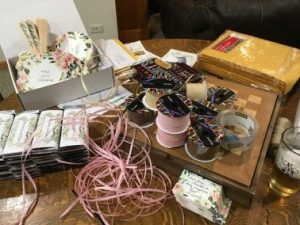
Try to build your newsletter list by offering a freebie (such as free story, writing tips, a webinar, a prequel). Personally, I do it by running contests with really big prize packages. I make sure to state that the contest winner will be picked only from my newsletter subscribers. I pay a designer to create a beautiful graphic of the prizes, post it on FB, and then boost the post. Not only does this get me a lot of new subscribers (sometimes thousands), but it exposes the series to new readers as well!
Build your network. Join online author groups (I am part of a fabulous private FB group organized by my publisher, She Writes Press. We all share ideas, marketing tips, and offer support and advice, especially to the newer authors just coming on board. It’s a collective wealth of information.) or real-world groups in your area. Don’t be jealous of the success of others, but help each other as much as possible. As my publisher, Brooke Warner has said, “There’s room for everyone at the table.”
Show up at other authors events, write reviews, help promote whenever possible. Go to conferences to meet not just readers, but other authors who can potentially help you. Remember that you are a business, and you need to do work within your community to begin standing out.
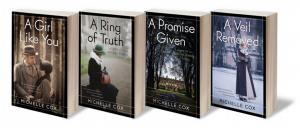
For example, my publisher and I overprinted Book 2 of my series, so, as per my contract, when the first year of publication had passed, I was faced with having to pay a storage fee for these extra books (a couple of thousand), have them shipped to my garage, or have them destroyed. I decided, instead, to send them to libraries and conference organizers. It was a lot of work and expense, but it got my book into the hands of hundreds, if not thousands, of potential readers, and hopefully, they’ll come back for more and buy the rest of the series. You have to be willing to take risks.
Also in this category would be to try to get a Bookbub deal, which, as we all know is really tough. Again, for Book 2 of the series, we submitted four times, trying to get a deal with the book being priced at .99 cents. I finally decided to offer it for free, and we cleverly put a buy link to book 3 at the end of Book 2. Bookbub then offered me a deal, and I had over 55,000 downloads in one day! Hopefully, a lot of those people will go on to buy Book 3 at full price.
Lastly, if the first book of your series is free, either permanently or occasionally, you can join Book Funnel, in which you “bundle” your book with others of a similar genre with each author promoting the bundle to their social network, which exposes your series to a whole new crop of readers. Readers are able to download your free book in exchange for their email address. So not only are you getting readers hooked on your series (hopefully!), but you’re building your subscriber/newsletter list.
Chanti: You could teach a Master Class on this at CAC20! Let’s chat about this later.
Chanti: What are you working on now? What can we look forward to seeing next from you?
Cox: Book 5 of the series is currently in production and scheduled to be released in Spring 2020. I said I was going to take a break from the series after that, but I admit, I’ve already started sketching out Book 6 – I can’t help it!
But what’s really exciting is a new stand-alone novel, The Love You Take, that I wrote, also based partially on a true story and set in Chicago in the 1930s. It’s a really fabulous book if I do say so, about a “backward” girl who has to go and live at a home for “bad girls” after she unwittingly becomes pregnant. I’m currently querying agents for it.
Chanti: Sounds intriguing. Please keep us updated. Who’s the perfect reader for your book?
Cox: Though some men enjoy my books, the primary audience is women. Anyone who loves Downton Abbey;Upstairs, Downstairs;Miss Fisher’s Murder Mysteries, the old black and white films, like The Thin Man . . . basically any period drama or old movie . . . will love my series. I can’t tell you how many people have written to me to tell me that the series is so visual, that reading it was like watching a movie. It’s delightful escapism; people tell me all the time they feel like they’ve been transported back in time after reading them.
Chanti: I know that’s why we read your books #delightful! What is the most important thing a reader can do for an author?
Cox: Tell a friend! Research shows that the number one thing that influences people to buy books is word-of-mouth. If you like a book, recommend it to friends or your book club. The second best thing is to write a review! People seem wary of doing this, telling me that they’re nervous about what to write.
“Nonsense!” I say.
A review can be one sentence: “This was a great book; I enjoyed it!”
There. Done.
You don’t have to go into a lengthy reworking of the synopsis (why do people do this?) or delve into symbolism or themes or whatever. Just give your one-sentence opinion!
Chanti: I’ve been telling my non-writing friends this for years… Do you ever experience writer’s block? What do you do to overcome it?
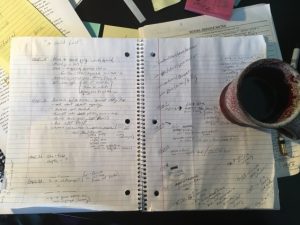
Cox: Not really! I have a lot of story ideas in my head, and thus I usually have the opposite problem. This is where outlining can really help. If you have a pretty weighty outline sketched out, then when you sit down to write each day, you pretty much already know what you’re supposed to write that day. Likewise, I enjoy taking an evening walk (or I try to, anyway!), during which I think about tomorrow’s chapter and what needs to go into it. Sometimes I even voice record if I have a really good idea or some strands of dialog. There’s something about walking—moving the legs back and forth, back and forth—that seems to stimulate something in the brain. They say that Dickens used to walk the streets of London for hours in the wee hours of the night. Now I know why!
Chanti: Time to reflect and let your mind wander. Movement really does help with this. What excites you most about writing?
Cox: Creating something out of nothing. I’ve always been a really creative person. Looking back, I see now that I’ve always been striving to create, and for a long time it took on many different forms. As a kid, I was always trying to illustrate Louisa May Alcott’s books or write little fan fiction stories based on Jo March. As I got older, it took the form of gardening and decorating the house, and then baking and then creating elaborate kids’ birthday party invitations! When I finally decided to try writing (long story), the creativity within me, that divine essence, finally found its true home. I’m happiest when I’m creating, and I hope I can keep writing for a long time.
Chanti: We hope you do, too, Michelle. What a fabulous interview! Thank you for sharing your story with us.
Speaking of sharing, if you like what you’ve read, please “like, comment, and share!” Sharing is caring, baby!
The CIBA Grand Prize Winners
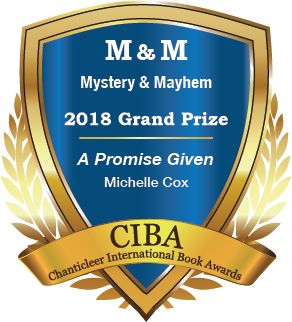
Michelle Cox is a multi-award-winning author who recently spent some time with us at CAC19. This year was particularly special because Michelle won the CIBA 2018 Grand Prize for Mystery & Mayhem Awards!
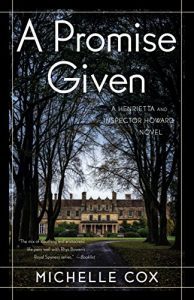
and took 1st Place in the Chatelaine Awards for Romantic Fiction – both awards are in honor of her book, A Promise Given. We will probably never stop celebrating this – it’s just too much fun!
To find out what Michelle’s up to next, Find and Follow her here:
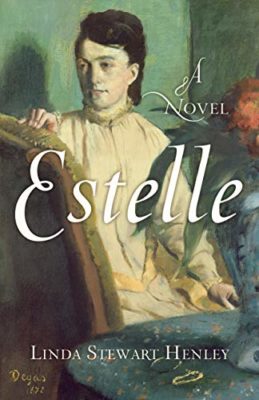
Twenty-two-year-old museum intern and unknown artist, Anne Gautier, has undertaken a significant project, restoring an elegant house on one of the most beautiful streets in New Orleans. The grand old Creole home has been in her family for many generations, and, when her grandfather died, he left her the house on Esplanade Avenue, where all the best French Creole families once lived.
There’s only one stipulation: She must restore the property or ownership will revert to the city. Even though the house is not in the best part of town, Anne is determined to celebrate the historical home not only because of her own family, but also because it was an integral part of New Orleans’ history during the visit of Edgar Degas in 1872. In fact, in Anne’s attic, Degas’s notebook gives her the money she needs to begin the restoration.
Her plans go sideways when someone breaks in and vandalizes the home, leaving behind a threatening note and a mystery to solve. On top of this, Anne is trying to reconcile her feelings about Stella, the half-sister Anne recently met. Is Stella behind the vandalism? She was left out of their grandfather’s will. Anne tries to rely on her new boyfriend, Sam, for advice, but he has begun acting strangely, sneaking around behind her back and hedging his answers to her questions. With no one to lean on, a demanding job, and her own artistic-inspiration waning, Anne may never see her beautiful home and its essential history revived.
The dual settings of New Orleans in 1870 and 1970 give this novel a unique perspective. The juxtaposition of the Musson and De Gas families’ issues to the modern trials of Anne and her own family provides perspective and education for the reader. Though their struggles seem completely unalike, the parallel stories are paradoxically similar. Estelle De Gas, sister-in-law and cousin of Edgar Degas, is a strong woman trying desperately to hold her marriage to a cheating husband together. At the same time, maintaining the expected appearance of a well-to-do Creole family while knowing the family’s fortunes have fallen.
Anne is struggling to find her place in the world and to hold together what family she has left while dealing with her own untrustworthy partner, Sam. Though Sam admonishes her for refusing to look at the practical realities of life, she seeks to make her surroundings beautiful, just as Estelle does in encouraging Degas to find his inspiration in la Nouvelle-Orléans. Anne wants desperately to make her own way in the world. Though Estelle isn’t an unmarried young woman, she understands the integral role she plays within her sphere of familial influence. The more Anne learns about Estelle, the more she realizes she needs to take a leaf from her ancestor’s playbook and find her own strength.
Art plays a huge role in this novel. Edgar and Anne share a similar notion that the life of an artist is not one easily shared with another. Both are suffering from a lack of inspiration and direction. During the time Degas spent in America, he had achieved little recognition, and his brothers hoped he would take an interest (and make an investment) in the family cotton business. Anne has given up her art for her busy internship and her flailing love life. Though the museum job isn’t her dream, she understands art is not an easy way to make a living. She avoids facing the truth just as Degas begins to feel he must help his family by selling his work and sending them much-needed money. Eventually, New Orleans offers both a new subject matter for their art. Anne, with her new-found sympathy for the poor of the city and Edgar with his own family’s business.
The growth of Anne’s relationship with her half-sister, Stella, is an interesting subplot in conjunction with Anne’s realization about the struggles of poverty-stricken New Orleanians. Anne has only recently learned of her sister’s existence because Stella, the product of a teenage dalliance, was given up for adoption immediately after her birth. Anne’s overwhelming guilt over her half-sister’s lost inheritance haunts her, and though she wants to share, giving up a portion of her estate is not the easiest thing to do. But the hard truth is, Stella is facing eviction from a Section C housing, a slum where the houses are more like shacks. Anne could offer Stella a home in their grandfather’s former home, but will she?
Chanticleer Book Reviews is seeking today’s best books featuring romantic themes and adventures of the heart, historical love affairs, perhaps a little steamy romance, we will put them to the test and choose the best among them.
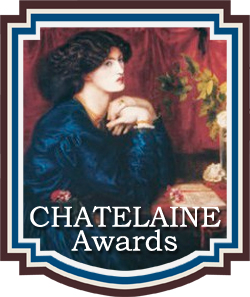
Find out more about the stunning beauty that Dante Rossetti painted, Jane Morris, at the end of this blog post.
Do you have a romance novel or manuscript ready for readers?
Do you want to see how it stands up to others in its category?
Then don’t delay! The CHATELAINE Book Awards division is accepting submissions from both recently published and complete manuscripts in romance and romantic fiction. But this year we’ve moved our deadline – to keep you on your toes!
The new deadline for the Chatelaine Awards is AUGUST31, 2020!
That’s right, the last day for submissions into the 2020 Chatelaine Book Awards is August 31, 2020. So, if you love Piña Coladas – and getting caught in the rain… I mean, if you like writing about those things, and other things having to do with matters of the heart, including these:
Insiders’ Tip: Other genre divisions of the Chanticleer International Book Awards have romance categories as well. Multiple submissions of the same work to a variety of CIBA writing competitions divisions are accepted. Check out our divisions here.
Please join us in congratulating and reading these top works in this diverse range of all reads Chatelaine: Romance, Chick-Lit, Women’s Fiction, Inspirational, Suspenseful, and, of course, Steamy and Sensual in the
CHATELAINE HALL of FAME!
Jane Austen Inspired:Pulse and Prejudice by Colette Saucier
Paranormal:Crimson Flamesby Ashley Robertson
Christian Inspirational Romance: Chasing Charlieby C. M. Newman
Restorative: A Path through the Gardenby Nancy LaPonzina
Classic Bodice Ripper:To Dare the Duke of Dangerfieldby Bronwen Evans
Who will win the CHATELAINE Book Awards Blue Ribbons for 2020?
The judging rounds will commence in August! Submit your works today!
The last day for submissions into the 2020 Chatelaine Book Awards is August 31, 2020. Winners will be announced at our CAC21 conference – scheduled for April
And remember our Insiders’ Tip: Other genre divisions of the Chanticleer International Book Awards have romance categories as well. Multiple submissions of the same work to a variety of CIBA writing competitions divisions are accepted. Check it out here!
A little information about the Chatelaine Book Awards icon:
We feel that Dante Gabriel Rossetti’s Pre-Raphaelite painting of Jane Morris (muse and wife of William Morris) in aBlue Silk Dress captures the many moods of the Chatelaine division of the Chanticleer International Book Awards. Jane Morris (nee Jane Burden—little is known about her childhood but that it was poor and deprived) was known for her keen intelligence. William Morris fell in love with her when she sat for him as a model. She was privately tutored to become a gentleman’s wife upon their engagement. It is said that she was the inspiration for George Bernard Shaw’s character Eliza Dolittle of My Fair Lady fame. The Blue Silk Dress was painted in 1868 by Rossetti and it currently resides in the Society for Antiquaries of London. She was 29 when Rossetti painted it. Rossetti and Jane Morris became closely attached until his death in 1882. To read more about the fascinating Jane Morris, click on this Wikipedia page.
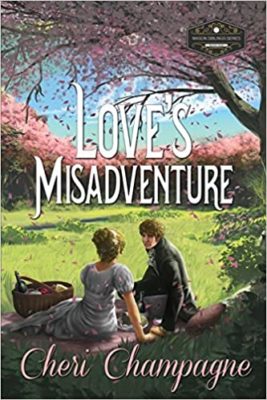
Miss Annabel Bradley needs a husband before she is officially an old maid. At the ripe age of twenty-five, she has been virtually “shelved” by the ton. Anna is eager to begin a family, and though she’s been reared on a healthy diet of adventure novels, she is willing to settle for any suitable match as long as she can begin the family she has always wanted. Anna knows exactly with whom she wants to share her life, her lifelong friend Lane Mason. Growing up on neighboring estates, Anna and Lane couldn’t be more perfect for each other, and even though they both know their marriage would provide an easy companionship, Lane has a secret that forces him to keep Anna at arm’s length. Despite loving Anna since they were teenagers, he can’t in good conscience marry her without first finding a solution to his problem. Anna isn’t willing to wait forever, and when another lord of the peerage shows interest in her, Anna must decide whether to follow her heart or take what might be her only chance for a family, but after Lane and Anna are kidnapped, both make life-changing decisions that seal their fates.
Love’s Misadventures has all the hallmarks of a romance lover’s dream. The wealthy, most-desired gentleman of the season, Lord Devon is the hunky blonde heartthrob, unafraid to come to the rescue of his lady love but sensitive enough to pack the perfect picnic. Annabel embodies the smart, ahead-of-her-time heroine who doesn’t want to settle for a loveless marriage but will do whatever she must to protect her family, and even though the novel has that comfort-food feel, it gives the reader with one huge surprise. Lane is a virgin. Not only is Lane inexperienced in the ways of love, but he also isn’t even sure he can perform his “husbandly duties.” While it is entirely typical to find this trait in the female protagonist, seeing it in the hero makes this novel a standout.
The friendship between Lane and Annabel will leave the reader touched and a little envious. So often, the plot of romance novels has lust that evolves into love, but Love’s Misadventures begins with friendship, a lasting friendship, that is put through so many challenges. Like a horse in a race, Lane doesn’t realize how fortunate he is to have found the love of his life in his best friend until he stands to lose her to another man, and Anna will sacrifice respectability to find love in the arms of the man who knows her better than anyone in the world.
In Cheri Champagne’s first novel in the Mason Siblings Series, readers will find the love and fire they expect from a historical romance but with refreshing twists that make the novel all its own.
Love’s Misadventures won First Place in the CIBA 2017 CHATELAINE Awards for Romantic fiction.
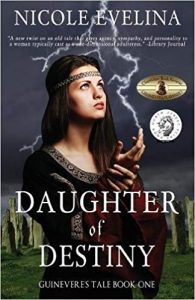
One woman unwittingly enters into a deadly game of obsession. What must she pay to regain her body and soul?
Between classes and her part-time job, Zara Logan doesn’t have much time for socializing or even the horror movies she loves and hates, but when Dorian Hatch moves in next door, her life quickly shifts from familiar routine to chaos. Dorian is drop-dead gorgeous. He’s the stuff that dreams are made of – and that becomes a bit of a problem for Zara.
It’s a deadly game, the pursuit of Dorian. Zara doesn’t set out to be possessed body and soul by her neighbor, but obsession is a tricky web. What begins as spying on the hot guy next door quickly becomes so much more. Zara knows her need for Dorian is unhealthy at its most innocent and destructive at its most dangerous, yet she cannot rid herself of the burning desire for him. She sees her identity slipping away, knows it’s consuming her, but nothing matters, not even when Dorian asks what she is willing to “stake” to be with him.
Zara’s attraction to the mysterious Dorian turns up a few thousand notches to an undeniable blazing heat, full-on obsession. Her relationships with her Aunt Cynthia (who raised her) and her best friend suffer when she begins lying so that she can secretly spend time with Dorian. Aunt Cynthia and Rachel try to make Zara comprehend their concerns, but Zara believes she is under control.
But who can fight a supernatural dark force? Zara soon experiences some rather strange physical symptoms such as blackouts and nightmares, and an all-out need for the man. Zara is far from being in control. She’s stuck in an all-consuming compulsion to be near him, but with every move closer, she senses absolute darkness surrounding him and knows it’s only a matter of time before she can no longer find her way back to herself.
Meg Evans doesn’t let up on her main character but pours on the heat and throws Zara into one sensuous scene after the other until Zara feels used up and strung out. The author manages to craft a tale that is simultaneously a steamy romance and an uncomfortable portrayal of what it is to be genuinely obsessed. Indeed, it isn’t until much later that Zara realizes how much of a Dorian-junkie she has become. He is the fulfillment of her greatest dreams and the embodiment of her worst nightmare. She feels the humiliation of her neediness but can’t pull away from the way Dorian makes her feel. How does he do it? What is this power he holds over Zara?
Zara’s stress is nearly her undoing, but this pain is nothing compared to the escalating obsession that consumes and drives her, leaving her to wonder if she is losing her mind. It’s all tied tightly together, which promises to leave readers enthralled and desperate for more.
Remember to pre-order your copy of Enthrallment right here!

 Jameson O’Halloran never asked for her life to be so complicated and unpredictable. She never asked for a cheating husband, never asked to be in charge of her father-in-law’s life, and indeed never asked for her brother-in-law to show up looking so irresistible. Since her recent divorce, Jameson has focused on rebuilding her life without the dream family she always wanted. Her toddler, Jackson, takes up most of her time, and when she isn’t caring for him, she is helping her sisters run the family pub in Mayhem, Minnesota, after the death of their father. Jameson is NOT looking for love, not now, maybe not ever again. Still, when her ex-father-in-law suffers a stroke, she is forced into the very delicate position of health proxy for the seriously ill man she still considers family. However, she isn’t alone. Big Win Clarke named a co-proxy, his estranged second son, Scott. Scott, a Project Peace employee, has spent the last ten years abroad, running from his father and from himself, but when he is called to his unconscious father’s bedside, he knows those years spent abroad were a mistake, one he may never get to correct if his father doesn’t recover. When he lays eyes on his beautiful ex-sister-in-law, he can’t deny the attraction drawing him to her. Together they must uncover the truth behind the mystery that sent him running years earlier and hopefully find themselves along the way.

 It is said that all is fair in love and war. In this wartime historical romance, young love is put to the ultimate test, and the love of family is strained to the breaking point. During World War II, the occupants of a ravaged England understand that all can be lost in a moment’s hesitation or in a hasty decision. Here, love is under attack by enemies seen and unseen. It’s the uncommon courage of many and the Heart of the Few that can hope to turn the fate of England during these dark days.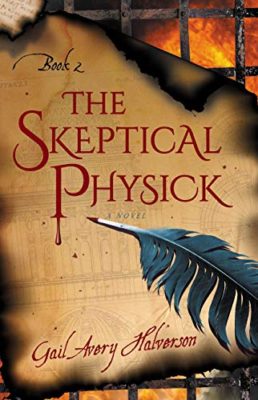
 In the second in a series by author Halverson, an aristocratic, intellectually curious young woman has fallen in love with a young physician, a commoner whose radical experimentations have jeopardized his reputation. The couple is just recovering from the professional and personal rigors of dealing with London’s plague victims when the city is overwhelmed by fire. Their services are needed now more than ever.









 For example, my publisher and I overprinted Book 2 of my series, so, as per my contract, when the first year of publication had passed, I was faced with having to pay a storage fee for these extra books (a couple of thousand), have them shipped to my garage, or have them destroyed. I decided, instead, to send them to libraries and conference organizers. It was a lot of work and expense, but it got my book into the hands of hundreds, if not thousands, of potential readers, and hopefully, they’ll come back for more and buy the rest of the series. You have to be willing to take risks.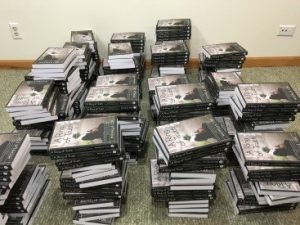





 Chanticleer Book Reviews is seeking today’s best books featuring romantic themes and adventures of the heart, historical love affairs, perhaps a little steamy romance, we will put them to the test and choose the best among them.








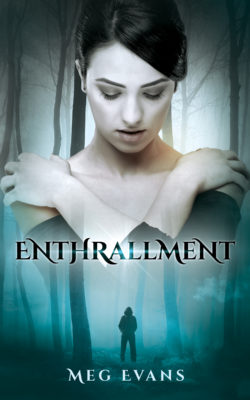
 One woman unwittingly enters into a deadly game of obsession. What must she pay to regain her body and soul?