
Tag: Roman history

  • The SILK and the SWORD by Ron Singerton – an epic journey from Rome to the Great Wall of China

    The SILK and the SWORD by Ron Singerton – an epic journey from Rome to the Great Wall of China

    Tacitus, the rebellious son of Gaius Septimus, learns too late that the temple that his gang has desecrated was his mother’s chosen holy place. Barely able to contain his murderous rage, Gaius issues an ultimatum to his son: Tacitus can spend the rest of his life as a slave, or he can work to redeem himself through military service.

    However, Tacitus has little time to absorb the shock of his punishment and his decision to join the military. Behind closed doors, Caesar’s consul, Marcus Crassus, makes a case for war and creating the need for many of the legionnaires. Tacitus is called to action, answering directly to the leadership of his centurion father, Gaius, who is Julius Caesar’s chosen “First Spear.”

    Cursed by his own arrogance and greed, Marcus Crassus’s military mission crumbles, leaving Gaius, Tacitus and a small band of surviving legionnaires to navigate uncharted foreign lands and savage cultures in their quest to return to Rome. With betrayal and deceit at every turn the soldiers suffer enormous physical and emotional beatings.

    Their survival, much less their success, hinges on the unlikely chance that Tacitus, an unrepentant son, and Gaius, an unforgiving father, will cast aside their differences and work shoulder-to-shoulder to restore order, hope and honor to their men.

    In this well-crafted follow-up to his first historical novel, “The Villa of Deceit,” author Ron Singerton delivers a cast of fresh, flawed, and completely believable characters through which he illuminates the universal strengths and weaknesses in all of us.

    Building upon the life story of his original main character, Gaius, the author invites the reader to investigate the events that have created a chasm between father and son. As Tacitus sheds his underdog status and takes the spotlight, we become invested in his trials and triumphs. And, as his respect for himself and his father grows, he becomes a hero worth rooting for.

    From the battlefields of Carrhae (now modern day Turkey), to the towering mountains and sweeping expanse of ancient Asia’s “Silk Road,” and on to the Great Wall of China, “The Silk and the Sword” is packed with vibrant historical and tactical detail.

    Culled from primary historical references as recorded by Plutarch, Pliny and Julius Caesar, the author illuminates the fascinating, multi-faceted private and public worlds of the Roman legionnaire. Fans of both historical fiction as well as Roman history will find Ron Singerton’s “The Silk and the Sword” to be a highly engaging, satisfying read about one of the most detrimental defeats in Roman military history.
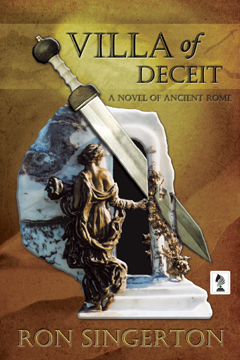
     

  • VILLA of DECEIT: a Novel of Ancient Rome by Ron Singerton

    VILLA of DECEIT: a Novel of Ancient Rome by Ron Singerton

    Ron Singerton’s “Villa of Deceit” cleverly portrays the transition from the Roman Republic, which had a complex constitution with checks and balances, to the rise of the imperial dynasty of the Roman Empire, which would rule the next four hundred years with an iron hand, by using the microcosm of a Roman family to reflect the changes and undercurrents that were beginning to change the course of Western Civilization.

    The book opens with young Gaius, the hero of the story, intending to celebrate the last night of the Ludi Flores festival with his good friend Appian Dio. But that afternoon, he makes the mistake of attempting to intervene on behalf of a young slave Gaius’s tyrannical father, Toronius, is unfairly punishing. Gaius fails, earning the wrath of his father, and is also injured during the altercation. For Gaius, the incident is further proof of what he has known for some time: Toronius is a brutal man with few scruples, and in Gaius’ eyes, unfit to head the family or the family’s trade.

    However, the laws of first century B.C. Rome are of no help in deterring a man such as Toronius. And Gaius’s young mother, who escapes the suffocating rule of her husband by looking after her own interests, is no ally to her son. Not long after the incident with the young slave, Gaius falls in love with a female slave brought into the household. To save her from his father, Gaius convinces her to flee with him and is disinherited as a result. Unfortunately, tragedy strikes, leaving Gaius alone with young son.

    In Gaius, the author gives us a highly sympathetic character who, though young, is intelligent and moral enough to draw conclusions about such unfair treatment of slaves, and brave enough to make difficult decisions in order to strive to live his life by a better standard. Forced into choices that carry consequences by the limited options available in those times, Gaius leaves the infant with a relative and joins the merciless military to try his luck at becoming a Roman Legionnaire.

    Singerton has done his research, and he paints a very accurate portrait of life for young men during first century B.C. Rome. Fathers demand that they come of age early in life, measuring their manhood and stamina by the number of women they bed in one night, and the amount of fear that they are able to strike into the hearts and minds of others.

    In 70 B.C. Rome, slaves and prostitutes are to be used and then discarded when no longer needed. A slave’s life has little value and is easily replaced by more prisoners who would be taken in the next cold-blooded military conquest.  Imported to Roman households from far away lands, slave were young children, and the women who were sorted as to their best use in the eyes of their captors. Those captured who were of little use were instantly put to death. The Roman Empire would continue to conquer and expand its undisputed rule across three continents for the next four hundred years.

    “Villa of Deceit: a Novel of Ancient Rome” by Ron Singerton will keep readers turning the pages as the author vividly conveys the brutality and wanton disregard of life on and off the battlefield in this cleverly plotted historical novel that speaks to a time that would affect Western Civilization for the next millennium.