
Tag: Religion

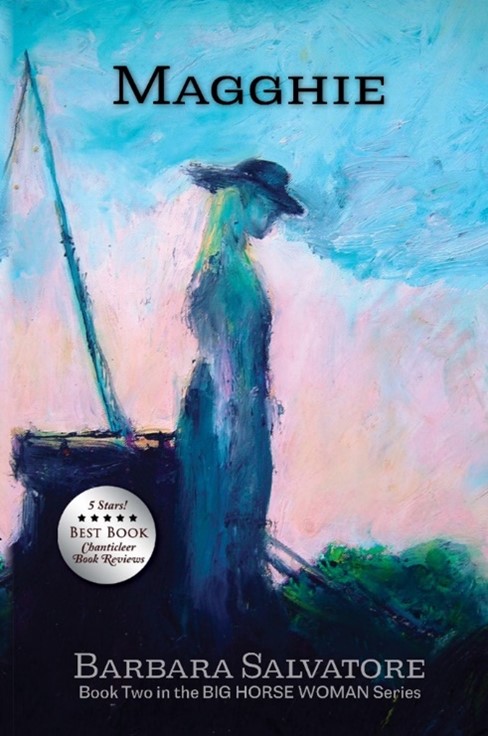
  • MAGGHIE: Big Horse Series by Barbara Salvatore – U.S. Historical Fiction, Women’s Historical Fiction, Horse Fiction


    Laramie Book AwardsAward-winning author Barbara Salvatore brings human foibles, horse traits, and herbal lore together through a young teenage girl’s eyes in her historical fiction novel, Magghie.

    Magghie Wilder has much to cope with, much to learn. She grows up as the only child of Hans and Maye, immigrants from Germany. They make a home in Pennsylvania, in the expanding United States. Hans talks too much, expounding on the simplest issues in grandiose German. He seems to have little time for listening to his curious but often distracted daughter.

    But Hans does teach Magghie how to train and handle the big draft horses needed for heavy hauling and farm work. He encourages her to drive her own team and learn the habits of each one. Maye, by contrast, dreams in quiet and calm, and from her, Magghie learns by watching. Maye understands plant lore deeply and elicits in Magghie the revelation that every green growing thing can be helpful and significant.

    The three live on a successful large farm in relative isolation. Neither religion nor socializing play a role in their routine.

    Things change when Braun, a blacksmith, and his lanky adolescent son, Karl, appear and are kept on as help with horses and farm. Magghie learns a smattering of English from the more worldly-wise visitors. Then, the somewhat chaotic but friendly incursion of a Mormon family follows. Magghie meets the husband, children, and two wives, one of which is pregnant. Maye, recalling the sorrows of losing more than one infant, helps Dora in childbirth. Magghie will watch and come to comprehend why Maye has always seemed so self-enclosed. From the Mormons, Magghie learns something else her parents had resolved never to tell her – the existence of God and the place of religion in human lives.

    Salvatore sets her scene, and the plotlines seem poised for positive outcomes. Until someone brings a life-threatening disease to the valley, creating havoc and despair.

    Salvatore’s current work includes teaching and consulting in Plant Medicine and Horse Care. Since she was thirteen, she has kept a “Dream Journal” and envisions her Big Horse series as a set of four novels, with Magghie being the second book. Her own interests shine clearly through every page of her story, which she tells in a cozy mix of prose and poetry.

    She has appended a lengthy section for her readers, offering further elucidation of the subject matter. This includes the history of Pennsylvania’s settlement, German language usages, extensive notations regarding the Percheron horses used on Wilder’s farm, and further facts about the Mormons’ epic cross-country pilgrimage.

    Salvatore’s Magghie has definite cinematic potential. The story ends with an open invitation to the sequel, promised by the author. That’s good news! 

    Magghie by Barbara Salvatore placed as a Finalist in the CIBAs Laramie Book Awards honoring Americana Fiction, and comes highly recommended!

    5 Stars! Best Book Chanticleer Book Reviews


  • DRUNK TALK by Mike Davis & TL Banks – Philosophy, Personal Transformation, Humor

    Authors Davis and Banks have combined forces to create this humorous but practical look at how people think and why they act as they do.

    The essential message of this satiric volume is that most people tend to nurse false notions about their lives and the universe in general – notions that the authors rapidly and thoroughly debunk. They take the stance of a drunk hanging out at a bar, hearing about everything that goes on in people’s minds. In forty-eight segments, various human problems are examined, derided, and substituted for what many readers will consider far more rational viewpoints.

    Some issues raised seem trivial – “Celebrities” who do not, as might be supposed, get to enjoy their fame since the general attitude toward them is “shut up and entertain us or else.” Other matters are significant. One of the longer treatises focuses on “Gods,” with the authors asserting that God is merely an imaginary projection, and religion only a means of seeing and believing what people want, “even if it’s not real or makes no sense.” A true, non-superstition-based belief system would impel people to help others more and take full responsibility for their actions.

    Science is also a target for this lively discourse, questioning, for instance, that since the Big Bang Theory “is only a theory,” why do people consider it an absolute happening? A repeated motif often placed at the ends of chapters is that we all have the option to “view the glass as half-empty or half-full,” to refill our glass, or even try the middle ground.

    Davis and Banks, the creators of this highly unconventional, witty, and wise exploration of human nature, are professional wordsmiths who write with verve and intelligence, spiced with sardonic humor.

    They invite readers to see the frailties and flaws in human nature, along with the potential for rational change. They have organized their work neatly, following their narrative segments with a lengthy list of “Drunken Quotes to Keep You Focused,” including such zingers as “Never stand underneath what you can’t lift,” and “Like pets, people are rewarded for being well trained.”

    Their book propounds a general sense that one must ignore convention and avoid conformity to succeed. It is filled with thought-provoking concepts couched in curse words that, in their opinion, represent a break with “the ruling majority.” With its undeniably alluring title, this book can help readers organize their personal philosophies and adopt a new, more dynamic way of dealing with life’s thorny issues.


    5 Stars! Best Book Chanticleer Book Reviews

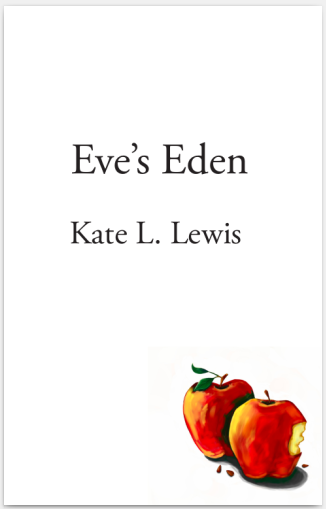
  • EVE’s EDEN by Kate L. Lewis – Literary Fiction, Contemporary Fiction, Feminist Fiction Metatheatre, Religion


    Eve’s Eden by Kate L. Lewis is a novelette, rich in tone and relevant to today’s audiences.

    When Shelly Hart left for the Vanguard Drama House and Social Club, she expected an evening of theatrical entertainment. She was not expecting a protest. Muscling her way through the sign-toting, shouting crowd, Shelly witnesses hostilities toward the playwright, Fran Miller. After Shelly has found her seat inside and Miller steps out and onto the stage, Shelly sees why.  With her controversial retelling of the traditional Adam and Eve story, Fran shows the struggle many women experience as she questions the role women play in a misogynistic society.

    The theme within this short work is complex.

    Misogyny and belonging seem paradoxical bedfellows; however, the two work together to create an engaging focus of the novelette. In an almost memoiric fashion, Fran Miller, the author of the play Eve’s Eden, takes center stage to recount her troubled personal experience with both. Some of her earliest memories are religious in nature. She learned at a young age that questioning the staunch beliefs of her community would lead to heartache.

    When Fran finds it far-fetched that Eve, the first female, could be responsible for bringing all sin into the world, she is severely disciplined. She feels this was her first introduction to misogyny and cannot understand how people, especially women, can be punished perpetually for something she finds questionable. However, she learns to hide these feelings, and later, she even justifies the world, which represses her by saying these times are only temporary “bubbles” that will pass.

    Fran refuses to believe what she has been taught – that people deserve the terrible things which happen to them – and moves past her abusive marriage and the sexual harassment in her workplace to find her voice by writing her play.

    Many women will see themselves within her narrative, her struggles to be a woman in a male-dominated world, and her journey to belonging.

    The Vanguard Drama House and Social Club is a place for all. Though some in this small city don’t like its “left-leaning tendencies,” criticism of the theater is rare, and Shelly finds her first visit a defining moment. It is here that she feels and understands the founder’s intent. P.T. Curtis brought his dream to fruition as a tribute to the many traveling shows of his youth. He built the theater and club as a place for free thinkers, a refuge where all could openly express themselves. No play was ever turned down based on content, and each generation after him held to the same beliefs.

    Such a place is a beautiful idea, and it’s little wonder so many find it comforting. Eve’s Eden is a perfect read for those who love a unique storytelling approach and who enjoy the theatre.

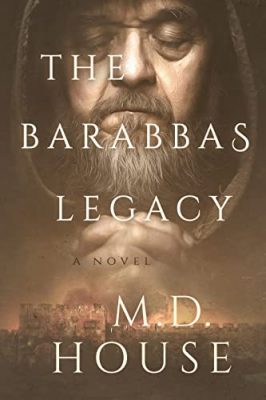
  • The BARABBAS LEGACY by M.D. House – Christian Historical Fiction, Historical Fiction, Ancient World Historical Fiction

    The Roman Empire rules much of the world but faces unrest in its leadership and opposition from the growing movement of Christianity, in this conclusion to the Barabbas Trilogy, M.D. House’s historical fiction novel, The Barabbas Legacy.

    God has a plan for the Barabbas family, and their travels have only just begun. The tense conflict between Roman forces and the Jewish community in Jerusalem comes to a head. Leaders of Christianity rush to help their Jewish brothers and sisters.

    Cornelius, a once-celebrated centurion of the Roman army, stands on trial for believing in God over the Roman Empire. Emperor Nero shows uncharacteristic leniency and exiles Cornelius from the Empire. Cornelius flees before any senators have him assassinated. Once out of Rome’s reach, Cornelius feels called to help grow the Christian community.

    In the introduction to the novel, M.D. House recounts his writing journey.

    He explains how he came to write about a biblical figure we know very little about. Initially wanting to write science fiction and fantasy, House shifted to Historical Christian Fiction after reading a particular bible story. House wondered about the life of Barabbas. He imagined what had led the man to become a prisoner and how his life changed after being freed.

    Very little knowledge of Barabbas has survived, which opens the opportunity for House to create Barabbas, the character. House builds a whole life by using his few brief mentions in the gospels as a jumping point. He developed his protagonist so well that an entire trilogy was needed to tell the complete story.

    The Barabbas Legacy sees Barabbas as an older man with his children grown. Some start families of their own, while others help the evangelical efforts of Christianity in its infancy.

    M.D. House’s The Barabbas Legacy, as well as the first two books in the series, I Was Called Barabbas and Pillars of Barabbas, will appeal to readers of historical fiction and general readers of Christian fiction. The Barabbas Legacy could also be a good book for a Christian book club or Bible study. It features themes about the relationship between people of different faiths and the importance of bravery in one’s beliefs.

    The Barabbas Legacy concludes Barabbas’ tale that started with curiosity and grew into a complete series. M.D. House succeeds in telling the story of Barabbas, a rebel and murderer turned strong follower of Jesus.

    Chanticleer Book Reviews 4 star silver foil book sticker


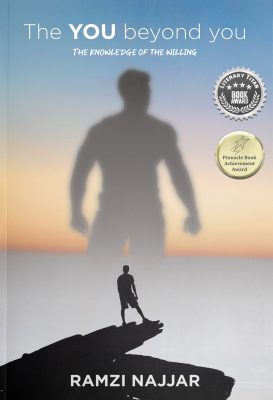
  • The YOU BEYOND YOU The Knowledge of the Willing by Ramzi Najjar – Personal Transformation, Motivational, Spiritual Growth Self-Help

    The YOU BEYOND YOU The Knowledge of the Willing by Ramzi Najjar – Personal Transformation, Motivational, Spiritual Growth Self-Help

    In The YOU beyond you – The knowledge of the willing, Ramzi Najjar addresses his audience with the contemplative calm of a mystic guru and the fervor of an old-time evangelist, in a how-to guide to good health, happiness, and inner peace as a personal philosophic treatise addressing the physical and spiritual quality of life in the 21st century.

    In the Preface, Najjar quickly captures readers’ attention with the question, “In a chaotic world, and a life of prevalent restlessness, how can we make sense of the non-sensical [sic]?”

    Who doesn’t relate to that?

    In seeking an answer to that question, rather than asking the who, what, when and whys of traditional philosophy, Najjar accepts that negative and “nonsensical” life conditions are a given and asks the question how.

    How can one change the negative impacts of these conditions upon one’s own being?

    Najjar contends, “… you become what you perceive … and what you permit to enter your body…,” and this is the underlying premise upon which the book is based.

    The author developed the rationale for his guide from personal experience, learning, observations, and understandings, along with widely accepted, common-sense information, uncited hypotheses, and research from various disciplines. In addition to ideas borrowed from areas of psychology, metaphysics, and epistemology, the author includes some concepts found in Eastern religions. The author weaves these bits and pieces together to create a new paradigm for 21st-century spiritual enlightenment.

    At 137 pages, The YOU beyond you is not a long book or a difficult read.

    Ramzi Najjar provides detailed explanations, relevant metaphors, and personal anecdotes to support his conclusions. Along with a preface, lengthy forward, and conclusion, he presents his ideas in six chapters: “Body Pollution; Mind Pollution; Restoring our body and mind; Getting imprinted with the correct memory; The Source and how to access it; and, Letting the right Memory run our life.”

    The first three chapters are relatively short and provide a fairly comprehensive review of the benefits of common-sense behaviors and choices, and of proven healthy practices that can pave the way to personal transformation. The latter chapters dip into metaphysics and spiritualism integrated with historical and current scientific thought regarding genetic memory found in contemporary neuroscience, energy medicine, and integrative physiology. If one follows the suggestions in Najjar’s latest guide, there is no doubt the outcome will lead to motivational and spiritual growth.

    The YOU beyond you may appeal to a varied audience. While at times verbose and loquacious, the intensity of Najjar’s arguments keeps the reader engaged. Many readers will relate to his friendly sometimes pedagogical, first-person voice and will find the book motivating and inspirational. All in all, The YOU beyond you is an interesting and provocative read.


    5 Star Best Book Chanticleer Reviews round silver sticker

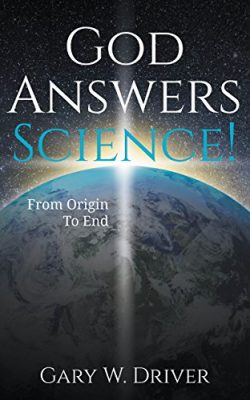
  • GOD ANSWERS SCIENCE! FROM ORIGIN to END by Pastor Gary W. Driver – Religion, Science, Inspirational

    GOD ANSWERS SCIENCE! FROM ORIGIN to END by Pastor Gary W. Driver – Religion, Science, Inspirational

    In this highly detailed and illustrated work, Pastor Gary W. Driver demonstrates a genuine zeal and unwavering respect for scientific knowledge, while holding to his conviction that, contrary to the opinion of many scientists, God cannot be left out of the picture when considering how the universe began, how it is sustained and how it might someday end.

    Driver quotes Einstein to support his ideas: “Science without religion is lame, religion without science is blind.” [Albert Einstein“Science, Philosophy and Religion: a Symposium”, 1941]

    Starting with the premise that the biblical account of creation needed science to develop to the point that it could be accurately understood, Driver cites the Big Bang Theory as supporting the story in Genesis that God simply created all that was, from nothing. To make everything from nothing requires a plan and a plan requires a planner. According to Driver, Edwin Hubble revealed the profound vastness of the universe and the inability for humankind to count the stars (both truths, the vastness of the universe and the number of stars, are stressed in the Christian Bible.) Similarly, he notes that the Bible describes space as a fabric. Scientists also use that metaphor to explain three-dimensional space.

    Driver suggests that the “days” of creation described in the Bible are symbolic and that any one of those days could have lasted eons. He goes into detail propounding his ideas of the geologic and anthropological happenings of each “day.” He does not shy away from tackling the concept of evolution, seeing earlier humanoid life forms as simpler versions of human beings. He posits that on the seventh day, God’s work was complete, and we continue to live in that day, experiencing the challenges of ecological change and the natural working of the law of entropy. He views God as the sustainer, who will in His own time see to the creation of a new heaven and earth, already part of the divine blueprint.

    Driver writes in a conversational yet thoughtful and organized manner, using charts, photos and numerous quotations from the Bible and the annals of science to support his theories. His arguments for God’s hand in creation bear weight because his research and studious attention to many arcane scientific facts go further than many standard treatments of this subject. He has labored diligently to confront and answer most of the arguments that scientists, naturalists or skeptics might produce.

    God Answers Science! is an engaging treatise on the role of religion in the cosmos; it has the potential to solidify the beliefs of the author’s religious cohort, while perhaps changing the views of those with a more secular mindset.