
Tag: psychotherapy

  • GESTALT as a WAY of LIFE: Awareness Practices as Taught by Gestalt Therapy Founders and Their Followers by Cyndy Sheldon – Gestalt, Self-Help, Psychotherapy, TA & NLP

    GESTALT as a WAY of LIFE: Awareness Practices as Taught by Gestalt Therapy Founders and Their Followers by Cyndy Sheldon – Gestalt, Self-Help, Psychotherapy, TA & NLP

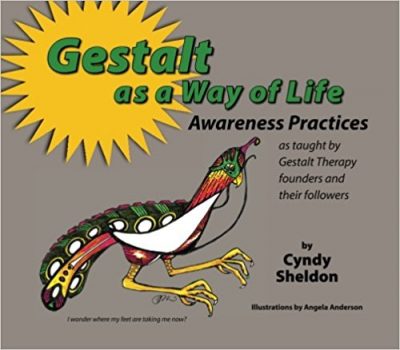
    Word of warning: I’m a bit of a self-help junkie, so Cyndy Sheldon’s Gestalt as a Way of Life is right up my alley. As one of the movement’s founders, Ms. Sheldon provides a valuable and instantly useable advice in this approachable introduction to Gestalt Therapy.

    The word Gestalt derives from the German word for “form.”  The group’s antecedents intended to create a holistic way of attending to human potential by, in Sheldon’s words, “… attending to the whole human being, including the physical, emotional, mental and intuitive or spiritual aspects.”

    The book came out of a series of seminars that the writer had been offering beginning in 2007 in the Pacific Northwest. It became clear to her that recording the information and making it available to a wider audience would allow not increase exposure to the ideas, but would allow people to refer back to sections of value as needed.

    Ms. Sheldon’s time spent among the Navajo Tribe, over ten years, clearly impacted the work. The overlap between Buddhist teachings, Navajo spiritualism, and Gestalt practices make an intriguing mix. The varying influences appear to really ground the suggested exercises or “experiments” as the author refers to them. Those experiments are intended to help the reader fully realize the benefits of the program as if one had attended the seminars as a participant. It’s in the experiments where the book shines, offering real-world practices the reader can revisit.

    The book is broken up into six sections with letter identifiers A through F: Awareness, Growing Up, Get Out of Your Head, Authenticity, The Magic and Sacred in Gestalt, and Final Thoughts. I found the section on Authenticity (D) particularly apropos. As the reigning Queen of Conflict Avoidance (Ask my friends! Okay you can ask absolutely anyone who has ever met me!), the exercises intended to assist with becoming more direct in interactions with other people target my style of using nearly any tactic to prevent trouble from brewing – even if it leaves me furious, frustrated, angry and resentful. The sample experiment below helped me recognize some of my favorite dodging language, used when trying to avoid hurt feelings at the cost of being clear:

    EXPERIMENTS (p. 83)

    1. Watch people in restaurants, in parks, wherever you can hear them, and listen for their qualifiers.
    2. Listen for your own. Exaggerate using qualifiers with good friends—see if they notice. Then experiment with not using them.
    3. What other ways do you use to be indirect? Exaggerate these, which will help you become more aware of doing this…
    4. Now be direct and clear without judging.

    That last instruction alone proved so valuable. Being clear without indulging in a knee-jerk urge to start a self-shame-athon (at my deplorable display of selfishness) helped increase my awareness of the automatic pilot way my mind works when trying to avoid hurting others’ feelings.

    Like most books of the genre, you benefit to the extent you are willing to engage in the suggested experiments. Gestalt as a Way of Life delivers on two levels: it provides a fine introduction to the Gestalt movement and a gentle method for applying it in your life.

    5 Stars! Best Book Chanticleer Book Reviews


  • PATHWAYS to HOPE by Harish Malhotra, M.D.

    PATHWAYS to HOPE by Harish Malhotra, M.D.

    Pathways to Hope is a wealth of practical advice and  positive messages presented in an easy to digest manner. It is a slightly more analytic approach to metaphor as a healing technique than Dr. Harish Malhotra’s earlier book, Metaphors of Healing. However, Pathways is still an accessible and powerful tool to help those with personal difficulties on a self-help basis, and yet comprehensive enough to be a guide to those professionals who want to add new methods and techniques to their patient communication skills.

    Dr. Malhotra proposes 23 essential pathways, all with playful titles, ranging from “Go on with Your Best Face,” “Leave Nothing Unturned” to “Change the Storm into a Breeze.” As the titles imply, the author employs ordinary experience to deal with extraordinary issues that afflict humans.  Again, Dr. Malhotra offers a simple, but brilliant, idea: Use the healing language of metaphor as a therapeutic strategy and a curative approach for daily life. What do these pathways of hope offer therapists and patients?

    He advises, that first, therapists should not depend on a single approach to solving problems, such as depending exclusively on standard psychotherapy or behavioral techniques. Dr. Malhotra believes in adjusting the style to fit the person, regardless of the type of therapy. For example:  If a patient has hallucinations that tell him to cut himself, his behavior is unlikely to change by telling him to look at the origins of the behavior.  He offers that instead of taking the “origin’s route” that the therapist shifting his patient’s attention to what voice the patient is actually listening to, and then guide the patient to determine  whether that voice is using  good judgment. This pathway may enable the patient to “deny the voice that is only loud thoughts” in his mind.

    Second, Dr. Malhotra advises us to highlight the positives—thought, word and deed—so that we may “put different highlights in our life book.”  How can one counsel a lonely patient, one who seeks but has no hope of meeting people?  The author shows that by connecting to the social media, hundreds of different opportunities present themselves. We strike up friendships through slight measures: small talk, shaking hands, smiling and just paying attention to a person.  A simple recipe: Grow a social network by taking small positive steps whenever and wherever you can.

    Whether you are a therapist, patient or truth seeker, what can be learned from this book?  We can summarize some major markers. Pathway l, “Go with Your Best Face,” emphasizes that we focus on our strengths, not our weaknesses. Pathway 8, “Search for the Silver Lining,” encourages the reader to pay attention to the joys of living rather than the fear of dying. Pathway 11, “Make Yourself a Happy Person,” clarifies that we all have choices, and that “happiness is an inside job.” One more illustration of metaphor, Pathway 12, “Leave Nothing Unturned,” focuses on good habits that inspire positive attitudes and healthy lifestyles—“neither of which require a copyright.”  Ordinary people can live extraordinary lives by considering new pathways, by hearing new stories, by learning by metaphor.

    Pathways of Hope and Metaphors of Healing are not theoretical psychotherapy books. As Dr. Malhotra makes clear, these are lighthearted stories to provide innovative insights and language to enhance our everyday lives. He seeks to empower readers with his decades of experience in helping people transform their lives and improve difficult situations in their daily lives.

    As with Metaphors of Healing, this is not a book to be read in one sitting or all at once. It is one that the reader will find herself/himself picking up again and again taking in a chapter or a metaphor to ponder and, perhaps, adapt. It will become a gentle companion that guides and inspires. One will find, on reflection and on rereading, that these simple stories contain deep insight and wisdom. Clinicians and those seeking to increase their understanding of themselves and their fellow humans would benefit immensely from reading Dr. Malhotra’s gentle, healing stories.

  • Metaphors of Healing by Dr. Harish Malhotra

    Metaphors of Healing by Dr. Harish Malhotra

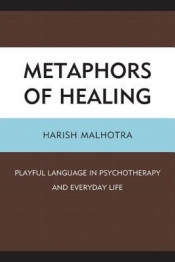
    One rarely sees a self-help book from a practicing psychotherapist that offers more humor and appeal to the common denominator in all of us than this collection of brief stories: Metaphors of Healing : Playful Language in Psychotherapy and Everyday Life. Dr. Malhotra offers a simple, but brilliant, idea: Use the healing language of metaphor as a therapeutic strategy and a curative approach for daily life.

    Metaphors of Healing organizes metaphors by themes, including “The Daily Grind,” “Dating,” “Being a Better and Happier You,” and “Addiction,” among the 14 chapter titles. For instance, try reading “Is the Left Lane Too Fast?” as a metaphor for slowing down, easing the professional load, and getting reacquainted with our family. Its appeal is in the simplicity of applying the idea toward easing anxiety and cutting back on the “daily grind” most of us know too well. In addition, we gain a visceral sense of how the self-imposed pressure to succeed contributes to everyday unease and unnecessary fears.

    Another feature of Metaphors is how easily one remembers a story, but forgets most of the high-minded advice of a therapist. If the story fits (and most of these have the superb quality of fitting very well) a client can leave his therapy session with an entirely new way of dealing with his or her issue. For instance, he says, “A dead-end road is not the same as a dead end journey.” We can always find another route more effective than the lost cause we thought was our destiny.

    Malhotra’s training in both psychotherapy and behavioral approaches offered flexibility for initially coping with his patients’ various maladies. Shifting to metaphor when confronting dis-ease, he discovered, incorporated an even broader spectrum: healing words from unexpected sources. Who knew a figure of speech could have such transformative powers?

    Malhotra aims to move people beyond their negativity, beyond their holding on to old problems, and even beyond their expectations to achieve a lifestyle free of judgment and criticism. I found his ideas on marriage as mindfulness exercises very significant—he speaks of empathy as the path to marital happiness: “Walking in the moccasins of one’s spouse” contributes to compassion and forgiveness, opening the door to an enduring love.

    The author is not a Pollyanna, an everything-is-beautiful-if only-you employ-a-metaphor to your life issues. Change requires commitment and persistence. We all seek successful relationships, whether we are talking about a difficult boss, an annoying neighbor next-door or our beloved spouse. Malhotra stresses how precious any relationship can be when it is working, even when it is very challenging. The healing power of any relationship blooms only under certain conditions, however: practicing the difficult virtues of restraint and diligence.

    This is not a book to be read in one sitting or all at once. It is one that the reader will find herself/himself picking up again and again taking in a chapter or a metaphor to ponder and, perhaps, adapt. It will become, more or less, a gentle companion that guides and inspires. One will find, on reflection and on rereading, that these simple stories contain deep insight and wisdom. Clinicians and those seeking to increase their understanding of themselves and their fellow humans would benefit immensely from reading Metaphors of Healing.