Tag: Professional

  • Chanticleer’s Back to School Bundle! Don’t Miss Out on the Chance to Become a Member of The Roost!

    Back to School Sales?

    They’re not just for kids!

    A chalkboard with the words Join us on the Roost and Back to School Bundle

    We have an ever bigger one you can Roost with!

    As summer comes to a close, we’re excited to offer a bundle that includes a year’s worth of access to our online platform filled with goodies and discounts for authors: The Roost!

    A Rooster with the words The Roost at Chanticleer

    The Roost is our exclusive membership platform where we perch together to share knowledge and connect with our community of expert authors.

    Every year after Labor Day the publishing industry comes back to life, and we’re happy to crow with the dawn and welcome it back!

    The Roost is our Favorite Spot to Perch!

    Don’t Miss Out on These Upcoming Events:

    • Weekly Tuesday Morning Write-Ins with David Beaumier
    • Weekly Wednesday Evening Write-Ins with Phoebe Walker and Janet Oakley
    • Monthly Thriller Craft Discussions with Dena Weigel
    • Monthly Writing Craft Discussions with David Beaumier
    • Monthly Recorded Workshops
      • Upcoming is Kickstarting Your Book with Kiffer Brown and David Beaumier, 9/13 at 1pm PST
    • Virtual Happy Hour (9/16 at 5pm PST) with Kiffer Brown
    • We’re available for virtual Office Hours on the Roost!
    • Plus Perpetual Discounts and Early Bird Deals on our Annual Authors Conference, Editorial Reviews, and the CIBAs!

    The Roost is a space driven by community! We build and add to it based on what our members ask for and want. Join us, and help transform the space into whatever you want it to be!

    Roost sign-ups are typically available only in-person at Conferences or for our First Place Winners. We’ve worked hard to cultivate this community of professionals. And it’s open now to you, but only through September 15th!

    Sign up now for

    A Chanticleer Editorial Review ($495)

    Two entries to the Chanticleer Int’l Book Awards ($198)

    And a Full Year as Chanticleer Members on the Roost (priceless)

    All for $645

    What does that include?

    The Objective Editorial Review

    Every book that receives a Chanticleer Editorial Review written by one of our professional reviewers receives the following:

    • Published online on the Chanticleer Reviews website for easy linking
    • Each online published review comes with a built-in All IN One Search Engine Optimization package (AIOSEO) to maximize the review and the book title/author’s digital footprint.
      • AIOSEO interfaces with Google, Bing, Firefox, and Explorer search engines.
      • We carefully apply AIOSEO techniques to increase higher search rankings for each review.
      • AIOSEO allows for easier integration into Google Analytics.
    • Each posted review comes with SEO metadata to optimize Google searches and Amazon crawlers.
    • Digital links to Amazon, Independent Bookstores, and the Author or Publisher’s website.
    • Each review is posted to our social media for easy sharing and commenting by the author/publisher.
    • All our reviews are promoted and highlighted in our Newsletter.
    • We continue to periodically post the review to social media and in blogposts with links to the review on our website for long-term marketing and to refresh digital footprints.

    You do not have to use the Chanticleer Book Review package now. You can use it in the future when you are ready!

    The Coveted Chanticleer Int’l Book Awards (CIBAs)

    You know you want it.
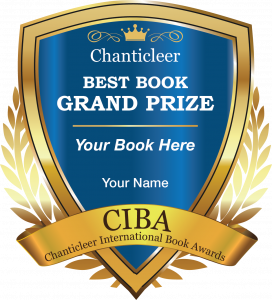
    A blank sample of the Chanticleer Overall Grand Prize Badge with the words "Your Book Here"

    The CIBAs run year round with promotions always popping up on our website to celebrate the incredible authors who advance. Starting at the Long List, we begin promoting work on our high-traffic website, on social media, and in our newsletter.

    From that point we add in digital badges, promotional stickers. By the time we reach the $1000 cash prize for the Overall Grand Prize Winner, we’ve given away over $30,000 worth of prizes!

    With all that plus our under the hood marketing technology, it’s no surprise that the CIBAs are the most popular of all our offerings at Chanticleer.
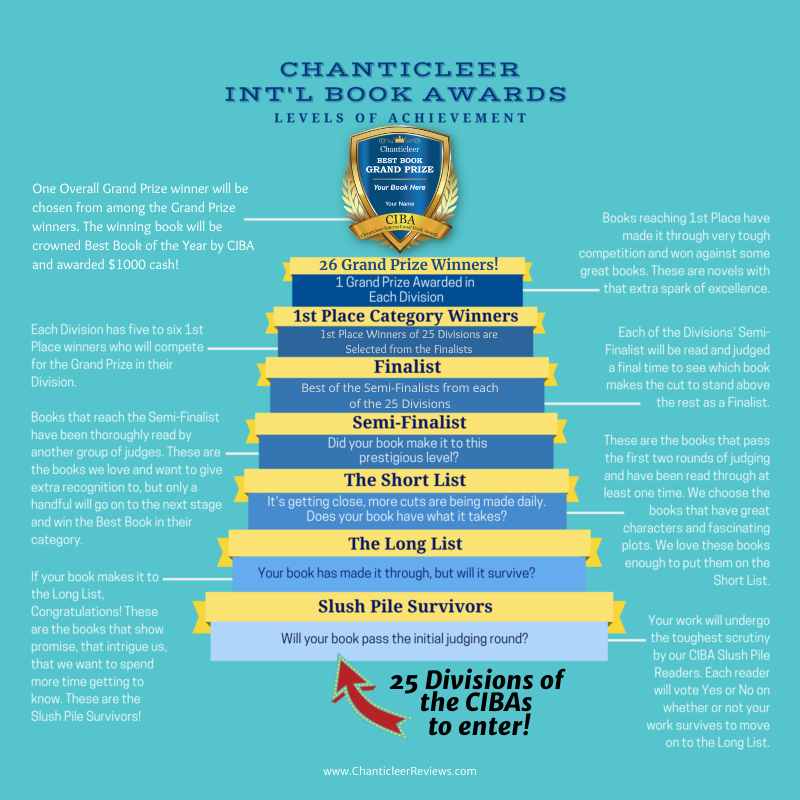
    The tiers of achievement for the CIBAs

    When You’re Ready, We’re Here

    Signing up for this bundle doesn’t mean you have to immediately submit your work to the CIBAs or for Review. We’re happy to hold your spot and check in with you on your terms, when your work is at its best. The same with the two CIBA entries!

    You might write your book alone, but authors live in community.

    Join The Roost today. We’re here, and we can’t wait to support you in your author’s journey and help your book be discovered!
    A Rooster in a laurel saying Welcome to the Chanticleer Authors Club

    Can’t do the bundle but still want to join?

    Reach out to AuthorOutreach@ChantiReviews.com for a discount code and sign up today!



  • The Art of Critique from the Desk of David Beaumier

    Understanding Peer Review and Feedback

    A Crucial Critique Skill for Authors

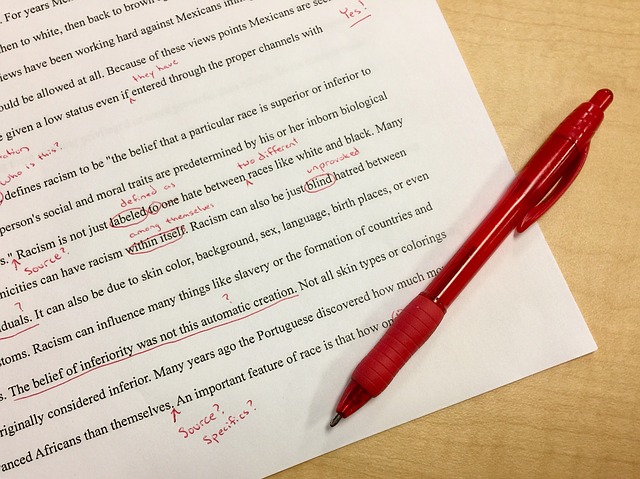
    Oftentimes when someone joins a critique group, it’s not because they’re in dire need of a free proofreader. They are looking to learn if their writing is any good, as Kiffer Brown says “Does it have a beat? Can you dance to it?”

    If you’d like to start your self-editing journey first, you can start here! Plus we have a secret solution to really get the feedback you need as an author! Read on to the end to learn what it is!

    While a work can be written in such a way that the errors make it unclear what the author wants to communicate. So, let’s get started.

    Ikebana is the Japanese art of arranging flowers. It can have more to do with writing than you would expect!

    What are the Guidelines for Critique?

    While every writing group will have extraordinarily varied suggestions for offering feedback, they often have a few golden rules:

    • Stay positive. We are critiquing, not criticizing.
    • Remember that suggestions should enhance the story through the author’s voice, rather than stating a variant of “this is how I would write it.”
    • We critique the work rather than the author. Look at what in the writing doesn’t work for you and address that.

    Let’s talk about each of those suggestions in greater detail.

    Staying Positive

    Not quite what we mean…

    No one wants to be in the group where people simply say “it was good, I liked it.” That’s not what we mean by positivity.

    The reason this rule is so common is that almost everyone who has ever submitted to a writing group has had at least one person thoroughly eviscerate a piece, calling it offensive, a waste of time, and of completely zero worth. This kind of feedback is about as helpful as “it was good I liked it,” because it doesn’t actually tell the author anything about the work.

    A sad looking Indian man in a blue shirt
    This guy isn’t getting actionable feedback!

    The best critiques often focus on direct observations or questions regarding the work. Pointing out contradictions and plot holes, or saying when a line rings true and why it rings true. For example, if your character is a member of the Canadian Royal Mounted Police, but doesn’t know how to ride a horse, there might be some questions as to why that is. Basics in Non-Violent Communication can really help get started in giving observational feedback (and hearing critique generally). You can read more about that here. For a less intensive and more focused look at just critique (as opposed to overall lifestyle), you can see this article by author and professor Brenda Miller here.

    In the end, the best critiques follow through and explain why the reader had the reaction to the text that they did.

    “Well, this is how I’d write it”

    Hopefully your critiques aren’t overwhelming the author

    Hopefully your critiques aren’t overwhelming the author

    Unless the reader is a co-author on the work in question, this statement is probably not geared toward helping the author’s voice come through.

    When writing my first book at around age ten, I tentatively showed it to my father. He added quite a bit to the first chapter, which focused on a tornado coming and whisking the main character away to a magical world where animals talked. Every place where he made a change stood out like someone had attempted to jam two different polaroids together with the hope no one would notice. –David

    Again, a focus on questions and observations can often help the author come up with the solution on their own.

    Friends, women, books, computer, smiling

    For example: “I noticed that there wasn’t a lot of setting description in this scene. Would there be a way to describe where the characters are having their conversation, both to add to the atmosphere of the story and to offer some beats that break up the dialogue?”

    This will let the author make the change instead of adding a new POV of the main character’s mother doing dishes and listening to smooth jazz in the background.

    We critique the Work, not the Author

    At this point, it seems clear that the focus is on the text. A character does things, and the author simply records them. However, while it’s always good to give the people critiquing work feedback, this is a crucial place to offer suggestions to the author.

    Remember that, as the author, people are not giving feedback as an attempt to sabotage the story or to make it worse. While all feedback isn’t useful, it is given with the intention of helping, and hearing it as something intended to help often makes listening to a critique easier.

    As such, here are a couple tips when receiving critique on your work.

    • Listen. Interrupting or arguing with the person giving you feedback means you have less time to receive a critique.
    • Remember that the work is yours. No one can force you to change your work, so there’s no need to quibble about what a reader sees as a must-have change that you won’t implement.
    • Ask questions. As you hear your critique, track places where you don’t understand where the reader is coming from or if you’re not sure you understand the motivation behind what they’re saying.
    • Say thank you. The best critiques are to improve your work, not review or judge it, and the reader’s work should be appreciated.

    Not sure how to get started on a group? Check out this article here to learn the ins and outs of forming a critique group!

    The Secret to get the Most out of your Critiques!

    The Secret to Successful Publishing

    Are you ready for this? The best thing you can do to guide the critique you receive is…

    Include specific questions and instructions for what you would like for your readers.

    The Number 1 request I get as an editor is to “Tear my work apart.” This guidance is about as helpful for an editor as “It was good” is helpful to a writer. – David

    By the time work is being submitted for critique, writers will hopefully have a good understanding of their own weaknesses. Setting, plot, and dialogue are common areas of focus. If you’re just getting started and not sure what to ask for, that’s alright! As you receive feedback, be sure to write down common feedback suggestions, like too many movie references that distract from the flow of the story, or not enough Star Trek references in your blogpost.

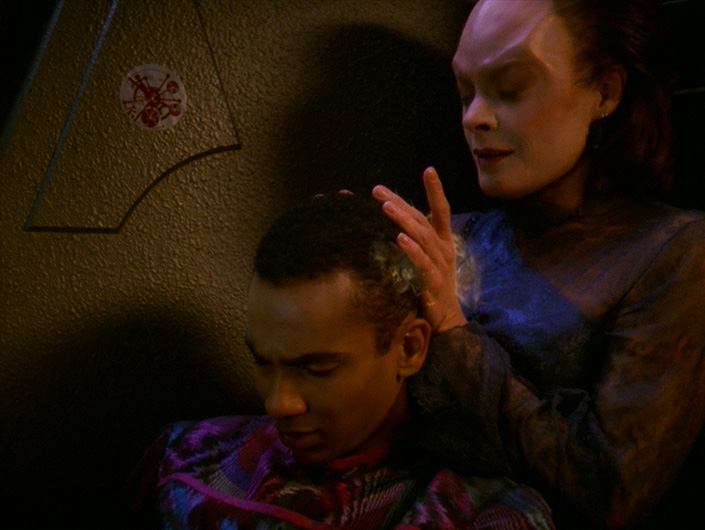
    We don’t recommend sacrificing all your creative energy at once to finish your work. Cirroc Lofton and Meg Foster as Jake Sisko and Onaya in the Deep Space 9 episode Muse

    Regardless of what your weaknesses might be, no editor is a mind reader. Many will be able to help, but the only way to guarantee you receive feedback on the craft elements you are most concerned for is to ask for it directly. Using a service like an MOV can be a great start to begin orienting your work to get the nitty gritty feedback of a Line Edit from a group before you commit to a professional Line Edit.

    Read Responsibly

    With that, you’re ready to go off and take a more active role in your writing community. We believe in you and know that you’ll do great!


    Thank you for joining us for this Writer Toolbox Article

    A red toolbox with the words "What's in your toolbox

    There is so much to learn and do with Chanticleer!

    From our Book Award Program that has Discovered the Best Books since the early 2010s to our Editorial Book Reviews recognizing and promoting indie and traditional authors, Chanticleer knows your books are worth the effort to market professionally!

    Helpful Toolbox Articles:

    When you’re ready,did you know that Chanticleer offers editorial services?We do and have been doing so since 2011.

    Our professional editors are top-notch and are experts in the Chicago Manual of Style. They have and are working for the top publishing houses (TOR, McMillian, Thomas Mercer, Penguin Random House, Simon Schuster, etc.).

    If you would like more information, we invite you to email us at info@ChantiReviews.com for more information, testimonials, and fees.

    We work with a small number of exclusive clients who want to collaborate with our team of top-editors on an on-going basis. Contact us today!

    Chanticleer Editorial Services also offers writing craft sessions and masterclasses. Sign up to find out where, when, and how sessions being held.

    A great way to get started is with our manuscript evaluation service, with more information available here.

    And we do editorial consultations for $75. Learn more here.