
Tag: Prairie Son

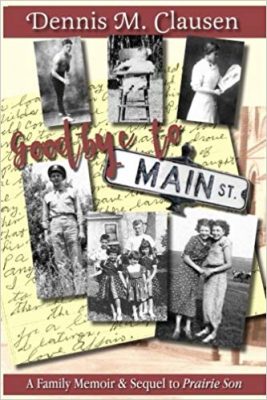
  • GOODBYE to MAIN STREET: A Family Memoir & Sequel to Prairie Son by Dennis Clausen – Memoir, Family Relationships / Saga, Multi-Generational Memoir

    Growing up in an estranged family atmosphere brings questions that beg for answers in this complex multigenerational memoir.

    Author Dennis M. Clausen recalls his early years growing up in the latter half of the last century with a detached, mostly absent father and a disabled, emotionally conflicted mother. In his tribute to small-town America, the author eloquently sketches the Minnesota village where he spent most of his youth, a place where the awnings on Main Street were opened and shut at the same time each day, and family secrets were hinted at but never discussed. Among the secrets was the enigma surrounding Clausen’s father, Lloyd, a wanderer who could never settle in one place, keep one job or stay with one woman for very long.

    There are many idyllic elements to Dennis’s upbringing. Though poor and often struggling for basic necessities, his mother and siblings got by, sometimes helped by the largesse of the community. On occasion, a visitor might sleep on the couch, and tuck nickels or dimes strategically into the sofa’s cushions, leaving Dennis and his brother, Derl, the means to go to the local movie theater. The boys also managed a paper route together.

    Reaching college age, there was no money, so Dennis stayed in his hometown at a newly created branch of the university. There he was fortunate to have as a mentor a legendary professor of American literature who recognized what the town’s librarian had noticed years before: that Dennis had great zeal for reading.

    As Clausen matured and closely observed the clan he was born into, certain flaws appeared in the pleasant but rather fuzzy picture that had been painted for him. He felt increasingly guided by hints – and finally by some handwritten memoirs from his father – to explore their shared past. In the years of Clausen’s youth, polio was a killer stalking the country and then was miraculously eliminated, but the psychological concept of “attachment disorder,” which undoubtedly afflicted Lloyd, was unheard of. In sifting through his father’s memorabilia, Clausen learned that Lloyd’s adoptive parents always regarded their charge more as free labor than loved one. In Prairie Son, Clausen has written vividly of Lloyd’s life as a mistreated orphan. The many remarkable results of that investigative work comprise the second portion of Goodbye to Main Street, complete with documentation and photographs in what can be seen as Clausen’s second vocation as the family detective.

    Clausen’s work has garnered a following among family both here and abroad who have contributed to his diligent search for his ancestry and among orphans and children of orphans who sense his empathy. There are many poignant moments in his coming-of-age account that will resonate with the experiences of an earlier generation of Americans. Perhaps this is the pull of Clausen’s memoir, the story of how one boy grew to manhood and overcame the odds, to become something other than what he was born into: from grinding poverty to successful academic.

    Now, after making numerous nostalgic visits to the old hometown and to various gravesites as part of his delving into family lore, he has come to see life as “a journey” and to respect its mysteries.

    Goodbye to Main Street won 1st Place in the CIBAs 2018 Journey Awards for Narrative Non-Fiction.

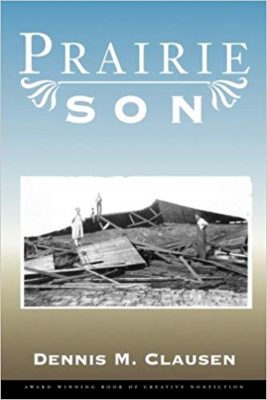
  • PRAIRIE SON by Dennis M. Clausen – Early 20th-Century Orphans, Family Drama, Biographies & Memoirs

    PRAIRIE SON by Dennis M. Clausen – Early 20th-Century Orphans, Family Drama, Biographies & Memoirs

    Lloyd Augustine Clausen has but one early memory of his real mother, in which she hugs him tightly displaying a deep love for him. Everything that follows is chaos and fear. He is handed over to an orphanage and by the time he is four or five years old, Lloyd knows two things: his adoptive Pa and Ma do not love him, and his role on the farm is to shut up and do as he is told. He takes Pa’s lunch pail out to him daily and tries to stay out of Ma’s way. For her part, Ma simply ignores him unless he does even the smallest thing wrong, inciting her evil temper.

    Had it not been for the daring protection of the farm’s two dogs, Buster and Minnie, Lloyd might well have been seriously injured or even killed by his adoptive mother. For example, one day he trips and falls down, breaking some eggs. Unconcerned whether or not he is hurt, Ma attacks him with a frying pan, only to be stopped by Buster. Another time, when Pa is in town playing cards, his Ma has a mysterious visitor come to the farm. When she locks Lloyd in the cellar, a place of total darkness, Buster finds a way to get his nose into the small space and offer comfort. Buster and Minnie, in fact, behave more like parents than the ones with whom he’s stuck.

    A friendly, mostly silent farmhand stays for a while and teaches Lloyd the art of machine repair and other skills needed to tend the farm, as Pa is increasingly lackluster in that regard. When the Great Depression hits, the family is often on the verge of starvation.

    Lloyd’s bright moments come when he spends time with a fellow orphan, Delores, condemned like him to be tricked, spat on and called “bastard” by the other, un-adopted children. A wandering cowboy once offers him a ride on his horse. Gypsies make him a fishing pole. And occasionally, neighbors, seeing the boy’s plight, step in to assure that Ma and Pa treat him better.

    Despite his terrible existence, Lloyd sometimes finds inspiration in the world of nature or the random kindness of others. As Lloyd grows older, he begins to research his past and through a series of serendipitous events, begins to find the answers he seeks.

    In 1979, author Dennis Clausen learned that his father Lloyd, who had been a distant but loving figure for him, was dying of cancer. He encouraged his father to write his memoir. The old man’s words, painfully written out on a few notepads, displayed a great talent for storytelling. Those words form the basis of this luminous coming-of-age saga of sorrow upon sorrow and the will of one little boy to keep looking for a better way.

    Bleak scenes of a weeks-long blizzard, a plague quarantine, and a tornado worthy of The Wizard of Oz provide lowering drama, as if the boy’s personal woes – being socked around by Ma, belted by Pa, and almost thrashed by school children until a local bully took his side – were not severe and frustrating enough. The direct effects of the Depression and then, rumors of World War II through the tinny voice of Roosevelt on the radio, fill out the historical picture. And, happily, the book’s ending is a kind of victory for the tough, lonely fighter.

    Clausen has skillfully woven his father’s handwritten pages into a riveting story worthy of Steinbeck, a cinematic setting redolent of fundamental American community values, and a paean of hope for all orphaned children.