Tag: Post 1750s Historical Fiction

  • The MUSE of FIRE by Carol M. Cram – Historical Fiction, Historical Romance, Theater Life

    The MUSE of FIRE by Carol M. Cram – Historical Fiction, Historical Romance, Theater Life

    Grace Johnson dreams of a life bigger than the one expected of a woman in the early nineteenth century. At twenty-two, she should be hoping for marriage and a home of her own. Instead, after a childhood spent privately acting for her mother, Grace secretly longs for a life in the spotlight, a place on a London stage, embracing the roles of Shakespeare’s greatest heroines. Alas, she fears her dream will never come true. Not only is Grace overly tall, clumsy, and what some would call plain, her father, a harsh man, blames her for her mother’s death. When his temper and drunkenness cause him to beat Grace, she finds herself alone on the dark streets of London’s theatre district, where a young man named Ned Plantagenet rescues her.

    Ned, a stage manager at the Theatre Royal in Covent Garden, gives Grace a place to stay, and as their friendship grows, he takes her to a play, a rare event for the woman who has only seen one other play years ago. When she fills in for an absent chorus girl one night, she knows this is where she belongs and defies her father by begging her estranged aunt for a place to stay. However, the more time spent with her newfound theatre family, the more Grace realizes her mother and aunt had a strange connection to the cast and crew. Questions emerge. In this world where women’s dreams have little agency, Grace must decide just how far she is willing to go to build a new life for herself.

    Perhaps the most striking trait of Grace Johnson is her willingness to accept the stigma associated with acting in the early 1800s. Though better than in centuries past, the theatre atmosphere was considered morally corrupt for women, even married ones. This world of impassioned men playing daring roles sure to seduce even the most hard-hearted of women often led to unwanted pregnancies and homeless girls, and Grace isn’t immune to the charms of one such rogue. Grace is well aware of what society might say about her, but that won’t stop her now. She makes her way on her own terms, doing what she must to continue acting even following her father’s disownment and her somewhat forced marriage. When her first acting performance flops, she licks her wounds then forges ahead.

    This optimistic-survivor attitude isn’t particular to Grace alone, though. Both Mr. John Kemble and Ned exhibit the same trait. Mr. Kemble, renowned actor and owner of the Theatre Royal, knows he must find a way forward when fire destroys his precious theatre. Kemble begs and borrows to finance a new building, one that’s larger than any other theatre in England and later stands firm against the raging crowds rioting in every theatre. Ned understands that ‘he can’t change what [he] can’t change’ and refuses to mourn his lowly birth in the Foundling Hospital. This broad-shouldered, gentle giant rose from an orphanage to become the right-hand man of Kemble, a staple in the wings of this successful company. He is like everyone’s big brother, protective and watchful, a “white knight,” showing his bravery during the OP Riots and his pure heart caring for Grace in her hour of need.

    This sprawling historical fiction takes the reader spinning through time with a cast of real-life stars of the London theatre in the early nineteenth century. The fictional characters interweave through the true story of two significant fires in the theatre district and the “Old Price” Riots, which disrupted theatre-goers and actors for months. Readers will see what life was like for the actors of the day as well as the average patron.

    The Muse of Fire won 1st Place in the CIBA 2018 GOETHE Awards for Late Historical Fiction.

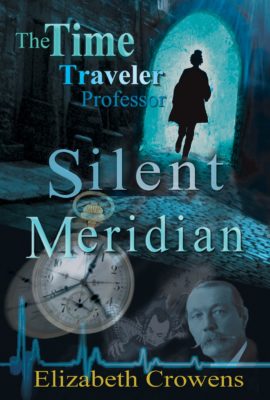
  • The TIME TRAVELER PROFESSOR, Book One: SILENT MERIDIAN by Elizabeth Crowens – Steampunk, Sherlockian, Time Travel

    The TIME TRAVELER PROFESSOR, Book One: SILENT MERIDIAN by Elizabeth Crowens – Steampunk, Sherlockian, Time Travel

    A budding concert pianist delves into the realms of spiritism, sexuality, and scary foreshadowing through his time travel adventures in Elizabeth Crowens’ steampunk novel, Silent Meridian.

    John Patrick Scott, a conservatory student, meets with Arthur Conan Doyle in Edinburgh, Scotland under unusual circumstances because of an elusive and mysterious red book. Arthur, lacking inspiration and tired of his Holmes character, covertly employs John as a ghostwriter. The two also indulge in the transmigration of souls and time travel. The latter topic is of high interest to the young aspiring musician since he has already accrued a handful of time-travel experiences via a mechanism of his creation. Although Arthur introduces John to nightly practices of communicating telepathically, John doesn’t include the beloved author in his time-traveling adventures until years later.

    John’s time-traveling skills sharpen to the point that he no longer needs his device and uses his grandfather’s timepiece instead. He becomes particularly fixed on exploring his past, especially his school days at the Underground University; he includes Wendell Mackenzie, his old schoolmate, on his adventures—some of which John escapes just in the nick of time. Over time, John finds it difficult to distinguish between time travel and dreams and seeks the help of Sigmund Freud and Carl Jung. His adventures take a dark turn when they predict an impending war.

    Sherlock Holmes’ enthusiast, Elizabeth Crowens, spins a wild tale riddled with glimpses of stories and themes from the early 20th century. Crowens’ quirky narrative, which covers sixteen years, could easily befit behind-the-scenes to John’s ghostwriting connections to Doyle’s published works: The Man with the Twisted Lip, The Adventure of Charles Augustus Milverton, and The Adventure of the Greek Interpreter, to name a few.

    Scenes regularly flip from John’s music studies and his time-travel quests, and are heavily punctuated with references to prominent historical figures and their thematic connections of the era, such as H.G. Wells, J.M. Barrie, Jules Verne (fantasy and sci-fi); Sigmund Freud, Carl Jung (psychology); and Aleister Crowley, Theodore Reuss (metaphysical). While sexual identity plays a close second to the last parenthesized theme scenes, providing only innuendos. John continuously processes his particular leanings, weighing his feelings as a woman in some of his time-travel ventures and amid affairs against Doyle’s and Wells’ free-love beliefs.

    Crowens balances nonfiction with fiction by incorporating memorable characters, such as Whit, John’s annoying tutor, and Finn (who John dubs Sherlock), John’s “Jiminy Cricket” guide who is only visible to John and comes and goes as he pleases. Sure to be a new favorite for Sherlock Holmes’ aficionados, Silent Meridian’s cliff-hanging closure is a perfect segue to the second book in Crowens’ The Time Traveler Professor series, A Pocketful of Lodestones.


  • The BOY WHO DANCED WITH RABBITS by J. R. Collins – U.S. Historical Fiction, Romantic Action/Adventure, Family Saga

    The BOY WHO DANCED WITH RABBITS by J. R. Collins – U.S. Historical Fiction, Romantic Action/Adventure, Family Saga

    J.R. Collins has given a voice to an ancestor, Jeb Collins, who was almost killed at birth – twice. His survival is significant for that, but also for the fact that in another part of the Georgia mountains, a Cherokee boy, Wolf, is born on the same night. The families of the two boys will meet and mix in the early days of American settlement when everyone had to struggle for survival, and such friendships were still possible.

    Jeb learns smatterings of Cherokee language, and Wolf and his kin pick up English with a sharp mountain twang from their settler neighbors. Together Jeb and Wolf explore the mystical, mountainous part of Appalachia named Cho-E-Sto-E for the prevalence of rabbits there.

    Both of the boys’ fathers remember and despise the British who killed the American rebels and betrayed the Indians who agreed to help them; and both hate all evil-doers, like the ones who kidnapped Jeb’s sister or the sneak-thieves who stole from Jeb’s family. But most of all, they will stand united against a nearby tribe that wants Wolf’s sister as a bride for their leader.

    The author grew up in the region he describes so vividly in this, his first novel, and has a sequel, the award-winning, Living Where the Rabbits Dance. The story, focusing on the boy’s view of a sometimes-dangerous world, is told in a satisfyingly recognizable dialect, using many endearing folk expressions – one of our favorites being, My heart melted like butter on a hot biscuit.

    This multilayered saga presages the time that will come when the Cherokees will be marched away on the Trail of Tears, and family connections like those depicted here will be destroyed in the name of Manifest Destiny. It is heartening to read about the few years enjoyed by such friends as Jeb and Wolf when they could roam the land together with the approval of their elders. There is a finely-honed homage paid to two religions, the Christianity of the Collins clan and the animist visionary beliefs of the Cherokees, each playing a role in Jeb’s perceptions of the world around him.

    From learning to fish to making bead bracelets from local gemstones, to seeing visions invoked by Cherokee spirits, here is a tale of a boy coming of age in a significant time and place. Collins’ book records that history, that atmosphere, with equal measures of zeal and reverence.

    The Boy Who Danced with Rabbits by J. R. Collins won First Place in the 2017 CIBAs for the Goethe Awards, Western Fiction.