
Tag: Positive Thinking

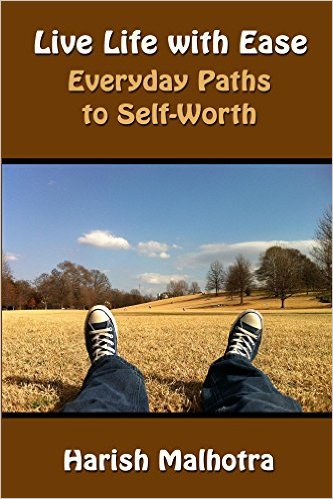
  • LIVE LIFE WITH EASE by Dr. Harish Malhotra, a practical self-help guide on self-healing

    LIVE LIFE WITH EASE by Dr. Harish Malhotra, a practical self-help guide on self-healing

    Readers of Dr. Harish Malhotra’s two previous books (Metaphors of Healing: Playful Language in Psychotherapy and Everyday Life and Pathways to Hope: Innovative Insights for Therapists and Patients) are in for a treat as his third title continues us on the healing path paved with entertaining metaphors. New readers too will enjoy holding Dr. Malhotra’s hand through life’s ups and downs as he takes us on a journey with 55 stories in Live Life with Ease: Everyday Paths to Self-Worth, each tale replete with his amusing touch.

    In chapters like, “Settle Into Your Ideal Lifestyle,” “Pain, Pain, Go Away,” “Overthrowing Fear,” and “The Weight of Eating,” Dr. Malhotra tackles universal themes in a lighthearted, yet practical way. By weaving these humorous metaphors, he blesses us with the way he sees life as we confront fear, worry, addiction, lack of self-worth, sleeplessness, and unhealthy eating.

    Take for example, the chapter “Infatuation,” where Dr. Malhotra advises us to employ the “Sleep on it/24-hour rule.” He compares decision-making to buying a new house – one that seems to boast a gorgeous skyline but is located on a dangerous street. “Let your excitement simmer down before making decisions. Reason may replace infatuation,” he counsels.

    In one of the more playful stories, Dr. Malhotra poses to the reader: “Are you like a fart or a flower?” Despite the silliness, he raises a sincere dilemma: why would we surround ourselves with people who are “toxic” and “seething with resentment,”  rather than those who are “fragrant” with a “pleasant demeanor and gracious words.” Point well taken, Dr. Malhotra, with a nod to our olfactory.

    We have to assume that Dr. Malhotra, a board certified psychiatrist in private practice in Summit, NJ, pulls from his more than 40 years in a white lab coat as many of the sketches include (imaginary?) dialogue between doctor and patient. “Don’t fight the smoke with a sword of worry,” he says to a patient who is anxious about the future.

    Throughout the book’s 304 pages (or 364 pages via e-reader), we feel like he is our own personal guru and we are a better person for it.

    In one of my favorites, “Dating, Inc.” he likens relationships to “Hair Softener or Chewing Gum.” Holding on too tight is like getting chewing gum balled up in your partner’s hair,” he says. “Some hair has to be cut off to get rid of the gum… Some problems in relationships stem from too much contact.”

    Perhaps the book, which makes a delightful gift for a college graduate or a loved one needing inspiration, can best be enjoyed as a bedside reader, referring nightly to the index to locate specific passages in times of stress: “Reframing Problems,” “Risk Taking,” “Welcoming Attitude,” and “Unlearning Habits.”

    For further inspiration, you can see Dr. Malhotra on his YouTube channel, “Helpful Hints for Hangups,” where he acts out the rousing metaphors with members of his family.
  • PATHWAYS to HOPE by Harish Malhotra, M.D.

    PATHWAYS to HOPE by Harish Malhotra, M.D.

    Pathways to Hope is a wealth of practical advice and  positive messages presented in an easy to digest manner. It is a slightly more analytic approach to metaphor as a healing technique than Dr. Harish Malhotra’s earlier book, Metaphors of Healing. However, Pathways is still an accessible and powerful tool to help those with personal difficulties on a self-help basis, and yet comprehensive enough to be a guide to those professionals who want to add new methods and techniques to their patient communication skills.

    Dr. Malhotra proposes 23 essential pathways, all with playful titles, ranging from “Go on with Your Best Face,” “Leave Nothing Unturned” to “Change the Storm into a Breeze.” As the titles imply, the author employs ordinary experience to deal with extraordinary issues that afflict humans.  Again, Dr. Malhotra offers a simple, but brilliant, idea: Use the healing language of metaphor as a therapeutic strategy and a curative approach for daily life. What do these pathways of hope offer therapists and patients?

    He advises, that first, therapists should not depend on a single approach to solving problems, such as depending exclusively on standard psychotherapy or behavioral techniques. Dr. Malhotra believes in adjusting the style to fit the person, regardless of the type of therapy. For example:  If a patient has hallucinations that tell him to cut himself, his behavior is unlikely to change by telling him to look at the origins of the behavior.  He offers that instead of taking the “origin’s route” that the therapist shifting his patient’s attention to what voice the patient is actually listening to, and then guide the patient to determine  whether that voice is using  good judgment. This pathway may enable the patient to “deny the voice that is only loud thoughts” in his mind.

    Second, Dr. Malhotra advises us to highlight the positives—thought, word and deed—so that we may “put different highlights in our life book.”  How can one counsel a lonely patient, one who seeks but has no hope of meeting people?  The author shows that by connecting to the social media, hundreds of different opportunities present themselves. We strike up friendships through slight measures: small talk, shaking hands, smiling and just paying attention to a person.  A simple recipe: Grow a social network by taking small positive steps whenever and wherever you can.

    Whether you are a therapist, patient or truth seeker, what can be learned from this book?  We can summarize some major markers. Pathway l, “Go with Your Best Face,” emphasizes that we focus on our strengths, not our weaknesses. Pathway 8, “Search for the Silver Lining,” encourages the reader to pay attention to the joys of living rather than the fear of dying. Pathway 11, “Make Yourself a Happy Person,” clarifies that we all have choices, and that “happiness is an inside job.” One more illustration of metaphor, Pathway 12, “Leave Nothing Unturned,” focuses on good habits that inspire positive attitudes and healthy lifestyles—“neither of which require a copyright.”  Ordinary people can live extraordinary lives by considering new pathways, by hearing new stories, by learning by metaphor.

    Pathways of Hope and Metaphors of Healing are not theoretical psychotherapy books. As Dr. Malhotra makes clear, these are lighthearted stories to provide innovative insights and language to enhance our everyday lives. He seeks to empower readers with his decades of experience in helping people transform their lives and improve difficult situations in their daily lives.

    As with Metaphors of Healing, this is not a book to be read in one sitting or all at once. It is one that the reader will find herself/himself picking up again and again taking in a chapter or a metaphor to ponder and, perhaps, adapt. It will become a gentle companion that guides and inspires. One will find, on reflection and on rereading, that these simple stories contain deep insight and wisdom. Clinicians and those seeking to increase their understanding of themselves and their fellow humans would benefit immensely from reading Dr. Malhotra’s gentle, healing stories.