Tag: Poetry

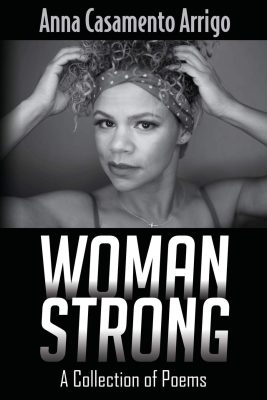
  • WOMAN STRONG by Anna Casamento Arrigo – Poetry, Family & Relationships, Political Strife


      Anna Casamento Arrigo’s Woman Strong showcases themes of love, heartbreak, death, disease, and political strife.

      In the newly-released audio version, Casamento, with the help of her narrator Valentina Latyna, captures the essence of life and living. Latyna brings these poems to warm, sensuous life. Her accent, at once elegant and romantic, lifts the poems off the page and gives them voice.

      The pearls strung into Woman Strong’s beautiful strand of poetry will stun and amaze readers. Many of them speak to the strength of women, as can be expected from the title, but many others talk about the fragile nature of life, of love, and of time.

      Each poem explores a theme, some overlapping, and all of them provide the hope that we are strong enough to survive anything.

      Casamento’s reminiscences of childhood show a creative mind already at work bending metaphors and figures of speech as she scrapes a knee or witnesses a transgression.

      One poem stands out in particular, the three-part “Just Ice.” In part I, it discusses an old woman who is the butt of the neighborhood jokes because she doesn’t like dogs pooping in her yard. Casamento gives this invisible woman a voice and reveals her as human. As a young woman, she brought conversation and blueberry muffins.

      The muffins appear again in Part II, where she talks to a veteran in the hospital, who is “between knowing and accepting.” Vincent had fought in a war seeking justice but failed to find it. Instead, he lost his limbs, and now questions justice as he calls it “Just Ice.”

      In part III, she enters a church, hoping to find justice when a woman who wears a smile “between knowing and accepting” joins her. “Just Ice” kept repeating in the silence.

      Casamento laments that humanity cannot exist in a world filled with just ice.

      In “Exorcizing the Monster,” she tells of a day she becomes faceless, and as she writes, she exorcizes the monster, Cancer.

      “Woman Strong,” explores hell and heaven separated by a fissure, where Casamento finds herself with an inescapable truth. She grows through the pain of her uncertainty, remembering her art and her passions, which become her solace.

      “Clothing Drive” is about mining for memories, and “Wanted Desire” takes us to the edge of sensuality through her masterfully descriptive language.

      Her title poem “Woman Strong,” as most of the poems in the collection are, is lyrical and powerful with images of strength as a mother, and the power as a lover to reveal the source of every woman’s strength: perseverance, patience, and love.

      Casamento’s thoughtful words come clearly through Latyna’s heart-felt and skilled readings.

      Take this collection of poems with you on your next long walk. You won’t be sorry.
       

      5 Stars! Best Book Chanticleer Book Reviews

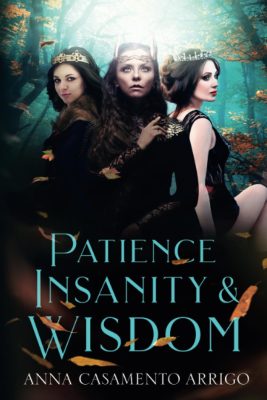
    • PATIENCE INSANITY And WISDOM by Anna Casamento Arrigo – Poetry, Family & Relationships, Mental Health

      Patience Insanity and Wisdom, Anna Casamento Arrigo’s poetry collection, dances seamlessly between reflective, philosophical, whimsical, colorful, and especially therapeutic.

      In her author bio, Arrigo shares that she turned to poetry as part of her recovery from a stroke. This gives a glimpse into the true depth of these poems, which offer healing to the reader as well. Arrigo deals with issues of love and loss, depression and survival, and life itself. Her poems carry the echo of her struggle, softly alluded to, but not blatantly laid bare.

      Arrigo’s poems take the reader through our shared human experiences. “I am enough” and “I am here” lay between “In Silence”. “Insanity” shares a painful childhood, “A constant stream of hateful words/slurred/rising from a golden whiskey tumbler.” “Wizard Wings” reflects on growing up, “From my toddler years/Through that period when neither girl nor woman be-.” “One soul” shares the joy and bittersweetness of the parent-child relationship, “it was not too long ago You held my hand/ Precious memories and hugs/One Soul We two/Divided in half.”

      “Just Another Birth Day” brings full circle the impact of the loss of one’s mother, “yesterday a mom celebrated her 68th birthday in heaven,” and yet, her continued presence in her children’s lives continues on, “Listen my dear children to the sound of the wind/ I’m there./Watch as dawn sips the darkness away./ I’m there/ Reach out and touch the roses-/comforted in essence of their being/ I’m there. I’m there/Speak my name/ Mom?/’I’m here’.”

      Patience Insanity and Wisdom does not shy away from the realities of grappling with life.

      “Depression” has this subtitle: “A dedication to the far too many who wear the mask. You are NOT alone,” empathizing with this common, yet hidden experience, “Waiting for those daily doses of ‘Happy Pills’/To bring my soul back to me-/For year/So many years…” and “Depression is not contagious-/Remove your mask!”

      “Hold On!” is a shout of encouragement, acknowledging the struggle for some with suicide awareness, “days when everything hurts -Wishing you would disappear…There will be day/ Of fighting back/Standing up/Holding on.”

      “Holding on Letting go” starts with the line, “It hadn’t been an easy death. But the will to die was less than my will…to survive […] Holding on/Letting go/A separation/Decisive/And in eternities bound…/Where my projected self-free falls/Letting go.”

      The poems share pages with Arrigo’s art, mostly impressionistic compositions with a wonderful mingling of bright and cool colors.

      To add to this experience, Arrigo partnered with musician Paul Simeone, setting some of these poems to music videos which can be found on YouTube and SoundCloud. Patience Insanity and Wisdom is like a dessert cart in a favorite restaurant, with poems that should be taken in small portions and savored to enjoy them fully.


      5 Star Best Book Chanticleer Reviews round silver sticker

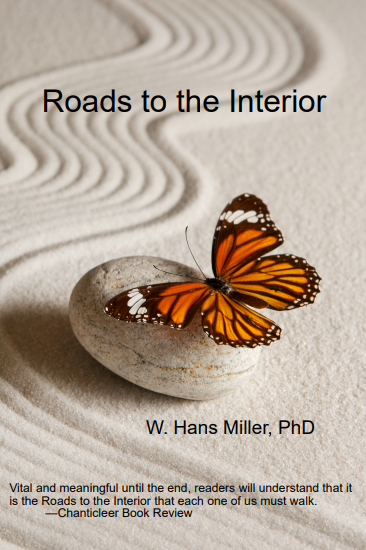
    • ROADS To The INTERIOR by W. Hans Miller – Poetry, Philosophical, Haiku


      Roads to the Interior by W. Hans Miller is a journey through the interior of the mind, seeking to find answers, peace, and insight.

      This book is inspired by, and dedicated to, the works of Matsuo Basho, the father of haiku and other spiritual writings. Haiku usually has a fixed pattern of three lines with a 5/7/5 syllable pattern – often referencing nature or reflecting on life – but the haikus within this book don’t always follow that tradition.  Rather, Roads to the Interior turns the haiku’s reflective questions on the mind itself.

      Each of this book’s three sections is filled with raw emotion, existential musings, and careful contemplation. Recurrent readings of this collection will allow readers to absorb yet more truths and insights.

      Different poems make reference to many thinkers, writers, and literary characters.

      “Part I – Wide Roads to the Interior”, considers struggle and longing. “Each Newborn Bubble” shares these truths: “Even Siddhartha had bad days.  A dear friend tells me to persevere: don’t search for spring’s source, care for each newborn bubble.” In “Penance” the speaker says, “I’ll speak no more of my predicament, always fearing my words will mean less than they say. I’m taller now but wiser when I was seven…”

      “Part II – Narrow Roads to the Interior”, reflects on the existential.

      Poems such as “Longing to Trust the World” and “Nothing is the Answer” pull readers into this shift. “Paradise Lost” is shaped much like a cocoon, taking the reader from dust to revelation and then dust again. These poems draw on other authors such as (T.S. Elliot and Walt Whitman, and even the protagonist of Albert Camus’ “The Stranger”, through such lines as, “Mersault found a truth. A truth that brought light falling upon that which already lit his gentle indifference to the world. His death testimony cause peace and calm to warp their arms around an unfinished circle on his brow.”

      The final section, “Your Brain’s Secret Interior Life: Seven Poems”, comes with an epilogue of the author’s journey through the complexity of the human mind. These last poems provide thoughtful considerations in the pursuit of understanding the Road to the Interior that each one of us must walk.


      5 Stars! Best Book Chanticleer Book Reviews

    • THIS TOO SHALL PASS by David Yuen – Poetry, Inspirational, Spirituality


      Poet and philosopher David Yuen shares observations on the human experience, showing how the gifts of life outweigh its pains, though not without a thought-invoking skirmish between the two.

      Covid-19 provoked Yuen to compose some poems fixed on the unique moments of the pandemic. One fascinating segment centers on a trip the author undertook to Ireland. It was a typical sort of tour, including a visit to the Blarney Castle, with the opportunity, which Yeun declined, to kiss the renowned Blarney Stone. Yet, he joined in the placing of stones, assisting a couple with one of the many stones they set around the world in memory of their departed son. Sharing in that small ritual was a high point of the journey, contrasting a low point as he scored positive on a Covid test and had to remain in Ireland for many days.

      Though at the time it seemed tedious, Yuen reminded himself of how often he wished for simple solitude in his busy life, and how fortunate he was to isolate in such desirable surroundings.

      Similar thoughts, rooted in a Christian perspective, occur to Yuen as he reads about the Russian attack on Ukraine, and the many implications of that war.

      In all situations, ranging from such issues as Roe vs. Wade, personal stresses like a horrific accident narrowly averted while driving to work, or a rather amusing argument with his morning coffee, Yuen maintains a positive stance. He believes that God wants humans to face tragedies, wars, and personal vulnerabilities with resolve, as Jesus invited us to count our blessings and feel secure that we are, in fact, “lavishly loved.”

      Yuen, a second-generation Chinese American, has developed the enviable ability to explore thorny issues and painful subject matter while maintaining an upbeat, spiritual viewpoint.

      His descriptions of his inner thought processes – energetic, entertaining, and credible – will remind readers of their own sometimes-conflicted ways of chewing on problems. Despite the inner turmoil, Yuen keeps a positive light at the end of even the darkest tunnels. His well-considered outlook, encapsulated in the title This Too Shall Pass, should be welcomed by anyone trying to approach time-worn trials or embrace the challenge of new ones.


      5 Stars! Best Book Chanticleer Book Reviews

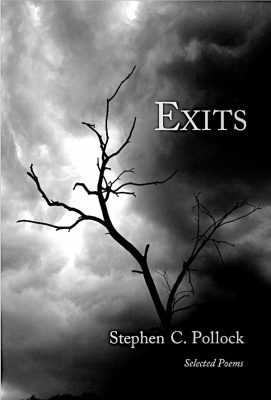
    • EXITS by Stephen C. Pollock – Poetry, Nature, Spirituality

      Exits by Stephen C. Pollock embodies the malleable nature of poetry, balancing the reflective, spiritual, personal, and primal. It changes from rhyme to free verse, even within one poem, and shares thoughtful observations.

      Some poems ask the reader to reflect on nature and human reactions to it. Arachnidæa: Line Drawings blends rhyme, stanza lengths, and free verse with the brutal truth of damaging trespasses that humans have taken into the natural world. Metamorphosis continues this theme as it shows the beautiful cycle of life from bloom to decay, and it challenges us to consider how our human intervention can render that cycle barren.

      “The butterfly bush on our berm… grew to resemble some great green sphere / whose blooms and perfume intoxicate the senses / of black-veined yellow swallowtails….But in May — Roaches! Panic! Pesticide spray / for the house…Now the butterflies are gone… It’s a shame to be sure, and surely no one’s to blame, / though our berm, and world, will never be quite the same.”

      Many of these poems reveal a darker side to nature, a struggle with health issues that can consume a person.

      Syringe references the chaste nymph Syrinx of Greek myth who was turned into hollow reeds, and the poem itself juxtaposes pastoral images of a serene pond and horsetails with the experience of living with multiple sclerosis, creating a powerful visual lyric.

      Spine of Dorian Gray alludes to the decaying of Dorian’s portrait in his attic, tied to the destruction of the speaker’s spine as the disease progresses. Nasal Biopsy compares the terrifying procedure that will reveal a possible cancer diagnosis with a spiritual experience of the sacrament and poses questions of faith in the face of nature.

      Exits offers a unique and thematically rich collection of poetry, and each reading reveals more insights for the reader to contemplate.

      5 Stars! Best Book Chanticleer Book Reviews

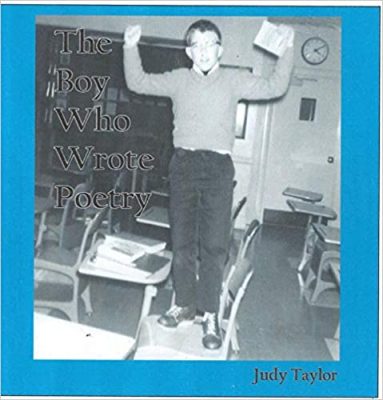
    • The BOY WHO WROTE POETRY by Judy Taylor – Poetry, Family Memoirs, Artist Biographies

      The Boy Who Wrote Poetry is a heartwarming and inspirational work about Mark Ford, a promising young poet and writer who died a tragic and premature death at the age of eighteen. This collection is the poetry he left behind.

      Judy Taylor, Mark’s sister and the author of the book, tells the story of her brother’s short life and their family, the circumstances in which he grew up, and how he began to express his creativity at a very young age. The examples of Mark’s poetry and general writings that the author presents are remarkable and moving. Considering the tender age at which Mark wrote the poetry, the sophistication and insight revealed in the work are astonishing.

      Despite the sometimes perplexing narration and lack of photograph captions, leading to confusion about who’s who in the images presented, the pictures of the family growing throughout the years give a touching clue to the close-knit family and the seven children, of whom Mark was the eldest and the author, his sister Judy, was the youngest. The photos, even without clarity on which child is which (the glasses at least make clear which is Mark Ford), make for warm reminiscences and give a clue to how the young poet lived and grew.

      What is of particular note is the degree to which the self-awareness is evident in Mark’s work. “Please excuse the misspelled words,” he requests in the introduction to a collection of his poetry. “It was meaning, not grammar I strove (and am still striving) for.”

      There are glimpses of what kind of storyteller that Mark would have developed into with offerings like “What do you use/To keep out the night? Try to conceal/Your delicate fright. Don’t call for help/For nothing is worse/Than wounded dignity/Innerness unhorsed.” A little trepidation, a little humor.

      Mark, according to the author, went through phases including fantasy (in particular The Lord of the Rings trilogy by J.R.R. Tolkien) and Bob Dylan’s work, and produced imagery that reflects the prose of the time:

      What changes in a day?
      What makes the sky so grey?
      What takes the wind and makes it so alone?
      What breaks the earth and scatters senseless stone?
      On the horizon, the bare brown
      Horizon, glowing with the last of life,
      Glowing with the last of life.
      What changes in a week?
      What makes it easier to speak
      The words I should have said but could not say
      And now that day has joined the past days
      Littered in a pile.
      A useless pile of days.
      A useless pile of days.
      A lightning tears the sky in two.
      Another moment it is through
      And sky is whole.
      Beating down your wincing brow
      The rains betray your wisdom now.
      Alone the storm.
      You, your trials, disappear
      For who will equal or compare
      Its tear-born ire?
      The weeping storm screams out aloud.
      Its tears are naked, bare and proud,
      Anew for each departed leaf.
      The sky lays down and cries its grief.

      Not only that, more than a bit of insight amid the darkness, in his final poem before his death:

      Guilt drops hawklike on suspecting man
      And plummets toward his silent, secret sin.
      The soul is pierced in vain; no talon can
      Remove the stain when it is held within.
      The grace of God, when sought, can dull
      The beak and claws of guilt. A man can pray
      And ease the burden in a heart too full
      To bear, although the pangs of failure stay;
      For God is God above us all and draws
      Us up to Him, but man is man and shall
      Persist in needing comrades in the pause
      Between the ultimate rise and the ultimate fall.
      God’s gifts uplift, but cannot be compared
      In saving strength to sadness equally shared.

      Mark Ford’s poetry and creative writing, the focus of the piece, were truly outstanding, and his early demise heartbreaking.


      5 Stars! Best Book Chanticleer Book Reviews

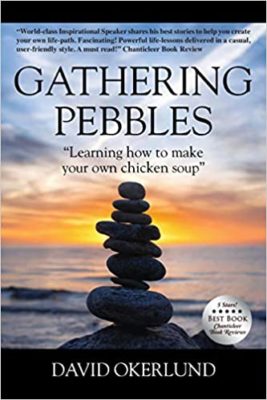
    • GATHERING PEBBLES: Learning How to Make Your Own Chicken Soup by David Okerlund – Memoir, Inspirational, Healthy Living

      GATHERING PEBBLES: Learning How to Make Your Own Chicken Soup by David Okerlund – Memoir, Inspirational, Healthy Living

      Inuit of the Canadian Arctic are known for creating stone structures used as navigational points and message centers for fellow travelers. Some of these directional monuments provide a spiritual connotation meant to enrich the journey.

      Gathering Pebbles is David Okerlund’s own “inukshuk” of sorts, a book filled with stories, recollections, and memorable life events that have become part of his personal road map for living. Okerlund, a world-class inspirational speaker, shares his best stories to help you create your own life-path. He shares this collection of nuggets in the interest of helping others along their chosen path and hoping to encourage their own “gathering” and sharing of valuable knowledge.

      Okerlund directs his writing in a casual, user-friendly style. Each of the book’s chapters is highlighted as a pebble gathered on his winding life’s path. Titles are effectively posed as questions to help draw readers into the topic at hand. Each chapter is formatted with a variable mixture of contemplative quotes, poetry, recaptured historical moments, and personal experiences, to showcase qualities such as perseverance, retaining a sense of childhood wonderment, the importance of faith, and following your dreams.

      Whether referencing the words of Pablo Picasso, Chuck Norris, Colin Powell, or Mario Andretti, Okerlund taps into thought from the world at large. From Presidents and self-help gurus to business moguls and religious leaders, the inclusion of such a broad range of sentiment represents a treasure trove of relatable wisdom. In a chapter on self-esteem and learning to be content with your present situation, even troubled starlet Marilyn Monroe’s ponderings ring true, “Wanting to be someone else is a waste of the person that you are.”

      In a similar light, included poems, primarily authored by Okerlund, often provide a whimsical complement to a chapter’s focus. Whether the narrative rhyming verse of “A Single Arrow” that emphasizes a need to stay on target to reach our goals, or the musings of “The Child Within” suggesting we retain the charms of our childlike curiosity and resilience. The messages are clear and heartfelt. “My Legacy” proves a down-to-earth embodiment of sincere gifts like smiles, laughter, dreams, and blessings.

      Okerlund weaves many of the classic and time-honored lessons amidst his storytelling.

      One narrative about efforts to avoid traffic pointedly entertains a “stop and smell the roses” philosophy. Additional directives to readers include being responsible for your actions, how to approach situations with a balanced head and heart when making decisions, and realizing that failure is often a prerequisite to success. The book has an interactive appeal with questions to ponder and simple exercises to help in assessing the likes of values, priorities, and needs vs. desires in our daily lives. A touching story about an unexpected friendship between a student with down-syndrome and a star athlete focuses on the importance of little things and how simple efforts can create positive change.

      While the core messages of this book may not be new, the shared information of Okerlund’s own deconstructed “inukshuk” proves an inspiring worthwhile effort to help others navigate life’s winding path. Such positivity is always a good thing.

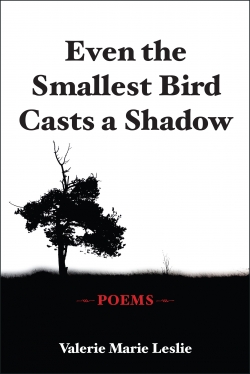
    • EVEN THE SMALLEST BIRD CASTS A SHADOW by Valerie Marie Leslie, a collection of youthful poetry

      EVEN THE SMALLEST BIRD CASTS A SHADOW by Valerie Marie Leslie, a collection of youthful poetry

      Spanning adolescence to the murky adulthood of the early thirties in each thematic chapter, Even the Smallest Bird Casts a Shadow also casts a light on the familiar struggles of maturity, romance, independence, doubt, depression, and further into the experiences of growing at the end of the last century. Altered little from their original creation, preserving the “dysfunctional integrity” of the youthful poems, Leslie varies the breathless experience with free form, rhyme, and lyrical verse.

      While plainly written for privacy and self-revelation, Leslie’s poems in nearly every form capture experience that might be known to any reader. Although each chapter covers roughly the decade and a half, there is a progression through the chapters that resembles the evolution of the narrative persona of Leslie. Back-to-school senses are evoked in the ramble of “During Science,” and there’s an affection to the poem “Hey Teacher,” which surely every high school writer has rendered some way. Heartbreak and romantic hope extend cover to cover but the early poems preserve the innocence of first attempts, culminating in the proud assurance of “The Ave Maria.”

      As the collection advances, the reoccurrence of life’s distresses, financial struggles, social pressures, miscommunication, failed expectations, and romantic disappointments, couple with resilience, ambition, and determination to reveal turmoil that’s as close as scented memory. The fallibility of human intention is confronted in Leslie’s poems at the same time as the loss of certainty in what she, we, seek from a life of surviving.

      The final chapters of supposedly reached adulthood still question the definition of that idea, and are laced with the aspirations and confusion of high school and college. The bitterness appears with simple sharp lines, “I didn’t get my degree for nothing,” and a young adult struggling to settle their purpose in life can find their frustration spoken from beginning to end in Leslie’s collection.

      Many of Leslie’s poems are untitled, and several throughout question, explore, or verify a sense of spirituality, connection, and security in God. These chapters plunge into the despair of doubt, guilt, and depression. In a life seeking love, Leslie expresses from an emotional pain felt in ages beyond the experience of her poems.
      Reading Leslie’s collection invited me to look back at memories and experiences of exactly the same time frame depicted, to question how I would define what I witnessed and learned then. The purpose of Even the Smallest Bird Casts a Shadow is to end a silence of self-doubt and shame, but it may easily motivate readers to delve into their past and youth for strength and inspiration.

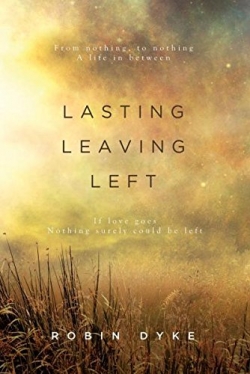
    • LASTING, LEAVING, LEFT by Robin Dyke, a poetry collection

      LASTING, LEAVING, LEFT by Robin Dyke, a poetry collection

      Every experience is a brush stroke on our life’s canvas. When our life ends, the artwork is completed; what will we leave behind for the world to see? Robin Dyke’s collection of poetry Lasting, Leaving, Left penetrates the deeper questions of what it means to live: Will I make a lasting impression on the world? How has the world made a lasting impression on me?

      Dyke’s works are the perfect balance of poetic eloquence with modern language. Lasting, Leaving, Left will engage and inspire poets and non-poets who seek to reflect and question their lives.

      Dyke’s book is organized into three sections: Lasting, Leaving, and Left. The first section, Lasting, groups together poetry focused on memories or concepts that have emotionally influenced each poem’s speaker. Such ideas ranged from recollections of a deceased grandfather, to the relationship between war and humanity.  

      The next section, Leaving, discusses the different stages people go through in their lives. One of the most unique poems I found in this section described a person playing a pinball game. The individual goes through several strategies to win the game, but once it is over, a new game begins. As time passes, we constantly leave one moment to enter another.

      The last section of the book, Left, introduces the notion of what people have left behind when they are gone. The final poems of this collection leave the reader to question him or herself about how they live their lives. With every poem, the speaker is thoughtful and gently pushes the reader to contemplate such profound questions.

      While the poetry incorporated numerous literary devices, the level of diction is perfect for readers who are not die-hard poetry lovers. Dyke’s poems are inviting to read, but they still leave the audience with wonder and opportunity to reflect upon their own life experiences.

      Nonetheless, poetry fanatics will appreciate the simple, yet thought-provoking ideas Dyke presents. Pretentious vocabulary would only overshadow the rich and naked moments of life that his poetry illustrates.

      Lasting, Leaving, Left allows individuals to find themselves reflected in poetry and use it as a lens to look into their own way of living. Readers can relate to the moments when they have endured losing a loved one, felt true love, or wondered where their life is going. Poetry is intended to connect us with the different facets of humanity. It is a vital form of expression that brings awareness to our intellectual and emotional selves.

      Dyke calls himself an “imagined dream caster” and that “poetry is a new expression of his work as a consultant and educator.” The final notes by Dyke point out that with the three Ls of this book, there is one final L to consider: Living. Through every leg of life’s journey, we need to embrace each moment to the fullest.

      Dyke’s poetry offered me a different perspective of living; life is a fluid cycle that is beautiful in the pain and pleasure it brings. Lasting, Leaving, Left is a poetically pristine read for individuals searching for another viewpoint on how they live their lives, with a dash of alliteration and rhyme.