Tag: Plotting Tips

  • Turning Points and Plot Points in Storytelling from Jessica Morrell’s Editor’s Desk – A Chanticleer Writers Toolbox post

    Turning Points and Plot Points in Storytelling from Jessica Morrell’s Editor’s Desk – A Chanticleer Writers Toolbox post

    Jessica Morrell, Top-tiered Developmental Editor Shares Her Thoughts on Turning Points and Plot Points in Storytelling

    Jessica Page Morrell
    Jessica Page Morrell, Top-Tiered Developmental Editor

    I want to talk about the thresholds and milestones that happen in storytelling, including films. These milestones are given different names by various experts. Most commonly they’re called turning points or plot points.

    Turning Point or Plot Point Development

    Crucial Scenes

    I was recently working on a client’s manuscript and an important scene was taking place in an early chapter creating the first major turning point. It features two main characters about to make love for the first time. It’s a crucial scene because everything in the story will change after this, the stakes will rise, serious repercussions will shape their futures. It’s an especially important scene because it’s the tale of forbidden love and once they’ve crossed this line they’ve admitted censure and danger into their lives. My job is to help the writer make the scene more momentous and intense, making sure the scenes contain enough emotional clout. Because these essential moments need to create major ramifications.

    Turning points are irrevocable changes staged as events or scenes, and are where the story shifts in a new direction. They’re also thresholds so characters pass through into a new situation. These moments, always shown via action, usually have an emotional change that comes with them. –Jessica Morrell

    Before this event, things might return back to normal; afterward, it’s a whole new game.

    One Way Gates

    As I’ve mentioned here before, effective fiction takes your main characters into new physical and emotional territory. Turning points are the thresholds to the other side. They signal the reader that danger and shifting tides lie ahead. I like to think of them as one way gates.

    The new territory can also be new spiritual territory, where principles, beliefs, and hearts are tested. Also, they are often tests and reveal what your protagonist is made of.

    And while turning points shift the direction of the story, keep in mind is that they’re also emotional turning points. I was thinking about them yesterday and how they snatch a protagonist from his or her comfort zone and thrust him or her into a threatening situation.

    Let’s look at The Hunger Games to help identify these crucial moments. It’s the first book in Suzanne Collins dystopian series that takes place in Panem, a country that’s formed after the collapse of North American governments.

    Inciting Incidents

    The inciting incident or catalyst happens on Reaping Day, an annual lottery where each of Panem’s 12 Districts must send two ‘tributes’ to participate in the state-sponsored, fight-to-the-death Hunger Games while the whole country watches the gruesome contest. Because the underlying brutality of the governing regime is an omnipresent threat. The winning district receives food. 
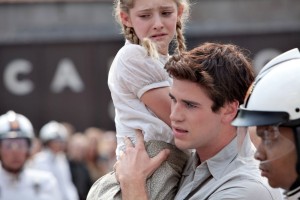
    Reaping Day in The Hunger Games – Gale and Prim (Katniss’ little sister).

    The story reprises the virgin sacrifices that existed in many cultures along with nods to mythical happenings. But then Collins has borrowed liberally from mythology and gory human history including a mashup of Dust Bowl imagery, a Nazi-like regime including the architecture, symbolism, and vicious stormtroopers, along with a hideous disparity between the classes.

    Complications

    At the Reaping, Katniss Everdeen volunteers to replace her 12-year-old sister Primrose in the deadly Games.

    Central Dramatic Question

    This creates the central dramatic question: Will Katniss survive? Then Peeta Mellark is chosen from District 12 too, and wouldn’t you know it, they have some history together because one of the rules of storytelling is Complicate, Complicate, Complicate.

    Katniss and Peeta leave home for the Capital (a threshold) and that’s when readers and movie-goers find out just how twisted and corrupt the Panem leadership is.

    Katniss and Peeta see just how wealthy the governing body is and how poor they are on the deluxe train ride.

    Plot Points Pushing Ahead the Plot’s Trajectory

    It turns out that Peeta is secretly in love with Katniss. Because Katniss needs to win to save her family, this is another complication in an already ghastly competition. Does she care about him too? Will she be forced to turn into a soulless killer to survive? The turning points that follow keep changing and pushing ahead the plot’s trajectory, but all affect her goal to survive.

    Katniss and Peeta decide to become allies and feign love in order to increase their chances of survival. Because the heartless denizens of the Capital love a love story in the midst of their killing field. Back in District 12 Katniss had learned to hunt to feed her family since her father had died in a mining accident. During the exhibition before the Games she gains notice for her archery skills.

    Atmosphere and Landscape

    Another turning point happens when the tributes enter the Arena – a nightmarish landscape where the rules keep changing, monsters and walls of flames appear out of nowhere. And can we just reiterate that these are children and teens operating in this whole blood-soaked nightmare?

    The children and teens from the 12 districts that must fight to the death until there is one survivor. Then, his or her district will receive food. The Hunger Games.

    Secondary Characters: Reflections of the Protagonist and Antagonist 

    The youngest tribute from District 11 is Rue and she represents innocence and all that’s wrong with the government and Games. Though agile and wily, she seems doomed or at least underestimated.

    Once the Games begin in the mad scramble to secure weapons and supplies Peeta and Katniss become separated.

    Katniss has been chased up a tree for safety and that’s when she hears a bird-like call. Rue is nearby in a tree. She warns Katniss of a nearby nest of deadly tracker-jackers (genetically-modified bee monsters). Katniss saws off the branch and the tracker jackers swarm on their adversaries. The girls become allies and readers, and viewers recognize that Rue is surrogate for her sister Prim.

    Rue warning Katniss about the deadly nest of robot yellowjackets.

    As allies they concoct a plan to destroy the Cornucopia, a huge stash of weapons and supplies.

    Reversals and Ramifications

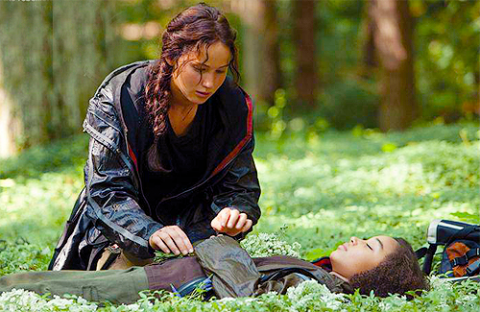
    Returning to Rue after Katniss succeeds, she witnesses her being murdered by another tribute. It is a major turning point in the story.

    The fallout cannot be overstated:

    • Katniss changes from a hunter to a killer, first taking out Rue’s murderer.
    • The story slows down briefly so Katniss can process her grief and feelings.
    • The slave-like conditions the citizens of Pandem live under is emphasized by Rue’s senseless death.
    • It reinforces Katniss’ desire to survive – she will win for Rue.
    • Katniss openly defies the Capital when she rings flowers around Rue’s corpse, showing her affection and respect.
    • Katniss uses her weapon for good when cutting flowers to honor Rue.

    The link to this emotional scene is here.

    Then with the Games’ cameras rolling, and honor and respect has been shown to Rue’s corpse, Katniss stands and salutes (as tribute) the other district’s people who are watching via he Games’ cameras, marking her defiance and the beginning of a rebellion. We’re talking major ramifications.

    Katniss’ symbol of defiance and respect is televised to all the districts in the Hunger Games. This simple gesture starts a movement.

    Later, Katniss’ compassion toward Rue saves her own life because Rue’s district sends her food – once again breaking the rules of the Games.

    Before: Rue and Katniss are allies and sisters in the struggle for survival.

    After:  Katniss would rather die than let the government regime win or steal her humanity.

    Question for Writers: What are the before and after statuses in your turning points for your work-in-progress?

    Another excellent example of plot points and turning points is The Toy Story series. It has terrific examples of thresholds that are easily identified because the characters often land in a new setting as they pass through each threshold.

    *Still photos copyright Lion’s Gate Entertainment

    Keep writing, keep dreaming, have heart. Jessica

    Jessica Morrell is a top-tier developmental editor and a contributor to Chanticleer Reviews Media and to the Writer’s Digest magazine. She teaches Master Writing Craft Classes at the Chanticleer Authors Conference that is held annually along with teaching at Chanticleer writing workshops that are held throughout the year. We suggest visiting her website for more articles on writing and the writing life. 


    When you’re ready, did you know that Chanticleer offers editorial services? We do and have been doing so since 2011.
    Our professional editors are top-notch and are experts in the Chicago Manual of Style. They have and are working for the top publishing houses (TOR, McMillian, Thomas Mercer, Penguin Random House, Simon Schuster, etc.).

    If you would like more information, we invite you to email Kiffer or Sharon at KBrown@ChantiReviews.com or SAnderson@ChantiReviews.com for more information, testimonials, and fees.

    We work with a small number of exclusive clients who want to collaborate with our team of top editors on an on-going basis. Contact us today!

    Chanticleer Editorial Services also offers writing craft sessions and masterclasses. Sign up to find out where, when, and how sessions being held.

    A great way to get started is with our manuscript evaluation service, with more information available here.

    And we do editorial consultations for $75. Learn more here.

    If you’re confident in your book, consider submitting it for a Editorial Book Review here or to one of our Chanticleer International Awards here.

    Our 10th Anniversary Chanticleer Authors Conference (CAC22) will be April 7-10, 2022, where our 2021 CIBA winners will be announced. Space is limited and seats are already filling up, so sign up today!  CAC22 and the CIBA Ceremonies will be hosted at the Hotel Bellwether in Beautiful Bellingham, Wash. Sign up and see the latest updates here!
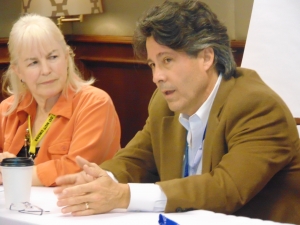
     

    Robert Dugoni
    Robert Dugoni is one of our most popular speakers at the Chanticleer Author Conference.

    Writer’s Toolbox

    Thank you for reading this Chanticleer Writer’s Toolbox article.

    Writers Toolbox Helpful Links: 

    At Its Core, the ‘Twilight’ Saga Is a Story About ________

    The INCITING INCIDENT: STORY, SETBACKS and SURPRISES for the PROTAGONIST
    BEATS & CONFLICT: The Engine for Your Book

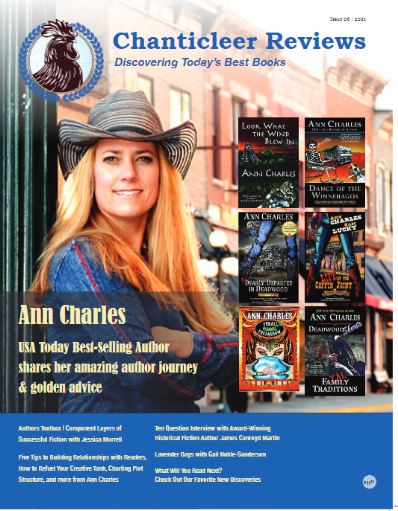
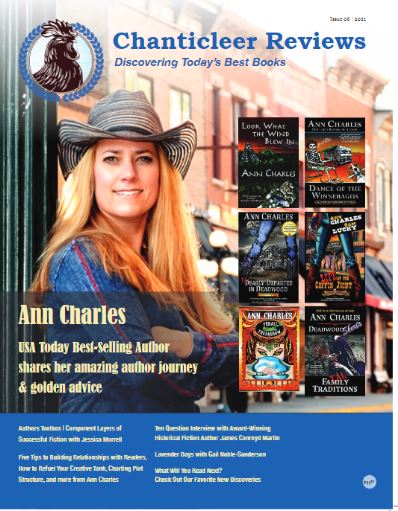
  • Chanticleer Magazine featuring USA Today Bestselling Author Ann Charles is Available in Print and E-Zine

    Chanticleer Magazine featuring USA Today Bestselling Author Ann Charles is Available in Print and E-Zine

    The latest issue features Ann Charles, USA Today Best-Selling Author.

    Ann shares her amazing author journey and her secrets to success! She has five, count them, five book series that are filled with mystery, humor, romance, supernatural, and the paranormal. Ann has also been awarded the CIBA Grand Prize for Paranormal Fiction.

            • Five Tips for Building Relationships with Readers
            • How to Refuel Your Creative Tank
            • Charting Plot Structure
            • Writing Life
            • Secrets for Writing Series

    All this and more in Sharon E. Anderson’s great interview with Ann!

    Order your print copy today!


    Download your e-pub copy today! Click here for a digital copy featuring Ann Charles. 

    Writing Craft with Jessica Morrell, Top-Tiered Editor and one of Chanticleer’s exceptional Master Writing Class instructors, expands on the components of successful fiction.

    Jessica Page Morrell
    Jessica Page Morrell

    James Conroyd Martin, Chanticleer Overall Grand Prize Winning Author known for bringing historical fiction to life, 10 Question Interview.

    James Conroyd Martin, Overall Chanticleer Grand Prize Winner!

    Sweet Lavender Days with Gail Noble-Sanderson with her delicious lavender shortbread cookie recipe. Gail is a multi-award-winning author who weaves an epic tale of romance set against World War I and II, full of warmth, family, and the hope that love can indeed conquer all.

    Award-Winning Author Gail Noble-Sanderson

    What Will You Read Next? Discovery New Reads from this issue’s Chanticleer reviews of these authors’ works from Non-Fiction to Fiction and even an anthology! More than 80 Chanticleer Reviews on the following authors’ works.

    Robert L. Slater, Ted Neill, G.R. Morris, Paul E. Vaughn, T. K. Riggins,  JW Zarek, Joy Ross Davis, Jeny Heckman, Richard J. OBrien, Chris Karlsen, Corey Lynn Fayman, Kevin G. Chapman, Pamela Beason, Norman M. Jacobs, M.D., Marilyn Larew, Michael Pronko, Michelle Cox, Wally Duff, Ann Charles, Karen Musser Nortman, Anna Castle, James Conroyd Martin, Bruce Gardner, Blaine Beveridge, Joe Vitovec,  Sandra Wagner-Wright, Andrea McKenzie Raine, Gerri Hilger, Michael L. Ross, Kari Bovee, David Fitz-Gerald, Sandra Rostirolla, L. A. Thompson, Susan Faw, Tiffany Brooks, Kay M. Bates, Robert D. Calkins, Aric Cushing, Sara Dahmen, Robert Scott Thayer, Simon Calcavecchia, L. E. Rico, Bronwen Evans, Elana Mikalsen, Claire Fullerton, Gene Helfman, Charlie Suisman, Lou Dischler, Eileen Charbonneau, Yorker Keith, Kris Kelso, Julie Jason, Lance Brewer, Franklin Ball, David Okerlund, Linda Jamsen, Cassandra Overby, Stevanne Auerbach, Bill W, Thomas Widman, Karen Keilt,  Jill Anderson, Dan Juday, Ilene Birkwood, Dr. Rhona Epstein, Ramzi Najjar, K,  Tanner T. Roberts, J. Nell Brown, Maya Castro, Janice S. Ellis, Ph.D, and The Red Wheelbarrow Writers.

    Where can you get you copies of the Chanticleer Reviews Magazine?

    You may order print and e-zine copies directly from us! Print copies receive complimentary shipping to anywhere in the United States.

    OR Purchase Print Copies from these Independent Booksellers:

    U.S.

    Village Books of Bellingham, Wash. They can mail magazines out anywhere and they keep copies of the latest issue of Chanticleer Reviews quarterly magazine in stock on their magazine racks.

    Canada & U.K.

    If you live in Canada or the United Kingdom, then order your print magazine from Dragon’s Lair: www.DragonsLairArtist.com or email Susan Faw at susan@dragonslairartist.com | We ship a stack to Dragon’s Lair in Ontario, Canada. Then, they can ship them much easier, faster, and for cheap to Canadian addresses. 

    E-zines!

    Order from Bookchain.ca

    Or download directly from us!

    Advertise?  Yes, please! Email DBeaumier@ChantiReviews.com  for more information.

    Chanticleer Reviews magazine will make a great showpiece for the coffee table, or to take to book signings, or to have in your writer’s den, or to take to other promotional events for your books, or with you to book club meetings, and just in time for the holidays! 


  • WILL YOUR STORY IDEA WORK? Questions to Ask Yourself – from the Editor’s Desk of Jessica Morrell – a Chanticleer Writers Toolbox article.

    WILL YOUR STORY IDEA WORK? Questions to Ask Yourself – from the Editor’s Desk of Jessica Morrell – a Chanticleer Writers Toolbox article.

    Story ideas often come to writers as a fleeting spark of an idea or feeling. Maybe it comes from meeting an interesting stranger. Maybe it comes from a childhood memory or looking back at a life-altering trip. Or perhaps you’re trying to rewrite a difficult situation you’ve always wished you’d handled better. Maybe you spot a person on the street who reminds you of someone from your past. Maybe that person broke your heart.  Or bullied you when you were a kid. Or she/he is the one who got away.

    Perhaps you have no idea where your story idea came from.

    Sometimes a story comes from asking what if. What if dad never left us? What if an adult with a family runs away from home?  What if I never met ___? What if a corpse is discovered missing its fingerprints?  What if someone refused to keep family secrets?

    All these ideas have potential….BUT ideas are the easy part of writing.

    A spark doesn’t always ignite into a flame. A spark doesn’t always equal a plot.

    So you need tools and criteria to judge your ideas. Visual artists have a great advantage over writers because an artist can place his painting in front of a mirror. The mirrored image will be so distinct that the artist will see it anew. Writers, alas, can’t use the mirror trick.

    Your friends or critique group can help you discern weak story concepts versus potent story concepts. But over time you’ll need to find ways to judge your own work.

    With that in mind, ask yourself these questions:

    • Does your idea foment or riot within you?
    • Do your main characters get your heart pumping?
    • Demand to be heard?  Demand to be shaped into a tale?
    • Can you ‘see’ the story in a series of vivid scenes?
    • Can you boil down the story into a few vivid sentences?
    • Can you ‘hear’ the main voice of the story already? Does the voice come naturally or easily as if from some untapped part of you?
    • Does a major twist come to mind?
    • Can you imagine the ending?
    • Can you plot the causality–as in one scene leads to the next, then leads to the next.

    Keep asking yourself questions about what comes next or the protagonist’s core traits or how you can complicate things. Perhaps a false accusation or betrayal might help shape the story. Perhaps a lie or secret lies at the heart of things. And what about the themes?

    • Can you offer fresh insights about human nature?
    • Create characters your reader has never met or imagined, but always wanted to?
    When we learn that Edward the vampire sparkles in the sunlight in “The Twilight Saga” — a new way of imaging vampires…

     If your characters don’t feel, neither will your readers because characters are revealed by their emotions.  And if emotions don’t lead to further actions, then part of fictional chain is missing.

    Character first. Plot is people. 

    (an encore, but worth repeating)

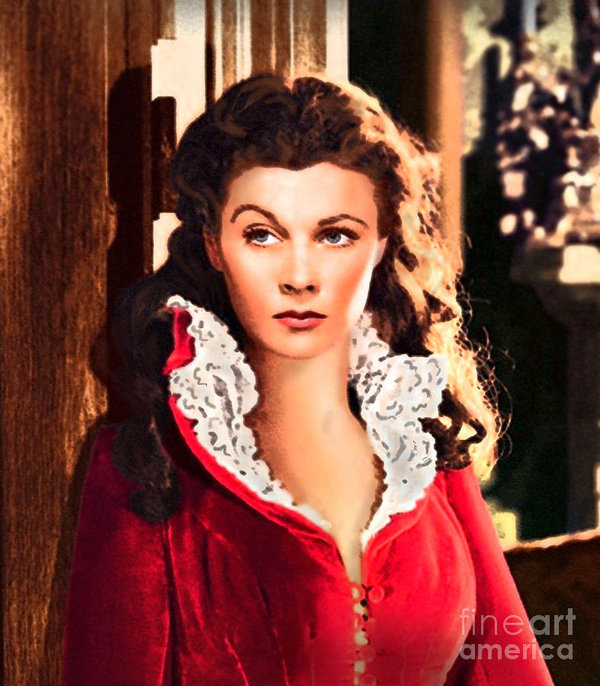
    It’s impossible to write about a main character you don’t care about. And you must care deeply. When I say care, you can actually pity the poor sod {Quoyle in The Shipping News}, or disagree with his morality as when you write an anti-hero like Scarlett O’Hara or Tyrion Lannister of the Game of Thrones series.  Or Lisbeth Salander in Girl  with the Dragon Tattoo. Or Katness Everdeen in the Hunger Games. Many readers find anti-heroes likable or relatable,  but so must the writer/creator. Because fiction writing requires a serious emotional and intimate involvement with the main characters.

    Fiction requires a serious emotional and intimate involvement with the main characters. – Jessica Morrell

    Katniss with her rallying three-fingered salute!

    Ideally you’ll find your protagonist fascinating, indelible, someone you can co-habitat with for at least a year—perhaps longer. Because between first drafts and final revisions it will take at least a year to finish your novel  Naturally this can work for short stories too, but the duration of the relationship  is often shorter.

    And if you are going to commit to a series well, you had better believe that you can go the distance.

    Your protagonists and antagonists should be fun to write or intriguing to the point of distraction.

    I’ve known writers who have fallen out of love with their characters and it ain’t pretty. Especially if they created a series character. Typically they discover their creation feels stale or predictable.

    Similar to a failing relationship in the real world. Like those glum couples you spot in restaurants not speaking to each other; sitting in slumped misery or apathy. I’ve been noticing these miserable pairings for years.

    There is nothing left to say or talk about…

    Of course, because  I’m a writer that makes me nosy and I am apt to spy on my fellow diners and eavesdrop—an occupational hazard so to speak.

    Back to you and your main characters. Think long haul. Lasting commitment, curiosity, or admiration. Think not being judge-y.

    Is your character your new love? Your best friend that you want to hang out with? The friend that always seems to get you in trouble but you don’t really mind?

    A few suggestions and/or gentle reminders for you:

    • Character first. Plot is people.
    • Create an intricate backstory that will cause motivations.
    • Give it time. It doesn’t need to be an instant attraction or intimacy, but your character should pique your curiosity.
    • Discover what in your character’s nature validates his/her humanity.
    • What about him or her is worthy of your reader’s time.  Some of the best protagonists are not immediately sympathetic or understandable. It can take readers time to understand them. But that’s okay. Because there will be tests along the way that reveal his/her true nature. An example is Strider in Lord of the Rings.
    Strider aka Ranger of the North aka Aragorn crowned King Elessar
    • Your protagonist needs traits you admire, even begrudgingly.
    • Figure in your protagonist’s chief vulnerabilities, then exploit them.
    • Understand how your character’s triggers, reactions or overreactions under duress.
    • Consider working out your demons through your protagonist and antagonist.
      • Is he or she insecure?
      • Will he feel misunderstood? (Professor Snipe in the Harry Potter series)
      • What about rewriting your awkward adolescent years through your character?

     If your characters don’t feel, neither will your readers because characters are revealed by their emotions.  And if emotions don’t lead to further actions, then part of fictional chain is missing.

    Your Homework

    Make a list of who are some of your most favorite and beloved characters and then try to assign traits to them that you find compelling. Conversely, who were their antagonists?

    Keep writing, keep dreaming, have heart. Jessica


    Chanticleer’s next Marketing blog post will address Hashtags and Social Media – Part 4 of How to Increase Online Book Sales.

    Our next Editorial blog post will address Opening Paragraphs and Beginnings.

    So please stay tuned…


    Jessica Page Morrell

    Jessica Page Morrell is a top-tier developmental editor for books and screenplays. Her articles have appeared in Writer’s Digest and The Writer magazines. She is known for explaining the hows and whys of what makes for excellent writing and for sharing very clear examples that examine the technical aspects of writing that emphases layering and subtext. Her books on writing craft are considered “a must have” for any serious writer’s toolkit.

    Jessica will teach the Master Craft Writing Classes at the Chanticleer Authors Conference on Thursday, Sept. 3, 2020  and will present sessions during the conference. She and Kiffer will also host a fun kaffeeklatch for Word Nerds at CAC20.


    Did you know that Chanticleer offers editorial services? We do and have been doing so since 2011.

    Our professional editors are top-notch and are experts in the Chicago Manual of Style. They have and are working for the top publishing houses (TOR, Macmillan, Thomas Mercer, Penguin Random House, etc.) and award-winning independent presses. If you would like more information, we invite you to email Kiffer or Sharon at KBrown@ChantiReviews.com or SAnderson@ChantiReviews.com.

    Click here to read more about our Editorial services: https://www.chantireviews.com/services/Editorial-Services-p85337185

    A great way to get started is with our manuscript evaluation service. Here are some handy links about this tried and true service:

    https://www.chantireviews.com/manuscript-reviews/

    We work with a small number of exclusive clients who want to collaborate with our team of top-editors on an on-going basis. Contact us today!

    Writer’s Toolbox


    Thank you for reading this Chanticleer Writer’s Toolbox article. 

    We encourage you to stay in contact with each other and with us  during this stint of practicing physical distancing to prevent the spread of COVID-19.

    Let us know how you are doing, what is going on where you live, how are you progressing on your writing projects.

    I invite each of you to join us at The Roost – a private online Chanticleer Community for writers and authors and publishing professionals. You are welcome to email me for more info also.

    We are active on Facebook, Twitter, and Instagram. You can find us by using our social media handle @ChantiReviews

    Minimize physical contact! Maximize social connecting!

    Be well. Stay safe. 

  • HOW to DEEPEN PLOTS from the Editor’s Desk of Jessica Morrell – A Chanticleer Writers Toolbox article

    HOW to DEEPEN PLOTS from the Editor’s Desk of Jessica Morrell – A Chanticleer Writers Toolbox article

    Fiction is about the cost of things.

    The plot should always somehow scar or wound the protagonist and put something valuable at risk.

    Protagonists suffer. Period. Paying heavy costs make characters relatable. I swear by these statements. Jessica Morrell

    Making protagonists suffer in storytelling creates stakes, motivation, and tension.

    Jon Snow – Game of Thrones

    Remember that fictional characters must take more risks than ordinary humans. But as in real life, not all risks pay off, but the cost should always be much higher in fiction.  Along the way friendships, allies, freedom or safety might be lost. Such is the cost of fiction.

    Even in comedies and cozy mysteries…

    How much will the protagonist suffer?  Sacrifice? Regret?

    Before I go further, it’s important to point out this doesn’t mean your protagonist will always be a martyr or your story ends in tragedy. But everything can be on the line in the fictional universe: friendships and allies, family, love, prestige, honor, trust, hope, money. Betrayals might happen. Long-held secrets revealed.  Obviously these possibilities create emotional distress.

    The Harry Potter novel series is a prime example of making your protagonist suffer from getting used mixed match socks for his birthday to betrayals to long-held secrets revealed.

    Just How Much Trouble Can this Kid Get Into?

    Not to mention to physical costs like  pain, injuries, and body parts. Think Katness fighting for her life in The Hunger Games and going deaf in one ear. Then she’s forced to fight for Peeta’s life because he’s been badly injured. (In the book, not the film series, he loses a leg)

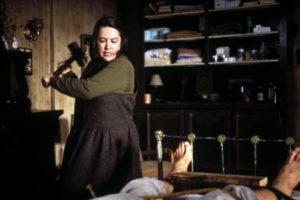
    Speaking of body parts: remember the suffering doled out by psychotic fan Annie Wilkes in Misery by Stephen King?

    Gulp.

    Misery by Stephen KingBecause bad things happen to our favorite characters. Really bad things. Your character’s suffering will always reveal his or her depths and strengths. Suffering always advances the plot. If it doesn’t, leave it out of your story.  Allow me to say it slightly different: any suffering, sacrifice, regret, betrayal, pain, or loss must advance the plot. 

    Let’s look at some examples:

    Jem Finch loses his innocence when he realizes the depth of racism in his small town in To Kill a Mockingbird.  

    Rocky Balboa is brutally beaten and loses to Apollo Creed. But he goes the distance and wins love.

    Juno MacGuff not only gives up her baby, but learns that the adoptive father-to-be is a man-child. She’s forced to risk giving her baby to a single mom instead of the stable couple she’d hoped for.

    Woody of the Toy Story series loses friends, risks his pride, leadership role,and life, battles greed and heartlessness. All these costs bring him maturity and wisdom.

    Woody of Toy Story

    In The Godfather the Corleone family loses their oldest son in the mob war that breaks out. Unfortunately it was Sonny’s impetuousness that started the war. The inciting incident, or catalyst in the story is a meeting between the Corleone family and are representative for the Tattaglia family. This issue on the table is investing a million dollars to get into heroin-trafficking business. Sonny, going against protocol, reveals his interest in the money-making scheme.

    After an attempt on the godfather’s life, and with the body count rising,  Michael, the youngest son, commits murder and is forced into hiding. The story follows his profound character arc from war hero and college graduate to cold-hearted mob boss. He loses his humanity with each power move and act of revenge.

    Michael Corleone and the Godfather

    Bad decisions often make things worse. Because fictional characters screw up a lot. Which brings on more misery, self-doubt, and need for more risks.

    Questions to consider when plotting:

    • Is the cost justified?
    • Will readers realize the cost or sacrifice is too great before the protagonist will?
    • Does the protagonist understand the cost involved or is he or she naive? Untested?
    • Can you make the toll affect several aspects of the protagonist’s life? Can the plot exact physical, emotional, financial tolls?
    • Will the cost involve another character? A vulnerable character?
    • Will the protagonist be exposed, peeled bare while paying the cost?
    • Will other characters try to dissuade the protagonist from paying the price?
    • Can you make the cost or sacrifice or pain visceral and believable?

    Moral Dilemmas to consider when plotting:

    • Principled choices and decisions will always create actions and consequences. They always drive the story forward.
    • Unprincipled choices and decisions typically cause chaos, pain, and also propel the story ahead. An example from Jurassic Park happens when the park employee-computer whiz leaves the grounds to sell off dinosaur DNA. His actions, taken during a horrendous storm, opens a Pandora’s box of disasters and life-and-death consequences.
    • The ramifications from all important decisions should be long lasting.
    • The higher the stakes, the higher the drama.
    • The choices often underline the genre type. A suspense story is often based on finding justice so decisions will hold a lot of weight and consequences.
    • Don’t provide characters easy answers. Corner them, stress them out, push them past their limits.
    • Know your fictional casts’ moral codes.

    Search out the important dilemmas in stories, noticing the enormous variety and possibilities. Are there shades in right from wrong? Is the crime story about sorting real justice from mob justice; truth from lies? Are actions based on loyalties,  faith, science, passion? 

    Homework

    Your homework this week:  Can you identify the cost in stories you read and films you watch?

    Keep writing, keep dreaming, have heart. Jessica


    Our  next marketing posts will be on SOCIAL MEDIA and PROMOTION TIPS for Selling Books ONLINE and New Selling Platforms.

    Our next editorial posts will be on Character Development.  So, please stay tuned…


    Jessica Page Morrell

    Jessica Page Morrell is a top-tier developmental editor for books and screenplays. Her articles have appeared in Writer’s Digest and The Writer magazines. She is known for explaining the hows and whys of what makes for excellent writing and for sharing very clear examples that examine the technical aspects of writing that emphases layering and subtext. Her books on writing craft are considered “a must have” for any serious writer’s toolkit.

    Jessica will teach the Master Craft Writing Classes at the Chanticleer Authors Conference on Thursday, Sept. 3, 2020  and will present sessions during the conference. She and Kiffer will also host a fun kaffeeklatch for Word Nerds at CAC20.

    Did you know that Chanticleer offers editorial services? We do and have been doing so since 2011.

    And that our professional editors are top-notch and are experts in the Chicago Manual of Style. They have and are working for the top publishing houses (TOR, Macmillan, Thomas Mercer, Penguin Random House, etc.) and award-winning independent presses. If you would like more information, we invite you to email Kiffer or Sharon at KBrown@ChantiReviews.com or SAnderson@ChantiReviews.com.

    Click here to read more about our Editorial services: https://www.chantireviews.com/services/Editorial-Services-p85337185

    A great way to get started is with our manuscript evaluation service. Here are some handy links about this tried and true service:

    https://www.chantireviews.com/manuscript-reviews/

    We work with a small number of exclusive clients who want to collaborate with our team of top-editors on an on-going basis. Contact us today!

    Writer’s Toolbox


    Thank you for reading this Chanticleer Writer’s Toolbox article. 

    We encourage you to stay in contact with each other and with us  during this stint of practicing physical distancing to prevent the spread of COVID-19.

    Let us know how you are doing, what is going on where you live, how are you progressing on your writing projects.

    I invite each of you to join us at The Roost – a private online Chanticleer Community for writers and authors and publishing professionals. You are welcome to email me for more info also.

    We are active on Facebook, Twitter, and Instagram. You can find us by using our social media handle @ChantiReviews

    Minimize physical contact! Maximize social connecting!