
Tag: Philippines

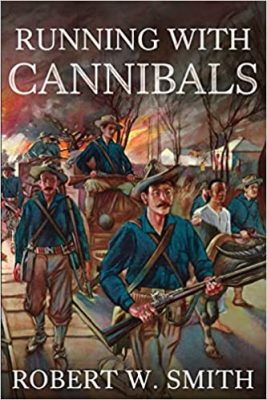
  • RUNNING WITH CANNIBALS by Robert W. Smith – Philippine-American War, Historical Fiction, Military History

    Robert W. Smith tells the story of a forgotten war and the fractured peace that follows in his powerful historical fiction novel, Running with Cannibals.

    It has been said that “War is hell.” It has also been opined that “It is well that war is so terrible, or we should grow too fond of it.” Running with Cannibals is a no-holds-barred, candid portrayal of a war that is glossed over in U.S. history, the Philippine-American War of 1899-1902. It was the first war fought overseas by the U.S.

    Running with Cannibals begins with an unnamed man on the run from an unjust accusation bought with blood and money.

    At first, the reader may wonder how this man ends up halfway around the world to the Philippines, a soldier hiding among other soldiers.

    Through the eyes of Sergeant Ethan Cooper, the reader has an intimate view of the self-fulfilling shibboleths that empower and provoke the U.S. Army into stupidity, atrocity, and self-aggrandizement. They squander the genuine possibility of cooperation and partnership with the Filipinos who were colonized by Spain.

    Running with Cannibals is a story where the truth sets one man, Ethan Cooper, free of the past that dogs his every step. He keeps his head down, desperately trying not to draw attention to himself. So afraid of being seen, Cooper participates in committing monstrous acts against the Filipino people with his fellow soldiers – even against his better judgment.

    When Cooper and his unit leave the capital for the remote villages on a mission that is doomed to fail because of the ignorance and racism of its commanding officer, Cooper’s eyes and the reader’s are fully opened to the U.S. true intent to subdue and subjugate the Filipinos into starvation and death. The more brutality Cooper sees, the more he questions what he’s been told. Not just about the supposed enemy, but about his own side.

    Running with Cannibals is both an adventure and a philosophical and sometimes even angst-ridden journey told through a very close third-person point of view.

    Smith crafts his story with exceptional skill, enabling readers an up-close look at Cooper’s ultimate metamorphosis. Ethan Cooper’s desperate desire to not see what is going on all around him does change over the course of his adventures into a soul-searching journey of purpose and fulfillment.

    Running with Cannibals is an epic tale of war, hell, and redemption that will stick with readers long after reading the last page. Highly recommended.


    5 Stars! Best Book Chanticleer Book Reviews

  • An Editorial Review of “Coming Home” by Gloria Javillonar Palileo

    An Editorial Review of “Coming Home” by Gloria Javillonar Palileo

    Coming Home, by Gloria Javillonar Palileo, brings vividly to life the plight of the American born non-white people, and particularly those of mixed blood, who must find a place to exist between diverse cultures. The acute pain of this dilemma is faced by millions of children whose parents are immigrants to North American culture. Palileo is well qualified to enlighten readers about the particular struggle of identity and of the need to fit in that many first generation Americans must grapple as she herself is an immigrant.

    Inspired by the experiences of the children that she and her husband adopted from the Philippines, Coming Home is a story that needs telling.

    Juan de la Cruz, an American-born twelve-year-old with Filipino parents who immigrated. He suffers from the racist barbs of school bullies who call him a “chink,” and then discovers his friends also do not consider him an American. However, Juan likes to go to the mall, play video games, and hang out like his peers. He doesn’t see himself as different. However, some of his classmates do since they don’t quite know where to place him since he isn’t white; he isn’t black. It is here when Palileo broaches the subject of generational racism as the children who mock Juan are picking up their opinions and derogatory name-calling from somewhere. Is it inherent in the culture? Do the children pick it up from their parents? Is it peer pressure?

    The conflict between identities is increased by his parents—his father welcomes being in America, his mother wants to return to the Philippines. She believes her son will never be accepted as an American. Juan, desperate to be an American, insists on being called “John,” asks his mother for plastic surgery on his nose, and, finally asks to be circumcised—a request that causes further crisis in the family.

    When Mrs. de la Cruz decides to take “John” for a visit to the Philippines, Juan decides he will become Filipino, tan himself and begins learning Tagalong. He soon discovers, however, that his Filipino cousins consider him very much an American. Though they take him on their adventures and include him in their games, the poverty and strange customs of his parents’ homeland, plus tales of circumcision practices of the past, convince Juan that he wants to come home to America. It isn’t until he is home that he realizes he, after all, belongs to his family and that is where “home” is for him.

    The book also gives an interesting insight into history and customs of the Philippines, a culture seeking to rid itself of the influence of hundreds of years under oppressive Spanish rule. Coming Home focuses on the effects that a history of oppression and racism could have when it zooms in on one little first generation American boy and his immigrant parents. Those who are intrigued by the story’s backstory of Philippine history may find Palileo’s latest work titled The Indios of great interest.