
Tag: Personal Transformations

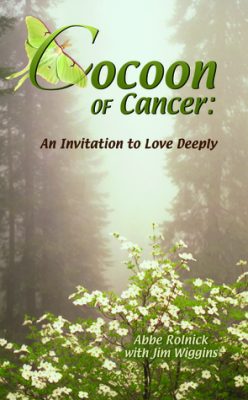
  • COCOON of CANCER: an INVITATION to LOVE DEEPLY by Abbe Rolnick & Jim Wiggins – Spiritual & Mental Healing, Personal Transformation, Living with Cancer

    COCOON of CANCER: an INVITATION to LOVE DEEPLY by Abbe Rolnick & Jim Wiggins – Spiritual & Mental Healing, Personal Transformation, Living with Cancer

    When author Abbe Rolnick’s husband Jim Wiggins slipped off a ladder in 2013, he was told he had osteopenia and would need to rest his back. He and Abbe went to Africa, but the pain persisted, in fact, got worse. Finally, the author “…got the call, the one every person dreads.” Jim had cancer, a rare, aggressive form called Multiple Myeloma. The plasma in his bone marrow had increased, taking over the normal cells, causing anemia and acidity that began to eat away at his spine. Life for Abbe and Jim would never be the same. What followed was a total disruption: for Jim it involved chemo, radiation, stem cell implants, pain, weight loss, and even height loss; for Abbe, an exploration of basic fears, and, of course, the deepest terror of loss of a loved one.

    Rolnick’s book is told for the most part in a series of emails among friends and family. Since she is a fiction writer (River of Angels, Color of Lies) she was able to express her feelings to others, especially to Jim, in a manner both poignant and poetic. She recounts the couple’s simple acceptance, the moments of despair, and the daily activities and routines they shared despite the discouraging limitations of Jim’s medical necessities. Whenever possible, the couple cuddled at night, exchanged kisses, watched funny, upbeat fare on television. The memoir is remarkable for these moments, balanced by the necessary, at times dreadful and dire medical information that impinged on their lives every day for a year. The couple had to live away from home, ask family for help, including cells donated by a brother, and rely on the kindness and expertise of strangers. As Rolnick puts it, “Cancer explodes with ramifications.” Jim’s round-robin emails form an especially touching piece of the narrative as he attempts to apply logic, masculine bravado and a mild sense of humor to the horrors he is experiencing.

    The author offers advice on keeping up with insurance issues, dealing with the caregiver role, with fears, and with the ultimate uncertainty. She doesn’t know, nor does anyone, how long remission might last. She advises being honest with doctors and with oneself, and notes that her viewpoint was often the most helpful, especially when Jim would deny he had pain while she observed how much pain he really felt from his overt reactions like groans and grimaces. At one point, the cancer clinic lab made a massive mistake; handling it judiciously but firmly was a learning experience. Two people, the author believes, can perhaps take in the totality of the problems. She describes the year as like being in a cocoon—dominated by the disease, yet growing and changing within.

    Leaving us saddened but cautiously relieved by the end of her account, with Jim at home, forming a new life around continued treatments, Rolnick has taken us on a journey, tough and full of dangers, but with a quiet resting place for now—and now is all that matters.

    5 Star Best Book Chanticleer Reviews round silver sticker

  • The WAY of HARMONY: ANCIENT WISDOM for MODERN TIMES

    The WAY of HARMONY: ANCIENT WISDOM for MODERN TIMES

    The Yi Jing, the most ancient of the Chinese classics, is both a book of philosophy and an intuitive divination tool. Its timely wisdom maps the world of change through its sixty-four Hexagrams, each representing a distinct message and point of view. Chinese culture pays deep homage to The Yi Jing as a source of the highest truth. It has many benefits and is especially useful as an intuitive approach for delivering wisdom and understanding. The Yi Jing is also called The I Ching or The Book Of Changes.

    The author makes no claims that his version is either complete or authoritative. Rather the text offers a “sincere attempt to faithfully express the Spirit of the Yi Jing themes.” The Oracle works through the Hexagram, a message in six parts. This is achieved by casting three coins, each with a heads and tails side (or a Yang and Yin side, the two complimentary forces that guide the universe). The seeker throws the three coins at the same time to determine each line of the six line reading.

    Hexagram readings are both simple and practical. They offer specific advice for balance, harmony, and creative action. They run the gamut from advising seekers that the moment is right for powerfully moving ahead, as in “The Creative” (Hexagram 1), to advising on how to deal intelligently with a time of “Conflict” (Hexagram 6). An essential principle found in The Yi Jing is that all human affairs follow a cycle of growth and decay.

    The philosophical voice of Confucius resonates through these pages, adding the message of  “universal benevolence” to the original texts. That Confucian goal is not merely to gratify the self, but rather to create a society where humanity can be harmoniously connected to self, family, community, King, and Heaven. Like many versions of The Yi Jing this one offers some Chinese-style illustrations of the adage “as above, so below” which is a way of describing how earthly nature reflects and compliments cosmic Heavenly influence.

    A brief illustration may show how The Yi Jing speaks to us.

    A recent family crisis led me to seek a Yi Jing Oracle reading for guidance. My first impulse was to move swiftly with little reflection and make rapid changes, such as evicting one of my family members and placing another in care. The Oracle advised me that such a course of action would not work. I received “Restraint” for the first Hexagram and a second Hexagram, “Discipline”, which further clarified the situation. A few weeks later I recognized how appropriate the advice was that the Oracle had given me.  Impulsive action would have destroyed significant relationships, possibly forever. While unresolved, the way has been left open for deeper bonding and mutual understanding among all the conflicting parties.

    The Way of Harmony is clearly and elegantly written while providing a lucid, highly intelligible, and sensitive account of the three thousand-year-old masterpiece The Yi Jing and introducing readers to its spiritual counterpart The Dao De Jing.

    Readers are invited to take the time to explore their own capacity for intuitive wisdom by using The Way Of Harmony as a guide. It is a way to quiet your mind and encourage feelings of deep harmony.

    My advice is to make a cup of tea, take some time to relax, and read The Way Of Harmony, a modern text that draws on ancient wisdom, making it accessible and practical in these hectic and over stimulating times.

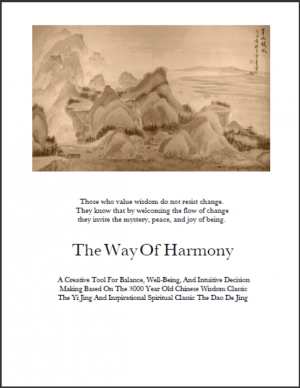
    Note: The Way Of Harmony is available in three versions: as a print book with color illustrations, as a print book with B&W illustrations, and as an ebook with color illustrations where the e-book format display allows for color. There are only three illustrations, each distributed several times through the book. These original creations are meant to evoke a peaceful mood that compliments the Yi Jing experience. We are told that the illustration on the cover of the color books, a misty mountain painted in the traditional Daoist style, was inspired by a famous centuries old handscroll and interpreted by a classical brush and ink artist living in China. It also appears within all the book’s versions.