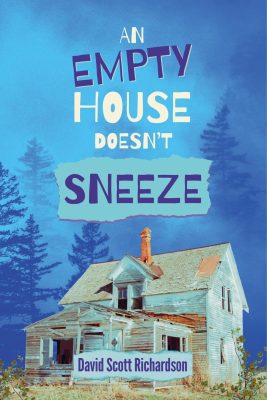
In David Scott Richardson’s YA WWII historical novel, An Empty House Doesn’t Sneeze, teenager Scott Johannsen—“Scotty” to his mom and friends—leads us on an adventure through the wartime Ravenna neighborhood in Seattle, Washington.
Boeing manufactures B-17s, his grandparents and neighbors grow victory gardens, his parents build a bomb shelter in their basement, and mandatory blackouts occur every night. Scotty navigates a chaotic world filled with danger and wonder yet finds security with family and friends in this heartfelt story.
Scotty runs with his pack—James, Marty, and Burr. We witness what lengths they will go to on a search for chocolate. With Ravenna Park as a backyard and Puget Sound just a short drive away, Scotty’s life is filled with exploration of the natural world. His fishing adventures with his dad in the Sound become an exciting way to supplement his family’s food rations as he dreams about netting a fighting salmon.
Scotty’s peaceful life evokes a sense of innocence in another time. Readers see the responsibilities average citizens rose to in their attempts to safeguard their neighborhoods and families against a potential attack.
Richardson masterfully relates the realities of coming of age in WWII America.
Scotty’s older brother Eric and his younger sister Grace help him navigate this tumultuous time. Gas shortages, young men sent to battle overseas, and the loss suffered by a community when one of their own is killed in battle.
Richardson also explores the plight of Japanese Americans during WWII. The loss of this part of his community directly impacts Scotty and his family when his friends and neighbors are sent to internment camps—regardless of their citizenship. To Scotty it seems incomprehensible and senseless, but Richardson confronts such an important historical fact directly.
Yet more troubles intrude on Scotty’s world. We meet his nemesis, Simon Lashbaugh, a bully who lives on the other side of the park.
He torments and confuses Scotty until he doesn’t know if he can trust his own brother. In his turmoil, Scotty confides in his sister and his buddies to help save his brother from the accusation that he is an arsonist setting fires during the city’s blackouts.
Richardson brings to life the experiences of an average American kid who loves his hometown of Seattle—fishing with friends, running errands for his mom, and sharing secrets with his siblings.
Our hero Scotty is not perfect. He’s a teenage boy who constantly thinks about girls, struggles with math, and tries to please his parents. He wants to survive school and adolescence and make sense of the chaos of WWII contrasted against his serene world.
An Empty House Doesn’t Sneeze grabs readers’ attention with a depiction of the great apprehension and uncertainty experienced by America’s youngest citizens during World War II.
Richardson’s characters leap off the page and will capture the hearts of all who enjoy a fast-paced historical war story about a struggling family and the boy who helps save his neighborhood.
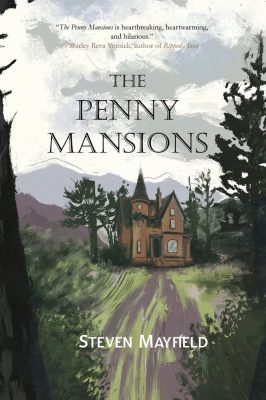
The Penny Mansions by Steven Mayfield, a historical novel of Paradise and Boise Idaho at the end of WWI, offers a concert of drama, comedy, and noir-tinged crime thriller.
The town of Paradise, Idaho, grew as a prospecting town, but the gold and people alike have dwindled. They no longer have a high enough population to keep the state government from taking the land through eminent domain. So, the town counsel puts an ad in papers across the country for families to purchase one of four mansions in town for only a penny. There’s a catch, of course – they must move in, fix the place up, and remain there for the next census count in 1920.
Readers will love the colorful characters who fill Paradise, from Bountiful Dollarhyde, an African American woman raised by the madam of what used to be the local bordello, to Lariot, a genius orphan skilled with rope tricks, and Goldstrike, an old prospector who gladly shares his strong opinions. These lively folk face a powerful threat. Gerald Dredd, a greedy land baron with a high office in the state government, uses his clout to bludgeon others into his schemes to ensure that Paradise doesn’t hit their all-important population count.
Through the people of Paradise, Mayfield explores themes of communities and found families – and what people will do to save them. He shows the dangers of government corruption gone unchecked until it creates malefic control.
Many of the characters are willing to sacrifice so much of themselves to save this small town in the Pacific Northwest frontier. And as the story pushes forward, even the newcomers to the town – not necessarily there in good faith at first – fall in love with the community and stand up against weaponized bureaucracy to save their newfound friends and home.
Mayfield’s writing style is extremely personable and fun.
The dialogue is playful and, at times, terrifying. Readers will connect with and worry for their favorite characters, and rightfully despise the antagonist and his willing compatriots. The Penny Mansions is also among the best depictions of a community banding together for a single cause.
There is a bit of a stylistic shift part way through the novel. After a major event, the story abruptly moves from a historic drama to a noir crime thriller. While this change might be jarring to some readers, the charm and humor of the book remains throughout.
The Penny Mansions will make readers chuckle and smile, and grimace with anger. Mayfield juggles emotion with ease, all while chugging the plot forward to intense confrontations.
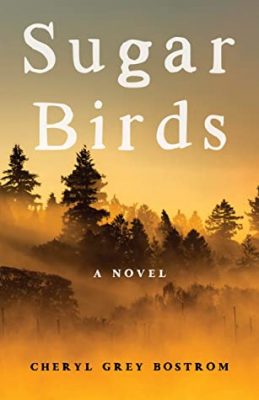
Sugar Birds by Cheryl Grey Bostrom is a heart-pounding coming-of-age story about two heartbroken girls who land at crossroads during one treacherous summer, as one runs to a dangerous forest and the other to a dangerous relationship in the Pacific Northwest.
As the story opens, Aggie, aged 10, and Celia, 16, have something in common: anger at their parents. That anger takes each of them on roads through very dark places – roads from which they barely manage to escape.
Aggie accidentally lights her family home on fire, then watches in horror as firefighters extract her unresponsive parents from the burning structure. She loses herself in the woods, practicing the survival techniques her father taught her, afraid that she caused her parents’ death and certain that she will be sent to jail if she is caught. But the arrest, she soon learns, is the least of her worries, as dangers imperil her survival and as guilt threatens to undo her. She is desperate and in constant danger – not from the searchers who only want to help her, but from being alone in the woods that she has never truly faced without her father’s protection.
Celia is angry with her parents for lying to her about pretty much everything involved with her summer exile to her grandmother’s farm. It’s when she joins the hunt for Aggie that Celia meets autistic savant Burnaby and charismatic, sensual Cabot. As her relationships with both grow, she must choose between the one who can help her understand herself and the one determined to claim her.
Aggie’s story is one of survival, while Celia’s is a more typical story of rebellious adolescence – or so it seems at first. Despite the difference in their ages, Aggie and Celia start from similar places. They have both lost trust in the adults in their lives and don’t know where to turn. Neither is mature enough to deal with the situations facing them.
Both girls are lost – until they come together just in time to save one another.
Readers who like survival stories will love Aggie’s journey, while those who enjoy coming-of-age stories featuring heroines who learn to rescue themselves will resonate with Celia’s path. Bostrom takes her readers gently by the hand and plunges them into an immersive tale straight from page one. Sugar Birds is a powerful coming-of-age story of betrayal and loss, rebellion and anger, friendship, forgiveness and redemption, all woven into a testament to the wondrous natural world.
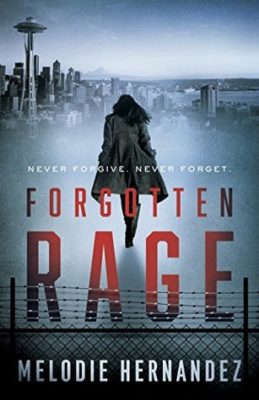
In Forgotten Rage: Never Forgive. Never Forget, Melodie Hernandez introduces Detective Luz Santos. Young, attractive, and smart, Santos works in Seattle, Washington, a city known for dark, rainy days. Hernandez sets the stage for a serial killer whose victims are not the rich and famous, but the homeless.
Detective Santos rushes to the first murder scene, and soon, we are embroiled in the professional and personal life of one tough cop. Santos’ heart belongs to Cheech, her Chihuahua, but Santos holds out hope, after several failed relationships, of finding the elusive partnership she’s always hoped for.
Ms. Hernandez filters the story through the lens of savvy Latina cop, Detective Santos, who is hell-bent on finding this killer before the killer finds her. As she works to exhaustion, she also struggles with her own demons and nightmares.
But Santos is relentless, and when she arrives at the scene of the second murder victim, the potential killer is found asleep nearby with the murder weapon on him. But Santos isn’t convinced.
Meet Nick Mason, a former attorney turned homeless guy. After his arrest for the murder of victim number two, he knows enough about the law to keep his mouth shut. Once Santos discovers his pre-homeless-identity and the reason he’s on the streets, the two become embroiled in a race to find a ruthless killer who is spiraling out of control. Luz stays ahead of the killer by a hair. As the bodies pile up, the clues come in too few and too almost too late.
Hernandez weaves lines from her original poem through the book to introduce chapters. The lines are from the killers POV, and they are chilling, to say the least. Another stroke of genius comes when Hernandez inserts chapters written in the first person from the killer’s POV, which brings us up close and personal with a deranged killer. But Santos is far from understanding the basics, for example, is the killer male or female? Hernandez keeps us guessing to the end when they find the last clue.
Hernandez presents a protagonist both human and relatable with a satisfying ending that ties up all the loose ends just enough for her fans to beg for book two. This fast-paced mystery will have you reading into the night to find out what happens next. A page-turner extraordinaire, one that we highly recommend diving into.
Forgotten Rage won First in Category in the CIBA 2018 CLUE Awards for thriller novels.
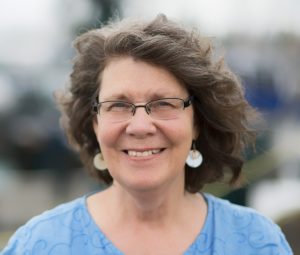
Janet Oakley is one of those authors who seems to show up everywhere – all at once! She’s won multiple awards and rightly so. Her novels and short stories are compelling, rich, and historically precise. She is a generous author and committed to her work. She knows what it takes to succeed in this business.
Ladies and gentlemen, I give you multi-award winning author, Janet Oakley.
Chanticleer: Tell us a little about yourself: How did you startwriting?
Oakley: I was born in D.C. and grew up Pittsburgh. It was a creative house with my mother a pianist, my dad a physicist. There was no TV in the house, so we pretty much used our imaginations. My parents both loved books and read to my brothers and I every night. The original Carnegie Library in downtown Pittsburgh was my haunt.
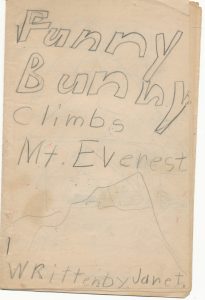
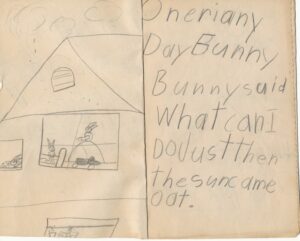
Like many published authors, I started writing early—in second grade. My oeuvre was a series, illustrated by myself, called Funny Bunny.
In fifth grade, I wrote my first historical fiction, with questionable historical facts. In college when I majored in history, my writing became more serious as I learned to do research and write essays and articles. In my sophomore year, I got an internship at the Smithsonian Institute. I was given an office in the annex of the Library of Congress and spent a whole quarter going through early 19th century magazines and newspapers looking for images of Native Americans. I returned to D.C. my senior year to research my thesis on the Comanche Indians as Prisoners of War and after graduation, I was awarded a stipend to work in the Smithsonian’s Anthropology Archives. I worked there until I left for Hawaii the following year. This experience of doing research and writing in my early years led to writing my first novel, The Jossing Affair. I haven’t looked back.
Chanticleer: That’s quite a rich growing up there, Janet. When did you realize you that you were an author and not only a historian?
Oakley: I spent nearly ten years pitching and query Jøssing and the other novels I was developing with little success but it wasn’t until I took a writing intensive class in 1999 at UW that I found a different way to publish and expressed myself– the personal essay. Though not one of my assignments at UW, the first thing I ever had published, other than some letters to the editor at my local newspaper, was an essay in Rugby Magazine, entitled, “On Being Rugby Mom.” I had started the essay on lunch break at UW. That success led to sending in essays to the Cup of Comfort series (part of the Writer’s Digest publishing house) I had five essays published in anthologies with titles like A Cup of Comfort for Women, A Cup of Comfort for Mothers and Sons and others. In 2006, I won first place at Surrey International Writers for my essay, “Drywall in the Time of Grief.” I realized then that I could write material acceptable for publication and get edited by a great editor. (We’re still friends) Then I could say I was an author. When indie publishing came into being, I was ready to publish my novels.
Chanticleer What genre best describes your work?
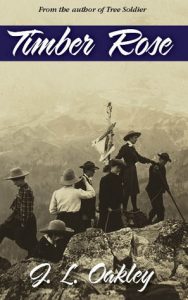
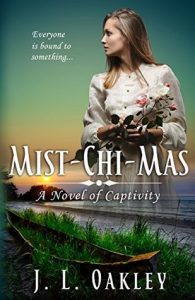
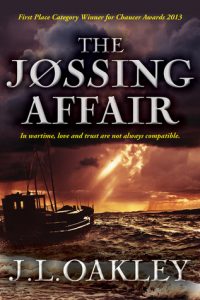
Oakley: Historical fiction, for sure. I love history and those little known, often forgotten events in both local and international history. Like Hawaiians in the Pacific Northwest in the 19th century (Oakley’s novel Mist-Chi-Mas: A Novel of Captivity is a timeless and important story that addresses what life was like for Pacific Islanders in the PNW). Women climbing mountains in skirts in 1907 (Timber Rose is Oakley’s novel about the first women’s hiking club). These historical tidbits have become the background for several of my historical novels. Historical fiction, however, has many aspects to it and can fit into thrillers and mysteries. My WWII novel, The Jøssing Affair, has been called a historical thriller and for the past three years, I have been writing mysteries set in Hawaii—a place I love—with some history in them. The Jøssing Affair was awarded the Goethe Book Awards Grand Prize for Historical Fiction, a division of the Chanticleer Int’l Book Awards.
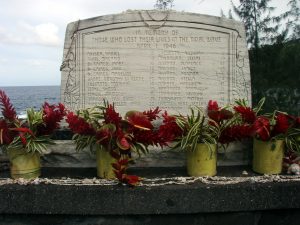
Coconut Island for one. Its historical background rests on the 1946 April Fools Day tsunami that wiped out Hilo. I got an inkling of its destruction and loss of life while teaching at Hilo Adult School—one of my students, a 4th-grade teacher, was a survivor. It wasn’t until I researched the tsunami for Coconut Island, did I learn its full impact: 96 people lost, homes and businesses destroyed. The tsunami arrived from the Aleutian Islands in under 5 hours. History has its own compelling storyline which I love to set my characters in and see how they do. Even in a mystery. I can’t seem to get history out of anything I write!
Chanticleer: So even your mysteries have a strong vein of historical running through them. Can you tell us a little more about that?
Oakley: Curiosity and family stories of homesteading in Kansas, Indian Territory and the NW in the late 1800s got me hooked on history. I grew up on stories of one great-grandfather who was a Union surgeon at the Battle of Gettysburg, another great-grandfather in the 1870s Hayden expedition to Yellowstone. My great-grandmother saw Lincoln on his way to his inauguration, then later went out to Kansas where her parents taught at Shawnee Mission. I’ve always wondered about people who lived in different times. What type of technology did they have available? How did they manage with their technology? What their lives were like without our modern conveniences. What made them succeed, be happy in life? My mom also influenced me as she loved history and love historical fiction herself.
Chanticleer: How does being an author affect your involvement in your community?
Oakley: Writing historical fiction has opened opportunities to talk about the history behind my novels. The Jøssing Affair, set in Norway during WWII, has been a popular book club choice as we have a large community of Scandinavians in the state, but I think my first published novel, Tree Soldier, has a more important impact.
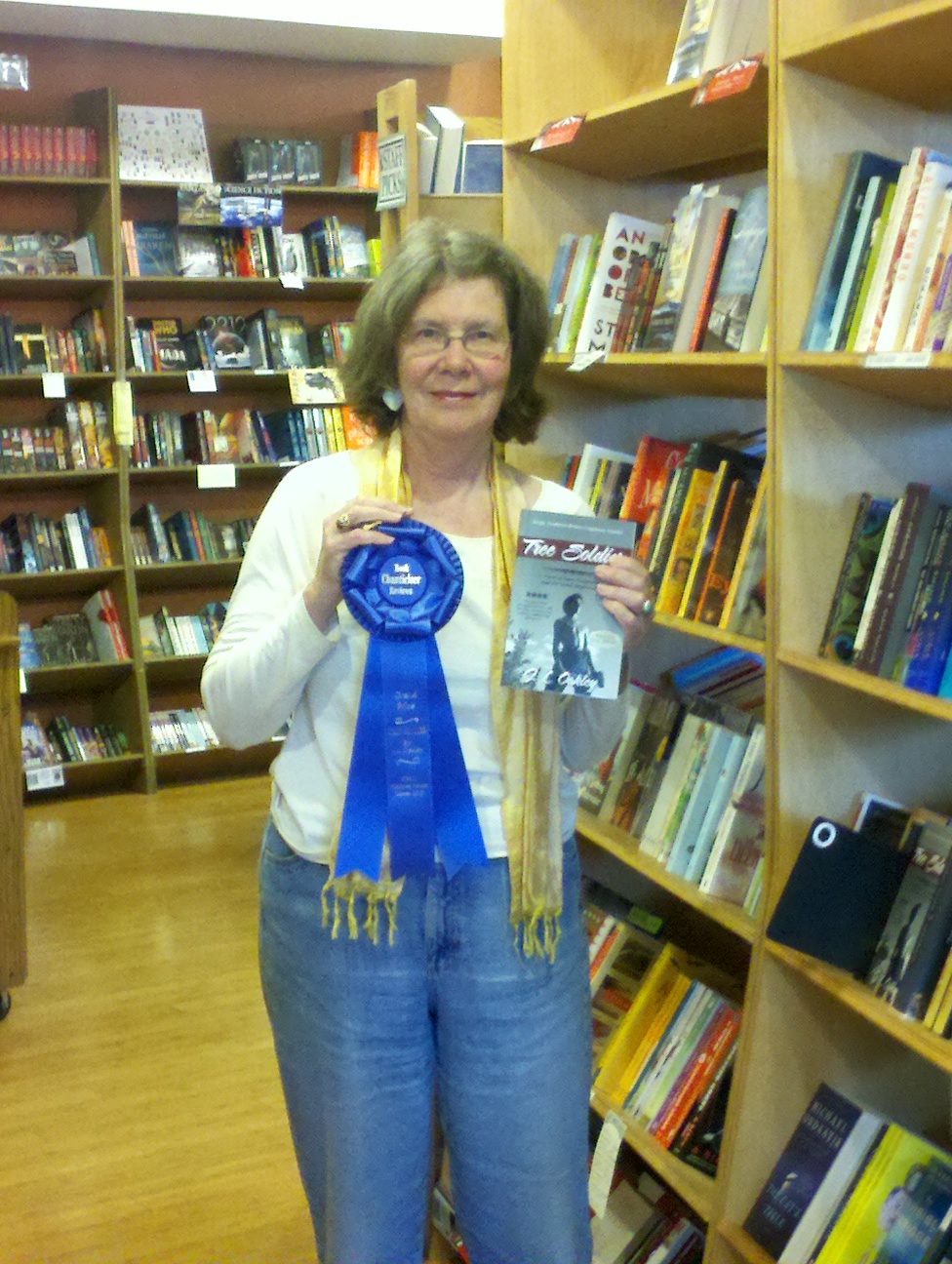
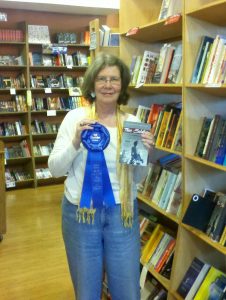
Janet Oakley at Village Books with her Chanticleer Grand Prize Ribbon
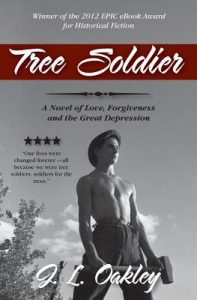
I grew up listening to my mother’s stories of the Civilian Conservation Corps boys from New Jersey who showed up at Lowman, ID in 1933. Part of the New Deal was to put young men back to work in environmental projects, these young men had been lifted out of their block in Jersey City and sent West. Tree Soldiercame as a result of my need for a history paper for my Master’s in Elementary Education. I interviewed five gentlemen who had been in the CCC. I began to present talks on the CCC and in 2013 was accepted into the Washington Humanities program. For two years, I went around Washington State talking about the CCC in Washington State (1933-1941) each time before I went to a new community, I researched the camps in their area and added the findings to my talk. Then Tree Soldierwas awarded the Chanticleer Grand Prize for Best Book. A presentation in Clarkston, WA led to an invitation to have Tree Soldier be selected as an Everybody Read for the Palouse area in both Washington and Idaho. What an honor! And a learning experience on how to present and engage with readers in the libraries. Not much later, Tree Soldier was again a book read for four libraries on the Olympic Peninsula.
I think the thing I am most proud of is being behind the installation of a CCC worker statue at Glacier Washington ranger station. As an educator, for me, this statue from a national CCC program, helps visitors to the Mount Baker National Forest learn and appreciate the work of out-of-work boys from long ago. When we dedicated the statue on June 16th, a 98-year-old CCC boy from Camp Glacier came. It was so wonderful to see the attention he received. Since then a 96-year-old CCC boy has contacted me through his granddaughter. I hope to meet him soon.
Chanticleer: Good work, Janet! What are you working on now? What can we look forward to seeing next from you?
Oakley: I’m working on the sequel to The Jøssing Affair, set in Norway a year after WWII. Rewriting my Kindle World mystery novellas and publishing them as Hilo Bay Mysteries. Once the third book is complete, I plan to do a boxset both in ebook and paperback.
Chanticleer: Can’t wait to see where this book takes you. It’s important to work on your craft. What do you do to grow your author chops?
Oakley: I write every day, usually in the morning starting at 8:00 AM. I belong to several writers groups, including a critique (going for 16 years now) and I am a member of the Independent Writers Studio where I work on WIPs with a wonderful editor and other members.
Chanticleer: That seems to be more than a simple commitment – it’s a way of life! Good for you. What craft books have helped you the most?
Oakley: Better than craft books, I have been taking classes from the authors and well-writing teachers such as Donald Maas on and off for over 25 years, Diana Gabaldon, Robert Dugoni and many other fine writers and teachers. Usually at conferences.
Chanticleer: What is the most important thing a reader can do for an author?
Oakley: Write a review on Amazon. It carries more weight than any other review site. Books need reviews in this crowded publishing world.
Chanticleer: Good point. What do you do when you’re not writing? Tells us a little about your hobbies.
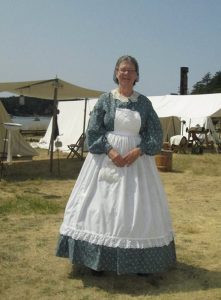
Oakley: For the past 35 years, I have researched and then taught hands-on history workshops to at schools children through Allied Arts and on my own and at a county museum. I wrote several social studies curriculum for Whatcom County schools and a national park. Following the publication of the curriculum for the San Juan Island National Historical Park in 1995, I began to give demonstrations on 19th-century foodways there. Soon I joined English Encampment, an annual gathering of reenactors at the national park as Miss Libby, an 1860 schoolmarm. Great fun! I also garden. Like words, the flowers and veggies need nurturing.
Chanticleer: Thank you for being with us, Janet Oakley. You are an inspiration and your passion is contagious!
Now, it’s your turn to show your support! Please find and follow Janet as she shares her writing, life, and insight into living a successful author-life.
If you would like to read Oakley’s books, here is a list of her titles can be found at Village Books, Barnes & Nobles, or by clicking on the Amazon links below:
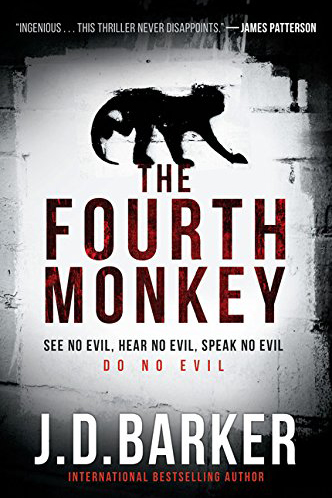
The author of the international bestselling thriller novel series, The Fourth Monkey and The Fifth to Die, along with the highly anticipated gothic horror prequel to Bram Stoker’s masterpiece, Dracul, will keynote and present at the 2019 Chanticleer Authors Conference.
J.D. Barker successfully published his debut as an indie and sold enough copies to land on the radar of the traditional publishers in a BIG way including seven-figure advances, two feature films, and a television program. He’ll open his toolbox and explain exactly what he did to make it happen. This is a not-to-be-missed session for any aspiring author or the seasoned veteran trying to find their place in today’s publishing world.
“Not since Hannibal Lecter had a friend for dinner has a serial killer been so skillfully rendered on the page.” —Taylor Elmore, Writer/Producer of Justified and Limitless
“This book is seriously brilliant: the best serial killer thriller I’ve ever read.”
—Lisa Milton, Executive Editor HarperCollins HQ
“The Fourth Monkey has one of the most ingenious openings that I’ve read in years. This thriller never disappoints.” —James Patterson, #1 NY Times Bestselling Author
Sold at auction to CBS Films with Bill Todman, Marc Webb, and Taylor Elmore attached, by Kristin Nelson of Nelson Literary Agency, Angela Cheng Caplan of Cheng Caplan Company Inc. and attorney Wayne Alexander.
“J.D. Barker is a one-of-a-kind writer and that’s a rare and special thing. Stephen King comes to mind and Lee Child, John Sandford. All one-of-a-kinds. Don’t miss anything J.D. writes.”
—James Patterson, #1 International Bestselling Author
“Barker knows how to evoke chilling imagery and will have readers anxiously looking over their shoulders with each terrifying “clickity, click, click.” — Library Journal
~Film rights optioned by Paramount with Andy Muschetti (IT, Mama) attached to direct!
~Named a Fall 2018 Buzz Book by Publisher’s Lunch!
~Named one of Publisher’s Weekly Top 10 Books of Fall 2018!
~Starred review at Library Journal!
“Brilliant… Close your windows. Lock your doors. Turn the lights on. Place a silver crucifix around your neck, and make sure to have a few sharp wooden stakes nearby. In other words, prepare yourself for a transfixing journey into the diabolically delicious world of DRACUL — if you dare.”
—Chanticleer Reviews
J.D. Barker’s debut novel that he self-published in 2014 is Forsaken. This is his indie novel that drew the attention of agents and traditional publishers to his debut thriller series, The Fourth Monkey, which lead to pre-empts and auctions worldwide with Houghton Mifflin Harcourt picking up for the U.S. and HarperCollins in the U.K.
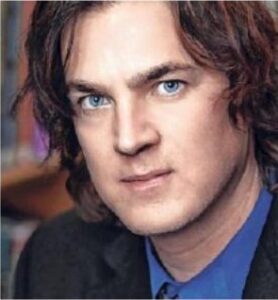
J.D. Barker (Jonathan Dylan Barker) is an internationally bestselling American author whose work has been broadly described as suspense thrillers, often incorporating elements of horror, crime, mystery, science fiction, and the supernatural.
J. D. Barker, Master of Suspense, and Intl’ Bestselling Author
We are thrilled to announce that J.D. Barker, Master of Suspense, will keynote and present at the 2019 Chanticleer Authors Conference.
We first met JD in New York at the Writers Digest Conference this past August. Clearly thrilled to hear aboutDracul, we were also quite impressed with Mr. Barker himself. He struck us as professional (serious), engaging (doesn’t take himself too seriously), and approachable (willing to share what he knows about writing with those who are working hard on their own craft).
In other words, JD Barker is a #SeriousAuthor who, when we asked him to join us at CAC19 as a keynote speaker and to present share his journey and knowledge with Chanticleer authors, not only did he graciously accept but said to count him in for all three days! April cannot come soon enough for us because we cannot wait for you to meet him. Below are a few samples of J.D. sessions for #SeriousAuthors at #CAC19
Below are a couple of the sessions he will present:
MAKING THE LEAP FROM INDIE TO TRADITIONAL PUBLISHING
J.D. Barker successfully published his debut as an indie and sold enough copies to land on the radar of the traditional publishers in a BIG way including seven-figure advances, two feature films, and a television program.
He’ll open his toolbox and explain exactly what he did to make it happen. His sessions are not to be missed by any aspiring author or seasoned veteran trying to find their place in today’s publishing world.
CROSSING GENRE and WHY YOU SHOULD DO IT!
From the moment you send out your first query letter, your work will be labeled by agents, publishers, and booksellers. Instead of resisting the urge to be labeled, J.D. will teach you why you should consider labels a way to make your books, and your author platform, more marketable.
Learn how to avoid the genre box and tell the story you want to tell to the largest possible group with the help of J.D. Barker who has successfully crossed over from horror, to paranormal, to thriller, and back again.
DID WE TELL YOU HOW EXCITED WE ARE THAT JD BARKER IS KEYNOTING at CAC!
The Journey Book Awards recognize emerging new talent and outstanding works in the genre of Narrative Non-Fiction and Memoir. The Journey Book Awards is a genre division of Chanticleer International Book Awards and Novel Competitions (CIBA).
These titles have moved forward in the judging rounds from the Long List to the 2018 Journey Book Awards SHORT LIST (aka the Slush Pile Survivors). We incorporate the Long List when the judges request an additional round of judging to accommodate the number and/or quality of entries received. These entries are now in competition for the 2018 Journey Semi-Finalists List. First Place Category winners and the Journey Grand Prize winners will be selected from the Semi-Finalists and the winners will be announced at the Awards Banquet and Ceremony on Saturday, April 27th, 2019.
Chanticleer International Book Awards is looking for the best books featuring true stories about adventures, life events, unique experiences, travel, personal journeys, global enlightenment, and more. We will put books about true and inspiring stories to the test and choose the best among them.
These titles are in the running for the 2018 JOURNEY Book Awards Semi-finalists list for the Narrative Non-fiction Fiction and Memoir CIBA Awards. Good Luck to all of the CIBA Journey Short Listers 2018!
Joy Ross Davis – Mother Can You Hear Me?
Sean Dwyer – A Quest for Tears: Overcoming a Traumatic Brain Injury
Philip Muls – Mind on Fire: A Case of Successful Addiction Recovery
H. Alan Day with Lynn Wiese Sneyd – Cowboy Up! Life Lessons from Lazy B
Andrew Jurkowski and Lisa Wright – Between The Swastika and the Bear: A Polish Memoir 1925 – 1948
Janice S. Ellis – From Liberty to Magnolia: In Search of the American Dream
Kayce Stevens Hughlett – SoulStroller: experiencing the weight, whispers, & wings of the world
Liberty Elias Miller – The Heart of the Runaway
Karen A. Anderson – The Amazing Afterlife of Animals; Messages and Signs From Our Pets on the Other Side
Jeff O’Driscoll, MD – Not Yet
Julie Morrison – Barbed
GySgt L Christian Bussler – No Tougher Duty, No Greater Honor – a memoir of a Mortuary Affairs Marine
Terry Milos – North of Familiar: A Woman’s Story of Homesteading and Adventure in the Canadian Wilderness
Janis Couvreux –Sail Cowabunga! A Family’s Ten Years at Sea
Dennis M. Clausen – Goodbye to Main Street
Russell Vann – Ghetto Bastard, A Memoir
Dr. Rick Scarnati – God’s Light
Rebecca Brockway – Miss Matched at Midlife: Dating Episodes of a Middle-Aged Woman
Austin M Hopkins – The Loose Ends Became Knots
Katrina Shawver – HENRY: A Polish Swimmer’s True Story of Friendship from Auschwitz to America
Lou McKee – Klee wyck Journal
Donna LeClair – IMMUNITY: Entitlement of Wealthy Political Notables
Cheryl Hughes Musick – The Day the Musick Died
Cheryl Aguiar – Great Horned Owlets Rescue: Where There’s a Will, There’s a Way…
Journey Book Awards for Narrative Non-Fiction 2018 Judging Rounds
Slush Pile (all entries)
Long List (Slush Pile Survivors)
Short List (Stickers and Digital Badges available (Website and e-newsletter notifications. Please LIKE and Follow Chanticleer Book Reviews to be tagged in social media).
Semi-Finalists (notified by email) Selected from Short List.
First Place Category Positions (announced at the CIBA ceremony in April, 27th 2019. (Selected from Semi-Finalists). Ribbon packages, stickers, digital badges awarded.
Journey Book Awards Grand Prize winner (selected from First Place Category Positions). Ribbon packages, stickers, digital badges awarded.
CIBA Grand Prize Winner
CIBA Grand Prize Winner (selected from the 16 CIBA divisions grand prize winners). $1,000 cash prize, CIBA ribbon packages, stickers, digital badges awarded.
All Short Listers will receive high visibility along with special badges to wear during the Chanticleer Authors Conference and Awards Gala.
Susan Marie Conrad, 2017 JOURNEY GRAND PRIZE WINNERJourney Book Award Winners
Good Luck to each of you as your works compete for the JOURNEY Book Awards Semi-Finalists positions.
The JOURNEY Grand Prize Winner and the Five First Place Category Position award winners will be announced at theApril 27th, 2019 Chanticleer Book Awards Annual Awards Gala,which takes place at the Chanticleer Authors Conference that will be held in Bellingham, Wash.
We are now accepting submissions into the 2019 JOURNEY Awards writing competition. The deadline for submissions is April 30th, 2019. Please click here for more information.
As always, please do not hesitate to contact us with any questions, concerns, or suggestions at Info@ChantiReviews.com.
If you were 18 or older in 1984, if you were from or migrated to Seattle in the latter half of the 20th Century, if you used far too many drugs, drank too much alcohol, thought Alaska was the Promised Land, thumbed your nose at the conventional American culture of the ‘80s, explored life aboard fishing boats, had too much sex, and had madcap adventures in global hotspots from Honduras to Cambodia, then you are the right audience for Some Kind of Ending by Conon Parks.
Calling this book an experimental novel is appropriate; there is little approximating a cohesive narrative. But that’s not a bad thing. It’s the tale of several drunken, chemically dependent people—not the kind you would take home to Mother—who converge on Seattle in 1984, wind up on a variety of fishing boats bound to Alaska in search of great fortunes to be made from the fishing industry and return to Seattle. More specifically the dives and women of Seattle’s Ballard seafaring community. Nothing in common seems to draw them together except the desire to live according to their Rabelaisian taste for life.
There are at least two explosions—one breaking out a colleague from a mental hospital, the other blowing up a submarine that may have rammed a Greenpeace sailing vessel and in turn, was blown up by another boat carrying an inordinate amount of military ordnance. There are fights galore, long meditations on the Foreign Legion, Gurdjieff, the Iran-Contra hearings, and disparaging comments about “Hanoi Jane” Fonda.
The closest to recognizable characters may be Andre, a literate college drop-out with at least one prison sentence in his past; and Doug, an idealist from the Midwest. But even identifying those names gives no sense of the swirl of characters and stories that circle through this picaresque novel. Characters pop up like moles in a garden, or more appropriately, whack-a-moles.
What is the book about? It’s a question not easily answered except to call it a diary, a 20th Century Samuel Pepys observation of a particular 1980s-based time and space. “Diatribe” is an equally applicable description. At one point, Andre reminisces about all the many images he has witnessed in his life, “from riots in Barcelona, to martial laws and Gestapo goons after the Kurds he was runnin’ within Istanbul, to Guatemalan guerillas and Mayan Indios, to Easy St. Louis hoods, to Israel and the West Bank, to Wounded Knee, to polio victims hobbling about with their knees above their ears.”
Stream-of-consciousness at its best, Some Kind of Ending drives readers on a colorful, and somewhat perplexing journey of absurdism. Recommended.
Parks won First Place in the 2017 SOMERSET Book Awards for Contemporary and Literary Fiction Novels for Some Kind of Ending.
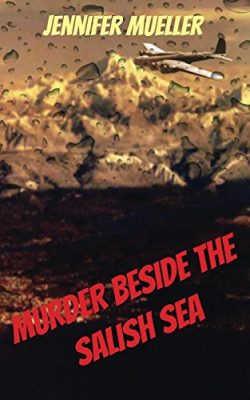
Brock Harker, World War II fighter pilot returns home to the Pacific Northwest on leave. He’s searching for a little peace once he finds his half Japanese wife who vanished while he was away. What he finds is Murder Beside The Salish Sea by author Jennifer Mueller, who artfully pulls Brock into an intriguing plot that hides the darkest of secrets.
Working as a pilot for the Flying Tigers in China, Brock earned the distinguished Order of the Cloud and Banner from the Chinese. After Pearl Harbor, he joins the Air Corps as a bomber pilot. Brock would say that flying was the one good thing his dad taught him, and he’d learned it so well he swore he could dogfight when he was ten years old. He should have been dead many times during these World War II years, but what has him frightened most is Amy’s disappearance. Half Japanese/American women have to watch themselves now. His heart broke when her letters stopped, and the letters he sent went unanswered. Now he’s determined to find her or find out what happened to her.
The search begins at his father’s home, the only family he has left. They parted years ago on the worst of terms, in large part because of his racist father’s hatred for Brock’s beloved Amy. Now, will his father greet Brock after all these years, or throw him away again? Brock reacquaints himself with his hometown of Bellingham, friends and other people he had known before, and meets military personnel on the nearby base. Several of these people become suspects in the ensuing murders. Brock is also accused by the police in his father’s murder. Brock applies wartime tactics and a little help from his friends to track and capture the murderer. Only then are devastating secrets revealed that may be unbearable for this war hero.
This thrilling, historical mystery that’s steeped in sweet romance tugs at a sense of adventure. The story travels across plot twists like an army jeep driving the diverse, Pacific Northwest landscape, from the Cascade Mountains to sandy beaches, and along the Straits to the Ocean. Hang on because just when the reader thinks the plot ahead is recognizable, there’s another curve and the view completely changes.
With Murder Beside The Salish Sea, Jennifer Mueller brings to life an important time in history, while weaving in poignant, personal drama. As Brock’s beloved wife Amy once said to him, “We endure what we cannot change.”
Here is the first half of a two-part series on How to Write a Synopsis. The first part deals with synopsis development and the second part will discuss the mechanics of a synopsis.
Part 1 of Jessica Page Morrell’s Writer’s Toolkit series on How to Write a Synopsis
I’ve got a book in progress now, but I’m planning to write several nonfiction projects, so I’ll be crafting proposals to sell these projects. Now, I’d rather yank out my fingernails one by one or undergo a series of root canals than write a proposal—there’s just something about them that fills me with dread and the worst case of procrastination this side of the Rockies. I know proposals are a top-drawer tool in my toolbox of writing skills, but I still loathe writing them. And I’ve heard this same sort of dread about writing a synopsis from fiction writers, so if you’re fortunate enough to be finishing a novel, here are some ideas for this next crucial step.
First, if you’re not fond of writing a synopsis, this doesn’t strike me as abnormal. After all, you’re summarizing about 400 pages into the briefest possible form while introducing the major players and situation and somehow leaving no questions unanswered, while not disclosing everything that happens in the story. A synopsis is part bare bones of your story (however, not too bare), part pitch, and part illustration of your writing style. And every sentence matters and must push the story forward.
Typically a synopsis completes a sales package that includes your first three chapters and sometimes a letter of introduction. Since at times editors read the synopsis first, it must be comprehensive, comprehensible, and compelling, forcing them to then peruse your chapters. Hopefully, your synopsis will be read not only by an agent and editor but if it passes muster, the marketing and art department will read it too. A synopsis will also be used in the publishing house meetings where decisions are made about what titles will be published in an upcoming season. In your synopsis, these professionals want to see a thoughtful writer at work—one who has crafted an enthralling story, with a gripping main conflict and intriguing motivations in the main players. They also want to understand how the story moves logically from the inciting incident in the opening chapters to the end, with major plot points and turning points along the way.
These days there seems to me no grand consensus on the ideal length of a synopsis. If you’ve written a saga, chances are you might weigh in at 10 pages or more and if you’ve written a fairly simple tale, you might get away with a one-page shortie. Since most agents and editors are notoriously pressed for time and read so much for their jobs, the five-page synopsis is appreciated by most. However, in the past, the wisdom about length went like this: one double-spaced page of synopsis for each 10,000 manuscript words. If you wrote an 80,000-word manuscript you’d write an 8-page synopsis.
If you’re new to the task of synopsis writing you might want to read the back cover copy of your favorite paperback novels and the inside jacket of hardcover novels. Notice how enticing the copy is and how the story question is revealed. Notice also the verbs and the level of specific detail. Then make a list of all the major characters and events that you need to include in your synopsis.
Start your synopsis with a hook—such as in:
When JAMES MALCOLM, an insurance adjustor, awoke in a strange basement wearing women’s clothing, he knows it won’t be an ordinary day, but could scarcely have imagined that the clothes he wore belonged to MELINDA DAVIS who had been recently murdered. Wrongly suspected of her murder, Malcolm is forced to discover who murdered Davis and why and why he was fingered for the crime.
Write in the present tense and the first time you introduce a character, type his or her name in all caps. A synopsis is written in the same order as the novel and is written in the style and tone of the manuscript—a witty, fast-paced novel requires a witty, fast-paced synopsis. If the story is literary, your synopsis will be more serious, but keep in mind that your dazzling prose goes into the manuscript, not the synopsis.
Don’t leave major questions unanswered such as who killed the victim, as well as how Malcolm solves his internal conflict, and how the subplot was resolved after he lost his job when he was arrested. A synopsis keeps the reader’s interest, but it’s not a tease and is not written with cliffhangers and such devices. It’s particularly important to demonstrate that your ending provides a satisfying conclusion to the plot and ties up loose ends.
A synopsis demonstrates that your characters are in jeopardy and what is at stake and why this matters. It introduces your main characters and their conflicts and agendas. It is not a list of characters or character sketches, and it usually does not describe physical attributes of characters, although the main characters are given some sort of tag. For example, you might want to refer to a character as the leading citizen in a small Southern town, or a respected doctor or frustrated novelist. Antagonists are always introduced, but secondary characters are mentioned only if they are involved with the protagonist’s inner or outer conflict. A synopsis is also written with a careful attention to flow—ideas follow each other logically and one paragraph leads to the next. This means that transitions will be important in connecting the dots.
The Part 2 will discuss the mechanics and formatting of a synopsis and her handy checklist (by Jessica Page Morrell).
LINKS
Instructional and Insightful Books by Jessica Page Morrell to add to your Writer’s Toolkit. Click here.

 In Forgotten Rage: Never Forgive. Never Forget, Melodie Hernandez introduces Detective Luz Santos. Young, attractive, and smart, Santos works in Seattle, Washington, a city known for dark, rainy days. Hernandez sets the stage for a serial killer whose victims are not the rich and famous, but the homeless.
 Chanticleer: Tell us a little about yourself: How did you start writing?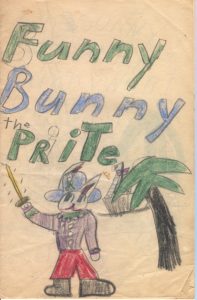
 I think the thing I am most proud of is being behind the
  curriculum for the San Juan Island National Historical Park in 1995, I began to give demonstrations on 19th-century foodways there. Soon I joined English Encampment, an annual gathering of reenactors at the national park as Miss Libby, an 1860 schoolmarm. Great fun! I also garden. Like words, the flowers and veggies need nurturing.


 The Journey Book Awards recognize emerging new talent and outstanding works in the genre of Narrative Non-Fiction and Memoir. The Journey Book Awards is a genre division of Chanticleer International Book Awards and Novel Competitions (CIBA).
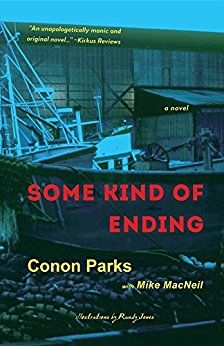
 If you were 18 or older in 1984, if you were from or migrated to Seattle in the latter half of the 20th Century, if you used far too many drugs, drank too much alcohol, thought Alaska was the Promised Land, thumbed your nose at the conventional American culture of the ‘80s, explored life aboard fishing boats, had too much sex, and had madcap adventures in global hotspots from Honduras to Cambodia, then you are the right audience for Some Kind of Ending by Conon Parks.
 Brock Harker, World War II fighter pilot returns home to the Pacific Northwest on leave. He’s searching for a little peace once he finds his half Japanese wife who vanished while he was away. What he finds is Murder Beside The Salish Sea by author Jennifer Mueller, who artfully pulls Brock into an intriguing plot that hides the darkest of secrets.