
Tag: Nursing during wartime

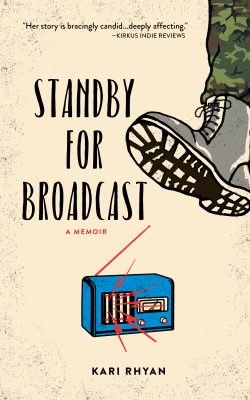
  • STANDBY for BROADCAST by Kari Rhyan – Memoir, Wartime Nursing, PTSD

    STANDBY for BROADCAST by Kari Rhyan – Memoir, Wartime Nursing, PTSD

    Childhood demons and combat wounds cause one Navy nurse to examine her life in Standby for Broadcast, a moving and turbulent memoir by Kari Rhyan.

    Rhyan served nearly twenty years in the US Navy as a nurse, her final deployment taking place in Afghanistan to a medical unit run by the British where Rhyan upheld her duties to aid others, while inwardly feeling unprotected and helpless. After witnessing the many tragedies of war, primary among them multiple amputations, she comes home scarred in mind. Her trauma becomes so obvious that she is sent to a special private unit.

    It is at this private unit, The Willows, where Rhyan is overseen by a compassionate counselor, Riza, who enjoins her to attend AA meetings. Rhyan refuses, feeling that “acceptance” is not the answer for her rational hatred of warfare. But she cannot dodge the assignment of writing a chronicle of her war experience to be read aloud to fellow patients at sessions in “The War Room.”

    Her memories of Afghanistan soon become jumbled with her childhood recollections of abuse by her addicted mother and sexual aggression by another family member, and with her current, difficult life as a gay mother. Because fellow patients were deployed as soldiers, Rhyan feels her suffering is not as authentic as theirs, but Riza continues to push her to write, to remember and describe, at the least, a single day. Finally, she is able to bleed out her agonized story of observing and treating pitifully wounded war victims, including a child, burned nearly to the bone. Ultimately, her treatment at The Willows leads her to separate from her alcoholic mother and find a new life outside the military.

    Rhyan writes with vivid emotion, leaving nothing out in her determination to make her story known and understood. Not a soldier, still she and her fellow medical personnel must find inner stores of courage and battlefield humor in order to take on the daily task of assisting young soldiers so badly torn apart that it would seem death more likely and perhaps the most desirable outcome.

    Throughout her recollections, which are liberally peppered with appropriate profanity and shocking imagery and at times exhibit a frantic desperation, Rhyan quotes great writers and philosophers on the subject of war. Through Riza’s voice, in a dramatic scene, she reminds us that warriors in ancient times were never allowed to return home because of the madness that war caused…so wars had to be continuous, to keep those who waged it occupied and out of sight. Rhyan shows us their madness close-up, with its many results, as she has seen and lived it: the nightmares, paranoia, violence, self-medication, self-hatred.

    The conclusion to Rhyan’s hard work on herself at The Willows is what seems for now like a restful, if not entirely peaceful existence, in closeness with her child and the spouse who remained faithful and understanding throughout her long ordeal.

    Rhyan’s memoir is frank, insightful, and a powerful reminder of the toil taken by those who wrestle with the fallout of the carnage of war. She also reminds us of the resiliency of the human spirit and the power of hope.

    5 Star Best Book Chanticleer Reviews round silver sticker

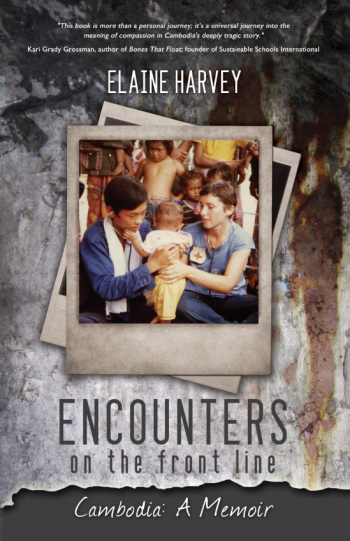
  • ENCOUNTERS on the FRONT LINE: CAMBODIA: a MEMOIR by Elaine Harvey

    ENCOUNTERS on the FRONT LINE: CAMBODIA: a MEMOIR by Elaine Harvey

    Encounters on the Front Line is the journey of a Canadian Red Cross nurse who, after traveling in far off reaches of Asia and Africa, finds herself in a refugee camp on Cambodia’s Thai border, in the midst of the war between the Vietnamese and Cambodia’s brutal Khmer Rouge.

    The encounter with the front line becomes a life journey told in three books: her experience in a refugee camp in 1980, a pilgrimage back in 2007-2008 in an effort to reconnect, and a third journey two years later as a mature woman and writer, seeking to pull together the experience that has marked her so deeply.

    The courage and resilience of the Cambodians survivors who serve with her, their beauty in the midst of the horrendous conditions shine through, even as the camp itself becomes torn by war. Harvey draws a vivid picture of contrasts: the abysmal conditions of the camp with the green of the surrounding rice fields, the terrors of the Pol Pot regime with the loyal gentleness of the individual Cambodians who serve with her. Photos increase the reader’s intimacy with these people, as does the poetry that runs through the book.

    Harvey’s return trips to reconnect and unravel the mystery of the land become a more personal search. It is again focused on people, both Cambodian and expats from around the world who have found their life’s work in Cambodia. The second visit focuses on an orphanage, Wat Opot, where she serves, and its American founder. The price of conflict is brought home by the stories of these tragic leftover of war—the children. In a land where poverty and conflict overwhelm, many find peace in Buddhism. Harvey finds that her greatest service lies in the healing touch.

    The honesty of this memoir—Harvey’s conflicting reactions to the filth and vermin—give it an authenticity that is refreshing. The third book in particular, we feel her frustration and grief at her failure to re-establish the personal connections of the first encounter. If it has any defect it is that the first book, given its subject matter, has a tension and intensity the other two do not.  And the personal search of the latter two is, that some readers may find it to be, at times, repetitive as the author reexamines her encounters. Life has moved on beyond her reach, and the intimacy and immediacy of war relationships cannot be reestablished. There is a large quotient of sadness in this last visit, and a once friend tells her that it is a mistake to cling too long.

    This is a very well written memoir and an intimate picture of a Southeast Asia  and its people. Readers will find their horizons broadened by Harvey as she shares her encounters as one who has served in the far reaches of the Third World, grown to love its people, then sought to give the experiences meaning. Harvey’s poetry and photographs add both variety and depth to the work, as they further the reader’s connection to the memoir beyond the power of prose.