Tag: Novelist

  • Chanticleer 10 Question Author Interview Series with Kevin G. Chapman – Award-winning book, The Other Murder, Clue Grand Prize Award, Author Life

    The Clue Award Badge for Thriller Suspense Fiction and True CrimeFrom the 2023 Clue Division Grand Prize Winner for Suspense/Thriller for his book The Other Murder, we have a brand new Chanticleer Author Interview!

    Kevin G. Chapman won the Grand Prize in the Clue Division of the 2023 Chanticleer International Book Awards for his novel, The Other Murder. The Clue Division includes books in the categories of:

    • Detective / Crime
    • Suspense / Thriller
    • Private Eye / Noir
    • Legal /  Medical / Police Procedural
    • US Political Thriller
    • Spy / Espionage / Undercover
    • True Crime / Investigations

    That’s a lot of ground and a lot of books! The Other Murder was the first place category winner in the suspense/thriller category, and was awarded the Grand Prize as the Best Book among all the CLUE entries

    blue and gold badge recognizing The Other Murder by Kevin G Chapman for winning the 2023 Clue grand prize

    Kevin sat down with the Chanticleer Book Review to talk about his writing and his new novel, Double Takedown, coming out this fall!

    Chanti:  Thank you so much for joining us Kevin! Tell us a little about yourself and how you started writing?

    Chapman:  Normally I’m explaining to my lawyer colleagues that the unusual thing about me is that I’m a mystery writer on the side. For mystery readers, you might be interested to know that I’ve been an in-house attorney for a major media company for the past 29 years. I’m a labor lawyer and former chairperson of the Labor & Employment Law section of the Association of Corporate Counsel. The L&E section consists of over 7000 in-house lawyers. I led the ACC section and oversaw our educational programs and publications. I even wrote an article for the ACC magazine on a radical plan for improving how companies run their employee evaluation programs! Yeah, I’m a law nerd (and proud of it).
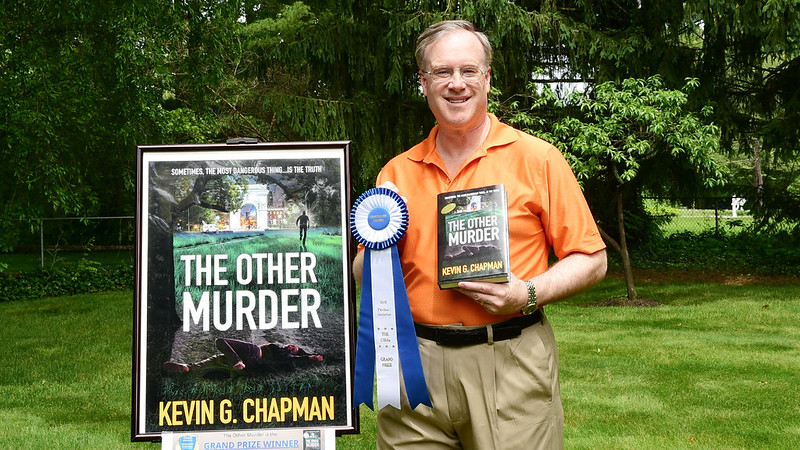
    Kevin Chapman, Orange shirt, the other murder, ciba award, clue division, garden, park

    Chanti: We all are nerds about something! How did you develop the idea for your current novel, The Other Murder, (Winner of the CLUE Award Grand Prize this year) and what inspired you to explore the intersection of media and law enforcement?

    Chapman: Because I’m a lawyer who works for a media company and writes crime thrillers, the most significant elements of my professional life all come together in The Other Murder. The story sprang from my non-original observation that pretty, affluent white girls who are missing or killed tend to dominate the news cycles. We often hear statistics about the number of murders and violent crimes in a particular city. We seldom (if ever) see significant media coverage given to a minority victim who isn’t rich and famous.

    This phenomenon could be called “unconscious bias,” but is likely more a conscious choice by producers and media executives focused on getting the biggest ratings. Particularly in broadcast news, including 24-hour cable news networks, getting eyes on your story is the most important thing. The story that can be made sensationalistic and involves a victim that will garner sympathy and is relatable is the story you feature. That’s good economics, but leads to a slanted presentation of the world. I wanted to make this murder mystery a story that gets inside that culture and lets readers see all sides of the story as it unfolds.
    Kevin G Chapman, Sharon Chapman, event, awards
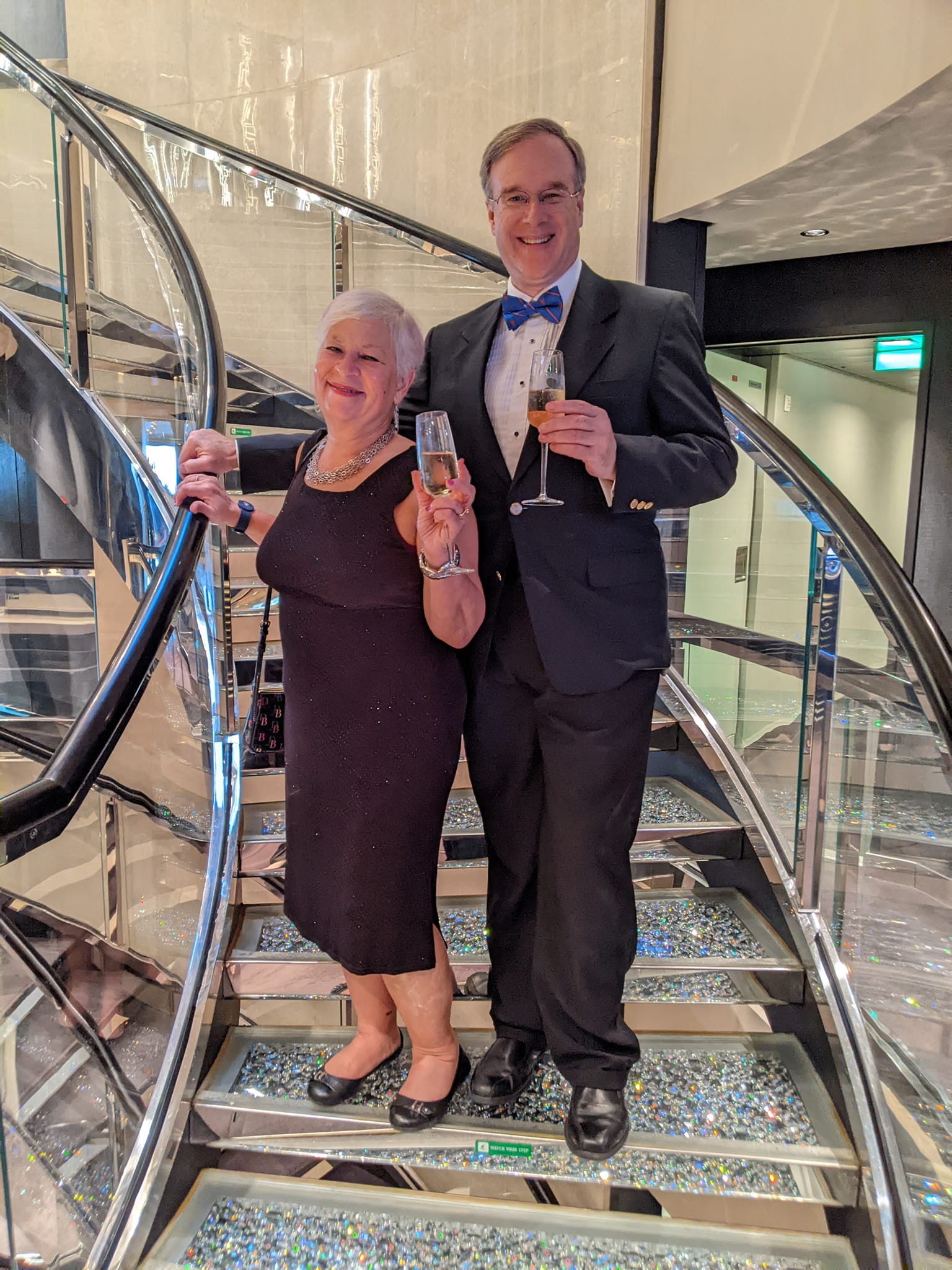
    Kevin and Sharon Chapman

    Chanti: The story of The Other Murder involves two journalists and two homicide detectives. How did you approach developing these characters, and what challenges did you face in creating complex relationships between them while navigating the intricacies of the murder mystery?

    Chapman:  The real “leads” of this story are the two journalists. Each of them has positive and negative attributes and each makes choices that are both selfish and noble – the two being not mutually exclusive. I wanted my cable news producer to be understood in the context of her job, her bosses, and her ambitions. I wanted the print journalist to be understood as someone who could have a “better” job, but who has a calling both to journalism and to his community. Their interactions disclose their similarities and differences as well as the nature of the business in which they work. And, of course, it’s a murder story so there must be cops. Here, the cops don’t have all the information and need the help of the journalists.
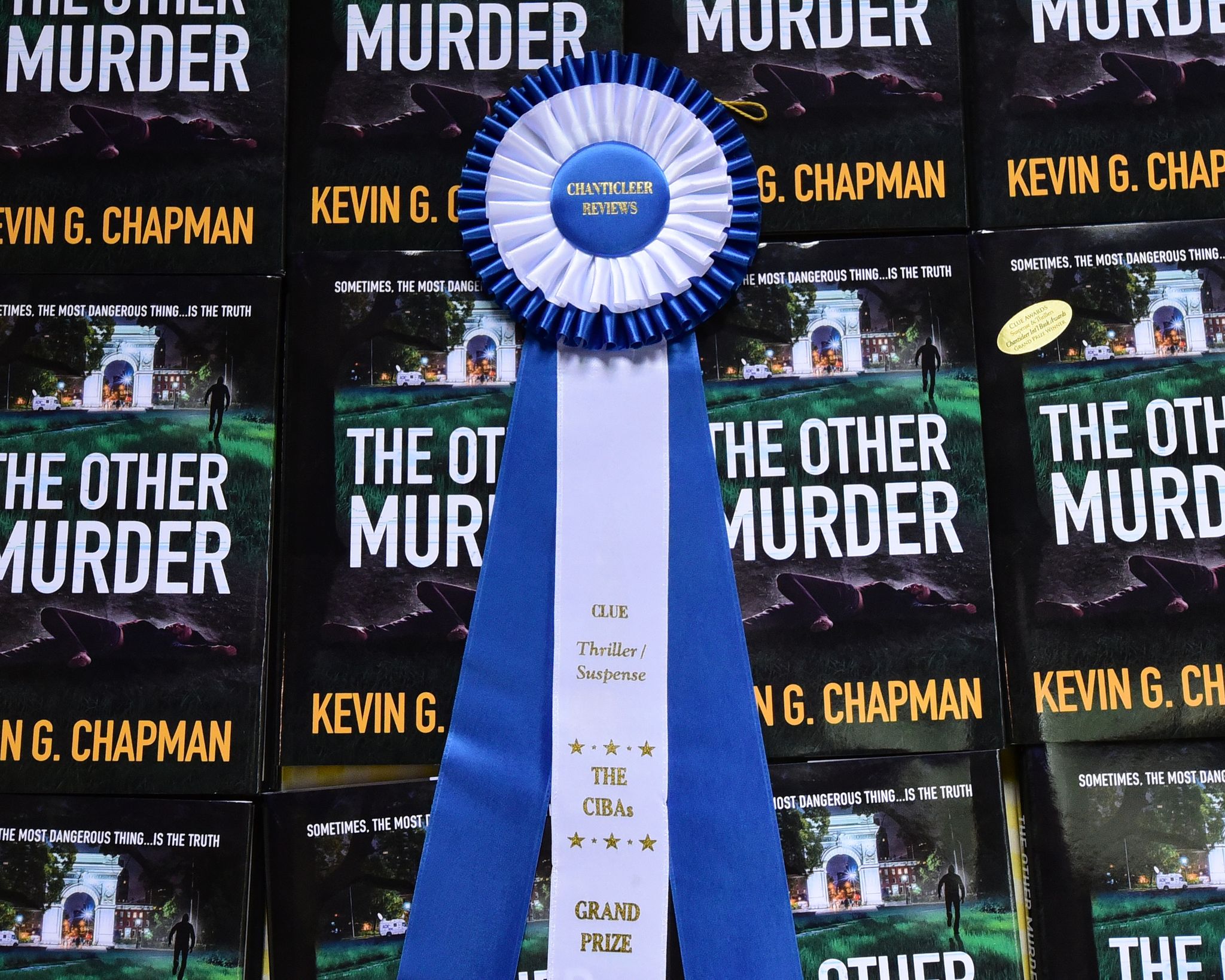
    CIBA award, Clue division, grand prize, the other murder, bookshelves, blue and white ribbon, Chanticleer Book Review

    The two partners have their own problems, including a recent incident that set them at odds. Through their eyes, the reader learns things the journalists don’t know and sees the way the media coverage affects the police investigation. Making the characters the focus of the story lets me tell the mystery story through interesting eyes.

    I have always loved the mysteries of Sara Paretsky, whose characters are the heart and soul of her books. In the Mike Stoneman Thriller series, I had a fixed set of main characters be my narrators. They, and their minor-character companions, gave me a universe of backstories to weave into the mysteries. This stand-alone story has brand new characters for my readers to relate to and care about.

    My goal, like Ms. Paretsky, is to make my readers as interested in the stories of the players as they are about the underlying “main” plot. The plot needs to hold them together, but the characters need to behave in a way that is both realistic and interesting.
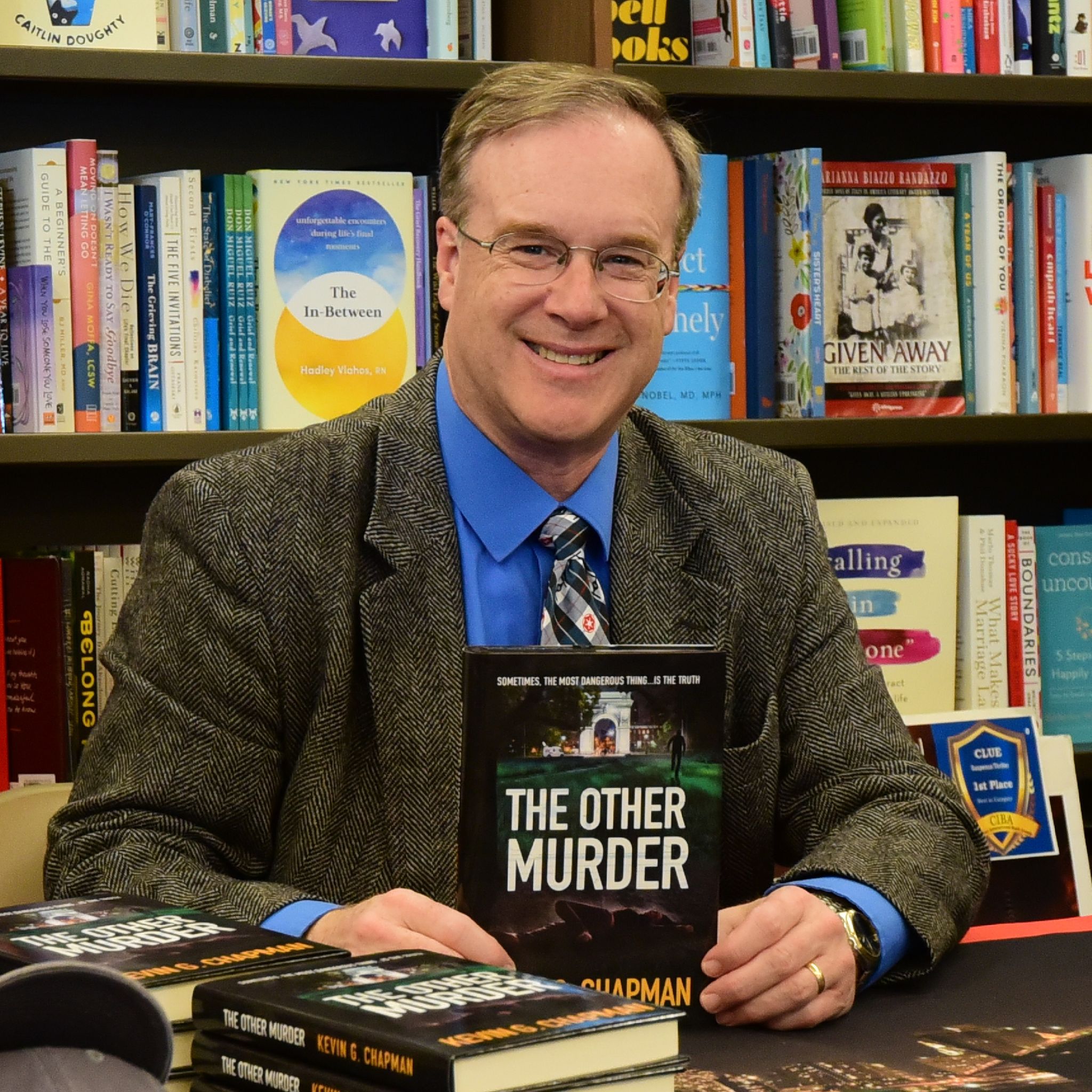
    Kevin G Chapman, The Other Murder, table read

    Chanti: Many of your stories feature important social issues, woven into your murder mystery plots. Why do you do that, and what message do you hope readers will take away from this aspect of the story in The Other Murder?

    Chapman: I always want my books to be entertaining, but I also want to make my readers think about issues that exist in the world and which often influence the stories I’m telling. Jason Dickson, Mike Stoneman’s partner, is a Black detective. He (and Mike) encounter racism inside and outside the NYPD and those issues play naturally into my plots. I try to let my readers make up their own minds about things, but also confront them with situations they need to think about.
    Kevin G. Chapman, Fatal Infraction, football, money, Chanticleer Book Reviews, stadium, Mike Stoneman

    In Fatal Infraction, for example (Mike Stoneman #4), the Black quarterback of a New York pro football team is murdered. The racially charged environment of pro football and the reaction of the community to a murder that may have been racially motivated is a big part of the plot.

    In The Other Murder, the main plot involves subtle racism that permeates the media and, to some extent, the police and the city officials, who are driven by publicity (positive or negative) and public perception. When the media tells the public that a situation is a horrible tragedy and an example of a huge problem that needs to be fixed, crowds gather, memorials are created, politicians and activists make speeches. This causes the media feed on itself as it amplifies the story.

    Government officials like the mayor and the police commissioner react by prioritizing that crime and devoting resources to solving it. Catching that killer matters because everyone is watching. In this story, the second murder involves a Latino boy with a history of gang membership. It garners no media attention and generates minimal police interest until cops discover that Javier Estrada’s murder may be connected to the white girl, Angelica Monroe. The immediately reported story is that Angelica was an innocent victim of urban gun violence. She becomes a saint. Javier Estrada is ignored.
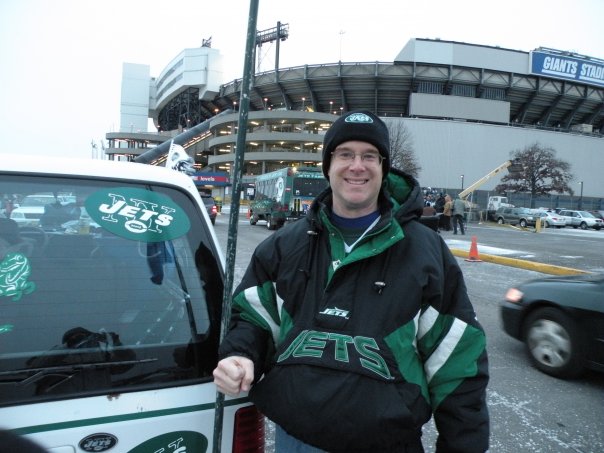
    Kevin G. Chapman, The Other Murder, NY Jets, Football

    Meanwhile, the two detectives on the cases are a white man and a Hispanic woman. Mariana is the only character involved in the police investigation who cares about Javier’s story. Similarly, only Paulo Richardson, the local newspaper reporter, cares about Javier’s portrayal in the press. Paulo wants to make people see the truth about Javier. Mariana wants her colleagues to see that the white girl isn’t always the victim and the Latino boy is not always the criminal. The investigation also lays bare the recent rift between Mariana and her partner, Dru Cook, arising from an incident of police brutality. Was that incident racially motivated? Dru didn’t think so. Mariana saw it differently.

    In the end, once the reader has all the facts (or, at least all the different versions of the facts), the question of who is a little bit racist and where motives and biases get mixed together makes things a lot less clear cut. My hope is that the reader not only enjoys the story and cares about the characters, but that the tale makes them think a little bit about their own perceptions.
    Chanti: The Other Murder challenges readers to guess what happened. How do you craft the tension in a narrative, and what techniques did you employ to keep readers engaged in solving your mystery?

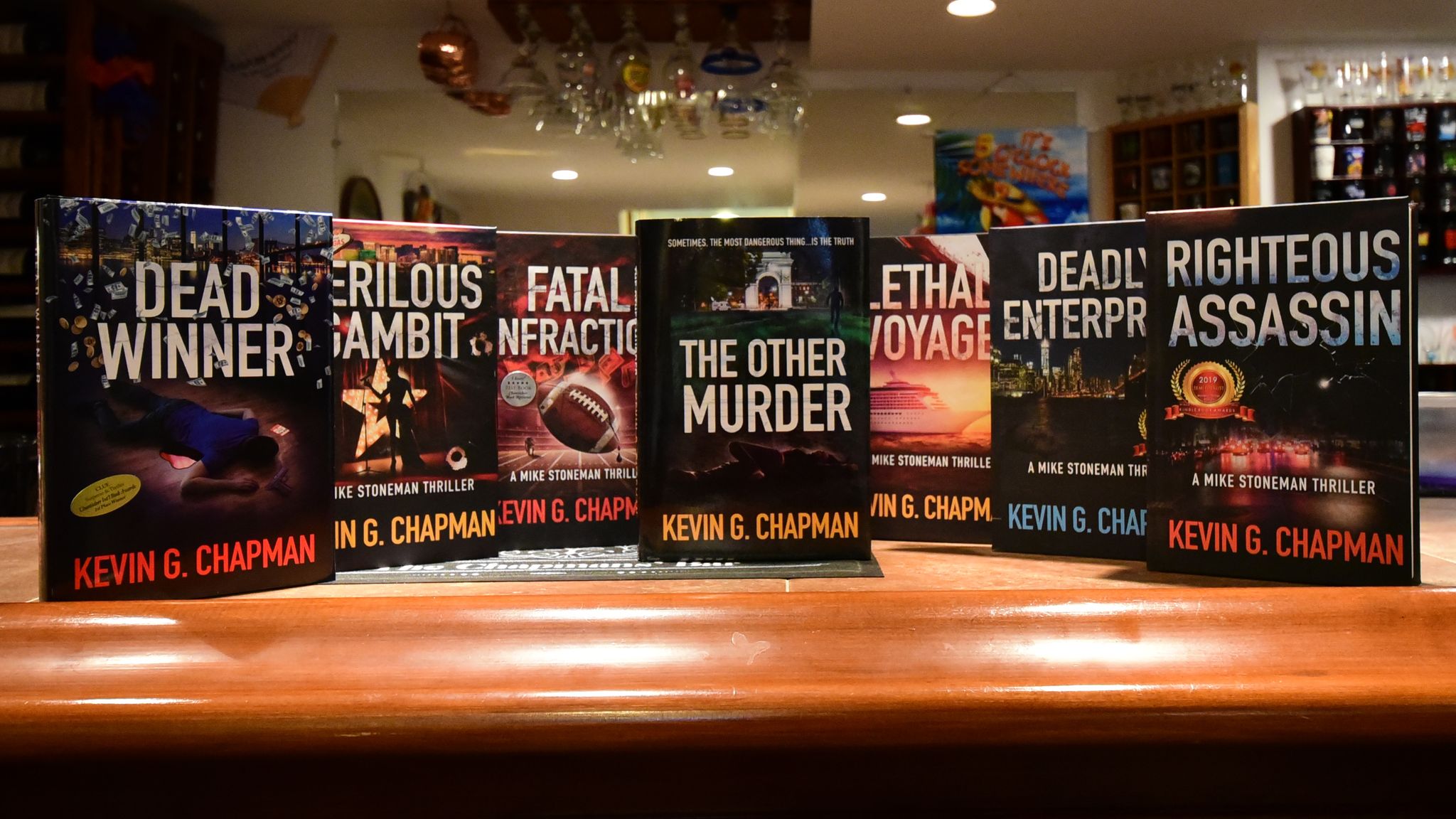
    Chapman: Each book has its own requirements. In Dead Winner, my stand-alone romantic mystery from 2022, the protagonist was entranced by a woman who induced him to both protect her and help her recover her lost lottery ticket. The suspense was what would happen and who was really pulling the strings. In the Mike Stoneman books, typically the mystery is who the killer is and whether/how Mike and Jason will catch them.

    Kevin Chapman, Work space, Shirt and tie, working, postcards, office

    In The Other Murder, the mystery is what really happened. In the first draft of the story, chapter one gave the reader a view into all the events that happened leading up to and including the murders of Angelica and Javier. I realized after the first draft was done that letting the reader know what happened and then following the investigations by the police and the journalists with that knowledge was not fully satisfying as a mystery. The story was: “how are they going to figure it out?” rather than “what happened?”

    So, I went back and deleted most of that first chapter and re-wrote the story so that the journalists and the police (along with the reader) are piecing together the facts, without knowing for sure who is giving them good information, which of their assumptions are correct, and what information they are missing. This allows the reader to guess where the characters have it right, and what might be wrong. Even at the end, nobody (including the reader) can be 100% sure they know the whole truth.
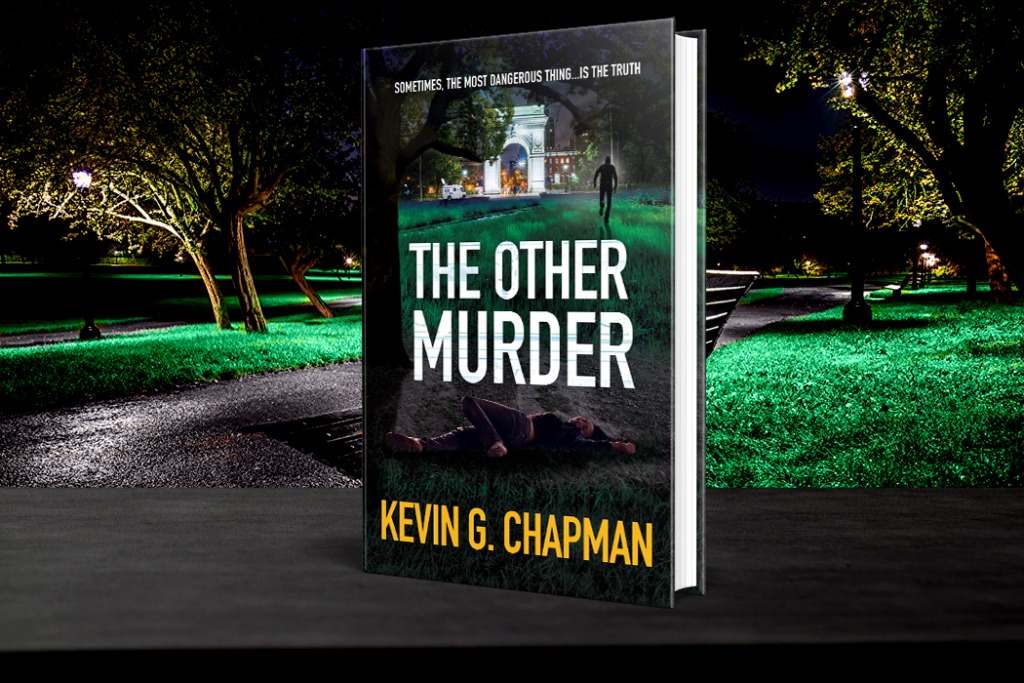
    Kevin G. Chapman, The Other Murder, Park, book cover, trees, grass, city nature

    Chanti: The novel highlights the danger of the truth. Can you elaborate on the significance of this theme and how it plays into the challenges faced by the characters, particularly Hannah and Paulo, as they uncover disturbing facts?

    Chapman: The tag line of the book was one of the first things I wrote after outlining the basic story. “Sometimes, the most dangerous thing…is the truth.” It is a common observation that humans are significantly influenced by what is called in psychology “recency bias.” Your strongest memories and emotions are attached to the things that happened most recently. It is also true in media that the first story is the one that gets imprinted in people’s memories, particularly if it sparks strong emotions. When asked whether one of two things is true, the one you heard first is the one you are more likely to believe.

    One of the core messages of The Other Murder is that people need to be careful about believing the first narrative they hear. But the reality is that, once a set of facts is in your head, it is hard to push it out. This is especially true when the original narrative reinforces your personal views and political objectives. Telling people who are emotionally, financially, and politically invested in one version of a story that the story they heard and want to believe is really a false narrative – is a dangerous thing to do.

    In the media world, once you have established your narrative and “hooked” your audience, it’s hard to switch gears and retain your viewers if you suddenly try to tell them that what you had been telling them is false and that there’s a new truth they should switch to. They are likely to switch – to a different news source that will reinforce their belief in the original story. That is part of the challenge facing Paulo and Hannah.
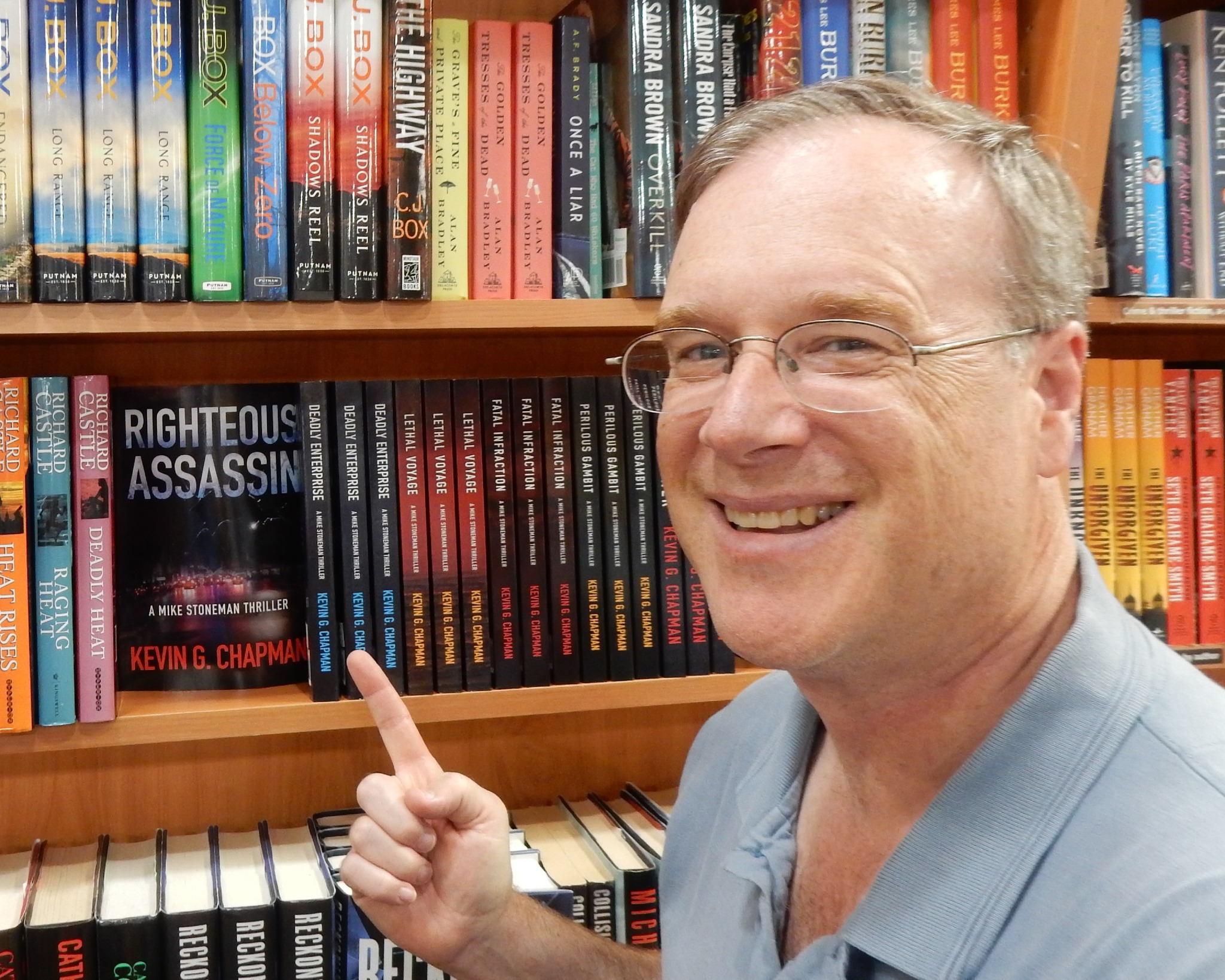
    Kevin Chapman, Mike Stoneman series, author, bookshelves, Pointing

    Chanti: That is so interesting! Do you find you often learn things from writing your books?

    Chapman: I’m always doing research to make sure that I’m getting the facts right in my stories, which can lead me to strange places. Like into the on-board morgue on a cruise ship (of course they have one!) or into the intricacies of how the NFL players’ association collective bargaining agreement treats the bonus money paid to a player who later dies. It’s fun to figure it out, but I almost always need volunteer consultants to help me and keep me honest.

    For The Other Murder, I researched the operation of a cable news network and consulted with a few experts in order to get the details and the terminology correct. I knew the print journalist world already, but merging them together with the police procedural story was a challenge and was fun for me.

    In my next book, I’ve been consulting with a pharmacist friend about drug interactions and how a murderer might use easily available drugs to induce a fatal reaction if you know what other drugs your victim is already taking. Cool stuff!
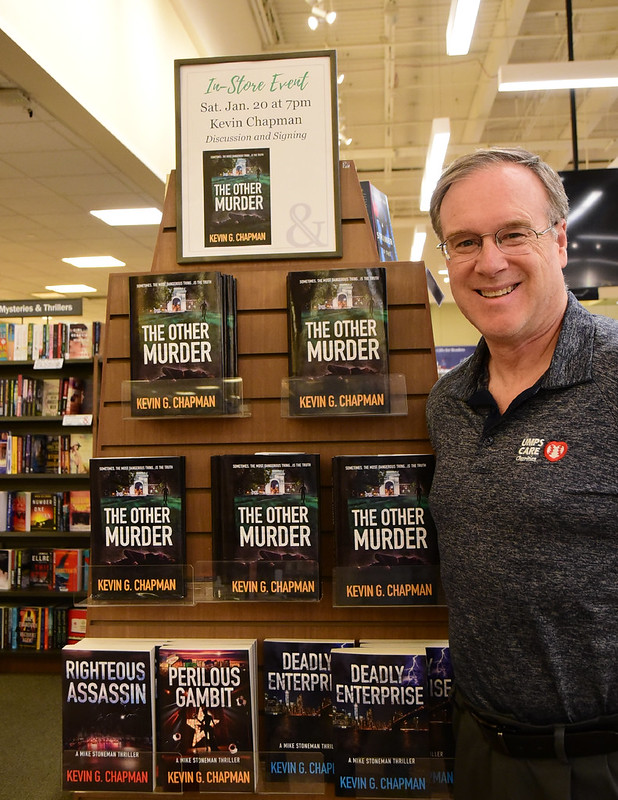
    Kevin G Chapman, Barnes and Noble, Book display, The Other Murder

    Chanti: Are there any secrets in your books that only a few people will find?

     Chapman: Oh, yes! Leaving Easter Eggs that will amuse a few readers who get the joke or the reference is great fun. Even if it’s only my wife and I who laugh. Sometimes it’s a name, a location, or a line of dialogue.

    In The Other Murder, there are several references to things from my last book (Dead Winner). There is a location where key events happened in the last book, and an object that found its way from that book into this one. There are also references to characters from the Mike Stoneman books.

    In the next book, there will be references to the two detectives from The Other Murder, who work in the same homicide division as Mike and Jason. I was even able to put a reference in Mike Stoneman #3 to a character who would be the murder victim in book #4. That’s so much fun.
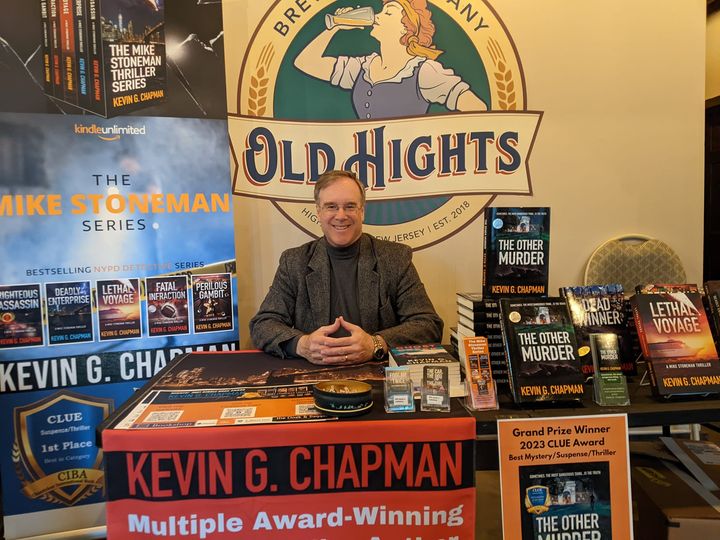
    Kevin G. Chapman, Table read, Old Hights, bookstore

    Chanti: With that in mind, who is the perfect reader for your book?

    Chapman: Lovers of murder mysteries, police procedurals, and romantic suspense will like my books. But what’s more important to me is that my readers be thinkers. If you don’t want anything in your books that raises difficult social/political issues and doesn’t make you examine your own biases and attitudes, then my books may not be for you. I don’t mind if you don’t agree with my characters, and I won’t be offended if you decide you didn’t like my subplots, but I want readers who accept a challenge. I also love readers who like to be surprised and who think they can figure out any mystery. Think you can figure out what happened? I dare you!

    Kevin Chapman, Audiobooks, recording, studio, Teal polo shirt, headphones, microphone
    Kevin G. Chapman recording his audiobook

    Chanti: It’s always a joy to try and figure out the next step as a reader. And speaking of which, what are you working on now? What can we look forward to seeing next from you?

    Chapman: I’m currently in the final editing stage of the next book in my Mike Stoneman thriller series, titled Double Takedown. I left off with Mike, Jason, and the other characters from the series in Las Vegas in January of 2020. I decided that I did not want to write those characters living through the COVID-19 pandemic (interviewing witnesses while wearing masks, etc.). So I wrote two stand-alone books that are not set in any particular year, including The Other Murder. Now, I’m picking up Mike and Jason in the fall of 2023 as they are preparing for a trial stemming from a murder from May of 2022 and investigating a new murder from September of 2023. This story includes a character who is a social media “influencer” and explores what happens when the police develop “tunnel vision” during an investigation. Look for Double Takedown this fall.


    Kevin G Chapman, white man with blue shirt and glasses, CIBA 2023 Clue Award Grand Prize winner for The Other Murder Kevin Chapman writes award-winning suspense/thriller/crime fiction. His books, including The Other Murder, are now available on Amazon in both hardcover and print, and as an ebook on Kindle via Amazon.com at https://www.amazon.com/dp/B0CJN6W5NJ.

    Paperbacks and hardcovers of all his books are also available through select independent bookstores and via Bookshop.org, which supports local bookstores. The audiobook version is available via CHIRP, iTunes, Googleplay, Roku, Nook (Barnes & Noble), LIBRO.FM (which also supports independent bookstores) and on Audible.

    Readers can contact Kevin Chapman, see all his content, and download two free short stories and a free novella at www.KevinGChapman.com.
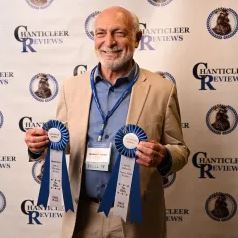
  • Chanticleer 10 Question Author Interview Series with Michael Cooper – Teen & Young Adult, Award-winning book, Dante Rossetti Grand Prize Award, Author Life, Wages of Empire

    CHANTICLEER 10 QUESTION AUTHOR INTERVIEW SERIES

    with Award-Winning Author, Michael Cooper


    A Blue and Gold Badge celebrating the 2022 Dante Rossetti Grand Prize for Michael J. Cooper and his book Wages of EmpireHello friends, we have another fabulous interview for you today. In 2022, Michael Cooper took home the Chanticleer Grand Prize in the Dante Rossetti Awards for his fascinating novel for his book Wages of Empire. Here, he tells us how Wages of Empire came to be and the subsequent heights it is now reaching! Take a minute or two and get familiar with Michael. You won’t be sorry!


    Chanti: Tell us a little about yourself: How did you start writing?

    Michael Cooper: That’s kind of a long story, but I’ll try to keep it under 1,000 words…

    Having been active in Zionist youth groups throughout my formative years, I emigrated to Israel after graduating high school in 1966. Studying in Jerusalem for the first three years, I attended and graduated from Tel Aviv University Medical School. Then, after living, studying, and working in Israel for a total of eleven years, I returned to the US to specialize in pediatrics and pediatric cardiology.

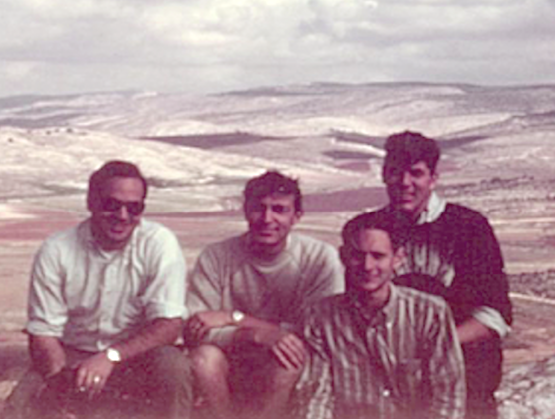
    Newly arrived in Israel 1966 (Michael J. Cooper in middle)
    Michael’s first arrival in Israel (center)

    After working for about fifteen years as a pediatric cardiologist in a large multi-specialty medical care consortium, I found myself disenchanted with some worsening aspects of the approach to patient-centered care. While I wasn’t personally affected by these negative changes since, as a sub-specialist, I had demanded and received the opportunity to design my own practice, however, this wasn’t the case for my primary care colleagues. So, I decided to advocate for them. I began tilting against administrative windmills in the form of impassioned letters, but found that I wasn’t getting anywhere. Though I did enjoy the catharsis of writing those letters!

    Tel Aviv University Medical School is a soft yellow with many windows and angles
    Tel Aviv University Medical School

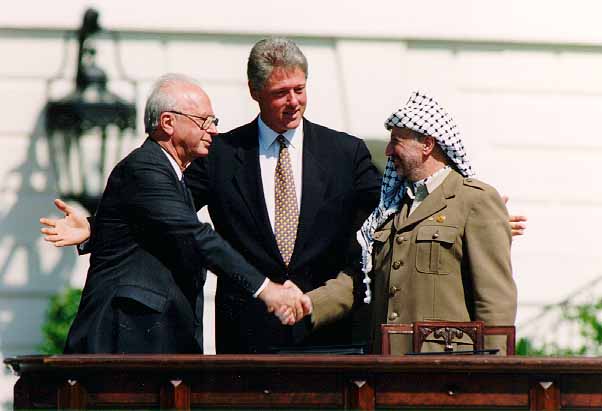
    So, I decided to just enjoy my pediatric cardiology practice, and to redirect my letter-writing to another area of my interest—the Middle East. At this point (the early 1990s) under the leadership of Israeli Prime Minister Yitzhak Rabin, there was finally a real peace process in the form of the Oslo Accords. But to my dismay, there was a good deal of angry push-back to Rabin’s efforts—both in Israel and here in the US. In this environment, I regularly published letters, opinion pieces and essays in support of Rabin’s peace efforts. Needless to say, I received more than a few angry responses.

     Yitzhak Rabin shakes hands with Yasser Arafatat the White House in 1993 as Bill Clinton looks on
    Israeli prime minister Yitzhak Rabin (left), American president Bill Clinton (middle), and Palestinian political leader Yasser Arafat (right) at the White House in 1993

    And as the peace process moved forward, the resistance to it increased. In the Middle East this resistance came from a seemingly bizarre and unholy alliance: on one extreme, ultra-nationalistic Jewish settlers, and on the other extreme, militant Palestinians such as Hamas—strange bedfellows in their vehement opposition to the peace-making efforts. And this angry resistance spilled over—into Israel, into the Jewish Diaspora, into the Arab street, and into the Arab Diaspora.

    In Israel, this resistance reached a fever pitch in 1995 prior to parliamentary elections. Rabin’s efforts were not only rejected by Netanyahu and his right-wing allies, but Rabin was personally vilified as a crypto-Nazi and a traitor to Israel. The risk of his assassination, as assessed by Israeli security services, was high. And, indeed, after a huge pro-Oslo/pro-Rabin demonstration in Tel Aviv on November 4, 1995, Rabin was killed by a right-wing Israeli zealot with two shots to the back.

    The shock to the Israel public and the world-wide Jewish community was profound. And after Rabin’s death, and with the ascension of a right-wing Israeli government under Netanyahu, the peace process grew dormant and eventually, died.

    For catharsis, I initially turned from writing letters and op-ed pieces to writing historical fiction set in the Holy Land at pivotal points of history. This was also my way of trying to insinuate a message of coexistence and peace into a vehicle that, unlike my previous writing, might succeed in changing a few hearts and minds. I began with historical fiction set in British Mandatory Palestine in 1948—Foxes in the Vineyard. This was followed by The Rabbi’s Knight, set in the Holy Land at the twilight of the First Crusade in 1290. Lastly and soon-to-be-released, is Wages of Empire, largely set in Ottoman Palestine at the beginning of WWI.

    Michael J. Cooper listening to a baby with a stethoscope while their mother holds them.
    Michael J. Cooper examining an infant

    Beginning in 2007, I also turned to volunteer work for a US-based NGO (non-governmental organization) offering pediatric specialty services to children within the Palestinian Authority. In doing about two missions per year since then, I’ve attempted to be part of the solution as a pediatric cardiologist for children with limited or no access to care.

    As of this writing, recent events in Israel/Palestine would suggest that things have only grown worse. But I won’t be deterred. I will continue to write, work, speak, and advocate for reconciliation and peace. And, in the words of Forest Gump, “That’s all I have to say about that.”

    And it only took 684 words.

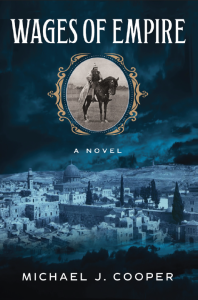
    Wages of Empire by Michael J. Cooper, a grayscale photo in a circle over a blue tinted Jerusalem

    Chanti: When did you realize you that you were an author?

    Cooper: In December of 2011—the first time I held my first published book in my hands.   I had dedicated the book to my big sister, Adrienne. She had fallen ill a few months before, and I was gratified to have been able to share that moment with her before she died.


    Chanti: Talk about genre. What genre best describes your work? And, what led you to write in this genre?

    Cooper: I write in the genre of historical fiction with added elements of mystery, action-adventure, mysticism, and a dash of romance. Having lived in Israel during my formative years (between the ages of 17 to 28), I had fallen in love with the immediacy of history that waited for you around every corner. The historical events and, indeed the historical characters also provided the scaffolding of a story that was, at once, very old, and still being written. As I researched and wrote all three books, I was pleasantly shocked by fascinating elements of hidden history, unsolved mysteries, and unbelievably engaging and bizarre characters that practically wrote themselves into the books.


    Chanti: Do you find yourself following the rules or do you like to make up your own rules?

    Cooper: As mentioned above, the advantage of writing historical fiction is the scaffolding, or to switch metaphors, the loom of the historical timeline you’re working with. As the historical characters move within the fabric of that framework, it’s great fun to weave the fictional characters into the pattern, creating a wonderful tapestry.

    As to rules, I would paraphrase a line from the 1974 movie, Blazing Saddles (replacing the word ‘badges’ with rules), “Rules? We don’t need no stinking rules!” (a version of that line appeared in the 1948 film, The Treasure of the Sierra Madre, and before that in a 1927 novel of the same name).

    Another and more sophisticated way of expressing the same idea is to quote the great Somerset Maugham, who famously said, “There are three rules for writing a novel. Unfortunately, no one knows what they are.”

    Somerset Maugham

    Chanti: What do you do when you’re not writing? Tell us a little about your hobbies.

    Cooper: Having already gone on and on about my work as a pediatric cardiologist for forty years, I would note that I’ve enjoyed running for the past 45 years, though I now do it considerably less often and am considerably slower. I used to play and perform folk music on guitar, banjo, and mandolin, though when I began writing about thirty years ago, I gradually redirected my creative energies away from music. Now that I’m retired, and when I’m not writing, traveling for research, and puttering around the house, I’m hoping to increase my volunteer work in Palestine.

    Michael J. Cooper running in a marathon
    Michael J. Cooper running in a marathon

    Chanti: How do you come up with your ideas for a story?

    Cooper: As noted above, the storylines arise organically from the historical timeline and from the different historical characters—creating a portrait that is enhanced by the fictional characters who allow for additional surprises, plot twists, betrayals, loves and alliances. As the book progresses, it’s a pleasure for me to watch the weave tighten as the different storylines are drawn together. I hope it’s also a pleasure for the reader.

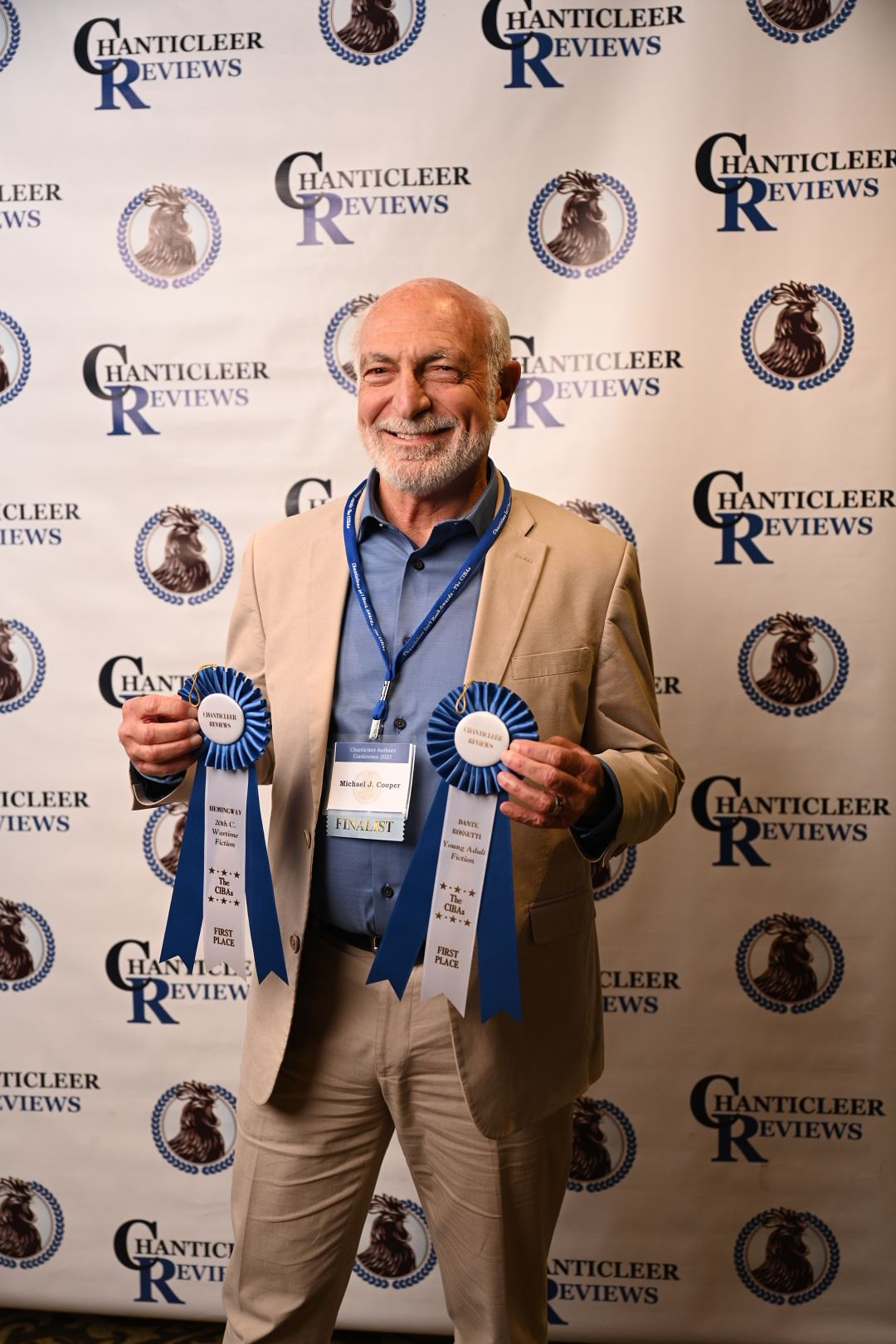
    Michael J. Cooper with his two First Place Ribbons before one is upgraded to a Grand Prize!

    Chanti: How structured are you in your writing work?

    Cooper: Not at all. When I was working full-time, I’d get up early to write or do some research for an hour or so. Then while commuting to work (sometimes up to an hour or more), I’d ruminate about what I’d written or read, and made mental notes about plot twists, opportunities for conflict to build tension, or the need for a particular fictional character to do something unexpected. Once at work, I’d scribble these ideas down during gaps in my workday. After work, (and after the kids’ homework, and once they were asleep), I’d write drafts from the ideas that had germinated during the day. Then I’d print out drafts, bring them with me to work or have them with me on family outings, and during quiet stretches of time, and using a #2 pencil with a functioning eraser, I’d read the draft aloud and edit. At work, that might happen during a lunch break while sitting outside (weather permitting). During family outings, the settings for writing and editing were more varied, ranging from video arcades, amusement parks, ski trips, RV trips, etc. Now that I’m retired and the kids are (generally) on their own, I have vast stretches of time to research and write, but again, without any rigid structure.

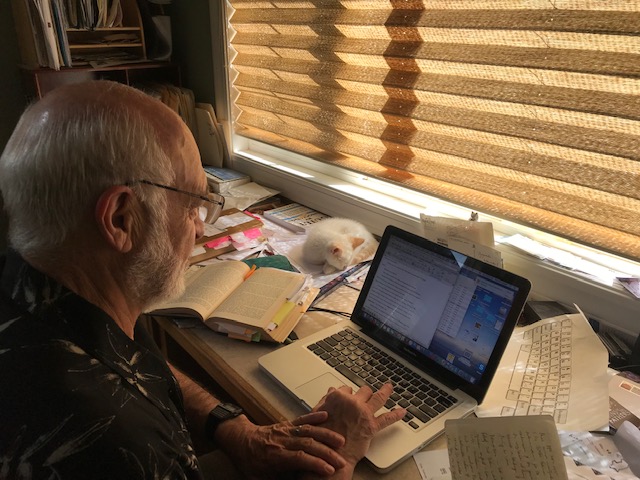
    Michael J. Cooper working with his kitten in the early morning
    An early writing session with the kitten looking on

    Chanti: How does being an author affect your involvement in your community?

    Cooper: During my years as a practicing pediatric cardiologist, I felt that I had a certain degree of “street cred” in my community. And by that, I refer to the quality of being “worthy of respect.” As an author, I feel a certain enhancement of my “cred,” insofar as those who used to vehemently disagree with me about the Israel/Palestine question, now seem more willing to acknowledge an alternative narrative of coexistence and peace instead of confrontation and endless strife.

    Looking at a screen during an appointment in Israel Palestine

    Chanti: What are you working on now? What can we look forward to seeing next from you?

    Cooper: That’s easy. I’m putting the finishing touches on the next book in the “Empire Series,” Crossroads of Empire, which immediately follows Wages of Empire. I’m determined to see it published in 2024. And after that will come the next in the series, End of Empire. At that point, I’ll probably leave it as a trilogy. Or not.

    Note from Chanti: Crossroads of Empire is in the 2023 CIBAs!

    Dante Rossetti Awards for YA Fiction
    Cooper won the Grand Prize in the Dante Rossetti Awards for YA Fiction

     Chanti: Who’s the perfect reader for your book?

    Cooper: Wages of Empire will appeal to a wide swathe of readers beginning with those WWI aficionados who enjoy a thrilling novel of historical mystery with elements of romance and international intrigue. Readers of all ages and particularly young readers will enjoy the classic hero story of a young man coming of age at a pivotal moment in history and risking everything to play a role in the unfolding of history. Likewise, readers coming from diverse backgrounds will appreciate the cross-cultural and universal appeal. And in this turbulent time in the Middle East, readers concerned about the prospects for peace in that troubled part of the world will appreciate an informative and historical narrative of coexistence.

    As it happens, Wages of Empire is a novel about war in a time of war—holding up a mirror that reflects on the current paroxysms of violence in the Middle East, and asking the question: What does that history have to do with the present?

    In a word?

    Everything.


    Michael Cooper

    Michael Cooper writes historical fiction set in the Middle East; Foxes in the Vineyard, set in 1948 Jerusalem won the 2011 Indie Publishing Contest grand prize and The Rabbi’s Knight, set in the Holy Land in 1290 was a finalist for the 2014 Chaucer Award for historical fiction. Coming in December of 2023, Wages of Empire set at the start of WW1 won the CIBA 2022 Hemingway first prize for wartime historical fiction and the grand prize for young adult fiction.
    A native of Berkeley, California, Cooper emigrated to Israel in 1966, studying and working there for the next decade; he lived in Jerusalem during the last year the city was divided between Israel and Jordan and graduated from Tel Aviv University Medical School. Now a pediatric cardiologist in Northern California, he travels to the region twice a year on volunteer missions for Palestinian children who lack access to care. http://michaeljcooper.net/Michael Cooper’s Wages of Empire launches DECEMBER 2023.
    You can pre-order his book from Amazon here and from Barnes & Noble here! Don’t miss out!
  • 10 Question Author Interview with Elizabeth Crowens – Anthologies, Murder Mysteries, Time Travel

    10 Question Author Interview with Elizabeth Crowens – Anthologies, Murder Mysteries, Time Travel

    CHANTICLEER AUTHOR TEN QUESTION INTERVIEW SERIES
    with Elizabeth Crowens

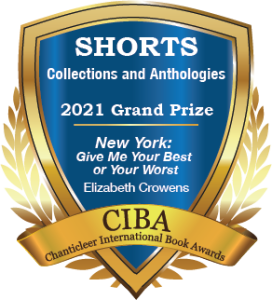
    The 2021 Shorts Grand Prize Badge for New York: Give Me Your Best or Your Worst by Elizabeth Crowens

    Author Elizabeth Crowens has been coming to our conferences (CAC) for a while now – and it is always a good time when she does. In fact, Elizabeth took home the GRAND PRIZE in TWO Divisions in 2021~ The SHORTS Awards for New York: Give Me Your Best or Your Worst and scored majorly in the CYGNUS Awards for A War in Too Many Worlds. And her literary agent just negotiated a 3-Book publishing deal. She is funny, smart, and cares deeply for her fellow authors. In short, she’s a perfect Chanticleerian! I want you to meet her – Elizabeth Crowens.

    Chanti: So, Elizabeth, when did you realize that you were an author?

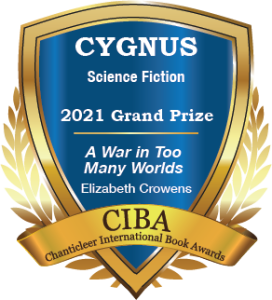
    The 2021 Cygnus Grand Prize Badge for A War in Too Many Worlds by Elizabeth Crowens

    Crowens: When I realized it was too complicated and too expensive to make elaborate feature films all by myself. This, of course, was in the pre-video and pre-smartphone days of motion picture cameras and processing outrageously expensive film stock, of which I had firsthand experience in a film school which touted experimental and avantgarde auteurism rather than commercial productions.

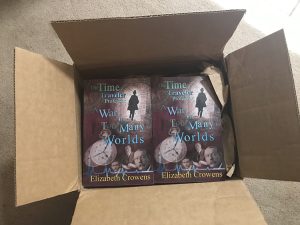
    Although I had the cinematographer’s eye, women in that realm faced a lot of restrictions, so I veered toward screenwriting. Never made my mark in that commercial arena either, but I did start a first draft of a novel, which stayed in my closet for many years until I took it seriously, polished it, and had it published. Now, there are three novels in that series, the latest of which is A War in Too Many Worlds, which won last year’s Grand Prize in the Cygnus Awards. The first book of that series, Silent Meridian, won First Prize in the Goethe Awards, and the second book, A Pocketful of Lodestones, won First Prize in the Paranormal Awards. There will be one more novel, The Story Beyond Time, before I complete my Time Traveler Professor series.


    Chanti: It always amazes me how much you juggle in your work. Good on you! But, how do you come up with your ideas for a story?

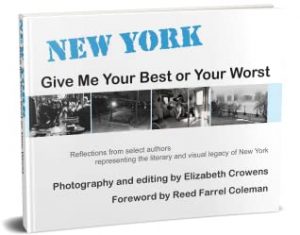
    Crowens: There’s always something personal when it comes to my story ideas. For my anthology, New York: Give Me Your Best or Your Worst, for years I had always wanted to publish a coffee table book using my photography. When I inadvertently stumbled upon an artist’s grant which could give me that New York Give me your best or your worst coveropportunity, I gave it a whirl, not expecting anything to come of it. However, there was one caveat—I had to involve others. That’s when I pitched the project like my popular Caption Contest on Facebook and was really surprised when I won one of those grants. Regarding other stories—they come from all over the place but, once again, there’s always a personal connection some way or other.

    Chanti: How do you approach your writing day?

    Crowens: If I can wake around 4:30 am and write until 9:00 am when the “business day” begins, that’s considered a productive day. It’s quiet then, and I don’t have to worry about being interrupted by robocalls or having to deal with the frustrating mundane stuff like booking doctor’s appointments or arguing with inept billing departments over why I don’t owe their bills. Hate that stuff with a passion, and it totally gets me out of the creative zone.

    Chanti: Ugh. I hate the robo calls! How structured are you in your writing work?

    Crowens: To expand upon the previous question, once I’m out of the zone, there’s no way I can force myself to get back on track. Once I have the spare time, I’ll concentrate on reading or watching a film—in the name of research, of course. Got to stay productive—no matter what.

    Chanti: Smart. What areas in your writing are you most confident in? What advice would you give someone who is struggling in that area?

    Crowens: Dialogue. I think that comes from my screenwriting background. Script length is roughly 110-120 pages. My weakest area would be in setting descriptions and sensory reactions. In screenplays, nearly all of that is eliminated unless it’s vital to the script.

    What it's like to be bi-coastal!
    What it’s like to be bi-coastal!

    Chanti: That’s good advice. You work in novels and film – two very different practices, two very different places – so I want to ask you about your craft. What do you do to grow your author chops?

    Crowens: I attend writer’s boot camps and conferences—a lot of them.

    Chanti: We’re always happy to see you at CAC! What craft books have helped you the most?

    Crowens: Story Trumps Structure by Steven James. Anything by Donald Maas or James Bell. Stephen King’s On Writing is a classic. Writer’s Digest publishes a lot of good ones.

    Chanti: What are you working on now? What can we look forward to seeing next from you?

    Crowens: It might be a while since you see my final alternate history/science fiction novel in the Time Traveler Professor series, because I’ve been concentrating on Hollywood mysteries. One of the reasons why I like entering in the Chanticleer Author Awards is that they allow unpublished manuscripts to A War in Too Many Worlds compete against the published ones. I have three unpublished mysteries which have won first prizes in various categories, and I’m keeping my fingers crossed that the one my agent is currently shopping, will leap beyond a finalist this year in the M&Ms or the Clue Awards.
    Chanti: Best of luck to you in the CIBAs! They don’t let me near them, so luck is the only thing I can offer. Do you ever experience writers block? What do you do to overcome it?

    Crowens: There are two instances where I hit a wall. One I mentioned previously, and that’s when I’m knocked out of the zone. The other is that cooling off period when I’m completely done with a project. During that time, I catch up on a lot of books and movies, many of which have no relation whatsoever to anything I might need for research on a future book. That’s the time to hit my TBR pile. Often, they might be novels from an author I know.

    Chanti: I like how you handle that. It’s productive – and sounds like it’s predictable as well. Good for you! What is the most important thing a reader can do for an author?

    Crowens: Give us reviews! Post them on Amazon, even if it isn’t a “verified sale” on Amazon and you purchased your copy at a retail store or book fair, and on Goodreads. NetGalley. Blog about them.

    Chanti: You heard it from the author, herself! The most helpful thing is to write the review – and talk up the books!

    EXCITING NEWS for Elizabeth Crowens – This just in! 

    We are beyond thrilled to announce that Elizabeth received a 3 Book Deal with her agent, Elizabeth K. Kracht for her Babs Norman 1940s Hollywood Mystery series.  The Deal was announced in Publishers Marketplace. Here’s a link to her website where the good news is also mentioned, and another link to her Facebook announcement: https://www.facebook.com/thereel.elizabeth.crowens

    Now that’s something to crow about!

    Elizabeth entered her unpublished manuscript, Babs and Basil, and the Hounds of the Hollywood Baskervilles, into the Mark Twain Book Awards division of the Chanticleer International Book Awards where it was awarded a First Place Blue Ribbon.

    May be a graphic of text that says 'Publishers Marketplace Deal Report HOUNDS OF THE HOLLYWOOD BASKERVILLES By Elizabeth Crowens Imprint: Level Best Author NEW YORK: GIVE ME YOUR BEST OR YOUR WORST Elizabeth Crowens's HOUNDS HOLLYWOOD BASKERVILLES which charming, failed young actor Hollywood golden age turns private investigator help Hollywood elite Basil Rathbone findA, famous missing canine thespian Hollywood, and growing list other vanished screenland hounds, Verena Rose Level Best, nice deal, three- book deal, for publication spring 2024, Elizabeth Kracht at Kimberley Cameron Associates (NA). liz@kimberleycameron.com Digital: Fiction: Mystery/Crime August 1, 2023'


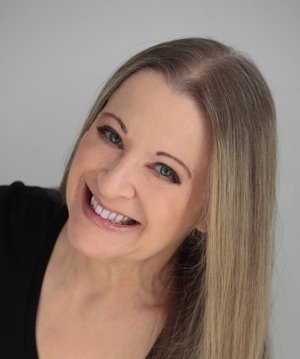
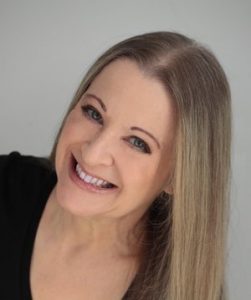
    A white woman with blue eyes and blonde hair smiling against a gray backdropElizabeth Crowens has worn many hats in the entertainment industry in NY and LA for over 25 years. Writing credits include short stories and articles in  Black Belt, Black Gate, and Sherlock Holmes Mystery magazines, stories in Hell’s Heart and the Bram Stoker Award-nominated A New York State of Fright, and three alternate history/SFF novels, which she self-publishes under the name of Atomic Alchemist Productions. Recipient of the MWA-NY Leo B. Burstein Scholarship, NY Foundation of the Arts grant to produce a self-published, photo-illustrated anthology, a Glimmer Train Honorable Mention, an Eric Hoffer Award First Prize, two Grand Prize and four First Prize Chanticleer Review awards. She is represented by Elizabeth K. Kracht at Kimberley Cameron & Associates, is currently writing in the Hollywood mystery genre, and is seeking a traditional publisher.

    If you would like to learn more about Elizabeth Crowens author extraordinaire, please like and follow her on her webpage: https://www.elizabethcrowens.com/