The Rocket Man’s Daughter: A Novel of Family, Faith and Resistance in Nazi Germany by Bruce Gardner tells a harrowing story of German life under the Nazi Regime from 1934 to 1945.
Through the experiences of a young woman whose family is torn by competing loyalties, this riveting tale shines a rarely seen spotlight on some of the most heartwrenching moral dilemmas faced by German civilians and soldiers caught up in the crucible of fascist tyranny and war.
Klara Neumann is the Rocket Man’s Daughter. She’s only fourteen in 1934 when the Führer, Adolf Hitler, finally eliminates all rivals and consolidates his control of Germany under the Nazi Party.
Klara’s family represents a microcosm of the country’s middle socio-economic class, working in government-sponsored roles that demand slavish obedience to the Führer and his decrees. Her father, Erich, is the quintessential ‘rocket man’, a university professor dragged into the Nazi war machine to help his friend and colleague Dr. Wernher von Braun develop the deadly new V-2 rockets intended to terrorize Germany’s future enemies. Her mother, meanwhile, strives to be a dutiful Nazi wife, her brother an honorable Wehrmacht army officer, and her elder sister Elke the devoted leader of a female Hitler Youth section.
Klara—an aspiring nurse—is the philosophical polar opposite of her sister, as Elke is a literal poster girl for the Nazi Party, while Klara does her best to protect her secret Jewish friends from the ever-increasing Nazi persecutions.
As Germany sinks ever deeper into the morass of world war after 1938, the Neumann family members travel further down their divergent paths. Gardner describes with chilling, historically accurate detail the horrific Nazi medical experiments that eventually drive Klara to augment her nursing job by secretly joining a Berlin resistance cell led by relatives of Dietrich Bonhoeffer, the charismatic, anti-fascist Lutheran pastor. Brutally intense, emotionally draining scenes of danger and betrayal follow as Klara and her resistance partners struggle to avoid discovery by a powerful, cunning SS police superintendent who has drawn Klara’s father and sister into his dark web of control and manipulation. Through the ordeal, Klara gradually learns to view her personal sacrifices for the resistance effort as an expected cost of true Christian discipleship, as Bonhoeffer had taught her.
The story moves relentlessly toward its gripping, unforgettable climax in 1945 when Hitler’s V-2 rocket campaign fails to stem the Allied tide and the Soviet Army invades Berlin.
The reader feels the stark terror along with Klara and her fellow citizens as Russian soldiers invade their hiding places and attempt to satiate their pent-up taste for revenge. At war’s end, tensions reach their peak as Klara’s father is hunted down by competing Soviet and American intelligence teams attempting to capture and exploit the expertise of Nazi rocket scientists for their own national purposes in the Space Race to come. Will Klara overcome the seemingly insurmountable odds against rescuing her father from a horrible fate? And can she ever forgive her father’s disreputable wartime decisions and actions?
The defining moral issue, which hangs over everyone involved, is that of responsibility for the terrible crimes of the Nazi regime. On what basis should Nazi-supporting civilians and soldiers be considered war criminals? Were they merely protecting themselves and their families? Were they just following orders? Does that justify their actions?
The Rocket Man’s Daughter expertly depicts the fractures within the fictitious Neumann family to offer the reader some possible answers to these perplexing questions. It’s left to the reader to finally decide.
Despite its expected longer length due to the extended time period and epic nature of the story, The Rocket Man’s Daughter by Bruce Gardner absolutely flies along with suspenseful situations and compelling dialogue the entire way. It’s diverse and vibrant characters raise for the reader many thought-provoking questions about family loyalty, faith, and moral obligation to society under extreme circumstances. In doing so, it proves itself a worthy successor to the author’s previous award-winning novels. The story of Klara Neumann and her family provides yet another example of Gardner’s ability to weave fictional and historical characters into a marvelous portrait of a time and place—one that’s guaranteed to keep readers of wartime historical fiction glued to the page from beginning to end.
The fight against tyranny grips readers and obsesses authors to this day.
“Soldiers, Sailors and Airmen of the Allied Expeditionary Force!
You are about to embark upon the Great Crusade, toward which we have striven these many months. The eyes of the world are upon you. The hopes and prayers of liberty-loving people everywhere march with you. In company with our brave Allies and brothers-in-arms on other Fronts, you will bring about the destrruction of the German war machine, the elimination of Nazi tyranny over the oppressed peoples of Europe, and security for ourselves in a free world.” — Order of the Day from Supreme Headquarters Allied Expeditionary Force given before the Invasion of Normandy
Chanticleer’s Personal Connection to WWII
At Chanticleer we often take particular care to honor veterans and those who serve.
Kiffer’s father retired after 36 years of service in the Unites States Merchant Marines & Marine Corps where he served in the WWII, Korean War, and the Vietnam War. He died in 1981 from one hundred percent service related injuries.
From left to right we have Kiffer’s brother Tony, her father, and Kiffer herself in Hawaii during the territory days. Her mother, Antha May, is taking the photo
David’s grandfather also served during WWII, stationed in France as a first generation Quebecois transplant in the United States
Robert Gerard Beaumier Sr. who served in WWII
My father would often tell the story of how his grandfather, Robert, was in France during World War II. At one point a dog came and wouldn’t stop barking at his unit, no matter how much they told it to go away. Finally, Robert said “Va t’en!” and immediately the dog ran off. Everyone was suitably impressed that the dog spoke French! — David
The National World War II Museum in New Orleans has an excellent summary of the lead up and importance of D-Day which we recommend you read here.
Most chilling perhaps is the closing of their thoughts that emphasize how important the landing on Normandy was:
The Normandy invasion was one of great turning points of twentieth-century history. An immense army was placed in Nazi-occupied Europe, never to be dislodged. Germany was threatened that same month by a tremendous Soviet invasion from the east that would reach the gates of Berlin by the following April. The way to appreciate D-Day’s importance is to contemplate what would have happened if it had failed. Another landing would not have been possible for at least a year. This would have given Hitler time to strengthen the Atlantic Wall, harass England with the newly developed V-1 flying bombs and V-2 rockets, continue to develop jet aircraft and other so-called “miracle weapons,” and finish off his killing campaign against ethnic and sexual undesirables.
It is our pleasure to share these wonderful WWII books with you from authors who have written about this time.
The JøSSING AFFAIR
By J. L. Oakley
At a time when true identities are carefully protected and information can get you killed, heroes emerge to fight the evils of Nazi-occupied Norway in J.L. Oakley’s highly suspenseful and beautifully penned historical fiction novel, The Jøssing Affair.
In a quiet Norwegian fishing village during the Nazi occupation, risk lurks everywhere. Most residents are patriotic members of the resistance, “jøssings,” but there are “quislings,” too. Those who collaborate with the Germans and tout the Nazi propaganda of Nordic brotherhood between the nations. Mistaking the two is a matter of life and death.
THE SILVER WATERFALL: A Novel of the Battle of Midway
By Kevin Miller
In The Silver Waterfall, author retired U.S. Navy Captain Kevin Miller reveals the intricate and deadly turns of the Battle of Midway, a combat shaped by transforming warfare, and one that would in turn shape the rest of WWII’s Pacific Theater.
After their surprise attack on Pearl Harbor, the Japanese Navy seeks to draw American aircraft carriers into an ambush, to secure Japanese power over the Pacific. In a time of great upheaval for warfare technology, aircraft carriers dominated both sea and sky. So, to destroy the USS Enterprise, Yorktown, and Hornet, Chūichi Nagumo— commander of the Japanese First Air Fleet— brings to bear his own four carriers, HIJMS Akagi, Hiryū, Kaga, and Soryu.
GENERAL in COMMAND – The Life of Major General John B. Anderson
By Michael M. Van Ness
Michael M. Van Ness, the grandson of “the general in command,” has created a remarkable biography chronicling the adventures of a farm boy who rose high rank in the US military and served with distinction in two world wars as a combatant, officer, and sage observer.
Born in 1891, John Benjamin Anderson must have had considerable intelligence as well as patriotism and grit, since he was accepted at West Point Military Academy at age 19, an honor conferred on only 130 applicants per year—and finished in the top third of his class. He would soon serve under General Pershing in the Mexican War, giving him the experience of combat and coincidentally, his first ride in an automobile. That deployment earned him inclusion in Pershing’s ranks in World War I. It was then his diaries began, and though he protested humorously that “I hate to write,” these personal recollections give readers an up-close picture of the devastation of warfare.
COLD PEACE: A Novel of the Berlin Airlift, Part 1
By Helena P. Schrader
Amidst the ruins of Post-WWII, Berlin struggles to rebuild from the ashes, torn apart and facing down the promise of another bloody dictator. A myriad cast, all shaped by that same war, become entwined with the broken city as its hour of need approaches.
Just as Germany is divided between the Americans, British, French, and Soviets, Berlin has been cut into pieces. But the balance of the occupation powers tips eastward as the Soviet Zone surrounds the city, giving them control of all ways into and out of Berlin – save for the air. The occupation currency is worthless thanks to Soviet over-printing, leaving Berlin on a barter system of cigarettes and black-market trading. In order for Germany to recover, the Western Allies plan to introduce a new currency, even if it angers the Soviet bear.
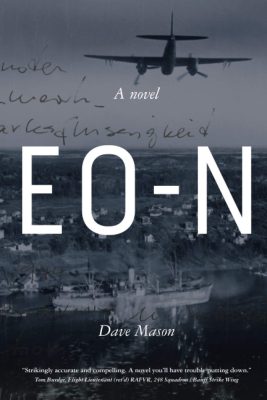
A young boy in Norway makes a discovery while playing with his dog, opening the mystery of EO-N by Dave Mason, a detective story spanning multiple decades and both sides of the Atlantic, a deep dive into the horrors of Nazi Germany, and a heartfelt love story.
A small metal fragment leads to the discovery of a downed WWII twin-engine Mosquito fighter-bomber hidden in snow and glacial ice for nearly 75 years. The crash site yields an initial set of clues, one of which finds its way across the world to Alison Wiley, a biotech CEO in Seattle. Having recently lost her mother, and, a few years earlier, her brother in Afghanistan, she finds her days full of despair, but the discovery makes a distant connection to her long-lost grandfather, and she flies to Norway. There, she meets Scott Wilcox, a Canadian researcher assigned to investigate the discovery after his government learned that the crashed aircraft belonged to the Royal Canadian Air Force. Their attraction is both intellectual and emotional, but the quest to uncover the plane’s mysteries and the fate of Alison’s grandfather place any romance to the side.
In The Sower of Black Field, Katherine Koch’s historical fiction novel, Father Viktor Koch— a 67-year-old Catholic priest— presides over a monastery in a small German village, as the Nazi regime sweeps through the country.
The time is April, 1941. Fr. Viktor’s order, the U.S.-based Passionists, built the monastery eight years prior, providing employment for most of the villagers and remaining a symbol of their faith.
DEAR BOB: Bob Hope’s Wartime Correspondence with the G.I.s of World War II
By Martha Bolton with Linda Hope
During World War II, Bob Hope traveled almost ceaselessly to outposts large and small, entertaining US troops – and inspiring them; Martha Bolton brings the extent of this work to light in Dear Bob.
Writer Martha Bolton worked with and for comedian Bob Hope. Now, with Hope’s daughter Linda, she has gathered and organized the letters written to Bob by the soldiers he helped.
Hope, English born, and born to entertain, once said he could not retire and go fishing because “Fish don’t applaud.” Among his sizzling lines – and there are hundreds recorded here – he told one audience that he’d gotten a wonderful welcome when he arrived at their camp: “I received a 10-gun salute… They told me on the operating table.”
Eighty Years later, and the sacrifices made in WWII still matter and the fight for a more just world continues. Thank you to everyone who has submitted books to us and been a part of our own journey and learning.
A young boy in Norway makes a discovery while playing with his dog, opening the mystery of EO-N by Dave Mason, a detective story spanning multiple decades and both sides of the Atlantic, a deep dive into the horrors of Nazi Germany, and a heartfelt love story.
A small metal fragment leads to the discovery of a downed WWII twin-engine Mosquito fighter-bomber hidden in snow and glacial ice for nearly 75 years. The crash site yields an initial set of clues, one of which finds its way across the world to Alison Wiley, a biotech CEO in Seattle. Having recently lost her mother, and, a few years earlier, her brother in Afghanistan, she finds her days full of despair, but the discovery makes a distant connection to her long-lost grandfather, and she flies to Norway. There, she meets Scott Wilcox, a Canadian researcher assigned to investigate the discovery after his government learned that the crashed aircraft belonged to the Royal Canadian Air Force. Their attraction is both intellectual and emotional, but the quest to uncover the plane’s mysteries and the fate of Alison’s grandfather place any romance to the side.
At first, the crash doesn’t appear exceptional, until certain contradictory and confusing clues emerge that make it clear that the circumstances that led to the plane’s fate were anything but simple.
EO-N’s story is complex, leading the reader from clue to revelation with a sure hand. And it takes a dark secret from the past and develops it into something that might make the world a better place.
The details are key to the novel’s success. Readers will wonder whether the facts outlined in the book are based on actual history, and while the specifics of the heinous Nazi activities at the center of the story may differ somewhat from reality, the spirit of the revelations rings true.
This novel is impeccably researched, and the characters are believable, warm, and heartbreaking. Readers won’t be able to put it down until its perfect conclusion.
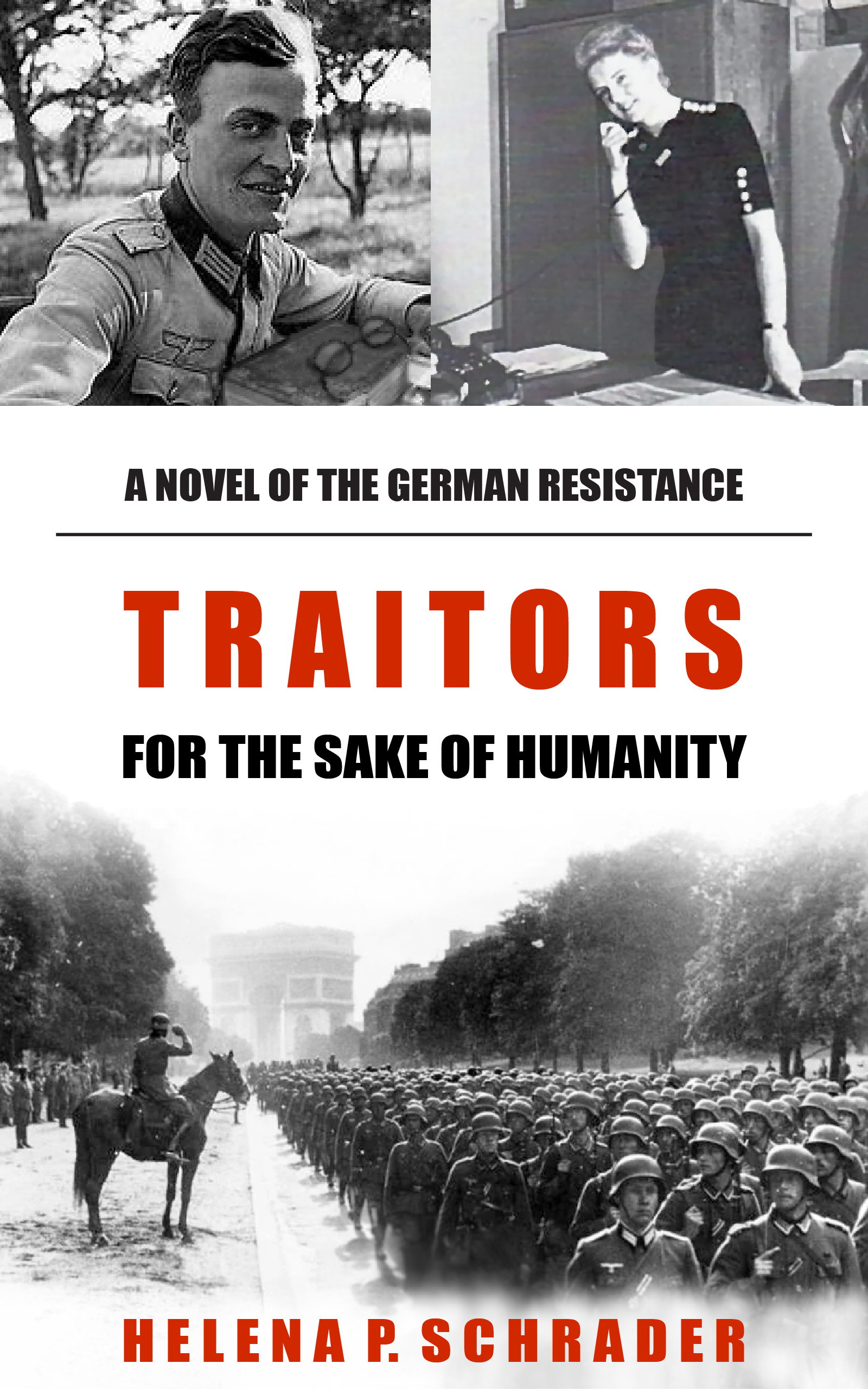
Traitors For the Sake of Humanity by Helena P. Schrader may be more terrifying today than when first released in 2008 as An Obsolete Honor and re-released in 2012 as Hitler’s Demons.
The chilling story reveals the means used under the leadership of Adolph Hitler to spread insidious Nazi socio-political ideology before and throughout WWII. Although a work of fiction, the grim, dehumanizing social transformation the tome reveals brings to mind the caution in George Santanya’s oft-quoted posit, “Those who cannot remember the past are condemned to repeat it.”
Schrader masterfully utilizes the setting as an unseen, omnipresent character. Scenes imbued with equal parts of detached cruelty, greed, and hunger for power – acting as a control agent affecting everyone within its grasp.
By Christmas, 1938, when the story begins, the Nazi Party dominates the German Parliament for nearly six years, and its influence alters the nation’s face. Within that period, during which Hitler becomes Chancellor, both welcome and unwelcome changes occur and spread beyond Germany’s large cities into and throughout the countryside.
The German citizenry is conflicted.
Many poor, disenfranchised citizens consider forfeiting their faith, culture, and free will for materially improved living standards and restoring their national pride as an acceptable trade-off. Others grow dismayed by the denigration and annihilation of traditional values, virtues, and mores. Residents find the mandated, unfettered obedience to the state’s authority and the flourishing of Machiavellian values an abomination.
Within this setting, we meet the aristocratic, well-educated, and cultured Baron Phillip von Feldburg. Phillip, the eldest of three children, is an officer in the prestigious German General Staff and has been imbued from childhood with the importance of honor, integrity, and allegiance to his country.
In the first chapter, Baron von Feldberg is juxtaposed with his immediate family, characters Schrader utilizes to reveal some of the varying socio-political views prevalent in Germany.
Christian, his handsome, devil-may-care Luftwaffe fighter pilot brother, lives in the moment, exhilarated by his conquests and the thrill of adventure. Theresa, an envious, entitled, and defiant “youngest child,” marries an uneducated, self-made man with a knack for doing business in the Nazi regime and little use for breeding, manners, or culture. Their widowed mother, the Baroness, gracious, kind, and concerned – but not enough to make waves—completes the family circle.
Phillip’s sense of honor and duty dominates his life, both personally and professionally.
As he advances within the military and is given more and more leadership responsibility, he begins to have troublesome questions about the decisions coming “down,” along with the ongoing, less-than-honorable actions and events he witnessed while serving on the front lines against Russia. Not until he meets the astute and savvy secretary with connections, Alexandra Mollwitz, that he begins to act upon his inner conflict, and his life begins to change in ways he could never have imagined.
Presented in multiple points of view of the von Feldburg family members, cohorts, and supporters, Schrader breathes life into some of the historically documented events occurring in Germany before and including WWII that forever changed the world. Each of their voices reflects their social status, belief systems, and loyalties—and their angst and fears as change turns evil and evil turns deadly.
Traitors For the Sake of Humanity, based upon documented historical events and personal memoirs recounted to the author by individuals who lived through that time.
In the end, the importance of this book cannot be underestimated. Traitors for the Sake of Humanity rises as a critical, provocative, and timely book that perhaps we would all benefit from reading. The Glossary and documentation alone impress.
Helena P. Schrader puts a human face on some “monsters,” and exposes the monster faces of others. Kudos, Dr. Schrader.