Tag: Native American Literature

  • Indigenous Peoples’ Day and a Spotlight on the Laramie Awards

    Indigenous Peoples’ Day and a Spotlight on the Laramie Awards

    Recognizing and Celebrating Indigenous Peoples Day and Discussing our Laramie Awards.

    It’s October 11th, which in Bellingham, Wash. means it’s Indigenous People’s Day. We believe in recognizing the rich history and contributions of native peoples here in the Americas, and are always working to expand our knowledge and understanding. To that end, we would like to acknowledge that our company is located in downtown Bellingham which is the ancestral home of the Coast Salish Peoples who lived and still live here today. They have a strong connection with the Salish Sea—the marine ecosystem that spans the United States-Canada coastal waterways from Olympia, Wash. to Comox, British Columbia, Canada.

    Coastal Salish Annual Tribal Journey on the Salish Sea. Approximately 100 canoes participate in the Potlatch.

    There are more than 65 Tribes and First Nations who have lived here for tens of thousands of years. Primarily, the Lummi and the Nooksack Nations reside here in Whatcom County by the Salish Sea. Whatcom is Salish for “noisy water.”

    The name Salish Sea was officially recognized by the United States in 2009 and Canada in 2010. Click here if you would like to know more about the Tribal Canoe Journeys: Paddle to Lummi

    Members of the Lummi Tribe in the PNW

    Indigenous People’s Day began to be celebrated as far back as 1991, with people suggesting it be celebrated as far back as 1977! Of course as most people know, the holiday was intentionally created to overlap, and in some places, replace Columbus Day. Why? History.com offers an answer:

    Some may ask why replace Columbus Day with Indigenous Peoples’ Day? Activists have long argued that holidays, statues, and other memorials to Columbus sanitize his actions—which include the enslavement of Native Americans—while giving him credit for “discovering” a place where people already lived.

    While there’s no denying that the bloody history of Columbus that has been sanitized throughout historical retellings, the original origin of Columbus Day was never meant to celebrate the brutalization of the people who lived on this side of the hemisphere. Within 60 years after Columbus landed, only a few hundred of what may have been 250,000 Taino were left on their island (currently known as the Dominican Republic in the Caribbean). History.com

    The holiday originated as an annual celebration of Italian-American heritage in San Francisco in 1869. In 1934, at the request of the Knights of Columbus and New York City’s Italian community, President Franklin Delano Roosevelt declared the first national observance of Columbus Day. (Smithsonian Magazine)

    President Franklin Delano Roosevelt

    Of course, as we learn more, we always aim to improve and progress as a society and as a country, working for the betterment of all, we can make updates and changes to reflect history more accurately and remember those who have been wronged in the past. Toward that end, we’d like to take a look at our Laramie Awards.

    Spotlight on Laramie Awards
    Western Pioneeer Civil War Fiction Award
    This artwork is from a 1907 postcard. The artist is unknown. The Laramie Awards recognize the best in Americana fiction.

    The word Laramie has French origins, meaning The Leafy Grove. However, Kiffer named the Laramie Book Awards after Laramie, Wyoming when she lived just south of there when in Fort Collins, Colorado.  Laramie was named for Jacques LaRamie, a French-Canadian trapper. He was one of the first Europeans to visit the area (1820s). He disappeared into the local mountain range.  Laramie was founded in the 1860s as a “tent city” as a stopover on the Overland Stage Trail that was needed for the development of the first transcontinental railway.

    In spite of having stores, houses, a school, and churches, Laramie was known for its rough frontier town lawlessness led by the town’s first marshal (Big Steve Long) who was a notorious gunman and a brutal bully who murdered dozens of Laramie’s people. It wasn’t until October  28, 1868  that some of the townspeople led by the county’s sheriff and fellow rancher, N.K. Boswell, fought back and lynched the marshal and his accomplices, thereby bringing some sort of law and order to Laramie.

    It is also said that it was the women who tamed Wyoming.

    In 1869, Wyoming with Laramie leading the way, was the first legislature led entirely of men that empowered women with voting rights and to hold office. In March 1870, five Laramie women became the first women in the world to serve on a civil jury. It was a Laramie woman, Louisa Swain, who was the first woman to cast a legal, recognized vote in a United States general election on September 6, 1870.
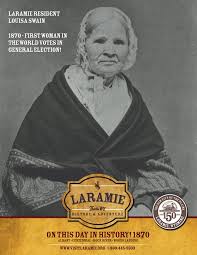
    In 1890, when Wyoming petitioned Congress to for statehood the U.S. Congress pushed back stating that Wyoming’s woman suffrage was obstacle and was delaying approval. The legislature, via a telegram from Joseph M. Carey (who later became governor of Wyoming), replied to the threat, “We will stay out of the Union a hundred years rather than come in without our women.” It was a very close vote in the U.S. Congress of 139 for – 127 against.

    In 1890, Wyoming became the 44th state—with the women.

    And those weren’t the only female firsts that took place in Wyoming. The first female governor was elected in Wyoming and the nation’s first woman to be appointed to public office was done so in South Pass City, Wyoming. In addition, the Equality State is home to the first female jurors, the world’s first female bailiff and the first town that was governed entirely by women.

    It would be another 50 years before the Nineteenth Amendment would be passed into law on August 18, 1920 granting the right to vote regardless of the gender. We invite you to read our post that pays homage to the Suffrage Centennial.

    Native American women would not be able to vote until the passage of the Indian Citizenship Act June 2, 1924.   

    Native Americans in their traditional attire holding American flag at the Lincoln Memorial building. STUNNING images of the indigenous Native Americans have been brought back to life through vivid colorization. The remarkable pictures show the group during the 1920s, with some of the leaders meeting with then American president, Calvin Coolidge, at the White House.

    The Indian Citizenship Act still didn’t offer full protection of voting rights to Indians. As late as 1948, two states (Arizona and New Mexico) had laws that barred many American Indians from voting, and American Indians faced some of the same barriers as Blacks, until the passage of the Civil Rights Act of 1965, including Jim Crow-like tactics and poll taxes.

    The last state to guarantee voting rights Native people was Utah in 1962.

    – [Information from the Constitution Center]. 

    The Voting Rights Act of 1965 was the most significant statutory change in the relationship between Federal and State governments in the area of voting since the Civil War.  The act prohibited poll taxes, intimidation tactics, harassment, physical violence, or economic reprisals for voting in civil elections.  OurDocuments.gov

    Sadly, tragically, Laramie is also known for the inhuman murder of Matthew Shepard on October 12, 1998. It seems that bullying can still find cracks to rear its ugly head. Yet, once again the people of Laramie were not going to put up with it. Law and justice were served.

    Americana Fiction

    We recently changed the description of the Laramie Awards from “Western Fiction” which could mean a great many things, to “Americana Fiction.” A quick search for Western Fiction shows that it refers the American Old West that takes place anywhere from late 18th to the late 19th century. While this covers our categories of Pioneer and Civil War (the pioneer period is often referred to as 1760-1850 with the Civil War raging from 1861-1865). Also, great contemporary Western Fiction such as  New York Time’s bestselling author and the basis for the hit Netflix series, Craig Johnson’s (a Wyoming author) Longmire Series.

    And we can’t forget Jim Harrison’s works. You might be familiar with one of his stellar works—Legend’s of the Fall.

    Legends of the Fall book cover before the film was made of it.


    On the other hand, Americana Fiction is defined by Goodreads as “Novels that help tell the history, culture and folklore of what makes Americans uniquely American.” You can even see a list here of what they consider to be Americana Fiction, which really shows the wide, incredible expanse, that Americana Fiction and history can transcend, though we tend to consider it more of a historical genre than some of these incredible books are.

    We made this change to promote a more accurate and inclusive representation of what we are accepting for the Laramie Awards.


    So what are some excellent reads featuring indigenous identities that have already been vetted by Chanticleer you might enjoy? We’re glad you asked!

    Jerkwater
    By Jamie Zerndt
    Somerset Award Winner

    Jerkwater cover

    Three friends in Mercer, Wisconsin find ways to deal with their problems amid a racist town in Jamie Zerndt’s Jerkwater.

    Shawna Reynolds’ life changed when her white stepdad murdered her Ojibwa mother. Now living with her Naan (grandmother), Shawna surrounds herself with those who make her feel most comfortable. Besides Naan, she clings to her horse Seven, her behind-the-scenes Ojibwa boyfriend Elmer, and two white friends: Kay O’Brien and her son Douglas. But racial tension cuts through the town of Mercer itself, galvanized by a fight over fishing rights.

    Read more here…


    The Conscious Virus
    By Miki Mitayn

    The Conscious Virus Book Cover Image

    Dr. Nerida Green travels across Australia, tending to struggling communities and connecting with her wife Mari—as well as the three spirits who Mari channels through her body, in Miki Mitayn’s climate-fiction novel The Conscious Virus: An Aedgar Wisdom Novel.

    Nerida works sporadic jobs as a doctor, from the mining community of Newman to the small town of Fitzroy Crossing, and back east to a disappointing stint at a naturopathy clinic in Byron Bay. Between her working hours, Nerida speaks with M’Hoq Toq, the Native American medicine man, Bartgrinn the Celtic druid, and Aedgar, an ancient being of the Earth. Nerida asks the spirits for their opinions on topics as broad as climate change and as narrow as her personal matters, engaging them in deep conversation.

    Read more here…


    Wanders Far
    By David Fitz-Gerald
    Laramie Award Winner

    Wanders Far A man who appears native with a red handprint across a face covered in white paint

    An engaging history of ancient Native American peoples is brought to magical life by author David Fitz-Gerald.

    In the early 1100s, in a region now known to us as the Adirondack Mountains of northern New York, a small band of tribal people is living in longhouses, growing crops, fishing, hunting, and enjoying certain rituals such as face and body painting, occasional migration for food survival, and even seasonal “vacations,” all while willingly obeying a simple form of governance with elements of basic democracy. In this tribe, we meet Wanders Far, a child who earns his nickname after showing a propensity to disappear and explore since he could walk. His mother, Bear Fat, is the recognized chieftainess of their group, mother of a large brood, one of whom is stolen as the book opens. Wanders Far would be considered an unusual child in any society, gifted with a highly accurate memory and the ability to visualize future events. He can also run like the wind, and with his love for travel, he is often the first to see and warn his people of danger, such as a cadre of warriors from a hostile tribe heading towards his home settlement.

    Read more here…


    Buck: Keeper of the Meadows
    By Gloria Two-Feathers

    Cover of Buck: Keeper of the Meadows, a fuzzy green wash inside of wooden looking frame

    In this engaging children’s tale by author Gloria Two-Feathers, a young colt named Buck will learn how to obey, how to defend, and how to strike out on his own.

    The scene is set in the Great Plains, where a river named Minisose divides a sea of tall green prairie grass. Many animals call that grassland their home, and the most magnificent is the herd of wild horses led by a dark stallion named Plenty Coups and his chosen mate, the lovely cream-colored mare, Cloud. By tradition and instinct, Plenty Coups protects the herd from attackers, while Cloud leads them to safety.

    Read more here…


    Have a great story focusing on Americana Fiction?

    When you’re ready, did you know that Chanticleer offers editorial services? We do and have been doing so since 2011.

    Our professional editors are top-notch and are experts in the Chicago Manual of Style. They have and are working for the top publishing houses (TOR, McMillian, Thomas Mercer, Penguin Random House, Simon Schuster, etc.).

    If you would like more information, we invite you to email Kiffer or Sharon at KBrown@ChantiReviews.com or SAnderson@ChantiReviews.com for more information, testimonials, and fees.

    We work with a small number of exclusive clients who want to collaborate with our team of top-editors on an on-going basis. Contact us today!

    Chanticleer Editorial Services also offers writing craft sessions and masterclasses. Sign up to find out where, when, and how sessions being held.

    A great way to get started is with our manuscript evaluation service, with more information available here.

    And we do editorial consultations for $75. Learn more here.  

    If you’re confident in your book, consider submitting it for a Editorial Book Review here or to one of our Chanticleer International Awards here.

    Also remember! Our 10th Anniversary Chanticleer Authors Conference (CAC22) will be April 7-10, 2022, where our 2021 CIBA winners will be announced. Space is limited and seats are already filling up, so sign up today!  CAC22 and the CIBA Ceremonies will be hosted at the Hotel Bellwether in Beautiful Bellingham, Wash. Sign up and see the latest updates here!




  • The CONSCIOUS VIRUS: An Aedgar Wisdom novel by Miki Mitayn – Native American Literature, Metaphysical & Visionary Fiction, Magic Realism Fiction

    The CONSCIOUS VIRUS: An Aedgar Wisdom novel by Miki Mitayn – Native American Literature, Metaphysical & Visionary Fiction, Magic Realism Fiction

    Dr. Nerida Green travels across Australia, tending to struggling communities and connecting with her wife Mari – as well as the three spirits who Mari channels through her body, in Miki Mitayn’s climate-fiction novel The Conscious Virus: An Aedgar Wisdom Novel.

    Nerida works sporadic jobs as a doctor, from the mining community of Newman to the small town of Fitzroy Crossing, and back east to a disappointing stint at a naturopathy clinic in Byron Bay. Between her working hours, Nerida speaks with M’Hoq Toq, the Native American medicine man, Bartgrinn the Celtic druid, and Aedgar, an ancient being of the Earth. Nerida asks the spirits for their opinions on topics as broad as climate change and as narrow as her personal matters, engaging them in deep conversation.

    While Nerida and Mari travel, the Coronavirus makes its appearance on the world stage, and shortly after that, Australia. Nerida manages to find them a safe place to live through quarantine, but her role as a doctor weighs heavily on her as the pandemic picks up steam. She turns to the advice of her ephemeral friends, who at once soothe her heart and spark her worries.

    The Conscious Virus tackles current global issues, both through Nerida’s personal experience and the wisdom of the spirits.

    Climate Change hurts the vulnerable people whom Nerida cares for, and as the spirits tell her, disrupts the natural systems and energies of the planet. Covid-19 spreads amongst people who are profoundly unprepared for a pandemic, while the entities try to communicate the metaphysical nature of the pandemic.

    All three spirits have distinct voices, filling their conversations with personality and the unique word-choice of people who haven’t walked the Earth in centuries. Their beliefs mesh with Nerida’s as often as they clash. She connects with them through their philosophy and deep thoughts on the world, but she struggles to understand their often very unscientific perspectives. How much of what they say is metaphorical, and how much is literal? Will Nerida side with the wisdom of the spirits or with the research and knowledge of her peers?

    Between Nerida’s lengthy conversations with the spirits, she and Mari experience the beauty and difficulties of the material world. Mitayn paints Australia with beautiful descriptions, full of color and heat and smells. The world becomes tangible as Nerida walks and drives through it. Her life with Mari is a grounded and realistic one, concerned with whether the air conditioning will keep working, how they’re going to find a place to stay along their travels, and how they should treat each other to maintain a relationship of love and respect. They meet and reconnect with many interesting people, creating a collection of vignettes across their journey.

    This story explores many facets of the modern world and its struggles.

    The lives and work of Aboriginal people often take center stage, as Nerida – an Aboriginal woman herself – understands the unique challenges they face. Nerida, Mari, and the spirits tell an engaging and deeply thoughtful story about LGBT+ identity, racist systems, and how entire groups of people are pushed down by the interests of the rich and powerful. Mitayn takes none of these issues lightly but instead gives them the time and consideration that they deserve.

    Jumping between past, present, and future, The Conscious Virus creates not just a compelling image of the modern world – but also of how the future might play out depending on whether people face their trials with wisdom and compassion – or something so pointless as greed.


    5 Star Best Book Chanticleer Reviews round silver sticker

  • WANDERS FAR – An Unlikely Hero’s Journey: Part of the Adirondack Spirit Series by David Fitz-Gerald – Native American Literature, Historical Fantasy Fiction, Folklore

    WANDERS FAR – An Unlikely Hero’s Journey: Part of the Adirondack Spirit Series by David Fitz-Gerald – Native American Literature, Historical Fantasy Fiction, Folklore

    An engaging history of ancient Native American peoples is brought to magical life by author David Fitz-Gerald.

    In the early 1100s, in a region now known to us as the Adirondack Mountains of northern New York, a small band of tribal people is living in longhouses, growing crops, fishing, hunting, and enjoying certain rituals such as face and body painting, occasional migration for food survival, and even seasonal “vacations,” all while willingly obeying a simple form of governance with elements of basic democracy. In this tribe, we meet Wanders Far, a child who earns his nickname after showing a propensity to disappear and explore since he could walk. His mother, Bear Fat, is the recognized chieftainess of their group, mother of a large brood, one of whom is stolen as the book opens. Wanders Far would be considered an unusual child in any society, gifted with a highly accurate memory and the ability to visualize future events. He can also run like the wind, and with his love for travel, he is often the first to see and warn his people of danger, such as a cadre of warriors from a hostile tribe heading towards his home settlement.

    Fitz-Gerald’s book interweaves family chronology, legend (such as tales of Hiawatha), and fact-weighted history into what is essentially a human drama focused on the personal lives of Wanders Far and his cultural community. Through the happenings described, we learn more about how such indigenous people survived and progressed. We see them fishing, hunting, and foraging, as well as loving, celebrating, and mourning. One dominant theme concerns the mixture of tribes in the area – Mohawk, Onondaga, Oneida, Cayuga, and Seneca. We see how they interact, with some being more generally friendly and others being enemies who may become allies as, in the future, they will meld into what is called The Iroquois Confederacy, serving a significant role in the founding of the first European colonies. We see Wanders Far and his relatives – all with earthy, practical names like Squash, Gentle Breeze, and Big Canoe – as real people who laugh and cry, fall in love, make war and form alliances in their nature-bound, intuitively guided, pre-technological circumstances.

    Imbuing his hero with “second sight” along with exceptional physical prowess, Fitz-Gerald states that he was drawn to compose the story of Wanders Far through his own powers of imagination coupled with a fascination for the region where he himself has lived and explored. He draws a dynamic portrait of how specially gifted people were and can still be welcomed into the fold despite their differences. Wanders Far will experience a long life, here skipping from his early twenties to his mid-seventies, and readers will hope that a future novel may reveal more of the exploits of his full manhood. A small hint at the book’s end alludes to a distant identity and makes us want to see more from this multi-talented, highly creative author.

    Wanders Far won First Place in the CIBA 2019 Laramie Awards for American Western Fiction.

  • LIVING WHERE the RABBITS DANCE (Choestoe Book 2) by J.R. Collins – American Western Fiction, Native American Literature, Coming of Age Fiction

    LIVING WHERE the RABBITS DANCE (Choestoe Book 2) by J.R. Collins – American Western Fiction, Native American Literature, Coming of Age Fiction

    In this stirring, coming of age saga by J. R. Collins, an old man shares his recollections of a time when the good old life was turning bad in his home region of the Tennessee mountains.

    Jebediah, known as Jeb, Collins was born in 1815 in a place known to the local Cherokee Indians as Cho-E-Sto-E, “Land of the Dancing Rabbits.” Owing to their closeness and their many shared needs, the family is, in a sense, adopted by the Cherokees. Jeb’s brother marries a Cherokee girl, and he himself is blessed by a sort of spiritual brotherhood with a Cherokee boy named Wolf who was born the same night as he. The story, a sequel to Collins’ earlier work, The Boy Who Danced with Rabbits, opens in 1827 as Jeb and Wolf, just on the brink of adolescence and able to act in manly ways, go on a hunting expedition. They slaughter a huge wild boar and are enjoying their conquest when renegade Indians enter their camp, demanding to know the whereabouts of a female slave who has run away into the woods. The intrepid lads manage to turn their intruders away and set out on their own to find the woman, after being alerted to her possible location by a panther, known in that part of the world as a “painter” cat. They find her nearly dead. Wolf sets her in a cave known to his people for its healing powers, where a huge bear will remarkably take part in her care before Jeb’s sister Anne can arrive with herbs and other remedies she has learned from her Cherokee relations.

    But lurking in the hills at that time are many, even greater dangers, as Jeb and Wolf learn when they encounter two surveyors for the United States Army, even now planning what will someday be called the “Trail of Tears,” driving the indigenous people abruptly, violently, from their spiritual and physical homeland. The reminiscences of Jeb as an old man give hints of that shameful time to come, while he sees his younger self resting rather easily after having helped to save the dying woman who, it evolves, has reason to rejoice at being found by members of Wolf’s tribe.

    Collins was raised in the area about which he writes so knowledgeably. He has an ear for the local dialect that runs throughout the narrative, and sensitive awareness of local lore with its powerful undertones of Native American culture and history. His sense of the tight connection between humans – both Irish and Cherokee – and the land they occupy is a dominant theme, along with the deep distrust both have for government men and the miners that have come to strip the area of its store of gold. Many supernatural events also demarcate the story, like the bear’s healing attention on the wounded escapee, and the many etheric visions experienced by Jeb as he realizes he is growing into manhood through his perils and victories.

    Those with a love of the old ways – both the real, factual events of America’s early development and the mystical imponderables that infuse the natural world of its native peoples – will savor Collins’ dramatic Choestoe series as thus far conceived, and wait excitedly for the next episode.

    Living Where the Rabbits Dance (Choestoe Series, Book 2) won First in Category in the CIBA 2018 LARAMIE Awards for American Literature.


  • BLOOD MOON: A Captive’s Tale by Ruth Hull Chatlien – Native American Literature, U.S. Historical Fiction, Western Fiction

    BLOOD MOON: A Captive’s Tale by Ruth Hull Chatlien – Native American Literature, U.S. Historical Fiction, Western Fiction

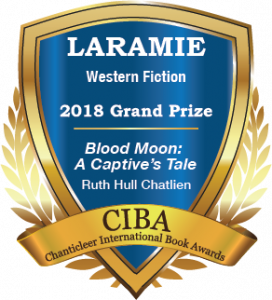
    A Blue and Gold Badge that says Laramie Western Fiction 2018 Grand Prize Blood Moon A Captive's Tale Ruth Hull ChatlienRuth Hull Chatlien’s historical novel Blood Moon: A Captive’s Tale shines a light on two worlds trying to coexist in the 1860s Minnesota, that of Westward Expansion and white settlers, and that of the complex network of Sioux tribes dealing with starvation and disease. We follow her protagonist, Mrs. Sarah Wakefield, as she is thrust unwillingly into the midst of the Indian Wars.

    Based loosely on the life of real captive, Sarah Wakefield, Chatlien explores both sides of this conflict, through the eyes of our terrified hero, who does what she must to save her life and the lives of her two small children. The first-person narrative in present tense places us in the thick of Wakefield’s narrow escapes, and the presence of the constant threats to her and her children.

    Sarah Wakefield has one goal, to save her children, and if that means dressing like a Sioux and helping her captives gather water, forage and cook food, and set up the teepee, so be it. Her fellow captives, mostly women and children maintain their prejudiced and racist attitudes, but Wakefield does not. She sees her captives as human beings, not “savages,” who are trying to survive just as she is.

    Chatlien expertly exposes the mindset between members of the Sioux tribe who had converted to Christianity and those who refused to convert. She exposes the injustices of an American Government that defaulted on treaty promises, causing starvation, illness, and death among the tribes, and the solution that many tribal warriors felt was their only recourse—war.

    Wakefield sees the dichotomy of those warriors who want to fight and those who have converted to Christianity and become farmers. She feels the losses endured by those who didn’t want to fight because of their beliefs, but she realized that death would be their penalty if they refused.

    The underlying themes in Chatlien’s novel provide us a complex and multidimensional read that captivates. Sarah is married. But her marriage is rocky—okay. Rumors of her past don’t help her present situation. But the woman she becomes as she survives her terror and provides for her children is a woman who will go to battle for a Sioux warrior in a court of law, even if it means losing her marriage and becoming a social pariah. At times readers may wonder if Wakefield might be an unreliable narrator suffering from “Stockholm Syndrome.” Nevertheless, she fights for the warrior who protected her and fights to save his life as he had saved hers.

    The injustices Chatlien shines her fictional light on are bound to grate on the progressive-minded reader of 2020, and the conclusion to this narrative based on real events will undoubtedly leave us wondering how little has changed in race relations in the USA. Chatlien shows how simple gossip and the petty mindsets of the “normal” Christian women were as big a detriment to Wakefield’s survival in the Indian Wars.

    Blood Moon: A Captive’s Tale won Grand Prize in the CIBA 2018 LARAMIE Awards for American Fiction.


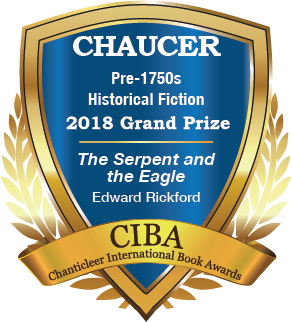
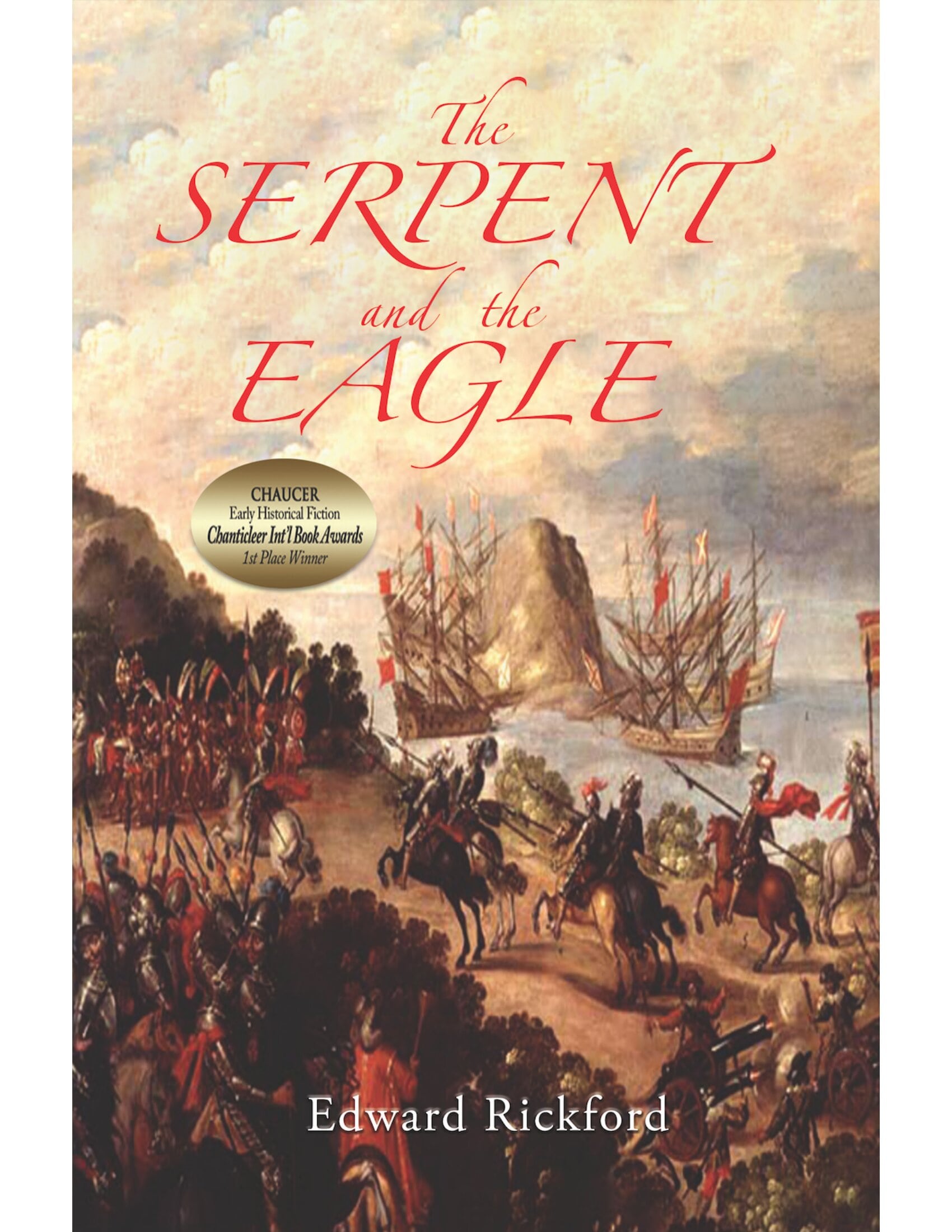
  • The SERPENT and the EAGLE, Tenochtitlan Trilogy (Book 1) by Edward Rickford – Native American Literature, Pre-Colonial Mexico, Cultural Historical Literature

    The SERPENT and the EAGLE, Tenochtitlan Trilogy (Book 1) by Edward Rickford – Native American Literature, Pre-Colonial Mexico, Cultural Historical Literature

    In The Serpent and the Eagle, Edward Rickford details Hernan Cortes’ 1519 expedition to explore and secure the interior of Mexico for colonization, fleshing out known facts with the human factor—it is, to the typical depiction of Cortes’ exploration of the Yucatán peninsula, what a chorus is to a solo or a tulip to a bulb. Primarily narrated by individuals who were actual members, or may have been members, of this expedition, Rickford has crafted a fascinating tale of intrigue, love, lust, greed—essentially all seven of the deadly sins—within two diametrically opposed political and cultural systems.

    The story follows the fates and fortunes of these individuals as they explore the Yucatán Peninsula before Cortes’ march on Tenochtitlán, the capital of the expanding Aztec empire in the 16th century. It has five major narrators and several minor narrators:

    Captain Hernán Cortés was a Spanish adventurer, who left Cuba with a small fleet of ships manned by soldiers and slaves for the mainland of the New World, purportedly to “…find gold and serve God and King.” He rescues Father Aguilar, a Catholic priest, on Cozumel Island where the priest had suffered years of enslavement by an indigenous tribe. Vitale, a New Christian of Jewish descent, is a crewmember on the Santa María de la Concepción. He befriends Solomon, a Moorish slave, who grew up in the Emirate of Granada Al-Andalus when Muslims, Jews, and Christians all lived there in peace. Doña Marina is a slave girl who rose from obscurity to power and ultimately became Cortes’ confidante and consort.

    Through the eyes of various tribal leaders, including, in particular, Motecuhzoma, the Aztec Huey Tlatoani, and several of his trusted counselors, the story takes the reader into the complex socio-political-religious system of the Aztec, and other indigenous tribes of pre-Colonial Mexico.

    The Serpent and the Eagle is rich with historical and cultural detail and faithfully follows the events as recorded at that time. The multitude of narrators and situations can be challenging to follow. We suggest reading this novel with a pen and paper handy for inevitable note taking.

    Rickford has written a book that forces the reader to reflect on the influence of history on the present, the possibilities when two cultures collide, and the impact of conflicting belief and ethical systems on human behavior.

    Not a fast read, but well worth the time it takes. Prepare to be entertained, educated, and challenged to think.

    5 Star Best Book Chanticleer Reviews round silver sticker