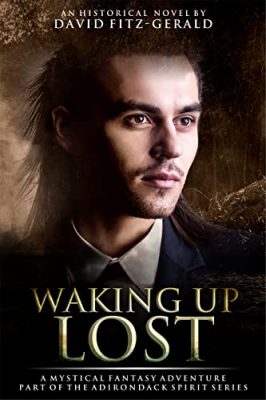
Seventeen-year-old Noah Munch craves acceptance more than anything in David Fitz-Gerald’s coming of age novel, Waking Up Lost.
As a biracial boy growing up in a small village in upper New York, Noah doesn’t feel that he belongs to either part of his heritage. Having lost his Native American father before he was born, Noah has spent his short life trying to connect with that missing part of himself. Meanwhile, he has to keep the peace with the Wilmington villagers who find his native side offensive. Noah also protects a family secret. His mother, Mehitable, speaks with spirits and his brother, Moses, has an uncanny ability to predict disaster and show up with inhuman speed to prevent it.
As a result of his complex home life, Noah spends a great deal of time alone. He dreams of someday being a mountain man, living off his wits and the nature around him. However, Noah can’t stop himself from admiring Arminda, the prettiest girl in town. He doubts he will ever have a chance to court the blonde beauty, especially considering the meanest young man in town, Erastus Moss, has spoken for her.
Erastus, whose grandparents died at the hands of Native Americans on a journey out West, begins to harass Noah when he notices Noah’s interest in Arminda.
Noah endures taunts, feeling the burden of prejudice and simultaneously the inadequacy of being the only “normal” member of his family until the night he wakes up on top of a mountain.
He begins to experience strange episodes, which he believes are sleepwalking fits. One night appears inside the home of his beloved Arminda. Once the town discovers his odd behavior, suspicion and fear turn even more people against him, and Erastus uses it as an excuse to escalate his torture. Can Noah stop the crazed man and find a way to control his abilities before it’s too late?
The fourth installment of the Adirondack Spirit Series revolves around Noah’s coming of age.
In true bildungsroman style, Noah embarks on both a physical and spiritual journey. He suffers the distance between himself and other boys, including his twenty-year-old brother. Noah, small, scrawny, and by his own admission, doesn’t have the physical presence that others expect of a boy his age. Though often the most handsome boy in Wilmington, Noah’s dark hair and olive skin set him apart in his racist town.
However, Noah never knew his father’s people, so he has nobody other than his white neighbors to socialize with. He can’t see himself as anything other than a clumsy daydreamer who will never fit in, driving him to live alone in the mountains as his father had done years ago. Noah yearns to connect to the father he resembles, but when he isolates himself, nature and man conspire to bring him right back to the town he hates.
He finds no solace in his mother and brother, even as they assure him that he possesses great power.
Even amongst his family, Noah doesn’t fit. He despairs his ordinary nature with a mother who guides spirits to the afterlife and brother with inhuman speed. If he could rely on a secret talent, he could tolerate his neighbors’ prejudice. But when he does develop an unexplainable ability, it proves nightmarish and deadly. Noah never knows when it will happen or, more importantly, where it will take him. Ironically, this strange power becomes paramount in discovering the very purpose he longs to find.
Faith and trust in God frame Noah’s life.
Noah often relies on his faith to carry him through the unbelievably tricky situations in his life. In pain, he turns to prayer for comfort and reassurance, and later when he commits a crime (albeit justified), he only frees himself of the burden when he seeks absolution from God. Though his episodes sometimes prove horrific, Noah realizes his power borders on the miraculous.
He searches for God’s plan for his life even while questioning how he will know it when he sees it. When Noah hits his lowest point, fearing for his life, he feels the “warmth” of God physically and hears His message that Noah isn’t alone. Noah becomes God’s servant, and he begins to understand that he must become what God expects, not what he wants.
The supernatural elements in the story set it apart from the typical novel of this genre, creating a hybrid between historical and paranormal.
The family members’ unusual abilities heighten their outsider status. Mehitable raised her biracial sons in a town of hate and prejudice for seventeen years. Though she does have a few staunch supporters, these people can’t always keep the wolves at bay. She and her sons suffer from the racism so prolific during the 1800s in America. Compounding her pariah-like treatment, she speaks to spirits and must keep her gifts secret for fear of further mistreatment. Moses must also keep his powers hidden. Noah suffers for his gift. Though he has no control over its occurrence, the townspeople practically exile him, leaving the young man to find a way to bridge this chasm between himself and others.
Recognizing and Celebrating Indigenous Peoples Day and Discussing our Laramie Awards.
It’s October 11th, which in Bellingham, Wash. means it’s Indigenous People’s Day. We believe in recognizing the rich history and contributions of native peoples here in the Americas, and are always working to expand our knowledge and understanding. To that end, we would like to acknowledge that our company is located in downtown Bellingham which is the ancestral home of the Coast Salish Peoples who lived and still live here today. They have a strong connection with the Salish Sea—the marine ecosystem that spans the United States-Canada coastal waterways from Olympia, Wash. to Comox, British Columbia, Canada.
Coastal Salish Annual Tribal Journey on the Salish Sea. Approximately 100 canoes participate in the Potlatch.
There are more than 65 Tribes and First Nations who have lived here for tens of thousands of years. Primarily, the Lummi and the Nooksack Nations reside here in Whatcom County by the Salish Sea. Whatcom is Salish for “noisy water.”
The name Salish Sea was officially recognized by the United States in 2009 and Canada in 2010. Click here if you would like to know more about the Tribal Canoe Journeys: Paddle to Lummi
Members of the Lummi Tribe in the PNW
Indigenous People’s Day began to be celebrated as far back as 1991, with people suggesting it be celebrated as far back as 1977! Of course as most people know, the holiday was intentionally created to overlap, and in some places, replace Columbus Day. Why? History.com offers an answer:
Some may ask why replace Columbus Day with Indigenous Peoples’ Day? Activists have long argued that holidays, statues, and other memorials to Columbus sanitize his actions—which include the enslavement of Native Americans—while giving him credit for “discovering” a place where people already lived.
While there’s no denying that the bloody history of Columbus that has been sanitized throughout historical retellings, the original origin of Columbus Day was never meant to celebrate the brutalization of the people who lived on this side of the hemisphere. Within 60 years after Columbus landed, only a few hundred of what may have been 250,000 Taino were left on their island (currently known as the Dominican Republic in the Caribbean). History.com
The holiday originated as an annual celebration of Italian-American heritage in San Francisco in 1869. In 1934, at the request of the Knights of Columbus and New York City’s Italian community, President Franklin Delano Roosevelt declared the first national observance of Columbus Day. (Smithsonian Magazine)
President Franklin Delano Roosevelt
Of course, as we learn more, we always aim to improve and progress as a society and as a country, working for the betterment of all, we can make updates and changes to reflect history more accurately and remember those who have been wronged in the past. Toward that end, we’d like to take a look at our Laramie Awards.
Spotlight on Laramie Awards
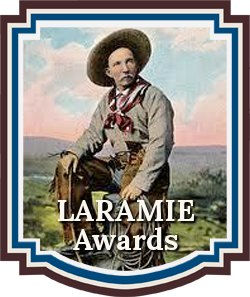
This artwork is from a 1907 postcard. The artist is unknown. The Laramie Awards recognize the best in Americana fiction.
The word Laramie has French origins, meaning The Leafy Grove. However, Kiffer named the Laramie Book Awards after Laramie, Wyoming when she lived just south of there when in Fort Collins, Colorado. Laramie was named for Jacques LaRamie, a French-Canadian trapper. He was one of the first Europeans to visit the area (1820s). He disappeared into the local mountain range. Laramie was founded in the 1860s as a “tent city” as a stopover on the Overland Stage Trail that was needed for the development of the first transcontinental railway.
In spite of having stores, houses, a school, and churches, Laramie was known for its rough frontier town lawlessness led by the town’s first marshal (Big Steve Long) who was a notorious gunman and a brutal bully who murdered dozens of Laramie’s people. It wasn’t until October 28, 1868 that some of the townspeople led by the county’s sheriff and fellow rancher, N.K. Boswell, fought back and lynched the marshal and his accomplices, thereby bringing some sort of law and order to Laramie.
It is also said that it was the women who tamed Wyoming.
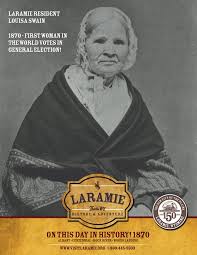
In 1869, Wyoming with Laramie leading the way, was the first legislature led entirely of men that empowered women with voting rights and to hold office. In March 1870, five Laramie women became the first women in the world to serve on a civil jury. It was a Laramie woman, Louisa Swain, who was the first woman to cast a legal, recognized vote in a United States general election on September 6, 1870.
In 1890, when Wyoming petitioned Congress to for statehood the U.S. Congress pushed back stating that Wyoming’s woman suffrage was obstacle and was delaying approval. The legislature, via a telegram from Joseph M. Carey (who later became governor of Wyoming), replied to the threat, “We will stay out of the Union a hundred years rather than come in without our women.” It was a very close vote in the U.S. Congress of 139 for – 127 against.
In 1890, Wyoming became the 44th state—with the women.
And those weren’t the only female firsts that took place in Wyoming. The first female governor was elected in Wyoming and the nation’s first woman to be appointed to public office was done so in South Pass City, Wyoming. In addition, the Equality State is home to the first female jurors, the world’s first female bailiff and the first town that was governed entirely by women.
Native Americans in their traditional attire holding American flag at the Lincoln Memorial building. STUNNING images of the indigenous Native Americans have been brought back to life through vivid colorization. The remarkable pictures show the group during the 1920s, with some of the leaders meeting with then American president, Calvin Coolidge, at the White House.
The Indian Citizenship Act still didn’t offer full protection of voting rights to Indians. As late as 1948, two states (Arizona and New Mexico) had laws that barred many American Indians from voting, and American Indians faced some of the same barriers as Blacks, until the passage of the Civil Rights Act of 1965, including Jim Crow-like tactics and poll taxes.
The last state to guarantee voting rights Native people was Utah in 1962.
The Voting Rights Act of 1965 was the most significant statutory change in the relationship between Federal and State governments in the area of voting since the Civil War. The act prohibited poll taxes, intimidation tactics, harassment, physical violence, or economic reprisals for voting in civil elections. OurDocuments.gov
Sadly, tragically, Laramie is also known for the inhuman murder of Matthew Shepard on October 12, 1998. It seems that bullying can still find cracks to rear its ugly head. Yet, once again the people of Laramie were not going to put up with it. Law and justice were served.
Americana Fiction
We recently changed the description of the Laramie Awards from “Western Fiction” which could mean a great many things, to “Americana Fiction.” A quick search for Western Fiction shows that it refers the American Old West that takes place anywhere from late 18th to the late 19th century. While this covers our categories of Pioneer and Civil War (the pioneer period is often referred to as 1760-1850 with the Civil War raging from 1861-1865). Also, great contemporary Western Fiction such as New York Time’s bestselling author and the basis for the hit Netflix series, Craig Johnson’s (a Wyoming author) Longmire Series.
And we can’t forget Jim Harrison’s works. You might be familiar with one of his stellar works—Legend’s of the Fall.
Legends of the Fall book cover before the film was made of it.
On the other hand, Americana Fiction is defined by Goodreads as “Novels that help tell the history, culture and folklore of what makes Americans uniquely American.” You can even see a list here of what they consider to be Americana Fiction, which really shows the wide, incredible expanse, that Americana Fiction and history can transcend, though we tend to consider it more of a historical genre than some of these incredible books are.
We made this change to promote a more accurate and inclusive representation of what we are accepting for the Laramie Awards.
So what are some excellent reads featuring indigenous identities that have already been vetted by Chanticleer you might enjoy? We’re glad you asked!
Jerkwater
By Jamie Zerndt
Somerset Award Winner
Three friends in Mercer, Wisconsin find ways to deal with their problems amid a racist town in Jamie Zerndt’s Jerkwater.
Shawna Reynolds’ life changed when her white stepdad murdered her Ojibwa mother. Now living with her Naan (grandmother), Shawna surrounds herself with those who make her feel most comfortable. Besides Naan, she clings to her horse Seven, her behind-the-scenes Ojibwa boyfriend Elmer, and two white friends: Kay O’Brien and her son Douglas. But racial tension cuts through the town of Mercer itself, galvanized by a fight over fishing rights.
Dr. Nerida Green travels across Australia, tending to struggling communities and connecting with her wife Mari—as well as the three spirits who Mari channels through her body, in Miki Mitayn’s climate-fiction novel The Conscious Virus: An Aedgar Wisdom Novel.
Nerida works sporadic jobs as a doctor, from the mining community of Newman to the small town of Fitzroy Crossing, and back east to a disappointing stint at a naturopathy clinic in Byron Bay. Between her working hours, Nerida speaks with M’Hoq Toq, the Native American medicine man, Bartgrinn the Celtic druid, and Aedgar, an ancient being of the Earth. Nerida asks the spirits for their opinions on topics as broad as climate change and as narrow as her personal matters, engaging them in deep conversation.
Wanders Far
By David Fitz-Gerald
Laramie Award Winner
An engaging history of ancient Native American peoples is brought to magical life by author David Fitz-Gerald.
In the early 1100s, in a region now known to us as the Adirondack Mountains of northern New York, a small band of tribal people is living in longhouses, growing crops, fishing, hunting, and enjoying certain rituals such as face and body painting, occasional migration for food survival, and even seasonal “vacations,” all while willingly obeying a simple form of governance with elements of basic democracy. In this tribe, we meet Wanders Far, a child who earns his nickname after showing a propensity to disappear and explore since he could walk. His mother, Bear Fat, is the recognized chieftainess of their group, mother of a large brood, one of whom is stolen as the book opens. Wanders Far would be considered an unusual child in any society, gifted with a highly accurate memory and the ability to visualize future events. He can also run like the wind, and with his love for travel, he is often the first to see and warn his people of danger, such as a cadre of warriors from a hostile tribe heading towards his home settlement.
Buck: Keeper of the Meadows
By Gloria Two-Feathers
In this engaging children’s tale by author Gloria Two-Feathers, a young colt named Buck will learn how to obey, how to defend, and how to strike out on his own.
The scene is set in the Great Plains, where a river named Minisose divides a sea of tall green prairie grass. Many animals call that grassland their home, and the most magnificent is the herd of wild horses led by a dark stallion named Plenty Coups and his chosen mate, the lovely cream-colored mare, Cloud. By tradition and instinct, Plenty Coups protects the herd from attackers, while Cloud leads them to safety.
When you’re ready,did you know that Chanticleer offers editorial services?We do and have been doing so since 2011.
Our professional editors are top-notch and are experts in the Chicago Manual of Style. They have and are working for the top publishing houses (TOR, McMillian, Thomas Mercer, Penguin Random House, Simon Schuster, etc.).
If you would like more information, we invite you to email Kiffer or Sharon at KBrown@ChantiReviews.com or SAnderson@ChantiReviews.com for more information, testimonials, and fees.
We work with a small number of exclusive clients who want to collaborate with our team of top-editors on an on-going basis.Contact us today!
Chanticleer Editorial Services also offers writing craft sessions and masterclasses. Sign up to find out where, when, and how sessions being held.
A great way to get started is with our manuscript evaluation service, with more information availablehere.
And we do editorial consultations for $75. Learn morehere.
If you’re confident in your book, consider submitting it for a Editorial Book Reviewhereor to one of our Chanticleer International Awardshere.
Also remember! Our 10th Anniversary Chanticleer Authors Conference (CAC22) will be April 7-10, 2022, where our 2021 CIBA winners will be announced. Space is limited and seats are already filling up, so sign up today! CAC22 and the CIBA Ceremonies will be hosted at the Hotel Bellwether in Beautiful Bellingham, Wash. Sign up and see the latest updates here!