Tag: Narrative Non-Fiction

  • FIVE THOUSAND BROTHERS-IN-LAW: LOVE IN ANGOLA PRISON: A MEMOIR Shannon Hager – A rare and authentic view inside the US penal system

    FIVE THOUSAND BROTHERS-IN-LAW: LOVE IN ANGOLA PRISON: A MEMOIR Shannon Hager – A rare and authentic view inside the US penal system

    An authentic and insightful account from behind the bars at one of America’s most storied penitentiaries. Shannon Hager, who worked more than twenty years as a nurse in the deep South’s prisons and jails, shares her inside experiences.

    After her years of connecting directly with this bizarre, labyrinthine system that strips away almost every human right, she retains genuine empathy for prisoners and their families in this award-winning memoir.

    Hager’s drama began ​in 1992 ​when she arrived at the Louisiana State Penitentiary, commonly known as Angola, a name held over from plantation days, denoting the origin of slaves who toiled there. Eighteen thousand acres are surrounded on three sides by the Mississippi River. Angola has been the last stop for thousands of criminals.

    Hager had important tasks as a health care professional, such as tuberculosis testing and investigating HIV/AIDS cases within its walls. Hager ​quickly learned ​that most of the staff were hostile toward anyone trying to help prisoners​. Above all, she was told repeatedly, prisoners were not to be trusted. This led to such paradoxical policies as refusing to allow prisoners to use condoms, because they could be utilized as weapons, or for transporting drugs, even though HIV/AIDS was widespread in the prisoner population.

    ​Though she came to know many prisoners well, and not only befriended but married one, she never got over the feeling of oppression and sorrow that festered inside the prison: “Pain seeped up from the ground like morning fog.”

    When she met Big Kidd, an older ​convict who had spent more years in prison than out, she found herself falling for with this ​charming, seemingly reformed, self-styled disc jockey/preacher. She quit her job to have a relationship with him; Hager became involved with Big Kidd’s family on the outside. She began to understand what relatives and loved ones experience when they have someone near and dear to them in prison.

    Hager poignantly describes her own love story, blooming from the jagged cracks of Angola Prison, as it tries to find enough light and humanity to survive. ​Loving Big Kidd caused her to share some of his suffering:  ​little privacy, no conjugal visits, and hard choices. It is a love that dramatically breaks all rules.

    Hager’s writing style comes from the heart and reflects her gradual immersion into Big Kidd’s reality. Using the common Louisiana practice of nicknaming, she vividly describes the characters she encountered, adopting their ​accents in conversation and sometimes even writing ​in their colorful street patois.

    Discrepancies and shortcomings of the United States penal system that encompassed more than two million people are exposed by Hager in an up close and personal way. Most of the two million prisoners come from unrelenting impoverishment, turbulent environments, and have no education or skills.

    A rare, vibrant view of a complex, dangerous, and at times, inhuman subculture of contemporary society–Five Thousand Brothers-in-Law communicates a significant and compelling message about the poor and oppressed—whoever they are, no matter what their misdeeds. ​
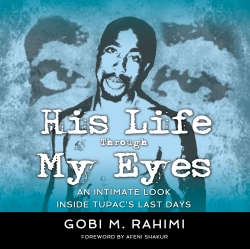
  • HIS LIFE THROUGH MY EYES by Gobi Rahimi

    HIS LIFE THROUGH MY EYES by Gobi Rahimi

    In the early ‘90s, up-and-coming artist Tupac Shakur was taking the rap industry by storm. Known for his electric energy and controversial lyrics, his music focused largely on social injustices and oppression. Equally notorious for the brilliance of his music and for his frequent problems with gang violence and the law, he accrued a large and passionate community of listeners and fans. When he was killed in a drive-by shooting at the young age of 25 in 1996, his legacy as a well-known and respected voice within the genre lived on.

    In the book His Life Through My Eyes, filmmaker Gobi Rahimi, who worked continually with Tupac in the months preceding his death, offers a unique glimpse into the artist’s day-to-day life. Sparing no detail, Rahimi takes the reader on an intimate and emotional journey through his memories of the times spent with Tupac, aided by photographs he took during the time. Rahimi tells the story of how he came to work with Tupac and become his close friend.

    This book is shamelessly personal; it is as much about Rahimi’s journey to process Tupac’s  death and honor his legacy as it is about Tupac himself. This is to Rahimi’s credit, though. What might otherwise feel like a series of empty anecdotes is bonded by Rahimi’s laudable honesty and openness with regards to his grief and admiration for Tupac.

    Rahimi touches on the sociopolitical controversy and turmoil that surrounded Tupac during his life, and does not gloss over Tupac’s struggles with racism in the music industry. However, his focus is much more on Tupac as a human being than as a public figure. Rather than recounting details of his friend’s public persona, he centers on portraying the man he knew.

    In many ways, the book reads very much like a series of diary entries. Some may find Rahimi’s accounts somewhat chaotically organized, but overall the stories provide captivating, interesting, and thought-provoking insights into Shakur’s life. Rahimi’s respect and love for his friend ultimately shine through. Engaging, personal, and deeply felt, Rahimi’s tribute to Tupac Shakur will be sure to move those interested in his legacy.

  • GUIDED to WISDOM: The JOURNEY to EMOTIONAL HEALING by Susan D’Agostino

    GUIDED to WISDOM: The JOURNEY to EMOTIONAL HEALING by Susan D’Agostino

    Susan D’Agostino has wisdom to share, garnered from a lengthy battle with cancer and the medical establishment. This is her intimate story.

    “In 2002 I found a lump in my breast, maybe the size of a pea.” Like anyone faced with a possible dire diagnosis, D’Agostino was scared and confused. Her encounters with medical people left her feeling like a statistic, and when she got the dreaded prognosis after a painful biopsy, it was accompanied by the standard recommended next steps: months of chemo and radiation treatment. Fearing the treatment almost as much as the cancer, she sought alternative healing methods.

    She consulted a variety of therapists—naturopaths, herbalists—and certain ones seemed like soul mates. In her search, she began to see signs: a strange affinity for the number 1111, a hawk landing and sitting in her yard. She began to trust her intuition; despite being prodded by the oncologist to get the standard treatment, she finally decided it wouldn’t be right for her. In the next few years, she became thoroughly immersed in her “mission”. She learned meditation, took yoga classes, eliminated aluminum products (like deodorants) from her life, began journal-ling, had colonics and kinesiology, and discovered automatic writing, leading her to her inner voice and a higher level of guidance.

    One day she said “I knew I was finished” with the medical establishment’s treatments, and despite ominous letters sent by the oncologist predicting her demise if she stopped, tests showed that the cancer was gone. After resigning from her day job, she realized she could help others, and has remade her professional life as an Emotional Healer and Journey Practitioner.

    D’Agostino’s saga is compellingly dramatic in the early pages, as the reader suffers with her and cheers her along on her personal mission. She has found her feet as a writer, staging her story skillfully, and frankly revealing the fears and rages that she believes were part of her inner cycle of “dis-ease” and healing. The last third of the book reinforces her positive messaging and could be used as a workshop tool for positive messaging and mediation. D’Agostino delivers a powerful and succinct message about hope and change in the subjective, human story that she shares. She reminds us that we are not alone.

    Doubtless a vehicle to inspire others who find themselves or loved ones in a similar, life-threatening plight, Guided to Wisdom offers a heart-rending true story along with responsible and valuable advice to consider when deciding treatments and alternative methods of healing and self-healing. Overall, with her treatise Guided to Wisdom: The Journey of Emotional Healing, D’Agostino implores us to look inside ourselves for answers to life’s challenges and to trust our intuition. 

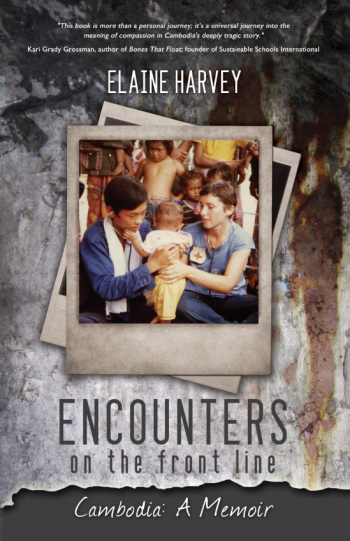
  • ENCOUNTERS on the FRONT LINE: CAMBODIA: a MEMOIR by Elaine Harvey

    ENCOUNTERS on the FRONT LINE: CAMBODIA: a MEMOIR by Elaine Harvey

    Encounters on the Front Line is the journey of a Canadian Red Cross nurse who, after traveling in far off reaches of Asia and Africa, finds herself in a refugee camp on Cambodia’s Thai border, in the midst of the war between the Vietnamese and Cambodia’s brutal Khmer Rouge.

    The encounter with the front line becomes a life journey told in three books: her experience in a refugee camp in 1980, a pilgrimage back in 2007-2008 in an effort to reconnect, and a third journey two years later as a mature woman and writer, seeking to pull together the experience that has marked her so deeply.

    The courage and resilience of the Cambodians survivors who serve with her, their beauty in the midst of the horrendous conditions shine through, even as the camp itself becomes torn by war. Harvey draws a vivid picture of contrasts: the abysmal conditions of the camp with the green of the surrounding rice fields, the terrors of the Pol Pot regime with the loyal gentleness of the individual Cambodians who serve with her. Photos increase the reader’s intimacy with these people, as does the poetry that runs through the book.

    Harvey’s return trips to reconnect and unravel the mystery of the land become a more personal search. It is again focused on people, both Cambodian and expats from around the world who have found their life’s work in Cambodia. The second visit focuses on an orphanage, Wat Opot, where she serves, and its American founder. The price of conflict is brought home by the stories of these tragic leftover of war—the children. In a land where poverty and conflict overwhelm, many find peace in Buddhism. Harvey finds that her greatest service lies in the healing touch.

    The honesty of this memoir—Harvey’s conflicting reactions to the filth and vermin—give it an authenticity that is refreshing. The third book in particular, we feel her frustration and grief at her failure to re-establish the personal connections of the first encounter. If it has any defect it is that the first book, given its subject matter, has a tension and intensity the other two do not.  And the personal search of the latter two is, that some readers may find it to be, at times, repetitive as the author reexamines her encounters. Life has moved on beyond her reach, and the intimacy and immediacy of war relationships cannot be reestablished. There is a large quotient of sadness in this last visit, and a once friend tells her that it is a mistake to cling too long.

    This is a very well written memoir and an intimate picture of a Southeast Asia  and its people. Readers will find their horizons broadened by Harvey as she shares her encounters as one who has served in the far reaches of the Third World, grown to love its people, then sought to give the experiences meaning. Harvey’s poetry and photographs add both variety and depth to the work, as they further the reader’s connection to the memoir beyond the power of prose.

  • 2014 Journey Award Finalists–Official List

    2014 Journey Award Finalists–Official List

    Narrative Non-FictionThe results for the Finalists for the 2014 Journey Awards are in!

    The Journey Awards recognizes new and emerging talent in the genre of Narrative Non-Fiction. It is a division of the Chanticleer Book Reviews Blue Ribbon Writing Competitions.

    There are nine sub-categories for the Journey Awards for Narrative Non-Fiction.

    Congratulations are in order to the following authors whose works have made it out of the slush pile and past the first round of judging. These works will go on to compete for First Place Category Winner for their respective categories within the 2014 Journey Awards for Narrative Non-Fiction. First Place Category Winners receive a competitive prize package including: shelf talkers, digital award badges, stickers, a complimentary book review and more.

    Soviet Letters by Michael Schneiderstein

    One Thousand Days in the Asylum by Shanny Nadudvary

    Coulda, Woulda, Shouda: a Mother’s Lessons, Learnings, and Insights from Her Daughter’s Battle with Cancer by Kenna P. Marriott

    Thwarted Escape: A Journey of Migrant Trails and Returns by Lopa Banerjee

    Five Thousand Brothers in Law: Love in Angola Prison by Shannon Hager

    Caregiving Our Loved Ones by Nanette Davis

    Once Upon a Road Trip by Angela N. Blount

    The Breast is History: An Intimate History of Breast Cancer by Bronwyn Hope

    Private Svoboda: Hope is the Last to Die by Steven Roberts 

    Horse Vet; Chronicles of a Mobile Veterinarian by Courtney S. Diehl, DVM

    Three Day Rule by Jack L.Cooper

    Moroccan Musings by Anne B. Barriault

    Waking Reality by Donna LeClair

    CURBChek Reload by Zach Fortier

    Bread and Butter: a Memoir and Recipes From a Writer’s Hearth by Jane Ward

    The Accidental Teacher: Life Lessons from My Silent Son – an Autism Memoir by Annie Lubliner Lehmann


    Entry into the 2015 Journey Awards is now open. The deadline is February 28, 2015.