Tag: #NaNoWriMoTips

  • Popular Tips to Get and Keep Your Writing Groove On – NaNoWriMo or Not – Chanticleer Writer’s Toolbox Series

    IF you are participating in NaNoWriMo, you are getting close to the FINISH LINE! Stay the Course as you try to achieve the 50,000 words goal.


     If you are NOT participating in NaNoWriMo, then we hope that this post will spur you on as write your work-in-progress (w-i-p) or your next work.

    RULE # 1

    WRITE FAST!  EDIT SLOW! 

    Don’t edit your first draft as you write it!

    Writing your first draft should be a mad dash to get your story out of your brain. Don’t hinder it by worrying about each little detail. There will be time for that later. NaNoWriMo or not.

    Not taking our word for that piece of advice?

    Chelsea Cain, a bestselling thriller author (with a TV series to her credit),  gives this piece of advice:

    Write the bare-bones version of the scene first using mostly dialogue, and then move on and in the second draft flesh out the scenes with description and action.

    “Action is dialogue. Dialogue is action.” – Robert Dugoni, Amazon Bestselling Author

    What is YOUR STORY?

    Story is essentially a problem that needs solving for the protagonist. – Jessica Morrell

    • What is your protagonist’s problem that must be solved—or else?
    • What is the worst thing that can happen next to your protagonist?
    • Remember that it is not your problem. It is your protagonist’s problem, obstacle, impossible dream.
    • Start at least one subplot. This subplot(s) should also complicate the protagonist’s goals.

    No matter when the problem begins (it’s always in Act One) the problem is weighty and vexing, perhaps insurmountable. If the problem is not immediately personal, it should become so that it will create a bond (connection) between the protagonist and antagonist. Classic examples are the connection between Sherlock Holmes and Jim Moriarty and Harry Potter and Voldemort. 

    What is the inciting event or threat? 

    The inciting incident might lead to the problem. This event will disrupt the status quo, demand response, and set actions in motion. It’s a threat that unbalances the story world and creates dilemmas that must be dealt with.

    To name a few:

    • The tornado incident in the Wizard of OZ
    • Katniss’s little sister selected for the Hunger Games
    • Luke Skywalker ‘seeing’ and hearing Princess Leia calling for help in Star Wars
     These excerpts above are from The Inciting Incident blogpost


    Environment (internal and external)

    These are great tips to get your creativity groove on!

    • Remember you want to send your protagonist into new emotional territory with new challenges and pressures.
    • And at the same time, she will need to deal with new physical territories such as a new school (Footloose) or a different culture (Dances with Wolves) or a different legal society with different norms (Handmaid’s Tale) or a new environment (Deadwood)  or a different time ( Outlander) or galaxy (Farscape).
    • Don’t be afraid to stage danger in benign or lovely settings or conversely gentle scenes in dangerous and gruesome settings.

    Kiffer’s Note:  I just saw this bucolic scene while watching The Wheel of Time first episode. All white coats and white tents. And then, bam! We learn that the guys in white are not the “good guys” —at all—even if their name is Children of the Light.

    Bucolic looking camp scene in Wheel of Time inhabited by these characters all in white.

    Atmosphere

    • Allow the overall atmosphere and mood to imbue your writing from the get-go.
    • The atmosphere lends itself to the overall tone and mood of a work. Allow it to permeate your work as you write.

    The atmosphere in Shadow and Bone series by Leigh Bardugo
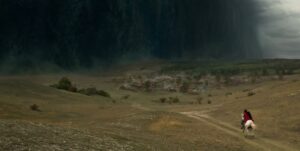
    Or Sex in the City by Carrie Bradshaw

    Why use atmosphere in your first draft? (or during NaNoWriMo)? 

      • Because it will affect your mood and approach to your story.
      • It will make you focus on creating unease–a necessary ingredient not always considered in early drafts.
      • Unease contributes to writing a page-turner.
      • Atmosphere underlines themes–even if you don’t have your themes nailed down yet.

    Here is the link to our Writer’s Toolbox article on Atmosphere

    Emotional Baggage

    • Know your protagonist’s main emotional wound, sometimes called baggage in real life. How is it going to affect his or her ability to solve the story problem? (See the questions below to jumpstart creativity.)

    Remember that Writers (that is you) should carry a notebook everywhere you go. You never know when a brilliant solution is going to appear. Jessica Morrell

      If I could offer a single piece of advice about creating characters it would be this (Jessica Morrell):

      • Take risks with your main characters.
      • Make them stand out from the myriads of fiction published each year.
      • And don’t be afraid to allow eccentricities, quirks, and oddball ways of seeing reality.

      More questions for your protagonist from Jessica Morrell—these are guaranteed to get your creative wheels turning:

      First, ask yourself these questions and then “ask” your protagonist. Have your protagonist go into depth. Find out what your protagonist’s iceberg under the waterline is all about.

      Photo taken in Greenland’s waters.

      Kiffer suggests that you take a walk when you are considering these questions. Be sure to either take notes or record your thoughts on your smartphone while you explore your protagonist’s emotional baggage. Walk a mile in your protagonist’s shoes. 

      • What’s the most embarrassing thing that has ever happened to you?
      • What is your biggest regret?
      • What is your superpower?
      • Who do you cherish most in the world?
      • If you could change one thing about your world, what would it be?
      • What is your average day or schedule?
      • What 5-6 words sum up your values?
      • What do you do after a really bad day?
      • How do you celebrate?
      • The secret you’d never tell your significant other? Your mother? Your sibling?
      • What reminds you of home?
      • What item must you always take along when traveling?
      • Favorite drink?
      • Secret vice?
      • Pizza or tacos? Cookies or tequila?
      • Favorite climate?
      • Reading or television to unwind?
      • Breakfast or coffee only?

      We hope that we helping you, Dear Writer, to arm and prep yourself to get down to the writing of your next work—the reckoning.
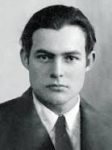


      Ernest Hemingway:  There is nothing to writing. All you do is sit down at a typewriter and bleed.

      Stay tuned for more NaNoWriMo Tips // Jump Start Your Novel Tips


      Chanticleer Editorial Services – when you are ready

      Did you know that Chanticleer offers editorial services? We do and have been doing so since 2011.

      Tools of the Editing Trade

      Our professional editors are top-notch and are experts in the Chicago Manual of Style. They have and are working for the top publishing houses (TOR, McMillian, Thomas Mercer, Penguin Random House, Simon Schuster, etc.).

      If you would like more information, we invite you to email Kiffer or Sharon at KBrown@ChantiReviews.com or SAnderson@ChantiReviews.com for more information, testimonials, and fees.

      We work with a small number of exclusive clients who want to collaborate with our team of top-editors on an on-going basis. Contact us today!

      Chanticleer Editorial Services also offers writing craft sessions and masterclasses. Sign up to find out where, when, and how sessions being held.

      A great way to get started is with our manuscript evaluation service. Here are some handy links about this tried and true service: https://www.chantireviews.com/manuscript-reviews/

      Writer’s Toolbox

      Thank you for reading this Chanticleer Writer’s Toolbox article.

      Writers Toolbox Helpful Links: 

      The INCITING INCIDENT: STORY, SETBACKS and SURPRISES for the PROTAGONIST – A Writer’s Toolbox Series from Jessica Morrell’s Editor’s Desk

      ESSENCE of CHARACTERS – Part One – From the Jessica Morrell’s Editor’s Desk – Writer’s Toolbox Series  

      Keep writing, keep dreaming, have heart. Jessica

      Jessica Morrell is a top-tier developmental editor and a contributor to Chanticleer Reviews Media and to the Writer’s Digest magazine. She teaches Master Writing Craft Classes at the Chanticleer Authors Conference that is held annually along with teaching at Chanticleer writing workshops that are held throughout the year. 

       

      Keep creating magic! Kiffer 

      Kathryn (Kiffer) Brown is CEO and co-founder of Chanticleer Reviews and Chanticleer Int’l Book Awards (The CIBAs) that Discover Today’s Best Books. She founded Chanticleer Reviews in 2010 to help authors to unlock the secrets of successful publishing and to enhance book discoverability. She is also a scout for select literary agencies, publishing houses, and entertainment producers.
       

      The Secret to Successful Publishing

    • Why Write Fast and Edit Slow? – Tips to Write and Finish that First Draft! – Michelle Rene, award winning author

      Why Write Fast and Edit Slow? – Tips to Write and Finish that First Draft! – Michelle Rene, award winning author

      From Snail to Sprint – Encore

      I wrote the first draft of my award-winning historical novel, Hour Glass, in sixteen days. You read that correctly—sixteen days. My experimental novella, Tattoo, was written in about three weeks. Both have been released in 2018.

      Though I am intensely proud of this accomplishment, I’m not telling you this to brag. I’m telling you that you can do this, too.

      “Sit down every day to write. Even if you don’t want to. A little every day.” –Michelle Rene

      Sounds like a line you’ve heard before, right? Yeah, me too. It’s not that this is bad advice. Far from it. Many people find this the best way for them to consistently write draft after draft. But if you really want to knock that rough draft out of the park, I’m going to ask you to kick that notion to the curb.

      I Once Knew Vincent by Michelle Rene

      I’m not magical; I’m a binge writer, and none of the ideas in this article are uniquely mine. Most of them are exercises I’ve stolen from other writers. I used to be just like you because I was led to believe novels should take years to write. I would write a chapter, go back and edit it, and then proceed to the next one. A first draft took me over a year to complete.

      It wasn’t until I decided I really needed to finish my novel,  I Once Knew Vincent, that I decided to shove my face in the cold, scary, deep end of the writing ocean. I went away to a writer’s retreat and forced myself to write as much as I could every day. I wrote the lion’s share of that book in six days, and those chapters were by far the best in the book.

      Why is that?

      Isn’t it counterintuitive that the chapters written in a whirlwind of typing be the best? I’m glad you asked, nebulous reader voice in my head. Let’s delve into that.

      Why Write This Fast?

      Nothing kills a book faster than never finishing that initial draft. A malaise sets in, often slowing a writer down to a crawl while they chip away over a long time and often give up entirely.

      “Will I ever finish this book?” the writer asks, (fists raised to the sky for dramatic effect).

      Maybe. Maybe not. That first draft is possible if you pick yourself up by your metaphorical bootstraps and do the work every day, but a large percentage of writers never cross the finish line. What a shame that is!

      Strangely, there is a raw emotion that comes from writing something so fast you don’t have time to noodle it to death.

      How excited are you when you first start fleshing out a story? How amazing does it feel to start naming your characters and setting up their scenes in your mind? Fan-freaking-tastic!

      This is because you are in the beginning of a book affair.

      Writing a book is like having a relationship. In the beginning, it’s like a honeymoon! You feel all the emotions. Love and pain and excitement and lust. Well, okay. Maybe not lust. Paper cuts hurt, so let’s not go there.

      “Writing a book is like starting a new relationship.” Michelle Rene

      The point is the first draft should be all elation and honeymoon. Leave the nitty-gritty for your fifteenth edited draft. You don’t want to be sitting in a rocking chair with your first draft complaining about how much he snores before you even get to edit. Taking years to write that first draft can land you in complacency town before you cross the finish line. Pour your heart and soul into the rough draft with reckless abandon.

      “Pour your heart and soul into the rough draft with reckless abandon.” – Michelle Rene

      “But nothing good can come from my sloppy first draft if I write it in a few weeks,” says the nebulous reader voice in my head that’s starting to sound whiny.

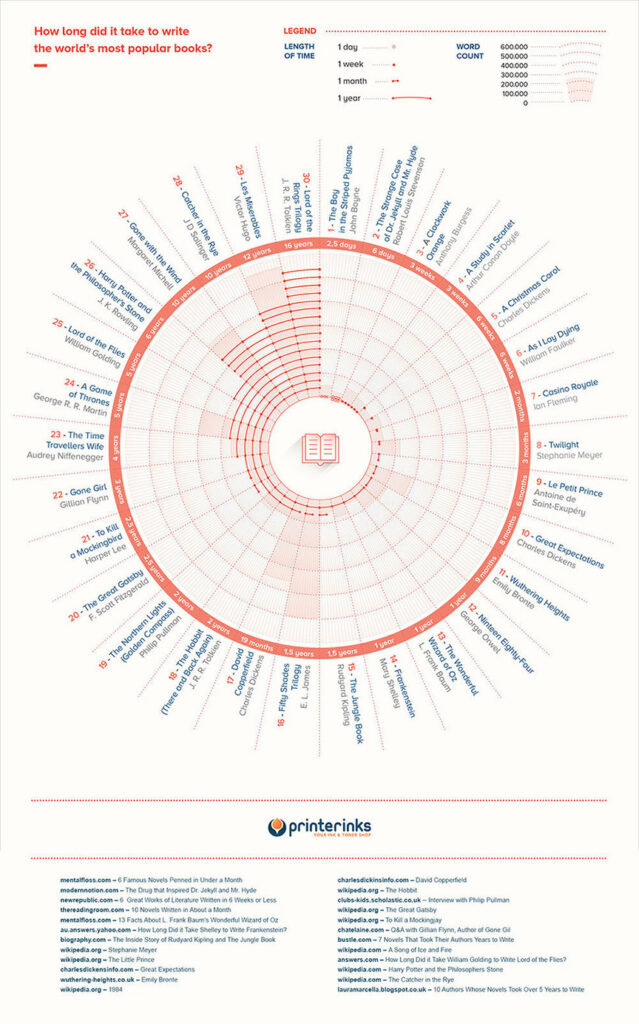
      Please refer to the infographic below. It lists some of the most popular books and how long it took the writer to finish them. While Lord of The Rings took a whopping sixteen years to complete (no shocker there), I’d like to direct your attention to roughly a quarter of the chart that indicates books written under three months. If the Boy in the Striped Pajamas was written in two and a half days, you can write something of quality in four weeks. Write Fast. Edit Slow.

      Hugh Howey wrote the sensational bestselling science fiction story WOOL in four weeks during NaNoWriMo 2011.

      Water for Elephants was drafted by Sara Gruen in four weeks.

      Jack Kerouac’s semi-autobiographical tale, On the Road, took three weeks to write the first draft.


      How Do I Start?

      Let’s begin with talking about the snarky, three-hundred-pound elephant in the back of your mind. Your inner editor. We are going to bind and gag that jerk, and it may take fifty shades worth of rope because it’s three-hundred pounds and takes up a lot of headspace.

      Write Fast! Edit Slow!

      Sara Bale, an extremely prolific romance writer, has similar advice for your would-be-elephant editor.

      “I think the biggest mistake an author makes when writing a rough draft is stopping and rereading/editing their work. The key is to keep moving forward and get the whole story out. Know the beginning and the ending. If you have those elements, the rest is easy.”

      Sara Bale


      “The key is to keep moving forward and get the whole story out.”  Sara Bale


      The passionate ideas come when the critic in our mind is silenced.

      Your visceral idea is key, and I will not accept the old “I don’t know what to write about” excuse. You are here to pour your heart and soul into a story. If you are having a hard time with inspiration, here’s a handy dandy exercise to help that I stole from a writer’s workshop I attended.

      Sit down with a piece of paper and a pen. Yes, a real piece of paper and pen. No cheating with keyboards. I know, I know. Your handwriting is horrible because all you do is type now. My handwriting looks like a serial killer’s ransom note, so I totally understand, but stick with me.


      Next, set a timer for ninety seconds.

      Hit start, write the first thing that comes to your mind and don’t stop until that timer goes off. No contemplating it. No editing your idea and wondering if Stephen King has already done it. He probably has. Just write, no excuses, for the whole ninety seconds.

      Go ahead… I’ll wait…

      You back? Okay. I’m not a betting woman, but I would put money on what you wrote was pretty damn good.

      Whether or not that is the idea you run with doesn’t matter. It’s an exercise to get the creative juices flowing. Use that. Build your characters. Plot the story fast and loose. Fall in love with your story. Get down and dirty in that honeymoon phase…but not literally because remember the paper cuts. We talked about that.

      And finally, outline! For the love of all that is holy, outline your story! Do not do this flying by the seat of your pants. That is a sure-fire way to crash and burn. It doesn’t need to be an in-depth outline. On the contrary, keep that pretty loosey-goosey, too.

      My outlines are often little more than a few sentences for each chapter.

      Time Management

      Okay, you have your outline, your idea, and your story. Let’s do this. The clock begins when you type “Chapter One” or “Prologue” if you want to be fancy. Let’s use NaNoWriMo (National Write a Novel in a Month) rules as I find these to be the best guidelines: 50,000 words in four weeks.

      So four weeks. That’s your mission.

      Write Fast. Edit Slow.

      Select a four-week span of time in your life that you can devote to writing. Don’t sabotage yourself by doing this during a family vacation or when it’s the busy season at work. Choose a month that will allow you some time to devote to this endeavor because it is important.

      For that month, give up on being the best mom, husband, wife, etc. Let your family know that this is going to be what you are doing for this month, and they can have you back after it’s over. The laundry can wait. Order in food. Maybe shower because, well, hygiene.

      Editor’s Note: I totally agree with Michelle. November can be an impossible time for many because of increased work demands, family demands for the approaching holidays, the doldrums due to shorter and shorter days. The main thing is to pick a time that works for you. It can be NaFebWriMo if you have to put in overtime starting in November for the holiday season, or NaJulyWriMo – if you are a teacher. Find a time period that works for you and stick with it! Put it on your calendar. Alert your friends and family.

      I highly, highly, highly recommend you track your progress. Doing a rough draft during NaNoWriMo is a great idea. This happens in November, and the organization sets you up for a win. You have a word tracker, writer friends to cheer you on, and helpful articles when you get stuck. If November is not a good month for you, try a program like WriteTrack. It will help you keep up with your progress.

      Insider secret: Don’t shoot for the minimum goal. If your tracker says you need to write 2,000 words that day, shoot for 3,000 or 4,000. It’s easy to fall behind only doing the bare minimum; but if you’re always ahead, you have a little breathing room.

      The Black Hole of the Internet

      Can someone say distractions? Turn those notifications off! Set your phone to do not disturb except for emergencies. Hang a banner on your doorknob with a picture of Gandalf saying, “Thou shall not pass!” Get away from the addicting vacuum of social media. It will be there when you get back.

      “That’s all well and good if you are writing something you just made up, but what about people who need to research their content?” asks nebulous reader voice again.

      With Hour Glass, I wrote a historical fiction novel about Calamity Jane. There was definitely some research involved there. I did as much as I could before the writing began, mainly broad stroke things: dates, places, and a few good details relevant to the story. Nothing more.

      Research is the most unassuming trap in writing. You’re on a good writing jag, everything is flowing, and then you hit a spot where you need the name of a city or a date or a vocabulary word. You have to have that accurate information, right? So you switch to the internet and start researching. Well, that first page on a website leads you to another, which leads you to Facebook; and then before you know it, it’s been three hours, and you lost your momentum.

      Broad stroke your research before you start; but while you’re writing, don’t research. If you need the name of a city, don’t go looking. Just write something like, “He rode into the sunset hoping his horse knew the way to {insert city name}.” Get the story down, and go back in later to fill in those brackets.

      Write your story from the heart and with passion. Research and accuracy can be added later.

      Write Fast! Edit Slow! 

      The Middle Stick

      It’s right around the 30,000-word mark that this happens. The Middle Stick is what I call the point where your initial enthusiasm begins to wane, and your progress gets sluggish. What began as “yay, I’m writing a book” turns into “I don’t know if I can do this.” It happens to everyone.

      This is where participating in programs like NaNoWriMo can be helpful. Having other writers in the same place can be encouraging, and they can hold you accountable. If you aren’t doing NaNoWriMo, I suggest getting a group of like-minded author friends to do this together. This is also where writing ahead of your minimum word count helps because The Middle Stick will almost certainly slow you down.

      Here are some other helpful tips.

      • Try that writing something in ninety seconds exercise I mentioned earlier to get inspiration.
      • Go out of your comfort zone and experience something related to your book. For example, if you are writing a western, go see a rodeo. Get away from your computer.

        Multi-award winning author, Janet Shawgo, has this to say about immersing yourself in your research outside the page when she was researching her book, Look For Me, set in the Civil War. “What helped me was putting feet on the ground at Gettysburg to get a feel of the area, what my characters saw, what they heard. To try on costumes true to that era. I walked some of the roads soldiers did in Virginia. If at all possible, put yourself there.”

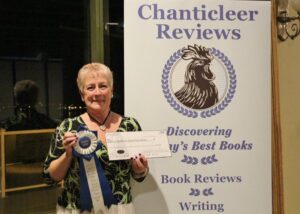
      Janet Shawgo Won the Chatelaine Grand Prize
      • Switch up your chapters. This is where outlining really helps you. If you are hitting a wall writing chapter thirteen, jump forward and write chapter twenty. Sure, you’ll have to go back to that chapter eventually, but this helps you jump over that block and continue to get your word count in.

      I wrote Tattoo entirely this way. It’s made of seven parts of a story told chronologically backward. I didn’t write any of those parts in order. Not one. Yet, I still managed to piece them together in the end.

      Just keep moving. The momentum will pick back up. You can do this.

      Hurray! You Did It!

      Out of breath and exhausted, you crossed that finish line. You did it! Rejoice! I told you you could do it!

      Go celebrate. Treat yourself to a fancy dinner. Toast your deed with some friends. Eat a whole chocolate cake. I don’t care. Party it up because you managed to do what the vast majority of humans on this planet cannot do. Most people never dream about writing a book. Fewer attempt it. Only a small fraction actually finish a draft.

      You are spectacular.


      Now, put the book aside for at least a month (more like two). You will eventually go back and edit. You will fill in those empty brackets. You will allow that annoying three-hundred-pound editor elephant back into your life. But not right now. That’s for another day.


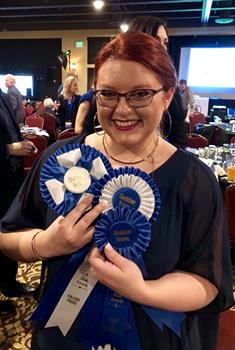
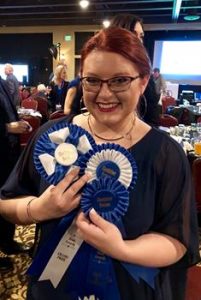
      Michelle Rene and her Chanticleer Grand Prize Ribbons

      Michelle Rene, the author of this blog post,  is a creative advocate and the author of a number of published works of science fiction, historical fiction, humor, and everything in-between.

      She has won indie awards for her historical fiction novel, I Once Knew Vincent. Her latest historical novel, Hour Glass, won the Chanticleer International Book Awards Grand Prize for Best Book. It was released on February 20th to rave reviews from Chanticleer,  Kirkus and Publishers Weekly. Her experimental novella, Tattoo, was released on March 7th.

      When not writing, she is a professional artist and self-described an all-around odd person. She lives as the only female, writing in her little closet, with her husband, son, and ungrateful cat in Dallas, Texas.

      A special thanks go out to the authors Sara Bale and Janet Shawgo for contributing their writing expertise to help others.


      Chanticleer Editorial Services – when you are ready

      Did you know that Chanticleer offers editorial services? We do and have been doing so since 2011.

      Tools of the Editing Trade

      Our professional editors are top-notch and are experts in the Chicago Manual of Style. They have and are working for the top publishing houses (TOR, McMillian, Thomas Mercer, Penguin Random House, Simon Schuster, etc.).

      If you would like more information, we invite you to email Kiffer or Sharon at KBrown@ChantiReviews.com or SAnderson@ChantiReviews.com for more information, testimonials, and fees.

      We work with a small number of exclusive clients who want to collaborate with our team of top-editors on an on-going basis. Contact us today!

      Chanticleer Editorial Services also offers writing craft sessions and masterclasses. Sign up to find out where, when, and how sessions being held.

      A great way to get started is with our manuscript evaluation service. Here are some handy links about this tried and true service: https://www.chantireviews.com/manuscript-reviews/

      Writer’s Toolbox

      Thank you for reading this ENCORE  Chanticleer Writer’s Toolbox article.


    • First Draft in Thirty Days? No Tricks! Award-Winning Author Michelle Rene Shares How She Does It!

      First Draft in Thirty Days? No Tricks! Award-Winning Author Michelle Rene Shares How She Does It!

      Strangely, there is a raw emotion that comes from writing something so fast you don’t have time to noodle it to death.

      How excited are you when you first start fleshing out a story? How amazing does it feel to start naming your characters and setting up their scenes in your mind? Fan-freaking-tastic!

      This is because you are in the beginning of a book affair.

      Writing a book is like having a relationship. In the beginning, it’s like a honeymoon! You feel all the emotions. Love and pain and excitement and lust. Well, okay. Maybe not lust. Paper cuts hurt, so let’s not go there.

      “Writing a book is like starting a new relationship.” Michelle Rene

      The point is the first draft should be all elation and honeymoon.

      Leave the nitty-gritty for your fifteenth edited draft. You don’t want to be sitting in a rocking chair with your first draft complaining about how much he snores before you even get to edit.

      The Thrill is Gone… Do not let this happen to your story!

      Taking years to write that first draft can land you in complacency town before you cross the finish line. Pour your heart and soul into the rough draft with reckless abandon.

      “Pour your heart and soul into the rough draft with reckless abandon.” – Michelle Rene

      “But nothing good can come from my sloppy first draft if I write it in a few weeks,” says the nebulous reader voice in my head that’s starting to sound whiny.

      The PROOF 

      Please refer to the infographic below. It lists some of the most popular books and how long it took the writer to finish them. While Lord of The Rings took a whopping sixteen years to complete (no shocker there), I’d like to direct your attention to roughly a quarter of the chart that indicates books written under three months. If the Boy in the Striped Pajamas was written in two and a half days, you can write something of quality in four weeks.

      Editor’s Note:  This is an awesome chart. I’d say awesome enough to print it and display it in your writer’s lair to spur you on. Michelle’s post continues after the graphic below.

      Why Write This Fast?

      Nothing kills a book faster than never finishing that initial draft. A malaise sets in, often slowing a writer down to a crawl while they chip away over a long time and often give up entirely.

      “Will I ever finish this book?” the writer asks, (fists raised to the sky for dramatic effect).

      Maybe. Maybe not. That first draft is possible if you pick yourself up by your metaphorical bootstraps and do the work every day, but a large percentage of writers never cross the finish line. What a shame that is!

      To reiterate: Strangely, there is a raw emotion that comes from writing something so fast you don’t have time to noodle it to death.

      How Do I Start?

      Let’s begin with talking about the snarky, three-hundred-pound elephant in the back of your mind.

      Your inner editor.

      We are going to bind and gag that jerk, and it may take fifty shades worth of rope because it’s three-hundred pounds and takes up a lot of headspace.

      Sarah Bale, an extremely prolific romance writer, has similar advice for your would-be-elephant editor.

      “I think the biggest mistake an author makes when writing a rough draft is stopping and rereading/editing their work. The key is to keep moving forward and get the whole story out. Know the beginning and the ending. If you have those elements, the rest is easy.”

      Sarah Bale


      “The key is to keep moving forward and get the whole story out.”  Sarah Bale


      The passionate ideas come when the critic in our mind is silenced. Allow yourself to fall head over heels in love with your story.

      Fall Head Over Heels in Love with YOUR STORY!

      Build your characters. Plot the story fast and loose. Fall in love with your story. Get down and dirty in that honeymoon phase…but not literally because remember the paper cuts. We talked about that. If not, we will.

      And finally, outline!

      For the love of all that is holy, outline your story! Do not do this flying by the seat of your pants. That is a sure-fire way to crash and burn. It doesn’t need to be an in-depth outline. On the contrary, keep that pretty loosey-goosey, too.

      My outlines are often little more than a few sentences for each chapter.

      The Middle Stick

      It’s right around the 30,000-word mark that this happens. The Middle Stick is what I call the point where your initial enthusiasm begins to wane, and your progress gets sluggish. What began as “yay, I’m writing a book” turns into “I don’t know if I can do this.” It happens to everyone.

      This is where participating in programs like NaNoWriMo can be helpful. Having other writers in the same place can be encouraging, and they can hold you accountable. If you aren’t doing NaNoWriMo, I suggest getting a group of like-minded author friends to do this together. This is also where writing ahead of your minimum word count helps because The Middle Stick will almost certainly slow you down.

      Here are two  helpful tips for when you are in the “saggy middle”

      • Go out of your comfort zone and experience something related to your book. For example, if you are writing a western, go see a rodeo. Get away from your computer.  (Or in Covid days, watch YouTube videos specific to your story or go for a walk or take a hike or try a new recipe that your protagonist would enjoy. – Kiffer)

        Multi-award winning author, Janet Shawgo, has this to say about immersing yourself in your research outside the page when she was researching her book, Look For Me, set in the Civil War. “What helped me was putting feet on the ground at Gettysburg to get a feel of the area, what my characters saw, what they heard. To try on costumes true to that era. I walked some of the roads soldiers did in Virginia. If at all possible, put yourself there.”

      • Switch up your chapters. This is where outlining really helps you. If you are hitting a wall writing chapter thirteen, jump forward and write chapter twenty. Sure, you’ll have to go back to that chapter eventually, but this helps you jump over that block and continue to get your word count in.

      I wrote Tattoo entirely this way. It’s made of seven parts of a story told chronologically backward. I didn’t write any of those parts in order. Not one. Yet, I still managed to piece them together in the end.

      Just keep moving. The momentum will pick back up. You can do this.

      PICTURE SELF in the FUTURE with a Completed First Draft! 

      Hurray! You Did It!

      Go celebrate. Treat yourself to a fancy dinner. Toast your deed with some friends. Eat a whole chocolate cake. I don’t care. Party it up because you managed to do what the vast majority of humans on this planet cannot do. Most people never dream about writing a book. Fewer attempt it. Only a small fraction actually finish a draft.

      You are spectacular.

      WHAT NEXT?

      Now, put the book aside for at least a month (more like two). You will eventually go back and edit. You will fill in those empty brackets.

      You will allow that annoying three-hundred-pound editor elephant back into your life. But not right now. That’s for another day.

      STAY TUNED for Michelle’s Next Chanticleer Writer’s Toolbox blog post on:

      • Time Management
      • From Snail to Sprint
      • 90 second exercise to keep you on track
      • How to Not Fall into the Black Hole of the Internet While Writing Your First Draft
      Michelle Rene and her Chanticleer Grand Prize Ribbons

      Michelle Rene, the author of this blog post,  is a creative advocate and the author of a number of published works of science fiction, historical fiction, humor, and everything in-between.

      She has won indie awards for her historical fiction novel, I Once Knew Vincent. Her latest historical novel, Hour Glass, won the Chanticleer International Book Awards Grand Prize for Best Book. It was released on February 20th to rave reviews from Chanticleer,  Kirkus and Publishers Weekly. Her experimental novella, Tattoo, was released on March 7th.

      When not writing, she is a professional artist and self-described an all-around odd person. She lives as the only female, writing in her little closet, with her husband, son, and ungrateful cat in Dallas, Texas.

      A special thanks go out to the authors Sarah Bale and Janet Shawgo for contributing their writing expertise to help others.


      Chanticleer Editorial Services – when you are ready

      Did you know that Chanticleer offers editorial services? We do and have been doing so since 2011.

      Tools of the Editing Trade

      Our professional editors are top-notch and are experts in the Chicago Manual of Style. They have and are working for the top publishing houses (TOR, McMillian, Thomas Mercer, Penguin Random House, Simon Schuster, etc.).

      If you would like more information, we invite you to email Kiffer or Sharon at KBrown@ChantiReviews.com or SAnderson@ChantiReviews.com for more information, testimonials, and fees.

      We work with a small number of exclusive clients who want to collaborate with our team of top-editors on an on-going basis. Contact us today!

      Chanticleer Editorial Services also offers writing craft sessions and masterclasses. Sign up to find out where, when, and how sessions being held.

      A great way to get started is with our manuscript evaluation service. Here are some handy links about this tried and true service: https://www.chantireviews.com/manuscript-reviews/

      Writer’s Toolbox

      Thank you for reading this Chanticleer Writer’s Toolbox article.


    • RULE #1 of Writing a Novel – Unspooling the Story in Your Brain Onto the Page –  Links included-Chanticleer Writers Tool Kit

      RULE #1 of Writing a Novel – Unspooling the Story in Your Brain Onto the Page – Links included-Chanticleer Writers Tool Kit

      The FIRST RULE of Writing Your Next Book

      (From top editor Jessica Morrell and Chanticleer’s own Kiffer Brown along with advice from Stephen King, Chelsea Cain, Ernest Hemingway, Robert Dugoni, J.D. Barker,  and many more bestselling authors).

      The Secret to Successful Publishing

      Don’t edit your first draft as you write it!

      Writing your first draft should be a mad dash to get your story out of your brain. Jessica calls it “unspooling your story thread.”

      Don’t hinder it by worrying about each little detail. There will be time for that later. NaNoWriMo or not.

      Not taking our word for that piece of advice?

      Chelsea Cain, a bestselling thriller author (with a TV series to her credit),  gives this piece of advice:

      Write the bare-bones version of the scene first using mostly dialogue, and then move on and in the second draft flesh out the scenes with description and action.

      Action is dialogue. Dialogue is action. – Robert Dugoni, Amazon Bestselling Author

      What is YOUR STORY?

      Story is essentially a problem that needs solving for the protagonist. – Jessica Morrell

      • What is your protagonist’s problem that must be solved—or else?
      • What is the worst thing that can happen next to your protagonist?
      • Remember that it is not your problem. It is your protagonist’s problem, obstacle, impossible dream.
      • Start at least one subplot. This subplot(s) should also complicate the protagonist’s goals.

      No matter when the problem begins (it’s always in Act One) the problem is weighty and vexing, perhaps insurmountable. If the problem is not immediately personal, it should become so that it will create a bond (connection) between the protagonist and antagonist. (A classic example is the connection between Sherlock Holmes and Jim Moriarty).

      Sherlock Holmes and James Moriarty

      What is the inciting event or threat? 

      The inciting incident might lead to the problem. This event will disrupt the status quo, demand response, and set actions in motion. It’s a threat that unbalances the story world and creates dilemmas that must be dealt with.

       These excerpts above are from The Inciting Incident blogpost


      Environment (internal and external)

      • Remember you want to send your protagonist into new emotional territory with new challenges and pressures.
      • And at the same time, she will need to deal with new physical territories such as a new school (Footloose) or a different culture (Dances with Wolves) or a different legal society with different norms (Handmaid’s Tale) or a new environment (Deadwood)  or a different time (Outlander) or galaxy (Farscape).
      • Don’t be afraid to stage danger in benign or lovely settings or conversely gentle scenes in dangerous and gruesome settings.

      Atmosphere

      • Allow the overall atmosphere and mood to imbue your writing from the get-go.
      • The atmosphere lends itself to the overall tone and mood of a work. Allow it to permeate your work as you write.

      Why use atmosphere in your first draft? (or during NaNoWriMo)? 

      • Because it will affect your mood and approach to your story.
      • It will make you focus on creating unease–a necessary ingredient not always considered in early drafts.
      • Unease contributes to writing a page-turner.
      • Atmosphere underlines themes–even if you don’t have your themes nailed down yet.

      Here is the link to our Writer’s Toolbox article on Atmosphere

      Emotional Baggage

      • Know your protagonist’s main emotional wound, sometimes called baggage in real life. How is it going to affect his or her ability to solve the story problem? (See the questions below to jumpstart creativity.)

      Remember that Writers (that is you) should carry a notebook everywhere you go. You never know when a brilliant solution is going to appear. Jessica Morrell

        If I could offer a single piece of advice about creating characters it would be this (Jessica Morrell):

        • Take risks with your main characters.
        • Make them stand out from the myriads of fiction published each year.
        • And don’t be afraid to allow eccentricities, quirks, and oddball ways of seeing reality.

        More questions for your protagonist from Jessica Morrell—these are guaranteed to get your creative wheels turning:

        First, ask yourself these questions and then “ask” your protagonist. Have your protagonist go into depth. Find out what your protagonist’s iceberg under the waterline is all about.

                                                                                        Photo taken in Greenland’s waters.

        Kiffer suggests that you take a walk when you are considering these questions. Be sure to either take notes or record your thoughts on your smartphone while you explore your protagonist’s emotional baggage. Walk a mile in your protagonist’s shoes. 

        J.D. Barker stated at the Chanticleer Authors Conference 2019 that he knows which rides his main characters would go on at Disney Land, the type of beer that he/she would order, and favorite toys that he/she played with as a child. He may not use this info in his manuscript but knowing  this information gives his characters subtext and undercurrents that make his novels international bestsellers.

        Jessica Morrell suggests that you ask your protagonist these questions?

        • What’s the most embarrassing thing that has ever happened to you?
        • What is your biggest regret?
        • What is your superpower?
        • Who do you cherish most in the world?
        • If you could change one thing about your world, what would it be?
        • What is your average day or schedule?
        • What 5-6 words sum up your values?
        • What do you do after a really bad day?
        • How do you celebrate?
        • The secret you’d never tell your significant other? Your mother? Your sibling?
        • What reminds you of home?
        • What item must you always take along when traveling?
        • Favorite drink?
        • Secret vice?
        • Pizza or tacos? Cookies or tequila?
        • Favorite climate?
        • Reading or television to unwind?
        • Breakfast or coffee only?

        We hope that we helping you, Dear Writer, to arm and prep yourself to get down to the writing of your next work—the reckoning.


        Ernest Hemingway:  There is nothing to writing. All you do is sit down at a typewriter and bleed.

        Unspooling the Thread of Your Story

        Stay tuned for more Writing and NaNoWriMo Tips

        Link to Part One of our Annual NaNoWriMo Writing Tips Series


        Chanticleer Editorial Services – when you are ready

        Did you know that Chanticleer offers editorial services? We do and have been doing so since 2011.

        Tools of the Editing Trade

        Our professional editors are top-notch and are experts in the Chicago Manual of Style. They have and are working for the top publishing houses (TOR, McMillian, Thomas Mercer, Penguin Random House, Simon Schuster, etc.).

        If you would like more information, we invite you to email Kiffer or Sharon at KBrown@ChantiReviews.com or SAnderson@ChantiReviews.com for more information, testimonials, and fees.

        We work with a small number of exclusive clients who want to collaborate with our team of top-editors on an on-going basis. Contact us today!

        Chanticleer Editorial Services also offers writing craft sessions and masterclasses. Sign up to find out where, when, and how sessions being held.

        A great way to get started is with our manuscript evaluation service. Here are some handy links about this tried and true service: https://www.chantireviews.com/manuscript-reviews/

        And we do editorial consultations. for $75.  https://www.chantireviews.com/services/Editorial-Services-p85337185

        Writer’s Toolbox

        Thank you for reading this Chanticleer Writer’s Toolbox article.

        Writers Toolbox Helpful Links: 

        The INCITING INCIDENT: STORY, SETBACKS and SURPRISES for the PROTAGONIST – A Writer’s Toolbox Series from Jessica Morrell’s Editor’s Desk

        ESSENCE of CHARACTERS – Part One – From the Jessica Morrell’s Editor’s Desk – Writer’s Toolbox Series  

        Keep writing, keep dreaming, have heart. Jessica

        Jessica Morrell is a top-tier developmental editor and a contributor to Chanticleer Reviews Media and to the Writer’s Digest magazine. She teaches Master Writing Craft Classes at the Chanticleer Authors Conference that is held annually along with teaching at Chanticleer writing workshops that are held throughout the year. 


        Keep creating magic! Kiffer 

        Kathryn (Kiffer) Brown is CEO and co-founder of Chanticleer Reviews and Chanticleer Int’l Book Awards (The CIBAs) that Discover Today’s Best Books. She founded Chanticleer Reviews in 2010 to help authors to unlock the secrets of successful publishing and to enhance book discoverability. She is also a scout for select literary agencies, publishing houses, and entertainment producers.



      • NaNoWriMo or Not – Great TIPS  for WRITING Your Next Work by Jessica Morrell and Kiffer Brown

        NaNoWriMo or Not – Great TIPS for WRITING Your Next Work by Jessica Morrell and Kiffer Brown

        Whether or not you are participating in NaNoWriMo, these BRAINSTORMING TIPS from Jessica Morrell with help jump start your next work of fiction.

        NaNoWriMo what?  NaNoWriMo is short for National November Writing Month. There is a tradition in the writing community around the world that writers hunker down and promise to write 50,000 words for one work during the month of November. Some writers flourish under the deadline. Others, well let’s just say there is much gnashing of teeth and fretting to meet the deadline. Some writers believe that NaNoWriMo has forced them to bang out their best work. Others look back on their month of NaNo-ing and see gibberish.

        As for me and others, November just isn’t the month to join in annual since Thanksgiving and the winter holidays are just around the corner. A few of us speak almost treasonously about doing it at a different time such as February. NaFebWriMo.

        But whatever your take on NaNoWriMo is, I believe that you will find Jessica’s suggestions and tips on How to Your Brainstorm Next Work will be useful additions to your writer’s toolbox. Kiffer Brown

        UnSpooling the Story Thread in Your Brain – Jessica Morrell

        With the end of October here that has NaNoWriMo looming just around the corner, I recommend that you get acquainted with your protagonist before you plunge into writing a new novel.

        It’s simple really; if you get acquainted with him or her beforehand, the story will unspool with more ease and speed. Because what the protagonist wants/desires and fears the most (the dreaded alternative) will be at stake in the story.

        Now, it’s likely that the protagonist’s needs and goals will shift and grow throughout the story, but you need a starting point of need and imbalance. If you begin with basic dynamics of storytelling now, then by the time the conflict heats up and things are really hairy, you’ll understand your protag’s reactions and next steps.

        In fiction, needs and motivations create goals.
        The protagonist’s goals will meet with opposition from the antagonist or another force. The protagonist will struggle to overcome the obstacles. These struggles create conflict and conflict fuels the whole shebang.

        Goals matter. Goals define fictional characters from Woody from Toy Story to Dorothy Gale in the Wizard of Oz to Atticus Finch in To Kill a Mockingbird.

        Goals are tied to dramatic structure and prevent your characters from being merely reactive.

        Fictional characters don’t give up even though goals are hard to achieve.

        Goals provide action, drive stories.

        CHARACTERS

        HUNGER GAMES by Susanne Collins

        Katniss Everdeen: Her path to greatness began the day of the Reaping when she steps in to save/protect her sister Primrose from taking part in the annual and deadly Hunger Games. Leaving home with Peeta, the other Tribute from District 12, she plans to somehow stay alive because if she dies her mother and sister will not be able to survive without her. Along the way, she trains, forms an alliance with Peeta, collects allies and enemies, and ultimately fights to protect Peeta’s life too. By story’s end, their examples show how remaining true to your principles is most important of all.

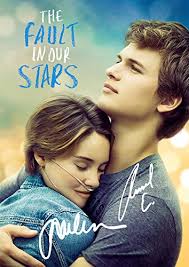
        The Fault in Our Stars by John Green

        Hazel Lancaster in The Fault in Our Stars: Teenaged Hazel has been dealt a lousy hand, thyroid cancer that has metastasized into lung cancer. Her first goal, to please her mother, is accomplished when she attends a support group for kids with cancer. At this meeting, she makes friends with Augustus Waters who becomes her first love. She introduces Augustus to her favorite novel about a girl with terminal cancer and explains she wants to meet the author and understand what really happened to his family. You see, the motivation that drives Hazel is that she needs to believe her parents will be okay after she dies. (spoiler alert) Along the way Hazel and Augustus travel to Amsterdam and meet the author, lose their virginity, and Hazel realizes how much she wants to live. But Augustus has been hiding a horrible truth: his cancer has returned and he has little time left. Quite a plot twist, isn’t it? Now Hazel needs to somehow support him, cherish their last days together, then handle her grief all the while coping with her own terminal diagnosis. She comes to understand what being a survivor means and that life has meaning no matter what stage you’re at. And she comes to feel more peace about her parents, especially after she learns her mother has been getting a degree in social work.

        Star Wars by George Lucas

        Luke Skywalker: Skywalker is a freedom fighter from humble beginnings. His path (and character arc) begins with a restless need to escape his dead-end existence on his uncle’s barren farm. He learns that Princess Leia is leading a rebellion against the Empire and wants to join. He longs to become a Jedi Knight, or fighter pilot especially after Obi-Wan Ben Kenobi, a desert hermit, informs him that his father was a Jedi fighter and he has the ability to harness the Force. Still reluctant to leave his family, his mind is made up for him when Imperial stormtroopers savagely murder his aunt and uncle. He’s all in now. Skywalker begins training with Hans Solo, then learns the princess has been captured. His next goal is to rescue the princess, which he accomplishes with more than a few swashbuckling moves. This sets up his final, seemingly hopeless goal of taking out the Death Star and ultimately saving the Rebel alliance.

        TAKEAWAYS

        Notice how the protagonists’ goals powered the story?

        Getting to know you….getting to know all about you…

        So how are you going to get acquainted with your protagonist? There are lots of questionnaires available online to create a physical presence and backstory.

        Walk a mile in their shoes…

        However, it seems to me that walking along or imagining characters as if they’re with you, their creator, can be one of these best methods of getting to know someone. Especially if you want to learn what makes them tick. Or in fiction speak, their motivations. Motivations stem from a character’s past, basic nature and personality, and compelling circumstances.

        Let’s repeat: Motivations create needs which create goals which fuel conflict = story.

        Just try it. Step outdoors and plan to walk for at least a mile with your invisible pal at your side.

        • What would your character notice or remark on?
        • How does he/she hold his/her body?
        • Fast walker? Ambler? Quiet?
        • Hates exercise? Feels most alive when moving?
        • What’s on his or her mind? Distracted? Preoccupied? Impatient?

        Do you remember those moments in life when you’re walking along with a friend and a profound truth slips into the conversation? Maybe it’s a tidbit or a bombshell or sharing a long-ago memory. We all have wounds and they’re often twined to a character’s internal goals and secrets. Those are the moments, the gold you’re searching for.

        And although time is short with November looming, how about a short road trip with your character riding shotgun? Or can he or she tag along when you’re running errands or chauffeuring the kids? Have you ever noticed how some people are a delight to travel with and some people are a nightmare? Which one is your protagonist? A nervous, watchful traveler? Open to adventure? Afraid of the unknown? Chatty? Reticent?

        Shaping your protagonist’s goals

        What’s wrong or not working in his/her current situation?

        What about emotional needs from the past? In other words, what’s screwing up your character?

        What first, clear-cut action step can the protagonist take toward his/her goal?

        Remember, a protagonist’s goals work best if they’re relatable, visible, and barely achievable. Side note: some of a character’s goals will remain ‘invisible’ since they are inner, emotional, personal growth goals.

        INCITING INCIDENTS

        What is the impetus to push your protagonist toward that goal?

        The inciting incident such as Prim begin chosen to participate in the Hunger Games? The first plot point when Hazel meets Augustus at the support group? Dorothy’s inciting incident? Luke Skywalkers’ inciting incident?

        What is your protagonist’s inciting incident? 

        Stay tuned for more NaNoWriMo Tips // Jump Start Your Novel Tips

        Jessica Page Morrell

        Keep writing, keep dreaming, have heart. Jessica

        Jessica Morrell is a top-tier developmental editor and a contributor to Chanticleer Reviews Media and to the Writer’s Digest magazine. She teaches Master Writing Craft Classes at the Chanticleer Authors Conference that is held annually along with teaching at Chanticleer writing workshops that are held throughout the year. 


        Chanticleer Editorial Services

        Did you know that Chanticleer offers editorial services? We do and have been doing so since 2011.

        Our professional editors are top-notch and are experts in the Chicago Manual of Style. They have and are working for the top publishing houses (TOR, McMillian, Thomas Mercer, Penguin Random House, Simon Schuster, etc.).

        If you would like more information, we invite you to email Kiffer or Sharon at KBrown@ChantiReviews.com or SAnderson@ChantiReviews.com for more information, testimonials, and fees.

        We work with a small number of exclusive clients who want to collaborate with our team of top-editors on an on-going basis. Contact us today!

        Chanticleer Editorial Services also offers writing craft sessions and masterclasses. Sign up to find out where, when, and how sessions being held.

        A great way to get started is with our manuscript evaluation service. Here are some handy links about this tried and true service:

        https://www.chantireviews.com/manuscript-reviews/

        Writer’s Toolbox

        Thank you for reading this Chanticleer Writer’s Toolbox article.

        Writers Toolbox Helpful Links: 

        The INCITING INCIDENT: STORY, SETBACKS and SURPRISES for the PROTAGONIST – A Writer’s Toolbox Series from Jessica Morrell’s Editor’s Desk

        ESSENCE of CHARACTERS – Part One – From the Jessica Morrell’s Editor’s Desk – Writer’s Toolbox Series