From Snail to Sprint
I wrote the first draft of my award-winning historical novel, Hour Glass, in sixteen days. You read that correctly—sixteen days. My experimental novella, Tattoo, was written in about three weeks. Both have been released in 2018.
Though I am intensely proud of this accomplishment, I’m not telling you this to brag. I’m telling you that you can do this, too.
“Sit down every day to write. Even if you don’t want to. A little every day.” – Michelle Rene
Sounds like a line you’ve heard before, right? Yeah, me too. It’s not that this is bad advice. Far from it. Many people find this the best way for them to consistently write draft after draft. But if you really want to knock that rough draft out of the park, I’m going to ask you to kick that notion to the curb.


I’m not magical; I’m a binge writer, and none of the ideas in this article are uniquely mine. Most of them are exercises I’ve stolen from other writers. I used to be just like you because I was led to believe novels should take years to write. I would write a chapter, go back and edit it, and then proceed to the next one. A first draft took me over a year to complete.
It wasn’t until I decided I really needed to finish my novel, I Once Knew Vincent, that I decided to shove my face in the cold, scary, deep end of the writing ocean. I went away to a writer’s retreat and forced myself to write as much as I could every day. I wrote the lion’s share of that book in six days, and those chapters were by far the best in the book.
Why is that?
Isn’t it counterintuitive that the chapters written in a whirlwind of typing be the best? I’m glad you asked, nebulous reader voice in my head. Let’s delve into that.
Why Write This Fast?
Nothing kills a book faster than never finishing that initial draft. A malaise sets in, often slowing a writer down to a crawl while they chip away over a long time and often give up entirely.

“Will I ever finish this book?” the writer asks, (fists raised to the sky for dramatic effect).
Maybe. Maybe not. That first draft is possible if you pick yourself up by your metaphorical bootstraps and do the work every day, but a large percentage of writers never cross the finish line. What a shame that is!
Strangely, there is a raw emotion that comes from writing something so fast you don’t have time to noodle it to death.
How excited are you when you first start fleshing out a story? How amazing does it feel to start naming your characters and setting up their scenes in your mind? Fan-freaking-tastic!
This is because you are in the beginning of a book affair.
Writing a book is like having a relationship. In the beginning, it’s like a honeymoon! You feel all the emotions. Love and pain and excitement and lust. Well, okay. Maybe not lust. Paper cuts hurt, so let’s not go there.

The point is the first draft should be all elation and honeymoon. Leave the nitty-gritty for your fifteenth edited draft. You don’t want to be sitting in a rocking chair with your first draft complaining about how much he snores before you even get to edit. Taking years to write that first draft can land you in complacency town before you cross the finish line. Pour your heart and soul into the rough draft with reckless abandon.
“Pour your heart and soul into the rough draft with reckless abandon.” – Michelle Rene
“But nothing good can come from my sloppy first draft if I write it in a few weeks,” says the nebulous reader voice in my head that’s starting to sound whiny.
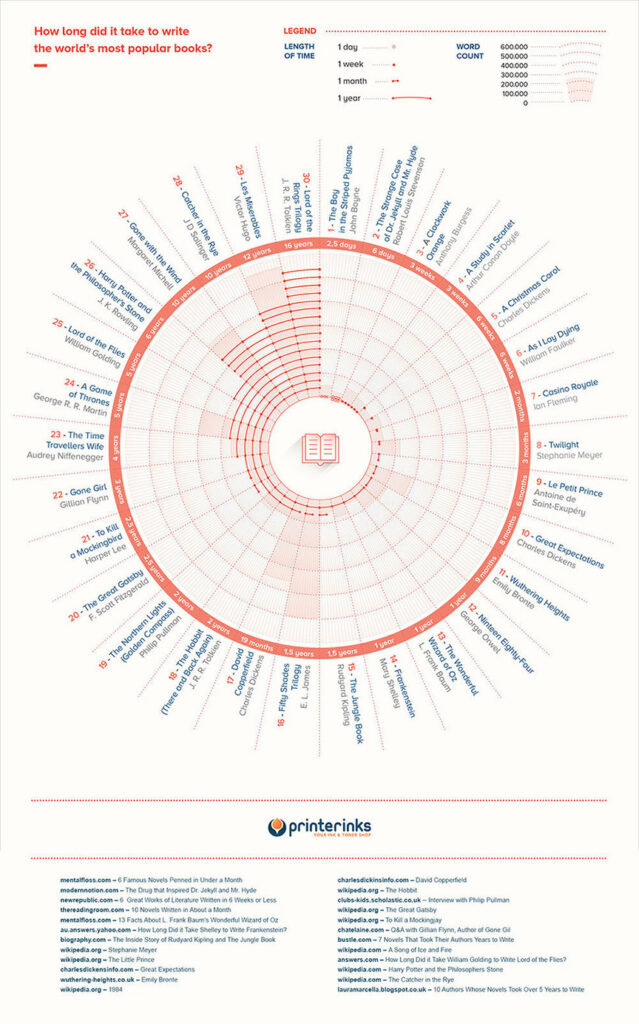
Please refer to the infographic below. It lists some of the most popular books and how long it took the writer to finish them. While Lord of The Rings took a whopping sixteen years to complete (no shocker there), I’d like to direct your attention to roughly a quarter of the chart that indicates books written under three months. If the Boy in the Striped Pajamas was written in two and a half days, you can write something of quality in four weeks.
How Do I Start?
Let’s begin with talking about the snarky, three-hundred-pound elephant in the back of your mind. Your inner editor. We are going to bind and gag that jerk, and it may take fifty shades worth of rope because it’s three-hundred pounds and takes up a lot of headspace.
Sara Bale, an extremely prolific romance writer, has similar advice for your would-be-elephant editor.
“I think the biggest mistake an author makes when writing a rough draft is stopping and rereading/editing their work. The key is to keep moving forward and get the whole story out. Know the beginning and the ending. If you have those elements, the rest is easy.”

“The key is to keep moving forward and get the whole story our.” Sara Bale
The passionate ideas come when the critic in our mind is silenced.
Your visceral idea is key, and I will not accept the old “I don’t know what to write about” excuse. You are here to pour your heart and soul into a story. If you are having a hard time with inspiration, here’s a handy dandy exercise to help that I stole from a writer’s workshop I attended.
Sit down with a piece of paper and a pen. Yes, a real piece of paper and pen. No cheating with keyboards. I know, I know. Your handwriting is horrible because all you do is type now. My handwriting looks like a serial killer’s ransom note, so I totally understand, but stick with me.

Next, set a timer for ninety seconds.
Hit start, write the first thing that comes to your mind and don’t stop until that timer goes off. No contemplating it. No editing your idea and wondering if Stephen King has already done it. He probably has. Just write, no excuses, for the whole ninety seconds.
Go ahead… I’ll wait…

You back? Okay. I’m not a betting woman, but I would put money on what you wrote was pretty damn good.
Whether or not that is the idea you run with doesn’t matter. It’s an exercise to get the creative juices flowing. Use that. Build your characters. Plot the story fast and loose. Fall in love with your story. Get down and dirty in that honeymoon phase…but not literally because remember the paper cuts. We talked about that.
And finally, outline! For the love of all that is holy, outline your story! Do not do this flying by the seat of your pants. That is a sure-fire way to crash and burn. It doesn’t need to be an in-depth outline. On the contrary, keep that pretty loosey-goosey, too.
My outlines are often little more than a few sentences for each chapter.
Time Management
Okay, you have your outline, your idea, and your story. Let’s do this. The clock begins when you type “Chapter One” or “Prologue” if you want to be fancy. Let’s use NaNoWriMo (National Write a Novel in a Month) rules as I find these to be the best guidelines: 50,000 words in four weeks.

So four weeks. That’s your mission.
Select a four-week span of time in your life that you can devote to writing. Don’t sabotage yourself by doing this during a family vacation or when it’s the busy season at work. Choose a month that will allow you some time to devote to this endeavor because it is important.
For that month, give up on being the best mom, husband, wife, etc. Let your family know that this is going to be what you are doing for this month, and they can have you back after it’s over. The laundry can wait. Order in food. Maybe shower because, well, hygiene.
Editor’s Note: I totally agree with Michelle. November can be an impossible time for many because of increased work demands, family demands for the approaching holidays, the doldrums due to shorter and shorter days. The main thing is to pick a time that works for you. It can be NaFebWriMo if you have to put in overtime starting in November for the holiday season, or NaJulyWriMo – if you are a teacher. Find a time period that works for you and stick with it! Put it on your calendar. Alert your friends and family.
I highly, highly, highly recommend you track your progress. Doing a rough draft during NaNoWriMo is a great idea. This happens in November, and the organization sets you up for a win. You have a word tracker, writer friends to cheer you on, and helpful articles when you get stuck. If November is not a good month for you, try a program like WriteTrack. It will help you keep up with your progress.
Insider secret: Don’t shoot for the minimum goal. If your tracker says you need to write 2,000 words that day, shoot for 3,000 or 4,000. It’s easy to fall behind only doing the bare minimum; but if you’re always ahead, you have a little breathing room.
The Black Hole of the Internet
Can someone say distractions? Turn those notifications off! Set your phone to do not disturb except for emergencies. Hang a banner on your doorknob with a picture of Gandalf saying, “Thou shall not pass!” Get away from the addicting vacuum of social media. It will be there when you get back.

“That’s all well and good if you are writing something you just made up, but what about people who need to research their content?” asks nebulous reader voice again.
With Hour Glass, I wrote a historical fiction novel about Calamity Jane. There was definitely some research involved there. I did as much as I could before the writing began, mainly broad stroke things: dates, places, and a few good details relevant to the story. Nothing more.
Research is the most unassuming trap in writing. You’re on a good writing jag, everything is flowing, and then you hit a spot where you need the name of a city or a date or a vocabulary word. You have to have that accurate information, right? So you switch to the internet and start researching. Well, that first page on a website leads you to another, which leads you to Facebook; and then before you know it, it’s been three hours, and you lost your momentum.
Broad stroke your research before you start; but while you’re writing, don’t research. If you need the name of a city, don’t go looking. Just write something like, “He rode into the sunset hoping his horse knew the way to {insert city name}.” Get the story down, and go back in later to fill in those brackets.
Write your story from the heart and with passion. Research and accuracy can be added later.
The Middle Stick
It’s right around the 30,000-word mark that this happens. The Middle Stick is what I call the point where your initial enthusiasm begins to wane, and your progress gets sluggish. What began as “yay, I’m writing a book” turns into “I don’t know if I can do this.” It happens to everyone.
This is where participating in programs like NaNoWriMo can be helpful. Having other writers in the same place can be encouraging, and they can hold you accountable. If you aren’t doing NaNoWriMo, I suggest getting a group of like-minded author friends to do this together. This is also where writing ahead of your minimum word count helps because The Middle Stick will almost certainly slow you down.
Here are some other helpful tips.
- Try that writing something in ninety seconds exercise I mentioned earlier to get inspiration.
- Go out of your comfort zone and experience something related to your book. For example, if you are writing a western, go see a rodeo. Get away from your computer.
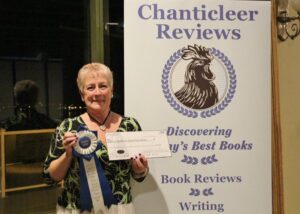
Multi-award winning author, Janet Shawgo, has this to say about immersing yourself in your research outside the page when she was researching her book, Look For Me, set in the Civil War. “What helped me was putting feet on the ground at Gettysburg to get a feel of the area, what my characters saw, what they heard. To try on costumes true to that era. I walked some of the roads soldiers did in Virginia. If at all possible, put yourself there.”
- Switch up your chapters. This is where outlining really helps you. If you are hitting a wall writing chapter thirteen, jump forward and write chapter twenty. Sure, you’ll have to go back to that chapter eventually, but this helps you jump over that block and continue to get your word count in.
I wrote Tattoo entirely this way. It’s made of seven parts of a story told chronologically backward. I didn’t write any of those parts in order. Not one. Yet, I still managed to piece them together in the end.
Just keep moving. The momentum will pick back up. You can do this.
Hurray! You Did It!
Out of breath and exhausted, you crossed that finish line. You did it! Rejoice! I told you you could do it!

Go celebrate. Treat yourself to a fancy dinner. Toast your deed with some friends. Eat a whole chocolate cake. I don’t care. Party it up because you managed to do what the vast majority of humans on this planet cannot do. Most people never dream about writing a book. Fewer attempt it. Only a small fraction actually finish a draft.
You are spectacular.

Now, put the book aside for at least a month (more like two). You will eventually go back and edit. You will fill in those empty brackets. You will allow that annoying three-hundred-pound editor elephant back into your life. But not right now. That’s for another day.
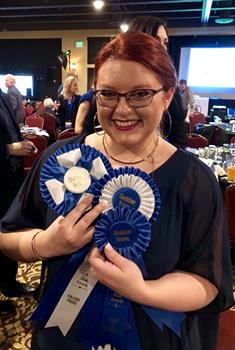
Michelle Rene, the author of this blog post, is a creative advocate and the author of a number of published works of science fiction, historical fiction, humor, and everything in-between.
She has won indie awards for her historical fiction novel, I Once Knew Vincent. Her latest historical novel, Hour Glass, won the Chanticleer International Book Awards Grand Prize for Best Book. It was released on February 20th to rave reviews from Chanticleer, Kirkus and Publishers Weekly. Her experimental novella, Tattoo, was released on March 7th.
When not writing, she is a professional artist and self-described an all-around odd person. She lives as the only female, writing in her little closet, with her husband, son, and ungrateful cat in Dallas, Texas.
A special thanks go out to the authors Sara Bale and Janet Shawgo for contributing their writing expertise to help others.
Chanticleer Editorial Services – when you are ready
Did you know that Chanticleer offers editorial services? We do and have been doing so since 2011.
Tools of the Editing Trade
Our professional editors are top-notch and are experts in the Chicago Manual of Style. They have and are working for the top publishing houses (TOR, McMillian, Thomas Mercer, Penguin Random House, Simon Schuster, etc.).
If you would like more information, we invite you to email Kiffer or Sharon at KBrown@ChantiReviews.com or SAnderson@ChantiReviews.com for more information, testimonials, and fees.
We work with a small number of exclusive clients who want to collaborate with our team of top-editors on an on-going basis. Contact us today!
Chanticleer Editorial Services also offers writing craft sessions and masterclasses. Sign up to find out where, when, and how sessions being held.
A great way to get started is with our manuscript evaluation service. Here are some handy links about this tried and true service: https://www.chantireviews.com/manuscript-reviews/

Writer’s Toolbox
Thank you for reading this Chanticleer Writer’s Toolbox article.