
Tag: Music

  • The DEVIL PULLS the STRINGS by J. W. Zarek –  Young Adult Epic Fantasy Adventure, Young Adult Fantasy Action Adventure, Young Adult Urban Fantasy

    The DEVIL PULLS the STRINGS by J. W. Zarek – Young Adult Epic Fantasy Adventure, Young Adult Fantasy Action Adventure, Young Adult Urban Fantasy


    Overall Best Book of 2021 Grand Prize Badge for J.W. Zarek's The Devil Pulls the StringsThe protagonist and all-around decent guy, Boone Daniels, is in a heap of hurt in JW Zarek’s new Young Adult novel, The Devil Pulls the Strings.

    One would think being plagued by an evil spirit wendigo since age six would be enough inconvenience to last a lifetime, but when Boone jousts with his best bud at a Ren Faire and accidentally deals a mortal blow, the hurt he experiences suddenly lands on a sliding scale of 1 to 1 million. And Boone Daniels becomes a millionaire, so to speak.

    No ordinary guy, Boone makes a living as a handyman and swashbuckling knight at Renaissance Faires around Missouri. He’s also uniquely gifted with a form of eidetic memory coupled with synesthesia. What’s that? Simply put, synesthesia allows people to see colors and taste things when they hear music – and an eidetic memory allows folks to memorize whatever they’ve seen or heard one time. But that’s not all. Boone can time-travel, make friends with almost any feline or shapeshifter, and convince a certain immortal he’s worth more as an ally than a snack. No kidding, Baba Yaya loves human meat.

    After wounding his best friend, Boone promises to fill in for him as lead vocalist in the band, The Village Idiots, for a major gig in New York City.

    The gig caps off the Dragons and Nymphs Annual Charity Ball – a blood drive. (The irony of this will make readers chuckle.) After the band plays, a mysterious score of music by Niccolò Paganini will be played by the best violinist of the time, who also happens to be Boone’s fast-friend-confidant-maybe-girlfriend-we’ll-have-to-see, Sapphire Anjou. Sapphire, the French Ambassador’s daughter, has connections that tie her deeply to the Lavender and Rose Society. There’s more to these societies. The Dragons and Nymphs want nothing but destruction and chaos, while the Lavender and Rose Society maintain order and work to keep people alive. And both societies seek the magical score. You see, no one actually has the Paganini sheet music. It’s a mystery and plenty of people die and get maimed in the pursuit of the piece, but finally, just in the nick of time, Boone and Sapphire obtain it.

    What’s so special about this piece of music?

    It’s magic, of course! Whoever plays the Paganini score can summon anyone they want. The Dragons and Nymphs want it to summon Ambrogio, their Vampire All-Father, who now resides in Hell. One immortal wants it to free her sister, who’s been caught in a pocket universe (you’ll have to read the book to figure out what that means). And then there’s the nefarious all-around baddie, Ambrozij Sinti, humiliated as a young boy, who now seeks his revenge by using the Paganini piece to summon the Devil himself and destroy the world. The stakes are high, and there’s no time to lose.

    Told in first-person by hero Boone Daniels, J. W. Zarek spins an epic fantasy with tons of action, adventure, and folklore.

    His writing peppers readers with alliteration in trios, that serve to tighten phrasing to speed up action scenes, evoking visceral responses. Readers feel the panic Boone feels as the world closes in around him. Does it work? Like a charm. Almost perfect, readers will surely love this first in series, epic fantasy world and fall in love with Zarek’s leading man because of it.

    Somewhere between The Librarians meets The Magicians – mixed with the flawed hero archetypes of Jim Butcher’s Harry Dresden and Harold Hearne’s Atticus O’Sullivan, Zarek’s hero brings fans of the genre something new to dig their teeth into – and that’s an excellent thing. Fans will be thrilled to learn that the novel will release in Graphic Novel format soon!


    The Devil Pulls the Strings won a whopping four Ribbons at the 2021 CIBA Ceremonies, a First Place Ribbon in both Ozma and Cygnus, as well as the Grand Prize in Paranormal, and the Overall Best Book of 2021 for the Chanticleer Int’l Book Awards!

    Chanticleer Book Reviews 5 Star Best Book silver foil sticker


  • TRACK TWO ON REPEAT by Rebekah N. Bryan – Y/A, Music, Friendship

    TRACK TWO ON REPEAT by Rebekah N. Bryan – Y/A, Music, Friendship

    Annette Amsel is not on the popular-girl list at her school. She’s obsessed with Fuchsia Fireball, an emo band least liked among her peers, and receives more than her fair share of ridicule, which often leaves her close to tears. It doesn’t matter that Annette consistently knocks out has near straight-A grades and is involved in sports (shot put, discus, and track). It isn’t that she lacks a friend, she has a few, but they are all too preoccupied with their boyfriends to notice her misery. Ugh.

    Amid her uncomfortable environs, Annette learns that Fuchsia Fireball will be performing in a sketchy area of Milwaukee. Besides requesting a concert ticket for her upcoming sixteenth birthday, Annette goes through a series of deals (including getting her driver’s license) with her parents so she can attend. One major prerequisite is for her to go with a friend, which is easier said than done. That’s when she turns to a Fuchsia Fireball fan website and begins chatting with a guy who may be a hopeful means to an end. Whether or not he is who he says he is and holds to his word remains to be seen.

    In the next installment of The Fandom Collection award-winning author, Rebekah N. Bryan dishes up a lead character with whom readers will easily relate. Annette is shy, somewhat socially awkward, and just a wee bit introverted. To her, fitting in at school is critical, yet she always seems to be doing the wrong things or liking the wrong bands or, well, whatever. And even though she knows she’s got brains, she doesn’t feel like she measures up to the other girls at school. In other words, Annette is the perfect target for bullies.

    Bryan’s plot may sound stereotypical, and that’s what makes the story ring so true. In a world where pressures surrounding today’s young adults lands somewhere in the too-much lane, Annette embodies these struggles, and we get to see if and how she resolves/solves them. Woven with today’s added bonuses of live chat rooms, experimental music, and online-strangers who feel like friends, bullying is the monster it always was. Readers will focus on the narrative’s underdog and follow along on her journey as she strives for self-acceptance. Bryan’s writing style is sure—a harmonious intermingling of story and dialogue (including chat lingo).

    Light verbal flirtatious innuendos with Annette’s chatroom “boyfriend” help to break the continual tension as Annette finds herself in a flurry of believable and often frustrating situations that appear to block her chances to enjoy high school social life, but more importantly, attend the Fuchsia Fireball concert.

    Track Two on Repeat is an engaging read and a nice addition to Bryan’s collection and won First Place in the 2017 CIBAs, Dante Rossetti, for Young Adult Fiction.


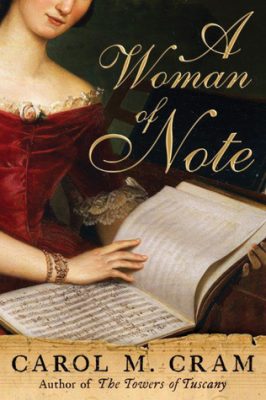
  • A WOMAN of NOTE by Carol Cram – Historical Fiction, Literary, Vienna

    A WOMAN of NOTE by Carol Cram – Historical Fiction, Literary, Vienna

    Isabette Gruber is in a panic. If only her sister were still with her to steady her hands on the keyboard as she plays Beethoven’s Eighth Sonata, known as the “Pathetique,” in her first public concert at Vienna’s Hofburg Palace. Then she hears Johanna’s voice in her head, and her poise and confidence return. The nineteen-year-old Isabette raises her hands, shapes her fingers above the keyboard, and launches into the “Pathetique.” Her powerful performance thrills the audience, whose applause continues through a third bow, and does honor to its composer, Ludwig van Beethoven, whose funeral took place in Vienna that very day, March 29, 1827.

    Filling Isabette’s heart more than the applause, however, are the words of praise from her beautiful, new American friend, eighteen-year-old Amelia Mason, who received four bows for her extraordinary vocal performance. Afterward, Amelia asks the young virtuoso pianist to become her accompanist. Isabette is eager to hear more about this enticing proposition, but Mama arrives with her cloak. Herr Dietrich (her indecorous manager) is waiting with their carriage. “Hurry, Isabette!”

    In A Woman of Note, Carol Cram has crafted a second brilliant female artist, this time a pianist and composer in 19th-century Vienna. Isabette must fight to establish her position in the male-dominated European world of classical music, much as Cram’s Sofia had to do in 14th-century Italy’s world of painting, in The Towers of Tuscany (2014). Cram’s precise, colorful writing enables us to hear the young Isabette playing the “Pathetique” in Hofburg Palace, see her enjoying a stroll with Amelia in the Prater, feel her pain over the loss of father and sister, and appreciate her determined efforts to convince music publisher Herr Weissel to accept her compositions, under the pseudonym of Anson Kruetzer. (Weissel roars with laughter, but agrees!)

    Once home from the Hofburg, Isabette thinks back to her practice session that morning in the small, dusty parlor of the apartment where she lives with her mother. With a heavy heart, she remembers what a happy home this had been when her sister Johanna and she shared both a talent and a love for music and were skillfully taught to play and compose by their proud father. Now Papa is dead, Johanna is in an asylum, and Mama seems to think of Isabette more as a means to an income than as her younger daughter. The tall, lanky girl with a plain face and dull, straight hair never gives a thought to her social life or the possibility of marriage and children. Her every moment is devoted to practicing. Tonight, though, she thinks of a new life with Amelia in it. Soon, they are together every day practicing, but also developing their friendship as they go for long walks around Vienna.

    When piano teacher Josef Hauser, who fancies himself a superior composer, meets the two young women, the story’s complexity grows. Josef is enamored with Amelia’s beauty but enthralled with Isabette’s talent. (In fact, he agrees to become her teacher if she revises his compositions so they will be accepted for publication.) Isabette treasures every minute she spends with the vibrant, cheerful Amelia, but feels uncomfortable when Amelia strokes her arms and kisses her neck. Amelia is jealous of Josef’s attention to Isabette during her piano lessons. Isabette realizes she could love Josef but knows that he is passionate about Amelia and could never feel that way about her. Then Josef’s flutist/poet friend Daniel Leitner joins the threesome. Gentleman that he is, he maintains a discreet distance from the ladies at least for a time.

    Readers will love Carol Cram’s colorful writing and attention to the minute details of daily life at this time in European history. Even more enjoyable, however, will be finding out where her intertwining love stories lead as the characters mature. The book never loses its pace. and readers will be rapidly turning the pages until the very end.

    While the cameo appearances and mentions of such famous musicians as Johann Hummel, Carl Czerny, Franz Schubert, Fredric Chopin, Robert Schumann and his wife Clara, and Louise Farrenc are of course fictional, they add drama and reality to the story, which is based on Cram’s meticulous research. An Author’s Note provides background on actual women composers of the time and place.

    A young virtuoso pianist rises above the many musicians of her time, blazing a path of passion for music and love that is hers and hers alone in nineteenth-century Vienna.

    5 Star Best Book Chanticleer Reviews round silver sticker