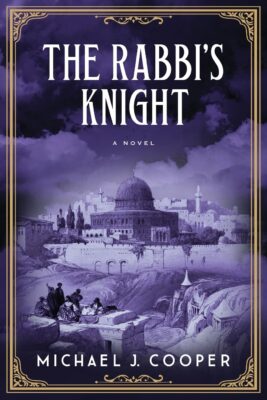
Knight Templar Jonathan St. Clair bears two messages for Rabbi Samuel of Baghdad, one of mortal treachery and another of mystic wonder. In The Rabbi’s Knight by Michael J. Cooper, they journey across the Holy Land to Jerusalem while divisions of faith portend the bloody conclusion of the Crusades.
Games of knowledge and influence play across the Mamluk Sultanate, as the Latin Kingdom holdout city of Acre braces for its last fight.
Samuel and another Rabbi, Solomon Petit, stand opposed in a bitter debate within Judaism concerning the integration of philosophy and science with religious tradition—a controversy sparked by the writings of the medieval philosopher Maimonides.
Samuel plans to excommunicate Petit for burning the writings of Maimonides and desecrating his tomb. Petit doesn’t intend for him to get the chance. Before Samuel can arrive in Acre, Petit makes a deal with the nearby Emir to kill Samuel in exchange for the secrets of Acre’s defenses as the last city under Christian rule will soon be put to siege.
Petit’s pupil, Isaac, realizes his teacher’s betrayal only after he helps him carry it out. He rushes to stop the scroll on Acre’s defenses from reaching the Emir, aided by William Wallace, a young Scottish pilgrim bound for Jerusalem.
Meanwhile, St. Clair and Samuel elude the Emir’s soldiers by hiding in a leper colony on the shores of the Galilee.
Throughout their adventure, Samuel teaches St. Clair some aspects of the mystic tradition of Kabballah—guiding the knight to an understanding of the inscription on the ancient scroll that St. Clair had brought to Samuel to unlock the hidden secrets of Jerusalem’s Temple Mount.
The Rabbi’s Knight weaves together fictional characters and fictionalized historical figures into a dynamic, lively cast.
Each of the central characters brings a distinct view of their world into the story, multifaceted and endearing in their own way. Isaac’s clever and welcoming nature makes Petit’s cruelty against him keen, and his friendship with Wallace—a newcomer unfamiliar with the region—pushing both young men to consider how they relate to the broader conflicts around them. As intrepid underdogs, their side of the story is particularly exciting to follow.
We also gain insight into the motivations of the villains, as bound by histories of violence as they are willing to perpetuate them. Rabbi Petit ruminates on the burning of Jewish holy texts in France while plotting the death of his own chosen ‘heretic’. Emir Abdullah and Prince Khalil, son of Qa’la’un, both use the coming siege of Acre as leverage to grasp at the Mamluk Sultanate throne.
St. Clair and Samuel share a confluence between their faiths, nurturing a friendship that underpins their journey, though disagreeing in the face of Zahirah—a Mamluk woman who joins their pilgrimage from the leper colony. Samuel tries to convince St. Clair that his growing affection for Zahirah is a sanctification of God, rather than a betrayal. Zahirah herself embraces her desire for St. Clair, dedicated to her own bold will despite how much it clashes with her culture’s expectations for women.
Readers get the pleasure of growing familiar with these good-hearted people through their complicated negotiations with religious philosophy and the various social structures that shape their world.
Cooper relishes in historical detail, welcoming readers to the lived-in corners of 13th-Century Palestine.
Isaac maneuvers through the cosmopolitan port of Acre while its Templar defenders are supplied by sea for the looming attack. The narrow alleys of Jerusalem reveal remnants of ancient history beside the works of restoration and craftsmen. Wallace chafes with his gaudy disguise as a Genoese merchant. Lepers cling to the hope that Rabbi Samuel’s examination will declare them clean.
The Rabbi’s Knight opens with a helpful map of the Holy Land in 1290. As the characters journey through it, readers get to explore living cities and hallowed landmarks through reverent sensory descriptions.
Despite how far in the past this story takes place, the setting feels suitably ancient to the characters themselves. They and readers share the experience of trying to understand a long-past but still relevant time.
Beneath its adventure, suspense, and history, The Rabbi’s Knight embraces a mystic philosophy of the pan-human search for the divine.
Jewish theological debate defines the conflicts between Rabbis Petit and Samuel, while Samuel’s instruction of St. Clair introduces readers to some Kabalistic concepts—uncovering the layered emanations of God’s essence. In his role as teacher, Samuel refutes the sectarian divides between and within different religions, insisting that each faith is dedicated to understanding the sacred pattern of creation.
The characters themselves grow to reflect this philosophy, risking all to help one another, they come to a far greater understanding of the world than they ever could have alone.
A thoughtful and rewarding tale, Michael J. Cooper’s The Rabbi’s Knight will satisfy lovers of history and theology alike, all on a well-paced adventure to the Holy City. Readers can follow the story further, centuries into the future, through Cooper’s earlier novels Wages of Empire and Crossroads of Empire.
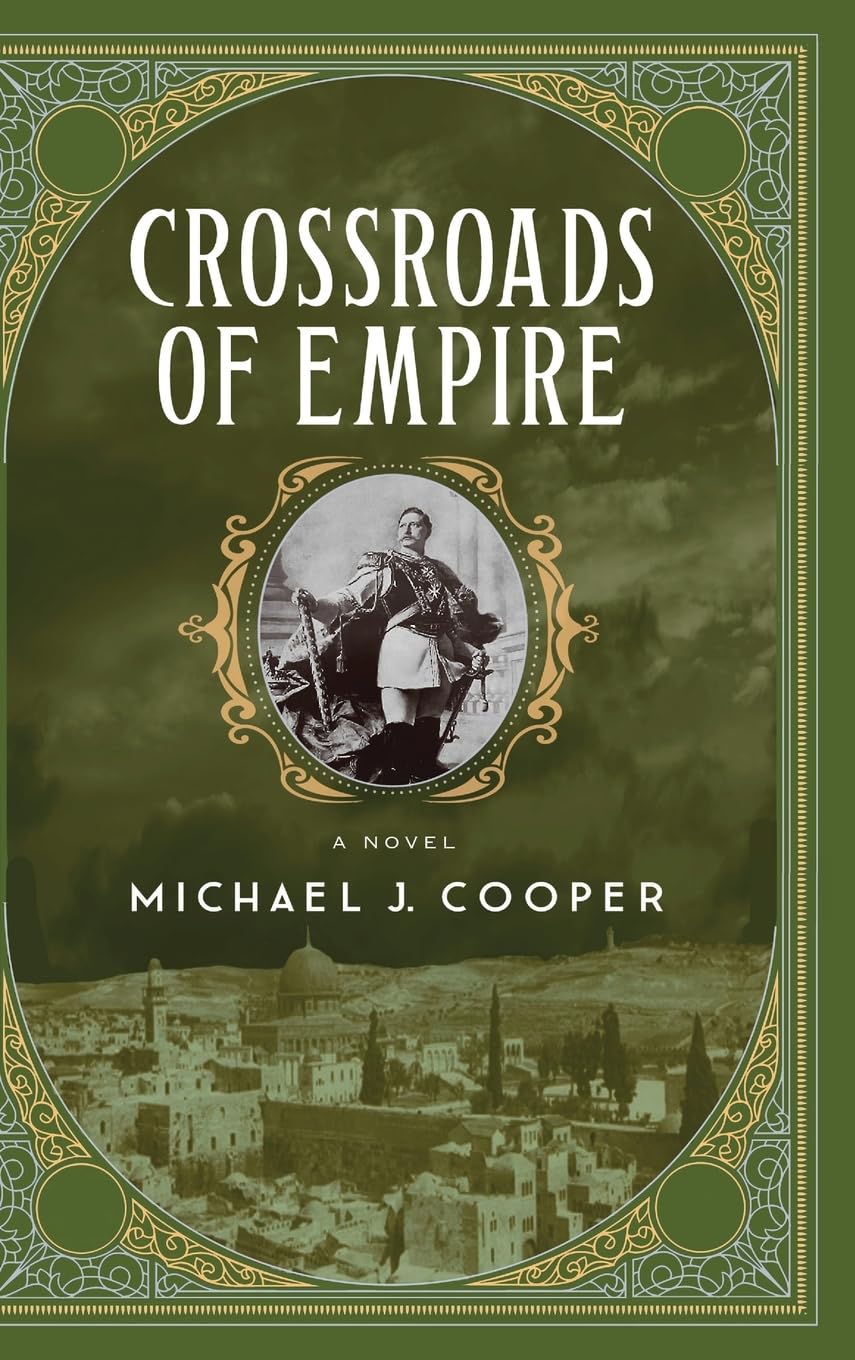
Crossroads of Empire by Michael J. Cooper brings readers back into sixteen-year-old Evan Sinclair’s journey through the battlefields of WWI. The adventures and the war itself pick up right where the award-winning Wages of Empire left off.
As in the first book, Evan begins his part of this story by going missing, this time not just from his father’s perspective, but from his own. Severely injured during his service with the Flemish resistance, Evan is discharged from a French field hospital. He’s on his way back to England by hospital ship when it is sunk by a German U-boat. When he reaches British shores as the sole survivor in a lifeboat, he’s left with amnesia and has no memory of who he is.
Evan’s search for his own identity leads him to Rosslyn Castle, the Sinclair family’s ancestral home in Scotland. There he unravels secret family histories and connections long buried. Finally, with assistance from a wise woman, Evan regains his memory. Without the protection the amnesia provided, he faces a host of painful and traumatic memories.
Crossroads of Empire brings to life a journey of self-discovery set against a backdrop of the war in motion. The horrific trench warfare along the Western Front, the disastrous defeat of the Entente at Gallipoli, and the British route of the Turks at the Suez Canal are made real and vivid to the reader.
Likewise, Evan’s journey takes place while the imperial powers jockey for position at the crossroads of empire in the Middle East as the Ottoman Empire, the ‘sick man of Europe,’ teeters on the brink of dissolution. The British, seeking to expand their colonial empire, feed the flames of Arab independence through T.E. Lawrence’s missions to the Bedouin tribes and to the man who would be king of an independent Arab State, Faisal son of Hussein, the Sharif of Mecca.
Cooper’s skillful storytelling sets an unrelenting pace with the international events of the early twentieth century coupled with Evan’s search for answers—about himself and his family’s history.
Back in England, biochemist and Zionist Chaim Weizmann gives his expertise in the production of key munitions components to the British government in the hope of leveraging his critical contribution to the war effort for the promise of Britain’s backing of a Jewish homeland in Palestine.
And all the while, Kaiser Wilhelm II looms over the conflict, hoping to sweep in and take the prize he’s always coveted – as have so many others over the centuries – Jerusalem.
Cooper deftly lays out separate strands of memorable historical and fictional characters across the globe – from Kaiser Wilhelm to a Red Cross volunteer – to bring this chapter of history to life. He elegantly intertwines the multiple strands he has created, making for a read that is both a gripping page turner and a series of carefully observed character studies.
Two parallel and equally compelling tracks make Crossroads of Empire impossible to put down. First, Evan’s story, which gives readers a young hero they can root for, and then an insightful and multi-dimensional perspective on a dramatic historical struggle now a century in the past, though one that still reverberates in the present.
The war is thus seen through a kaleidoscope of perspectives beginning with Evan’s father Clive Sinclair at work in London’s War Office, and also includes a fascinating array of people and places which allows the reader to fully experience the war through immediate first-hand experiences. These figures, marvelously brought to life, range from Gertrude Bell and T.E. Lawrence to a proto-Nazi Guido von List in the service of the kaiser, to the future King Faisal of Iraq and the future first president of Israel, Chaim Weizmann.
As Evan recovers in Rosslyn Castle unravelling long-hidden family mysteries, the war rages on—from the killing fields of the Western Front, to the debacle of Gallipoli, to Lawrence’s mad race across the Sinai to warn Cairo of an Ottoman attack on the Suez Canal. Throughout, Crossroads of Empire races through its world at a breathless pace that will leave readers gasping for more.
Beautifully written in a voice and in details that capture the era, Crossroads of Empire is a must-read for readers of all ages with high hopes for more of Evan’s adventures yet to come.
Chanti: Tell us a little about yourself: How did you start writing?
Michael Cooper: That’s kind of a long story, but I’ll try to keep it under 1,000 words…
Having been active in Zionist youth groups throughout my formative years, I emigrated to Israel after graduating high school in 1966. Studying in Jerusalem for the first three years, I attended and graduated from Tel Aviv University Medical School. Then, after living, studying, and working in Israel for a total of eleven years, I returned to the US to specialize in pediatrics and pediatric cardiology.
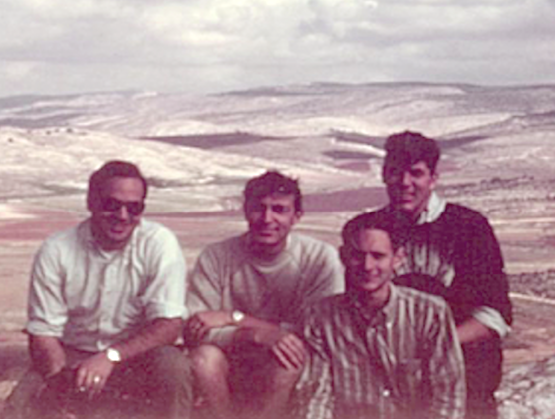
Michael’s first arrival in Israel (center)
After working for about fifteen years as a pediatric cardiologist in a large multi-specialty medical care consortium, I found myself disenchanted with some worsening aspects of the approach to patient-centered care. While I wasn’t personally affected by these negative changes since, as a sub-specialist, I had demanded and received the opportunity to design my own practice, however, this wasn’t the case for my primary care colleagues. So, I decided to advocate for them. I began tilting against administrative windmills in the form of impassioned letters, but found that I wasn’t getting anywhere. Though I did enjoy the catharsis of writing those letters!
Tel Aviv University Medical School
So, I decided to just enjoy my pediatric cardiology practice, and to redirect my letter-writing to another area of my interest—the Middle East. At this point (the early 1990s) under the leadership of Israeli Prime Minister Yitzhak Rabin, there was finally a real peace process in the form of the Oslo Accords. But to my dismay, there was a good deal of angry push-back to Rabin’s efforts—both in Israel and here in the US. In this environment, I regularly published letters, opinion pieces and essays in support of Rabin’s peace efforts. Needless to say, I received more than a few angry responses.
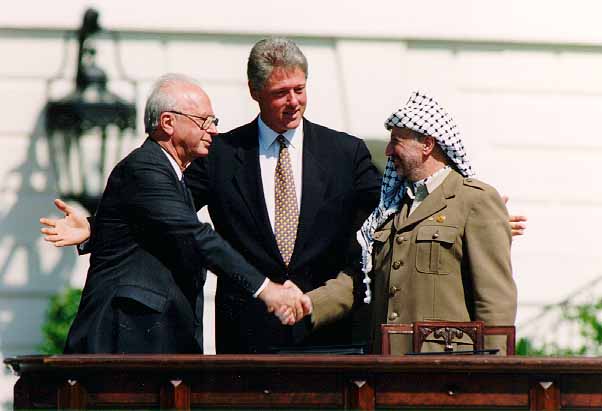
Israeli prime minister Yitzhak Rabin (left), American president Bill Clinton (middle), and Palestinian political leader Yasser Arafat (right) at the White House in 1993
And as the peace process moved forward, the resistance to it increased. In the Middle East this resistance came from a seemingly bizarre and unholy alliance: on one extreme, ultra-nationalistic Jewish settlers, and on the other extreme, militant Palestinians such as Hamas—strange bedfellows in their vehement opposition to the peace-making efforts. And this angry resistance spilled over—into Israel, into the Jewish Diaspora, into the Arab street, and into the Arab Diaspora.
In Israel, this resistance reached a fever pitch in 1995 prior to parliamentary elections. Rabin’s efforts were not only rejected by Netanyahu and his right-wing allies, but Rabin was personally vilified as a crypto-Nazi and a traitor to Israel. The risk of his assassination, as assessed by Israeli security services, was high. And, indeed, after a huge pro-Oslo/pro-Rabin demonstration in Tel Aviv on November 4, 1995, Rabin was killed by a right-wing Israeli zealot with two shots to the back.
The shock to the Israel public and the world-wide Jewish community was profound. And after Rabin’s death, and with the ascension of a right-wing Israeli government under Netanyahu, the peace process grew dormant and eventually, died.
For catharsis, I initially turned from writing letters and op-ed pieces to writing historical fiction set in the Holy Land at pivotal points of history. This was also my way of trying to insinuate a message of coexistence and peace into a vehicle that, unlike my previous writing, might succeed in changing a few hearts and minds. I began with historical fiction set in British Mandatory Palestine in 1948—Foxes in the Vineyard. This was followed by The Rabbi’s Knight, set in the Holy Land at the twilight of the First Crusade in 1290. Lastly and soon-to-be-released, is Wages of Empire, largely set in Ottoman Palestine at the beginning of WWI.
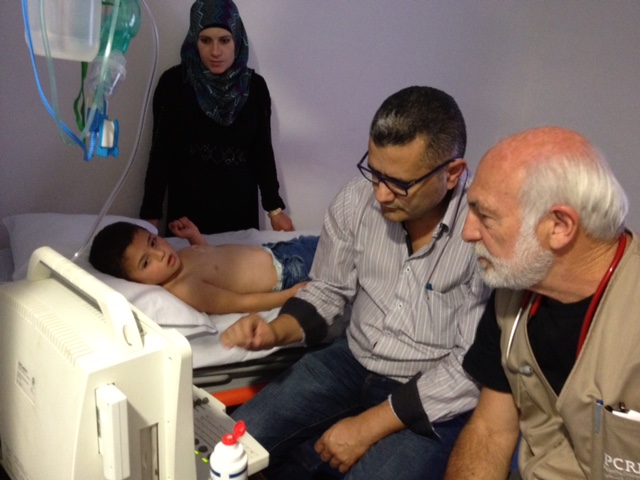
Michael J. Cooper examining an infant
Beginning in 2007, I also turned to volunteer work for a US-based NGO (non-governmental organization) offering pediatric specialty services to children within the Palestinian Authority. In doing about two missions per year since then, I’ve attempted to be part of the solution as a pediatric cardiologist for children with limited or no access to care.
As of this writing, recent events in Israel/Palestine would suggest that things have only grown worse. But I won’t be deterred. I will continue to write, work, speak, and advocate for reconciliation and peace. And, in the words of Forest Gump, “That’s all I have to say about that.”
And it only took 684 words.
Chanti: When did you realize you that you were an author?
Cooper: In December of 2011—the first time I held my first published book in my hands. I had dedicated the book to my big sister, Adrienne. She had fallen ill a few months before, and I was gratified to have been able to share that moment with her before she died.
Chanti: Talk about genre. What genre best describes your work? And, what led you to write in this genre?
Cooper: I write in the genre of historical fiction with added elements of mystery, action-adventure, mysticism, and a dash of romance. Having lived in Israel during my formative years (between the ages of 17 to 28), I had fallen in love with the immediacy of history that waited for you around every corner. The historical events and, indeed the historical characters also provided the scaffolding of a story that was, at once, very old, and still being written. As I researched and wrote all three books, I was pleasantly shocked by fascinating elements of hidden history, unsolved mysteries, and unbelievably engaging and bizarre characters that practically wrote themselves into the books.
Chanti: Do you find yourself following the rules or do you like to make up your own rules?
Cooper: As mentioned above, the advantage of writing historical fiction is the scaffolding, or to switch metaphors, the loom of the historical timeline you’re working with. As the historical characters move within the fabric of that framework, it’s great fun to weave the fictional characters into the pattern, creating a wonderful tapestry.
As to rules, I would paraphrase a line from the 1974 movie, Blazing Saddles (replacing the word ‘badges’ with rules), “Rules? We don’t need no stinking rules!” (a version of that line appeared in the 1948 film, The Treasure of the Sierra Madre, and before that in a 1927 novel of the same name).
Another and more sophisticated way of expressing the same idea is to quote the great Somerset Maugham, who famously said, “There are three rules for writing a novel. Unfortunately, no one knows what they are.”
Somerset Maugham
Chanti: What do you do when you’re not writing? Tell us a little about your hobbies.
Cooper: Having already gone on and on about my work as a pediatric cardiologist for forty years, I would note that I’ve enjoyed running for the past 45 years, though I now do it considerably less often and am considerably slower. I used to play and perform folk music on guitar, banjo, and mandolin, though when I began writing about thirty years ago, I gradually redirected my creative energies away from music. Now that I’m retired, and when I’m not writing, traveling for research, and puttering around the house, I’m hoping to increase my volunteer work in Palestine.
Michael J. Cooper running in a marathon
Chanti: How do you come up with your ideas for a story?
Cooper: As noted above, the storylines arise organically from the historical timeline and from the different historical characters—creating a portrait that is enhanced by the fictional characters who allow for additional surprises, plot twists, betrayals, loves and alliances. As the book progresses, it’s a pleasure for me to watch the weave tighten as the different storylines are drawn together. I hope it’s also a pleasure for the reader.
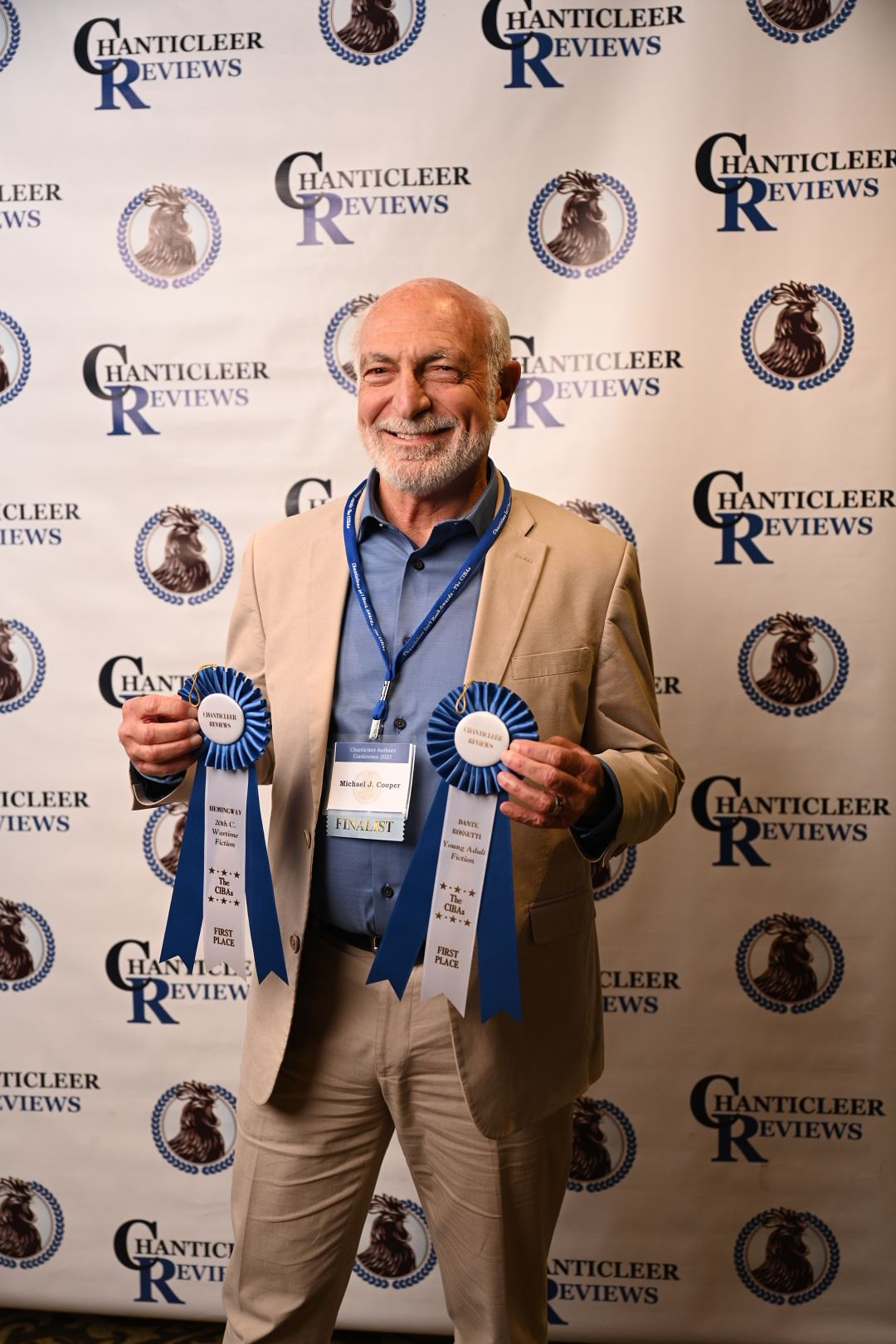
Michael J. Cooper with his two First Place Ribbons before one is upgraded to a Grand Prize!
Chanti: How structured are you in your writing work?
Cooper: Not at all. When I was working full-time, I’d get up early to write or do some research for an hour or so. Then while commuting to work (sometimes up to an hour or more), I’d ruminate about what I’d written or read, and made mental notes about plot twists, opportunities for conflict to build tension, or the need for a particular fictional character to do something unexpected. Once at work, I’d scribble these ideas down during gaps in my workday. After work, (and after the kids’ homework, and once they were asleep), I’d write drafts from the ideas that had germinated during the day. Then I’d print out drafts, bring them with me to work or have them with me on family outings, and during quiet stretches of time, and using a #2 pencil with a functioning eraser, I’d read the draft aloud and edit. At work, that might happen during a lunch break while sitting outside (weather permitting). During family outings, the settings for writing and editing were more varied, ranging from video arcades, amusement parks, ski trips, RV trips, etc. Now that I’m retired and the kids are (generally) on their own, I have vast stretches of time to research and write, but again, without any rigid structure.
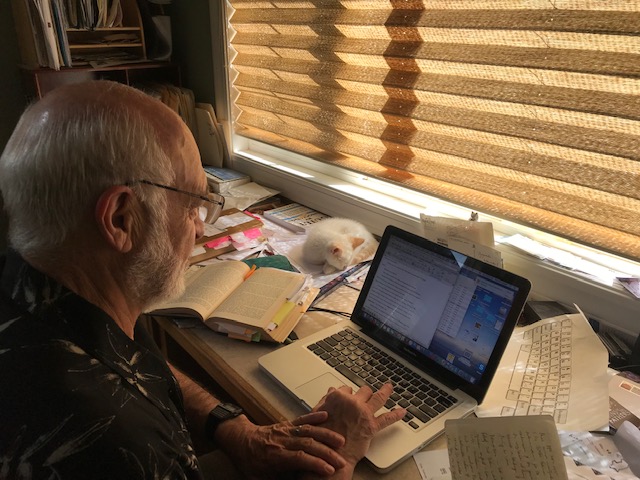
An early writing session with the kitten looking on
Chanti: How does being an author affect your involvement in your community?
Cooper: During my years as a practicing pediatric cardiologist, I felt that I had a certain degree of “street cred” in my community. And by that, I refer to the quality of being “worthy of respect.” As an author, I feel a certain enhancement of my “cred,” insofar as those who used to vehemently disagree with me about the Israel/Palestine question, now seem more willing to acknowledge an alternative narrative of coexistence and peace instead of confrontation and endless strife.
Chanti: What are you working on now? What can we look forward to seeing next from you?
Cooper: That’s easy. I’m putting the finishing touches on the next book in the “Empire Series,” Crossroads of Empire, which immediately follows Wages of Empire. I’m determined to see it published in 2024. And after that will come the next in the series, End of Empire. At that point, I’ll probably leave it as a trilogy. Or not.
Note from Chanti: Crossroads of Empire is in the 2023 CIBAs!
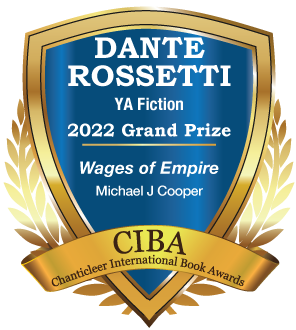
Cooper won the Grand Prize in the Dante Rossetti Awards for YA Fiction
Chanti: Who’s the perfect reader for your book?
Cooper: Wages of Empire will appeal to a wide swathe of readers beginning with those WWI aficionados who enjoy a thrilling novel of historical mystery with elements of romance and international intrigue. Readers of all ages and particularly young readers will enjoy the classic hero story of a young man coming of age at a pivotal moment in history and risking everything to play a role in the unfolding of history. Likewise, readers coming from diverse backgrounds will appreciate the cross-cultural and universal appeal. And in this turbulent time in the Middle East, readers concerned about the prospects for peace in that troubled part of the world will appreciate an informative and historical narrative of coexistence.
As it happens, Wages of Empire is a novel about war in a time of war—holding up a mirror that reflects on the current paroxysms of violence in the Middle East, and asking the question: What does that history have to do with the present?
In a word?
Everything.
Michael Cooper writes historical fiction set in the Middle East;Foxes in the Vineyard, set in 1948 Jerusalem won the 2011 Indie Publishing Contest grand prize andThe Rabbi’s Knight, set in the Holy Land in 1290 was a finalist for the 2014 Chaucer Award for historical fiction. Coming in December of 2023,Wages of Empireset at the start of WW1 won the CIBA 2022 Hemingway first prize for wartime historical fiction and the grand prize for young adult fiction.
A native of Berkeley, California, Cooper emigrated to Israel in 1966, studying and working there for the next decade; he lived in Jerusalem during the last year the city was divided between Israel and Jordan and graduated from Tel Aviv University Medical School. Now a pediatric cardiologist in Northern California, he travels to the region twice a year on volunteer missions for Palestinian children who lack access to care.http://michaeljcooper.net/Michael Cooper’sWages of Empirelaunches DECEMBER 2023.
Michael J. Cooper’s latest historical fiction novel, Wages of Empire, draws readers into the perilous journey of sixteen-year-old Evan Sinclair and his father into WW1. On this path, their lives will intersect with such historical figures as TE Lawrence, Gertrude Bell, the Zionist leader Chaim Weizmann, the Arab nationalist Faisal ibn Hussein, the proto-Nazi and advisor to the German kaiser Guido von List, and Kaiser Wilhelm II himself.
Set in the summer of 1914 we find Evan living in the American southwest where his father moved the family from England for his Oxford sabbatical. Evan struggles to cope with his mother’s death in childbirth and yearns to escape his father’s controlling grip. As war breaks out in Europe, Evan decides to leave home and join the fight, without telling his father.
By the time Clive realizes Evan is missing, the war is in full swing. Clive returns to England to search for Evan and reactivates his commission at the War Office in London. There, Clive uses every means available to find Evan. Meanwhile, Evan has made his way across the Atlantic and into France with the hope of joining the British Expeditionary Force (BEF), but instead he is arrested by the Paris police as a possible German collaborator. He escapes, but by mistake, crosses into occupied Belgium where he barely survives a German artillery barrage with poison gas. Joining the Flemish resistance, he is badly wounded after helping to flood the lowlands, a deciding factor in stopping the German army. After recovering in a BEF hospital in France, Evan begins a romance with a beautiful young nurse just before he is discharged to return to England by hospital ship.
Cooper masterfully weaves a compelling narrative that includes fictional and historical characters with high stakes in the conflict. Wages of Empire takes us from Whitehall in London to the Western Front in Flanders, where we glimpse a world of imperial power where massive casualties result from outdated military tactics in the face of new wartime technologies. Cooper also provides an intimate look into the German Kaiser’s machinations in the conflict and his intentions for the Holy Land.
The Kaiser, who anticipates victory in the war, has sent his agents to facilitate his rule in Jerusalem as Holy Roman Emperor with dominion over Arabia’s rich oil reserves and control of the Suez Canal. And from his throne on the Temple Mount, he plans to extend a vision of German-Nordic racial supremacy throughout the world. Woven into this challenge, we glimpse a covert fellowship of Guardians of Jerusalem’s Temple Mount. This mysterious and clandestine community is aware of the Kaiser’s intentions and dedicated to stopping him.
With gripping tension, Cooper keeps readers on the edge of their seats as the stakes are raised with each turn of events. Will Evan and Clive be reunited? Will they survive the war? These questions and more are left echoing in the reader’s mind long after the story’s conclusion.
Michael J. Cooper’s Wages of Empire is a must-read blockbuster for history buffs of all ages. The novel’s masterful storytelling will leave readers wanting more. Available for pre-order now.

 Crossroads of Empire by Michael J. Cooper brings readers back into sixteen-year-old Evan Sinclair’s journey through the battlefields of WWI. The adventures and the war itself pick up right where the award-winning Wages of Empire left off.




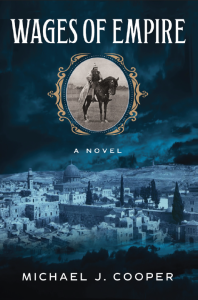




 Michael J. Cooper’s latest historical fiction novel, Wages of Empire, draws readers into the perilous journey of sixteen-year-old Evan Sinclair and his father into WW1. On this path, their lives will intersect with such historical figures as TE Lawrence, Gertrude Bell, the Zionist leader Chaim Weizmann, the Arab nationalist Faisal ibn Hussein, the proto-Nazi and advisor to the German kaiser Guido von List, and Kaiser Wilhelm II himself.