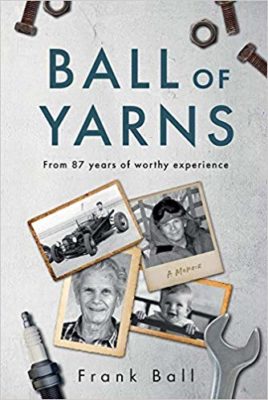
Author Frank Ball delivers an engaging, poignant account, contrasting idyllic times growing up and the remote, icy climes of his later years in his memoir, Ball of Yarns – From 87 Years of Worthy Experience.
Born in 1931, Ball was raised in rural California. Often left on his own, the result was a series of escapades with the first object of his affections – vehicles of any kind. An early solo experiment with his father’s sedan gave him the heady feeling of “wheels unguided by human hands.” A next adventure involved rebuilding, with his brother, a neglected Chevy Roadster that Ball proudly drove to school in the sixth grade. Yet another, more terrifying event occurred when he and a friend decided it would be fun to take a farm tractor up into the mountains on a snowy day; the descent was “reminiscent of a scene from the Keystone Cops.”
In high school, he and his pals visited an inactive bomb-testing site and exploded “dud” ordnance for kicks, and he later drove a racecar and worked as a pitman for that sport. Ball served in the military during World War II, stateside, getting technical education leading to a career in electronics, in which he excelled. After retirement, he and his wife Josie pursued more exploits together, living for long stints in Antarctica, she as a cook and he as an all-round mechanical whiz. It provided an atmosphere of camaraderie where the person nearest to a disaster had to deal with it immediately or risk the whole camp’s population freezing to death.
Ball tells his life saga in engagingly short, chronological episodes, most only a page or two. He has provided a few photographs to underpin his often-amusing narrative. His writing style shows a particularly strong ability to put the reader into the frame. This is especially the case with his story of going into the salvage business with a friend. Using shallow-water diving gear, they discovered a submerged vessel near the San Diego Bay. Pirating bits of it, mostly brass propellers, they were observed, and a story made the local newspapers since the vessel was, in fact, an abandoned US Navy submarine. Equally enthralling are the many aspects revealed about his working in frigid conditions, repairing everything from aircraft fuel pumps to urinals and figuring out for his own amusement how long it takes a cup of hot coffee to freeze when setting out in the subzero cold. And even in his eighties, he is still repairing and driving vintage cars.
Ball’s well-organized reminiscences will charm anyone with a love of vehicles, machines, youthful high jinx, and general mischief. His compelling American story speaks to timeless values of passion, family, ingenuity, determination, and legacy.
**Ball of Yarns by Frank Ball releases on January 14, 2020. To get your copy, please click on Kobo or Amazon.
Karen Keilt led a life of privilege, a life that most of us only dream of, but she turns the dream upside down in her memoir The Parrot’s Perch: A Memoir of Torture and Corruption in Brazil, where she exposes the seamy underside of that life and the corrupt government under which she lived. Keilt takes us from her childhood filled with the horses she loved, to her marriage to a man she adored, to the fatal incident that destroyed the world she knew.
The memoir moves between New York and Sao Paulo as Keilt sets the stage for an incident that occurs shortly after her marriage. Keilt places no blame, but tells her story with an objective eye, while expressing the confusion she held of her experiences: the kidnapping, torture, rape, and interrogation by the police for “…forty-five days of hell. Three million, eight hundred and eighty-eight seconds.”
Karen Keilt presents a memoir that is tough and unapologetic. She sandwiches her story within an interview at the UN, which is smart because some of the events are so intense and violent, they call for a breathing space where readers can decompress.
The sign of a good memoir, like any other piece of literature, is readers cannot put the work down. Here, Keilt has crafted her story in a plot that flows, and characters who are sympathetic and despicable. We follow her through her vivid, active setting in beautiful Brazil, to the prison, to New York, and California. Her struggles are heartfelt right up to the satisfying ending.
When she receives the call from the Truth Commission, she is willing to help her beloved Brazil in any way she can, even if it means resurrecting her past and the recurring nightmares. She’s interviewed by a political scientist and investigator who is building a case against the Brazilian government for crimes against human rights that had been perpetrated for decades by its savage police force and military dictatorship. These interviews, held at the UN in New York City, envelope the story she relates.
Keilt’s page-turning memoir takes readers on a journey we might be reluctant to travel, but compelling and essential, nonetheless. We must see how she gained her freedom from the oppression and how she lived the nightmare of those forty-five days. Her story is too real, too raw, too vital to simply set aside.
This action-packed memoir exposes international affairs, historical events, and human rights abuses. For some, Keilt’s story will hit a rather delicate nerve and serve to remind us why it is crucial to protect our democracy, to be vigilant and aware of those forces that seek to unravel our freedom of speech and freedom of the press. Indeed, we must all work towards a democracy that puts the lives of its citizens before those of a few powerful politicians who may have their own agendas.
In corresponding with the author, she reflects, “The truth is, I was sooo very lucky. I was, by the grace of God, a dual citizen. I was welcomed to the US when I made my escape. I had with me the only precious thing I could never have left behind. My son. Also a dual citizen. Today, when I hear the echo of those words, ‘Welcome home, Mrs. Sage,’ uttered by the passport control agent, I truly understand how blessed I was. My experience gives me more empathy for the agonizing fear of today’s immigrants who flee terror, starvation and tyranny often journeying through untold dangers for weeks or months only to finally arrive in the US and be turned away or worse, imprisoned and separated from their children. If that had happened to me, I would not have survived.”
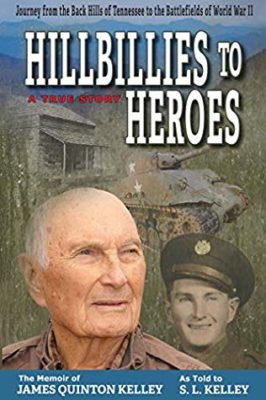
World War II veteran Quinton Kelley recounted his life story to an avid biographer – his daughter, S. L. Kelley, a documentarian and award-winning video producer.
Kelley’s tale begins in Coker Creek, Tennessee, where he was raised on an 80-acre farm, in a log cabin that he described as rough, but “brightened” with flowers. Taught to be honest and hardworking by his parents, he grew up with kerosene lamps for light, a fireplace for warmth and a wood stove for cooking. His recollections are colorful, with language that recalls his roots.
As a boy, he wore shoes only to church or to town and attended a church that doubled as a one-room schoolhouse. Everyone in the region knew someone who made moonshine, “a scruffy bunch,” Kelley called them; the local country store had bullet holes in the walls from fights between that bunch and the storekeeper. In his teens, he began work away from the farm, first for a local gold prospector, then for the TVA. Then in 1940 he heard about World War II and knew he’d be drafted.
The second part of the book shows Kelley leaving Coker Creek for Camp Beale, California, where he became the company carpenter. Assigned to an armored division, the former farm boy showed his worth as the only member of his group who did not need the training to drive a tank. He met fellow recruits from all over America, and despite the manly joshing and rough language among them, the boys in his platoon once generously gave him money to get home when his sister was dangerously ill.
He drove into combat, first in France, then in Germany, as part of an initiative that ultimately saw the end of Hitler’s Third Reich. Kelley (who passed away before the publication of his memoir) did not glorify himself in recounting his war exploits, but vividly described what it’s like to sit in a tank, looking at the action through a tiny window, always in danger of being killed while trapped inside the metal box. There’s not much room, he opined, for mistakes in battle.
In his Tennessee argot, he states that combat “made me a bit jubrous.” Still a homeboy at heart, courting a girl by mail, Kelley noted that French and German people were good farmers, though still using horses, and very orderly in their houses and fields. Camped near Berchtesgaden after victory, he refused to go see Hitler’s former hangout: “I didn’t want to waste a minute on that sorry ol’ scudder.” Once back in the US, marriage to his sweetheart soon followed.
Two books in one, this substantial memoir can be read equally avidly by nostalgic southern and mountain folk as a wide-ranging recreation of simpler times, or by anyone who is drawn to tales of war – both the battles and the long days and hours waiting and watching for the next conflict – as seen up close and personal. Using her writer’s instinct and flair, S.L. Kelley has done a remarkable job of combining her father’s spoken words, his accent, and slant, with those of fellow combatants, and others. Her book would make a splendid gift for old-timers, and a wholesome educational read for younger generations who would do well to remember and revere the sacrifices of America’s soldiers, and a heartfelt recollection that those who make history can be kindhearted and good!
Kiffer’s favorite quote from this book: “…it took all of our personal sacrifices to go from war to peace.” Quinton Kelley
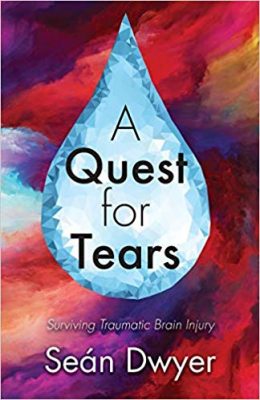
A Quest for Tears by Sean Dwyer is a captivating memoir written four years after the author suffered a Traumatic Brain Injury (TBI) as the result of a rear-end car collision.
While such casualties often foster long-term, unpredictable damage and seem a medical mystery, here Dwyer’s goal is to share his unique roadmap of struggles and experiences, while also advocating for fellow TBI survivors.
At age fifty-four, Dwyer was a college educator, fluent in Spanish, and a creative writer who had authored two novels and a work of nonfiction. A prolific songwriter, he was also blessed with an excellent memory, supportive of the talent of colleagues, and was always able to display his emotions easily. But in the aftermath of his January 29, 2015 accident, life changed.
Initially diagnosed with whiplash, back sprains, a leg wound, and soft-tissue damage to his arm, subsequent tests revealed a concussion and TBI. Now, in addition to dealing with the expected discomfort of his outer physical injuries, Dwyer was forced to navigate the arduous, mired path of debilitations faced by those dealing with head trauma. From a first-person perspective showcasing determination and resilience, Dwyer journeys through a slow, laborious labyrinth towards recovery. With a touch of wit, he applies the moniker
“Sean 2.0” to his injured self, and like a software upgrade, he begins to explore the new cognitive alterations of his brain.
Dwyer now faces life with an extreme sensitivity to light. Also, there is the absence of the familiar “earworm” that once inspired music and stories. His now quiet brain struggles for words has difficulty reading and lost the sense of musical enjoyment. Minimal laughter and a noticeable inability to shed tears lead him to wonder, “Am I going to be an emotional zombie for the rest of my days?”
Dwyer went from being a man with high regard for hygiene and fashion standards to an individual preferring comfortable attire and choosing vibrant novelty socks that delighted his injured brain. Painful head movements during a simple haircut caused him to eliminate the grooming event for two years. This was the new Dwyer.
Dwyer seeks numerous treatments over several months, from physical therapy and acupuncture to neuropsychologists and craniosacral practitioners. During a visit with a priest, he looked for help from the sacrament of healing. Attending conferences with fellow TBI survivors proves an essential part of his recovery, as he learns progress can still occur well beyond the one-year mark of the initial injury. Lightening the intensity of this autobiographical account, Dwyer distinguishes the one-year “smashiversary” of his accident with a celebration at a local Mexican restaurant. Along with a cathartic, hanging car pinata, a gifted plaque featuring the accident photo Dwyer was always quick to produce in conversation, is humorously preserved with the fitting caption “stronger than steel.”
The importance of the much-needed understanding and support he received from his wife and family, the medical community, and a vast tribe of friends, students, and colleagues continues to be imperative in Dwyer’s recovery.
Mock classroom set-ups helped him acclimate to possibilities for teaching, while fellow writers proved compassionate in fueling his need to find new pathways for creative expression. Dwyer weaves poignant moments throughout his story, including an unexpected conversation with a wheelchair-bound boy who inspired him to push through his newfound obstacles. He also highlights the guiding force of his beloved elder feline companion, Sophie, who proved the utmost source of comfort throughout his ordeal.
Written primarily as a resource for TBI survivors, their caregivers, and members of the medical community who often fail to distinguish the difference between intelligence and brain health, Dwyer’s A Quest For Tears is a remarkable achievement. Ultimately it proves a positive affirmation of the human spirit, focusing on the ability to learn and adapt when faced with the unique challenges brought on by sudden brain injury — a powerful and inspiring read.
A Quest for Tears won First Place in the CIBA 2018 Journey Awards for Memoir/Biographical works.
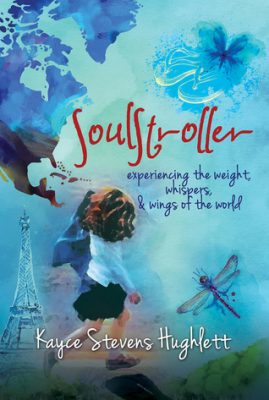
In a creative blend of existential memoir and artful travel journal, Kayce Stevens Hughlett’s SoulStroller takes readers along on an adventurous journey of self-discovery. Reminiscent of Elizabeth Gilbert’s popular Eat, Pray, Love, Hughlett focuses on family issues, ancestral memories, and dreams explored within the context of personal travels, focusing on the importance of moving beyond our comfort zones.
Here we come to learn that a SoulStroller is a term used for an individual who ventures into the fullest version of their true selves. Guided by intuition and spiritual essence, they stroll through life with a feeling of curiosity, compassion, contentment, and gratitude. Like a pilgrim on a quest, they follow their heart, rather than move ahead with a tourist mentality of set goals and to-do lists.
Raised with the traditional expectations of the “good girl,” Hughlett lived the first 30 years of her life within 150 miles of Oklahoma City, an area of white, middle-class, conservatives. The blinders came off when she moved to Seattle. Divorced, and remarried with two children, Hughlett indicates that when everything is FINE, sometimes that refers to the acronym for “fucked up, insecure, neurotic, and exhausted.”
It is during a trip to Mexico in search of a therapeutic boarding school for her troubled son that she finds a sense of peace and a firm idea of place as she falls in love with the desert landscape. With the outstretched arms of the saguaro cactus offering a sense of peace, it is in this moment that everything changes.
Hughlett’s journeys go far beyond visits to the likes of the Eiffel Tower and Louvre. Whether enjoying the delicacy of an eggplant and cheese sandwich on the banks of the Seine or meeting a charmingly eccentric and her poodle, Hughlett learns to distinguish the essential rhythms of her own life.
Hughlett writes with a comfortable conversational voice that invites readers into her world view; one that she approaches with both exuberance and trepidation. The overall narrative unfolds in a generally chronological sequence, though journal entries and recollections can at times reflect past memories or events.
Insightful words from several authors, poets, scholars, and artists are used to grace the opening of each chapter, including contributions as varied as those of Roald Dahl, Thich Nhat Hanh, Gloria Steinem, and Henry Miller. Mark Twain’s quote seems to epitomize the central “SoulStroller” sentiment in “Sail away from the safe harbor. Catch the trade winds in your sails. Explore. Dream. Discover.”
Each section of the book concludes with a simple practicum highlighting suggestions for readers to venture into their own SoulStrolling mindset. Exercises range from quiet meditation and writing prompts, to practicing self-kindness and ideas for travels off the beaten path.
While Hughlett considers that her story may be too personal or esoteric for some readers, her work speaks to her positive growth, as her travels and experiences have allowed her to trust her own voice and value the lessons of her own journey. This is a book that strings together individual pearls of wisdom that have universal appeal.
SoulStroller by Kayce Stevens Hughlett won 1st Place in the CIBA 2018 Journey Awards for Narrative Non-Fiction.
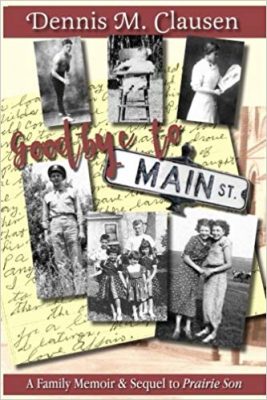
Growing up in an estranged family atmosphere brings questions that beg for answers in this complex multigenerational memoir.
Author Dennis M. Clausen recalls his early years growing up in the latter half of the last century with a detached, mostly absent father and a disabled, emotionally conflicted mother. In his tribute to small-town America, the author eloquently sketches the Minnesota village where he spent most of his youth, a place where the awnings on Main Street were opened and shut at the same time each day, and family secrets were hinted at but never discussed. Among the secrets was the enigma surrounding Clausen’s father, Lloyd, a wanderer who could never settle in one place, keep one job or stay with one woman for very long.
There are many idyllic elements to Dennis’s upbringing. Though poor and often struggling for basic necessities, his mother and siblings got by, sometimes helped by the largesse of the community. On occasion, a visitor might sleep on the couch, and tuck nickels or dimes strategically into the sofa’s cushions, leaving Dennis and his brother, Derl, the means to go to the local movie theater. The boys also managed a paper route together.
Reaching college age, there was no money, so Dennis stayed in his hometown at a newly created branch of the university. There he was fortunate to have as a mentor a legendary professor of American literature who recognized what the town’s librarian had noticed years before: that Dennis had great zeal for reading.
As Clausen matured and closely observed the clan he was born into, certain flaws appeared in the pleasant but rather fuzzy picture that had been painted for him. He felt increasingly guided by hints – and finally by some handwritten memoirs from his father – to explore their shared past. In the years of Clausen’s youth, polio was a killer stalking the country and then was miraculously eliminated, but the psychological concept of “attachment disorder,” which undoubtedly afflicted Lloyd, was unheard of. In sifting through his father’s memorabilia, Clausen learned that Lloyd’s adoptive parents always regarded their charge more as free labor than loved one. In Prairie Son, Clausen has written vividly of Lloyd’s life as a mistreated orphan. The many remarkable results of that investigative work comprise the second portion of Goodbye to Main Street, complete with documentation and photographs in what can be seen as Clausen’s second vocation as the family detective.
Clausen’s work has garnered a following among family both here and abroad who have contributed to his diligent search for his ancestry and among orphans and children of orphans who sense his empathy. There are many poignant moments in his coming-of-age account that will resonate with the experiences of an earlier generation of Americans. Perhaps this is the pull of Clausen’s memoir, the story of how one boy grew to manhood and overcame the odds, to become something other than what he was born into: from grinding poverty to successful academic.
Now, after making numerous nostalgic visits to the old hometown and to various gravesites as part of his delving into family lore, he has come to see life as “a journey” and to respect its mysteries.
Goodbye to Main Street won 1st Place in the CIBAs 2018 Journey Awards for Narrative Non-Fiction.
Author Anna Carner was living in a horse-friendly farming area of New Jersey in 1999, when she encountered a newborn fawn, barely breathing, near her home. The animal seemed to be communicating its need to her, and, with some experience of animal and human care, Carner set out to revive the fawn.
She took the baby deer into her house and nursed her back to health. When she and her husband, Pino, saw the fawn curled up asleep with the family dog, the couple knew they had a new pet. Her name, Blossom, seemed suited to her sweetness and soft, gentle beauty.
But the couple lived in an area where some people consider the deer population a problem; pests to be eliminated, hunting a necessary and enjoyable sport. As Blossom grew and began to range out with other, wilder kin, Carner realized she would have to take extreme methods to shield her from danger.
Carner and Pino created posters with the animal’s picture and a plea not to hurt Blossom. Some neighbors were sympathetic, but others were cynical. Some even made a practice of stalking Blossom and harassing Carner. One man claimed to have the deer in captivity, demanding a ransom for her return. Carner’s efforts to protect Blossom gradually took root in the community and soon neighbors joined in; other stray deer were saved and adopted. A widespread movement was started that included the possibility of spaying by vaccination to limit the deer population without the violence of hunting.
In writing her memoir of the years with Blossom, Carner revisits her own past and the violence she suffered as a baby at the hands of her father; injuries that required hospitalization and subsequent treatment for much of her youth. These recollections give her empathy for Blossom and other suffering creatures, and no doubt the reason she is passionate about her role as a rescuer.
Blossom, as she so vividly describes her, was an ideal patient and pet that seemed to speak at times, and to obey commands almost like a canine. The deer’s sensitivity to her human caregivers is perhaps extraordinary or may reflect what many “wild” creatures are capable of, given a chance. The chapters are interspersed with poems by Jeanne Hamilton Troast, a fellow animal enthusiast. Through action and rich, well-crafted dialog, Carner highlights her endeavors to promote better care of all animals based on the experience she and Pino shared as they cherished their time with Blossom.
Carner writes both for convinced animal lovers and, additionally, for those who may never have given the issues much thought, offering strong evidence of the worth of living in harmony with deer and other creatures whose perceived harmfulness has been to some extent created by our human rules and boundaries, not by their natural inclinations.
Not just a sweet deer with a fantastic story, Blossom is the subject for the Nat’l Geographic NATURE documentary. To view a 4-minute video of Blossom’s story please click here. Blossom was also featured in National Geographic’s Nature presentation, “The Private Life of Deer.” Please click here to see the film.
While mothers are as varied and diverse as the many varieties of flowers in the world, none of us would be here without them! When I think of the word “mother,” there is no possible way I can disassociate the word from my mother. She is strong-willed, strong-minded, and strong-opinioned. And her love rivals the strength of the greatest army the world has ever known. She is my mother. She is the one person who loves me enough to tell me when I am wrong and, yet, loves me anyway.
How and When was “Mother’s Day” Started
As all things of Western Civilisation seem to have started in ancient Greece it seems (reference: My Big Fat Greek Wedding), so did Mother’s Day. Well, sort of, honoring the goddess, Cybele/Rhea (depending on time and region). The early Christian Church co-opted the day, calling it “Mothering Sunday,” a festival day in which the faithful would return to the church of their birth.
When is Mother’s Day Celebrated Around the World?
Mother’s Day is celebrated on thesecond Sunday in May, in the USA, Canada, most European countries, Australia, New Zealand, India, China, Japan, the Philippines, and South Africa.
The UK and Ireland celebrate Mother’s Day on the fourth Sunday in Lent.
Most Arab countries celebrate Mother’s Day on March 21st (vernal equinox).
Most East European countries celebrate Mother’s Day on March 8th. For a complete overview of the dates of Mother’s Day around the world see Mother’s Day on Wikipedia.
The Rise of Mother’s Day in America
Before the Civil War, Ann Jarvis and her friend, Julia Ward Howe decided to set up regional clubs, “Mothers Day Work Clubs” designed to teach young mothers how to care for their infants. Their involvement and the clubs continued throughout the Civil War and once the war ended, they held a Mothers’ Friendship Day and invited both Union and Confederate soldiers and their mothers to attend. Big strides toward reconciliation were made through the efforts of these women.
The women who inspired Mother’s Day were social activists, abolitionists, suffragettes, and educators who wanted to make their world – and their children’s world a much better place. And that is something to celebrate!
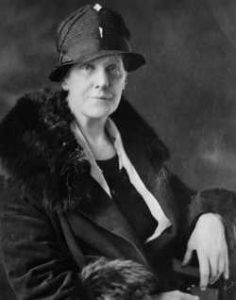
It was all made a legal holiday when Anna Jarvis, inspired by her social activist mother, Ann Maria Reeves Jarvis, decided to memorialize a day in which to celebrate her mother. In 1907, three years after her mother’s death, she did just that. She chose a white carnation to inspire people to remember their mothers and what they sacrificed for them.
“Its whiteness is to symbolize the truth, purity and broad-charity of mother love; its fragrance, her memory, and her prayers. The carnation does not drop its petals, but hugs them to its heart as it dies, and so, too, mothers hug their children to their hearts, their mother love never dying. When I selected this flower, I was remembering my mother’s bed of white pinks (flowers)…” – Anna Jarvis (quote)
It wasn’t until 1914 that Woodrow Wilson signed a decree that designated the second Sunday in May as the United States official day to celebrate Mother’s Day. Of course, Mother’s Day is celebrated all over the world (in at least 49 countries) on different days.
It should be noted that Anna Jarvis wasn’t very happy with the commercialization of Mother’s Day and she fought long and hard to try and get it withdrawn as a national holiday, but we all know how that ended. And if you don’t, well, let’s just say it is a most intriguing mystery…
Suggested Reads
Because mothers are incredibly diverse in their habits and reading lists, we invite you to dive into our reviews and choose what’s you think your mother would like to read most and to perhaps enjoy the books yourself.
Chanticleer Mother’s Day Reading List!
Jaimie Ford‘s Love and Other Consolation Prizes is powerful storytelling from a master storyteller! Jaimie Ford breathes to life a little-known piece of Seattle history spanning the early to the mid 21st century. And a truly unique story of the many ways a mother’s love can manifest itself.
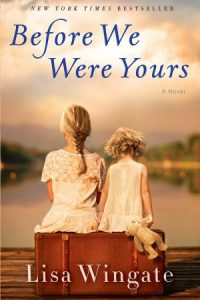
Before We Were Yours by Lisa Wingate is a disturbing look into what those who should know better, choose to do to society’s most vulnerable during the 30-years between 1920 and 1950 at the Tennessee Children’s Home Society.
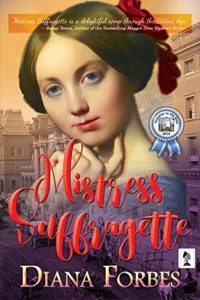
Diana Forbes‘ Mistress Suffragetteexamines the facts of life, the challenges of social restrictions, and the woes of youthful love through the eyes of a sharp-minded, sharp-shooting young woman. Mistress Suffragette is now available on Audible!
Nicole Evelina‘s Madame Presidentessis a fascinating story of a woman’s meteoric rise from rags to riches, from subservience to achievement – based on a true story that was instrumental in propelling the Suffragette Movement.
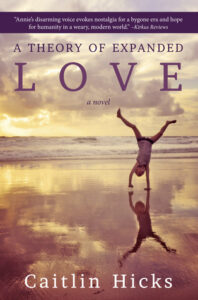
A Theory of Expanded Love by Caitlin Hicks is a bold, authentic, & captivating –a young teen in the 1960s confronts doctrine when it threatens to outweigh compassion.
Caregiving Our Loved Ones by Nanette Davis, Ph.D.Dr. Davis passes on her knowledge to caregivers for dealing with the ongoing emotional, financial and health toll of taking care of someone who will never get better.
Nick Adams‘ Away at War: A Civil War Story of the Family Left Behind is a rich and fascinating account of day-to-day life in rural America in the mid-19th century set against the backdrop of the Civil War. Taken from primary sources, this narrative brings to life all that was loved and all that was lost.
This is just the beginning of our list! To find more amazing reads in every genre, please click here to discover our favorites!
We would like to wish all mothers, mothers-to-be, stand-in mothers, and those who possess the mothering instinct, a very Happy Mother’s Day!
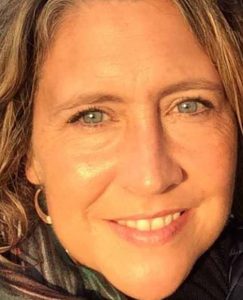
Cami Ostman holds a B.Ed. in English from Western Washington University and an M. S. in Marriage and Family Therapy from Seattle Pacific University. She is the author of Second Wind: One Woman’s Midlife Quest to Run Seven Marathons on Seven Continents, co-editor of Beyond Belief: The Secret Lives of Women in Extreme Religions, a contributor to Adventures Northwest and to her own blog, 7marathons7continents.com. Cami is also the founder of Red Wheelbarrow Writers, a community of writers in Western Washington and a blogger for psychologtoday.com. She has been profiled in Fitness Magazine and her books have been reviewed in O Magazine, The Atlantic, and Washington Post. Having spent fifteen years as a psychotherapist, and now serving as a writing coach and editor, Cami specializes in helping authors “figure out what they really have to say.” She is currently working on a novel and on her second quest memoir.
Cami has long been interested in how the words we use to describe ourselves actually serve to CREATE our identities. Her experience in writing supports this, as does her work as a psychotherapist for the past fifteen years. When she wrote about turning herself into a runner on a quest to do a marathon on every continent, she became a runner on a quest to do a marathon on every continent.
Cami will present the following sessions on Sunday, April 28th
Making Money with Back End Programs: How to take the content of your non-fiction book and create programming people will pay you for.
Master Mind Your Book:Using the Story Spine as a tool to move you forward when your writing gets stuck.
Tom Edwards grew up rough and never lost his yen for travel and new adventures, as shown in this wide-ranging portrait that spans numerous years and continents.
The author depicts himself through the eyes of an omniscient observer, growing up as a sailor’s son in and around the city of Portsmouth, England during the Depression era. Many scenes of his childhood speak to the poverty in which the family, his mother, sister, and brother, lived in as they rarely saw the father/husband who was mostly away at sea.
But the boy never realized they were poor until one Christmas when the better-off folk visited his neighborhood with boxes of fruit, cakes, and toys for the children. Vivid historical touches including everything from famous buildings, castles, and ships in the harbor are wrapped around childhood memories of the flannel vests slaked in camphor that children were forced to wear all winter, to the sports cards sold with cigarettes that children prized, saved, and fought over. Yet despite an absent father and a mother who seemed happy to have the old man gone, Tom chose the seafaring life.
Born in 1929, Tom was accepted at Portsmouth Technical High School, and as the war was ending, he joined the Royal Navy, beginning his roving lifestyle. He was often punished in his training stint for being a daring young man, but he also managed to compete in various sports – swimming, boating, sailing, and once – but only once, boxing.
Stationed in Ireland, he was then transferred to Malta, his first experience of a truly foreign place. That was followed by years in various countries of southern Africa and finally Australia. In those years he was married, twice, had daughters whom he loved but rarely saw as his wife kept returning to England, while he couldn’t bear the boredom of home for long.
He mined for semi-precious gems, learned to fly gliders, played water polo, started a camera magazine, headed a rescue team, battled and won a fight against tuberculosis, worked in a dynamite factory, sailed around the world, and was shipwrecked three times, became a surveyor, a painter and ran art groups in three countries, and immigrated to Australia when independence movements in Africa began to make existence difficult for the former English colonizers.
Edwards is known for his writing, his first book compellingly titled If I Should Die, composed after he joined an anti-terrorist unit in Rhodesia. His prose is colorful and well organized, and his interjections of significant events in the world add a stirring background – the abdication of Edward VIII, the coronation of Elizabeth II, the war and all its terrors told both by the history book and from the observant memory of a growing boy in a critical seaport city. Small details overlap the larger scheme of things, including a great deal of humor surrounding young men’s constant longing for, and occasional securing of, female companionship. He is careful to admit his flaws, such as his weaknesses as a husband, his incurable need to seek new adventures in new climes, and his now waning physical powers after a youth and manhood of grit and occasional glory.
Edwards has made a comfortable name for himself in several spheres and here delivers a memoir that combines the larger historical picture and a plethora of nostalgia, revealing him as both gutsy and tenderhearted.


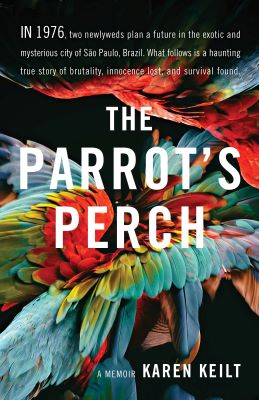
 Karen Keilt led a life of privilege, a life that most of us only dream of, but she turns the dream upside down in her memoir The Parrot’s Perch: A Memoir of Torture and Corruption in Brazil, where she exposes the seamy underside of that life and the corrupt government under which she lived. Keilt takes us from her childhood filled with the horses she loved, to her marriage to a man she adored, to the fatal incident that destroyed the world she knew.











 Cami Ostman holds a B.Ed. in English from Western Washington University and an M. S. in Marriage and Family Therapy from Seattle Pacific University. She is the author of