Tag: Memoir

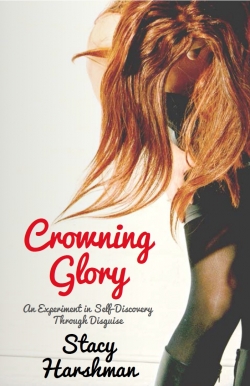
  • CROWNING GLORY by Stacy Harshman, an adventure memoir about self-image and anxiety

    CROWNING GLORY by Stacy Harshman, an adventure memoir about self-image and anxiety

    Hairstyles can speak volumes about your personality, or at least, that’s the idea Stacy Harshman explores in Crowning Glory: An Experiment in Self-Discovery through Disguise. A heartfelt portrayal of Harshman overcoming anxiety, her memoir is for anyone looking to read an uplifting story that’s also a sheer delight.

    Harshman spends weeks in New York City running an outrageous experiment: she records people’s reactions to the different colored wigs she wears. Her hairstyles range from a fiery redhead to a raven-haired goth. Her obsession with hair goes back to her adolescence:  “…my hair has been my archenemy since seventh grade. There was never enough of it, and what I had was wimpy.”

    In addition to the unusual experiment, readers are drawn to the author’s motivation to continue and complete her venture. Readers connect to not only the book’s premise, but to Harshman herself; readers advocate for her to succeed.

    However, beneath the hilarity of the experiment, readers see the author’s vulnerability:

    “I didn’t have a job to give me some sense of being a productive human being… I wanted to get one, but just the idea freaked me out…Before the depression, I had rehearsed and performed music…not being able to play out with my band killed me…just being around people was tough to impossible…I spent the rest of the day fighting panic attacks.”

    Readers also cheer for Harshman’s bravery to face and conquer her anxiety through finding her true self.  Her courage elevates the writing of this memoir, definitively distinguishing it from a self-absorbed story. The narrative reduces the stigma of mental illness that plagues so many people. The story offers hope and encouragement to those who have a mental illness, while bringing awareness and understanding to those who do not.

    The memoir demonstrates that appearance does play a role in social interactions to varying degrees. People’s feelings about their looks can become a determining factor in how others perceive them; a better understanding of self goes a long way in relationships.

    Some may find that the impact of the story is too diluted due to Harshman’s retelling of the experiment as she explores different looks. However, the book still resonates with emotion throughout, while still providing readers with a candid and fun experience.

    Readers get to embrace the past and present life of Harshman, sharing in her laughs, fears, and tears as she plays out her social experiment. An adventurous journey from start to finish, Crowning Glory provides fresh perspectives and insights about anxiety and self-image that might just inspire readers to conduct their own experiments with image in today’s society.

  • WAKING REALITY by Donna LeClair, a courageous memoir about surviving abuse

    WAKING REALITY by Donna LeClair, a courageous memoir about surviving abuse

    Writing a memoir is more than merely putting facts down on paper and regurgitating the gory details of our painful past. We’ve all had heartbreak and joy, but the glue must be in the story. As American author Susan Shapiro (“Five Men Who Broke My Heart”) puts it, “A novel that is merely autobiographical is a great disappointment, but a memoir that reads like a novel is a great surprise.”

    Donna LeClair does the genre justice in Waking Reality, her page-turning memoir. It will make you appreciate full disclosure honesty rather than disparage over a writer evincing her suffering, which occurred mainly at the hands of men, including her father. This memoir is for anyone willing to go along for the ride with a writer who exposes her life’s nooks and crannies, some uplifting, and many horrifyingly unreal.

    Through engaging and well-written prose, LeClair relates the 1963 murder trial known as State of Ohio v. Bill Bush, a police sergeant who murdered three members of one family. Bush happened to be her uncle and the family he tore apart, hers. Due to the circumstances of the trial, LeClair and her sisters were in protective custody. Imprisoned at ten years old in her own home, she was forced to crawl so she “would not be within visual range of a shooter.” She stopped watching TV because the glowing screen alerted potential intruders when the family was home.

    Amid the horror, LeClair introduces the word “hologram” 27 times (I counted), evoking themes of truth, light, and above all, faith, as in this passage early in the book: “Lurking behind these seasoned holograms are withering spirits who weep in unfathomable chateaux, scrutinizing the tumbling of their gingerbread thoughts. None of our lives’ fantasies or any of our hearts’ desires can put crumbling pieces back together, but if you secure the courage to journey inward, the key to your happiness reflects there.”

    She doesn’t just tell us the story of her childhood fear, she sings it, using these fairytale-like passages: “I know angels carried me home that day because I was too young to make the journey unaccompanied, and hell is too far of a gallop for legs groomed not for devil’s track. Wings of godliness cloaked my thought’s defiance of belief and knowing; the communion of virtue and endurance heralded a sanctuary of nudities unbeknownst to my virgin eyes.”

    To some, the fantasy interludes may be a distraction; others will see the distorted sense of reality her child self endured. “Mirror, mirror of the truth, I beg of you, show no more. Why do I have to look inside? It would be easier to hide… Hide, if you wish, but there is no escape to all those things buried deep inside.”

    LeClair apparently honed her literary acumen in high school, but not by attending class and taking notes. Detecting a deep sadness in her student, LeClair’s English teacher excused her as long as she produced a short story or poem by the end of the day.

    Waking Reality is recommended reading for anyone looking for an engrossing account of a woman’s courageous story growing up in the 1960s. You will want to see that she emerges through the dark tunnel of abuse; LeClair has two children and three grandchildren and does lectures around the country.

  • FIVE THOUSAND BROTHERS-IN-LAW: LOVE IN ANGOLA PRISON: A MEMOIR Shannon Hager – A rare and authentic view inside the US penal system

    FIVE THOUSAND BROTHERS-IN-LAW: LOVE IN ANGOLA PRISON: A MEMOIR Shannon Hager – A rare and authentic view inside the US penal system

    An authentic and insightful account from behind the bars at one of America’s most storied penitentiaries. Shannon Hager, who worked more than twenty years as a nurse in the deep South’s prisons and jails, shares her inside experiences.

    After her years of connecting directly with this bizarre, labyrinthine system that strips away almost every human right, she retains genuine empathy for prisoners and their families in this award-winning memoir.

    Hager’s drama began ​in 1992 ​when she arrived at the Louisiana State Penitentiary, commonly known as Angola, a name held over from plantation days, denoting the origin of slaves who toiled there. Eighteen thousand acres are surrounded on three sides by the Mississippi River. Angola has been the last stop for thousands of criminals.

    Hager had important tasks as a health care professional, such as tuberculosis testing and investigating HIV/AIDS cases within its walls. Hager ​quickly learned ​that most of the staff were hostile toward anyone trying to help prisoners​. Above all, she was told repeatedly, prisoners were not to be trusted. This led to such paradoxical policies as refusing to allow prisoners to use condoms, because they could be utilized as weapons, or for transporting drugs, even though HIV/AIDS was widespread in the prisoner population.

    ​Though she came to know many prisoners well, and not only befriended but married one, she never got over the feeling of oppression and sorrow that festered inside the prison: “Pain seeped up from the ground like morning fog.”

    When she met Big Kidd, an older ​convict who had spent more years in prison than out, she found herself falling for with this ​charming, seemingly reformed, self-styled disc jockey/preacher. She quit her job to have a relationship with him; Hager became involved with Big Kidd’s family on the outside. She began to understand what relatives and loved ones experience when they have someone near and dear to them in prison.

    Hager poignantly describes her own love story, blooming from the jagged cracks of Angola Prison, as it tries to find enough light and humanity to survive. ​Loving Big Kidd caused her to share some of his suffering:  ​little privacy, no conjugal visits, and hard choices. It is a love that dramatically breaks all rules.

    Hager’s writing style comes from the heart and reflects her gradual immersion into Big Kidd’s reality. Using the common Louisiana practice of nicknaming, she vividly describes the characters she encountered, adopting their ​accents in conversation and sometimes even writing ​in their colorful street patois.

    Discrepancies and shortcomings of the United States penal system that encompassed more than two million people are exposed by Hager in an up close and personal way. Most of the two million prisoners come from unrelenting impoverishment, turbulent environments, and have no education or skills.

    A rare, vibrant view of a complex, dangerous, and at times, inhuman subculture of contemporary society–Five Thousand Brothers-in-Law communicates a significant and compelling message about the poor and oppressed—whoever they are, no matter what their misdeeds. ​

  • An Editorial Review of “Prepare to Come About” by Christine Wallace

    An Editorial Review of “Prepare to Come About” by Christine Wallace

    Christine Wallace writes with great clarity and honesty–and at times, with humor–about weathering the highs and lows of navigating family, career, and love in her gripping memoir Prepare to Come About.

    Wallace chronicles her wildly successful perinatal business that brought her accolades and awards for business achievement, along with celebrity radio and TV interviews, and other accouterments that come with the lifestyle. As the business garnered awards, it began assuming a life of its own.

    Christine’s professional life skyrockets, while her family life plummets. Christine’s confesses to her readers that her children were often left to fend without their own mother as she worked to help other women become one and the conflict that she internalized. She unflinching shares the other not-so-bright sides that sometimes accompany commercial professional achievement: teenage children in crisis, endless exhausting days, family pressures, work demands, and, seemingly, black holes of chaos.

    Her full-throttle lifestyle comes to a grinding halt at the zenith of her success beginning with the day she received an award at the U.S. Chamber of Commerce Summit from President George W. Bush. The sharp contrasts between motherhood and professional accomplishment culminate during the awards ceremony in Washington, D.C. —thousands of miles away, one of her children must be admitted to the emergency room.

    As the economic tides turn, uncontrollable events broadside her business causing a devastating professional aftershock that amplifies her personal heartaches. Christine and her family struggle with a loss of control of everything in their lives. Christine struggles with her loss of identity as a successful professional, a role model, a caring mother, and a supportive spouse while she battles with the economic recession, personal depression, and, worst of all, her own loss of trust in herself and her capabilities.

    The fractured family makes an unorthodox choice that pivots them all into unfamiliar waters. Their lifeline comes in the form of a tall ship named Zodiac and its enigmatic captain. Life or death challenges and unforeseen moments of wonder and awe await Christine and her family. As they venture forth together in this new venture, the family members reconnect and rebuild their lives.

    This memoir illuminates the struggles and chaotic lives that many contemporary families are challenged with and then goes further. It inspires readers to look beyond society’s conventional solutions and rationalizations to plot their own course.

    Prepare to Come About by Christine Wallace is a story that restores faith in the strength and love of a family and will reaffirm your belief that a life lived on one’s own terms is the truest meaning of “achievement.”

  • An Editorial Review of “Where is Home?” by Anneros Valensi

    An Editorial Review of “Where is Home?” by Anneros Valensi

    Anneros Valensi, in Where is Home? shares a seldom seen perspective of WWII—the side of a young German girl, along with her mother and siblings, trying to survive behind the front lines of the war raging in Europe.

    Born in Falkenau, Silesia, East Germany, in 1938, Valensi was just six years old when one day all the children in her village were ordered to greet everyone with “Heil Hitler” and a raised right arm. Her world took on ominous overtures from her pre-war, ordinary family life: the girls playing with dolls, learning to sew, being teased by the older brothers, playing hide-and-seek. At Christmas, we see her in a black velvet dress with puffy sleeves and tiny red bows, black Mary Janes on her feet.

    Now, her father would come and go without explanation. In January 1945, her family was evacuated, allowed to take only what they could carry. Three months later they returned home, now under the Russian regime. Their nice, comfortable, home was confiscated and they were left to find shelter where they could. Soon the family was being evacuated again, a mother with five children ranging in age from one and a half to eleven, put on trains and relocated to one place after another, living a life of uncertainty, hardship, and hunger. That was her life for many months. The after affects for the twelve year-old girl were traumatic and the loss of home and relatives haunted her and she kept hoping to find home again. We also learn of the Red Cross providing food, clothing, and temporary living quarters for those in need regardless of battle lines.

    A shy and quiet child, Valensi was now afraid of her own shadow, living in a state of numbness, but through it all held onto dreams of a better life. At age eight, she had had very little schooling and had a lot of catching up to do. Her small school had two teachers and the students were divided into two groups, grades one through four on one side and five through eight on the other.

    At twelve, she took a test to enter high school and felt that she was slowly growing up. She rejoiced in going to a real school, studying Latin, English, and French. She started to see a future in which she could be her own person.

    In 1952 the Red Cross located Valensi’s father and the family was reconnected. She had not seen him since she was a small child and didn’t recognize him. A bookkeeper before the war, her father got a position doing payroll for the US Army in Mannheim.

    Valensi, now a young woman, meets Wolfgang, a young man visiting from Bochum and learns what love feels like. Wolfgang will be going to university to become a lawyer, but she is already studying to become a nurse and she wants to see the world.

    With the goal of improving her English, Valensi moves to London as an au pair for six months, and then takes a nursing position at St. Mary’s hospital. Life in London opened up more opportunities for the better life she was seeking.

    Valensi gives us an inside look at her life a different perspective of what life was like behind the “enemy” lines as a child. She chronicles her childhood filled with fear and uncertainty of growing up in a war torn country to her young adulthood filled with pride and achievement in Where is Home. Her inspirational account will draw you right into the heart of a strong young person who never gave up the search for a better life.


  • Borrowed Time: 75 Years & Counting by Carolyn Leeper

    Borrowed Time: 75 Years & Counting by Carolyn Leeper

    In Borrowed Time: 75 Years & Counting, A Memoir, Carolyn Leeper shares with her readers a heartwarming and uplifting memoir. Mrs. Leeper intersperses her own poetry with short prose pieces throughout her book. She recalls memorable experiences, the variety of caring relatives who raised her, and what times were like when she was young. She writes of coming of age passages and of how she continues to treasure each day—her borrowed time.

    Books and workshops abound that offer guidance to seniors and social workers in evoking life review memoirs. Mrs. Leeper’s Borrowed Time is an excellent example of a life review memoir that is well-written, succinct, and a pleasure to read.

    Leeper begins with the story of her birth, and her mother’s death just two weeks later. The tragedy is tempered by the author’s appreciation of the relatives who stepped in to raise her with love and care. Following sections focus on her early childhood memories, her grandparents, and her father, whom she did not meet until she was seven years old.

    Her pieces entitled “Money” and “More Money”—where she describes understanding the concept of money, her pride in earning it, and discovery of how to save it— would make Suze Orman’s heart sing. Leeper’s respectful attitude in regard to money reflects that of many children raised by parents who lived through the Great Depression.

    Mrs. Leeper, a freelance writer and newsletter editor in Bellingham, Washington, has a clear, conversational writing style. However, reading her memoir had me wishing that she would add more details along with expanding on her life experiences instead of the brief summaries. Clearly, she has led (and clearly, is leading) an interesting and fulfilling life. I wanted Leeper to share with me and her readers more references such as the ones about saddle shoes, the cost of candy, and how she learned to swim. These details and reference points would place her life more vividly in an historical perspective and engage the reader. And I do believe that the reader would enjoy reading more about her experiences.

    While Borrowed Time will be most appreciated by Leeper’s family and friends, it stands as an uplifting and heartfelt example of life review and life lessons lovingly rendered.

    [fusion_builder_container hundred_percent=”yes” overflow=”visible”][fusion_builder_row][fusion_builder_column type=”1_1″ background_position=”left top” background_color=”” border_size=”” border_color=”” border_style=”solid” spacing=”yes” background_image=”” background_repeat=”no-repeat” padding=”” margin_top=”0px” margin_bottom=”0px” class=”” id=”” animation_type=”” animation_speed=”0.3″ animation_direction=”left” hide_on_mobile=”no” center_content=”no” min_height=”none”][Editor’s note: Upon my first reading of Leeper’s memoir, I easily envisioned it as an illustrated children’s book that could share with young children what life was like for their elder grandparents, aunts and uncles when they were young. After my third reading, I am sure that properly “translated” it would make a cherished story for young children who are curious about how their elders dressed for prom, how much they paid to see a movie, what life was like before TV, cell phones, or computers. Her vivid description of the Seven Dancer Daughters had me imaging them in my mind’s eye. Her memoir would also impart lessons to be learned and applied in the young readers’ lives. I do hope that Mrs. Leeper will give consideration to this suggestion because I would love for my young nieces to read it if she does. ]

    [/fusion_builder_column][/fusion_builder_row][/fusion_builder_container]