Tag: launching a book

  • Third in the Seven Must-Haves for Authors series by Kiffer Brown

    Third in the Seven Must-Haves for Authors series by Kiffer Brown

    dreamstime_m_51247787What is the cornerstone of any successful author’s promotional platform? 

    Unlocking the Secrets of Successful Publishing!

    I was asked by Orna Ross of Alliance of Independent Authors to share what I consider to be the “Seven Must-Haves for Independent Authors” at  UPublishU event that was held at the Book Expo of America 2016 held in Chicago. Of course, I agreed!

    However, the Seven Must-Haves are applicable for all authors whether they are self-published, small press published, traditionally published, or hybrid published. Today, I am addressing the second of the Seven Must-Haves for Authors. 

    What is the cornerstone of any author platform? Editorial Book Reviews

    Why? Why is it that the big traditional publishing houses have staff and contractors whose main job responsibility is to secure editorial book reviews for their upcoming releases? 

    First a PDQ lesson about the different types of reviews (and, yes, books should have all four):

    • Editorial Reviews by professional reviewers in the publishing industry (required by librarians before purchase)
    • Peer Reviews by peer authors or same genre authors who further up the top-selling list
    • Consumer Reviews by individual consumers (readers)
    • Manuscript Overviews: these are pre-editing, pre-publication evaluations

    Why are Editorial Reviews Important to Traditional Publishers?

    • Editorial Reviews are needed for pre-launch sales, bookseller tradeshows, sales catalogs, distributor catalogs, sell sheets, and to create marketing collateral.
    • Editorial Reviews establish credibility and competence in the publishing marketplace.
    • Editorial Reviews help set the tone for reader interaction.
    • Editorial Reviews give readers the language and vocabulary to write consumers reviews, thereby, increasing the number of consumer reviews a book receives.
    • Editorial Reviews distinguish your work from the millions of other books that are vying for the reader’s attention and help to crystallize what your book is about (book discovery tools).
    • Editorial Reviews support your author platform by adding evidence that your work has been evaluated and validated by publishing industry professionals.
    • Editorial Reviews are critical to your book’s success in today’s digital age of publishing. Many potential readers may never see your book in print at a book store, but your reviews will be easily available on the internet, add credibility to your books in a digital environment.
    • Editorial reviews connect readers and promote discussion on social media, forums, and book clubs.
    • Editorial Reviews give authors and their publicists something to post, blog, and chat about with their works that a publishing professional has said about a work. Authors can easily re-tweet, share, like, and comment on their Editorial Reviews without sounding “self-promoting.”

    Editorial Book Reviews are consistently one of the most powerful tools available to traditional publishers for promoting their books–making them one of the most powerful tools available to Indie authors for the promotion of their books.

    Authors must recognize the need for strong credentials to demonstrate competence to potential readers, book buyers, librarians, and media professionals.To address the question that comes up the most and to clear the air, I ‘d like to answer this question:

    What about “paid” editorial reviews? Are they “wrong?” 

    Chanticleer Reviews is sent Advanced Reader Copies (ARCs) on a regular basis from the Big 5 traditional publishing companies for us to consider to review for “free.” We are sent the ARCs of future releases six months to a year ahead of the scheduled title launches.

    Let me confirm that these big traditional publishing companies never “pay” for editorial reviews and will, most likely, admonish those authors and publishing houses who do pay for editorial reviews.

    However, I am here to set the record straight. All editorial/professional reviews are paid for–one way or the other. Most indie authors and publishers could not afford to pay Chanticleer Reviews what the traditional big publishers pay us in-kind with promotion and publicity.

    Chanticleer at BEA ChicagoWhoa! That’s right. It is just that the big guys don’t pay us in cash or Paypal. They pay us in-kind with advertising, promotional considerations, press releases, having Chanticleer Reviews name appear on covers of thousands and thousands of books, helping us build relationships with the all important book distributors, and helping us (Chanticleer Reviews) to earn prestige among the traditional publishing houses. How much would we have to pay for this type of priceless promotion? I can’t even think about the number of zeros that would follow the dollar sign. Conversely, how much would we have to charge authors and smaller publishers who do not have staff and contractors to run the p/r machine to match the type of compensation that the big guys offer with each ARC that we receive from them in the mail or from Net Galley?

    That being said, editorial reviews must come from objective, trusted, and unbiased professional editors and reviewers. 

    Chanticleer Book Reviews was established in 2010 when independent authors were still treated unfavorably by many in the book industry, including editorial review companies. Chanticleer was founded on the principle that all authors deserve an equal chance at success. Today, indie authors are finally winning the respect they deserve and Chanticleer remains the young upstart, championing the new, the innovative, and the leading-edge of the book industry.

    “Chanticleer Reviews has quickly risen to the ranks of the premier, respected trade reviews in the industry. Their opinion is highly valued by independent and traditional publishers alike. They have been a wonderful resource for me as an unknown, indie author trying to obtain recognition for my work.” Michael Hurley, author of The Prodigal, The Vineyard, The Passage, and others.

    What do editorial book reviewers look for when evaluating a book?

    • Is the story compelling?
    • Professionalism of editing and formatting
    • Characterization
    • Pacing
    • Continuity of story-line
    • Intriguing opening
    • Satisfying ending (not necessarily “happy”)
    • Uniqueness of story
    • Writing craft
    • Plotting craft
    • Other genre specific criteria

    At Chanticleer Book Reviews, if your work is not well-received, our editors will write a “evaluation” that addresses the major issues and problems found so that the writer may work on improving the quality of the work in question. 

    We do not publish “negative” reviews, but we do give constructive feedback to those who submit their works for an editorial review.

    Positive reviews generate content for:

    • Social Media Posts
    • Point of Sale Marketing Materials
    • Shelf Talkers
    • Press Releases
    • Author Platforms and Websites
    • Meta-data
    • Blogging
    • Interviews
    • Book Discovery
    • Distribution Reviews
    • Increasing Book Sales

    Chanticleer Book Reviews are for the serious author ready for professionally reviewed, unbiased, objective assessments of their work.  

    Does your book to have this “big 5” advantage?

    IF not, submit your work today for the Chanticleer Editorial Review package!

    For more information about the editorial review process at Chanticleer Reviews, please click here.

    To find out how to submit your book for a Chanticleer Editorial Review, please click here.

    SPECIAL DISCOUNT OFFER for Chanticleer Reviews e-news subscribers: 

    And, as a special for those who have read all the way to the end of this article, please accept this discount code for a $50 discount off from the standard $345 rate which includes a two-year digital promotion campaign from date of review posting to the Chanticleer Reviews website.

    $50 Discount Code:  $50CRDISCBEST

    #1 Must Have:

    What is the traditional publishing tool that authors can implement to propel their writing careers to new levels and to earn an income from selling their books?  Click here to read the post: #1 Must-Have 

    #2 Must Have:

    What is the single most important publishing tool for first-time authors? Click here to find out

    Kiffer-Brown-CBR-132x150.jpgAs always, please do not hesitate to contact us with any questions, concerns, or suggestions at KBrown@ChantiReviews.com

    Best, Kiffer Brown

    Inform, Involve, Engage! 
  • What is the Single Most Important Publishing Tool for Indie Authors?

    What is the Single Most Important Publishing Tool for Indie Authors?

    The 2nd Must-Have for Independent Authors:

    What is the single most important publishing tool for first-time authors?

    IMG_20160513_115410I was asked by Orna Ross of Alliance of Independent Authors to share what I consider to be the “Seven Must-Haves for Independent Authors” at  UPublishU event that was held at the Book Expo of America 2016 held in Chicago. Of course, I agreed!

    However, the Seven Must-Haves are applicable for all authors whether they are self-published, small press published, traditionally published, or hybrid published. Today, I am addressing the second of the Seven Must-Haves for Authors. 

    What could be almost or maybe more important than the content of a book? THE COVER!

    Now don’t get me wrong—content is KING/QUEEN. However, when it comes to selling books, especially for Indie published authors, it is the cover that will rule.

    Why is the cover the most important publishing tool for first-time authors? 

    The cover is what makes a reader who has never heard of you or read your other works pick up your book, or click on the link, or choose your book’s digital thumbprint on Amazon’s  Customers Who Bought This Item Also Bought carousel of book covers.

    Book covers are so important that major booksellers demand having the final decision in the cover designs of books that they decide to carry so that the covers will appeal to their particular customer demographics.

    Key Concepts in Book Cover Design (digital and print)

    1. Genre placement – the cover should immediately (less than 3 seconds) convey the genre of the book. Is it an intense suspense/thriller novel? or Historical Fiction? Or How-To?
    2. Category within genre – is it Regency Romance? or Contemporary Women’s Fiction with Southern elements?
    3. Does the color scheme work with the genre?
    4. Do the design elements convey an idea of what the story is about?
    5. Is the cover appealing to the readership that you are targeting?
    6. Is it dated? Covers can and should be refreshed and tweaked at least every five years.
    7. Covers should work whether they are enlarged to be 50 feet tall to hang from scaffolding at tradeshows or whether they are reduced to the size of a thumbnail. Keep in mind that cover design may be slightly different for digital and for print. Slightly.
    8. A book cover is its must important piece of retail real estate. Every inch should be considered for maximum visual and emotional impact.
    9. Make sure that the entire book’s “packaging” (typography, formatting, fonts, and layout) is co-cohesive and that all of the elements are complementary to each other.
    10. Color—use color to convey emotion, time period, genre, theme, etc.

    IMG_20160512_161055

    Key Elements in Book Cover Design (digital and print)

    1. Many authors/publishers overlook the spine of their books as a prime selling tool. Since most first time authors’ books will be shelved spine-out instead of front cover out, it is very important to make the spine of your books as appealing as possible to your targeted audience. I recommend that first time authors start the design process from the spine and then move forward to front cover and then the back cover.
    2. Each design element should convey the story within.
    3. Typography is part of the cover design and should not be an afterthought. It should enhance the design image of the book and be legible. Resist using the latest curly cues fonts or “urban decay” fonts UNLESS they are easily readable. Do not ever use more than three fonts. If you use one font with a “serif” then you should use a complementary font without a serif.
      1. Here is an example of a font with serifs (extra flourish): Georgian
      2. Here is an example of a font that is sans serif.
    4. Note – interior copy (the story) should always be printed (digitally or print) with a serif font for ease of readability.
      1. Here is a link to a Huffington Post  on  Type Fonts: A Totally Definitive Ranking of Fonts
      2. A post by Joel Friedlander about picking fonts for self-published books. 

    Here is a great link to examples of fonts for book covers that will inspire you.

    My advice to authors is to begin thinking of your cover concept long before you type The END to your manuscript.

    Here are some before and after covers for your consideration. What do you think:

    The Great Symmetry by James R WellsThe Great Symmetry by James Wells before cover

    Now ask yourself:

    What is the genre of this book? 

    What is the story about? Is it fiction or non-fiction? 

    Are you compelled to find out more about what is inside? 


    great symmetry james wells

    The Great Symmetry by James Wells after cover

    In less than three seconds, a potential reader can see:

    That this is a science fiction novel and the story is action based — the spaceship looks like it is fleeing something and heading into a dangerous place that must be less scary than what it is escaping from.

    The primary color is “tech-blue.”  Notice how much more pleasing the alignment of the title is and what a difference the typography makes–all caps with a more techie type font. I like how the author’s name and and the book title work together to make a singular visual impression.


    Now you pick, which is the before and which cover is the after for The Only Witness by Pamela Beason

    TheOnlyWitness_updated200tallOnlyWitnessCvr-New-copy-e1426269259568.jpg


    Another example

    virtues-of-war-image1.jpg
    virtues-of-war-e14221387917351.jpg


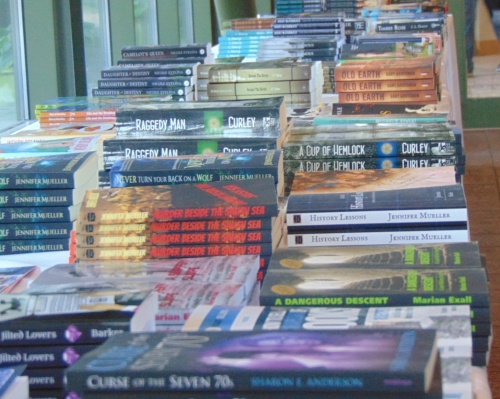
    Here are some photos of book spines to drive the point home about their importance and the 3 second rule of thumb.

    BOOK SPINES MATTER!

    BOOK SPINES MATTER!       Legacy-Cover-w-Spine


       How will your book standout? How to Increase Book Sales in Book Stores


    More exceptional cover designs:

    The Girl and the Clock WOrk Cat - Nikki McCormackNotice  that the reader can immediately tell that this is a steampunk young adult novel that takes place in London,  with a young adult female protagonist and a cat. All of this information is conveyed by the cover design.

    There's Something About MartyCozy mystery readers who like a humorous edge  to their stories can tell immediately that this book may be of interest to them.

    The Treasure of Ching Shih by John GillgrenNo mistaking that this is a children’s book about sea adventures and pirates!



    Farewell to a QUeen

     Yep, I read this book to find out what happened to the Queen of the North!

      Your cover should incorporate your author brand along with some 3rd party P/R.

    STRAIGHT-INTO-DARKNESS-front Award


    Notice how tastefully that this author differentiates himself from the other millions of authors with his designation of being an award winning author.


    Higher Ground by McKendree Long You are probably starting to get the concept….of just how much information a cover is able to convey. Help readers discover your books by using your book’s cover real estate as effectively as possible. Make every little detail work for you. Imagine that your cover is a commercial for your book and make each everyone on those three seconds that you have to hook the potential reader into picking up your book instead of someone else’s or to click on your digital cover instead of someone else’s.

    Covers can sell readers on your first work, but it is the content that will make them come back for book two and three….


    It is the COVER that will sell your books at industry trade shows when book buying professionals pick up your books’ Sell Sheets.  Make your books standout and get noticed. Start working on the cover concept almost as soon as you start working on the story concept. Use it start finding Beta readers, on your website, with your author platform to start lining up book signings for your book launch, and planning promotional materials BEFORE your launch date. Keep in mind hour your cover will influence your marketing materials and web promotions.

    Remember that it doesn’t matter how much time and money that you spend on getting your book in front of potential readers. If the cover isn’t  engaging to the reader, the reader will not pick it up to look at the inside or read the back cover blurb, or click on the image to for more information and all of your time, money, and effort will be for naught.

    Covers should convey an emotion first. The cover should have a visual impact that grabs the potential reader and makes him/her want to know more about what is inside. The cover must be enticing! 

    milkyway-galaxy.jpg

    This is the second blogpost in the Seven Must-Haves for Author series.

    The first article addresses:

    What is the traditional publishing tool that authors can implement to propel their writing careers to new levels and to earn an income from selling their books? Click here to read. 

    The third article in the series asks: What is the corner stone of any author platform?

    Stay tuned! – Kiffer Brown, Head Hen at Chanticleer Book Reviews


  • Top Ten Takeaways from Book Expo of America 2016 by Kiffer Brown

    Top Ten Takeaways from Book Expo of America 2016 by Kiffer Brown

    IMG_20160513_115454Top Ten Takeaways from 2016 Book Expo of America – Chicago

    The Number One publishing industry event in North America and one of the biggest in the world. BEA is the largest gathering of booksellers, librarians, retailers, publishers, rights, licensing, and book industry professionals in North America.

    BEA gave me a press pass that allowed me a carte blanche to walk the show, take in presentations and sessions, attend special events, view the latest products, and meet with exhibitors.

    Here are the ten takeaways that I gathered from overhearing buzz, listening to experts sharing the latest information, and seeing the latest trends at BEA 2016.

    Drum-roll please! 

    The Top Ten Takeaways from BEA 2016

    1. Never ever forget that books for “the trade” (books available to the general public – digital or print) must entertain–even if their purpose is to educate.IMG_20160512_161055
    2. Covers RULE — every spot of a cover whether digital or print is highly valued real estate because it is the number one influencing tool to induce a potential reader to pick-up a book or click on a digital book for more information.
    3. Book buyers for libraries, as a rule, wait to decide on whether or not they will  purchase a book until they can “hold it in their hands” along with requiring that the book has been editorially reviewed (not consumer reviewed). If authors/publishers want to reach librarian book buyers, it behooves them to have their books at the ALA conventions.IMG_20160513_143314 (1)
    4. E-books as a percentage of US wholesale trade market sales are more than 25% of all sales in 2013, 2014, & 2015.  Source: AAP
    5. Readers are “flipping like otters” between e-books and print books.
    6. The publishing market is going global because of E-books. Forty percent of Smashwords/iBooks sales are global. Retail digital platforms (Amazon, Kobo, iBooks, Smashwords, etc.) are global.
    7. Generation Z, X, & Millennials now use YouTube as their Google Search. Keep this in mind when creating channels of book discovery pathways.
    8. Publishers want/need series–not one-offs (single titles)– because that is what bookstores want and, ultimately, what readers want. IMG_20160513_173524
    9. Gen Z, Y, and X want authenticity in engagement. They do not want to be sold to on social media platforms. Gen Z communicates in images — think emoticons.
    10. The nut to crack is to get people to read and buy books rather participate in other kinds of entertainment (gaming, movies, watching TV, etc .) that are competing for their time rather than worrying about Indie vs Traditional publishing.  See Item 1.

    Next year, BEA 2017 will be held in back in New York City and Kiffer Brown of Chanticleer Reviews plans on being there to bring the Chanticleer Community of Authors the latest in publishing news.

    Be sure to check out Kiffer Brown’s marketing blog-post series that she presented at BEA 2016, The Seven Must-Haves for Authors.


  • E-Book Sales as Core of Your Books’ Marketing Plan by James Wells

    E-Book Sales as Core of Your Books’ Marketing Plan by James Wells

    The eBook market is a huge opportunity, especially for indie authors.

    If you’re not focusing on eBook sales as a core part of your marketing plan, you’re missing out.

    great symmetry james wells

    When I published my first novel The Great Symmetry, I printed a few hundred copies and imagined that it would be a great success if I sold them out. I had no idea where I would find the vast majority of my readers.

    Just a year later, about 95% of my sales are eBooks. Every day, readers are buying my book on Amazon and other sites from all over the world.

    To get traction in the eBook market, I tried out new things, made plenty of mistakes, and then had a series of increasing successes. I’m grateful to the authors who helped along the way. Now I’m distilling the most important lessons to help other authors.


    At the upcoming Chanticleer Authors Conference, I’ll be presenting a series of three sessions about eBook publishing. The content won’t focus on mechanics like eBook file formats – that’s boring and you can figure out that stuff easily. Rather, we’ll dig into the most important decisions facing an author in the eBook market. The sessions are:

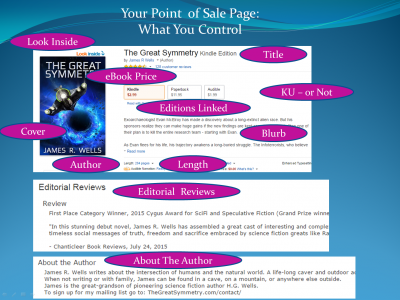
    • eBook Publishing 101: Designing your points of sale (such as your Amazon page) to convert browsers into buyers.
    • eBook Publishing 102: Getting readers to your points of sale. We’ll emphasize the most cost-effective tool around – the discount promotion.
    • eBook Publishing 103: Advanced topics such as series planning, reader magnets, and more.

    An overarching theme of all of these sessions is that your eBooks are a central part of your offering.

    Chanticleer blog post James Wells


    For some types of book (especially genre fiction by indie authors), it’s the most important channel for you. This means you should plan ahead for your eBook. For instance, some cover designs look wonderful in print, but are failures online – we’ll discuss how to avoid that pitfall. There may even be reasons to modify the text of your novel to sell well as an eBook.

    It’s ironic because I don’t even like reading eBooks myself. I only just gave in and bought a Kindle last week. But my preference doesn’t matter to the market – your priority as an author should be to make your book available, and well positioned, in the channels where the readers are found. These days, that means eBooks.

    Note from Kiffer Brown

    [fusion_builder_container hundred_percent=”yes” overflow=”visible”][fusion_builder_row][fusion_builder_column type=”1_1″ background_position=”left top” background_color=”” border_size=”” border_color=”” border_style=”solid” spacing=”yes” background_image=”” background_repeat=”no-repeat” padding=”” margin_top=”0px” margin_bottom=”0px” class=”” id=”” animation_type=”” animation_speed=”0.3″ animation_direction=”left” hide_on_mobile=”no” center_content=”no” min_height=”none”]

    James-Wells-Author-Picture
    James R Wells, Science Fiction Author

    I would like to thank James R. Wells, the author of The Great Symmetry for sharing his knowledge and experience with the Chanticleer Community.

     [/fusion_builder_column][/fusion_builder_row][/fusion_builder_container]

  • Three Questions with the Founder of the World’s Largest Book Club – Kathy Murphy

    Three Questions with the Founder of the World’s Largest Book Club – Kathy Murphy

    Pulpwood Queens Book Club’s Founder, Kathy Murphy, tells all! 

    Pulpwood QueensMeet Kathy Murphy, the “Pulpwood Queen” who opened the only Hair Salon/Bookstore, Beauty and the Book in the country in Jefferson, Texas and in 2000, founded and now operates the 600+ chapter book club, The Pulpwood Queens, nationally and in 15 foreign countries. Have a question for the Queen? Bring it to the Chanticleer conference session!


    1. What was your motivation to launch the Pulpwood Queens?

    Shortly after opening my Hair Salon/Book Store, (Beauty and the Book), the local book club invited me to join them for a meeting. I thought they invited me to join and be a MEMBER, not!

    Evidently, only eight members were allowed to join and as the hostess told me, “Unless someone dies or moves away, that is all that will fit around our table.”

    I was secretly thinking, Who made up that RULE?! Anyway, I went home, sat down, and made a list on what I would do if I started my own book club.  This book club would be inclusive, not exclusive.  We would call ourselves The Pulpwood Queens, “where TIARAS are mandatory and reading OUR good books was the only Rule!”

    By wearing the crown, we would tell the world that we were “beauty within” queens as we were real readers.  So for nearly 16 years we have been meeting monthly, first with my charter chapter, The Pulpwood Queens of East Texas.

    Since then we have made the news with appearances on The Oprah Winfrey Show, Good Morning America, we kicked off their “READ THIS” Book Club and other radio and print media with now over 600 chapters nationwide and in 15 foreign countries.

    [fusion_builder_container hundred_percent=”yes” overflow=”visible”][fusion_builder_row][fusion_builder_column type=”1_1″ background_position=”left top” background_color=”” border_size=”” border_color=”” border_style=”solid” spacing=”yes” background_image=”” background_repeat=”no-repeat” padding=”” margin_top=”0px” margin_bottom=”0px” class=”” id=”” animation_type=”” animation_speed=”0.3″ animation_direction=”left” hide_on_mobile=”no” center_content=”no” min_height=”none”]

    Timber Guy sexy reading contest
    Timber Guy Sexy Reading Contest at the Pulpwood Queens’ Girlfriend weekend!
    1. What will readers get out of being a member of a chapter and where/how can they hook up with an existing Pulpwood Queens or Timber Guys chapter?

    Everything pertaining to membership is on our website, www.beautyandthebook.com but the difference our book club has over others is we bring the authors into the picture.  Most of our authors will teleconference, SKYPE or even visit chapters and for sure be featured at our annual Pulpwood Queen Girlfriend Weekend. I know of no other book club where you have this kind of access to the authors.

    I also make all the authors participate in ALL EVENTS at our Girlfriend Weekend.  So it’s no secret that Pat Conroy has served Sweet Tea at our Author Dinner, where I make all the authors wait the tables in crazy costumes.  You eat, drink, and the authors even stay in the same hotels and bed and breakfasts.

    It’s full immersion into the Wonderful World of the Pulpwood Queens with the Grand Finale being our Great Big Ball of Hair Ball. The theme this year is ONCE UPON A TIME.  All the authors dress up, too, and it’s the ultimate Kodak moment, so bring your cameras BIG TIME!

    pulpwood queen & family photo


    Ed. Note: To become a member, visit: www.beautyandthebook.com/membership

    1. What is Kathy Murphy looking for in a good book? What speaks to you as a reader?

    Since my book club is now international, here is what I am looking for:

    1. An unknown author, one that is perhaps a first time/first book or one that hasn’t been discovered in a really big way. Yes, I want to pick a big name once in while but only if they can come and be a Keynote at my annual convention which we call Girlfriend Weekend. Example, Pat Conroy, Fannie Flagg, John Berendt, Jamie Ford, etc.
    2. This is a given but it must be well written, free of flaws and my book club members do not like to read books with gratuitous violence or language, but I do make exceptions. I selected Girl with the Dragon Tattoo because it was just such a great, well written story.
    3. Most important of all, the book must tell a story that has NOT been heard before or from a perspective that gives the reader a different view of a subject. Examples: The Sunday Wife by Cassandra King, The Dive From Claussen’s Pier by Ann Packer, Empty Mansions by Bill Dedman. Do not send me another queen book set in the south, particularly one that is also a hairdresser. I hold that card, DONE.
    4. I want a book that changes people’s lives for the better. Examples: My Orange Duffel Bag, Same Kind of Different As Me, a book that is discuss-able and that includes book club discussion questions written by the author. My book club hates generated book discussion questions, too literary and not very personal. Authors tend to write questions that they answered.
    5. I really don’t care who publishes a book, a good book is a good read no matter who publishes it.
    6. Last, I want a real book to read, I’m on the computer so much, I want to cuddle with a book in bed!

    Book-Clubs-in-Where-Writers-Win-Winner-Circle

    Thank you Shari Stauch, CEO of Where Writers Win, for this informative interview with Kathy L. Murphy, the Pulpwood Queen!

    Shari will present several sessions sharing her book marketing expertise at CAC16 along with Friday evening’s keynote presentation.

    Tell Us About the Live Book Clubs YOU Know!

    The WWW team and the Chanticleer Reviews team are reaching out regularly to bloggers, Twitter-ers, indie bookstores, readers at book festivals and more, once every few months we circle back to the coolest source –YOU– to ferret out the latest book clubs in cities around the world. Because, the club you know about might also be of value to one of our other emerging authors – and their club may be of value to you!

    Contact:  BookClubs@ChantiReviews.com and/or contact Where Writers Win.

    Editor's Note about Kathy L. Murphy:

    DreamWorks signed on to produce a movie about Kathy, though as she says, ”I did not do this alone and am not an overnight sensation,” Murphy said. “This came about through years of struggle and hard work and the incredible friendship and help of my Pulpwood Queens Book Club members and our authors and the love of my daughters, my sister and family. We — note that I say WE have struck a film deal.”

    The latest update regarding the film as of April 2016 is that the screenplay has been written and approved. Dreamworks has sent the script “out to talent,” so stay tuned to see who will play Kathy L. Murphy.  

    We can hardly wait to see it! 

    [/fusion_builder_column][/fusion_builder_row][/fusion_builder_container]

  • Why Book Clubs Matter by Shari Stauch, CEO of Where Writers Win

    Why Book Clubs Matter by Shari Stauch, CEO of Where Writers Win

    Shari_Stauch-171x3001.jpgCEO of Where Writers Win, Shari Stauch, and Pulpwood Queens Book Club founder Kathy Murphy, will conduct a special session at the Chanticleer Conference, “Why Book Clubs Matter” – Here’s some great info to get you ready!

     

    LIVE Book Clubs: Are You Reaching These Critical Influencers?

    IBook clubs can be a defining moment in any author’s career. Fact is, the success of any book is accelerated if book clubs get hold of it and begin spreading the news. That’s why we call them “influencers” and that’s why book club listings are a key component of WWW’s Winner Circle.

    We encourage every author to develop a list of at least 10-12 thoughtful questions that relate to their book(s). Here’s how to get going with your own set of book club questions, what to do with them once you have them, and how you can share book clubs you know about, too! My next article will share some special insights from Pulpwood Queen Kathy Murphy,

    book-club-questions

    1. How to Write Your Book Club Questions

    If you’re unsure where to begin, here are a couple sites to get you started. PLEASE note, these are generic questions and we strongly suggest you use these as your “starter dough” to establish thoughtful reader discussion questions that pertain directly to your own work:

    1. From LitLovers.com – Questions for Fiction: http://www.litlovers.com/run-a-book-club/questions-for-fiction
    2. From LitLovers.com – Questions for Non-Fiction: http://www.litlovers.com/run-a-book-club/questions-for-nonfiction
    3. From AboutEducation.com – A list of general book club questions for discussion: http://classiclit.about.com/od/bookclubs/a/aa_bcquestions.htm
    4. From Book-Club-Queen.com – More general discussion questions for fiction at: http://www.book-club-queen.com/book-club-questions.html
    5. From Book-Club-Queen.com – General non-fiction discussion questions: http://www.book-club-queen.com/book-club-discussion-questions.html
    6. For reading guides/book club questions from hundreds of other books, visit: http://www.booklistreader.com/2008/05/07/book-groups/stalking-the-online-reading-guide/

    Here are a few of our authors with some fun book club questions that began with the starter dough above. Use them to inspire you:

    2. Where to Post Your Book Club Questions

    Your book club questions, book discussion guide, or whatever else you want to call it, should be listed in the back of your book. Whether or not that’s possible, there are other places to share as well:

    On your author website. Have a separate page/tab for your book club questions. We typically suggest that you paste them into the site, but also have a pdf of the questions, (perhaps nicely laid out with a graphic of your book’s cover), that readers can easily download and print for their next meeting.

    Share this page widely on your social media outlets. You might also put up a question a day or one a week over the course of time to create more following and even encourage online discussion of your book.

    book-club-survey

    Include your questions when pitching reviewers or book clubs. Make sure you let reviewers, clubs and conferences you may be pitching know that you have discussion questions. You needn’t list them out in each pitch, but do provide a link to where they can view and/or download your guide. One paid option we’ve seen ($200 and we don’t have feedback yet as to its worth to authors) is ReadingGroupGuides.com – you can visit this link for more info: http://www.readinggroupguides.com/how-to-add-a-guide.

    With your help, our vetted list of LIVE book clubs in the Winner Circle, now already over 300 live clubs and thousands of readers strong, will offer emerging authors the best chance to expose your work to thousands of new readers. And book clubs will have the opportunity to read new work in the genres of their choice, and maybe even influence who the next best-seller will be… That may be you!

    A note from the Chanticleer Reviews Team:

    Thank you, Shari Stauch, CEO of Where Writers Win, for sharing this useful information with the Chanticleer Community. We are looking forward to hearing more from you about reaching out to book clubs at CAC16! 

    We would also like to mention that we have a special blog post just for connecting authors and readers on the homepage of the Chanticleer Reviews website. Be sure to check it out for the latest in specials and offerings just for readers!

    Book Clubs and Readers Community News from Chanticleer

  • CO-OP Publishing: An Indie Option by Sara Stamey

    CO-OP Publishing: An Indie Option by Sara Stamey

    SaraLargerHawaiiPhotoJoin award-winning novelist and editor Sara Stamey to explore one of the newest alternatives to traditional publishing at #CAC16.

    Sara Stamey Unlocks Her Secrets to Successful Publishing 

    After being published by a traditional “Big 5” house and then starting her own “micro-press,” Sara has now joined Book View Café, one of the leading co-op publishers. With over 50 professional novelist members, the co-op takes control of how its authors’ writing is published, bypassing restrictions and delays of mainstream publishers, and distributing straight to their readers.

    “I was frustrated with my treatment by my traditional publisher and the endless delays, as well as mismanagement. But going it alone as an indie author was exhausting. Working together with a supportive group of fellow authors has made all the difference.”

    Join Sara for an introduction to the cooperative publishing model and ideas for joining or creating your own author coop at the Chanticleer Authors Conference 2016. Sara will be sharing her knowledge of this economical and highly vetted publishing avenue that is available to qualified Indie authors.

    “Our members donate the skills they have in return for the skills they need to publish books. So each of our members is both an author and an important cog in a publisher. We emulate everything a major publisher does.

    We have editors, ebook formatters, print typesetters, cover designers, accountants, web designers, IT and legal professionals, PR people, administrators and managers.  We even sell sub-rights – we’ve sold the audio rights to a couple of hundred of our books for a very good six figure sum to Audible.

    We also make our ebooks available in libraries – selling to them direct and via all the major library distributors like Overdrive, 3M, and Gardners.” -Book View Café member Chris Dolley

    http://bookviewcafe.com/bookstore/

    “I love the freedom, the fact that we can mix genres, that our books won’t be slashed to fit marketing’s mandated word count, that we get vigorous editorial feedback and it doesn’t take years, that people will do my formatting and covers for me. The team effort, I feel, makes us much greater than the sum of our parts.” -BVC member Sherwood Smith

    Sara’s newest novels from Book View Café, both Chanticleer Award-winners:

    • The Ariadne Connection – CYGNUS 2014
    • Islands – Paranormal Awards 2014.

    ariadneconnection

    Stamey-Islands_600x9001-200x300

    www.sarastamey.com

    Listen to Sara Stamey talk about indie publishing on Episode 05 of “The Whatcom Wordsmith” podcast with Jennifer Karchmer. 

  • One Author’s Creative Approach to Book Signings

    One Author’s Creative Approach to Book Signings

    To compete in the current book market, where millions of  books are published each year, you have to find interesting new ways to get your books in front of potential readers.

    [fusion_builder_container hundred_percent=”yes” overflow=”visible”][fusion_builder_row][fusion_builder_column type=”1_1″ background_position=”left top” background_color=”” border_size=”” border_color=”” border_style=”solid” spacing=”yes” background_image=”” background_repeat=”no-repeat” padding=”” margin_top=”0px” margin_bottom=”0px” class=”” id=”” animation_type=”” animation_speed=”0.3″ animation_direction=”left” hide_on_mobile=”no” center_content=”no” min_height=”none”]

    book signing opportunities
    Same old same old

    Today, Janet Shawgo, award winning author of the Look for Me series, shares her experience with setting up book signings at wine bars—and how the right creative approach can help spread the word about your books.

    Also, as an added advantage, your books will have more focused attention from potential readers. It is a great one-two promotional punch!

    Setting Up Book Signings in Unique Places Other than Bookstores

    12924511_1181270135225159_5230181094765279286_nBookstore managers don’t always return calls or emails, dates may not be available, or dates may be reserved six months in advance.

    But who says that you can only hold book signings in a bookstores?  

    If you can get the okay to set up a table with books, you can have a book signing wherever that may be. (Like a wine bar.) I know of one very successful western fiction author who has his best signings (read as sells more books) in grocery stores!

    Another author whose romance novels have a natural healer as a protagonist holds some of her most successful signings in food co-ops and natural supplement stores. Yet another author holds her signings at outdoor equipment stores for her eco-mystery series.

    The possibilities are endless. 

    The Point is to Engage Readers – Janet says:

    These days, you need to find something unique to get your books to new readers. But getting yourself in front of readers can be frightening. I get it! Making your book signing into an event where you can have more interaction than just signing books helps ease the awkwardness.”

    “Think of what fits with the theme or genre of your book. If you have a cozy mystery about food, find a local restaurant. If you write romance, a little wining and dining might go a long way.”

    12998493_1187296194622553_2292896810247946110_nJanet Shawgo shares info about her Wine Bar Book Signings

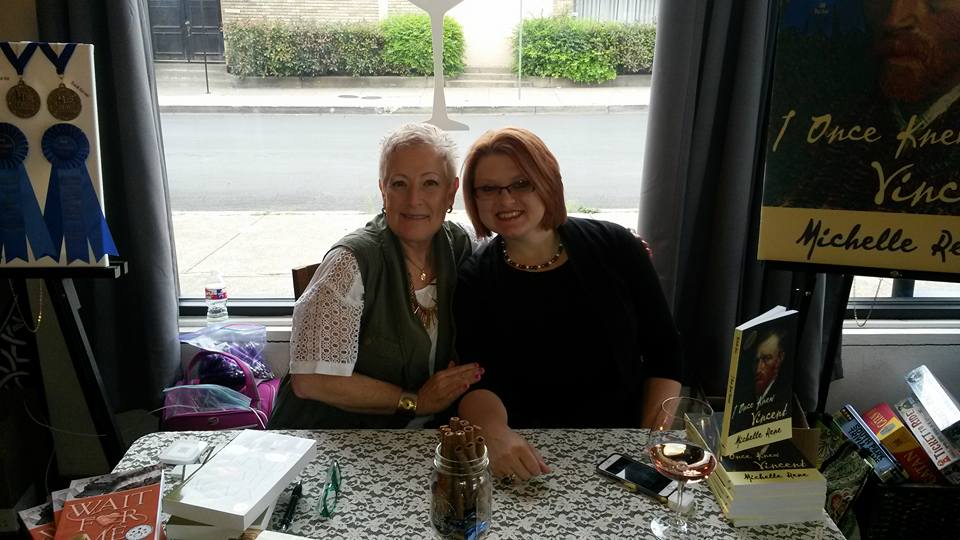
    “In April, another Dallas-area author, Michelle Renee, and I are hosting a book signing at a wine bar in the Bishop Arts district. We contacted the owner to ask if we could set up a table and sell our books on a slow weeknight. In return, we will purchase a few bottles of wine (white, red, and rose). We’ll hand out tickets to people, which entitles them to a glass on us.”

    “I’ve had huge success with signings at wine bars. At another signing, I sold a good number of books, people enjoyed the glass of wine, and the wine bar had one of its best nights and welcomed me back to hold another signing.”

    How to Make the Most of Your Book Signing – More Info from Janet Shawgo, award winning author of the WAIT FOR ME series

    “To make sure people get to your book signing, be sure to spread the word! We’re on social media, sharing information about our wine bar book signing, but we’re also telling people at work, as well as family and friends. Don’t be afraid to ask the place that is hosting you to post on social media about the event, too. Targeted Facebook ads to locals might also help spread the word.”

    “At the signing itself, we have a signup sheet for our newsletters to capture emails, and we also choose two or three people from it for door prizes at the end of the evening.”

    1262515_10153217559070403_1589138071_o“Be sure that your table is appealing and inviting. Readers love free items, so we have pens, bookmarks, candy, magnets, and key chains. Items that have information about our books on them keep us in readers’ minds.”

     

    Thank you, Janet Shawgo, for the sharing your great idea with other Chanticleer authors!

    Kiffer Brown asks: Where do your books’ targeted readers hang out? 

    • kitchen stores?
    • gardening centers?
    • yarn shops?
    • trivia nights at pubs?
    • comic book stores?
    • boat supply stores?
    • pet stores?
    • coffee shops?
    • outdoor recreation suppliers?

    310715_270645636302227_1489383886_n

    The possibilities are endless!

    Expand your readership—make your list of author/book signing opportunities today! 

    Click on the links to read Chanticleer’s reviews of Janet Shawgo’s award winning books: Look For Me, Wait For Me, and  Find Me Again

     [/fusion_builder_column][/fusion_builder_row][/fusion_builder_container]

  • AGILE PROJECT MANAGEMENT for AUTHORS by Tom Wise, Ph.D. and Nance Wise

    AGILE PROJECT MANAGEMENT for AUTHORS by Tom Wise, Ph.D. and Nance Wise

    Authoring Is A Business and this is why Tom Wise Ph.D., project management consultant, advises authors to implement AGILE PROJECT MANAGEMENT METHODS to meet their publishing goals.

    Recap of Three Steps to Using Your Writing Time More Effectively – Agile for Authors Article One

    In the previous article, we discussed how to build a network to create a team. This requires relationships and understanding the skills and abilities of these people. Part One was setting the stage to prepare to work within a strong network of supporters. In this article, we are going to cover how to apply most effectively your network in your business.

    Part 2. Authoring is a Business

    Knowns

    8,760 hours in a year.

    Timelines and schedules are precious commodities. Each of us is given only twenty-four hours in the day and one hundred sixty-eight hours in a week. We only receive fifty-two of those weeks in a year filled with eight thousand seven hundred and sixty hours. We spend almost two thousand nine hundred of those hours in sleep and another one thousand hours commuting, shopping, and general time with family duties.

    Agile for Authors

    Hours In A Day Breakdown Of Activities

    Note: Hours in the day are an estimate of an average person with a full-time job:

    1. Working/Living/Education:  8 hrs a day
    2. Sleeping: 8 hrs a day
    3. Commuting/Eating/Chores/Grooming/Exercising/Family Duties/Community Participation (clubs, volunteering, reading) 6 hours
    4. Writing???? 2 hours

    For the knowledge worker, that leaves a mere forty-five hundred hours to split between the remaining activities such as leisure and love, eating and playing, housework and writing. If we are lucky or good, and manage to split our time perfectly, that provides the author seven hundred fifty hours, or two potential hours of precious time to write in a twenty-four hour period. Now, I don’t know about you, but I rarely manage to focus for a full couple hours in a day, let alone seven hundred fifty hours straight.


    Rework in authoring a novel or book is very costly in time, money, and confidence. The problem is often not the writing or the mechanics, but rather a process. A life-cycle may not be clear to us, but it does exist. Getting published historically took years to complete, but that has changed.

    In the new millennium, some software experts developed a twelve-point manifesto for Agile principles to apply to writing novels. They discovered that a network of invested peers made their writing process more effective.

    Agile Principles for Authors


    Realize, there is a difference between content writers and authors. Content Writing tends to be paid position or contracted. Authors, and especially Indie Authors, invest their time and money up front hoping for a return on work at the other end of the process. Authors hunker down, close themselves away, and work until they complete the manuscript. Then polish the work, send it off, and hold their breath, cross their fingers, hoping for someone to send a love letter of acceptance.

    AGILE FOR AUTHORS

    Top companies in the world understand the necessity of a more streamlined process. Hired consultants make billions of dollars teaching companies how to create processes for efficiency and economic savings. Experts measure, refine and reduce their product processes into effective work segments to complete the product. These techniques can be employed in your authoring efforts.

    Some people have learned a family business, and others seem to instinctively know how to segment out their work and  organize others to get work done and goals met. For the rest of us, this can be a learned skill.

    Agile Manifesto’s Twelve Concepts

    Agile authors have the ability to use the flexible methods. The idea, the method of agile, developed during the 1990’s by software developers with the simple focus of targeting the desires of their customers before the work begins. It includes building a team focused on customer satisfaction, a team with shared mission and participation of quality experts, engineers, analysts, and business people. These software developers gathered at The Lodge at Snowbird Ski Resort in the Wasatch Mountains in Utah and developed what is now known as the Agile Manifesto.

    The Agile Manifesto expresses twelve concepts of a well working team that can be applied to the business of authoring.

    1. Customer satisfaction is priority
    2. Welcome changes
    3. Deliver working software frequently
    4. Business and Development work together daily
    5. Motivation, Environment, and trust are needed
    6. Face-to-face is best
    7. Working software is the measure
    8. Maintain a constant pace
    9. Technical excellence and good design
    10. Simplicity – maximize work not done
    11. Self-organizing teams
    12. Regular retrospection and adjustment

    A Shift in Paradigm –  A to Z no longer applies!

    In segmenting work – A to Z no longer applies. Now, working on A to D, R to Z, and then E to H, is possible, getting feedback and input along the way, improving as the work progresses, to a thoroughly edited, refined product.

    Agile for Authors

    Consider what can be grouped, or segmented into independent units of work, and the need to include people with these skills in your team:

    • Division of responsibilities to make your group a team
    • Division of tasks into short phases of work (Sprints) characterized by division of tasks
    • Publishers
    • Cover design
    • Marketing
    • Bloggers – who and when
    • Social media
    • Beta readers
    • Developmental and line Editors – who and when
    • Identify who needs to work on what
    • Who needs what information – focus on that info with those people
    • Conferences and author signings

    Teams and groups work differently. One of the key differences in the behaviors of teams is due to the separation of responsibilities. When an individual is assigned a unique task or given a goal, he/she can take on the leadership role when it comes to meeting the assigned objective.

    When work is segmented into small chunks, called sprints, with a short duration and a clear goal, the team can move quickly to completion of a quality product. Prioritize small sprints of two to three weeks on a specific goal, and with the team members that are needed to complete that small chunk of work.

    Agile for Authors

    Short Sprints Win the Race

    At the end of each sprint, take the time to discuss the past segment. Ask the team the hard questions. By continuous reassessment, your team will quickly become efficient at turning that crank and churning out quality work.

    • Frequent reassessment and adaptation
    • People – are they responsive to you and are you responsive to them, working well together.
    • Communication – are the tools and behaviors working?
    • Commitment – are you, and they dedicating the time and focus to getting work completed in the way and time agreed?
    • Time – are the estimates accurate? Is the time to meet convenient and sufficient to get the work done?

    When the opportunity to write presents itself, an author must have options ready and prioritized. This requires the author to have a routine that enables them to move into the zone, one zone or another, quickly.

    Creating that “zone” means understanding the priority, and what needs to be available that activates the muse. Identify the psychological triggers that engage your creative abilities.

    • Have a scent prepared that gets you in the mood to write (coffee? cinnamon? campfire smoke? brandy?)
    • Know the lighting that is needed to make you comfortable (candles? bright light? darkened writing cave?)
    • Identify the background sounds that move you (white noise? rain forest sounds? dance tunes? sultry Barry White?  Western music?)
    • Choose a setting (busy coffee shop? attic studio? kitchen table? favorite bookstore? local pub? closed office with the door closed?)
    • Choosing a time of day is ideal (first thing in the morning? late night after everyone goes to sleep? immediately after exercise?)
    • Have needed ideas listed. (Always jot down or record anything that you think might be useful for writing projects. Don’t let these muse tidbits dissipate into the air.)

    Choosing a specific time of day with no distractions is essential. If the author has a family, often this time is before the family awakens, or after the family retires for the night. Perhaps for you, it is after the children head out to school, or during your lunch break at work. Whatever time that is, set that time aside on your calendar and give it to yourself. Don’t allow excuses to infringe on the task. Perhaps you can arrive to work early, or stay late on a preset schedule. This provides the family, or significant other, the ability to support your time to write.

    • Stage your work area
    • Be organized and have everything together (prepared)
    • Know the psychologically stimulating triggers that jog your muse
      • Diane Gabaldon’s is lighting candles for her muse.
      • Robert Dugoni’s is reading the Green Mile by Stephen King — again!

    [fusion_builder_container hundred_percent=”yes” overflow=”visible”][fusion_builder_row][fusion_builder_column type=”1_1″ background_position=”left top” background_color=”” border_size=”” border_color=”” border_style=”solid” spacing=”yes” background_image=”” background_repeat=”no-repeat” padding=”” margin_top=”0px” margin_bottom=”0px” class=”” id=”” animation_type=”” animation_speed=”0.3″ animation_direction=”left” hide_on_mobile=”no” center_content=”no” min_height=”none”]

    Jennifer Cook - coffee pic (1)
    “What my Coffee says to me” by Jennifer R. Cook


    Moving from one role to another, both physically and mentally takes planning, skill, practice, and agility. As an author, if we have a team of people with unique skills and responsibilities, then your team can take a leadership role when necessary. This gives the author more opportunity to shift roles from writing text to editing, scheduling, and organizing for subjects such as cover designs, reviewing publishers, and marketing.

    Parting Words

    Allow yourself to have every benefit possible to make the transition to your creative self to take advantage of that precious time when it is just you and your story. 


    NOTES from the Editor:

    The fun picture above titled “What My Coffee Says to Me” is by Jennifer R. Cook, a creative graphic design consultant and illustrator. Ms. Cook has been graciously given Chanticleer Reviews permission to use this picture with Tom and Nancy Wise’s AGILE for Authors series.  We absolutely love her artwork and graphic designs!

    “What my Coffee says to Me” is a daily, illustrated series which began January 1, 2012 by Jennifer R. Cook a strategic graphic designer and illustrator creating for mental health awareness, please visit www.catsinthebag.com

    For more information on building an environment for Agile success read Agile Readiness; Four Spheres Of Lean And Agile Readiness by Thomas P Wise and Reuben Daniel. Available at Amazon, Barnes & Noble, and Gower Publishing, and anywhere books are sold.

    Tom holds a Ph.D. in Organizational Management and teaches courses in project management and quality at Villanova University and DeSales University. He is currently developing curriculum at Eastern University based on his books: Agile Readiness and Trust In Virtual Teams.

    Tom and Nancy are award winning authors. Their book, The Borealis Genome is the 2013 Dante Rossetti Grand Prize Winner and a 2014 Cygnus Award First In Category winner. Their books have won multiple awards including Finalist with the USA Best Book Awards and The International Book Awards.


     [/fusion_builder_column][/fusion_builder_row][/fusion_builder_container]

  • BUBLISH: Your Questions Answered! and a FREE 30 day Free Trial and More

    Chanticleer Reviews is honored to have Bublish, a proven book promotion and  marketing tool, as a sponsor of the Chanticleer Reviews Novel Competitions Awards.Bublish and Chanticleer

    Bublish awarded more than $5,000 in services to the 2014 Chanticleer Reviews Writing Competitions’ winners at the Chanticleer Authors Conference Awards Banquet held on September 29, 2015 at the Hotel Bellwether located in Bellingham, Wash.

    The award winners responses were so positive that I asked Kathy Meis, the CEO of Bublish, if there was anyway to make Bublish available at a special rate for the entire Chanticleer Community of Authors. And she said, “Yes!”

    Many of you may not be familiar with Bublish and more than several of the Chanticleer writing contest winners had no idea about the marketing power of the CBR Bublish Awards package. But once they did, the compliments came rushing in!

    And that is when I knew that I had to try  make Bublish marketing power available to all of the Chanticleer Reviews Community of Authors.

    Kathy Meis, CEO of Bublish, enthusiastically agreed!

    I asked her for an exclusive interview to introduce Bublish to the Chanticleer Reviews Community of Authors and Readers.

    And here it is!

    Kiffer: I am excited that you have taken time during the busy holiday season to give us an overview of the Bublish platform–especially when many of Chanticleer Community members are deciding on their marketing strategy for the new year. 

    Kathy: I am delighted to, Kiffer. Bublish is the world’s first complete publishing platform with integrated branding and discoverability features.

    Authors can use Bublish to:

    • write
    • promote
    • sell
    • and track their work.

    Our mission is to help authors reach their target readers, engage them and convert them to lifelong fans. We are committed to helping authors build a dynamic brand that drives more book sales. Every feature we build at Bublish, even our writing and eBook creation tools, works to enhance discoverability and build the author’s brand.

    Kiffer: What problems does Bublish address for authors?

    Kathy: In today’s crowded book marketplace, we know that discoverability is an enormous challenge. First-time and emerging authors face the biggest hurdle when it comes to discoverability. We know that readers are 15 times more likely to seek out and purchase books from authors with recognizable brands. Authors who successfully build a powerful brand can also charge more for their books. Writers who want to build a career as an author, must master brand-building skills in order to be successful. Bublish helps by automatically branding all the samples authors share with readers. The design, the features, the visual elements – it’s all part of our platform for the specific reason of making brand building easier for authors.

    Kiffer: Tell us about some of Bublish’s features.

    Kathy: Our most popular feature is the Book Bubble – our award-winning book sampling tool that combines crucial brand elements with calls to action. Book Bubbles take only minutes to create, and allow authors to:

    • Brand themselves along with their books with every book sample they share
    • Enrich their book excerpt with “the story behind their story” in the Bubble’s. Sharing inspirations, struggles, and your “why” draws readers into their creative journey. Authors get to build a community around their work, rather than feel like salespeople.
    • Efficiently create, share and track social engagement with multiple Book Bubbles from multiple books all from one dashboard. And because Book Bubbles are “evergreen” content, they can be shared over and over across multiple social platforms. Your dashboard grows into a library of branded digital assets that you can weave into your content marketing calendar.
    • Track conversions to the book’s product page at the major online retailers. We work with Amazon, Barnes & Noble, Google Play, iBooks and Kobo.
    • Optimize discoverability in two ways. First by connecting the dots for readers. With one click readers can go from sampling the author’s book in the Bubble to buying that book at their favorite online retailer. If they’re not ready to buy, they can visit the author’s website, view their profile on Bublish or follow them to receive email updates from the author. through automated the SEO (search engine optimization). When an author sets up their profile and their books profile, all the metadata associated with the book (title, subtitle, author’s name, ISBN, cover image, keywords, etc.) all “travel” with the Bubble, so that more readers can find your books through online searches. Secondly, draw interested readers from a social engagement with your Book Bubbles into permission-based email marketing through our “follow” feature.

    If authors choose to write their books on Bublish with our eBook Creator, there are also “rough cut” Book Bubbles that can be shared right from an author’s manuscript. This helps build pre-launch buzz, makes it easy to request reviews, and lets authors capture pre-orders. When the author is finished writing the book, they can select a book template with a single click and generate a beautiful ePub for distribution. There’s no other writing tool like it in the world!

    Kiffer: You’ve been in publishing for a long time, Kathy. What changes have you seen?

    Kathy: I’ve watched the content industry change dramatically in the last 25 years. The rise of mobile devices, digital formats and online shopping has changed everything. You can write the best book in the world, but if no one can find it, it will be lost among the millions of books available at the touch of a button. Authors need new tools to reach and engage their readers and build a dynamic author brand to drive more book sales. Bublish was created to help authors be successful in this transformed book marketplace.

    Here is a link to a Bublish Bubble by best-selling author Joni Rodger: http://bit.ly/1NiNt5W.

    I’ve also seen this industry become more author-centric. No matter whether an author is independent or traditionally published, they’re taking on more of the marketing of their work. I wanted to make it easier for authors to share their work without feeling like salespeople. The Book Bubble was designed to take care of the marketing, branding and discoverability elements, and let the author focus on storytelling – both through their book excerpt and the Bubble’s Author Insight.

    Some of the most powerful brands in the world use storytelling to break through the noise. I wanted authors to have that power, too. I know what it takes to create great content for readers, and I believe every writer deserves a chance to have their books seen by readers. That’s my mission. It’s why I created Bublish.

    Kiffer: What does it cost to subscribe to Bublish?

    Kathy: Our monthly subscription rate is $9.99 and our annual subscription is $99. We have created a special discount offer just for the Chanticleer community. Authors can sign up for our 30-day free trial at bublish.com. No credit card is required to try us out. If they upgrade by January 31, 2016, and use the discount code CHANTICLEER116, they’ll get a full year subscription to Bublish for only $79. That’s 40% off the monthly rate. It’s our way of supporting the great authors who work with Chanticleer.  

    Kiffer: Those are great deals! Thank you and the Bublish Team for your wonderful support and for recognizing this past year’s annual Chanticleer Award winners.

    Kathy Meis and Kiffer Brown: 

    Happy Holidays from Bublish and Chanticleer Reviews!

    • 30 day FREE Trial – no credit card required
    • 40% discount codeCHANTICLEER116  valid until Jan. 31, 2016 for a full year subscription for just $79. 

    Bublish example for Chanticleer Reviews