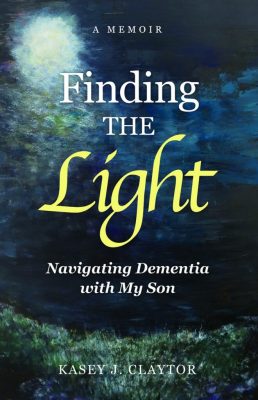
Some stories are impossible to look away from, and from its very first sentence, Finding the Light, Navigating Dementia with My Son by Kasey J. Claytor proves itself one of them. “…when my 49-year-old son, Justin, was first diagnosed with a form of early-onset dementia, I was stunned.” Without hesitation, the book draws readers into a saga of family, illness, and resilience.
Although a memoir, Finding the Light is in many ways an instructional text, too. Readers don’t need similar medical situations to draw from Claytor’s lessons of improvement. The conversational, approachable writing style serves this purpose well.
Although it’s in chronological order, this is an unconventional, modern text.
Traditional scene-based paragraphs are offset by poetry, informative sidebars, and even the full text of letters sent throughout Justin’s illness. Claytor deftly shifts between these sections, building a cohesive narrative from which readers can easily learn.
The past is vibrant and immediate: Claytor chronicles events in rich yet simple prose as Justin falls deeper into frontotemporal dementia, or FTD.
Yet Claytor also pauses often to address readers directly with a reflective tone from the present day. This gives welcome context to the book’s main narrative. She uses everything she’s learned to help readers understand Justin’s illness. FTD is a progressive, terminal disease—and a mysterious one, with no known cause. Finding the Light explains FTD patiently, without delving too far into medical details or terminology.
Claytor’s an adept records-keeper, combining her carefully recreated personal experience with thorough research.
The details she offers, from specific dates to particular images (piles of unopened mail, drives along the river road), give the story a tangible quality, as though readers are having this experience alongside her. Yet sometimes, the details come in the stark form of a list or a set of bullet points instead. These breaks from traditional prose offer a sense of the fractured, clinical experience that a terminal illness can become.
At times, Claytor’s emotions burn bright, particularly in her frustrations with the poor training and management at several care facilities. Yet she quickly pulls back from these moments of anger or frustration, letting her present-day self take over with calm reflection instead. She explains her calmness well, however, instructing readers, through example, on the deep value of patience and compassion.
Claytor truly excels at “finding the light,” just as the book’s title suggests.
“Every time I read these words like ‘horrible’ about FTD, it hurts like a paper cut,” she writes. This book offers consistent positivity without the emotional artifice that self-help or instructional books sometimes resort to. Claytor accepts Justin’s changing situation, watching him revert in many ways to his child self, and even finds beauty in this process. She finds true acceptance. And throughout this book, readers may learn how to accept similarly challenging situations in their own lives.
Finding the Light often feels like a long and enthralling conversation over coffee with a friend.
Between its accessible writing style and the unpredictable medical situation, the book becomes impossible to put down. At each turn readers will find a surprising development, such as when Justin contends with COVID, or when he must repeatedly move to new facilities. And each development is carefully contextualized with compassion for Justin, for his caretakers, and for everybody touched by the impacts of FTD. A literary rhythm emerges: touching scene, thoughtful reflection, clear information.
As Justin’s tale with FTD comes to a close, Claytor addresses the reader one last time, with a message for the painful, difficult turns in life.
The final sections of the book are written in the second person, as Claytor wraps up the narrative with a set of clear, actionable takeaways. The last chapter, “7 Survival Tips for Rough Times,” is a welcome reminder that while everyone’s challenges are different, we must all face them. The test is how we navigate these experiences. Thanks to Finding the Light, readers will have a roadmap for travelling through whatever dark paths life has in store with grace, acceptance, and love.