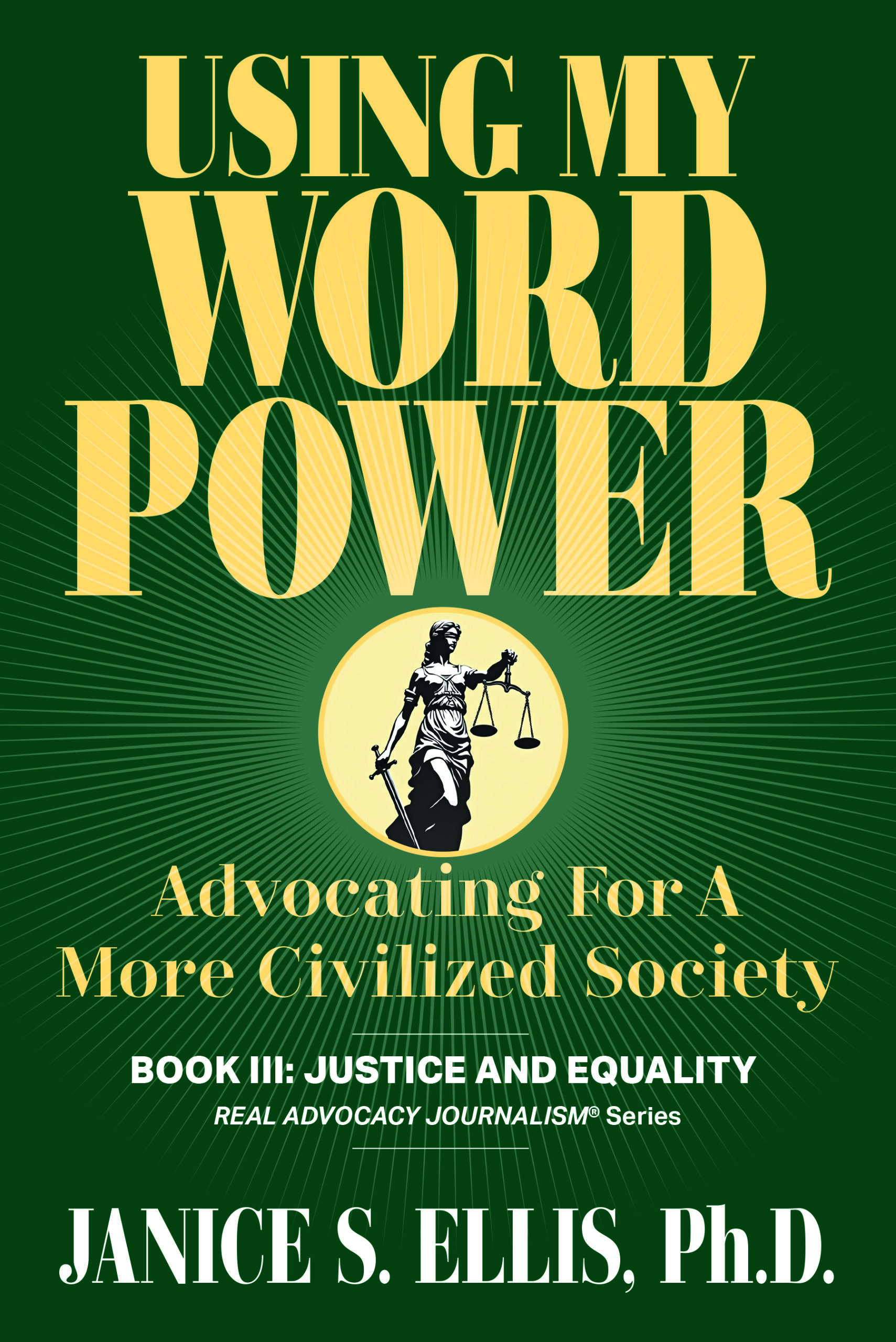
Janice S. Ellis, Ph.D’s USING MY WORD POWER: Advocating For A More Civilized Society, Book III: Justice and Equality chronicles America’s social history and asserts that every society can change the course of their destiny with conscious humanitarian efforts rather than letting the unchallenged tide of political inertia drag vulnerable people down.
Justice and Equality, Book III in the Real Advocacy Journalism® series, roots itself as memoir and manifesto, blending the author’s struggles for civil rights with her responsibility as a journalist. Real advocacy journalism here serves as a tool for fact-based writing, balancing support for a cause with dedication to fact and direct accounts, an antidote to the venom of propaganda media.
Dr. Ellis’s unrelenting voice fills Justice and Equality with the real-world basis for her advocacy. Her experiences as a black woman fighting for civil rights in Mississippi reverberate across the text. All that she witnesses fuels both her personal resilience and a broader call for justice.
Across four parts, Justice and Equality weaves a vision of America’s moral and social future.
The first part covers women’s struggles and intersectionality, tracing from the Equal Rights Amendment (ERA) to #MeToo; this section underscores the stubborn nature of gender inequality that is reinforced by institutional resistance to change.
Part two exposes racism and systemic discrimination, where education becomes ground zero for cycles of privilege and deprivation. This part presents the cases of Trayvon Martin and Michael Brown as testimony to the larger structural nature of police brutality and racial profiling.
The third part covers children, framing their treatment as a litmus test of a society’s humanity and character. This part impels urgent attention, lest domestic violence, mass shootings, healthcare crises, and educational inequality become the new ‘normal.’
Part four argues that education is the great equalizer. It shows how censorship like book banning and history denial snatch away the chances for dialogue and learning, threatening democracy.
The message of the book is sharp and urgent: America must confront the ugly underbelly of racism, sexism, classism, and censorship.
Dr. Ellis’s language presents these injustices in a graspable narrative, avoiding heavy statistics. She doesn’t shy away from the darkness of her subject matter, but rather than leaving readers in hopeless despair, her writing impels one to stand up and motivate change.
Articles included from the 1970s feel evergreen, fitting perfectly in a contemporary context. Dr. Ellis diagnoses these issues affecting the American body politic as chronic diseases—the symptoms of which keep appearing as the underlying illness is never cured. This perspective calls for foundational changes to the systems that marginalize people, rather than mere treatments for their impacts.
Justice and Equality is for readers interested in a reflective approach to the bigger inequities of society.
For students and young adults, it helps in understanding the systemic inequalities and social justice movements around them. For teachers and guardians, Justice and Equality encourages deep reflection on the flaws in the education system. Most of all, it extends a practical lens to activists and social workers, who can relate America’s complex institutional injustices to the context of their own advocacy.
Janice S. Ellis, Ph.D’s USING MY WORD POWER: Advocating For A More Civilized Society, Book III: Justice and Equality calls upon every individual to see that ignoring the real essence of society’s ills means running away from responsibility to one’s nation and humanity. The book aligns with Martin Luther King Jr.’s quote, “Injustice anywhere is a threat to justice everywhere,” resonating beyond the context of America’s problems to remind us that these issues in discussion are universal. The intention is clear: there is no room for complacency in the pursuit of justice and equality for all.