Tag: John W. Feist

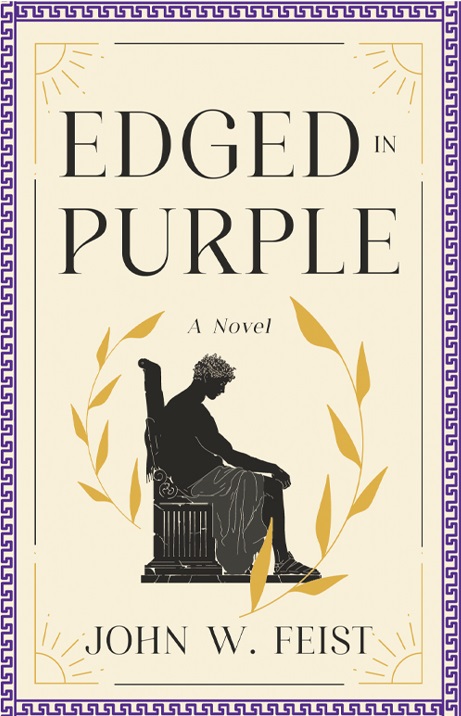
  • EDGED In PURPLE by John W. Feist – Myths & Legends, Historical Fiction, Romance


    Chatelaine 1st Place Best in Category Blue and Gold BadgeEdged in Purple by John W. Feist welcomes readers to a place outside of time and space, a liminal space where characters of myth wait to return to their fated stories.

    The Fold is a beautiful land, a near-utopia shepherded– literally– by Thetis and Peleus of Greek mythology. They raise the heroine of Shakespeare’s The Winter’s Tale, Perdita, after her father had accused her mother of betraying him with another, the whole sad story a product of his own paranoia.

    Perdita’s story is proceeding as it was written. She has already met Florizel, the man who should be the hero of her romance– when her story is intersected by another. Just as The Winter’s Tale features royal courts, doomed relationships, mistaken identities, and family murder, so too does an ancient Greek drama: the Oresteia of Aeschylus, the story of Agamemnon after the Trojan War.

    Orestes, the hero of that ancient tale, joins Perdita in the fold, pulling both of them from the paved road of fate.

    They fall in love. Florizel goes mad with jealousy and proves that she’s MUCH better off with Orestes– as he pursues the lovers out of The Fold and into a reality that none of them are quite prepared for.

    The reality they wake up in is that of the late 19th century, among the ruling class of the teetering Austro-Hungarian Empire of the Habsburgs, not far from Archduke Franz Ferdinand’s date with destiny.

    Edged in Purple begins as a whimsical combination of fantasy and mythology.

    Characters such as Orestes and Perdita’s adopted mother Thetis mingle with characters from the classics of literature– not just Perdita herself but nearly all of the personae from The Winter’s Tale. Peleus implies that characters from countless other stories have passed through The Fold on their way to their own endings, whether happy or not.

    This setting offers a wealth of possibilities for stories to mingle and morph, which Edged in Purple explores to excellent effect.

    It turns two familiar stories into one brand new adventure, transforming The Winter’s Tale into the kind of love vs. power romantic triangle that defines such stories as The Princess Bride, with Orestes, Perdita, and Florizel taking the roles of Wesley, Buttercup and Prince Humperdinck, respectively.

    However, the curtain of fantasy is pulled back and the characters must inhabit the bodies of very real historical figures. And yet still, they seek to control their own fates.

    After all, they managed it once, back in The Fold.

    But as fantasy transforms into historical fiction, their lives become fixed to moments in time. And as Orestes– now Franz Ferdinand– learns, the wheels of history can’t be steered as easily as a story.

    The two very disparate parts of Edged in Purple are equally compelling, and while that switch from fantasy fairy tale utopia to oncoming historical tragedy could send some readers for a spin, those interested in the blending of genres will be enthralled by this mirrored tale.

    For readers who do make the leap, Franz Ferdinand and Sophia’s impossible happy ever after is both compelling and heartbreaking. Recommended for readers who enjoy portal fantasy, historical fiction, and tragic romance.
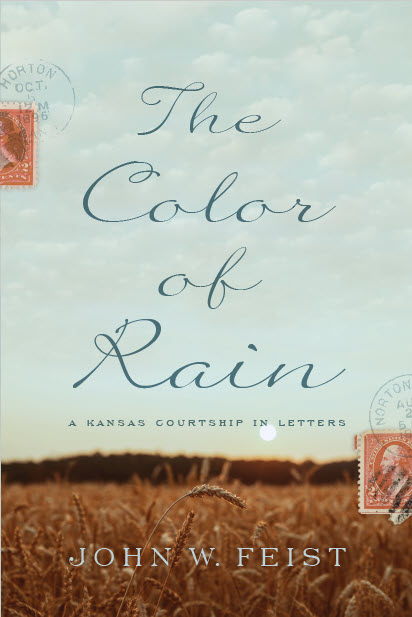
     

  • The COLOR of RAIN: A Kansas Courtship in Letters by John W. Feist – Family Saga 19th Century, Love Story in Letters, Family History

    The COLOR of RAIN: A Kansas Courtship in Letters by John W. Feist – Family Saga 19th Century, Love Story in Letters, Family History


    Author John W. Feist unfolds a true-love story, old-fashioned letter style, in his historical romance novel, The Color of Rain: A Kansas Courtship in Letters.

    Three and a half years pass before Irene Webb, a college-educated schoolteacher, hears about the beloved Wilson family she stayed with as a boarder, caring for Harold and Wallis, their two sons. But the news sent to her in August of 1896 is not good; Allie, Frank’s wife, unexpectedly dies. “I realize this is no time for letters,” Irene writes to him before expressing her most profound condolences. Formalities aside, the letter sparks renewed friendship, and the two Kansas friends begin exchanging letters regularly.

    A handsome, well-respected local banker and now eligible bachelor, Frank Wilson, is nothing less than a hot ticket item with “the path to [his] home … a pilgrimage for unmarried women bearing casseroles.”

    While the attention is encouraging, he’s not interested in finding a replacement for Allie right away. Except for Irene. Three months after Allie’s death, Frank makes the day trip via two trains from Horton to visit her at her parents’ farm in Nortonville—a mere half-hour drive with today’s modern conveniences. Thus, a long-distance courtship commences.

    Frank and Irene remain busy people – his with banking, and Irene (the oldest of seven children) cares for her ailing father and holds down the fort of the large Webb household. The two lovers keep to weekly letter-writing since they barely have the chance to see each other, especially when trials and tribulations convolute their individual lives. Irene cannot imagine the issues she must confront, including an enticing school principal offer, as she contemplates marriage.

    Rising author, John W. Feist, utilized his storytelling skills to bring a love journey to life.

    The benefactor of his grandparents’ courtship correspondence, Feist saw an opportunity to go back in time and recreate what “dating” looked like near the turn of the twentieth century. It’s difficult to imagine the formalities behind courtship, let alone women succumbing to patriarchal ties. But that was not necessarily the case with Feist’s grandparents.

    If Irene wasn’t the intellectual she was, she might have balked at Frank’s direction toward marital preparation. Instead of following through with the usual romantic proposal, Frank gave her Orson Squire Fowler’s groundbreaking Creative and Sexual Science to read and for them to discuss. To his delight, she took up the challenge. Although the hefty read might have carried an undercurrent of male domination, what made it revolutionary was Fowler’s eye-opening stance that husbands and wives should be considered equals, an ideal Frank had with Allie and hoped he’d have Irene.

    Of course, there is so much more to Frank and Irene’s relationship.

    The Color of Rain: A Kansas Courtship in Letters goes beyond recording a family legacy; it is a human-interest story. Feist’s rich writing style stitches historical details, providing a seamless flow from letters-writing to narrative sections that capture everyday life’s realities amid unsettling times. Concerns over Indian Territory and Negro Freeman allotments (which Frank was involved in as a banker) and contracting diseases like malaria and typhoid (both Irene’s mother had, eventually dying from the latter) are two prime examples.

    The Color of Rain: A Kansas Courtship in Letters is a must-read for all, especially history aficionados.


    5 Star Best Book Chanticleer Reviews round silver sticker