
Tag: Jewish Historical Fiction

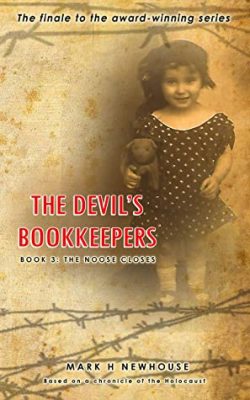
  • The DEVIL’S BOOKKEEPERS: The Noose Closes, Book 3 by Mark H. Newhouse – Jewish Historical Fiction, WWII Historical Fiction, Jewish Literary Fiction

     Blue and Gold Badge for the 2020 Series Grand Prize for Genre Fiction The Devil's Bookkeepers by Mark Newhouse

    In The Noose Closes, book three of the award-winning series, The Devil’s Bookkeepers, author Mark H. Newhouse continues the story of his compelling characters and their difficult predicaments in the closing months of World War II in occupied Lodz, Poland.

    Newhouse is a gifted writer and educator, born in Germany to Holocaust survivors. His series is a fictionalized account of what happened in the Lodz ghetto, a barbed-wire enclosed slum in Poland during the Nazi occupation. As he deftly utilizes the first-hand accounts of those who were there, we witness the ribbon of humanity and compassion woven through each book. This raises the series to premiere status – an exceptional if sobering examination of the immutable human spirit. His series should encourage all who read it that hope is a gift and kindness is the answer.

    Jewish engineer Bernard Ostrowski records the daily events for the ghetto chairperson, whom many call the Devil. Bennie and his small team find the information more terrifying with each passing hour. They compose their reports in a manner that will mollify the infamous ghetto boss, Chairman Rumkowski. Rumkowski and his embattled assistant, Neftalin, must please their Nazi handlers. Rumkowski oversees every aspect of the city and forces its residents into BECOMING factory workers for the German military. He hopes to keep the Nazis from taking control of Lodz by doing so.

    Even Ostrowski and his educated co-workers struggle to comprehend the desperation and death in the place they once called home. The sight of bony children fighting in garbage heaps for anything edible is unfathomable. How can this be happening in their city? Surely Rumkowski will help them.

    Ostrowski doesn’t quite know what to make of the masses of used shoes and other clothing that arrive via trucks, while Lodz Jews are shipped out of the ghetto almost daily. Are the Germans shepherding the Jews out of Lodz to safety from the war, as they and Rumkowski say?

    Rumors begin to slip in. The Jews are being taken to camps where only death awaits.

    The novel continues to weave in the story of Ostrowski’s love for his wife. Nearly defeated by the shocking events in book 2, Ostrowski longs for any news about his wife Miriam and his daughter Regina. The couple had become estranged when Bennie suspected Miriam of having an affair with the young and reckless Singer before the man disappeared.

    When Singer returns, now a resistance fighter, he attempts to enlist Ostrowski into an underground Jewish resistance movement. What follows are acts of bravery and sacrifice readers will remember long after the book is put down.

    Newhouse’s parents were among the 5,000 Jews of more than 200,000 trapped in the Lodz ghetto who survived the Nazi occupation. Will any of the novel’s characters survive as The Noose Closes around them?

    Newhouse utilizes the shocking events described in The Chronicle of The Lodz Ghetto (Yale University Press, 1984), placing sobering quotes from the historical account at the beginning of each chapter. Readers will feel as if they are on the streets of Lodz due to the vividly depicted sights, sounds, and smells during this bleak and desolate time. The Nazis’ wanted to annihilate an entire race of human beings. The incontestable proof became all too clear only as WWII came to a close.

    In The Noose Closes and the other books in The Devil’s Bookkeepers series, Newhouse interjects the ironic humor that brings the epic tale to life, gallows humor, if you like. These people are real – and readers feel it. Newhouse skillfully weaves into the story the profound depth of faith and belief that enabled desperate people to cling to hope, despite their dire circumstances.

    In fact, this bold human spirit enables the residents to find courage in the face of danger that rests at the heart of the series. His characters believe that relying on faith overcomes fear, and above all else, love will always be triumphant. This powerful series reminds us that the more we learn about the Holocaust, the more we remember this time of terror, the more likely it is that we can genuinely say, “Never again – to anyone!”

    The Devil’s Bookkeepers series won Grand Prize in the 2020 CIBA Fiction Series Awards and is a series that is not only timely, but one we highly recommend.

    Please read our reviews of the first two books in The Devil’s Bookkeepers by clicking on their titles, The Noose and The Noose Tightens.



    5 Stars! Best Book Chanticleer Book Reviews


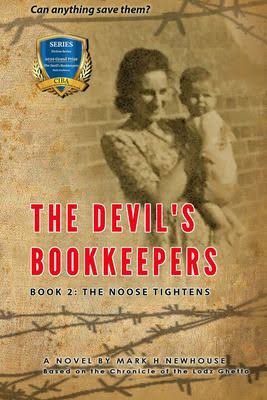
  • The DEVIL’s BOOKKEEPERS: The Noose Tightens, Book 2 by Mark H. Newhouse – Jewish Literature, Jewish Historical Fiction, WWII Historical Fiction

    Blue and Gold Badge for the 2020 Series Grand Prize for Genre Fiction The Devil's Bookkeepers by Mark Newhouse

    Mark H. Newhouse, son of German Holocaust survivors, includes the very personal and poignant first-hand sourced materials made available to him by the Yale University Press in his important historical fiction series, The Devil’s Bookkeepers. This inclusion lends a ribbon of humanity and compassion that raise the series to premiere status – a study, if you will, of the immutable human spirit. Newhouses’ series should encourage all who read it that hope is a gift and kindness and understanding is the answer to hate. It is a gripping story of love and survival that will haunt you until it’s shocking climax.

    From the first day of 1942, the conditions in the Jewish ghetto of Lodz, Poland, deteriorate. In Mark H. Newhouse’s historical fiction novel, The Devil’s Bookkeepers: Book 2, The Noose Tightens, those who thought their situation would get better now wish to survive and save their loved ones, But can they?

    The narrator Bernard Ostrowski, an engineer, should have enjoyed the prime of his life. He married a beautiful young wife, Miriam, who gave birth to their newborn daughter Regina. Ostrowski landed a lucky position in the records office of the ghetto’s leader, Chaim Rumkowski (an actual historical figure drawn by the author in dark, realistic detail). Rumkowki uses brutal force to forge the ghetto prisoners into a manufacturing hub for the Nazis in a still hotly debated effort to save its residents as the Nazi noose inexorably tightens.

    Ostrowski’s team includes a young man named Singer. And as the war continues to escalate, Singer urges Ostrowski to escape with his wife and child. Singer even promises to help them do so. However, Singer disappears, leaving an astonishing letter declaring his love for Miriam behind. The letter torments him as he tries to survive and save Miriam and his daughter.

    In the meantime, the Nazis begin deporting Jews from Poland – to where, no one knows.

    Rumkowski receives news that will shatter the bookkeepers’ faith in his leader’s basic decency. As the Nazis ramp up the expulsion of Jews from the city. Ostrowski, finally realizes that the noose is closing on everyone in the ghetto. Starving and weakened, he and Miriam must attempt to escape.

    Newhouse opens each chapter with brief vignettes from the primary sourced materials that will chill the reader.

    This book offers truth enmeshed with a well-crafted, imaginative, and credible story that will change and challenge readers. Newhouse wishes that in absorbing it, we may all say, “Never again to anyone.”

    The Devil’s Bookkeepers series by Mark H. Newhouse is highly recommended and won the Grand Prize in the 2020 CIBA Fiction Series Awards.

    Read our review of the first book in The Devil’s Bookkeepers series, The Noosehere.


    5 Stars! Best Book Chanticleer Book Reviews


  • The PRICE For GLORY by M.N. Snitz – 20th Century Wartime Historical Fiction, Family Saga, Wartime Fiction

    In The Price for Glory, author M.N. Snitz delivers a compelling multi-generational epic tale of warfare and passion with roots in ancient lore.

    Abraham Steinnermann grows up in a family dwelling in the same German Black Forest where the great Teutonic warrior, Arminius, held off the incursion of Roman soldiers in the first century. This legacy of war and triumph infuse his destiny, sending him down paths that even he, a somewhat narcissistic young man, could never imagine – until forced to live it.

    Bright and handsome, Steinnermann makes up only a few Jews who are accepted at the notably antisemitic Heidelberg University.

    As he studies high finance, his talent for numbers becomes evident, landing him a job in Germany’s banking community as Hitler rises to power. Steinnermann admires Hitler’s determination to recoup his nation’s esteem. For several years, even as the war heats up and Jews become the obvious target, the intelligent young banker continues to excel without harm.

    Steinnermann’s luck, however, cannot hold in Hitler’s Germany.

    One day, two Nazi soldiers come for him. Soon, he struggles to stay alive in the hell of a concentration camp. But Fortune or Fate smiles once again on the young man when a camp guard notices his talent. Steinnermann is offered a job that will lead to his being one of the few survivors.

    As the Allies move in, so does the Red Cross.

    Steinnermann meets the beautiful Merriam, a Red Cross volunteer, and falls in love. The attraction is mutual. The two maintain a long-distance correspondence when Steinnermann relocates to America. Once there, his perspicacity in finance will land him in a selected, fated role. He sends for and marries the woman he adores. His memories of the war and the many times he dodged death are transmuted to the next generation, within the mind of his son Jack, who must serve in Vietnam.

    Snitz, who served in the US Military in Vietnam and was an observer of the Israeli Yom Kippur War, draws together many threads to create his vast tapestry of a multi-generational tale in The Price for Glory.

    He successfully creates in his central character a man the reader may “love to hate” – someone whose skills and intelligence are admirable but whose arrogance and boastfulness seem a colossal deficit. As the story progresses though, Snitz’s protagonist wins the reader over by surviving the deep sorrows and immense perils he faces along the way.

    Wordsmith Snitz seems at home within his story.

    A student of classical literature, who avows writing his first novel in fifth grade, Snitz aptly portrays the feelings of women like Merriam embroiled in a long-distance romance. He depicts the emotions of men like Steinnermann, who are tortured by an insane enemy, and showcases the young Jack who is enmeshed in the terrible duties of warfare.

    The Price for Glory is a lengthy saga taking place on three continents and within the minds of those – young and brash, and old and wise – who carry the understanding of that price all too heavily. This novel is highly recommended.

    5 Stars! Best Book Chanticleer Book Reviews


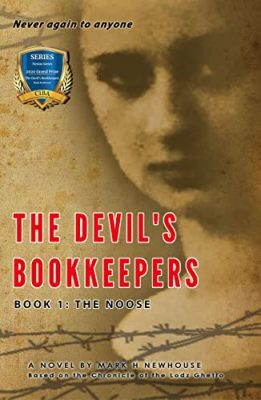
  • The DEVIL’s BOOKKEEPERS: Book 1: The Noose by Mark H. Newhouse – Jewish Historical Fiction, Jewish Holocaust Fiction, Jewish Literature

    The DEVIL’s BOOKKEEPERS: Book 1: The Noose by Mark H. Newhouse – Jewish Historical Fiction, Jewish Holocaust Fiction, Jewish Literature


    CIBA Grand Prize Series Badge

    Mark H. Newhouse has created an intense, harrowing, story of love and loyalty surrounding life within the Lodz Ghetto in Poland, established to control a sizeable portion of the Jewish population under Nazi domination in the first book in the series, The Devil’s Bookkeepers: The Noose.

    The author’s viewpoint is focused through the lens of Bernard Ostrowski, an engineer who will join three other men chosen for their related skills to report on daily happenings in the ghetto while secretly codifying incidents that the Nazis would not have wished to have recorded. Ostrowski and his cohort – the distinguished but embittered Oskar Rosenfeld, a noted Zionist, Julian Cukier, a journalist, and Oscar Singer, the youngest of the crew and the most impulsive. As Ostrowski opines privately, “Two Jews are a debate. Three, an argument. Four? A war.” Yet the four will co-exist, all trying in their separate ways to fulfill their assignment and please their highly controversial boss, Chaim Rumkowski.

    Rumkowski was the real overseer of the Lodz Ghetto.

    Some hated him since the people under his sway were starving and dying in disproportionately high numbers even as he commanded them to work for the German cause in German-run industries. Others, like Ostrowski and his companions, did their best to obey him despite many strong reservations, seeing him as the only hope, if faint, for their people’s survival. In their workday, the four men would learn of ever-increasing horrors taking place in the home where they’d been consigned. From very young people shot by German police or Jewish police under Nazi dominance to more people brought in by the thousand when all within the ghetto barely survived, strange, disturbing rumors arose about urns of Jewish ashes being sent to relatives in the ghetto from the concentration camp at Buchenwald.

    Ostrowski has other palpable worries as the story evolves in the chaos around him.

    His young wife Miriam wants a baby, and her pregnancy makes their deprivations even more distressing. Though they love one another, she is suspicious, as are many in the ghetto, of Rumkowski and his motivations. As her husband willingly works for and accedes to Rumkowski’s wishes, a line between them grows. In his role as “the engineer,” Ostrowski believes he is helping to keep his co-workers more concentrated on hard realities from an objective, constructive viewpoint. Miriam’s criticism torments him. Singer secretly suggests to Ostrowski that he take Miriam, their new daughter Regina and flee the ghetto. As the “noose” tightens, this begins to seem like the only realistic plan. But carrying it out would risk their three lives.

    An award-winning writer and educator, Newhouse was born in Germany, the child of Holocaust survivors.

    Gifted by his mother with a considerable narration entitled The Chronicle of the Lodz Ghetto (translated and edited by Lucjan Dobroszycki, Yale University Press, 1984) and seeing that his parents had had a personal attachment to the account, he read it, and within a short time, he had begun this trilogy, of which The Noose is Part One.

    Much of the Chronicle was composed by unknown scribes. Newhouse decided on a fictional treatment speaking for its many authors and encompassing its vital, often horrific, truths. His wide-reaching story of conditions in and feelings about the Lodz Ghetto is educated and realistic. Newhouse deftly combines historical fact with a vibrant portrait of high-minded human beings caught in the trap of being “chosen” – but for what? – and trying their best to fulfill religious and family expectations while suspecting their efforts will all be in vain.

    The Devil’s Bookkeeper series won the CIBA 2020 Grand Prize for Series.


    Chanticleer Book Reviews 5 Star Best Book silver foil sticker


  • DAVID and AVSHALOM: Life and Death in the Forest of Angels by Bernard Mann – Ancient History, Augmented Historical Accounts, Jewish Literature and Fiction

    DAVID and AVSHALOM: Life and Death in the Forest of Angels by Bernard Mann – Ancient History, Augmented Historical Accounts, Jewish Literature and Fiction

    Debut novelist Bernard Mann has diligently researched a wide-ranging saga centered on the life, loves, songs, and struggles of King David, a central figure in the Old Testament and author of the Book of Psalms.

    The tale begins at a crucial stage of David’s life as he is escaping the wrath of King Saul. Once a father-figure to the former shepherd boy, Saul’s view of David sours when the majority of his subjects begin to revere David over him. David flees with a small band of loyal stalwarts. He is still a fast friend to Saul’s son and likely successor, Jonathan, and is married to Saul’s daughter Maacah. Moreover, he still holds fast to his faith in God and continues to compose poems and songs in praise of Him. When both Saul and Jonathan perish in battle, David takes up the struggle, amasses an army, receives the crown, and seizes the city of Jerusalem, making it the seat of Israelite power.

    The title, David and Avshalom, is reflective of the King’s sin of infidelity and murder. David lusts after his general’s wife. He sends the soldier to the front line of battle with a cryptic deadly message so he can take Batsheva as his lover and wife. David loses two precious sons, one of them his beloved Avshalom (often spelled “Absalom”) whom he had hoped to crown as his successor.

    The details of King David’s life, as told in the Bible, are generally accepted. Mann includes augmented material in this lengthy portrait of one of history’s most significant players, whose actions in the restoration of the city of Jerusalem impact the region today. Portions of psalms (poetry/songs) speckle the narrative, put in place as the inspiration to critical junctures in the King’s life, such as the death of Samuel or the conquest of Goliath.

    One aspect of David’s personality that Mann stresses is his respect for women. Calling together numerous scribes to begin recording his people’s history, David is introduced to the works of Judith and includes them and the writings of other women in the endeavor. Here is a king who contradicts the standard practices of the day and honors his daughters equally with his sons.

    An international architecture expert, Mann pieced David’s exploits together by drawing on several books of the Bible – Samuel I and II, Joshua, Kings I, Chronicles I, and Psalms. He describes his book as “presented in fictional fabric” while assuring the reader of its scholarly sources and attributions. He has included some lesser-known facts about his main character – alliances, weaponry, and, again, the belief in the equality of women. Mann proclaims, “… David…was cast by the Lord in a different mold than that of any other man.”

    The result? Mann delivers smart text, worthy of study, as well as a lively plot capable of engaging thoughtful readers. His prose is rich and his imagination equally so, as he brings King David back to life in a fresh way sure to invite attention and appreciation.

    David and Avshalom:  Life and Death in the Forest of Angels won First Place in the 2018 CIBAs, Chaucer Awards for Early Historical Fiction.